
Most articles about generative AI use cases hand you a list of ideas and no proof. This one does the opposite. Every use case below is tied to a published number: a percentage, a dollar figure, a cycle time, or a survey finding from a named source. If a claim could not be backed up, it did not make the list.
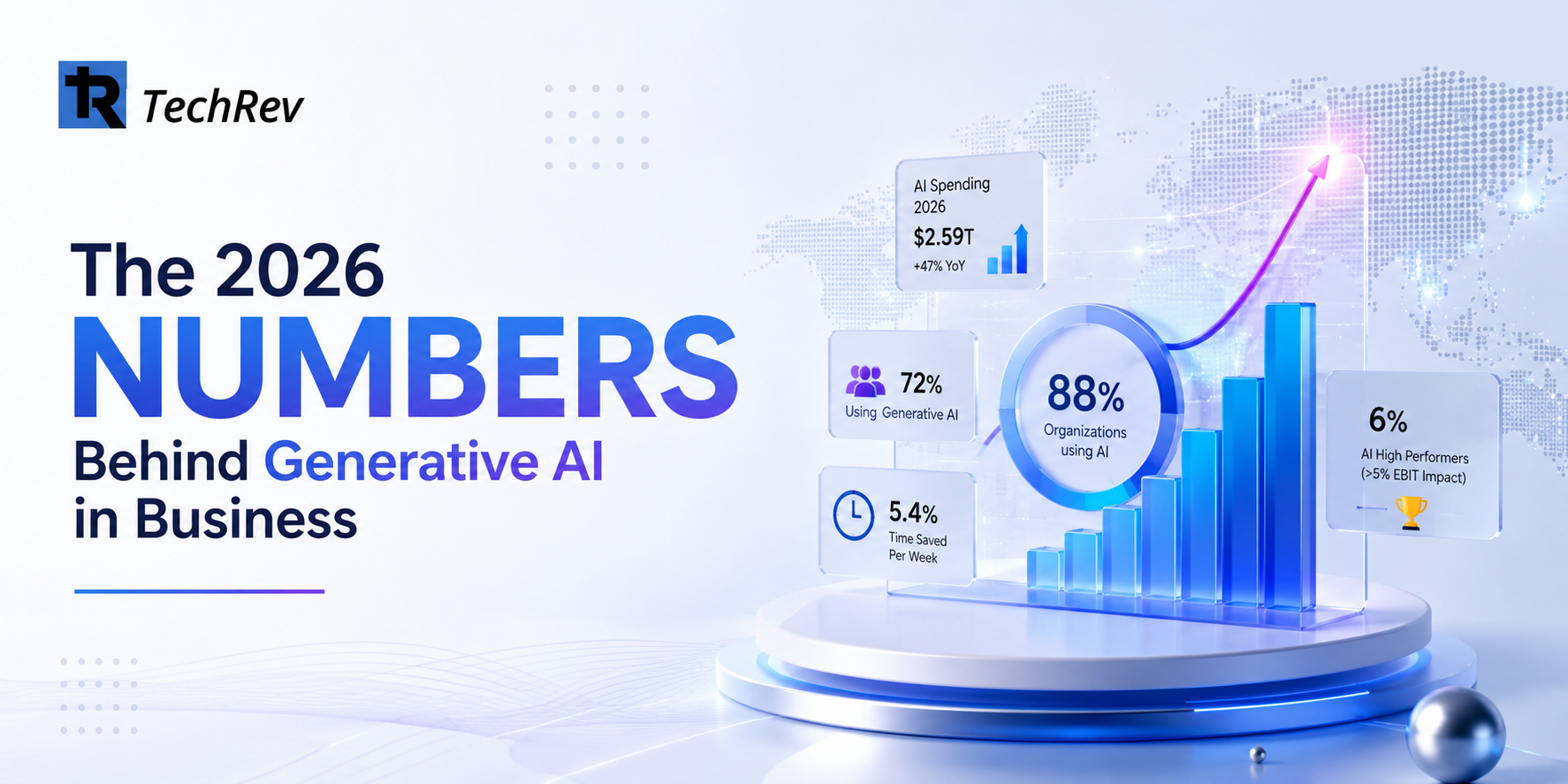
That matters more in 2026 than it did two years ago. Gartner now forecasts worldwide AI spending of $2.59 trillion in 2026, a 47% jump year over year, yet the same research notes that CIOs still struggle to prove value from AI investments and demonstrate tangible business outcomes. Money is not the constraint anymore. Evidence is.
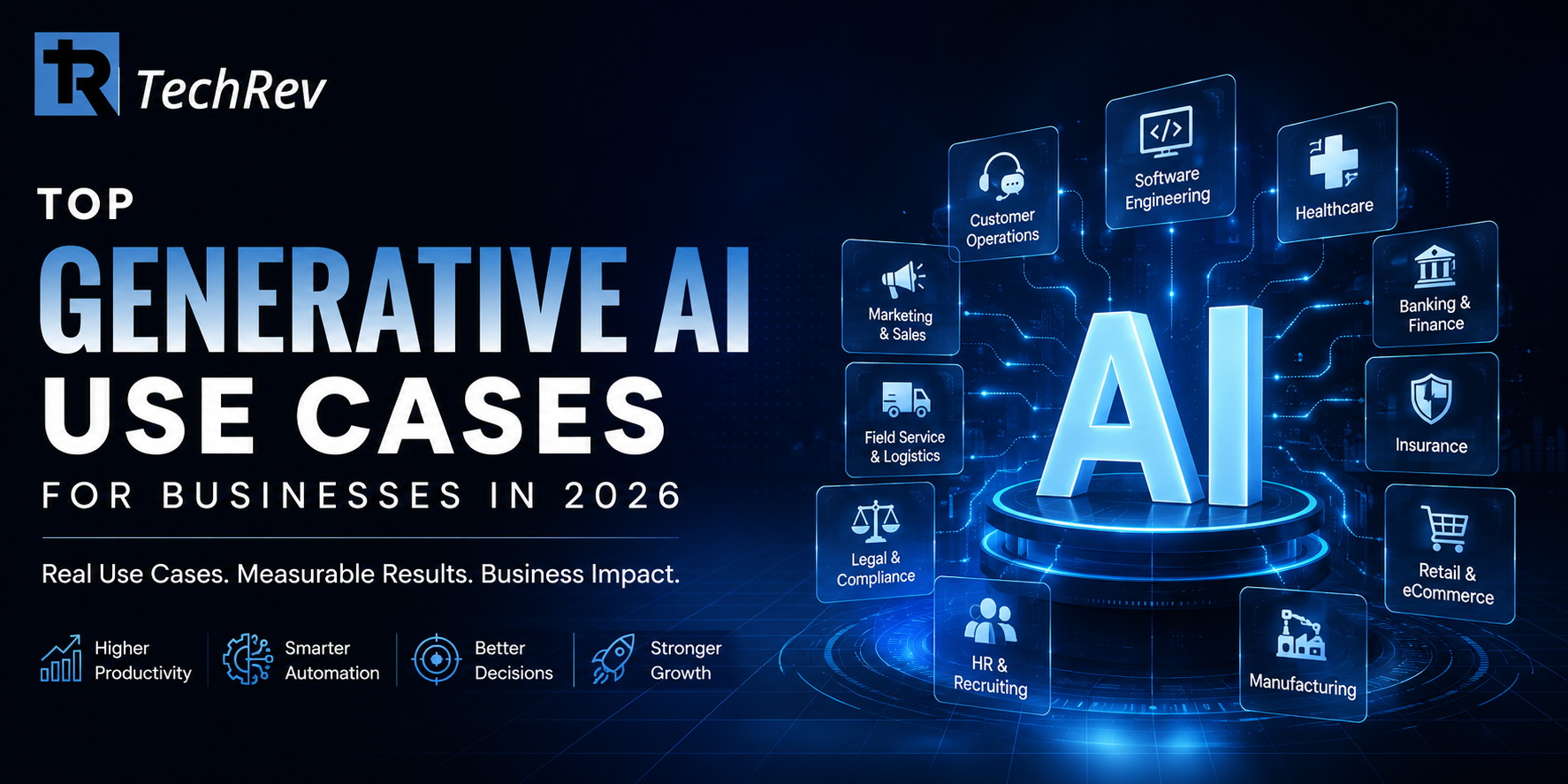
So here are 20 generative AI use cases, grouped by industry, with the results people are actually measuring. Treat it as the working shortlist of the top use cases of Gen AI development in 2026, not a wish list.
What are the top generative AI use cases in business?
The highest-return generative AI use cases in business are customer support copilots, AI coding assistants, ambient clinical documentation, KYC and claims document processing, product content generation, demand planning copilots, and contract review.
These work because the underlying tasks are repetitive, document-heavy, and high-volume, which is exactly where measured gains are largest.
The 2026 numbers behind generative AI in business
These figures set the bar you will be measured against.
1. Adoption is close to universal
McKinsey’s State of AI survey, fielded across 1,993 respondents in 105 countries, found 88% of organizations regularly use AI in at least one business function, with 72% reporting gen AI use, up from 33% the year before.
2. Spending keeps climbing anyway
Gartner puts 2026 AI software spending at $453.2 billion and spending on AI models specifically at $32.6 billion, up from $15.5 billion in 2025, a 110% jump driven by multistep agentic workflows consuming far more tokens than single-turn chat.
3. Time savings are real but modest at the average
Federal Reserve analysis found workers using generative AI save about 5.4% of their work hours, roughly 2.2 hours a week. That is a genuine gain, and it is nowhere near the 10x claims you see on LinkedIn.
Also Read – LLM vs Generative AI: Choosing the Right AI for Your Business!
Generative AI use cases in customer operations
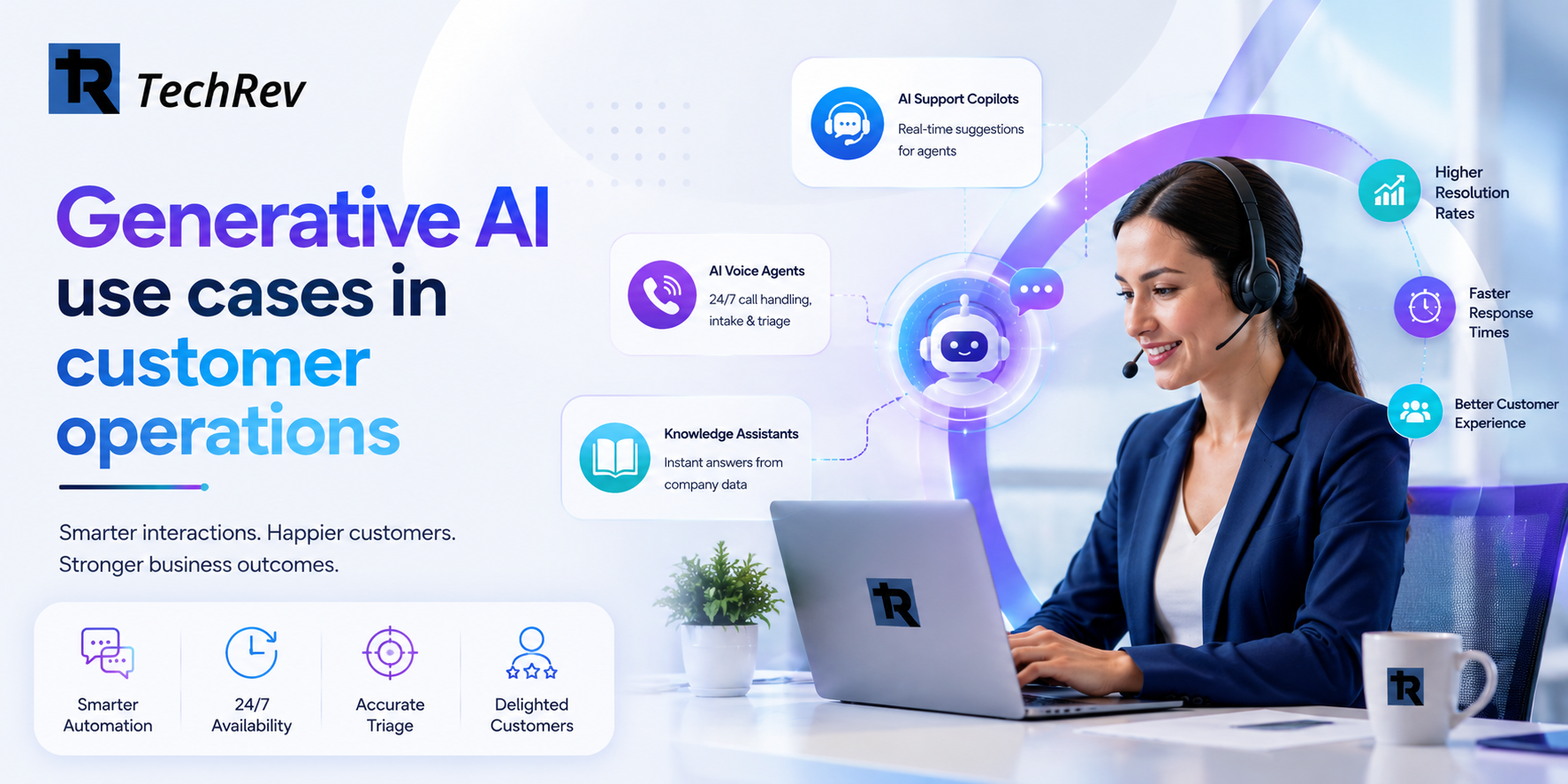
The following are some
1. Support copilots that draft agent replies in real time
The system listens to the live ticket or call, retrieves the relevant policy and account history, and drafts a response the human agent edits and sends.
Who this is for: Any team with more than 15 agents and a documented knowledge base.
2. AI voice agents for intake, triage and first notice of loss
Voice agents now handle inbound calls end to end: capturing details, verifying identity, filling the intake record, and escalating anything ambiguous to a human.
3. Enterprise knowledge assistants built on RAG
Instead of searching six systems, employees ask a question and get a grounded answer with citations back to the source document.
Also Read – Custom AI Agent Development: Process, Tech Stack, Timeline
Generative AI use cases in software engineering
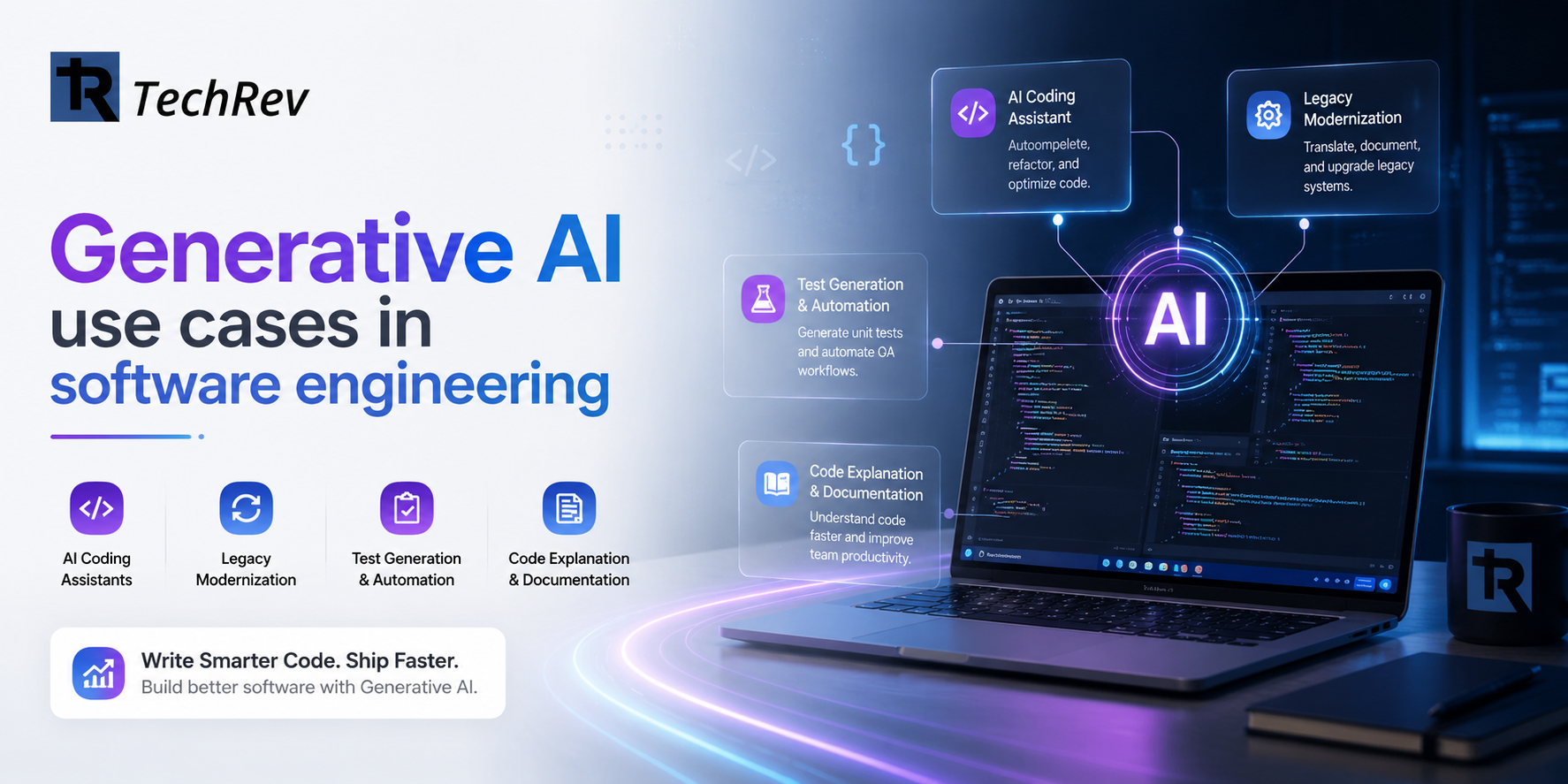
The following are some:
4. AI coding assistants
Autocomplete on steroids, plus test generation, code explanation, and pull request summaries.
Measured result: GitHub’s controlled experiment found developers completed a defined coding task 55% faster with Copilot. Broader research on AI coding assistants has put ROI as high as 376% when measured against license cost and delivered story points.
One honest caveat that belongs in any serious list of generative AI examples: analysis of enterprise deployments suggests that for roughly every 10 hours of gross AI productivity gain, about 4 hours go back into correcting and rewriting weak output. Net gain lands near 60% of gross. Plan for review time and your projections survive contact with reality.
5. Legacy modernization, code translation and test generation
Banks are among the most aggressive adopters here.
Coding copilots, automated testing, code translation and documentation generation are being used to attack decades-old technology estates, and many institutions now treat AI agents development as strategically critical to accelerating broader transformation programs.
Why does it work?
Legacy modernization has always been bottlenecked by comprehension, not typing. A model that can read 40,000 lines of COBOL and explain intent changes the cost curve of the whole project.
Generative AI use cases in healthcare
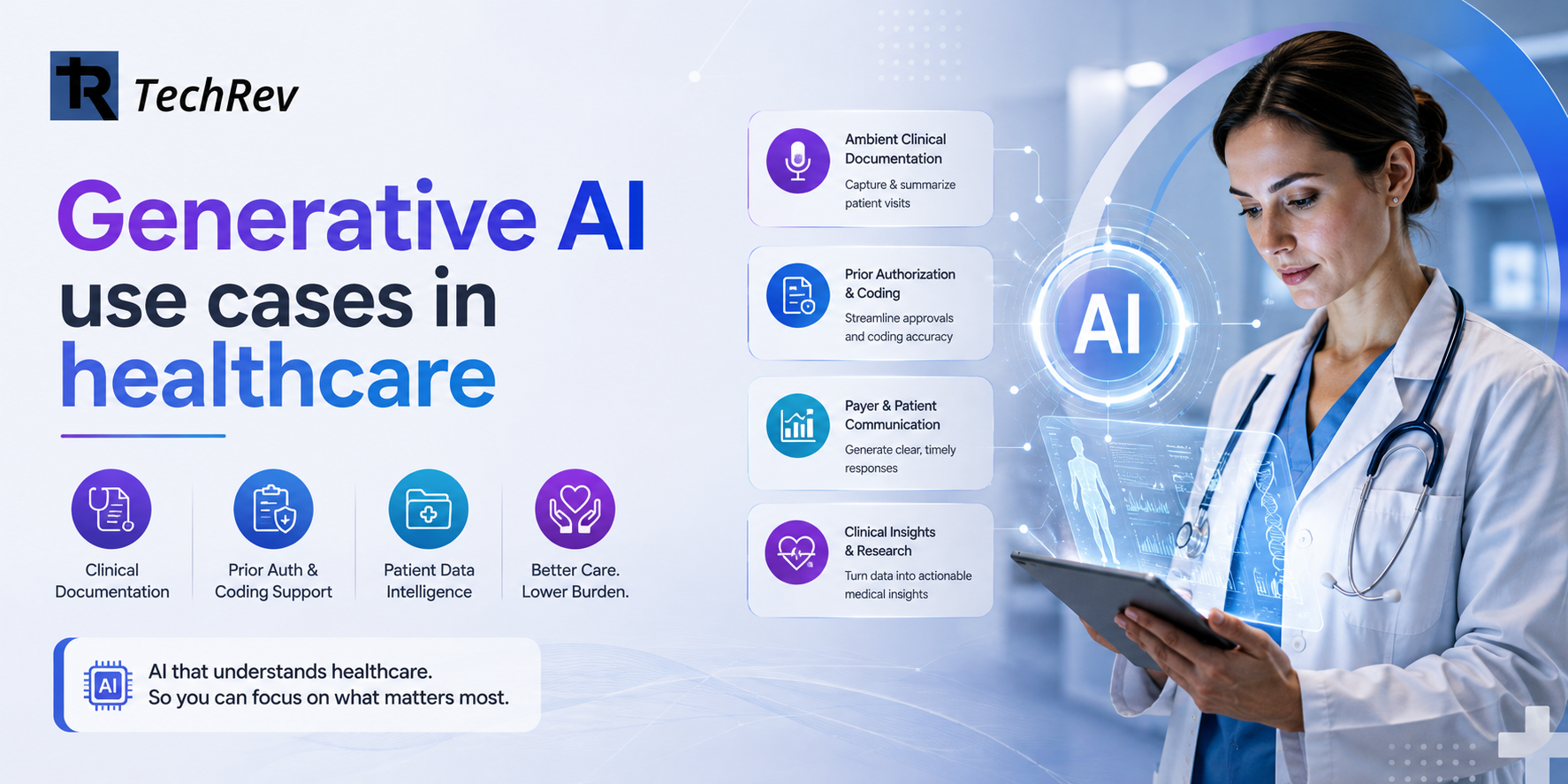
Healthcare produces some of the best-documented generative AI applications anywhere, because clinical research standards force real measurement.
6. Ambient clinical documentation
The tool listens to the patient’s visit and drafts the clinical note. The clinician reviews and signs.
Measured results, all from JAMA Network Open studies published in 2025:
- Across six US health systems, clinician burnout dropped from 51.9% to 38.8% after just 30 days of ambient scribe use.
- At Mass General Brigham, researchers recorded a 21.2% absolute reduction in burnout prevalence at 84 days. At Emory Healthcare, a 30.7% absolute increase in documentation-related well-being at 60 days.
- A matched-cohort study at UChicago Medicine found ambient AI users spent 8.5% less total time in the EHR and over 15% less time composing notes than look-alike non-users.
7. Prior authorization, coding support and payer correspondence
Generative AI developers reads the chart, assembles the clinical justification, and drafts the payer submission. Administrative burden in US healthcare is enormous and this is one of the few places where a document-generation model maps perfectly onto the actual bottleneck.
Generative AI use cases in banking and financial services
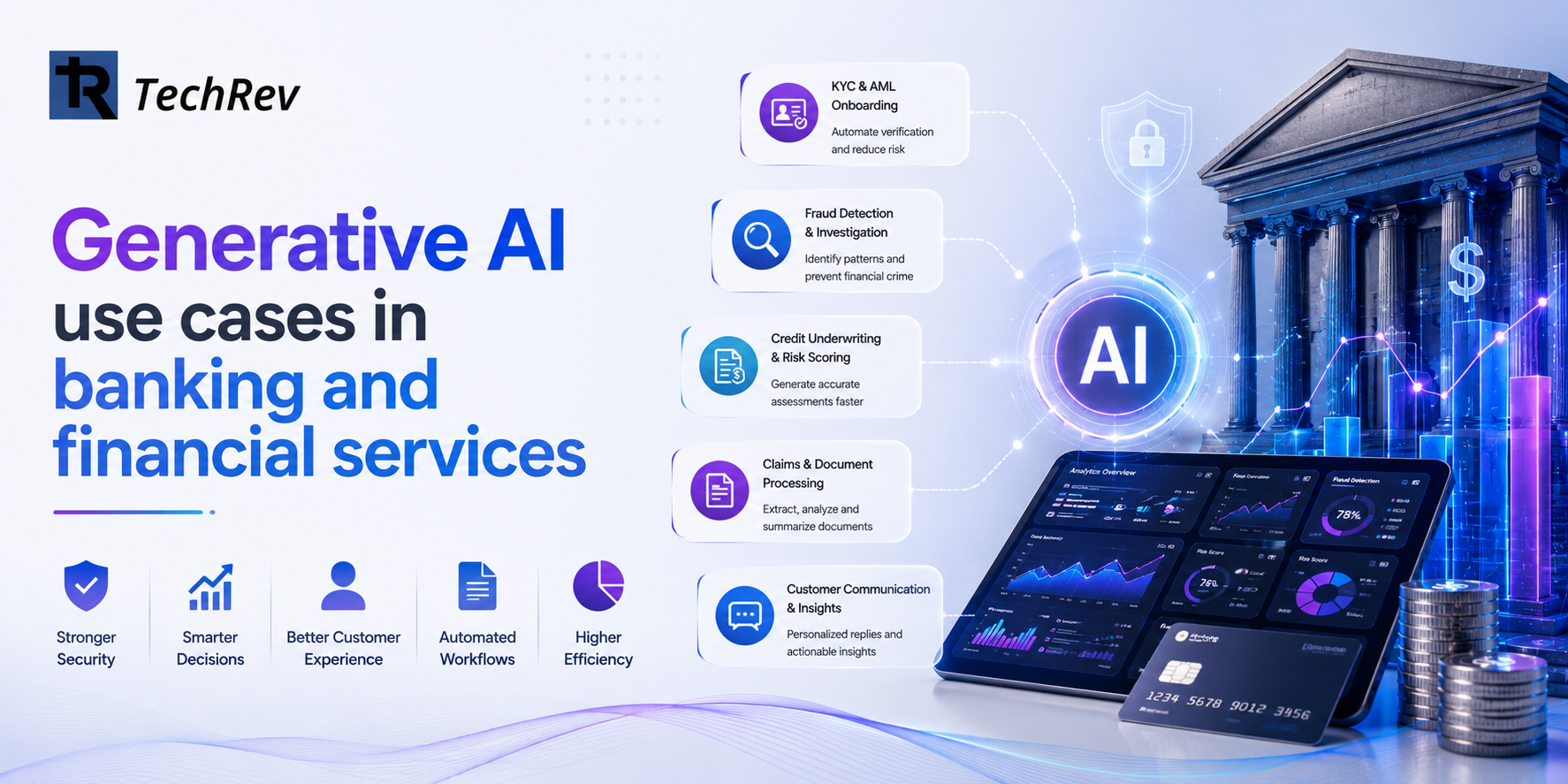
McKinsey estimates generative AI could add $200 billion to $340 billion annually in value to global banking, driven partly by front-office productivity gains projected in the 27% to 35% range.
8. KYC and AML onboarding automation
The model extracts and validates identity documents, proof of address, financial statements and beneficial ownership chains, then runs adverse media screening across global news sources in real time.
Measured result: Reported reductions of 40% to 60% in onboarding time, moving a process that took days into minutes for standard cases.
9. Fraud investigation and case narrative generation
Measured result: Mastercard reported that generative AI doubled the speed of compromised-card detection, cut false positives, and identified at-risk merchants 300% faster.
False positives matter more than most teams admit. Every wrongly declined transaction is lost revenue plus a customer service call plus a trust hit.
10. Credit memo and underwriting draft generation
Analysts spend hours assembling the same document shape: financials, covenants, comparables, risk factors.
A model with access to the data room drafts version one in minutes and the analyst spends their time on judgment instead of formatting.
Also Read – AI Automation Agency vs Custom AI Development: The Best?
Generative AI use cases in insurance
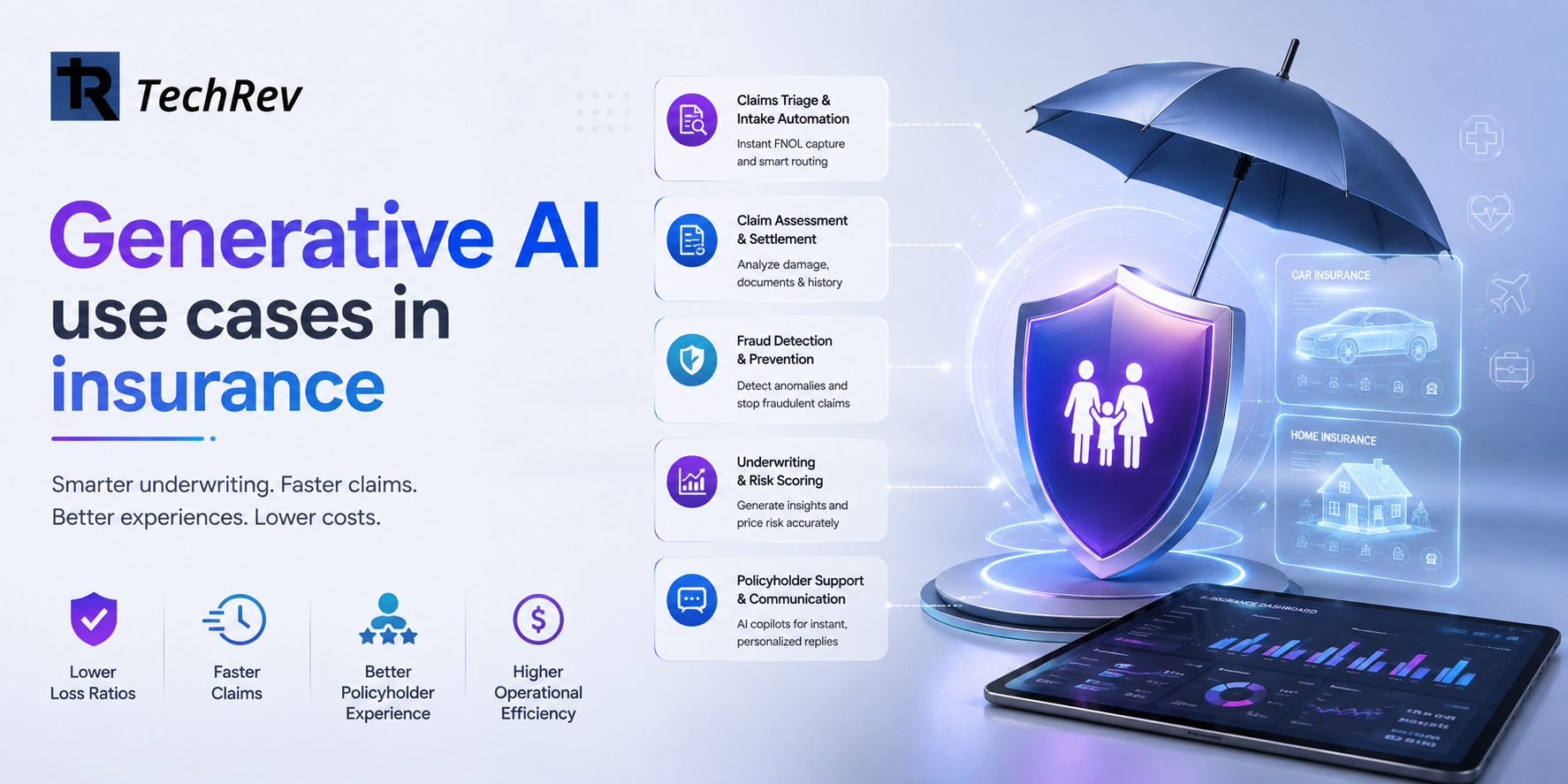
Insurance may be the single best structural fit for generative AI in business.
A commercial property submission can run past 200 pages of loss runs, inspection reports, policy wordings and statements of value, and a mid-sized underwriter might review 30 to 50 of those a week.
11. Claims triage and settlement acceleration
Measured result: BCG research shows AI-enabled carriers cut claim resolution time by 75%, from about 30 days to 7.5 days, with cost per claim dropping 30% to 40%.
Bain estimates generative AI could create over $100 billion in benefits for property and casualty claims handling alone, with 20% to 25% reductions in loss-adjusting expense and 30% to 50% cuts in leakage.
12. Submission ingestion for commercial underwriting
Traditional OCR extracts text. It cannot be noticed that sprinklered throughout in the inspection report contradicts partial sprinkler coverage in the statement of values. A language model can. That contradiction-spotting capability is the actual product.
McKinsey estimates generative AI could unlock $50 billion to $70 billion in additional insurance industry revenue, concentrated in marketing, customer operations and software engineering.
Generative AI use cases in retail and ecommerce
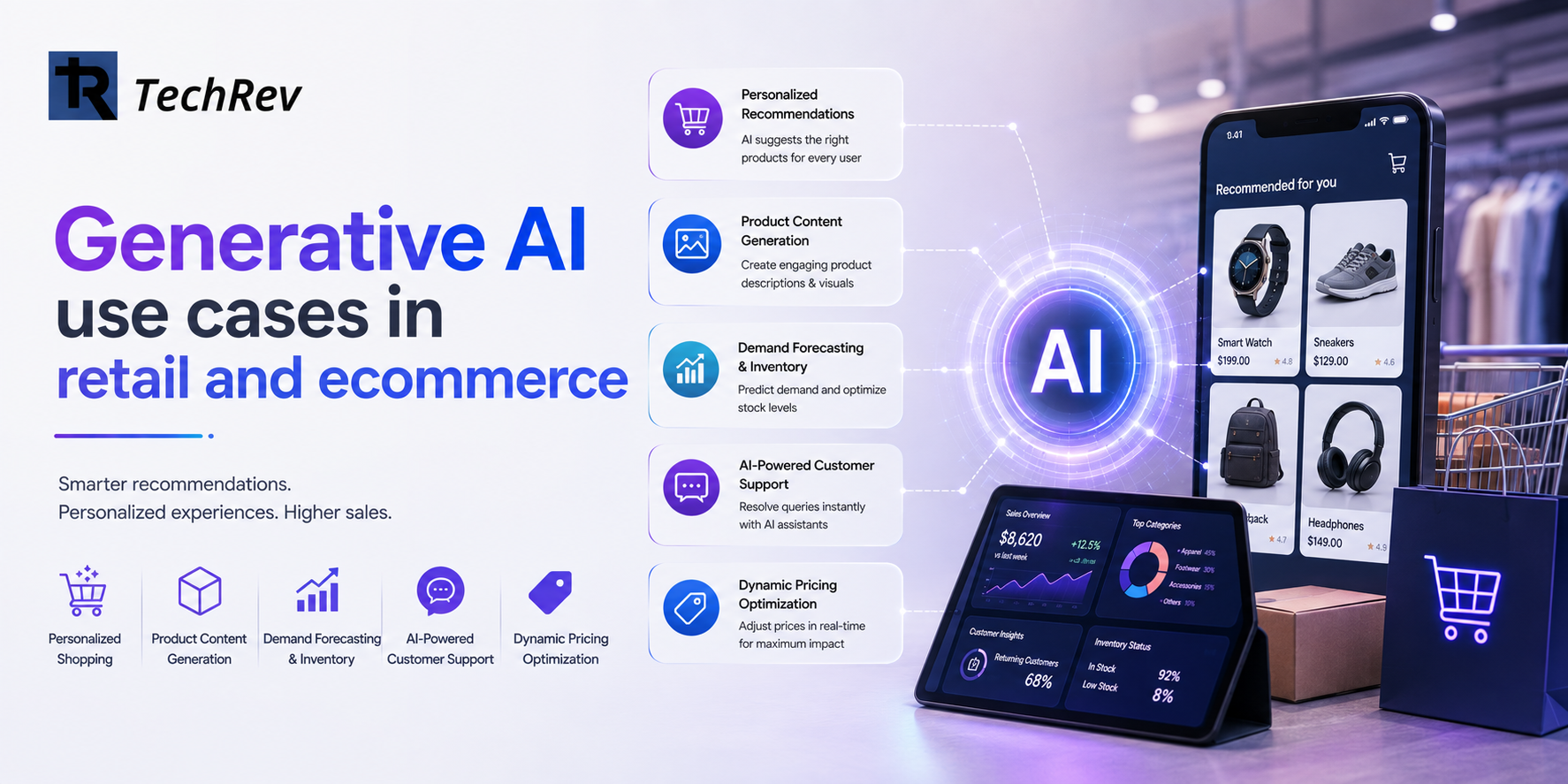
13. Product content generation at catalog scale
Titles, descriptions, attribute tables, size guides, localized variants, and alt text, generated per SKU and per audience segment. For a 40,000 SKU catalog this is the difference between we will get to it next year and it shipped Thursday.
McKinsey’s personalization research puts typical revenue lift from personalization at 5% to 15%, with top performers reaching 25%. McKinsey has also sized the generative AI opportunity for retail at $240 billion to $390 billion in economic value, with margin increases of 1.2 to 1.9 percentage points.
14. Conversational shopping assistants and agentic commerce
This is the trend that moved fastest in the last twelve months, and it is one of the most important generative AI examples for anyone selling online.
Adobe Analytics found that during the 2025 holiday season, visitors arriving from generative AI sources converted at rates 31% higher than traditional channels, and revenue per visit from AI-referred shoppers jumped 254% year over year.
Also Read – Llama vs GPT: A Comparison for AI App Development
Generative AI use cases in manufacturing and supply chain
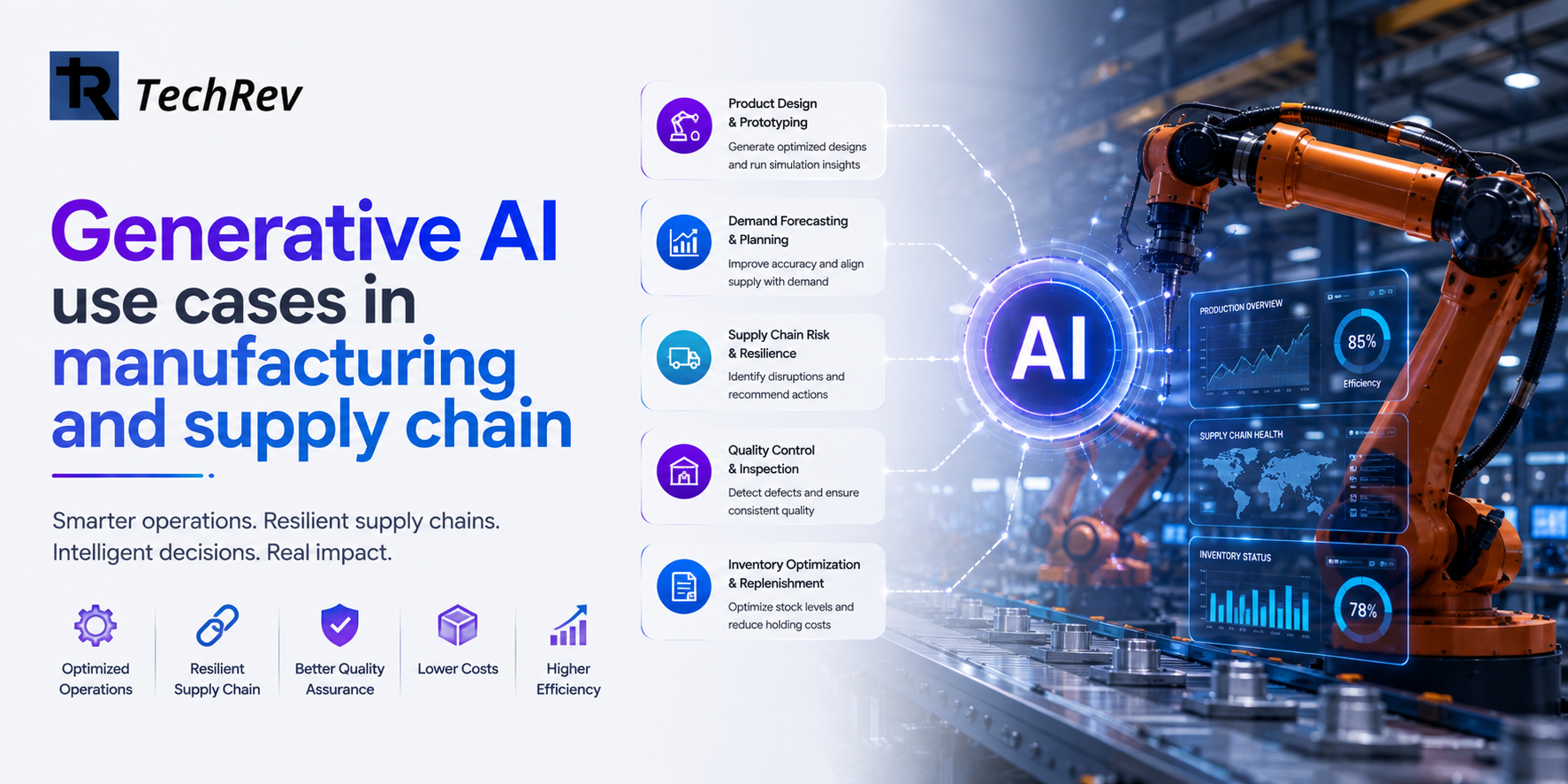
15. Demand planning and scenario copilots
McKinsey research on AI-driven demand forecasting reports 20% to 50% improvement in forecast accuracy. Planners stop rebuilding spreadsheets and start interrogating scenarios in plain language: what happens to fill rate if the Long Beach lane slips four days?
Research from AI at Wharton and The Hackett Group found 94% of procurement executives now use generative AI tools at least weekly, up 44 percentage points year over year. Procurement went from curiosity to habit in about a year.
16. Generative design and shop-floor knowledge agents
Engineers define constraints and the system generates candidate geometries. Separately, technicians query maintenance manuals, past work orders and OEM documentation by voice while standing at the machine.
Generative AI use cases in legal and compliance
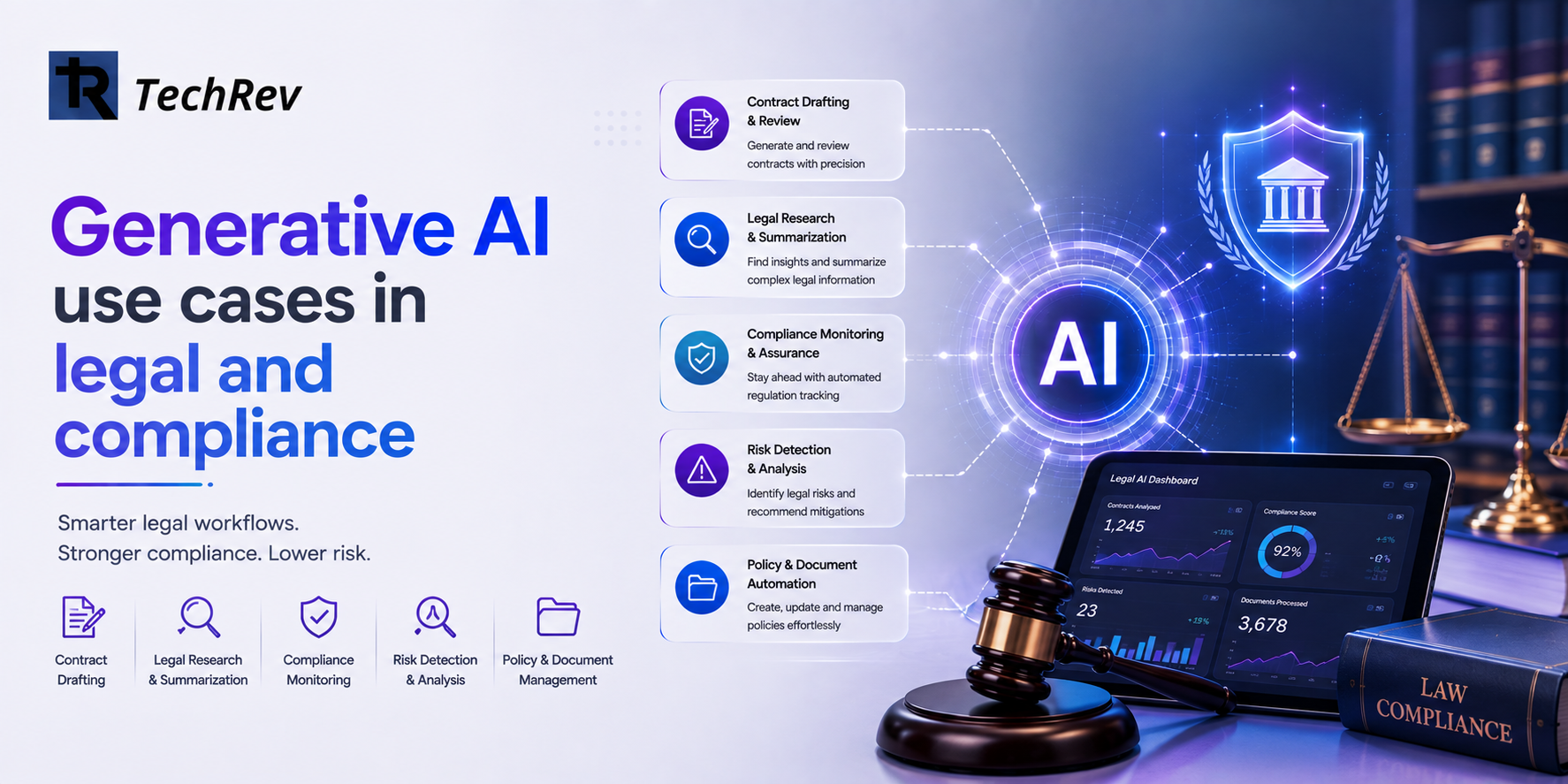
17. Contract review, clause extraction and regulatory change tracking
Generative AI reads the contract against your playbook, flags deviations, extracts obligations into a tracker, and drafts the redline.
Legal professionals reported 31% generative AI use in 2025, up from 27% in 2024, with larger firms at 39%. Legal moves slower than most sectors, which is exactly why the firms moving now are compounding an advantage.
Also Read – Enterprise AI Agents: What, Use Cases, and Benefits in 2026?
Generative AI use cases in HR and recruiting
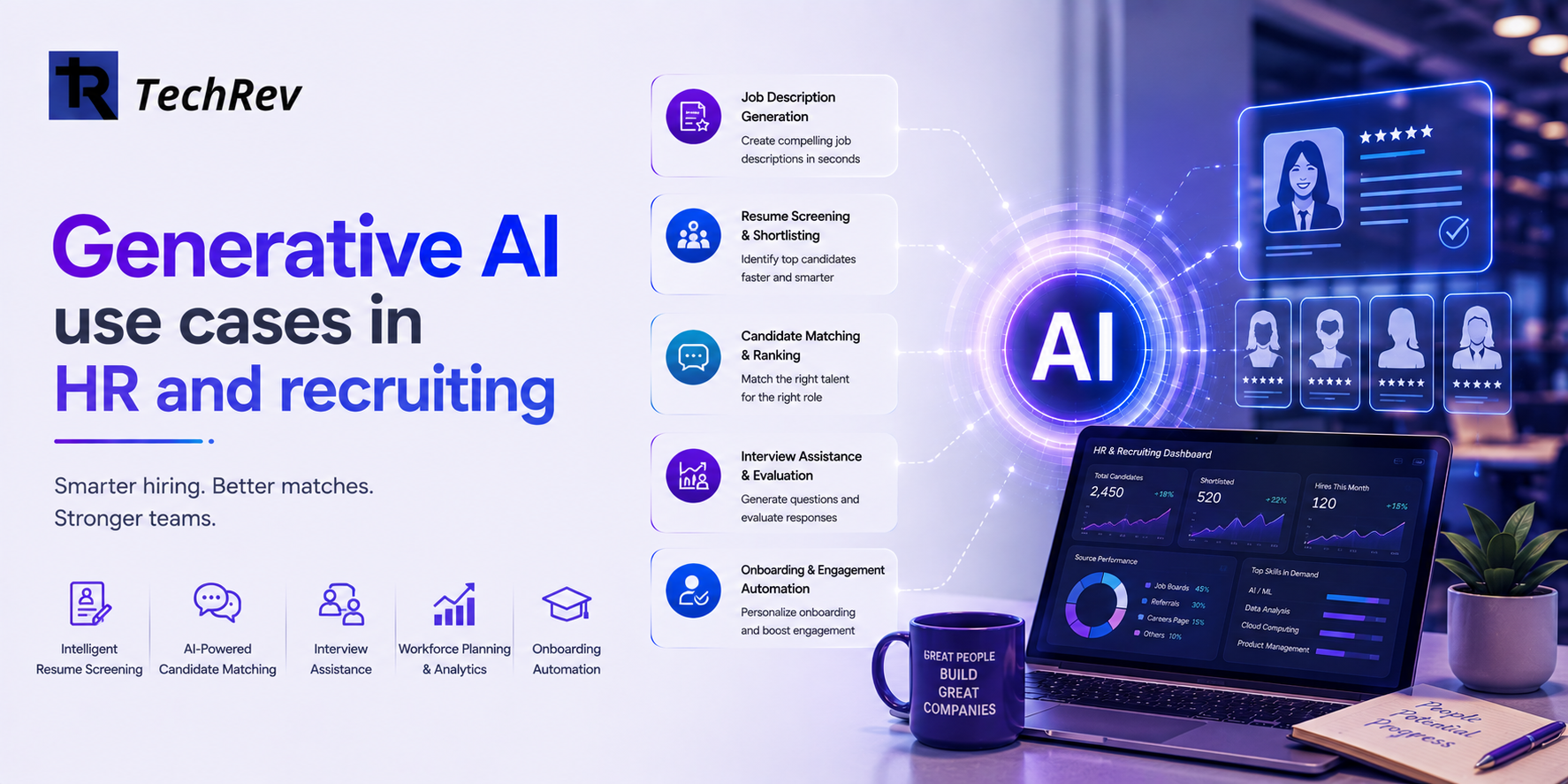
18. Requisition to shortlist automation
Job description drafting, resume screening, outreach personalization, interview scheduling, and structured interview summaries.
LinkedIn found talent acquisition professionals using generative AI report roughly a 20% workload reduction, about one working day per week. SHRM’s data shows 43% of organizations used AI for HR and recruiting tasks in 2025, nearly double the prior year’s 26%, with job descriptions the top use at 66% of adopters and resume screening at 44%.
Generative AI use cases in marketing and sales
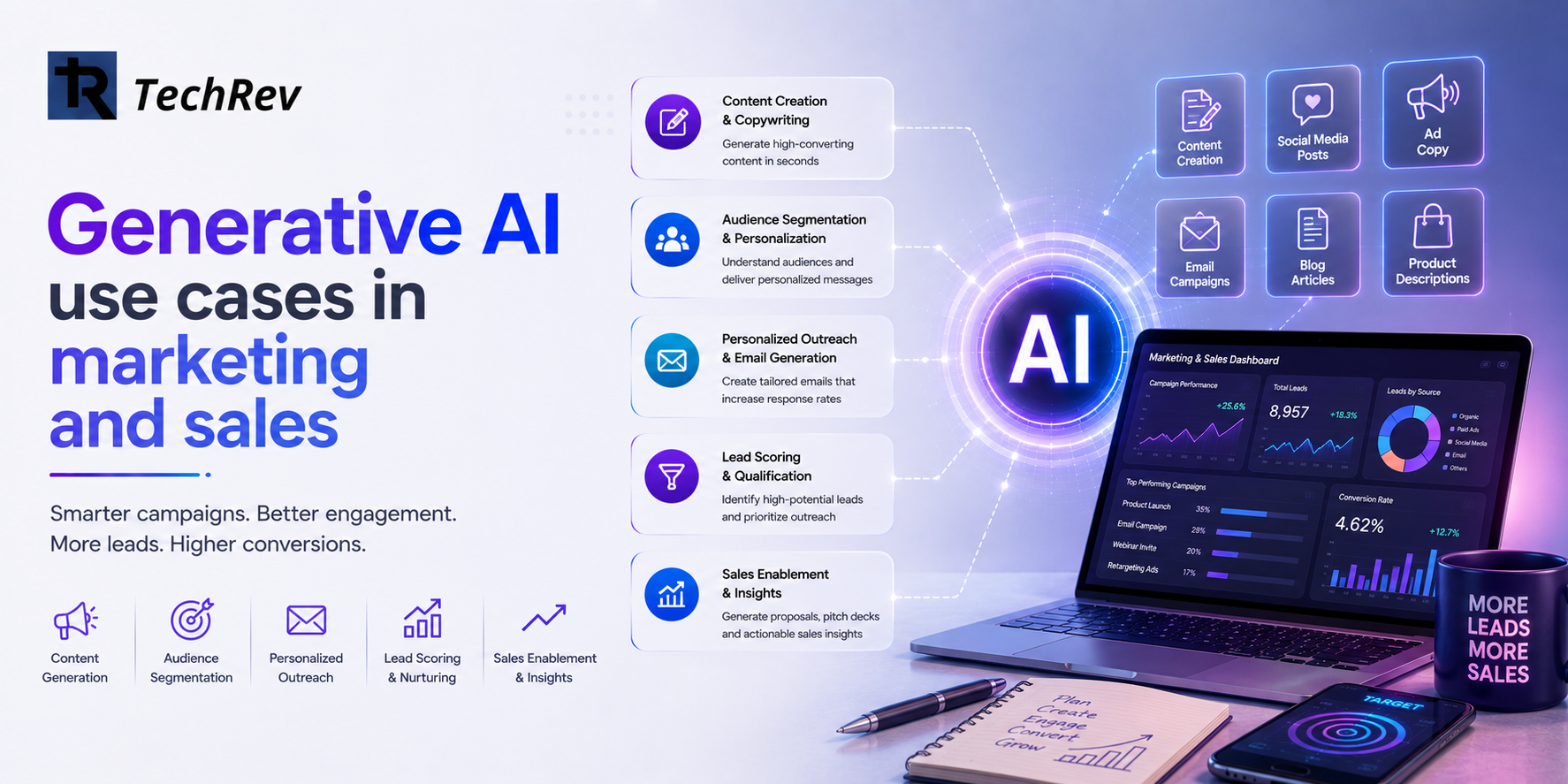
19. Content engines built for AI Overviews, not just blue links
Content production was the first gen AI use case anyone tried. The 2026 version is different: you are not writing for ten blue links anymore, you are writing to be cited by answer engines.
Seer Interactive found LLM-referred visitors convert at 15.9% from ChatGPT and 10.5% from Perplexity, against a 1.76% organic search conversion rate. Ahrefs found AI search visitors generated 12.1% of signups while making up only 0.5% of total visitors. BrightEdge found AI Overview citations increase adjacent organic click-through rate by 35%, which settles the old argument that AI visibility cannibalizes SEO.
What that means practically: structure content in answer-first blocks, keep entities explicit, use plain language, and publish verifiable numbers. Which, you may notice, is exactly how this article is built.
Generative AI use cases in field service, facilities and logistics
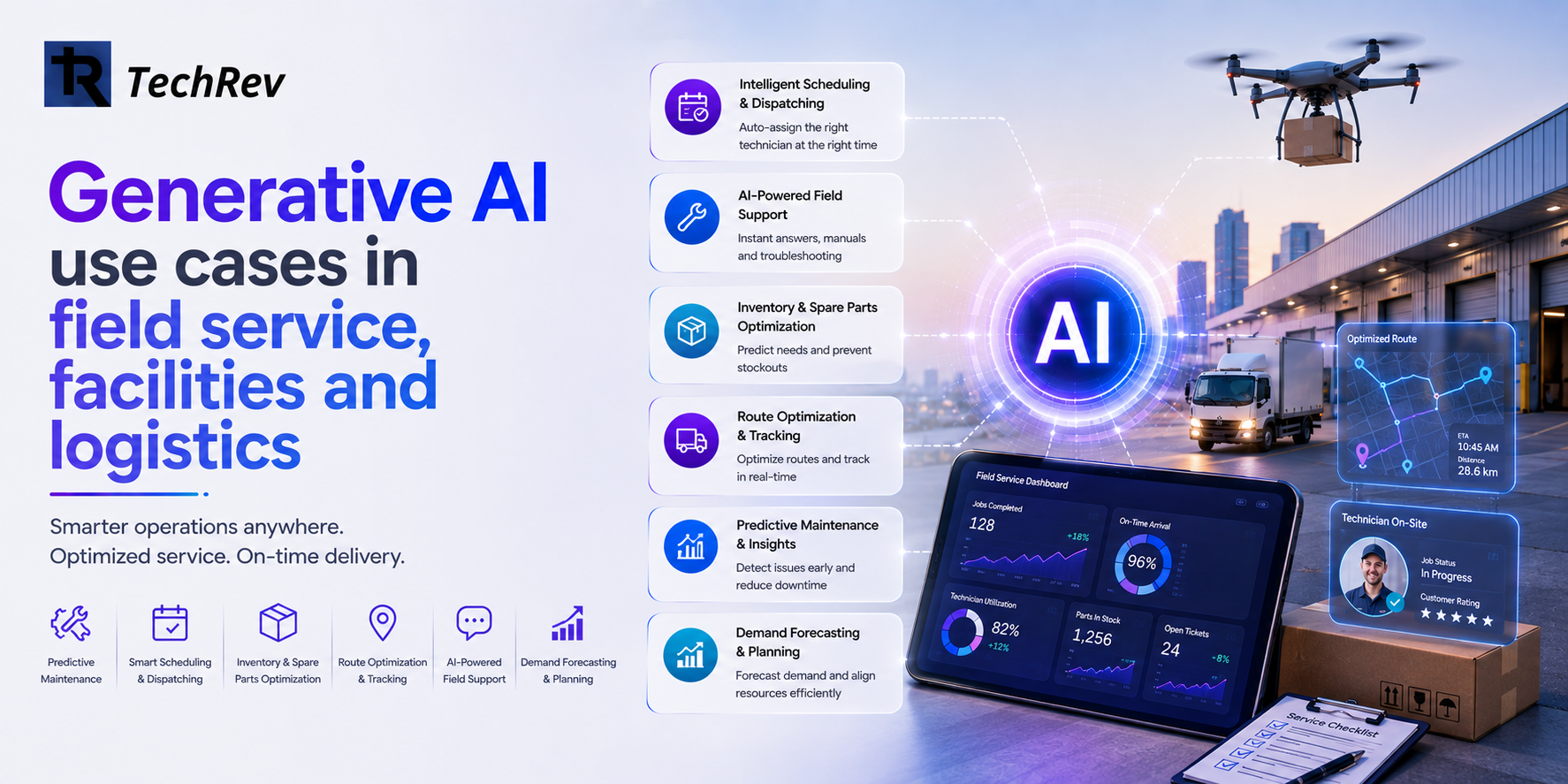
Facilities management, medical linen, asset tracking, HVAC service and distribution all run on high-volume repeatable workflows spread across many locations, which is precisely the profile where measured gains are largest.
20. Work order intelligence and technician copilots
A technician dictates what they found. The system writes the compliant service record, updates the asset history, flags a warranty claim, and schedules the follow-up. Dispatchers get route suggestions that account for skills, parts on the van, and SLA clocks.
Measured pattern: research on agentic invoice and document workflows in operations settings shows processing time moving from days to hours with materially fewer errors, because the agent extracts, validates against source records, and routes without a human touching the handoff.
TechRev has been building exactly this class of system for over a decade: barcode-driven asset tracking across hospitals and multi-site facilities, mobile app development for field crews, route planning, compliance tracking, and reporting dashboards, with AI-assisted mapping and voice-assisted workflow management layered on top. It is unglamorous software that saves real hours every single shift.
Generative AI for small business: what the data actually shows?
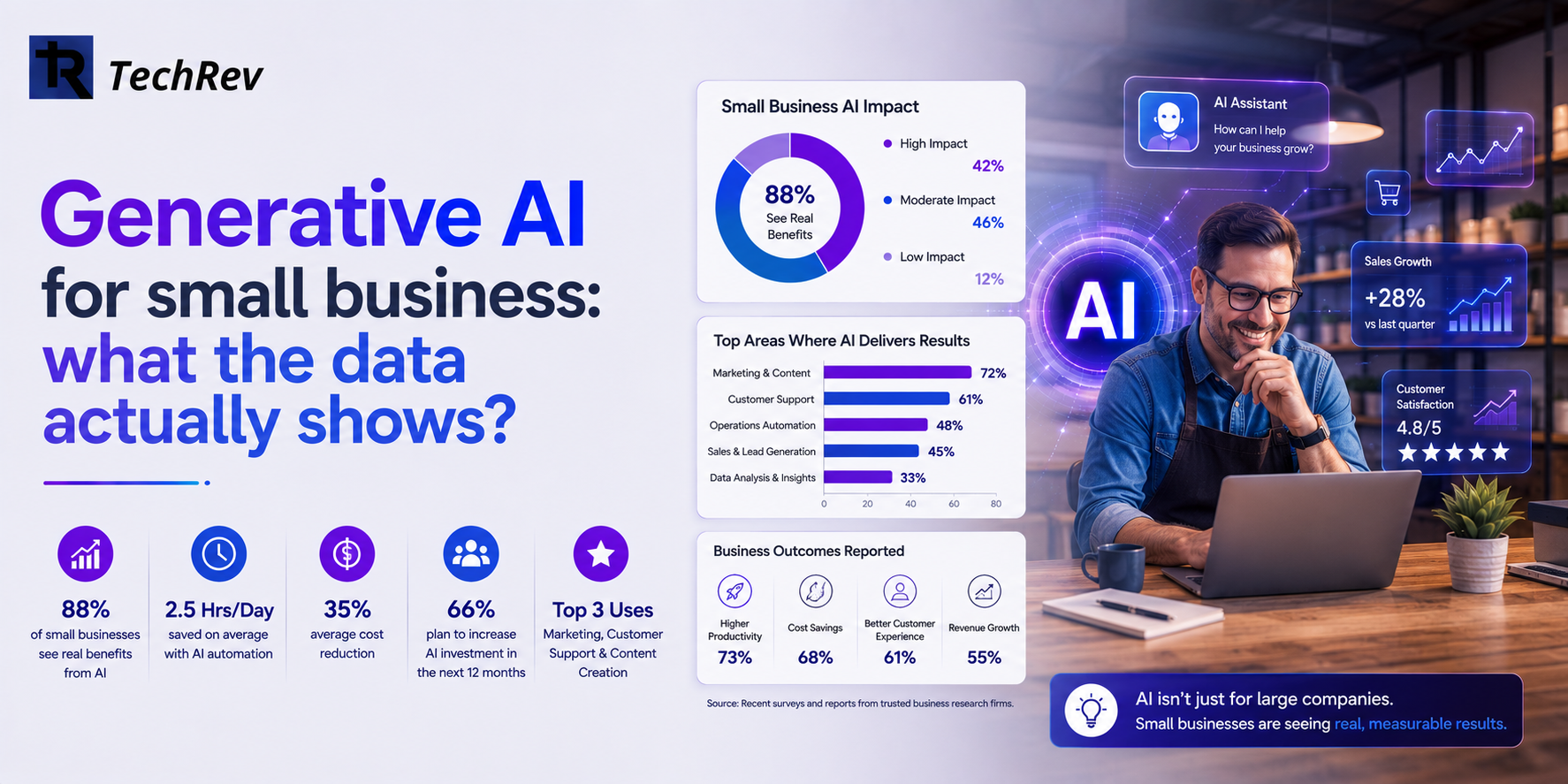
You do not need an enterprise budget to get returns. Generative AI for small business has moved from novelty to default in about 24 months.
- 58% of small businesses now use generative AI, up from 40% a year earlier and 23% two years before that, per the US Chamber of Commerce.
- 91% of small businesses using AI say it boosts revenue and 90% say it improves operational efficiency, per Salesforce research.
- The JPMorgan Chase Institute found the 2025 cohort of new small businesses reached 10% AI adoption in six months, compared with 77 months for the 2019 cohort. That is a 13-fold acceleration in uptake speed.
The 2026 tech stack behind enterprise generative AI
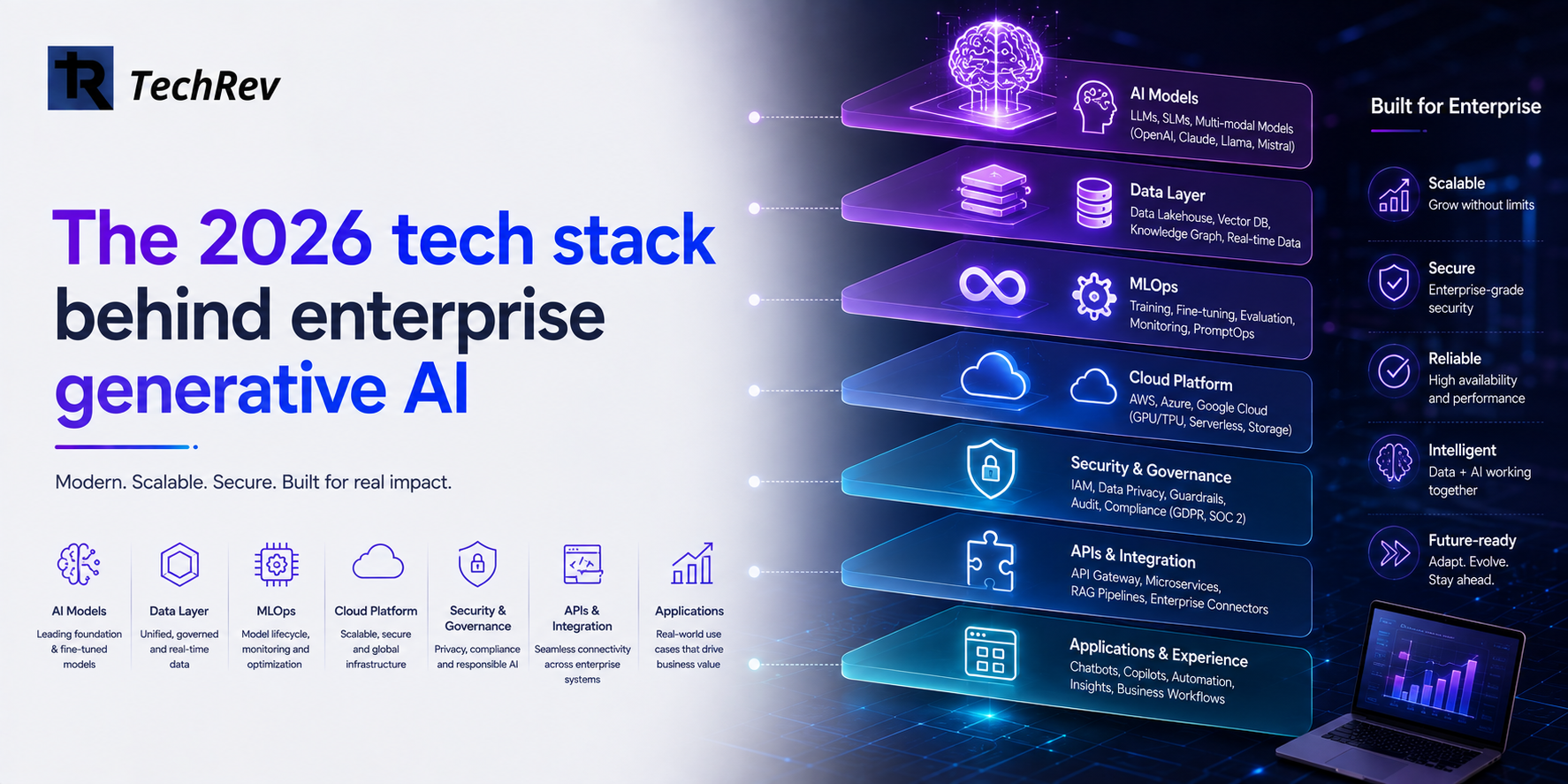
The top use cases of Gen AI above all sit on a fairly consistent architecture. If your vendor cannot explain these layers, keep interviewing.
1. Retrieval-augmented generation (RAG)
Enterprises route 30% to 60% of AI use cases through RAG because grounding responses in your own documents substantially reduces hallucination and removes the cost of retraining a model every time your policy changes. RAG is now the baseline expectation, not a differentiator.
2. Agents and orchestration
McKinsey found 62% of organizations at least experimenting with AI agents and 23% scaling them somewhere in the enterprise. Gartner expects 40% of enterprise applications to embed task-specific AI agents by the end of 2026, up from under 5% in 2025.
3. Model Context Protocol (MCP)
MCP standardizes how agents connect to tools and data sources, and public MCP servers crossed 9,400 as of April 2026. The strategic point: standardized tool interfaces lower the cost of switching models, which shifts leverage away from any single model provider and toward whoever owns the workflow context.
4. Small and domain-specific models
The default of use the biggest model for everything is dying. Smaller purpose-built models trained on industry data deliver comparable results on narrow tasks at a fraction of the inference cost, which matters when the median enterprise monthly LLM bill grew 7.2x year over year entering Q1 2026.
5. Evaluation and observability
Agents have identity, privileges and access to systems across the business. That is a new, non-deterministic attack surface. Baselines, regression evals, audit trails and human escalation paths are not overhead. They are the reason your deployment survives its first bad output.
6. Governance
Deloitte research covering 3,235 director-to-C-suite respondents across 24 countries found only 21% have a mature AI agent governance model, while roughly 75% plan to deploy agentic AI within two years. That gap is where the next 18 months of incidents will come from.
When you evaluate generative AI development services in USA, ask the vendor to walk you through all six layers for your specific use case. Anyone who jumps straight to model choice has skipped the five layers that decide whether the thing survives production.
Also Read – Prior Authorization Automation: How AI Is Fixing Healthcare?
Why do most generative AI pilots stall and what do the 6% do differently?
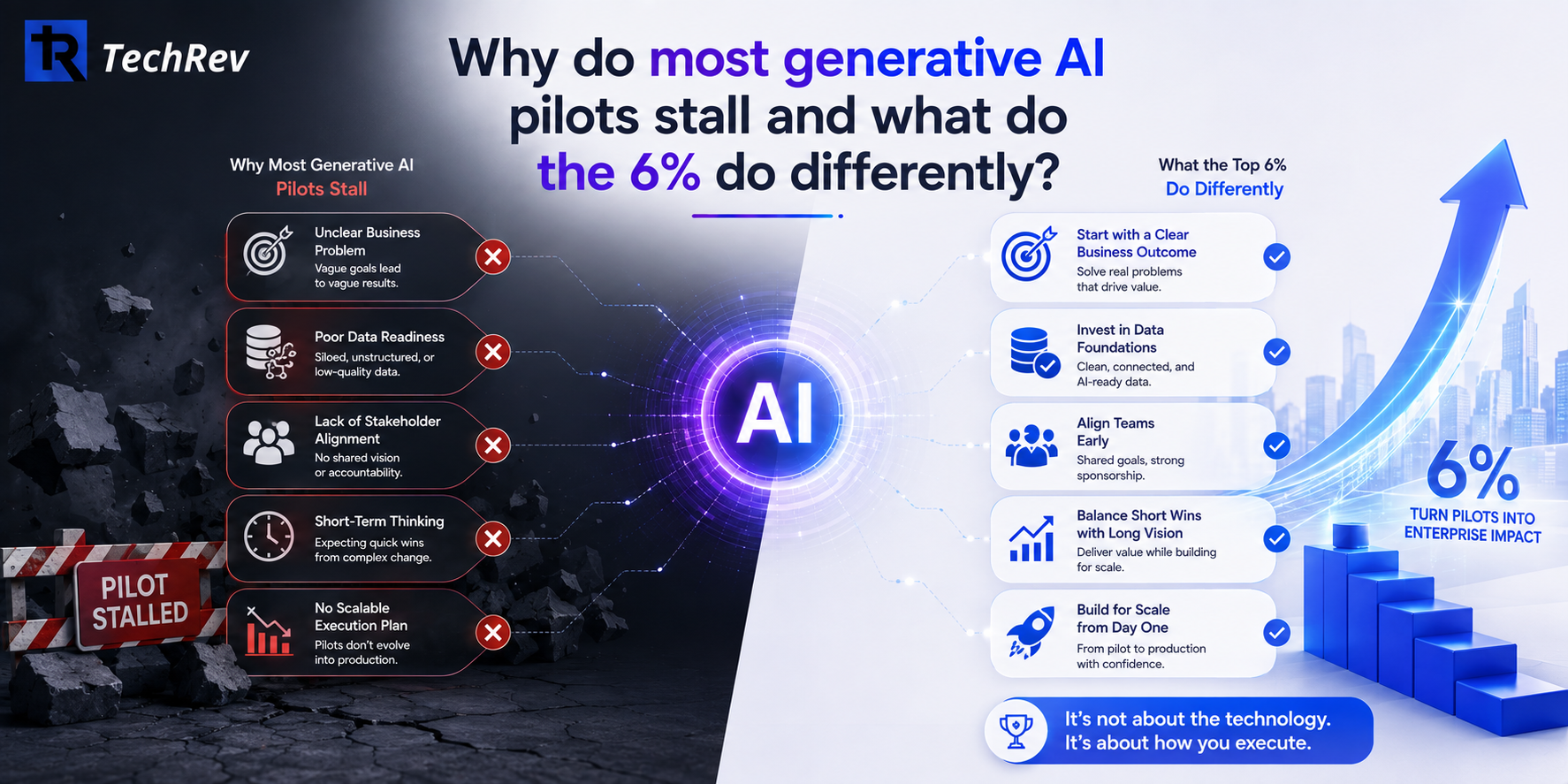
MIT’s Project NANDA reported that 95% of generative AI pilots delivered no measurable profit and loss impact. That statistic gets quoted as proof AI does not work. It is actually proof that buying a tool is not the same as changing how work happens.
Three failure patterns show up over and over in the 2026 research:
- No baseline. Teams deploy without documenting the process they intend to improve, so there is nothing to measure against later.
- Silos. AI runs disconnected from the systems that track outcomes, so gains stay anecdotal.
- Unchanged workflows. Deloitte found 84% of organizations have not redesigned roles around AI despite a 50% increase in worker access during 2025.
What separates the small group getting enterprise-level returns: senior leadership ownership (high performers are 3x more likely to report strong executive engagement), centralized or hub-and-spoke operating models (associated with roughly 36% higher AI ROI than scattered decentralized efforts), and a willingness to redesign the job, not just equip the person doing it.
How TechRev turns generative AI use cases into shipped systems?
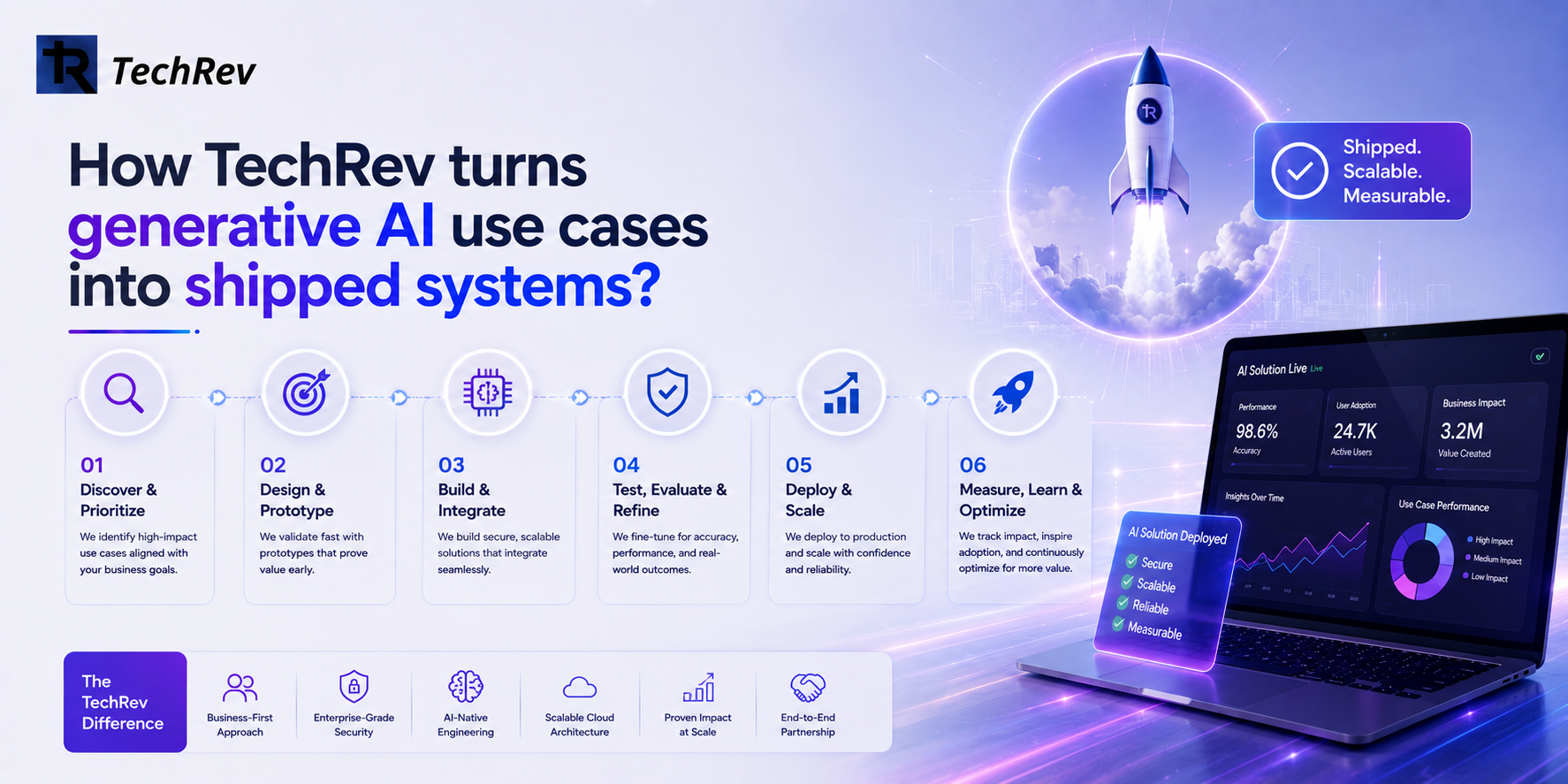
Every generative AI development company in USA will tell you they can build an agent. The harder question is whether they can build one that survives a compliance audit, integrates with the system your operations team actually uses, and still works in month eighteen.
TechRev is a US-based AI development company with over 10 years of building, 50+ products shipped, senior US-based engineers who own decisions from kickoff to launch.
What TechRev builds:
- AI agents and agentic workflows covering autonomous decision making, tool use, reasoning workflows and multi-agent collaboration, plus ongoing optimization: monitoring, retraining, prompt tuning and performance improvement.
- LLM applications with RAG, connecting language models to enterprise knowledge bases so answers are grounded, cited and auditable rather than plausible-sounding.
- AI voice agents that handle inbound calls, outbound outreach, appointment scheduling and lead qualification with speech recognition, natural language understanding and voice synthesis.
- NLP and document intelligence, including lightweight domain-specific micro models for faster performance, better privacy and simpler production deployment.
- Custom platforms across HealthTech, LegalTech, FinTech and field operations, with security and integration designed from line one.
TechRev’s approach to generative AI development services in USA starts with a baseline. Before anything gets built, the current process gets measured: how many minutes per record, how many touches, how many errors, how many escalations. Without that number, no one can honestly tell you what the system returned.
What makes TechRev different from a generic AI development company?
Most agencies sell model integration. As a generative AI development company in USA, TechRev builds and operates the platform around the model: the workflows, the data plumbing, the audit trails, the mobile apps your field crew actually uses. Veteran-founded, Florida-based, senior engineers who write the code they pitched.
Does TechRev only work with enterprises?
No. TechRev works with funded startups shipping MVPs on 90-day clocks and with established operators modernizing decade-old systems. Scope, not company size, determines fit.
How does TechRev handle compliance-heavy industries?
Security, access control and integration are designed in from the first line of code, not retrofitted before an audit. That approach comes from years of building HealthTech platforms that had to clear HIPAA scrutiny, not just pass a demo.
Also Read – Voice AI Agents: How They Work and Where They Replace Calls?
Conclusion
Pick one workflow that is repetitive, document-heavy, high-volume, and already measured. Baseline it for 30 days. Build the narrowest version that solves it. Measure again. Then expand.
That sequence is the difference between the 6% of organizations capturing real enterprise value and the majority still describing pilots in board decks.
If you are shortlisting a generative AI development company in USA, judge the shortlist on one thing: which of them asked what you measure today before telling you what they would build.
TechRev starts there. If you want generative AI development services in USA delivered by senior engineers in your timezone, talk to TechRev. Bring the workflow that annoys your team most. That is usually the one worth automating first.
FAQs about generative AI use cases
1. What are the most common generative AI applications in business right now?
Content generation leads adoption at around 60% of businesses, followed by predictive analytics at 44%, personalization at 42%, customer segmentation at 41%, and AI assistants at 40%. Across McKinsey’s eight years of AI research, IT and marketing and sales are consistently the functions most often reported to be using AI.
2. Which generative AI use cases deliver ROI fastest?
Customer support copilots and software development assistance. Both show measurable gains within a single sprint or reporting cycle, both have clean baseline metrics already being tracked, and both operate on high-volume repeatable tasks where small per-unit savings compound quickly.
3. What is the difference between generative AI and agentic AI?
Generative AI responds to a prompt by producing content. An agent plans and completes multi-step tasks on its own, calling tools and systems along the way without a human input at each step. Most enterprise generative AI deployments in 2026 are moving from the first pattern toward the second.
4. Do we need to train our own model?
Almost never. Most enterprise generative AI applications are built on foundation models accessed via API and combined with RAG to bring in company-specific data. Training from scratch is a research budget, not a product budget.
5. How much are companies actually spending?
KPMG research across US companies with over $1 billion in revenue found average annual AI budgets reaching $124 million, with 67% saying they would maintain spend even in a recession. Smaller organizations spend a tiny fraction of that.
The Process Excellence Network’s survey found 18% of businesses planning to invest $10,000 to $49,999 in AI over the next year, and the same share planning under $10,000.
6. Is generative AI worth it for a business with under 20 employees?
The data says yes, with a condition. 58% of AI-using small businesses report saving more than 20 hours a month and two thirds report saving $500 to $2,000 monthly. The condition is workflow change. Buying a subscription and carrying on as before produces nothing measurable.
7. What should we measure to prove it worked?
Pick the metric your business already reports on. Cycle time per record, cost per contact, first contact resolution, days to close, forecast error, cost per hire. Capture it for 30 days before you deploy anything. Roughly 70% of organizations discover data infrastructure gaps only after launch, and teams without a pre-deployment baseline cannot tell the difference between a real gain and a good story.