
Custom AI agent development is where most enterprises discover that the model was never the hard part. Gartner projects 33% of enterprise software will include agentic AI by 2028, up from under 1% in 2024, and Capgemini found 82% of organizations planning to integrate AI agents within three years. Yet Gartner also predicts over 40% of agentic AI projects will be canceled by the end of 2027, and MIT researchers reported in 2025 that roughly 95% of enterprise generative AI pilots delivered no measurable ROI, with poor workflow integration named as the culprit.
Those four numbers describe one situation: everyone is building agents, and most builds are failing for engineering reasons, not intelligence reasons.
This blog is the engineering answer, covering the custom AI agent development process end to end, the architecture and tech stack decisions that determine success, realistic timelines, team composition, and the failure patterns worth designing against.
What Is Custom AI Agent Development?
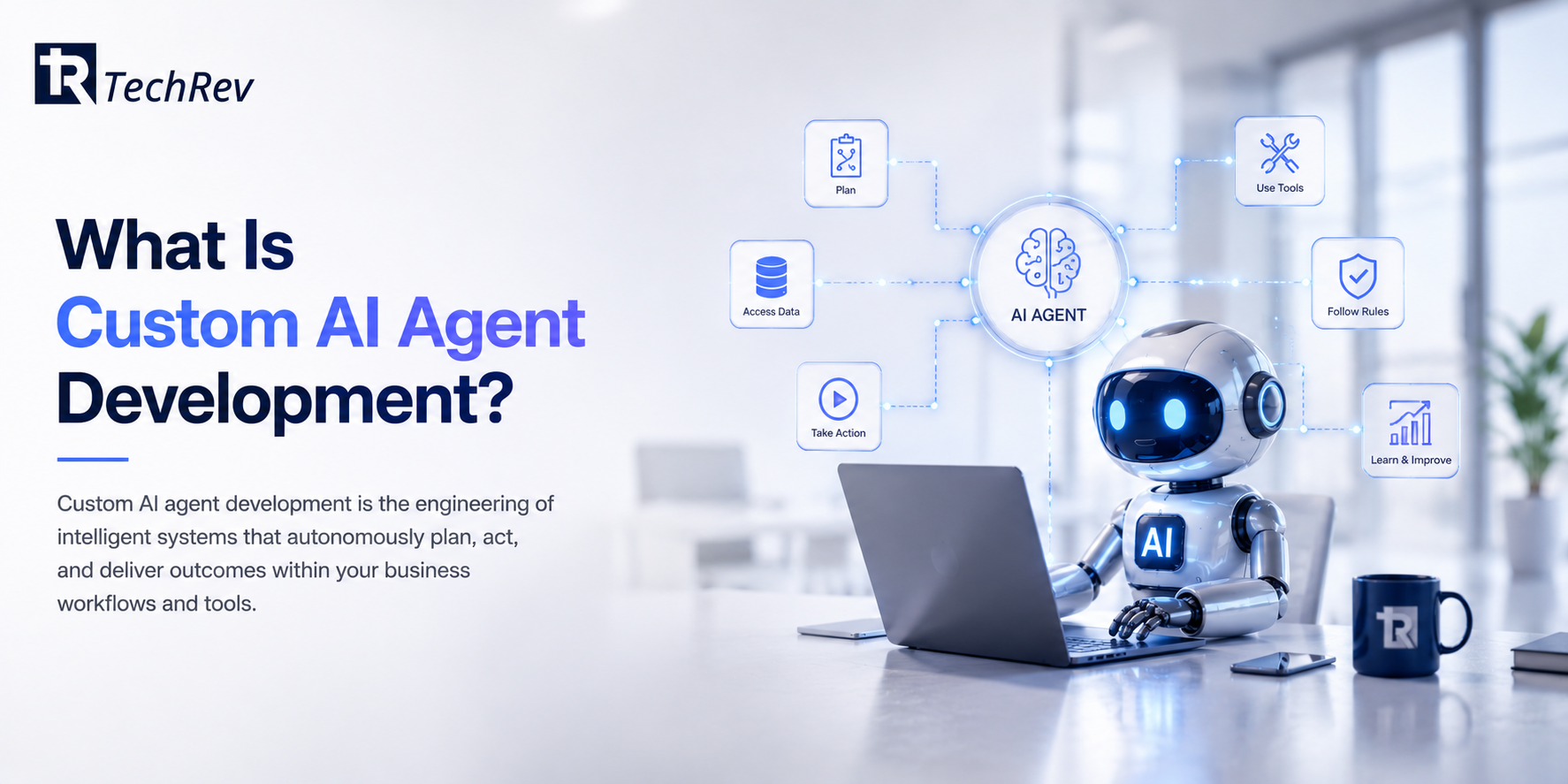
Custom AI agent development is the engineering of AI systems that pursue goals autonomously inside your specific business systems: planning multi-step work, calling tools and APIs, making decisions within defined rules, and escalating exceptions to humans.
Unlike configuring an off-the-shelf agent platform, custom development builds the agent’s logic, integrations, guardrails, and evaluation around workflows that are specific to how your business actually operates.
The distinction that matters commercially: platforms rent you an agent’s shape, and custom development gives you one shaped like your process. For when each option is right, see our comparison of AI automation agency vs custom development.
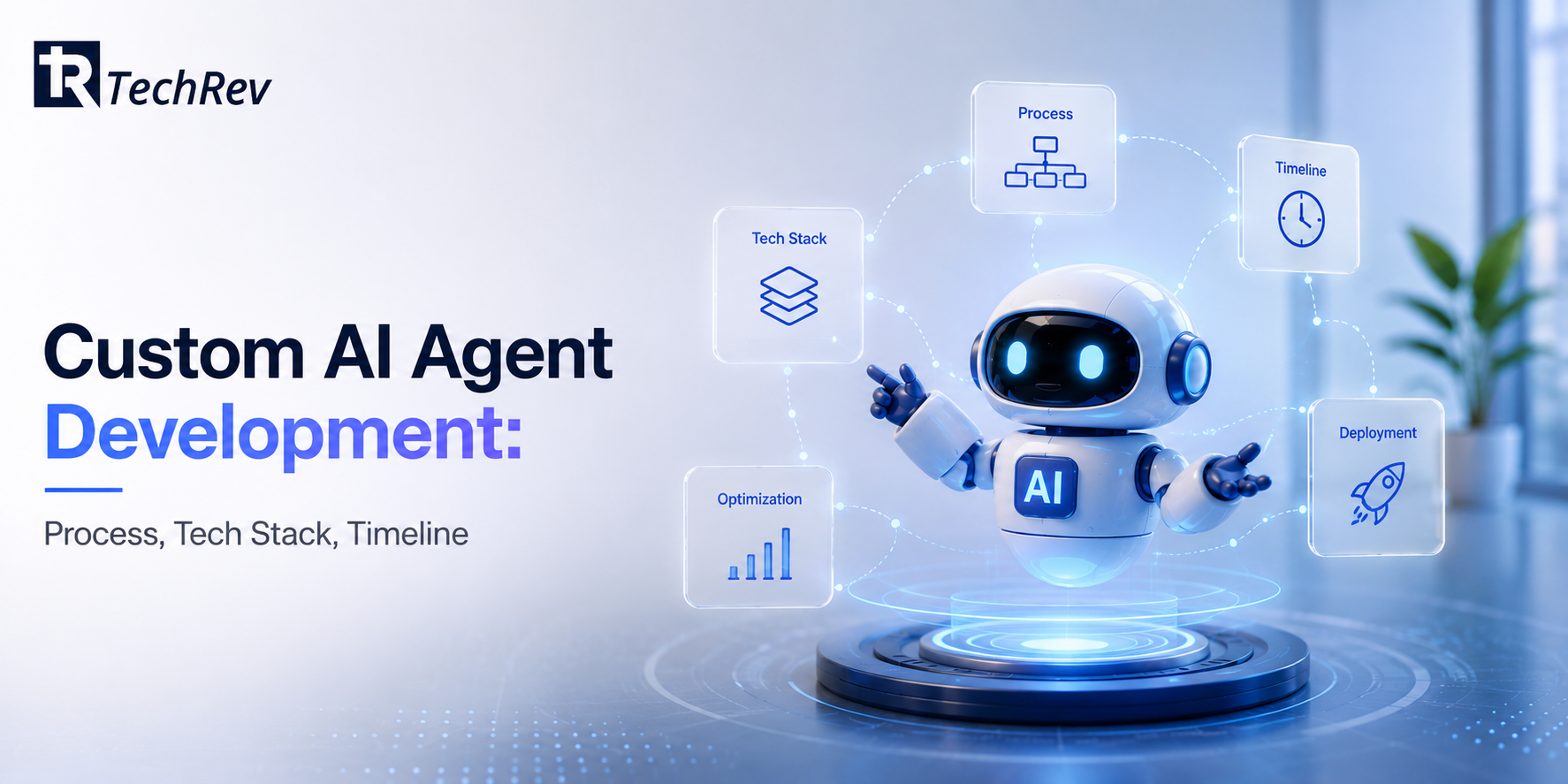
The Custom AI Agent Development Process: 7 Steps
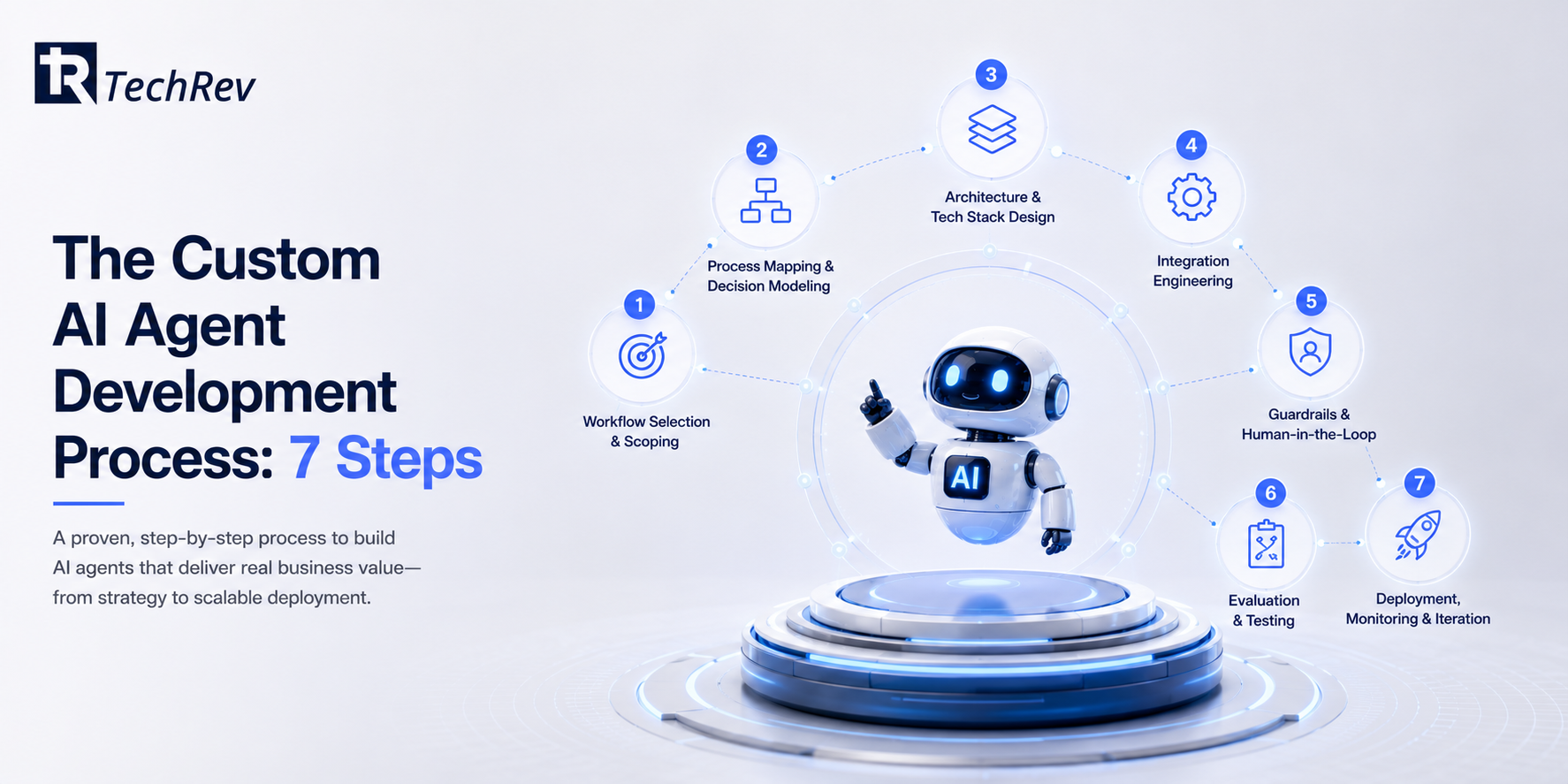
- Workflow selection and scoping. Score candidates on volume, rule clarity, system access, and measurability, then pick exactly one. Skipping this step is the single largest contributor to that 40% cancellation rate, and the full selection framework lives in our guide to agentic AI use cases.
- Process mapping and decision modeling. Document how the work happens today, including the exceptions people handle without thinking. Those exceptions are the specification.
- Architecture and tech stack design. Model selection and routing, memory strategy, tool definitions, retrieval design, and orchestration pattern (next section).
- Integration engineering. Read and write connections to the CRM, EHR, ERP, or custom systems where the work lives, with permissions scoped tightly. Integration typically consumes a third or more of the build, and it is the difference between an agent and a demo, as detailed in our AI integration services methodology.
- Guardrails and human-in-the-loop design. Approval checkpoints for consequential actions, escalation paths, permission boundaries, and audit logging of every agent decision.
- Evaluation and testing. Structured evals against real historical cases, adversarial testing, and regression suites, because “it worked in the demo” is not a quality standard.
- Deployment, monitoring, and iteration. Shadow mode first, then supervised production, then autonomy within limits, with weekly metric review throughout.
How Long Does Custom AI Agent Development Take?
A scoped single-workflow agent with two or three system integrations typically takes 6 to 12 weeks from kickoff to supervised production. Multi-agent systems, regulated environments, or agents spanning many systems run in quarterly phases.
Timelines compress dramatically for the second and third agents, because architecture, guardrails, and integration patterns are reused rather than rebuilt.
Also Read – How to Build an AI Agent for Real Business Use?
AI Agent Architecture: What Actually Goes Into the Build?
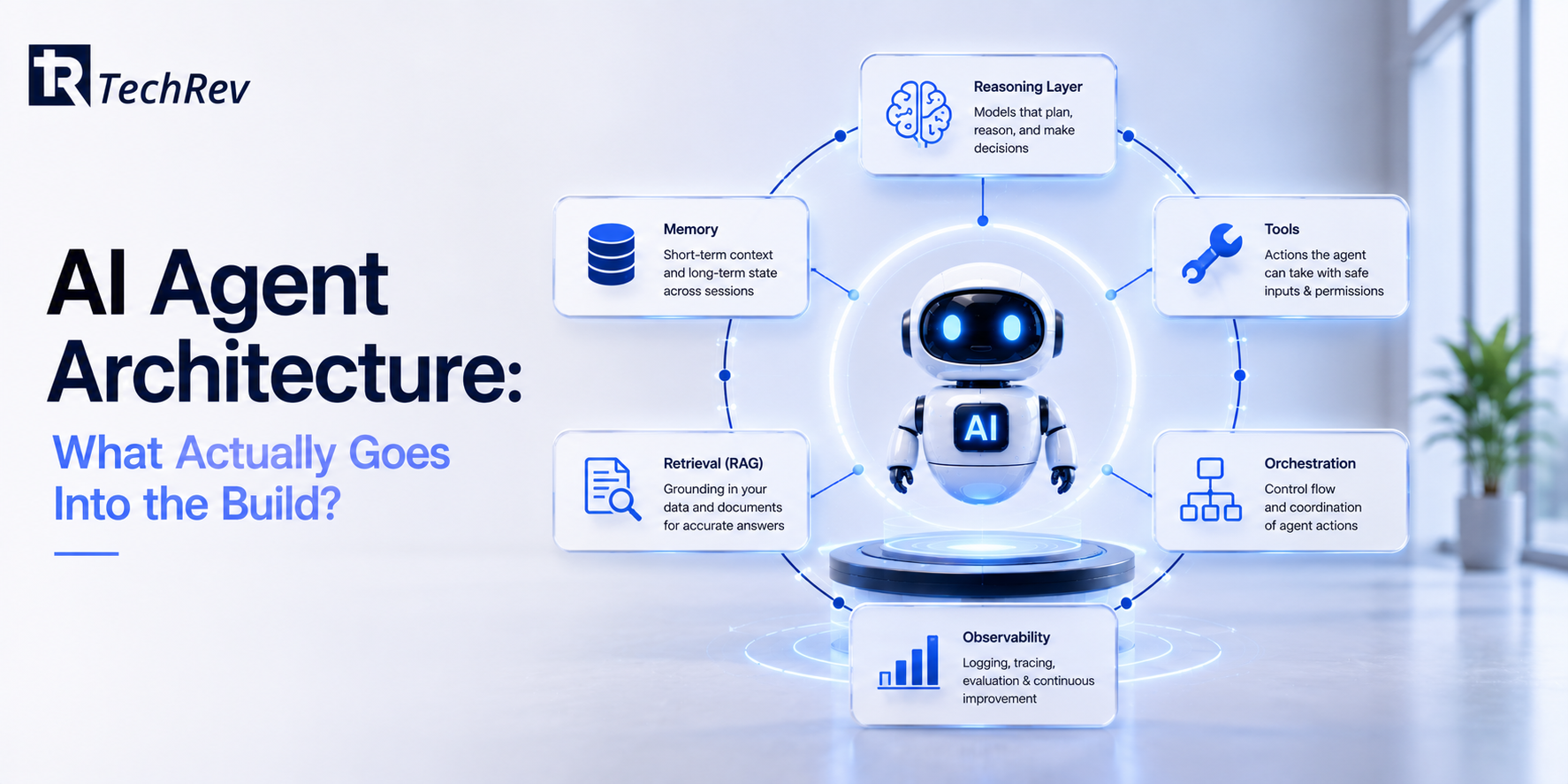
Every production agent has six components, and each is a decision, not a default:
- Reasoning layer: the model or models that plan and decide, usually routed so routine steps use smaller, cheaper models and hard reasoning escalates to premium ones. This is where ongoing cost is won or lost.
- Memory: short-term conversation context plus longer-term state, so the agent remembers what happened across steps and sessions without carrying irrelevant history.
- Tools: the actions the agent can take, defined precisely, with input validation and permission scoping on every one.
- Retrieval (RAG): grounding in your documents and records so answers reflect your reality, with a well-built RAG pipeline as the difference between accurate and plausible.
- Orchestration: the control flow deciding what happens next, whether a single agent loop or multi-agent coordination.
- Observability: logging, tracing, and evaluation hooks, because an agent you cannot inspect is an agent you cannot improve or defend in an audit.
Single Agent or Multi-Agent System?
Start with a single agent. Multi-agent systems, where specialized agents coordinate on subtasks, add real capability for complex domains but multiply failure modes, debugging difficulty, and cost.
The engineering rule: split into multiple agents only when one agent’s tool list or instructions have grown unmanageable, and never as a starting architecture.
Choosing the AI Agent Tech Stack
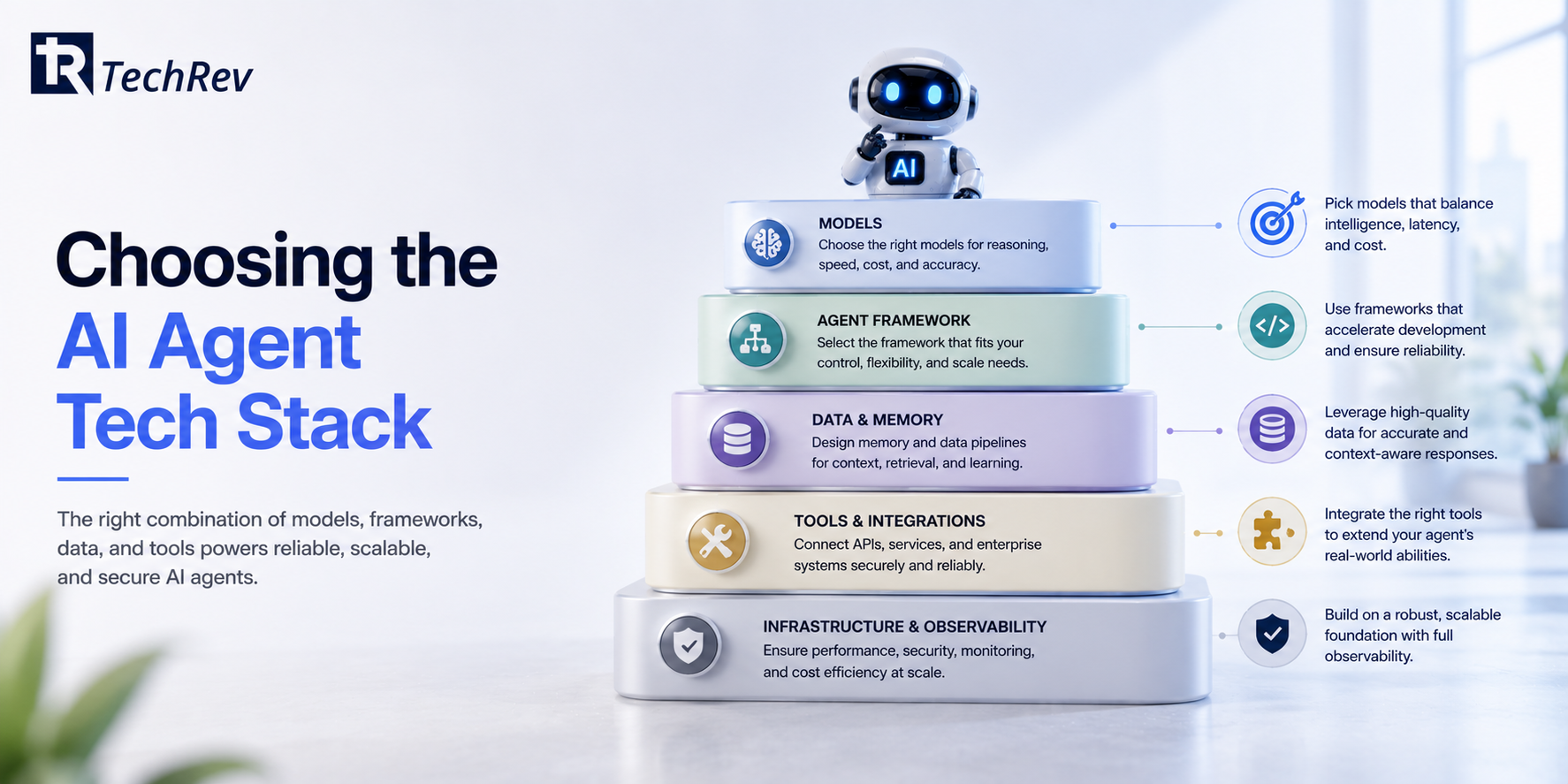
Four decisions define the stack, and none of them should be made by brand preference:
1. Models
Frontier models for complex reasoning, smaller and cheaper models for classification, extraction, and routine steps. Multi-model routing is standard practice in 2026 because it cuts running costs substantially without hurting quality where it matters.
2. Agent framework
Established orchestration frameworks accelerate development, while direct API implementation gives maximum control for narrow, high-volume agents. Neither is universally right, and heavy frameworks on simple agents are a common source of unnecessary complexity.
3. Integration layer
APIs into your systems of record, increasingly standardized through protocols that expose tools to agents consistently. Where legacy systems lack APIs, encapsulation comes first, the pattern detailed in our legacy system modernization blog.
4, Infrastructure and governance
Hosting, secrets management, encryption, role-based access, and audit logging, non-negotiable in regulated environments and much cheaper designed in than retrofitted, per our HIPAA compliant development checklist.
Who Builds a Custom AI Agent? Team Composition
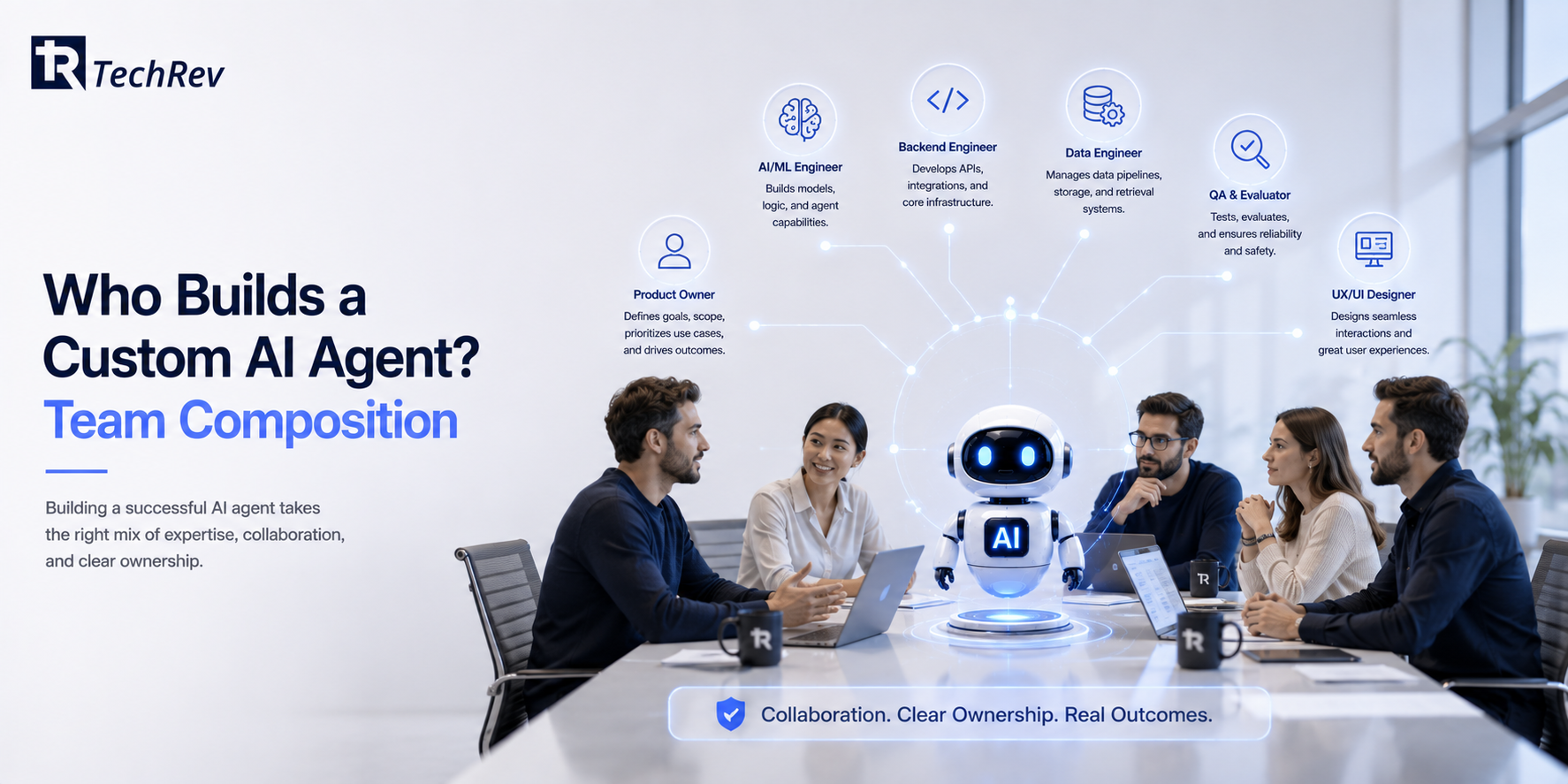
A production agent build typically needs five capabilities, sometimes in three people: AI engineering (models, prompting, evaluation), backend and integration engineering (the systems work that dominates the timeline), domain expertise from the people who do the workflow today, security and compliance where regulated data flows, and product ownership to hold the metric.
Notably absent from that list: data scientists training custom models, which most agent projects do not require now that foundation models plus retrieval handle the intelligence.
Why Custom AI Agent Projects Fail and How to Prevent It?
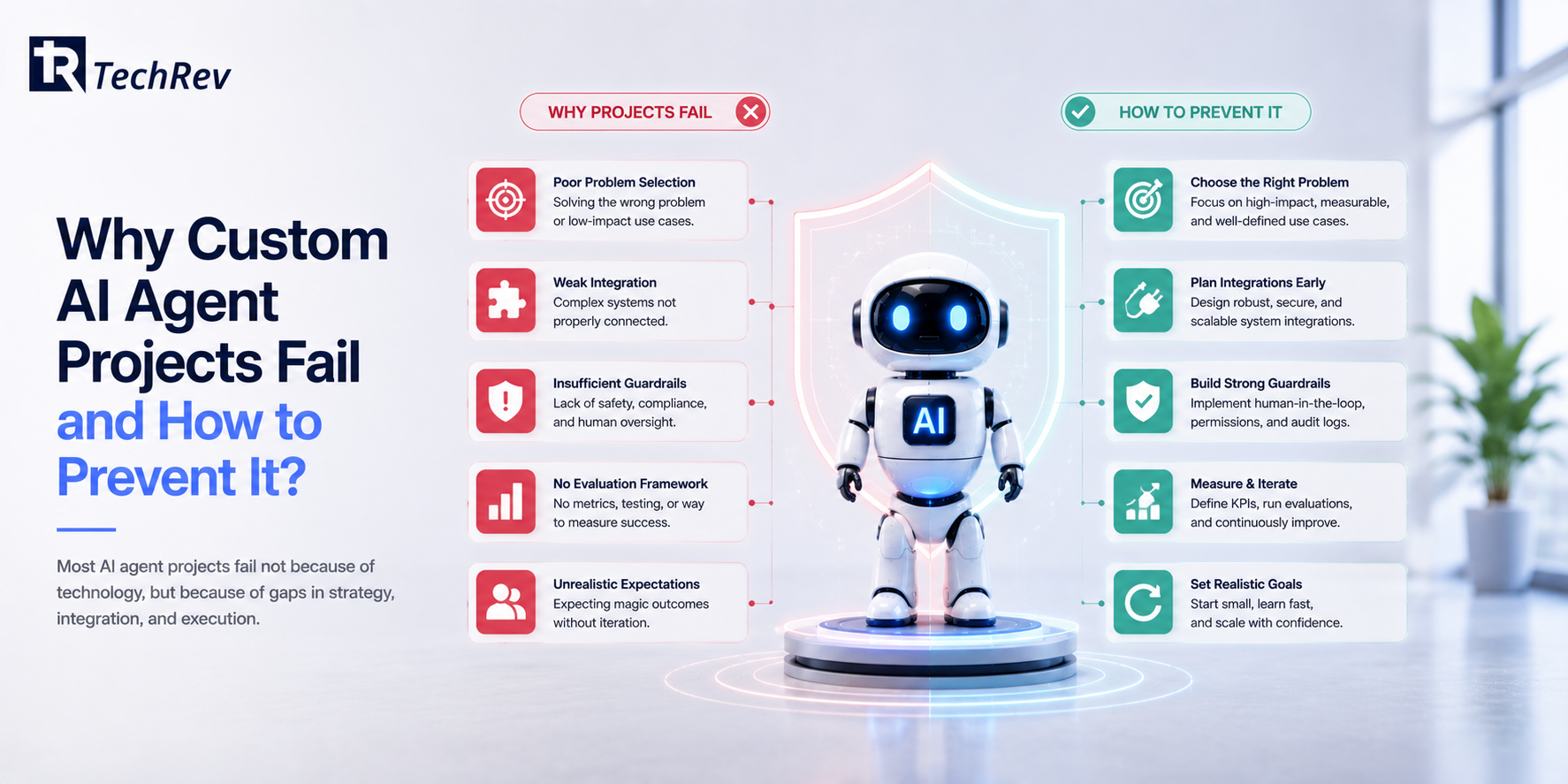
Five patterns account for most failures:
- Vague scope. “An agent for operations” has no success condition. One workflow, one metric, 90 days.
- Shallow integration. The MIT-documented failure mode: agents that cannot read and write real systems produce demos.
- No evaluation harness. Without structured evals against real cases, quality is anecdote, and regressions ship silently.
- Missing guardrails. Unbounded permissions and no human checkpoints turn a small error into an incident, and kill organizational trust permanently.
- Ignoring token economics until the invoice. Model routing, caching, and context discipline are design-time decisions; retrofitting them is re-engineering. Full pricing mechanics are in our AI agent development cost breakdown.
The prevention is one habit: treat the agent as production software with metrics, tests, and permissions, not as a prompt with ambitions.
Also Read – AI-First Cloud Services: Providers Delivery and Users Needs!
How TechRev Approaches Custom AI Agent Development?
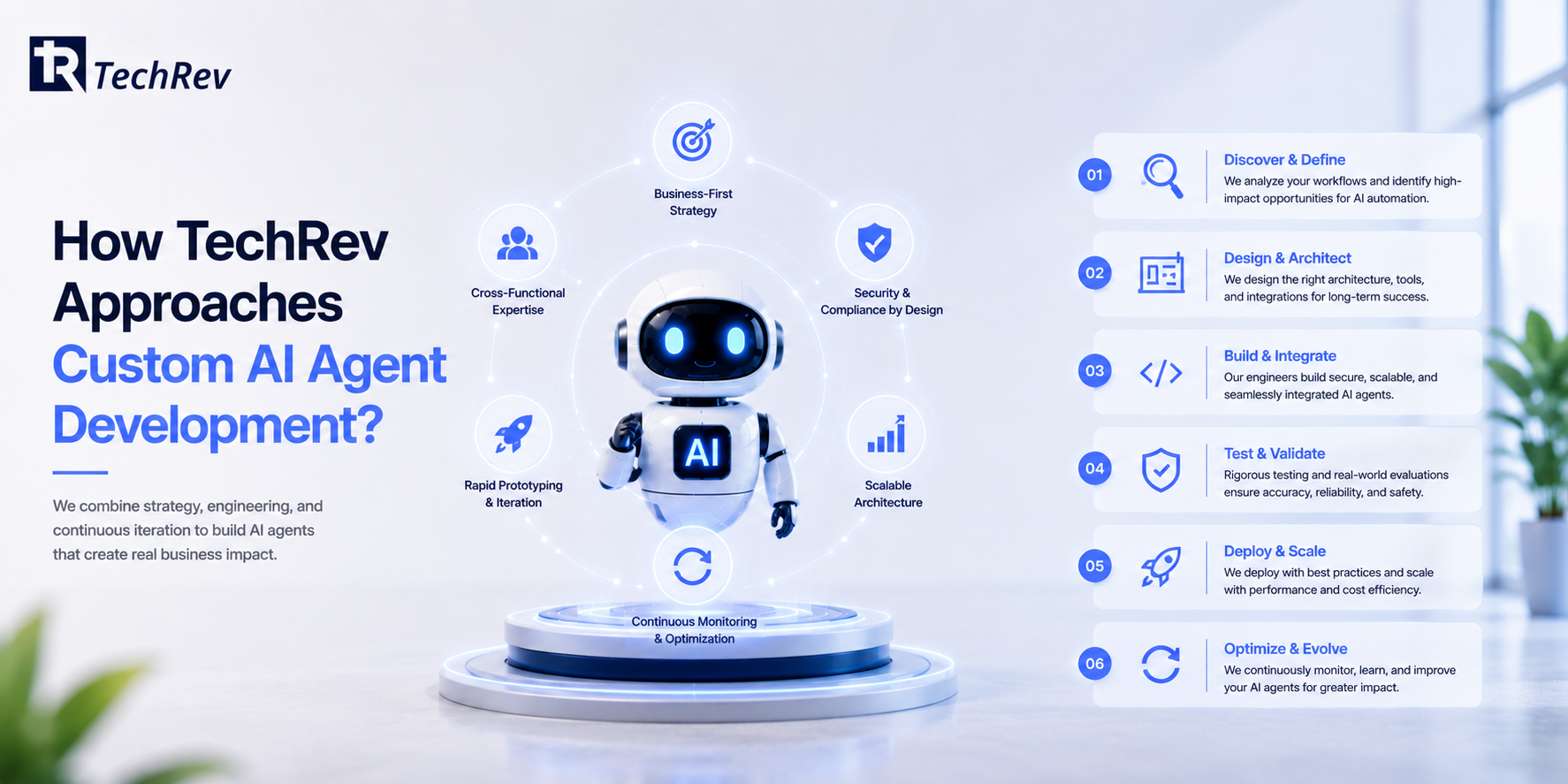
TechRev is a US-based AI agent development company building production agents into the systems businesses already run, delivered through generative AI development with regulated-industry architecture as the default rather than an upgrade.
Q1: What does TechRev’s custom AI agent development process look like?
Engineering discipline over demo velocity. We start by scoring your candidate workflows and picking one with volume, rules, system access, and a metric, then map the process with the people who actually perform it, including the exceptions. Architecture follows: multi-model routing engineered against your volume, retrieval grounded in your data, tools with scoped permissions, and human-in-the-loop checkpoints on consequential actions.
Integration is where we spend the most engineering, because that is where value lives, and every build ships with an evaluation harness, audit logging, and observability so quality is measurable rather than claimed. Deployment runs shadow mode first, then supervised, then bounded autonomy.
The second agent reuses this foundation, which is why our clients’ cost and timeline per workflow drop with each phase.
Q2: Can TechRev build agents that work with our legacy systems?
Yes. Where APIs are missing, we encapsulate legacy systems behind secure interfaces first, then build agents on top, delivering automation without waiting on full modernization.
Q3: Does TechRev build compliant agents for regulated industries?
Yes. HIPAA and SOC 2 environments are our default posture: scoped permissions, encryption, immutable audit trails of agent decisions, BAA-covered services, and mandatory human approval on sensitive actions.
Q4: What results has TechRev delivered with custom agent automation?
For a hospital services vendor, TechRev’s AI-powered workflow and tracking system cut installation errors by 90% and recovered billing evidence that manual processes kept losing.
Also Read – Agentic AI vs Traditional Fraud Detection – A CTO’s Guide
Conclusion
A third of enterprise software heading agentic, 82% of organizations planning integrations, and a failure rate near 40% among projects that skip the engineering: custom AI agent development in 2026 rewards teams that treat agents as production systems. Scope one workflow, integrate deeply, guard the actions, evaluate honestly, and let the numbers earn the next phase.
If you have a workflow worth automating properly, talk to TechRev’s AI team. We will score it against the selection criteria in this guide, design the architecture around your systems, and put success metrics in writing before a line of code gets written.
FAQs
1. How do you build an AI agent for business use?
Pick one high-volume, rules-based workflow with a measurable outcome; map the process including exceptions; design the architecture (models, memory, tools, retrieval, orchestration); integrate deeply with systems of record; add guardrails and human checkpoints; build an evaluation harness; then deploy in shadow mode before granting autonomy.
2. What is an AI agent framework, and do I need one?
Agent frameworks provide orchestration, memory, and tool-calling scaffolding so teams do not rebuild plumbing. They accelerate complex builds but add abstraction; narrow, high-volume agents are often cleaner and cheaper built directly against model APIs. Choose by complexity, not popularity.
3, What is the difference between custom AI agent development and using a platform?
Platforms configure predefined agent patterns quickly and price per seat or task; custom development engineers the agent around your workflows, integrations, and compliance requirements, producing software you own with costs that flatten as volume grows. Standard workflows favor platforms; distinctive or regulated ones favor custom.
4. How many agents should a company build?
One, then measure. Portfolio programs are built one proven workflow at a time, and each subsequent agent costs less because architecture, guardrails, and integrations are reused. Companies that start with a fleet typically end up in Gartner’s canceled 40%.
5. Do custom AI agents require training your own model?
Rarely. Foundation models with retrieval grounding and well-designed tools handle the vast majority of business agent work. Fine-tuning is worth considering only for narrow, proprietary tasks where prompting and retrieval demonstrably fall short, and it is a cost decision as much as a quality one.
6. How do you measure whether an AI agent is working?
Define the metric before the build: tasks completed autonomously, containment or resolution rate, cycle time, error rate, and cost per completed task. Review weekly, keep an evaluation suite of real historical cases, and treat regressions as production bugs.