
Enterprise AI agents are quickly becoming the most talked about technology investment in American boardrooms, and for good reason. Unlike the chatbots of the last decade, enterprise AI agents do not just answer questions. They complete work. They read the ticket, check the system, make the decision, and close the loop, often without a human touching the keyboard.
If you run operations, IT, or a growth team at a US company, this guide will walk you through what enterprise AI agents actually are, the agentic AI use cases delivering real returns in 2026, what AI agent development costs, and the one deployment mistake that sinks nearly half of all projects.
Let’s get into it.
What Are Enterprise AI Agents?
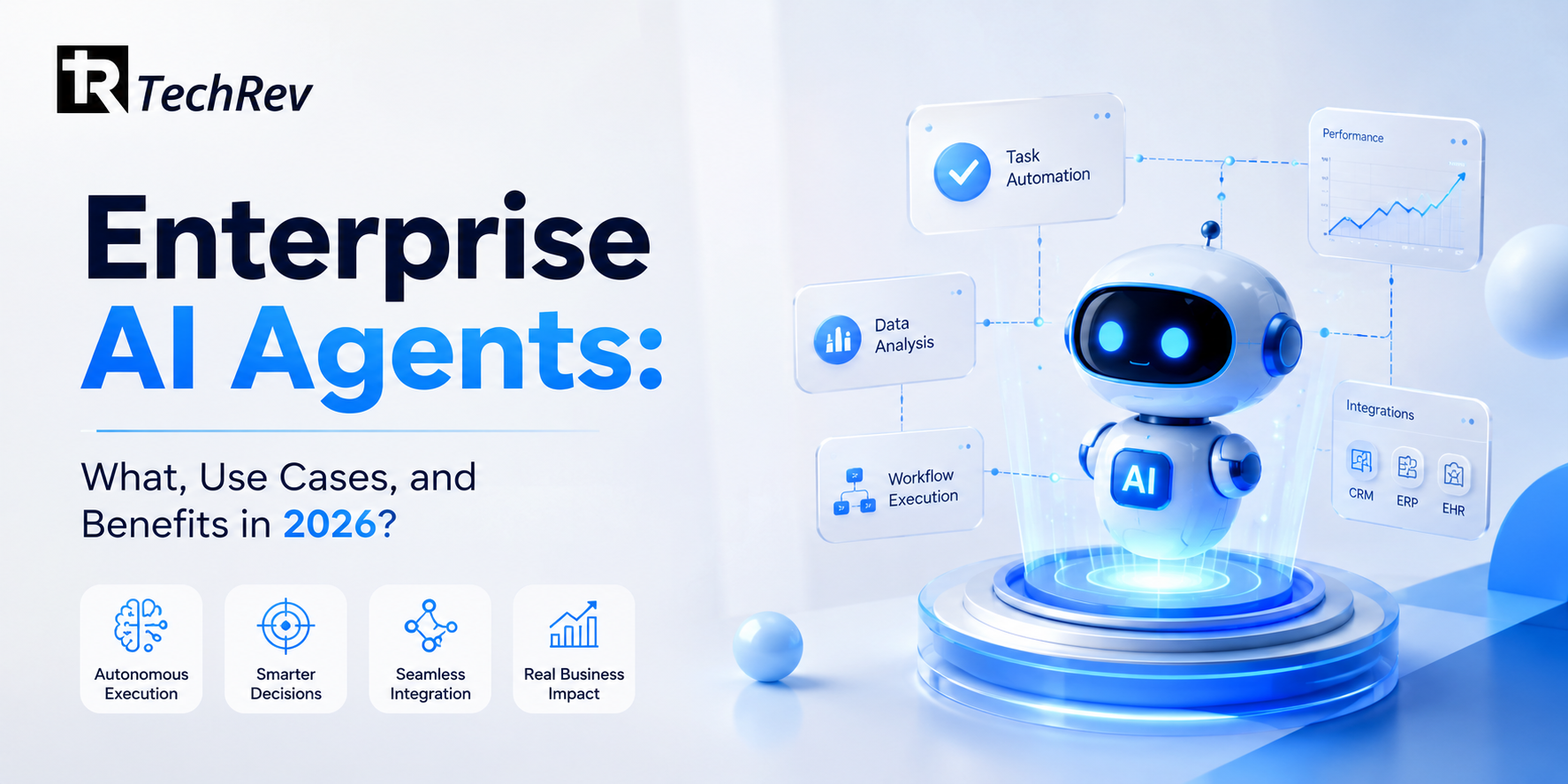
Enterprise AI agents are AI systems that can plan, make decisions, and execute multi-step tasks inside your business software with minimal human input. Instead of waiting for a prompt like a chatbot, an AI agent pursues a goal. It can pull data from your CRM, draft the response, update the record, and escalate exceptions to a human, all on its own.
Think of the difference this way. A chatbot is an employee who answers the phone. An enterprise AI agent is an employee who answers the phone, looks up the order, processes the refund, and emails the confirmation.
That shift from “answering” to “doing” is why agentic AI has become the defining enterprise technology story of 2026.
How Are Enterprise AI Agents Different from Chatbots and Copilots?
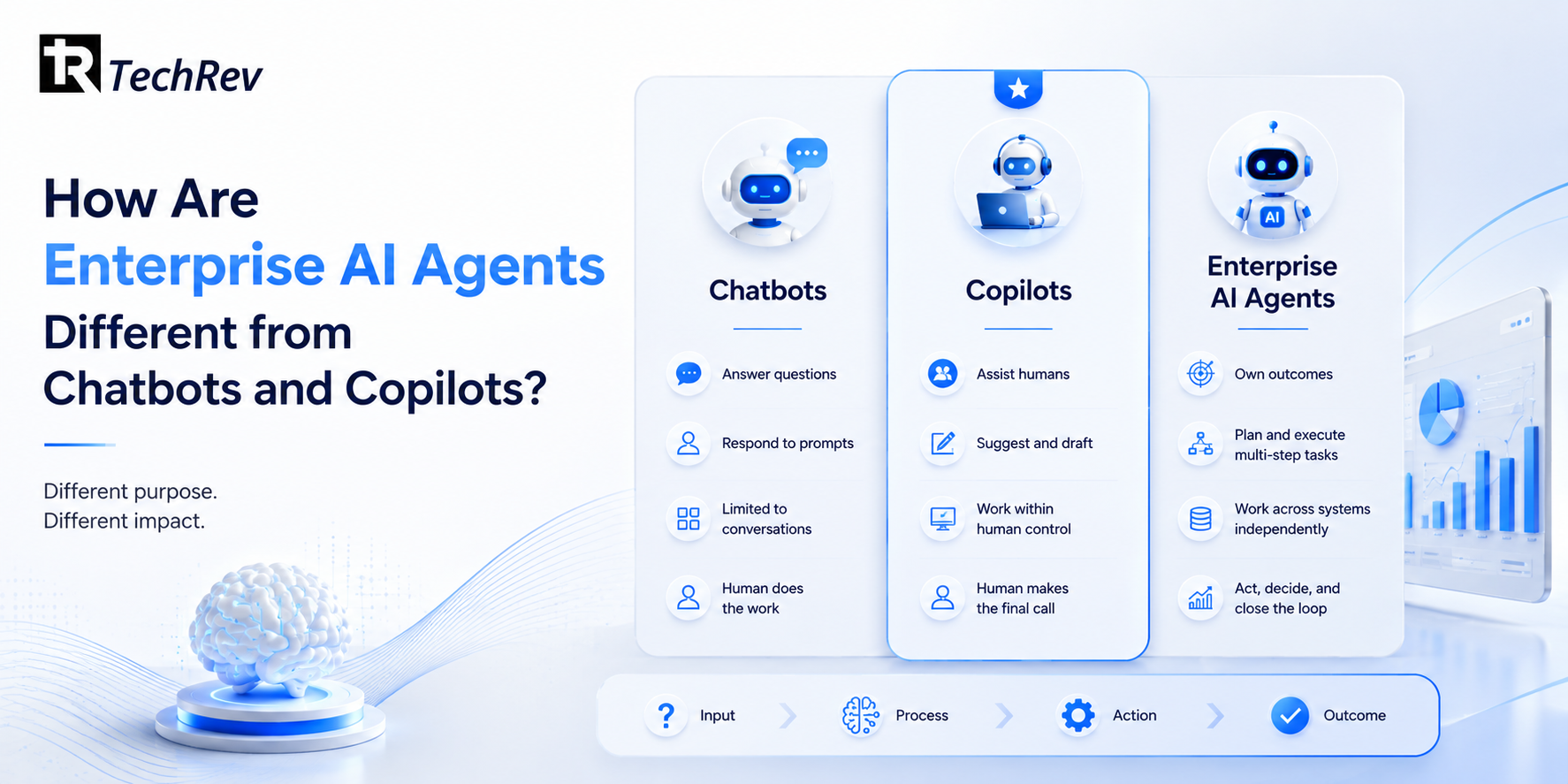
AI agents differ from chatbots and copilots in one word: autonomy. A chatbot responds to questions. A copilot assists a human who stays in control. An enterprise AI agent owns an outcome and works toward it across multiple systems and steps, asking for human approval only when needed.
Here is a simple way to compare the three:
| Capability | Chatbot | Copilot | Enterprise AI Agent |
| Answers questions | Yes | Yes | Yes |
| Works inside your tools | Limited | Yes | Yes |
| Completes multi-step tasks | No | Partially | Yes |
| Acts without a prompt | No | No | Yes |
| Makes decisions within set rules | No | No | Yes |
The practical takeaway: if your team still copies information between screens after talking to your “AI,” you have a chatbot, not an AI agent.
Why Are Enterprise AI Agents Exploding in 2026?
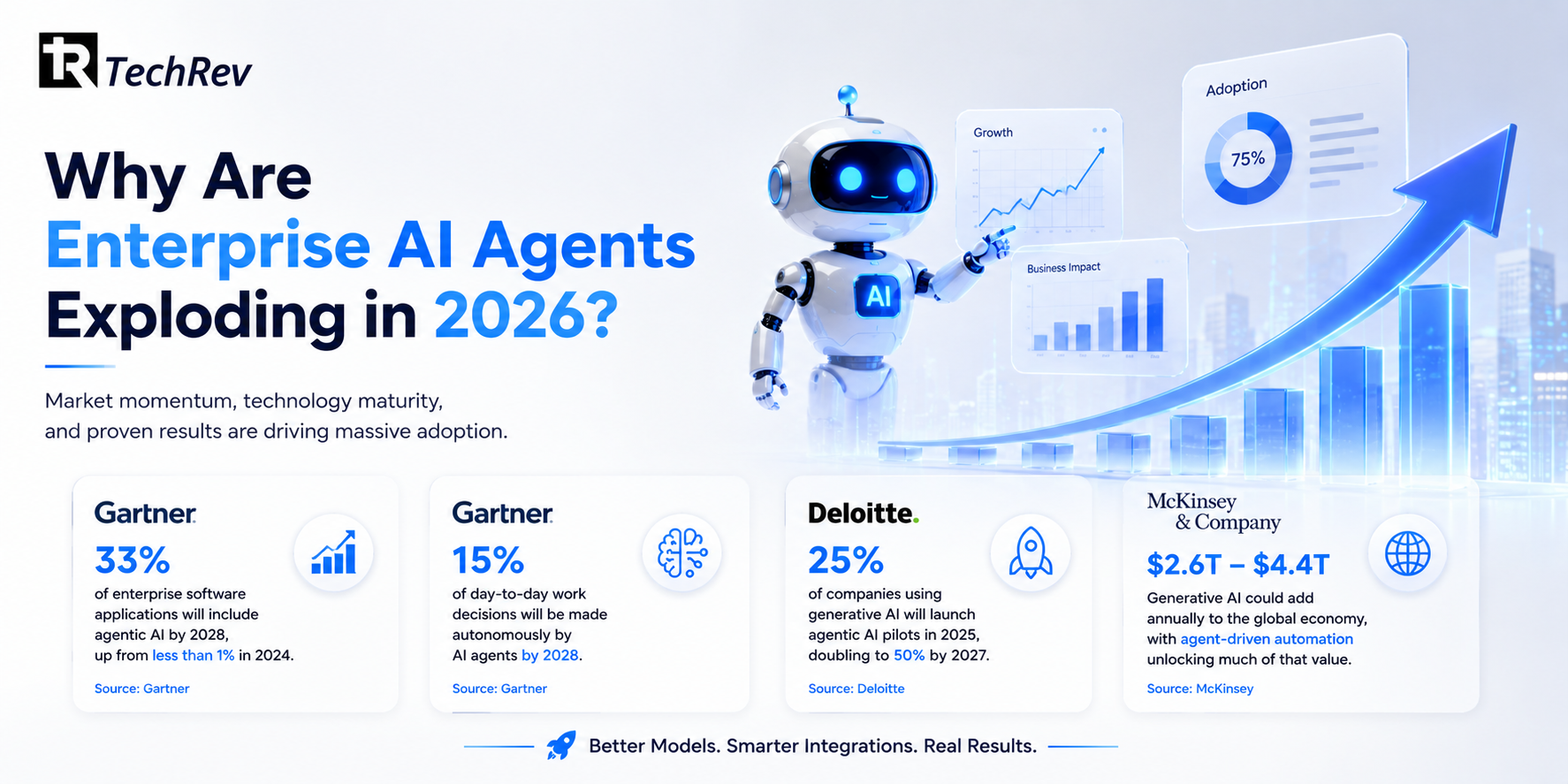
The numbers behind agentic AI adoption are hard to ignore:
- Gartner predicts that by 2028, 33% of enterprise software applications will include agentic AI, up from less than 1% in 2024.
- Gartner also expects 15% of day-to-day work decisions to be made autonomously by AI agents by 2028.
- Deloitte projected that 25% of companies already using generative AI would launch agentic AI pilots in 2025, doubling to 50% by 2027.
- McKinsey estimates generative AI overall could add $2.6 to $4.4 trillion annually to the global economy, and agent-driven automation is where much of that value gets unlocked.
So what changed? Three things matured at the same time: large language models got reliable enough to follow business rules, integration standards made it far easier to connect AI to existing tools, and early adopters started publishing results. Once your competitor’s support queue clears itself overnight, waiting stops being the safe option.
What Are the Top Agentic AI Use Cases in the Enterprise?
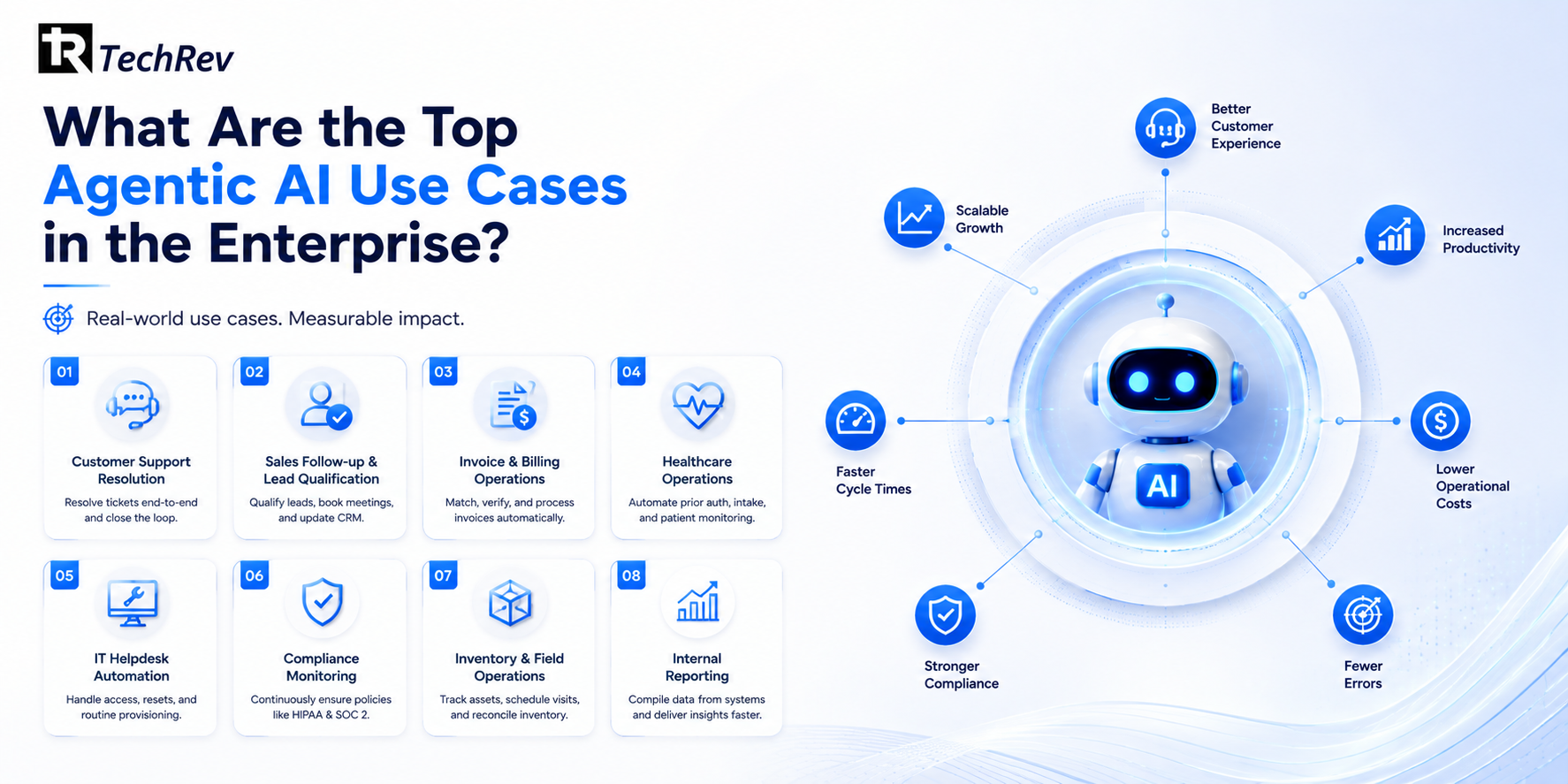
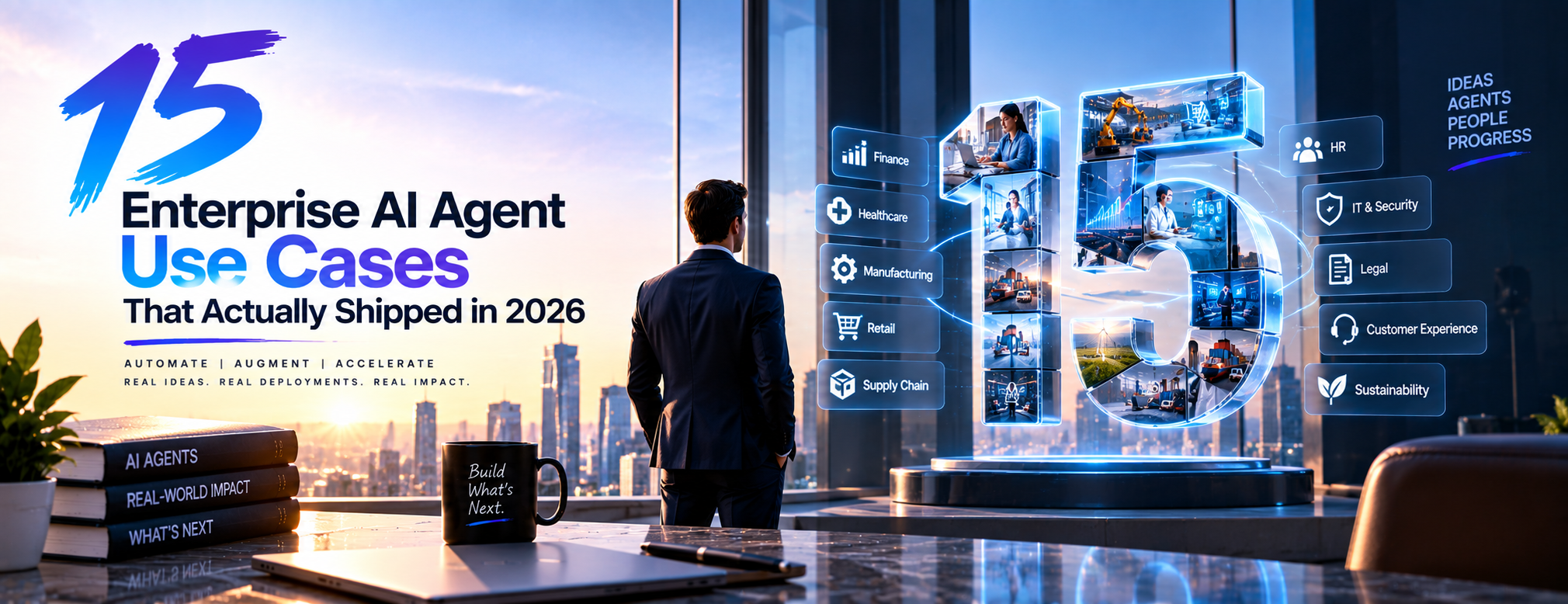
The highest-return agentic AI use cases in 2026 are the ones sitting on top of repetitive, rules-based work that humans find tedious. Here are the eight we see driving the strongest results for US businesses:
- Customer support resolution. AI agents that resolve tier-1 tickets end to end: reading the issue, checking account data, issuing the fix, and documenting it.
- Sales follow-up and lead qualification. An AI sales agent qualifies inbound leads, books meetings, and updates the CRM before your reps even log in.
- Invoice and billing operations. Agents match invoices to purchase orders, flag discrepancies, and push clean records into your accounting system.
- Healthcare operations. From prior authorization paperwork to patient monitoring and intake, agentic AI is cutting through the administrative work that eats 25 cents of every US healthcare dollar.
- IT helpdesk automation. Password resets, access requests, and routine provisioning handled without a human in the queue.
- Compliance monitoring. Agents that continuously check records and workflows against HIPAA or SOC 2 requirements instead of waiting for the annual audit scramble.
- Inventory and field operations. Agents that track assets, schedule service visits, and reconcile stock counts across locations.
- Internal reporting. An agent that assembles the Monday morning numbers from five systems, so nobody spends Sunday night doing it.
Notice a pattern? None of these are moonshots. The winning agentic AI use cases automate the boring middle of the business, and that is exactly why they pay for themselves.
Which Use Case Should You Start With?
Start with a process that is high-volume, rules-based, and painful when it backs up. Support tickets, intake forms, and billing reconciliation are the classic first wins because success is easy to measure: tickets closed, hours saved, errors reduced.
How Do You Deploy Enterprise AI Agents Without Rebuilding Your Systems?
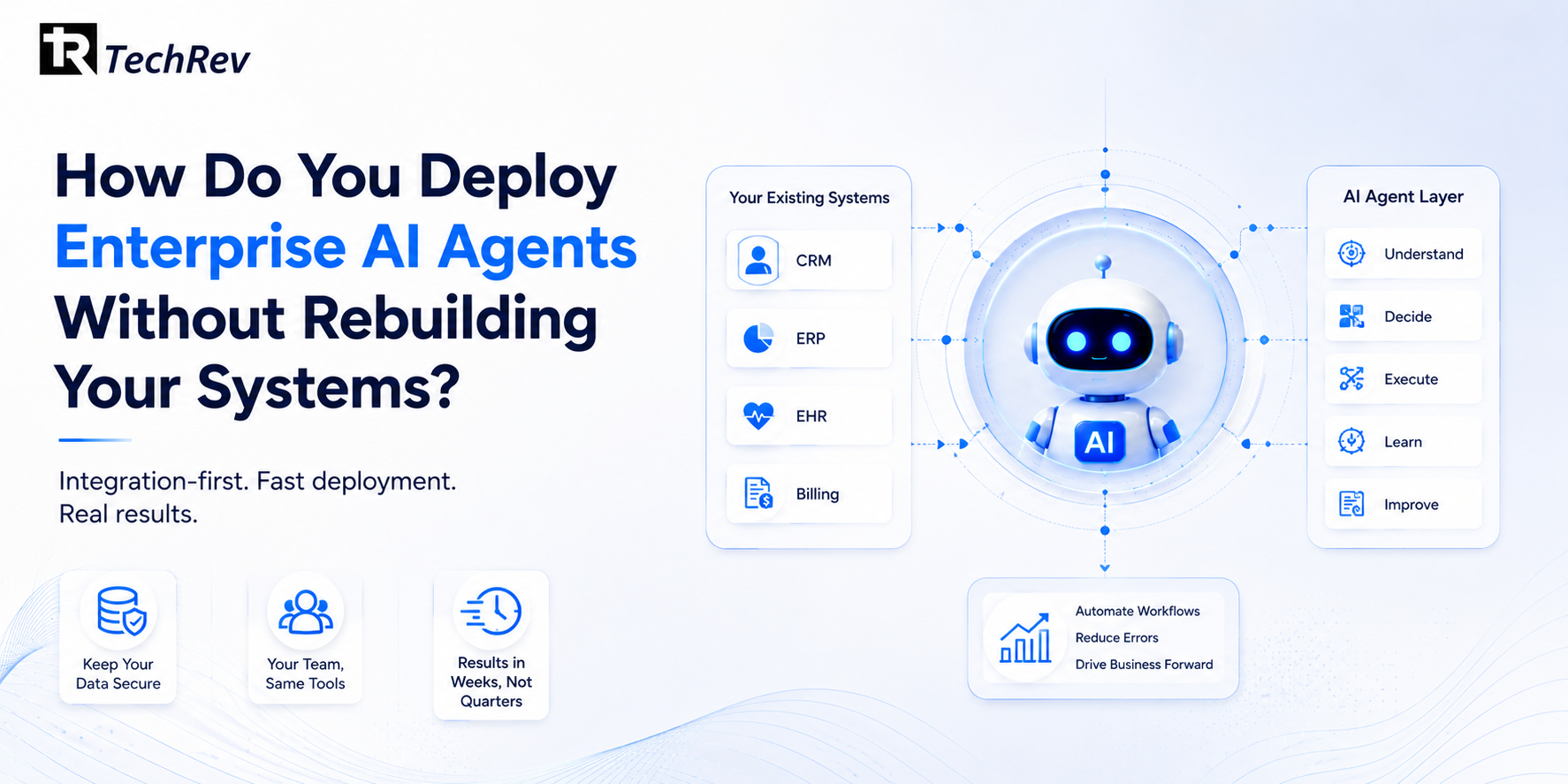
You do not need new software to use enterprise AI agents. The fastest path in 2026 is integration-first AI agent development: connecting agents to the CRM, EHR, ERP, or custom apps you already run, rather than replacing them.
This matters more than most vendors admit. The “rip and replace” approach doubles your cost, disrupts your team, and delays results by quarters. Integration-first deployment flips that:
- Your data stays where it is. The agent connects through APIs and secure integration layers instead of migrations.
- Your team keeps their tools. Adoption is easier when nobody has to learn a new system.
- You see results in weeks, not quarters. A scoped agent on one workflow proves value before you expand.
A real-world example: TechRev built an AI-powered barcode and workflow system for a healthcare services vendor whose field teams were losing track of thousands of hospital assets. Instead of replacing their operations software, the system layered tracking, scheduling, and verification workflows on top of how teams already worked. The result was a 90% reduction in installation errors, along with recovered billing evidence that used to slip through the cracks.
That is the integration-first difference. The AI adapts to your business, not the other way around.
How Much Does AI Agent Development Cost?
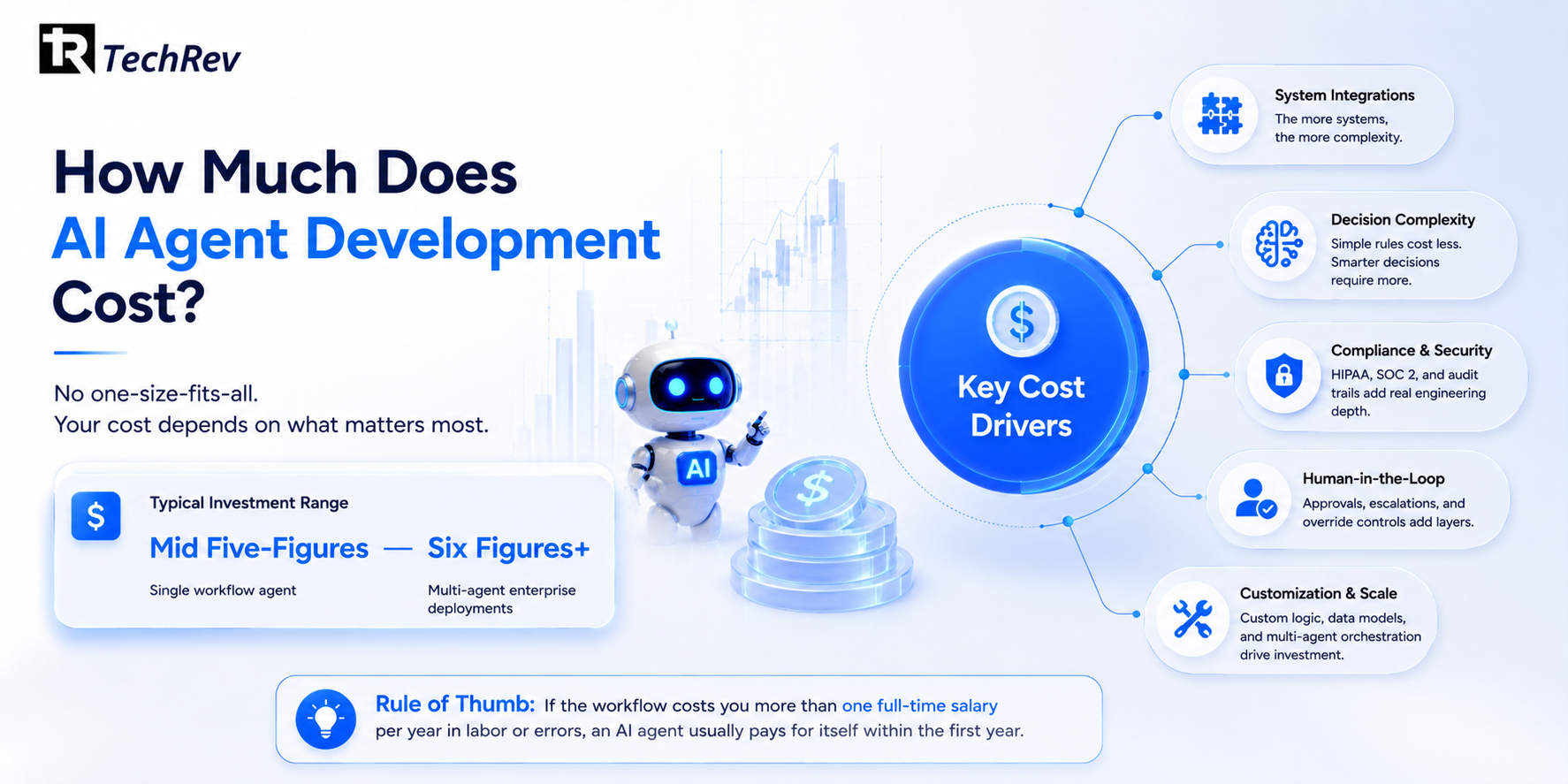
Custom AI agent development for a single, well-scoped business workflow typically starts in the range of a mid-five-figure project, while multi-agent enterprise deployments with deep integrations and compliance requirements can reach six figures. Off-the-shelf agent subscriptions look cheaper monthly but charge per seat or per task forever, and they rarely fit workflows that make your business different.
The honest cost drivers are:
- Number of systems the agent must connect to (CRM only vs CRM plus billing plus scheduling)
- Decision complexity (simple routing vs judgment calls with exceptions)
- Compliance requirements (HIPAA, SOC 2, and audit trails add real engineering work)
- Human-in-the-loop design (approval steps, escalation paths, override controls)
A useful rule: if the workflow costs you more than one full-time salary per year in labor or errors, a custom AI agent usually pays for itself within the first year.
Why Do Over 40% of Agentic AI Projects Fail?
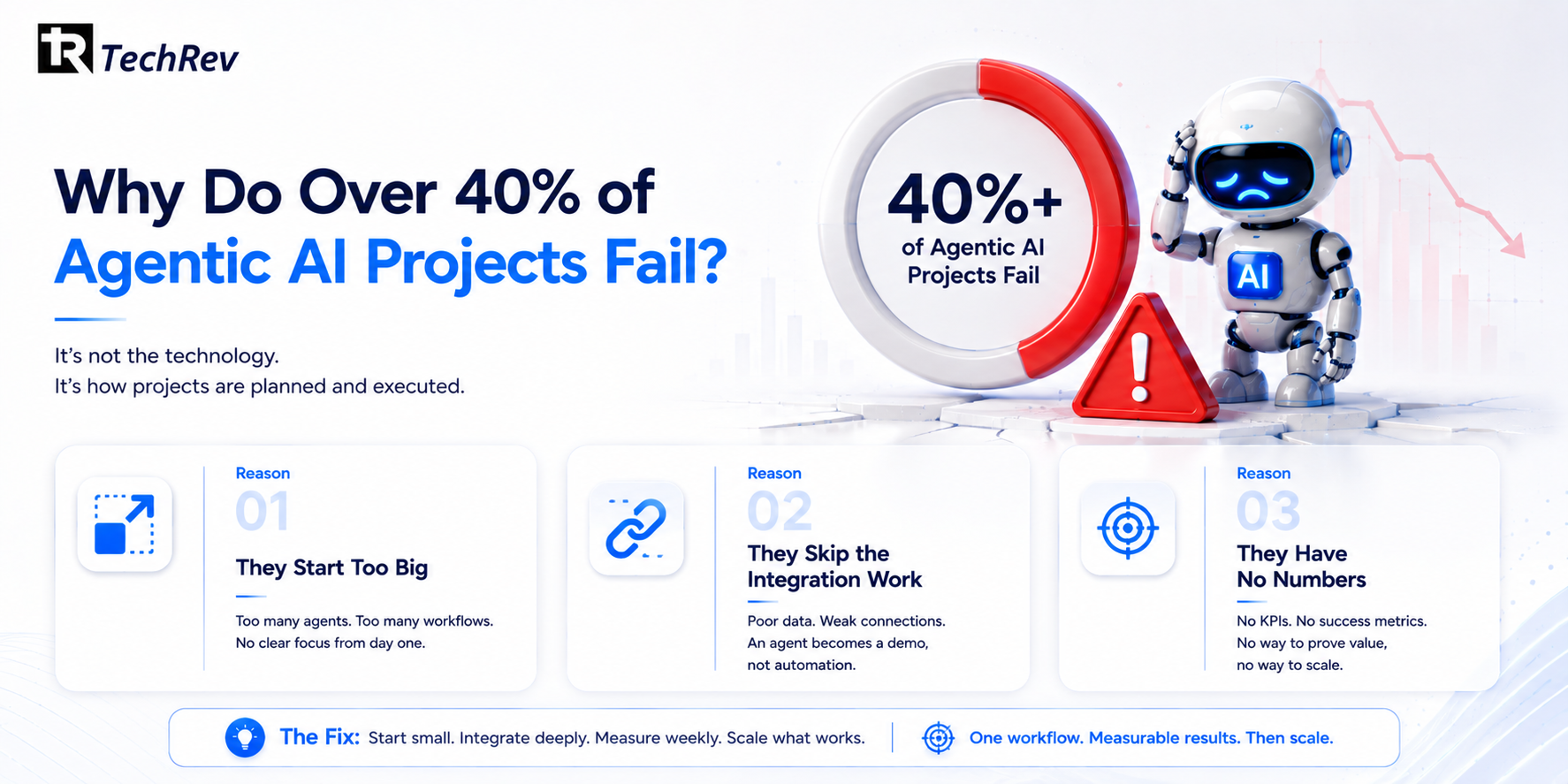
Gartner predicts that over 40% of agentic AI projects will be canceled by the end of 2027, mostly due to runaway costs, unclear business value, and weak risk controls. That is not a reason to avoid AI agents. It is a reason to deploy them like an operator, not a tourist.
The failed projects share three habits:
- They start too big. Ten agents across the whole company on day one, instead of one agent on one measurable workflow.
- They skip the integration work. An agent that cannot reliably read and write to your real systems is a demo, not automation.
- They have no numbers. If nobody defined “success” as tickets resolved, hours saved, or errors cut, nobody can defend the budget in month six.
The fix is boring and effective: pick one workflow, integrate deeply, measure weekly, then scale what works.
How TechRev Helps You Deploy Enterprise AI Agents?
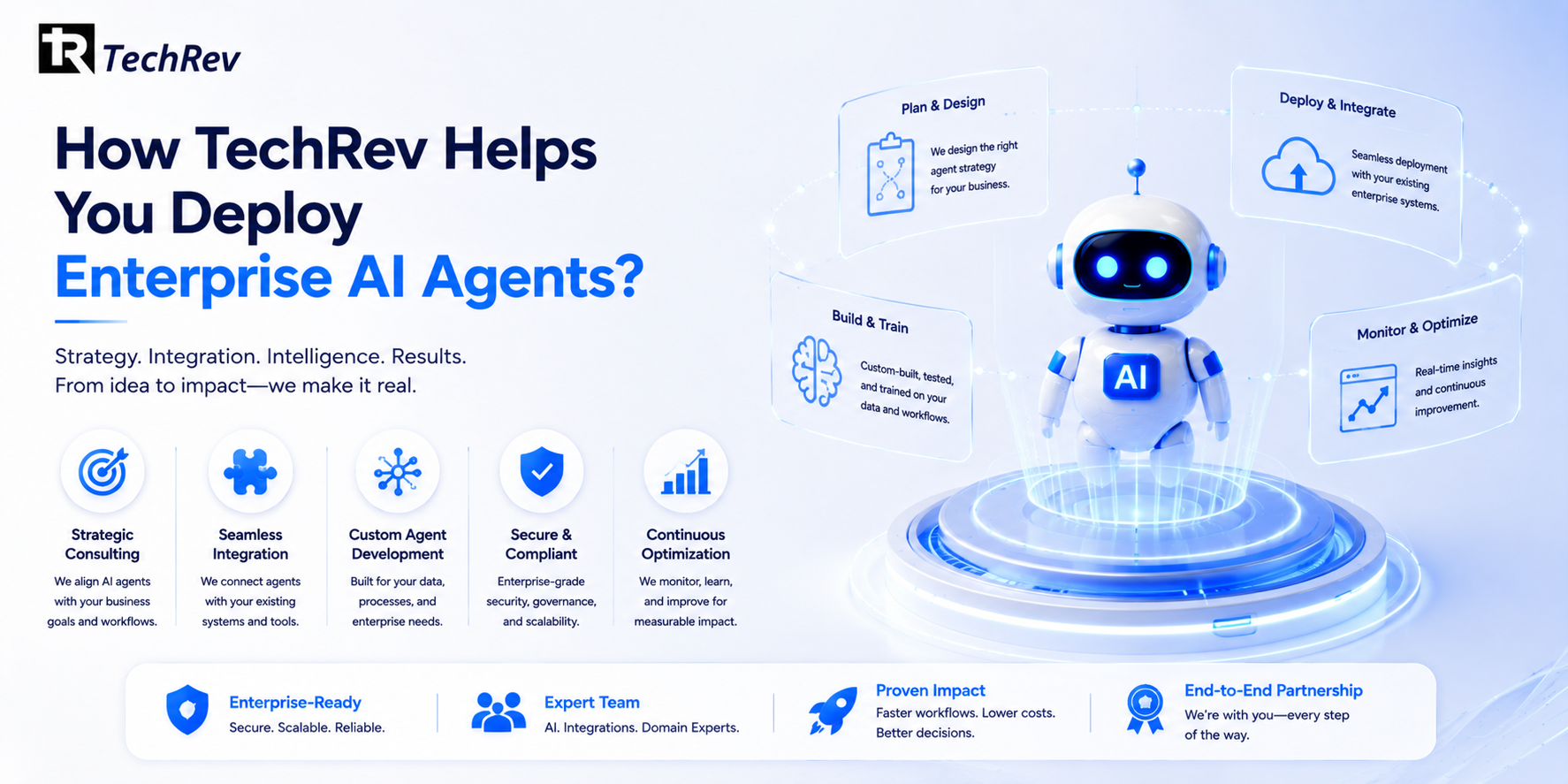
TechRev is a US-based AI development company that builds and integrates enterprise AI agents into the systems businesses already run, with deep experience in HealthTech, LegalTech, and regulated workflows.
Here is what that looks like in practice, in numbers-first terms:
Q1: What makes TechRev’s approach to AI agent development different?
Most agencies pitch a platform. TechRev starts with your workflow. We map the process, identify where an AI agent removes hours or errors, and build the agent into your existing CRM, EHR, or custom software through secure integrations.
You get automation without migration, which is typically the difference between a project measured in weeks and one measured in quarters. And because we scope MVP-first, you validate returns on one workflow before spending on ten.
Q2: Can TechRev build HIPAA compliant AI agents?
Yes. TechRev builds HIPAA compliant, SOC 2 aligned AI systems for healthcare organizations, including audit trails, access controls, and human-in-the-loop safeguards.
Q3: What results has TechRev delivered with AI automation?
For a healthcare services vendor, TechRev’s AI-powered tracking and workflow system cut installation errors by 90% and recovered billing evidence that manual processes were losing.
Q4: Does TechRev replace our existing software?
No. TechRev’s integration-first approach connects AI agents to the tools you already use, so your team keeps their workflow and you skip the cost of a rebuild.
FAQs
1. What are enterprise AI agents in simple terms?
Enterprise AI agents are software workers powered by AI that complete business tasks on their own, such as resolving support tickets, processing invoices, or updating records, while escalating exceptions to humans.
2. What is the difference between agentic AI and generative AI?
Generative AI creates content when prompted. Agentic AI uses that intelligence to take actions and complete goals across multiple steps and systems. Every AI agent uses generative AI, but not every generative AI tool is an agent.
3. How long does it take to deploy an enterprise AI agent?
A single-workflow AI agent integrated with existing systems typically deploys in 4 to 8 weeks. Multi-agent deployments with compliance requirements take longer, which is why starting with one measurable workflow is the smart play.
4. Are enterprise AI agents safe for regulated industries?
Yes, when built with guardrails: role-based access, audit logs, human approval steps for sensitive actions, and compliance frameworks like HIPAA and SOC 2 designed in from day one rather than bolted on.
5. Do AI agents replace employees?
In most 2026 deployments, AI agents absorb repetitive task volume so existing teams handle growth without new hires. The measurable outcomes are faster cycle times and fewer errors, not headcount cuts.
6. How do I know if my business is ready for AI agents?
If you have a high-volume, rules-based process that backs up regularly, and the data for it lives in systems with APIs, you are ready to pilot an enterprise AI agent.
Ready to Put an AI Agent to Work?
The companies winning with enterprise AI agents in 2026 are not the ones with the biggest budgets. They are the ones that picked one painful workflow, integrated AI into the tools they already had, and measured the results.
If that sounds like the approach you want, TechRev’s team will map your first agent workflow with you, no rebuild required. Talk to TechRev’s AI experts and find out what one AI agent could take off your team’s plate this quarter.