
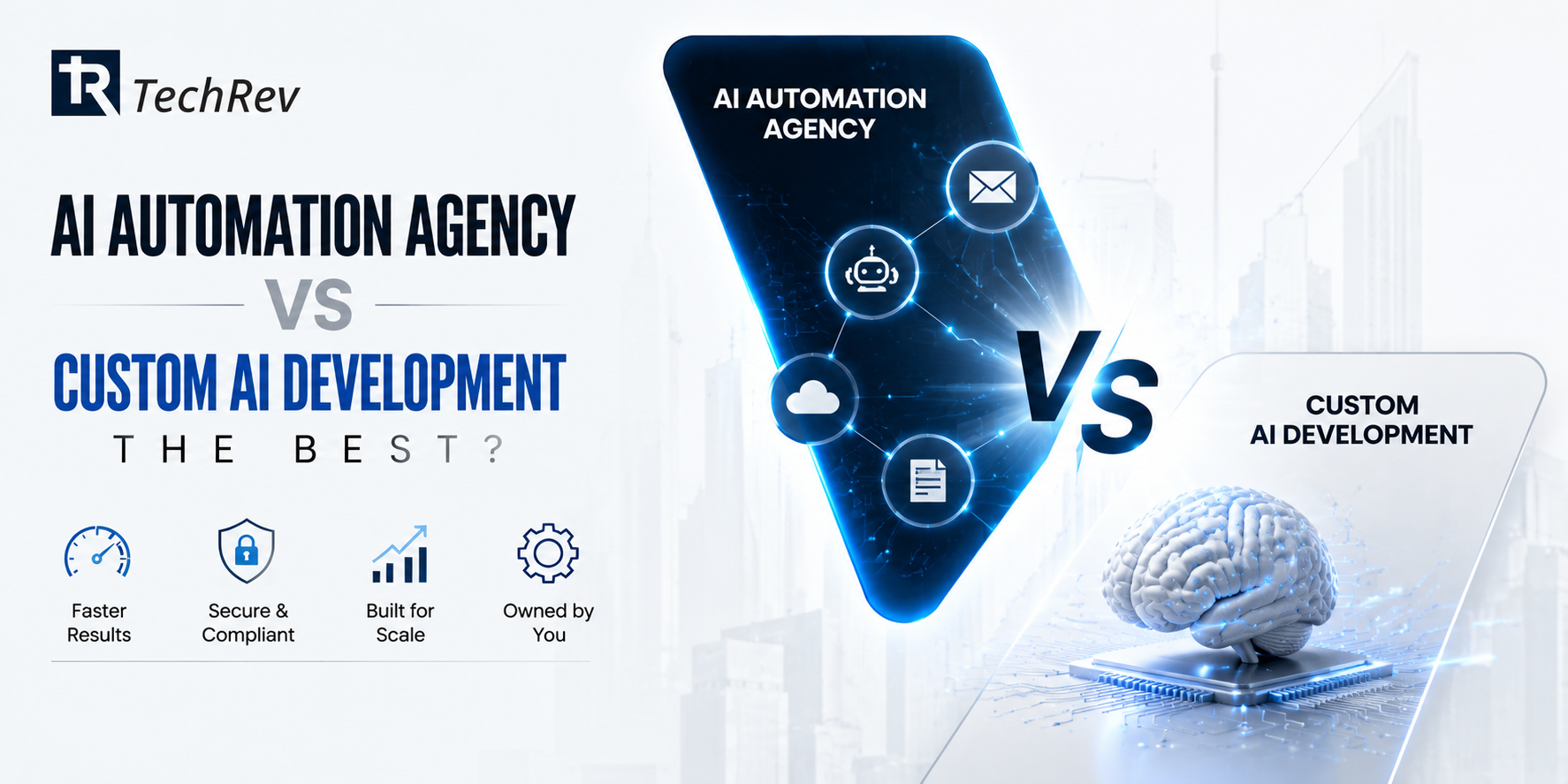
Search for an AI automation agency today and you will find thousands of them, most founded in the last two years, all promising to automate your business with AI. Meanwhile, established software firms pitch custom AI development for the same problems at very different price tags. Both camps are growing fast for the same underlying reason: according to McKinsey’s global AI survey, 78% of organizations now use AI in at least one business function, and the companies that have not started are feeling it.
So which one do you actually need? The honest answer is “it depends on what you are automating,” and this blog gives you the framework to decide: what each option really delivers, what each costs, where each fails, and the red flags to watch for on both sides.
What Is an AI Automation Agency?
An AI automation agency is a service firm that connects existing AI tools and no-code platforms to automate business workflows, typically wiring together large language models, automation platforms, and your everyday apps to handle tasks like lead follow-up, content drafting, data entry, and customer messaging. Agencies usually charge monthly retainers and deliver working automations quickly by assembling proven building blocks rather than writing software from scratch.
Think of an AI automation agency as a skilled electrician working with off-the-shelf components: fast, practical, and effective, as long as your walls are standard.
What Is Custom AI Development?
Custom AI development is building AI capability as software: AI agents development for your specific workflows, integrations built directly into your systems through APIs, and intelligence layers designed around your data, security requirements, and edge cases. (Link the “AI agents” anchor to the Enterprise AI Agents post once live.) It costs more upfront, takes longer to ship, and produces something no competitor can subscribe to: automation shaped exactly like your business.
If the agency is the electrician, custom AI development is the licensed contractor who can also move the walls.
Why Is Everyone Buying AI Automation in 2026? The Real Numbers
The demand behind both models is not hype; it is arithmetic:
- McKinsey’s research estimates that about half of all work activities are technically automatable with current technology, and that generative AI could add $2.6 to $4.4 trillion annually to the global economy.
- 78% of organizations already use AI in at least one function per McKinsey’s State of AI survey, which means AI adoption is no longer a differentiator; the quality of implementation is.
- Gartner projects that by 2028, 33% of enterprise software will include agentic AI, up from under 1% in 2024, and expects 15% of day-to-day work decisions to be made autonomously.
- The sobering counterweight: Gartner also predicts over 40% of agentic AI projects will be canceled by the end of 2027 due to cost overruns, unclear value, and weak risk controls. Whoever you hire, the failure mode is real, and it is usually a planning failure, not a technology one.
- The market for automation technologies, spanning workflow automation, business process automation, and intelligent automation platforms, is measured in the hundreds of billions of dollars per industry analysts, which is why the vendor landscape got crowded so fast.
Read those together and the pattern is clear: the winners are not the companies that “use AI.” They are the companies whose automation actually holds up in production. That is the real question behind agency vs custom.
AI Automation Agency vs Custom AI Development: The Honest Comparison
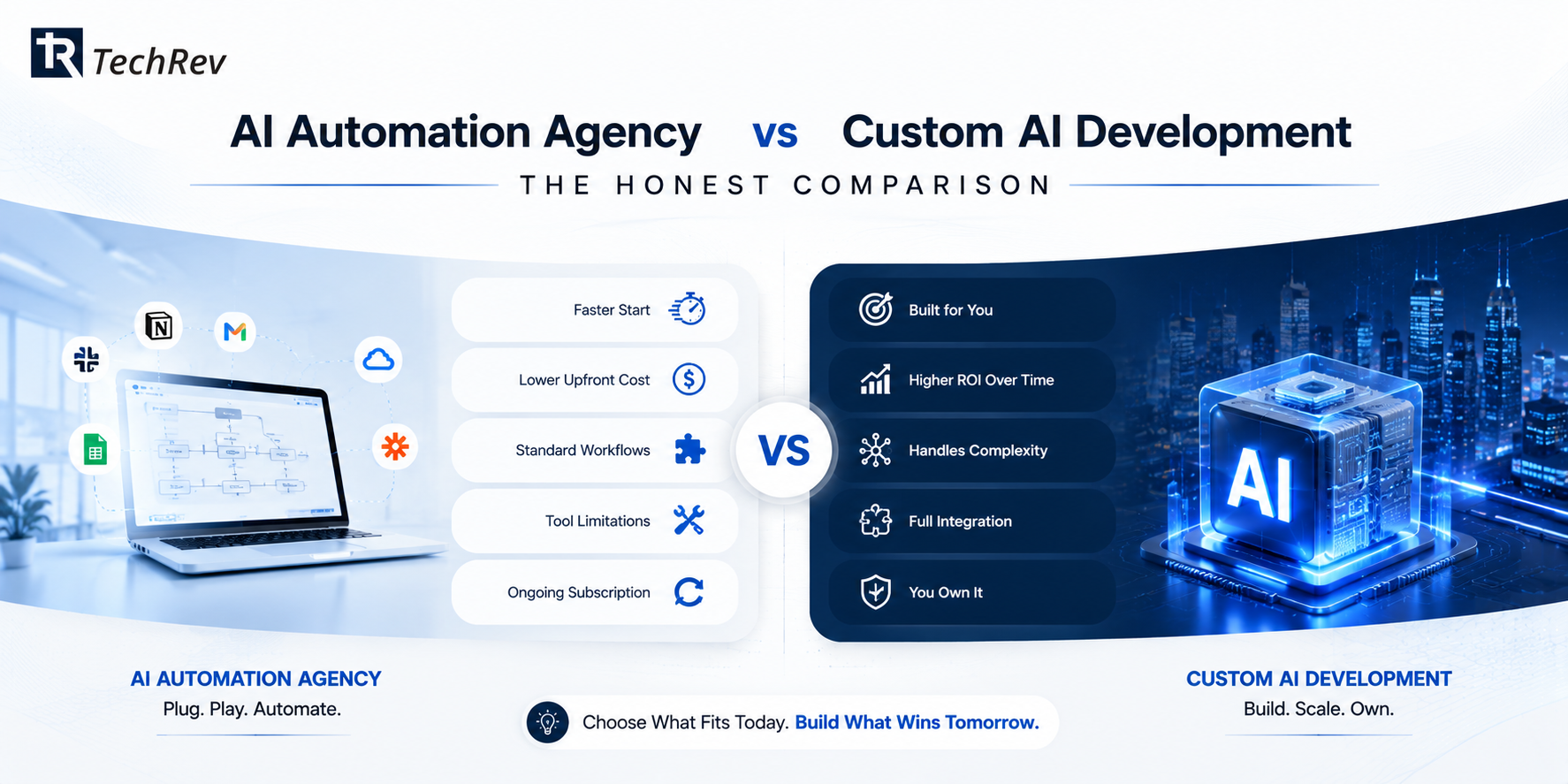
| Factor | AI Automation Agency | Custom AI Development |
| Speed to first result | Days to weeks | Weeks to months |
| Upfront cost | Low (retainer) | Higher (project) |
| Ongoing cost | Retainer plus per-tool subscriptions, forever | Hosting and maintenance |
| Fit to your workflows | Good for standard workflows | Built around your exact process |
| Handles edge cases and exceptions | Weak spot | Core strength |
| Works inside legacy or custom systems | Limited to tools with connectors | Direct API integration, including legacy systems (link to Legacy System Modernization post once live) |
| Data security and compliance | Depends on each tool in the stack | Designed in: encryption, audit trails, HIPAA/SOC 2 |
| Ownership | You rent the stack | You own the software |
| Scale economics | Costs rise with volume and seats | Costs flatten as volume grows |
| Best for | Standard workflows, fast wins, testing ideas | Regulated industries, high volume, competitive-edge workflows |
The pattern worth noticing: agencies win the first month, custom wins the third year. Which matters more depends entirely on the workflow.
Which Should You Choose? A 4-Question Framework
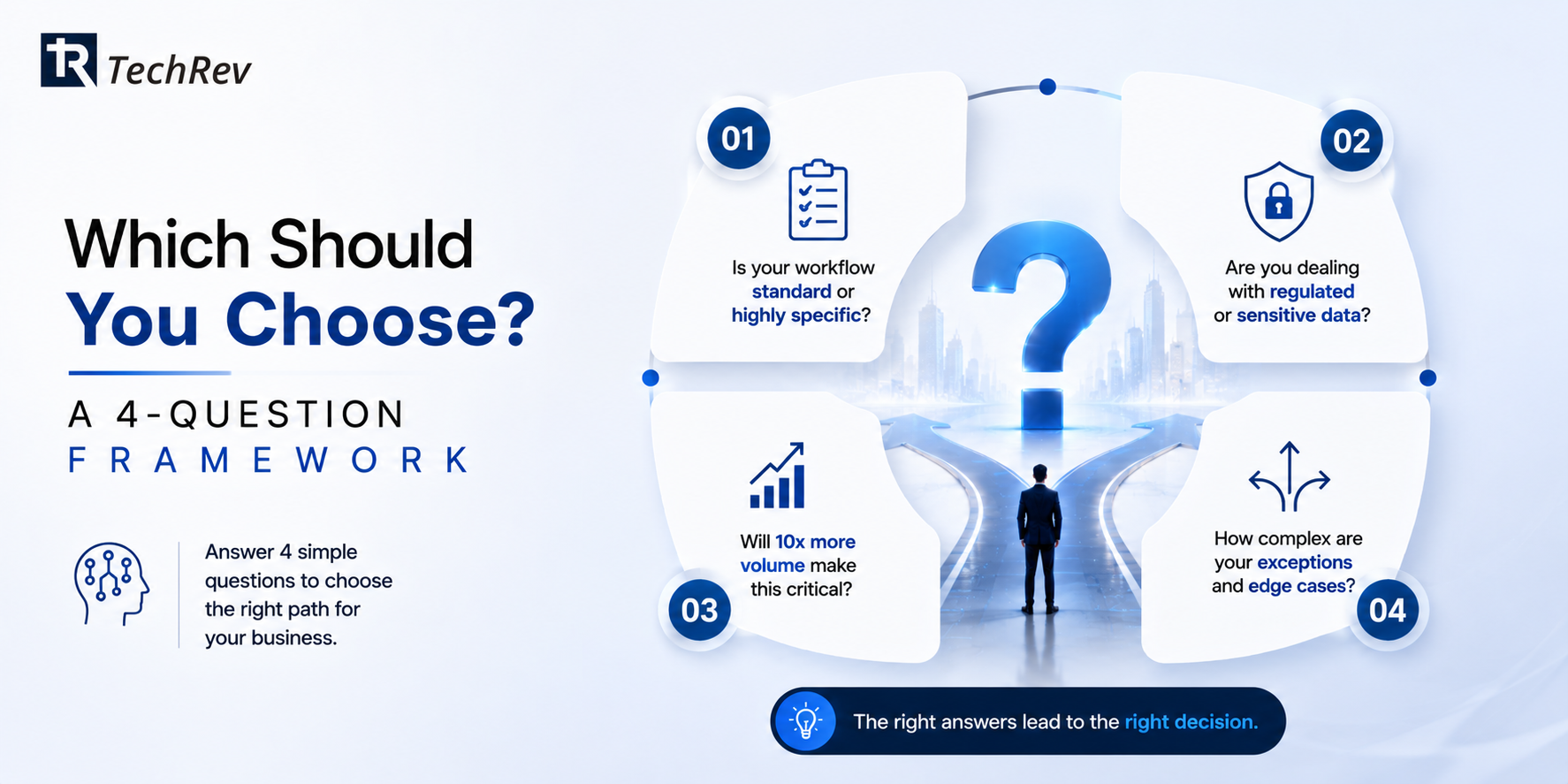
- Is the workflow standard or specific? If a hundred other businesses automate it the same way (appointment reminders, basic lead follow-up), an AI automation agency assembling proven tools is efficient. If the workflow embodies how you win (your intake logic, your pricing rules, your compliance process), custom AI development protects the edge.
- Is the data regulated? Healthcare, legal, and financial data raise the bar. Every tool in an agency’s stack is another vendor touching sensitive data. Custom builds keep data inside architecture you control, which is why regulated industries lean custom, a pattern we see constantly in AI in healthcare app development.
- What happens at 10x volume? Per-task and per-seat pricing that looks cheap at pilot scale gets expensive at production scale. Model the subscription stack at your growth number before signing.
- Does it need to survive exceptions? Demos run on happy paths. Production runs on exceptions. If a failed automation costs real money or compliance exposure, you need engineered error handling, human-in-the-loop checkpoints, and audit trails, which is custom territory.
Can You Start with an Agency and Switch to Custom Later?
Yes, and it is often the smart sequence: use agency-style automation to prove a workflow is worth automating, then rebuild the proven winner as owned software when volume, security, or edge cases outgrow the tool stack. Just avoid wiring your core operations so deeply into rented tools that switching becomes a hostage negotiation. Keep your data exportable and your process documented.
What Does Each Option Cost?
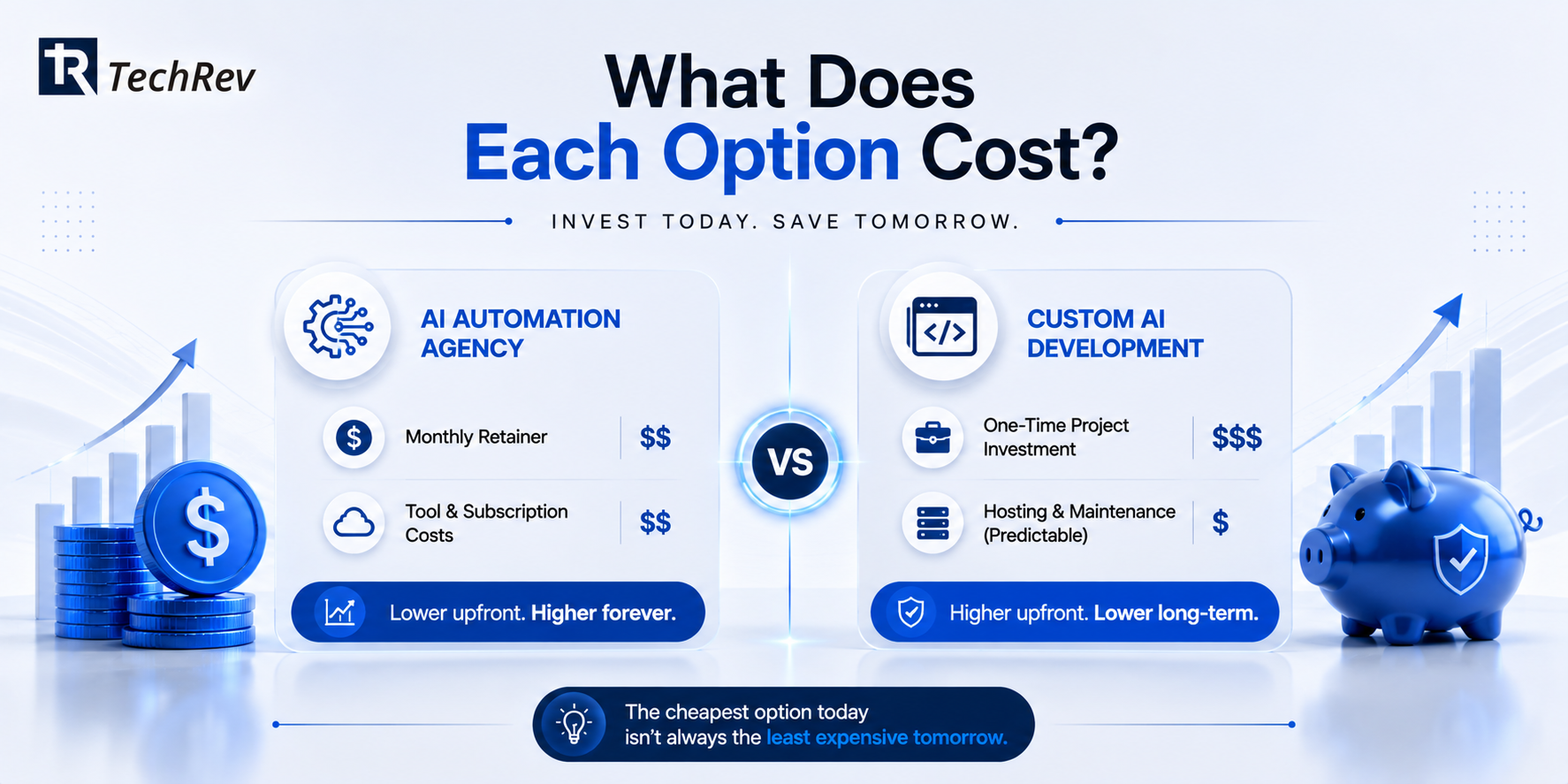
AI automation agencies typically charge monthly retainers ranging from a few thousand dollars for basic automation maintenance to five figures monthly for ongoing build-and-manage engagements, plus the underlying tool subscriptions, which commonly add hundreds to thousands per month as the stack grows. Custom generative AI development is project-based: focused single-workflow builds typically start in the mid five figures, and multi-workflow platforms with deep integrations and compliance requirements run into six figures.
The comparison that actually matters is not month one; it is the 24-month total cost against the value of the workflow. A retainer plus tool stack often crosses a custom build’s price within one to two years, and at the end of it you own nothing. Custom costs more to start and less to keep, and the asset is yours. For workflows central to revenue or compliance, ownership usually wins the math.
What Are the Red Flags When Hiring Either?
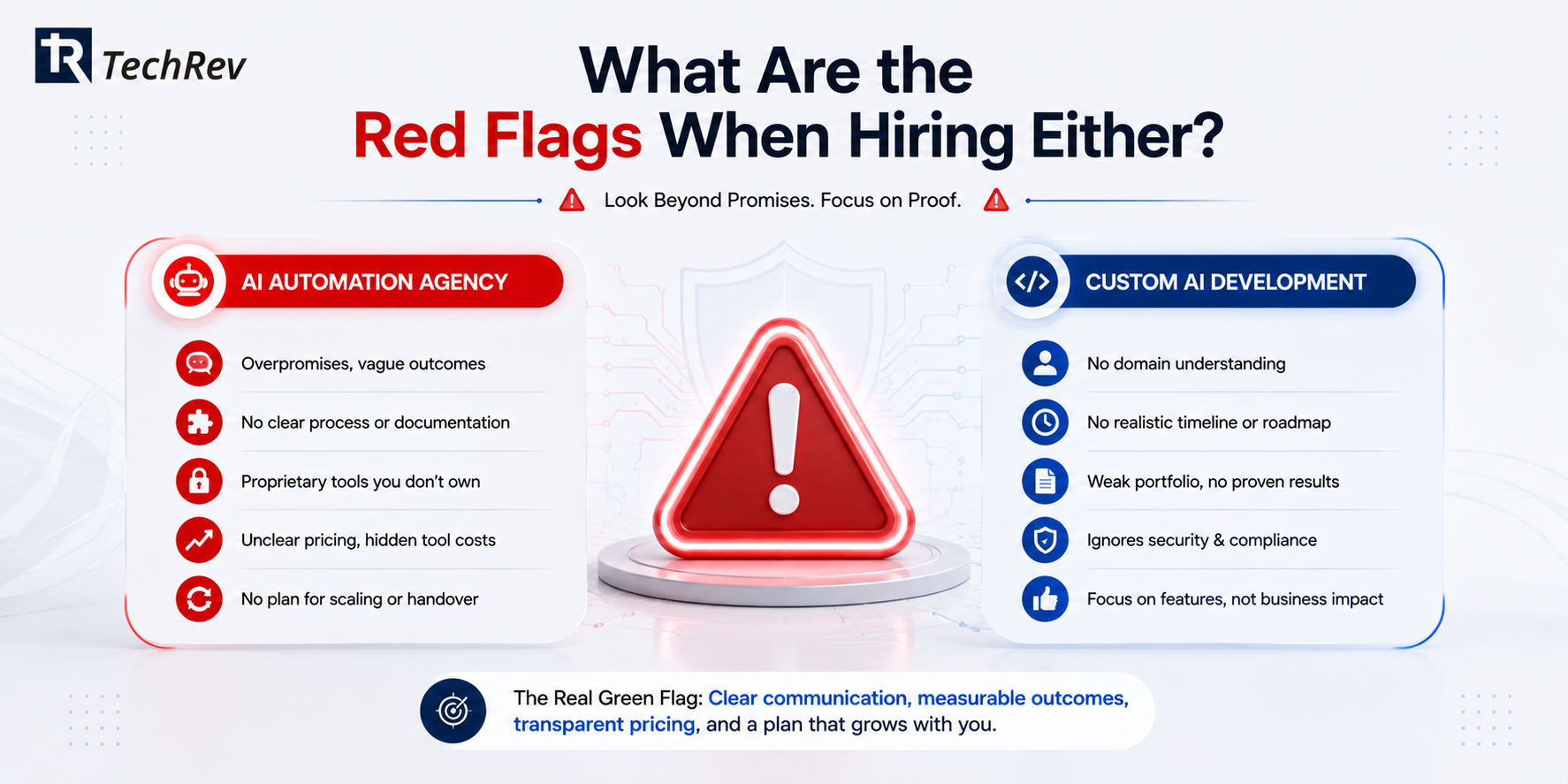
Agency red flags: guaranteed outcomes before seeing your data, no discussion of error handling or what happens when the automation fails, pricing that hides the tool subscriptions, and demo videos instead of references from businesses like yours.
Custom development red flags: a quote before workflow discovery, no compliance conversation in a regulated industry, big-bang timelines with no phased delivery, and teams that talk models instead of outcomes. Serious builders scope through MVP development, define success metrics upfront, and ship in phases.
Universal red flag: anyone who cannot tell you, in numbers, how you will know the automation worked. Remember Gartner’s 40% cancellation prediction; the canceled projects are the ones that never defined success.
How TechRev Helps You Get AI Automation That Lasts
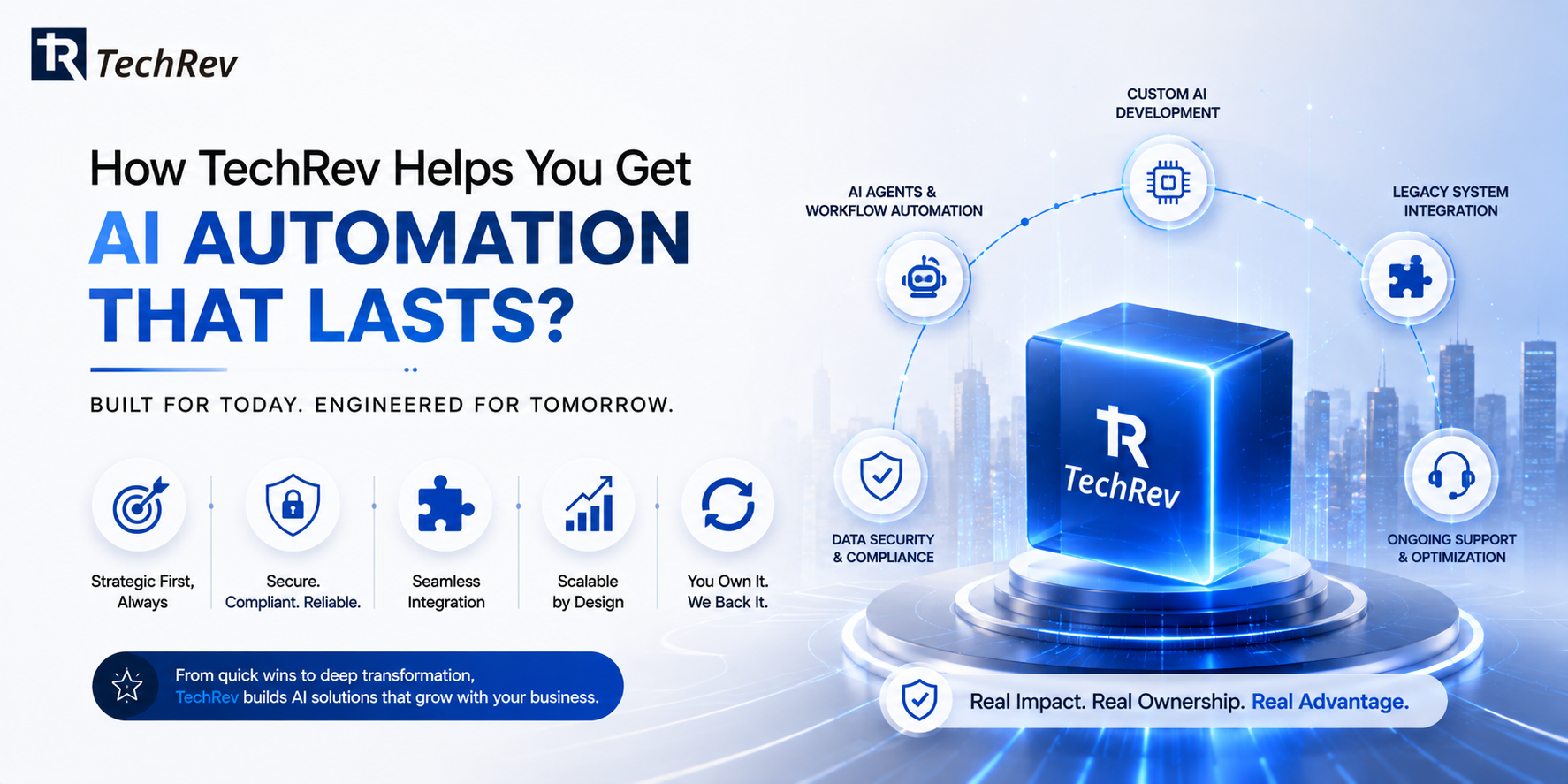
TechRev is a US-based AI development company that builds custom AI automation into the systems businesses already run: AI-powered sales and intake agents, workflow automation, and generative AI development engineered for regulated, high-volume environments.
Q1: How is TechRev different from an AI automation agency?
We build software you own, integrated directly into your systems, rather than assembling rented tool stacks. That means your automation handles your edge cases, meets HIPAA and SOC 2 requirements where needed, and stops costing more every time you grow.
We scope MVP-first, so the engagement starts like an agency (one workflow, fast, measurable) and matures like an asset: the first build proves the numbers, then the roadmap expands on evidence. You get agency speed on custom foundations, without the per-seat meter running forever.
Q2: Can TechRev work with the automation tools we already use?
Yes. Integration-first means exactly that: we connect custom AI to your existing platforms and tools through APIs, replacing only what limits you and keeping what works.
Q3: Does TechRev build AI automation for regulated industries?
Yes. TechRev builds HIPAA compliant, SOC 2 aligned automation with encryption, audit trails, and human-in-the-loop controls, the requirements agency tool stacks typically cannot certify end to end.
Q4: What measurable automation results has TechRev delivered?
For a hospital services vendor, TechRev’s AI-powered workflow and tracking system cut installation errors by 90% and recovered billing evidence that manual processes kept losing.
Conclusion
The AI automation agency boom and the custom AI development market are answering the same demand from different directions, and both have a legitimate place. Rent the automation for standard workflows and fast experiments. Own the automation that runs your revenue, touches regulated data, or encodes how you win.
If your highest-value workflow deserves better than a tool stack, talk to TechRev’s AI team. We will map the workflow, define the success numbers with you, and scope a first build that has to prove itself before you fund the rest.
FAQs About AI Automation Agencies and Custom AI Development
1. What does an AI automation agency actually do?
An AI automation agency designs and maintains automated workflows using existing AI tools and no-code platforms: connecting your apps, configuring AI models for tasks like drafting replies or qualifying leads, and managing the stack for a monthly retainer. The work is assembly and orchestration rather than software engineering.
2. Is an AI automation agency worth it for a small business?
Often yes, for standard workflows: fast setup, low upfront cost, and quick wins on tasks like follow-up and scheduling. The value fades when workflows are unusual, data is sensitive, or per-tool costs stack up with growth. That is the switch point to custom.
3. How much does an AI automation agency cost per month?
Typical retainers run from a few thousand dollars monthly for maintenance-level service to five figures for ongoing build engagements, plus underlying tool subscriptions. Always price the full stack, not just the retainer.
4. What is the difference between AI automation services and AI consulting services?
AI consulting services advise: strategy, feasibility, roadmaps. AI automation services implement: working automations in production. Many businesses need a short consulting phase to pick the right workflows, then an implementation partner to build them. Beware of engagements that never leave the slide deck.
5. When does custom AI development beat an agency?
When the workflow is high-volume, regulated, exception-heavy, or competitively distinctive. Those four conditions are where rented tool stacks strain and owned, integrated software pays for itself, typically within one to two years against equivalent retainer costs.
6. How do I measure whether AI automation is working?
Pick the workflow’s native numbers before you build: tickets resolved without humans, response time, error rate, hours saved, cost per transaction. Review weekly. Automation without metrics is how projects join Gartner’s 40% cancellation statistic.