

The AI medical scribe is the first AI technology American physicians actually asked for, because it attacks the exact thing driving them out of medicine. Time-motion research in the Annals of Internal Medicine famously found physicians spending nearly 2 hours on EHR and desk work for every 1 hour of direct patient care, AMA survey data has tracked physician burnout hovering around half the profession in recent years, and separate Annals research estimated burnout-driven turnover and reduced hours cost the US system roughly $4.6 billion a year.
Against that backdrop, ambient AI documentation spread faster than any clinical AI before it: The Permanente Medical Group rolled AI scribes out across thousands of physicians in one of medicine’s largest AI deployments, with published evaluations reporting less time in notes and improved physician experience.
This blog covers the whole territory: what an AI medical scribe is, how it works, accuracy and safety, AI versus human scribes, real costs, and when a healthcare organization should build custom software development AI instead of subscribing.
What Is an AI Medical Scribe?
An AI medical scribe is software that listens to the clinical visit (with patient consent), transcribes and understands the conversation, and drafts the clinical note, history, exam, assessment, and plan, directly into the EHR for the clinician to review and sign.
Modern versions are “ambient”: no dictation, no commands, just the natural visit conversation converted into structured clinical documentation.
The one-line version: the physician talks to the patient instead of the keyboard, and the note writes its first draft itself.
Also Read – 15 Agentic AI Use Cases Transforming Business in 2026
AI Medical Scribe Stats: The Documentation Crisis in Numbers
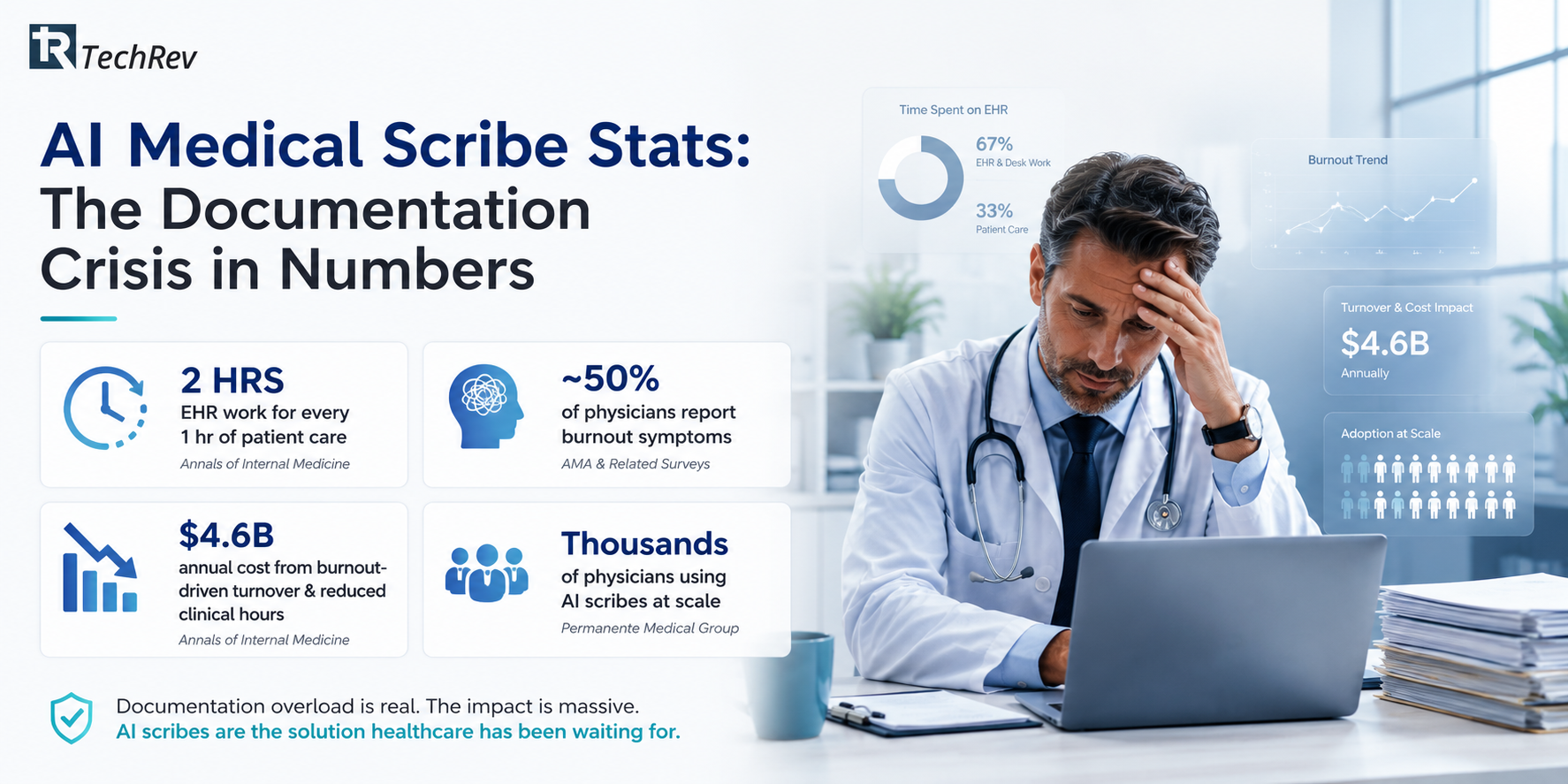
- 2 hours of EHR work per 1 hour of patient care (Annals of Internal Medicine time-motion research), plus the after-hours that turned documentation into an evening job.
- Roughly half of US physicians report burnout symptoms in AMA and related survey research, with documentation burden consistently cited among the top drivers.
- ~$4.6 billion annually in burnout-attributable turnover and reduced clinical hours, per research published in Annals of Internal Medicine, before counting the human cost.
- Deployment at scale is already here. The Permanente Medical Group’s ambient AI scribe rollout reached thousands of physicians with published evaluations reporting reduced note time and better work experience, and health systems nationwide followed.
- The market moved accordingly. Ambient clinical intelligence has become one of health tech’s fastest-growing categories, with the broader clinical documentation market measured in the billions of dollars, and buyer intent priced to match: best-AI-scribe searches carry CPCs above $15.
The strategic read: documentation was the beachhead where clinicians learned to trust AI. That trust is now the foundation for every other workflow in the AI in healthcare stack.
Also Read – How AI in Healthcare Sorts 80+ Items in Under 3 Minutes?
How Does an AI Medical Scribe Work?
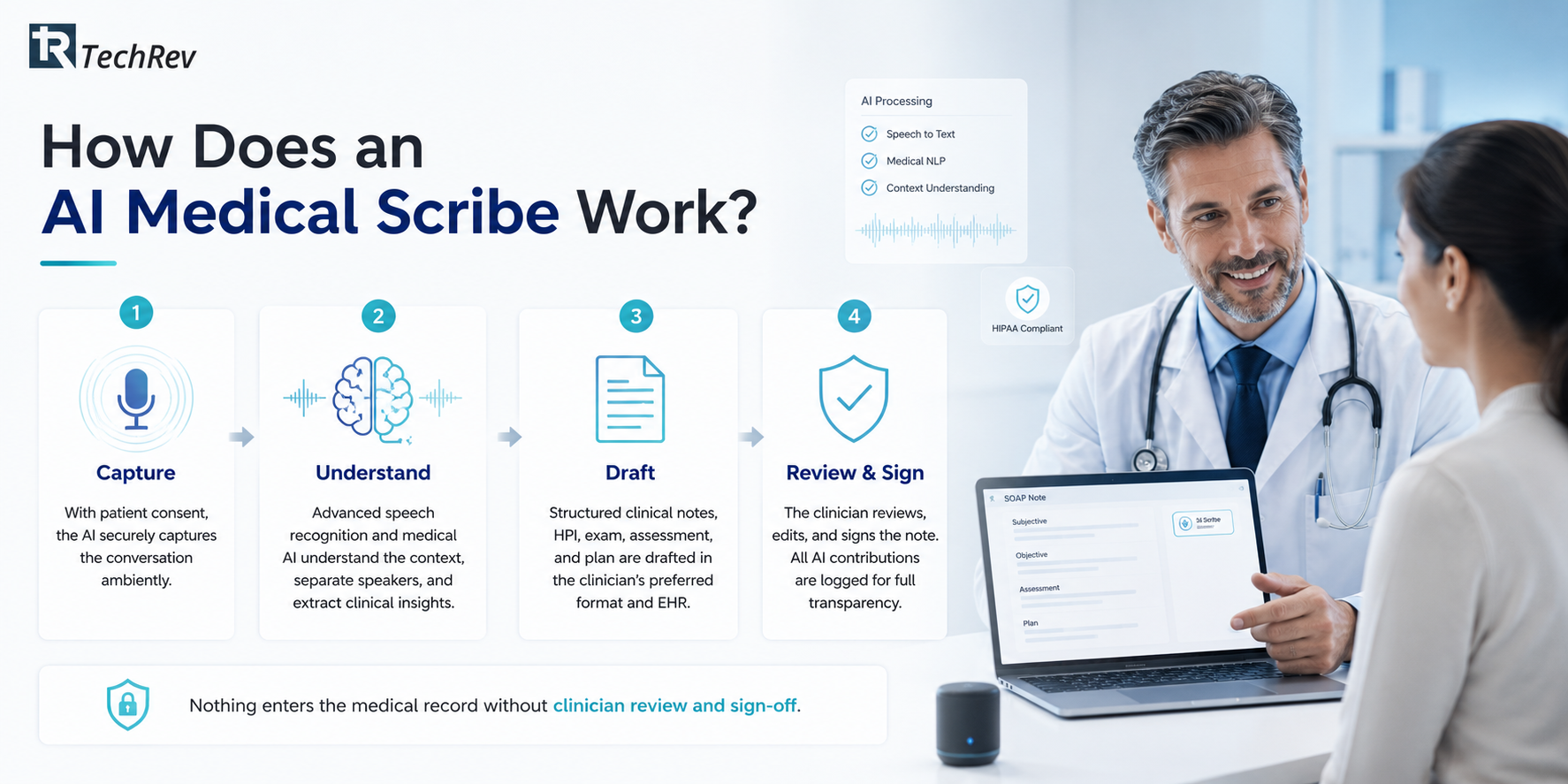
An AI medical scribe works in four steps: it captures the visit audio ambiently with consent; understands the conversation using speech recognition plus medical language models that separate speakers, filter small talk, and identify clinical content; drafts a structured note in the clinician’s format, pulling relevant context from the chart; and routes for review, where the clinician edits and signs, with every AI contribution logged. Nothing enters the record without clinician sign-off.
Two engineering details separate good scribes from demos: EHR integration depth, so drafts land in the right note sections of the systems covered in our EHR software development guide, and specialty tuning, because a cardiology visit and a therapy session need different ears.
AI Medical Scribe vs Human Scribe vs Dictation
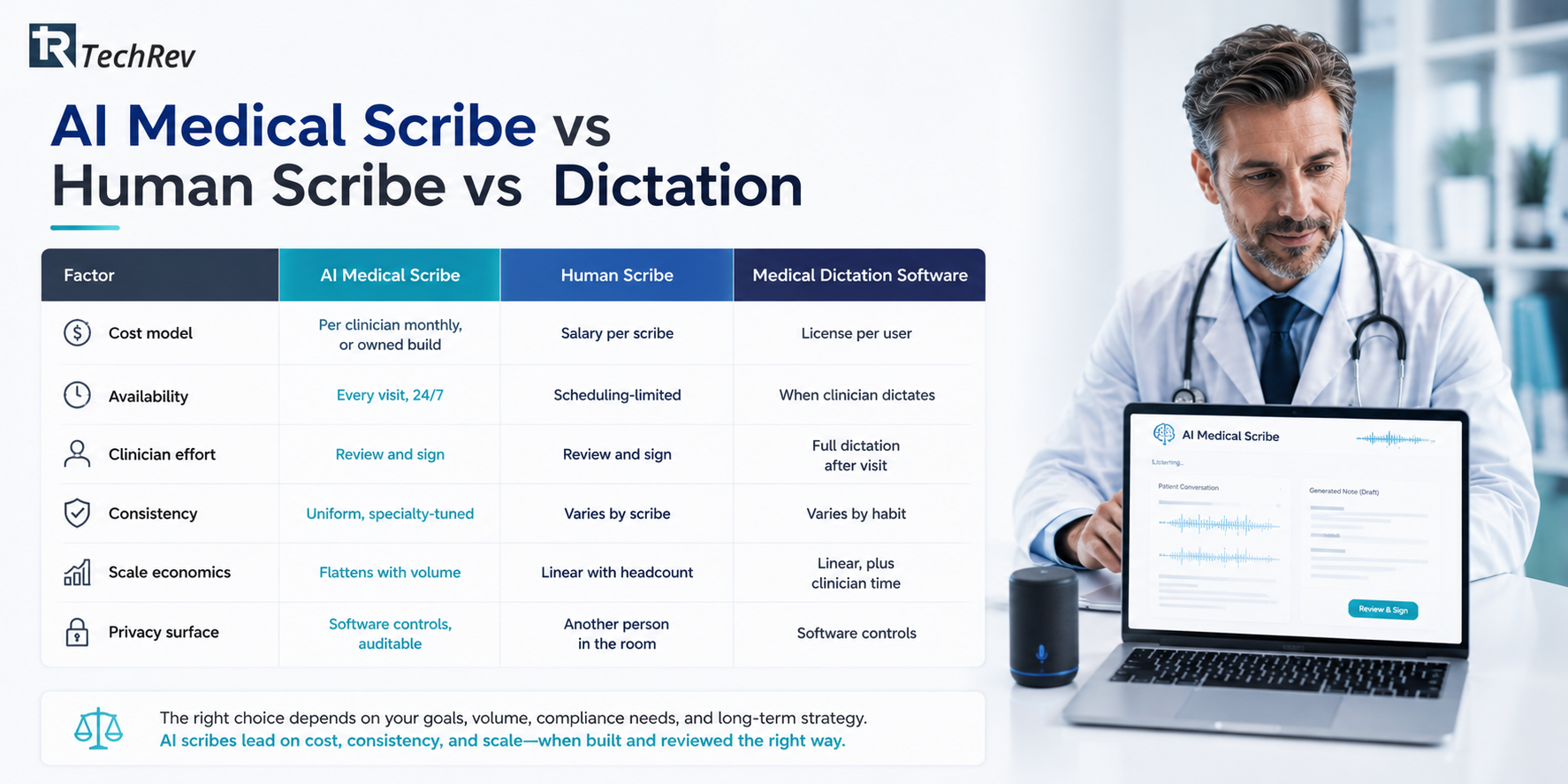
| Factor | AI Medical Scribe | Human Scribe | Medical Dictation Software |
| Cost model | Per clinician monthly, or owned build | Salary per scribe | License per user |
| Availability | Every visit, 24/7 | Scheduling-limited | When clinician dictates |
| Clinician effort | Review and sign | Review and sign | Full dictation after visit |
| Consistency | Uniform, specialty-tuned | Varies by scribe | Varies by habit |
| Scale economics | Flattens with volume | Linear with headcount | Linear, plus clinician time |
| Privacy surface | Software controls, auditable | Another person in the room | Software controls |
The honest summary: dictation still makes the clinician do the work after hours, human scribes work well but cannot scale or standardize, and the AI scribe wins on economics and consistency, provided the review discipline and privacy architecture are real.
Are AI Medical Scribes Accurate and Safe?
Accurate enough to draft, not to sign: published deployments and health-system evaluations consistently position AI scribes as first-draft tools with mandatory clinician review, which is both the safety model and the regulatory posture.
The real safety questions are architectural: patient consent workflows, HIPAA-grade handling of audio and notes, BAA-covered AI services, and audit trails of AI contributions, the same requirements detailed in our HIPAA compliant app development checklist.
Organizations that get those right report the technology’s failure mode is an editable imperfect draft; organizations that skip them have a compliance problem wearing a productivity costume.
Also Read – NLP in Healthcare: 8 Real Use Cases Transforming Patient Care
Where AI Scribes Deliver: Top Use Cases
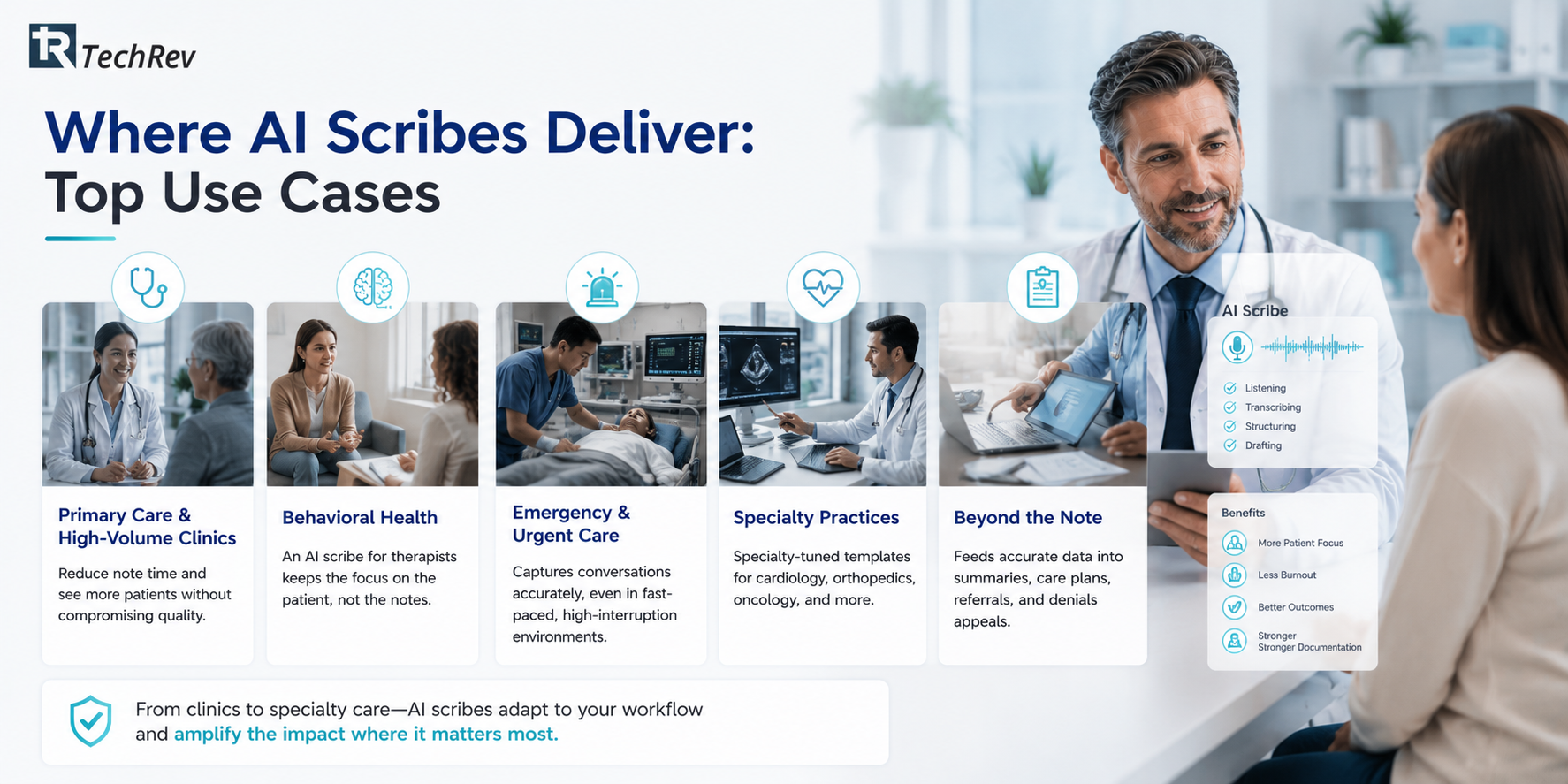
- Primary care and high-volume clinics, where note volume makes the per-visit minutes compound fastest
- Behavioral health, where an AI scribe for therapists removes the impossible choice between eye contact and notes, with session documentation drafted for review
- Emergency and urgent care, where ambient capture survives interruptions that defeat dictation
- Specialty practices, with tuned templates for cardiology, orthopedics, oncology, and beyond
- Beyond the note: the same ambient pipeline increasingly drafts after-visit summaries, referral letters, and coding suggestions, and feeds structured data to remote patient monitoring and care-gap workflows, which is where documentation AI becomes operations AI.
Buy an AI Scribe or Build Custom Clinical Documentation AI?
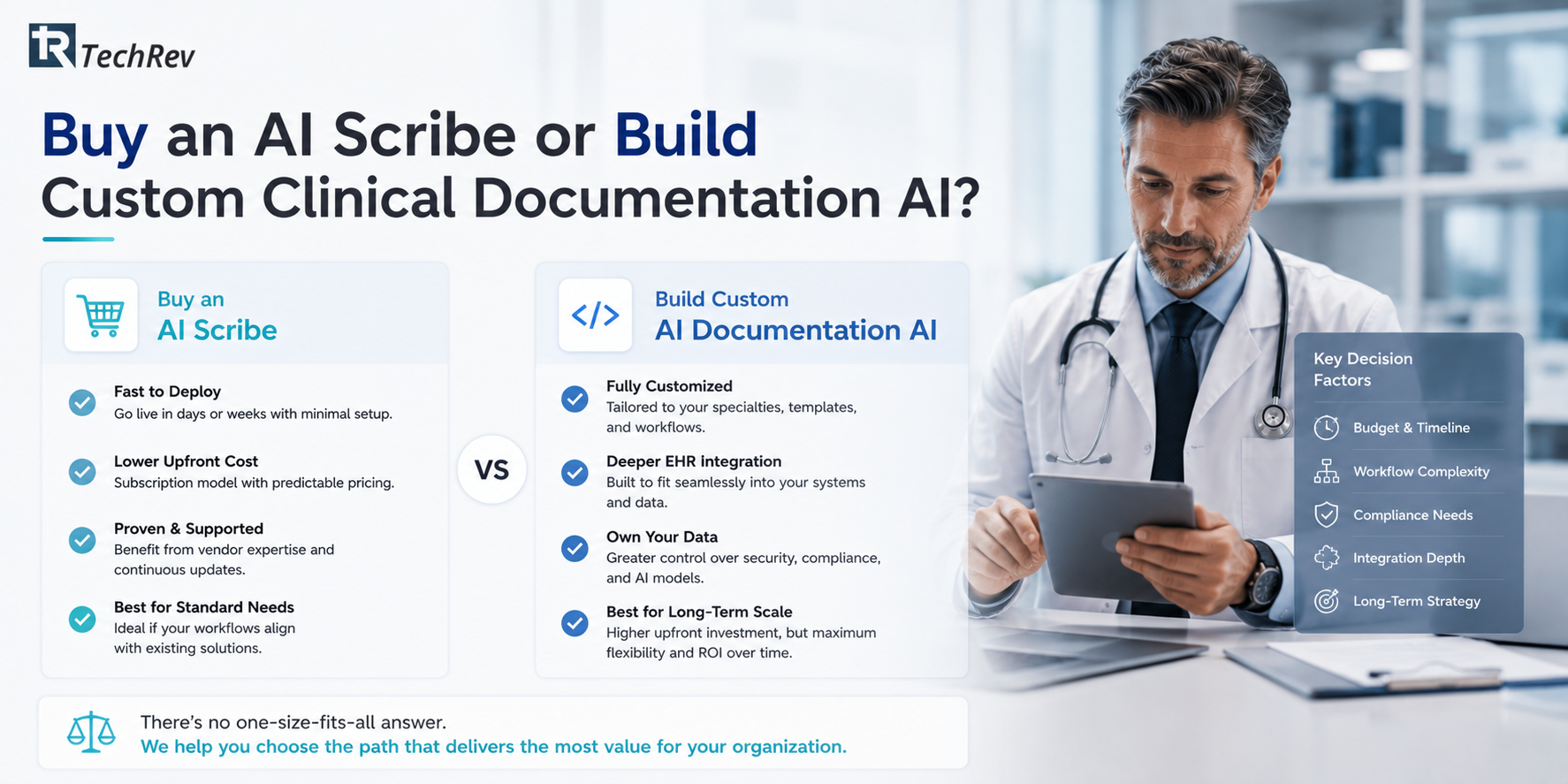
Subscribing to an established AI scribe is the right call for most practices: proven products, fast deployment, per-clinician pricing.
Building custom clinical documentation AI makes sense in four situations: healthcare software companies adding documentation capability to their own product, where subscribing is not an option and the feature is the roadmap; health systems and vendors at volume, where per-clinician-per-month pricing across hundreds of users outruns an owned build; specialty and workflow depth the general products do not serve, from niche specialties to multilingual populations to vendor-specific operations documentation; and data control mandates, where audio and notes must stay inside architecture the organization controls end to end.
The build path runs on the integration-first pattern: ambient capture and medical language models grounded in your templates and workflows, wired into your EHR through APIs, with consent, logging, and human review engineered in, the approach behind our AI integration services methodology.
How Much Does an AI Medical Scribe Cost?
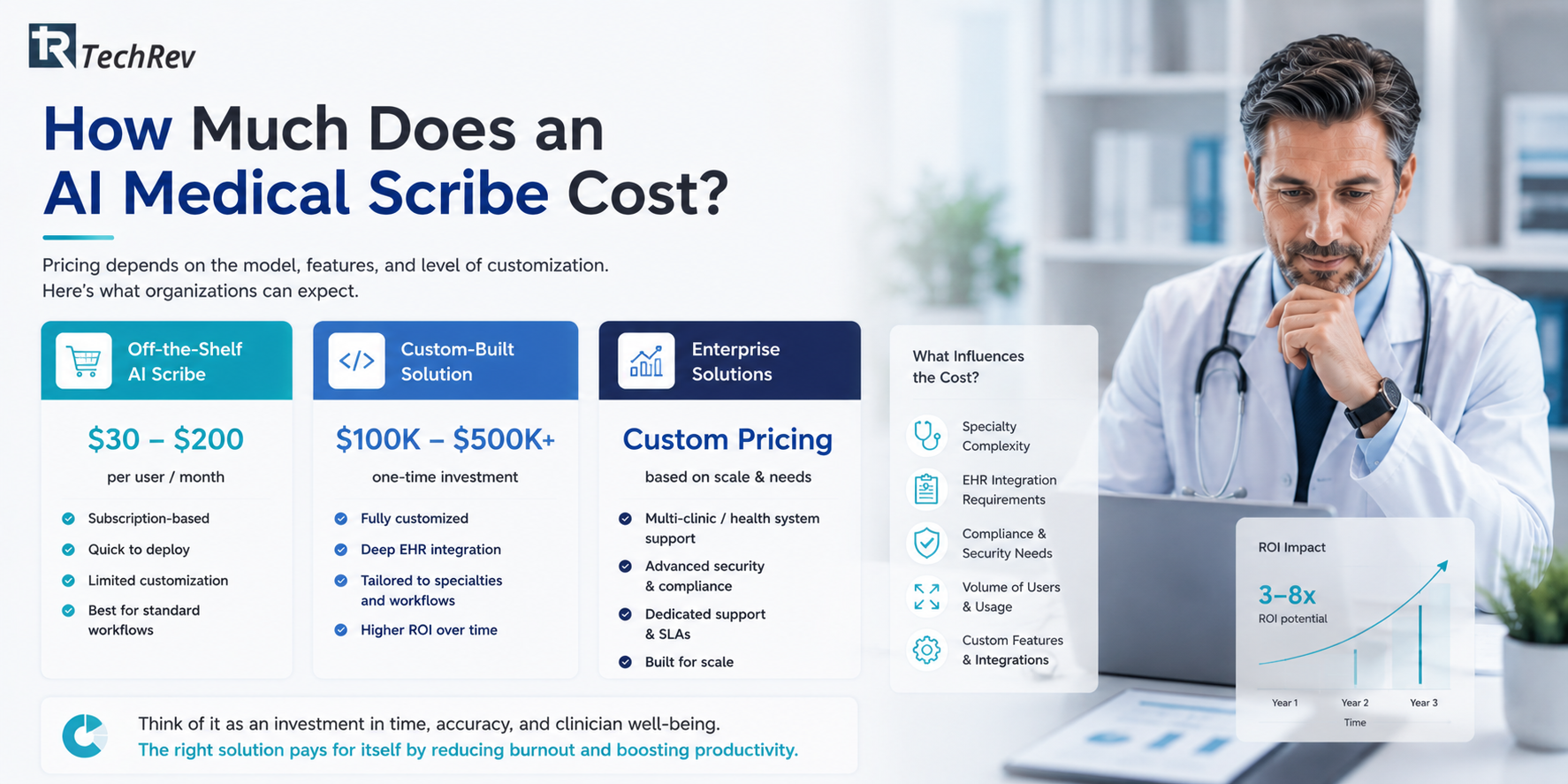
Commercial AI medical scribes typically run from roughly $100 to $600 per clinician per month depending on tier and specialty features, often undercutting a human scribe’s salary many times over.
Custom clinical documentation AI typically starts in the high five to low six figures for a focused build (one specialty’s workflows, EHR integration, consent and audit architecture), with 15 to 25% of build cost annually in model usage, hosting, and maintenance, and per-visit economics engineered at design time.
The comparison that decides it: at small clinician counts, subscribe. As counts grow, multiply the monthly per-clinician price across your roster and years, and run it against the owned-build line, which flattens while subscriptions compound. Healthcare app development companies face a different math entirely: documentation capability in the product is an asset, and renting the core of your own roadmap rarely survives diligence.
Also Read – 7 Questions to Ask a Healthcare Software Development Company
How TechRev Builds Custom AI Medical Documentation?
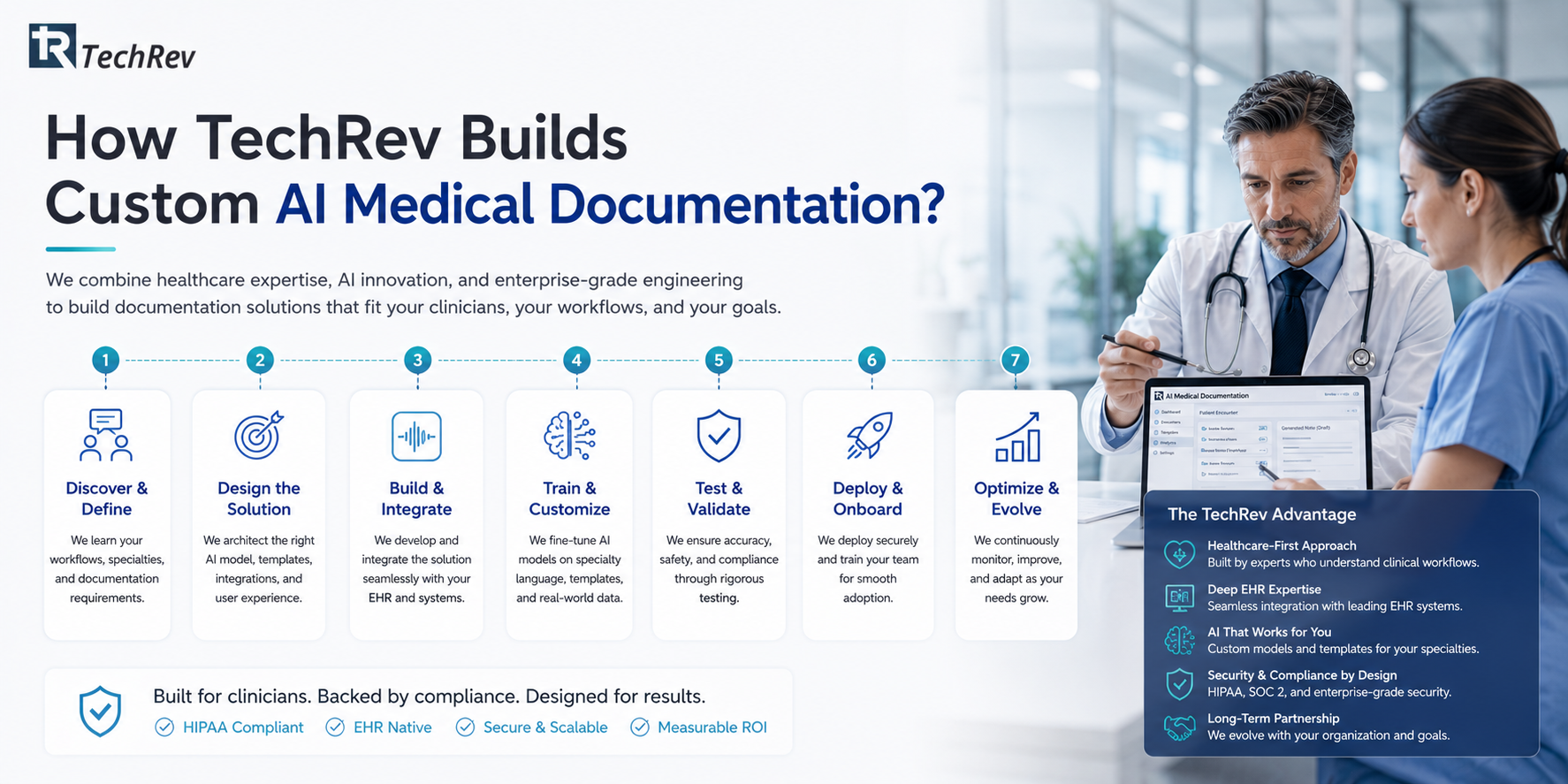
TechRev is a US-based healthcare AI development company that builds HIPAA compliant clinical documentation AI and ambient workflows into the products and systems healthcare organizations already run, with the consent, logging, and review architecture designed in from day one.
Q1: What does TechRev build in a custom clinical documentation project?
The full pipeline: ambient or dictated capture with consent workflows, medical speech and language processing tuned to your specialty and templates, structured note drafting into your EHR through FHIR and API integration, coding and summary outputs where wanted, and the governance layer (BAA-covered services, encryption, audit trails of every AI contribution, mandatory clinician sign-off).
We scope through MVP development: one specialty, one note type, minutes-per-note measured before and after, so the documentation AI proves its time savings before the roadmap expands. It is the same compliance-first architecture we bring to all our healthcare builds, applied to the workflow physicians care about most.
Q2: Can TechRev add AI scribe capability to our healthcare product?
Yes. For healthcare software companies, we build documentation AI as a native product capability you own, integrated with your data model and priced into your margins rather than rented per seat.
Q3: Is TechRev’s documentation AI HIPAA compliant?
Yes. Audio, transcripts, and notes are handled under HIPAA discipline: BAA-covered services, encryption in transit and at rest, role-based access, consent capture, and immutable audit logs.
Q4: What measurable results has TechRev delivered in healthcare operations?
For a hospital services vendor, TechRev’s AI-powered workflow system cut installation errors by 90% and recovered billing evidence manual documentation kept losing.
Conclusion
Two hours of screens per hour of patients, half the profession burning out, billions lost to turnover, and a technology that hands evenings back: the AI medical scribe earned its adoption curve honestly, and the published large-scale deployments settled the “does it work” question. What remains in 2026 is the ownership question, subscribe per clinician forever, or build documentation AI into the systems and products you own.
If you are a health system running volume math or a healthcare software company whose roadmap needs a documentation brain, talk to TechRev’s healthcare AI team. We will map the specialty and workflows, scope the build against your subscription math, and put minutes-per-note numbers on it before you commit.
FAQs
1. What is the best AI medical scribe?
For most practices, the best AI medical scribe is an established commercial product matched to their specialty and EHR; for health systems at volume and healthcare software companies, the best answer is increasingly custom documentation AI they own, tuned to their workflows and economics.
2. How does an AI medical scribe work with the EHR?
Through integration: the scribe drafts into the correct note sections, pulls chart context, and files structured data via EHR APIs. Integration depth is the single biggest quality difference between products, and the first question to ask any vendor or builder.
3. Do patients have to consent to an AI scribe?
Yes. Consent capture is standard practice and, in recording-consent states, a legal requirement. Well-built systems make consent a logged workflow step, and clinicians report patients overwhelmingly accept it, especially when told the screen is no longer competing for attention.
4. Can AI scribes work for therapists and behavioral health?
Yes, with specialty tuning: session-appropriate note formats, careful handling of sensitive content, and documentation drafted for clinician review. Behavioral health is among the fastest-adopting specialties because the eye-contact-versus-notes tradeoff is most painful there.
5. How accurate is medical transcription with AI?
Modern medical speech recognition performs at draft-quality accuracy across most specialties, with errors concentrated in medication names, numbers, and heavy-accent or noisy environments, exactly why clinician review before signing is the universal deployment model.
6. Will AI scribes replace human medical scribes?
Largely, for the transcription function: the economics and availability gap is decisive. The human roles that persist move up the stack, into review support, template governance, and documentation quality programs that the AI pipeline makes measurable.