
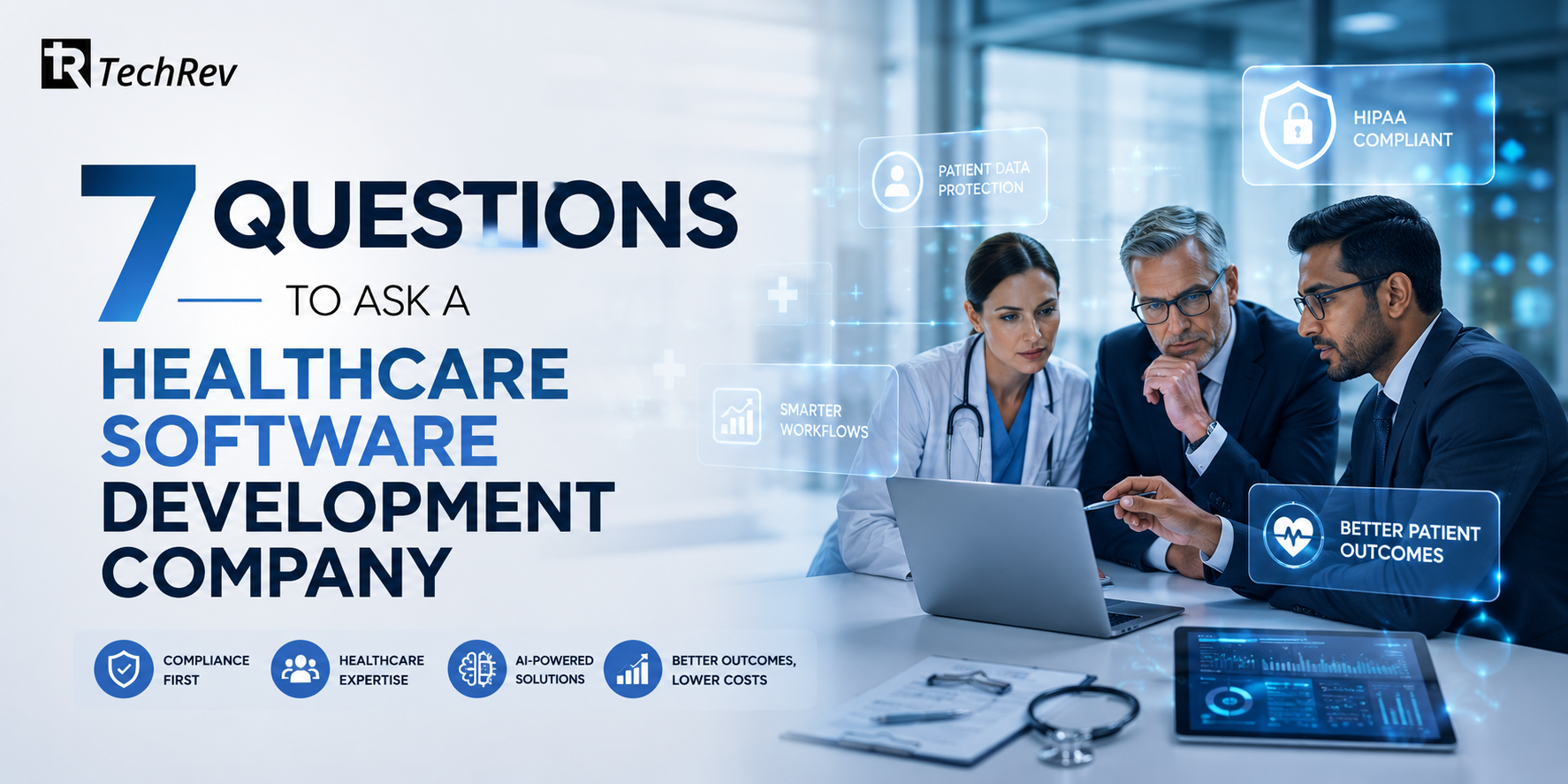
What happens if you hire the wrong healthcare software development company? You lose money, sure. But in healthcare, the damage runs deeper. A poorly built app can leak patient data, break clinical workflows, and put your organization on the wrong side of HIPAA. That is not a risk any hospital, clinic, or health tech startup can afford to take.
Here is the thing, though. Most decision makers do not know what to ask before signing a contract. They compare portfolios, look at pricing, maybe check a few reviews, and then hope for the best.
Hope is not a strategy. Questions are.
The stakes have never been higher. The global AI in healthcare market was valued at 36.7 billion dollars in 2025 and is expected to reach 50.7 billion dollars in 2026, with North America holding a dominant 54 percent revenue share. In the US alone, 63 percent of physicians reported using AI tools by early 2026, up from 47 percent just nine months earlier. Every serious healthcare organization is either building software or falling behind those who are.
So before you shortlist vendors, print out these seven questions. They will save you from the expensive mistakes that most buyers only discover six months too late.
Why Choosing the Right Healthcare Software Development Company Matters?
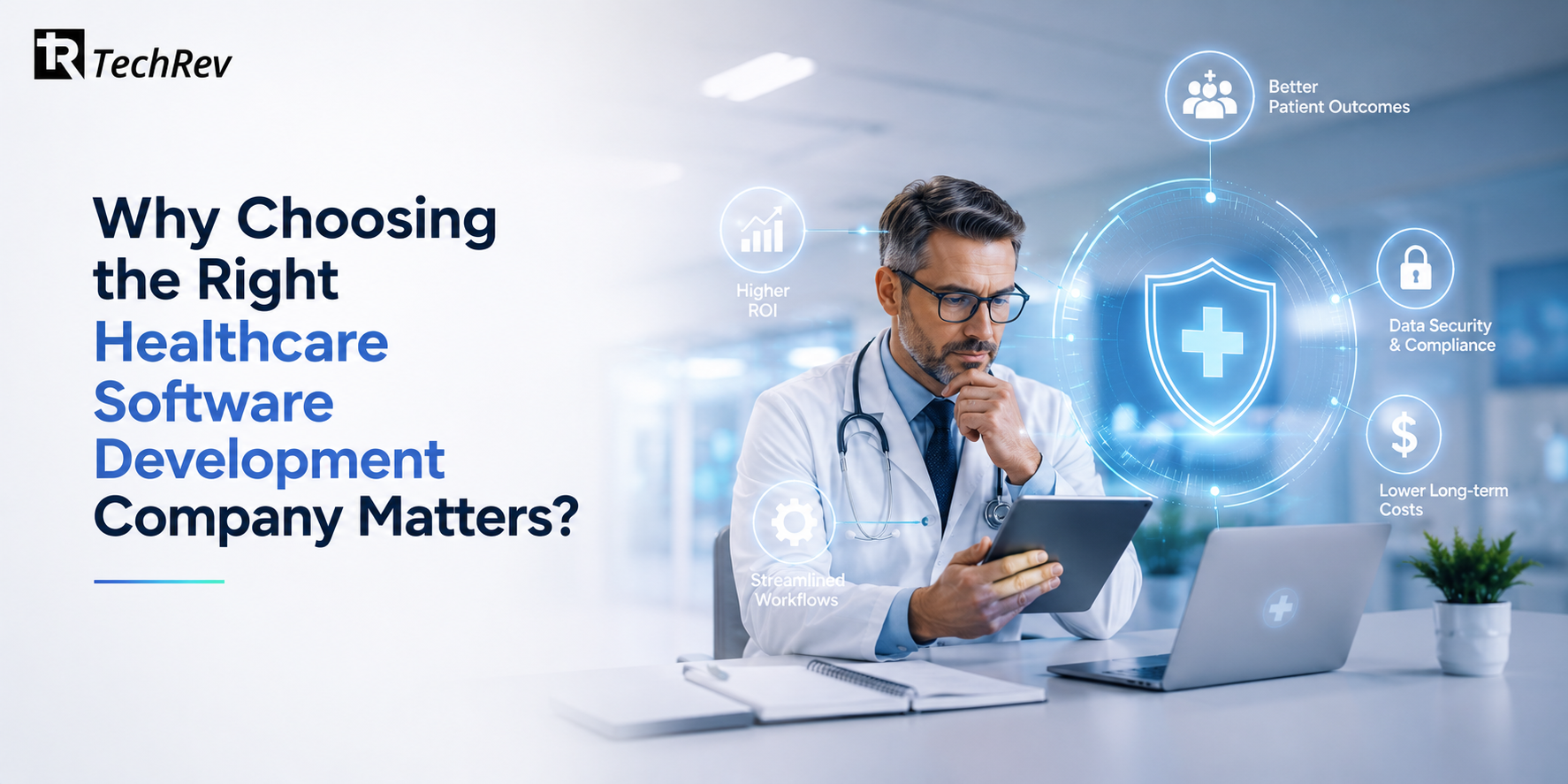
A healthcare software development company is not just a vendor. It becomes a custodian of protected health information, a partner in patient safety, and often the technical backbone of your entire operation.
1. Get it right, and the Numbers Work Strongly in Your Favor.
Research shows healthcare organizations see an average return of 3.20 dollars for every 1 dollar invested in AI, with typical payback in about 14 months. Hospitals using AI documentation tools have cut physician charting time by roughly 40 to 45 percent.
2. Get it wrong, and The Costs Are Brutal
Healthcare has been the most expensive industry for data breaches for 14 consecutive years, with an average breach cost of 7.42 million dollars in 2025. Healthcare breaches also take the longest to detect and contain, an average of 279 days.
That gap between success and failure usually comes down to the questions you ask before the contract is signed. Let’s get into them.
Question 1: Do You Have Real Healthcare Domain Experience?
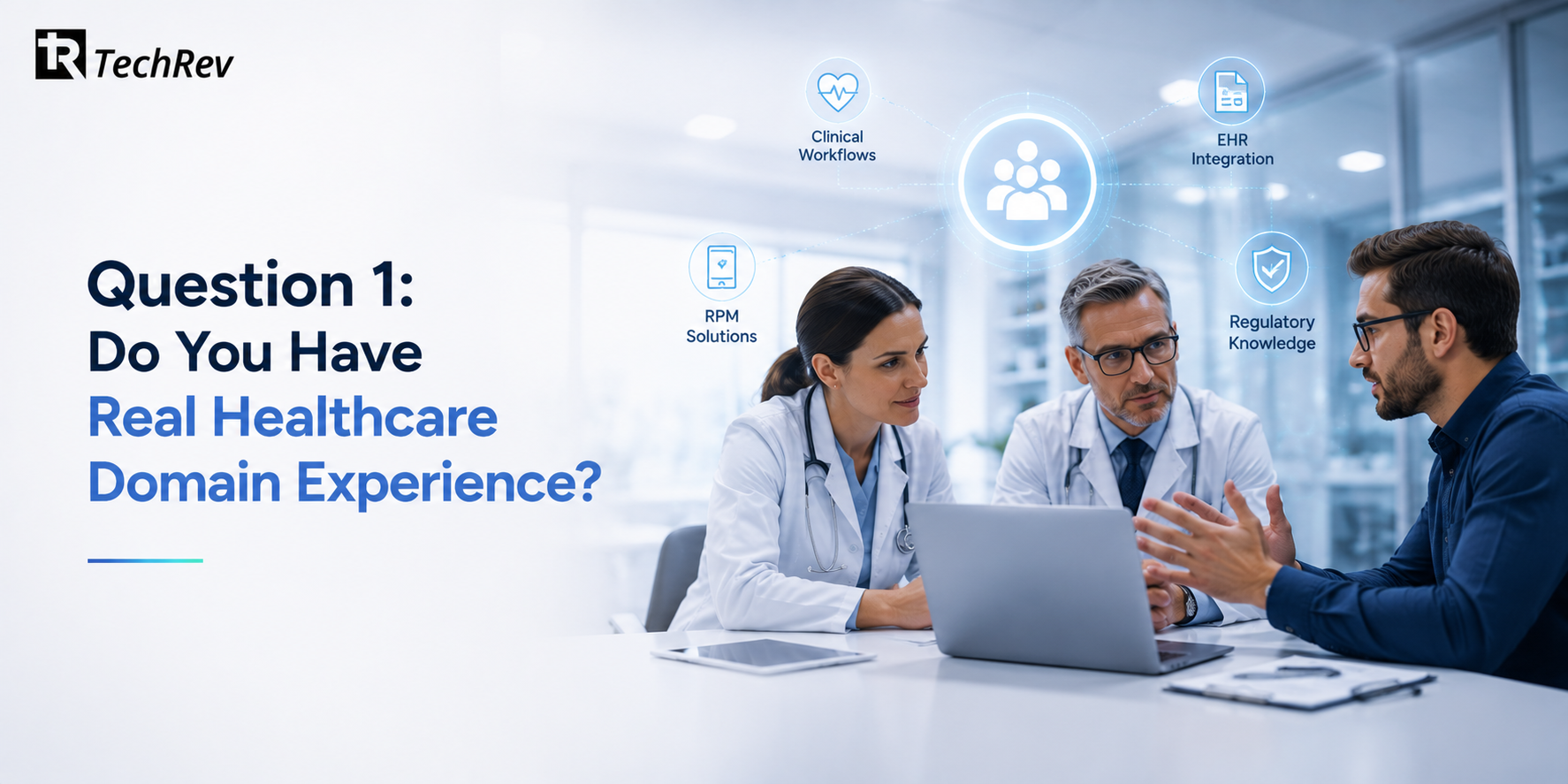
This is the first filter, and it eliminates most generalist agencies immediately.
Building a food delivery app and building a remote patient monitoring platform are two completely different worlds. Healthcare software lives inside a maze of regulations, clinical workflows, interoperability standards, and life-or-death reliability requirements. A team that has never worked with HL7, FHIR, or an EHR integration will learn those lessons on your dime and your timeline.
Ask the custom software development company to walk you through actual healthcare projects.
- What clinical problem did the software solve?
- How did clinicians respond?
- What went wrong, and how did they fix it?
Specific case studies with named challenges, measurable outcomes, and honest talk about obstacles.
For example, TechRev, a Florida based development company, has built healthcare products like remote patient monitoring apps and health platforms for clients such as DocVoice, Akesa Health, and CubeCare, alongside its broader portfolio of custom web and mobile solutions since 2016. That kind of visible, verifiable client history is exactly what you want to see.
Red flag: Vague claims like “we have worked across many industries” with nothing healthcare specific to show.
Question 2: How Do You Handle HIPAA Compliance and Data Security?
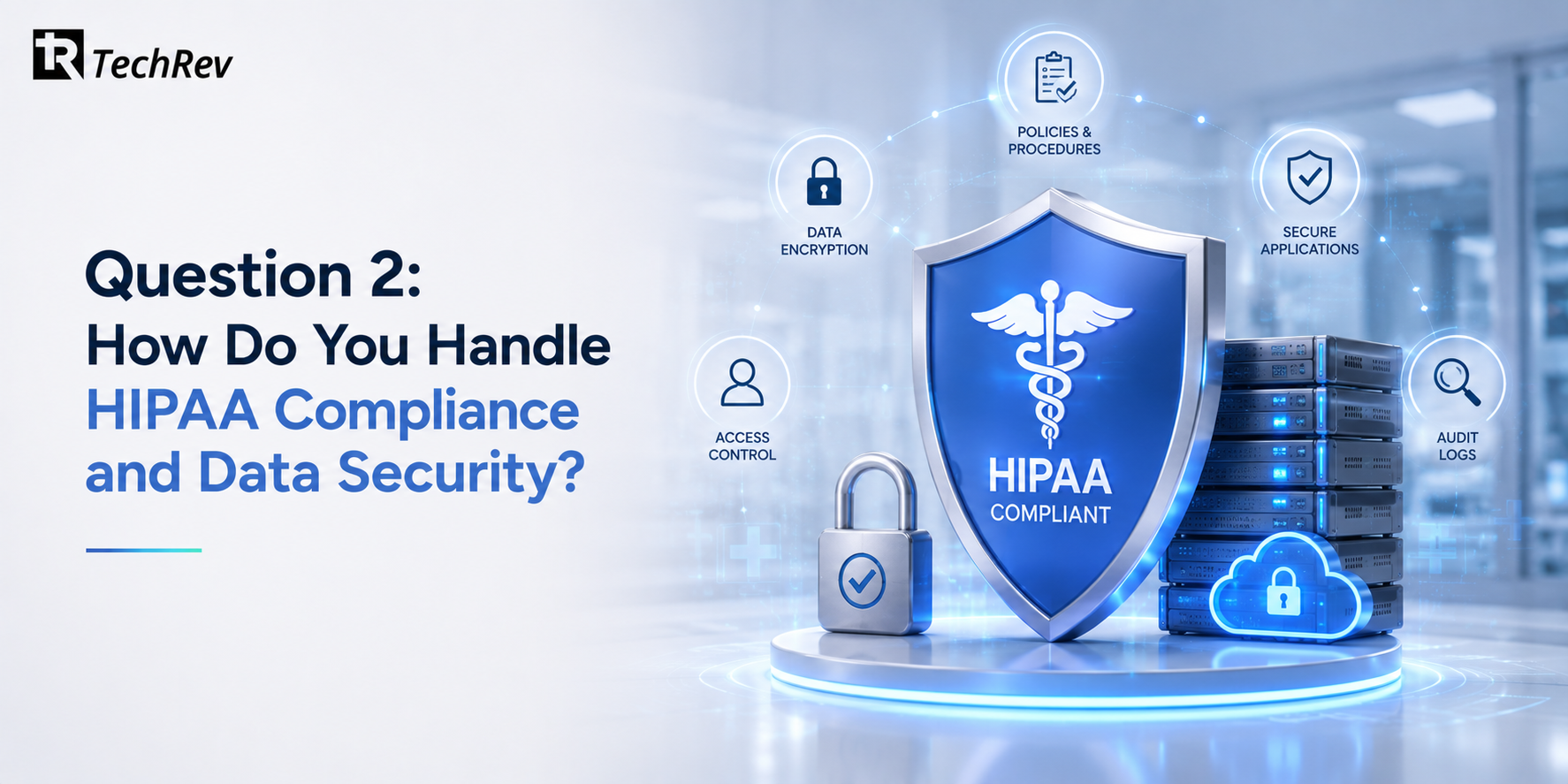
Any company offering healthcare software development services must treat HIPAA compliance as a design principle, not a checkbox at the end. That means encryption of data at rest and in transit, role based access controls, audit logging, secure authentication, business associate agreements, and a documented incident response plan.
Why does this matter so much?
Because the average healthcare data breach costs 7.42 million dollars, and nearly half of breached healthcare organizations end up raising prices on patients and payers to absorb the damage. On top of that, US breach costs overall hit an all-time high of 10.22 million dollars in 2025, driven largely by regulatory fines.
Ask these follow-ups:
- Will you sign a Business Associate Agreement (BAA)?
- How do you handle PHI in development and testing environments?
- What is your process for security audits and penetration testing?
- How do you secure AI models that touch patient data?
That last one is increasingly critical. IBM’s research found that most organizations adopting AI lack governance policies to manage AI risk, and those without governance paid more when breached. If a vendor is pitching AI solutions in healthcare but cannot explain AI data governance, walk away.
Question 3: What Is Your Approach to AI in Healthcare?
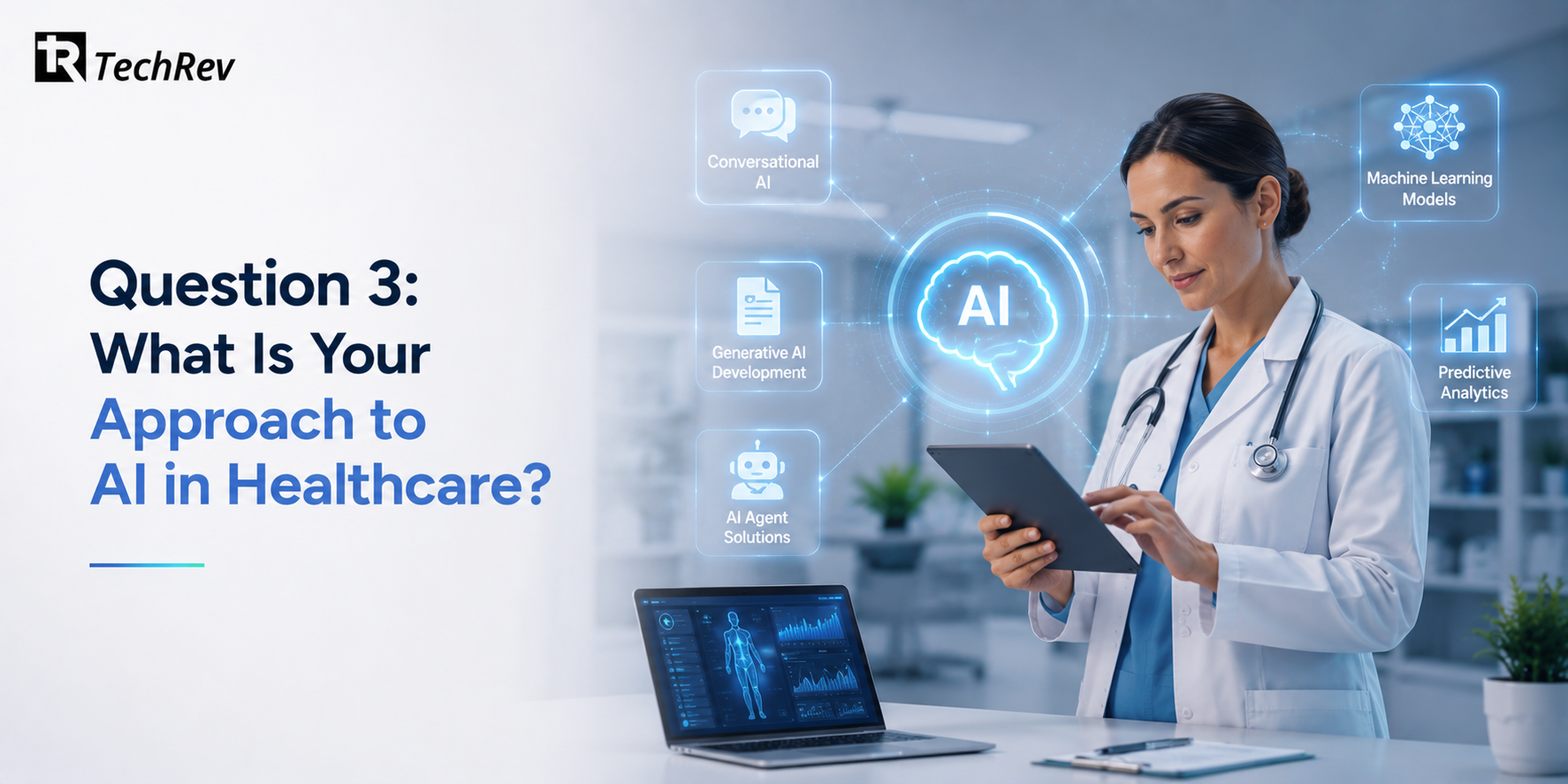
You cannot evaluate a modern development partner without digging into their AI capabilities. The AI in healthcare industry is moving fast, and the difference between a vendor who genuinely builds AI and one who sprinkles buzzwords is enormous.
Consider where the market is heading. Generative AI in healthcare is projected to grow from 4.7 billion dollars in 2026 to 39.8 billion dollars by 2035. Roughly 75 to 80 percent of US health systems already use at least one AI application. AI also captured 46 percent of all healthcare venture investment in 2025, totaling more than 18 billion dollars. This is not a trend you can sit out.
1. Generative AI development
Can they build tools that draft clinical notes, summarize records, or generate patient education content? Ambient AI documentation is one of the highest ROI use cases right now, with studies linking it to a 21 percentage point reduction in clinician burnout.
2. Conversational AI in healthcare
Do they have experience with patient-facing chatbots, virtual assistants for appointment scheduling, or symptom triage tools that actually understand medical context?
3. LLM development
Can they fine tune or integrate large language models safely for clinical settings, with guardrails against hallucination and clear human-in-the-loop review?
4. AI agent development services
This is the frontier. AI agents can autonomously handle multi-step tasks like prior authorization follow-ups, claims status checks, and referral coordination. Ask whether they have shipped agentic workflows, not just chatbots.
5. AI ML development services
Predictive analytics for readmission risk, no-show prediction, staffing optimization. Machine learning held the largest technology share of the healthcare AI market at 35 percent in 2025, so mature ML skills are non-negotiable.
A strong partner offering AI development services will tell you honestly where AI fits your problem and, just as importantly, where it does not.
TechRev, for instance, leads with AI-first development across chatbots, predictive models, NLP, and automation tools, and also integrates AI features into existing applications rather than forcing a rebuild.
Question 4: Can You Integrate With Our Existing Systems and Automate Our Workflows?
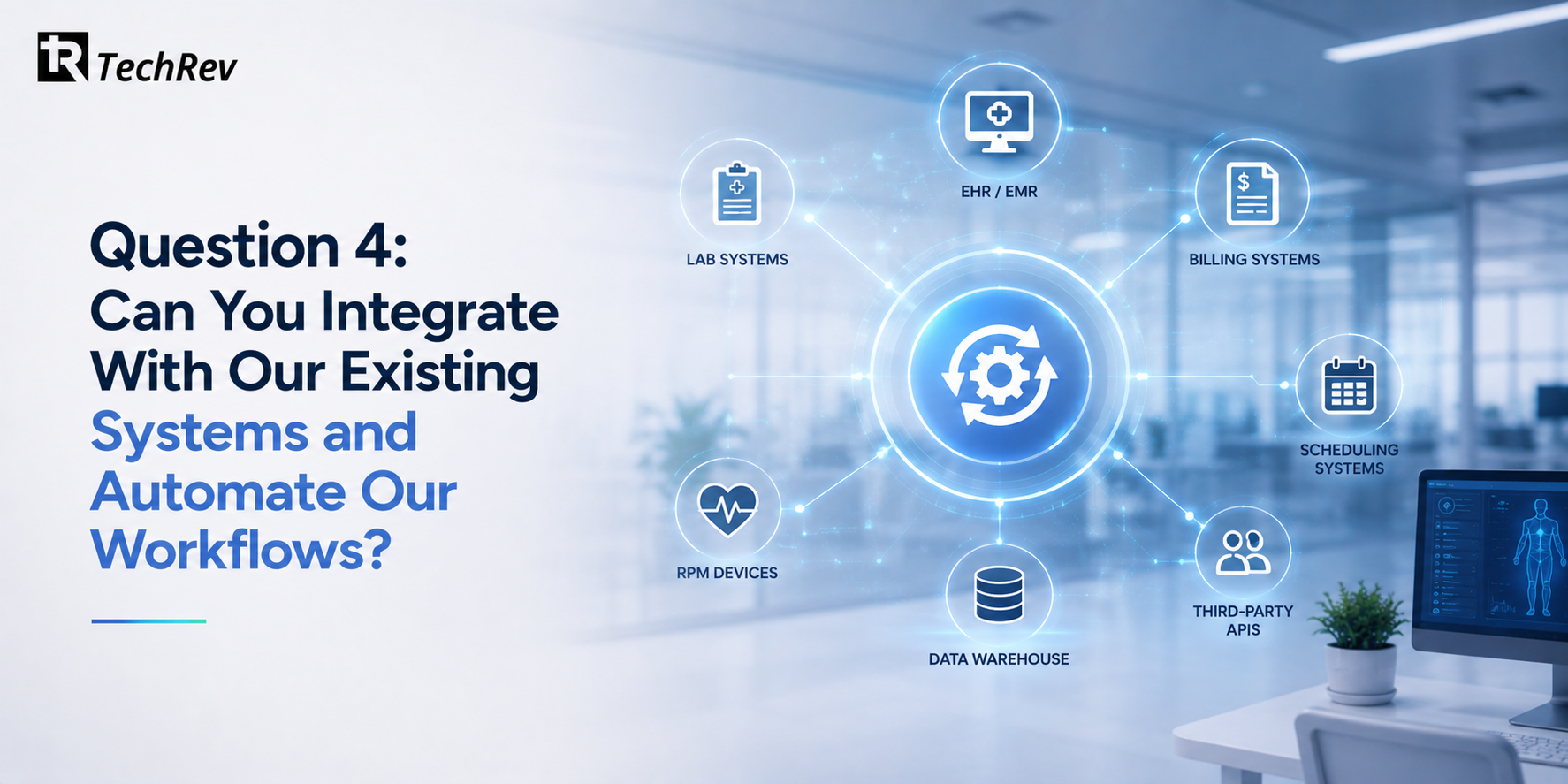
Healthcare does not run on one system. It runs on dozens. EHRs, lab systems, billing platforms, pharmacy software, scheduling tools, and telehealth apps all need to talk to each other.
So ask directly: how will your software connect with what we already use?
A capable partner should speak fluently about FHIR APIs, HL7 interfaces, and third party integrations. They should also understand healthcare workflow automation as a discipline, not an afterthought.
The real value of software in a hospital or clinic comes from removing manual steps: automatic appointment reminders, smart intake forms, automated insurance eligibility checks, and AI-assisted documentation that flows straight into the EHR.
This is also where a Service Management App can transform operations. Think about everything a healthcare facility manages beyond direct patient care: equipment maintenance, IT tickets, facility requests, staff scheduling, vendor coordination.
An AI Service Management App takes this further by intelligently routing requests, predicting equipment failures before they happen, and prioritizing tickets based on clinical urgency. The impact is real; AI-powered record retrieval alone has cut search time by more than 50 percent in some settings.
Question 5: What Does Your Development Process Look Like?
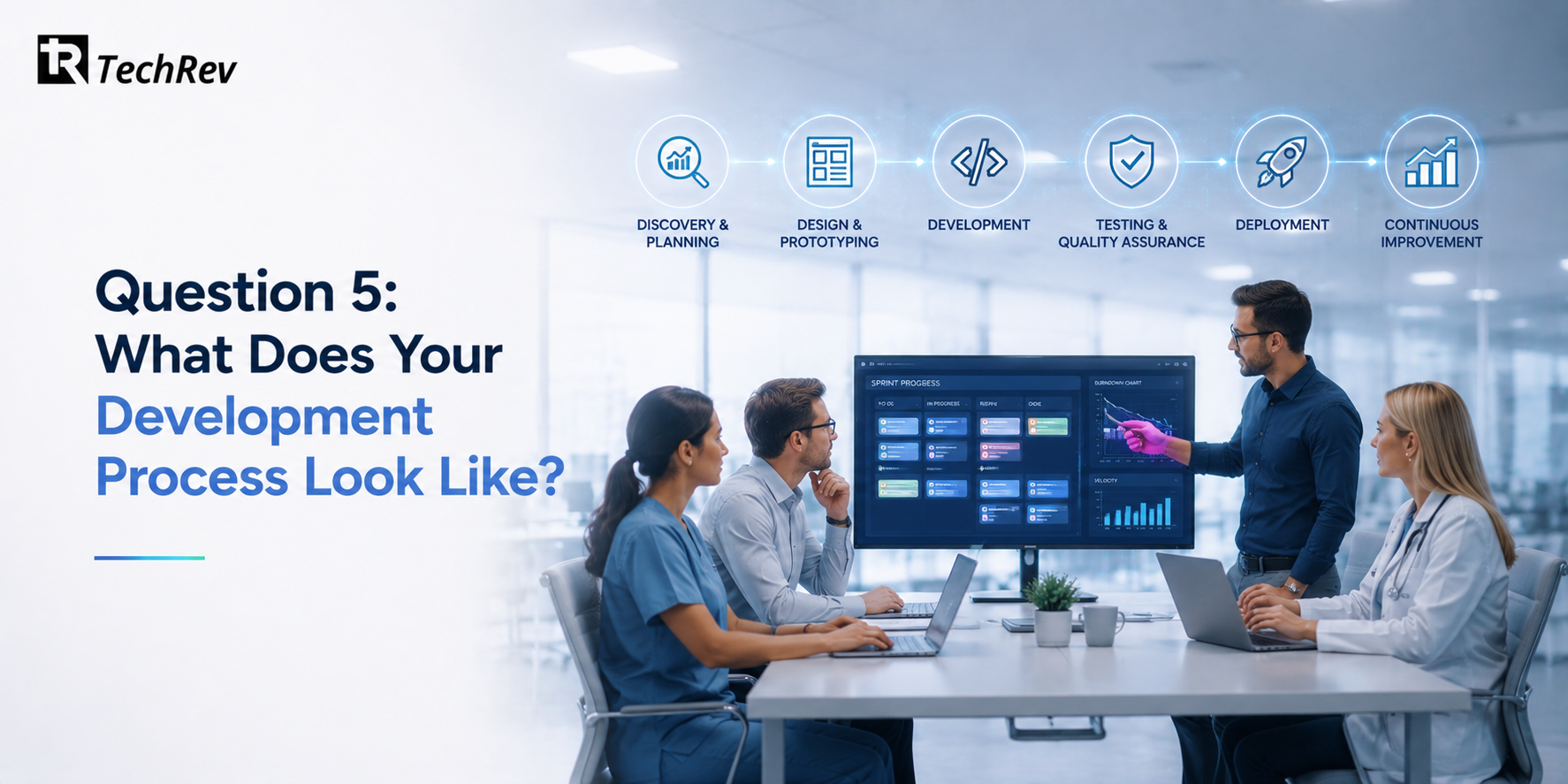
Process sounds boring until a project goes sideways. Then it is the only thing that matters.
You want clear answers on:
- Methodology: Agile sprints with regular demos, or a black box where you wait months to see anything?
- Communication: Who is your point of contact? How often do you get updates? US-based teams or coordinated offshore teams with overlapping hours?
- Team composition: Will you get dedicated developers, or will your project be juggled between whoever is free? Companies like TechRev offer dedicated developer models and IT staff augmentation, meaning the team works as an extension of your own staff with full focus on your goals.
- Testing: How do they test clinical software? Automated testing, user acceptance testing with actual clinicians, load testing for peak usage?
A realistic timeline is also a signal of honesty. A basic application typically takes 4 to 8 weeks, while complex AI-powered platforms may run 3 to 6 months or longer. Any vendor promising a full custom healthcare platform in three weeks is either lying or planning to cut corners you will pay for later.
Question 6: How Do You Price Custom Healthcare Software Development Services?
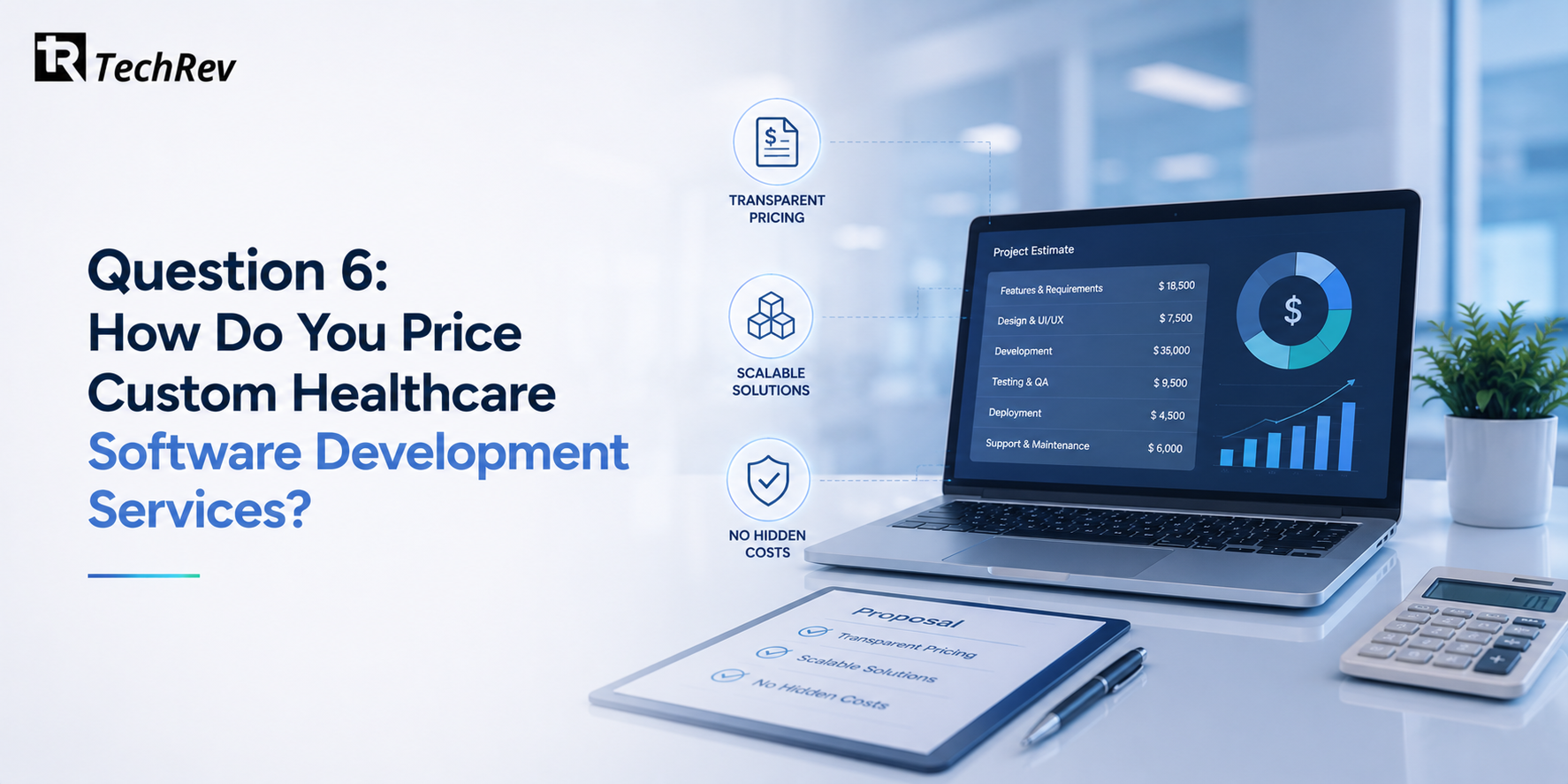
Custom healthcare software development services can be priced as fixed bid, time and materials, or dedicated team retainers. Each model has trade-offs. Fixed bid gives budget certainty but punishes changing requirements.
Time and materials offer flexibility but require trust and transparency. Dedicated teams work best for long-term product development.
Get clarity on:
- What exactly is included in the quote? Design, development, testing, deployment, compliance documentation?
- What triggers additional costs? Scope changes, third party licenses, cloud infrastructure?
- What are the payment milestones tied to?
For reference, straightforward apps often start around 5,000 dollars, while enterprise-grade or AI-driven healthcare platforms typically start at 25,000 dollars and scale up with complexity.
A trustworthy healthcare application development services partner will give you a detailed, itemized quotation after understanding your requirements, not a suspiciously round number after one phone call.
And remember the ROI math. With healthcare AI investments returning an average of 3.20 dollars per dollar invested within about 14 months, the right question is not “what is the cheapest option” but “which partner will actually deliver the outcome.”
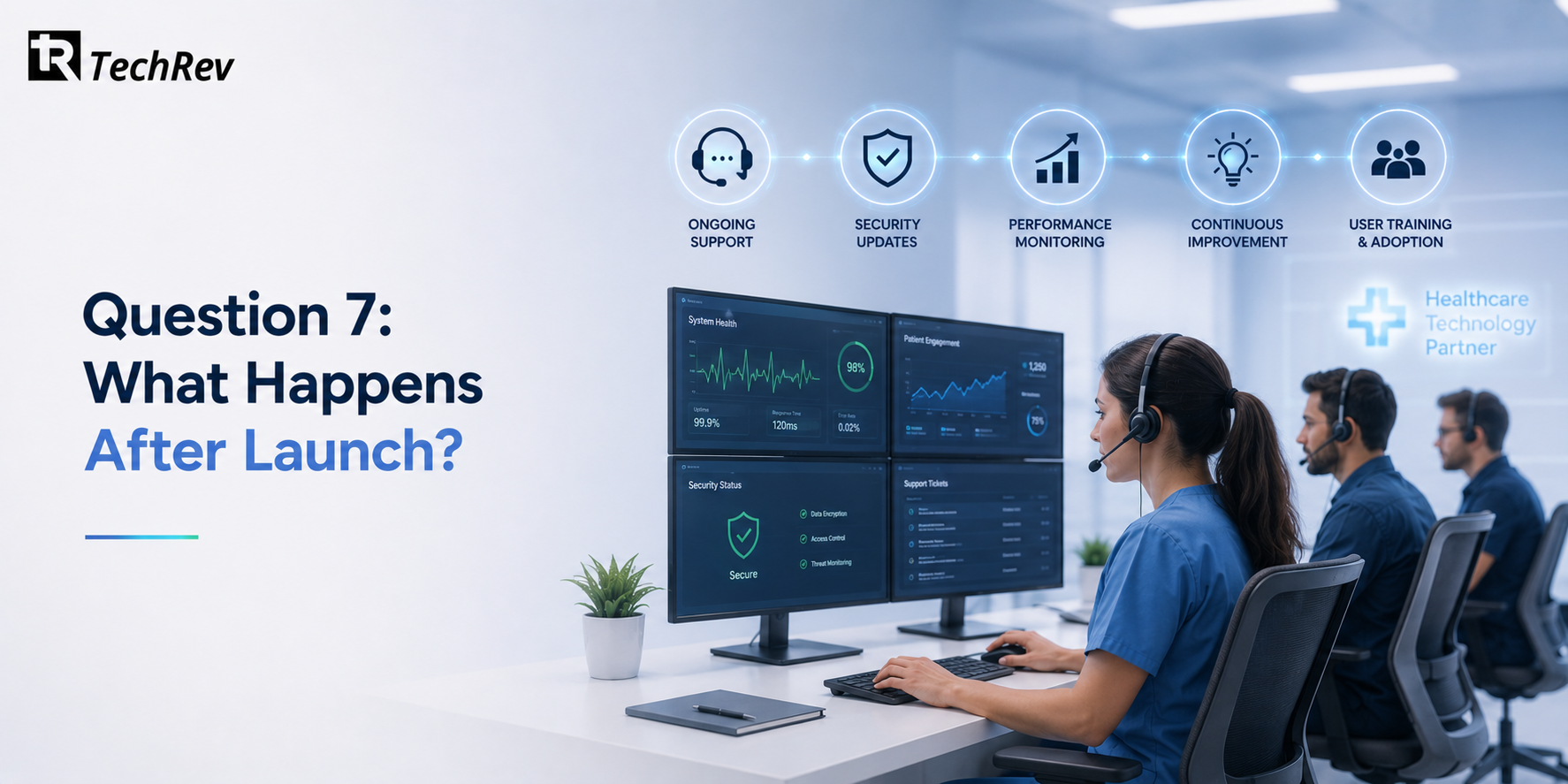
Question 7: What Happens After Launch?
Here is where many custom software development project’s relationships quietly fall apart.
Healthcare software is never finished. Regulations change. Operating systems update. Security threats evolve daily. Clinical users request new features. An AI model that performed beautifully at launch can drift as patient populations and data patterns shift.
Ask:
- Do you offer post-launch support and maintenance plans? What do they cover?
- What are your guaranteed response times for critical bugs versus minor issues?
- How do you handle security patches and compliance updates?
- Will you monitor and retrain AI models over time?
- If we part ways, do we own our code, data, and documentation completely?
That last question is huge. Some agencies create dependency by holding source code hostage. Insist on full ownership in the contract. Companies with mature AI application development services practices,
TechRev included, structure post-launch support around bug fixes, performance optimization, security updates, and ongoing feature enhancements, which is exactly the standard you should demand from anyone.
Quick Checklist: What to Verify Before You Sign?
Use this as your final gate before choosing a healthcare software development company:
- Proven healthcare portfolio with verifiable client outcomes
- Willingness to sign a BAA and documented HIPAA-first architecture
- Demonstrated AI development services across generative AI, ML, and conversational AI
- Concrete EHR and third party integration experience (FHIR, HL7)
- Transparent agile process with named points of contact
- Itemized pricing with clearly defined scope and change policies
- Written post-launch support terms and full IP ownership for you
If a vendor clears all seven, you are talking to a genuine partner, not just a coding shop.
Why Healthcare Teams Work With TechRev?
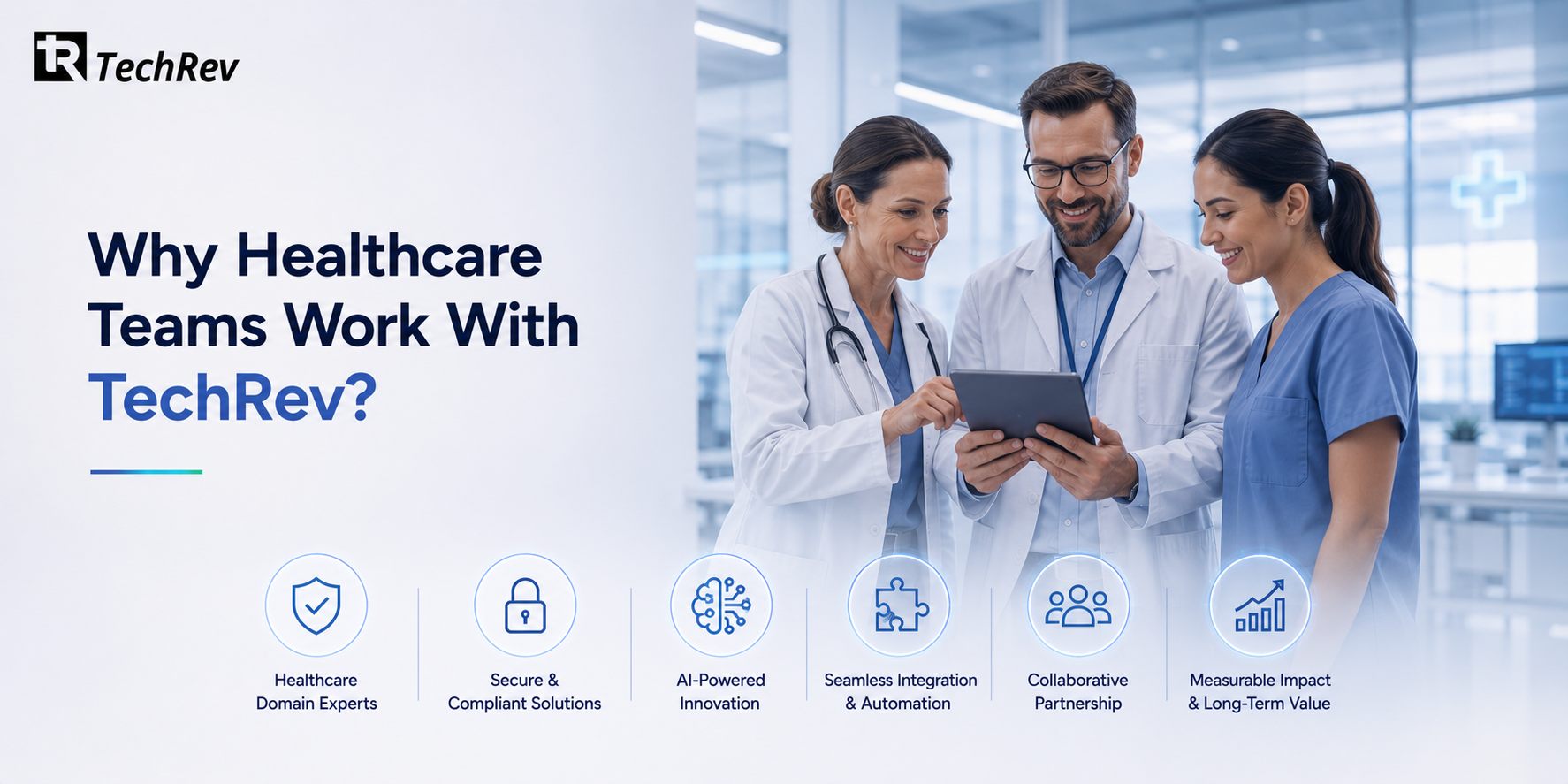
Full transparency: this blog is published by TechRev, so judge us by the same seven questions above. We would not have it any other way.
TechRev is a US-based mobile app development company headquartered in Florida, building AI-powered software since 2016.
Healthcare is one of our deepest areas of work, with products delivered for clients like DocVoice, Akesa Health, CubeCare, and Premier, spanning remote patient monitoring, health platforms, and care coordination tools.
Our teams handle the full spectrum discussed in this blog:
- Custom web and mobile development
- Generative AI development
- Conversational AI
- Machine learning and predictive analytics
- NLP, healthcare workflow automation
- Cloud services
API development and integration, and dedicated developer teams that plug directly into your organization. Whether you need a brand new platform, AI integrated into an existing application, or an AI Service Management App to streamline your facility operations, we start with your clinical and business reality, not a template.
If you are evaluating partners, bring us your hardest questions. Talk to a TechRev expert and see how we answer all seven.
Conclusion
Choosing a healthcare software development company is one of the highest-leverage decisions your organization will make this decade. The market data makes that obvious. AI in healthcare is racing from 50.7 billion dollars in 2026 toward hundreds of billions within a decade, physician adoption is climbing every quarter, and organizations that build the right software are compounding advantages in efficiency, patient experience, and cost.
The difference between those two futures is due diligence. Ask all seven questions. Demand specific answers backed by real projects. Verify compliance practices in writing. Insist on ownership and post-launch commitment.
And when you are ready to put a development partner through this exact interrogation, TechRev is happy to be first in line.
Reach out for a free consultation, bring this checklist with you, and let the answers speak for themselves.
FAQs
1. What types of healthcare applications can TechRev develop?
TechRev builds a wide range of healthcare solutions, including remote patient monitoring apps, telehealth platforms, patient portals, appointment and scheduling systems, AI-powered chatbots and virtual assistants, predictive analytics dashboards, and enterprise healthcare workflow automation tools.
We develop for mobile (iOS, Android, cross-platform), web, and cloud environments, and we design every solution around your specific clinical workflows rather than forcing you into an off-the-shelf template. Since 2016, our Florida-based team has delivered healthcare products for clients like DocVoice, Akesa Health, and CubeCare.
2. Can TechRev add AI to my existing healthcare application?
Yes. TechRev specializes in integrating AI into existing apps, including automation, natural language processing, predictive analytics, recommendation engines, and conversational AI, so you can modernize without rebuilding from scratch.
3. How long does TechRev take to build a healthcare app?
A basic application typically takes 4 to 8 weeks, while complex AI-powered healthcare platforms usually require 3 to 6 months. TechRev provides a transparent timeline before the project begins.
4. How much does custom healthcare software development cost at TechRev?
Simple applications may start around 5,000 dollars, while enterprise or AI-driven healthcare platforms typically start at 25,000 dollars and up. Pricing depends on complexity, features, integrations, compliance requirements, and technology stack.
TechRev provides a detailed, itemized quotation after understanding your exact needs, so you know precisely what you are paying for before development begins.
5. Does TechRev provide support after my healthcare app launches?
Absolutely. TechRev offers post-launch support covering bug fixes, performance optimization, security updates, and ongoing feature enhancements, so your application stays reliable, compliant, and current as your organization grows.
6. What AI solutions does TechRev offer for healthcare organizations?
TechRev provides AI chatbots and virtual assistants, machine learning and predictive analytics, computer vision, natural language processing, recommendation engines, and robotic process automation. For healthcare specifically, these translate into faster documentation, smarter triage, automated administrative work, and better data-driven decisions.
7. Can TechRev help with more than development, like design and marketing?
Yes. Beyond development, TechRev offers UI/UX design, cloud services, IT consulting, managed IT services, API integration, and full digital marketing, making it a true end-to-end technology partner.