

NLP in healthcare is no longer an experimental idea sitting in a research lab. It is now working inside hospitals, insurance companies, and pharmaceutical labs across the United States, turning messy clinical text into decisions that save time and, in many cases, save lives.
Every patient visit creates a story. A doctor writes it down in a note, a nurse adds an update, a specialist attaches a follow-up. Most of that story sits in free text form and never gets read by a computer system. Natural Language Processing changes that. It reads clinical language the way a trained human would, then turns it into structured data that software can act on.
This blog breaks down the technology in plain terms, then walks through eight proven use cases of NLP in healthcare, backed by real deployments at organizations like Mayo Clinic, Boston Children’s Hospital, and Kaiser Permanente.
We built this blog from public research, verified case studies, and hands-on project experience at TechRev, a healthcare app development company that builds HIPAA-compliant software for hospitals, digital health startups, and provider networks across the US.
If you run a hospital, a clinic network, or a digital health startup and you are exploring NLP development for your organization, this article gives you the full picture before you write a single requirement document.
What Is NLP in Healthcare?
NLP in healthcare is the branch of artificial intelligence that reads, interprets, and structures human language found in clinical text, such as doctor’s notes, discharge summaries, lab reports, and patient messages. It converts unstructured medical language into structured, searchable data that electronic health record (EHR) systems, billing platforms, and clinical decision tools can use directly.
In short: NLP takes what a clinician writes in plain English and turns it into something a computer can act on, without asking the clinician to change how they document care.
Why NLP in Healthcare Matters Right Now?
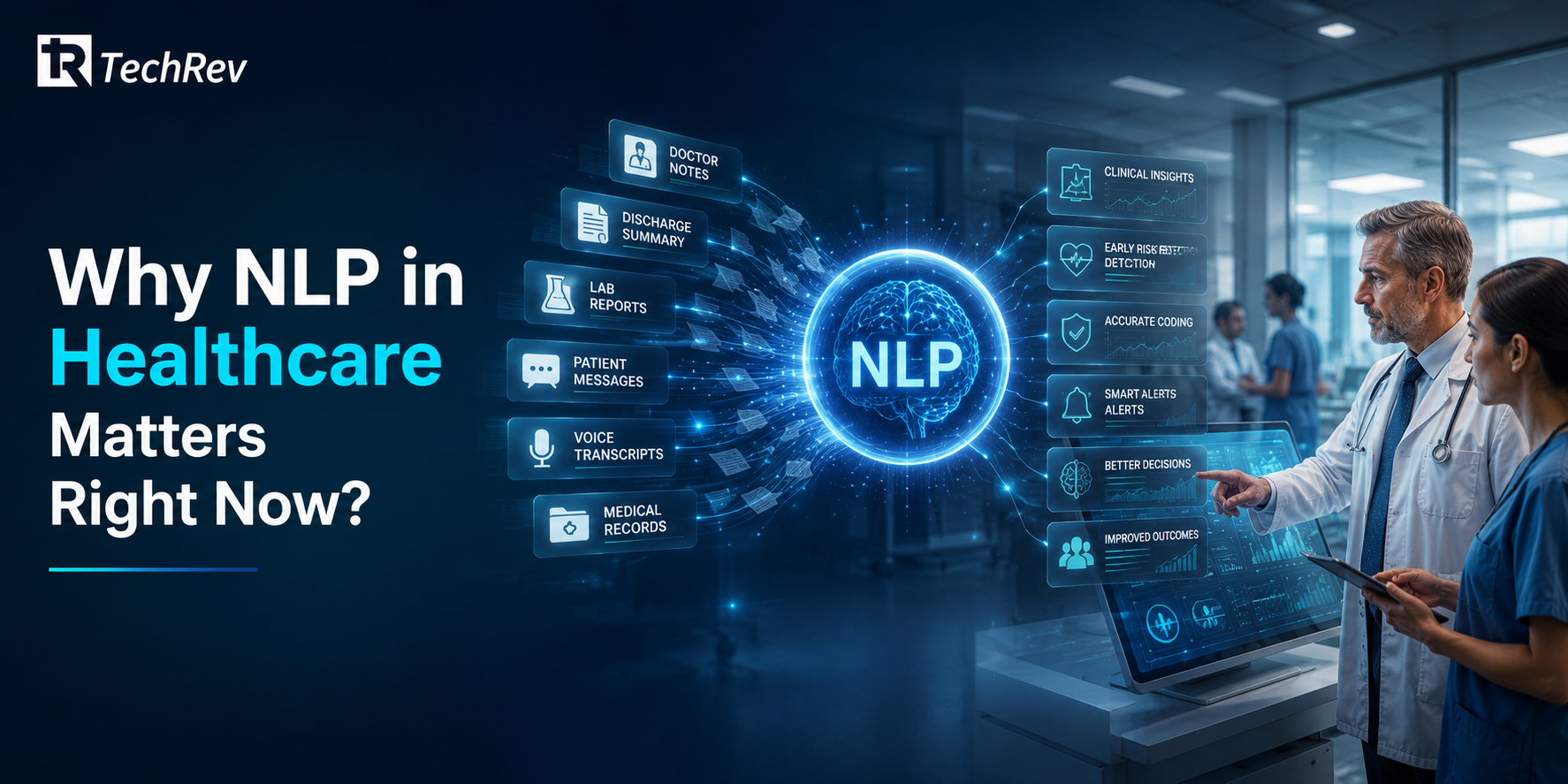
Healthcare generates an enormous amount of text every single day, and most of it goes unused by analytics systems. A few figures explain why hospitals, payers, and health tech companies are investing heavily in NLP development right now.
| Data Point | Figure | Source |
| Global NLP in healthcare and life sciences market, 2025 | USD 4.82–5.18 billion | Fortune Business Insights, Grand View Research |
| Projected market size by 2030 | USD 16.01–37.0 billion | Grand View Research, Fortune Business Insights |
| Market CAGR through 2030 | 25.3%–34.7% | Multiple industry reports |
| US office-based physicians using EHR systems | 95.0% | CDC, December 2025 |
| Physician time spent on clinical documentation | 35%–50% of the workday | Industry workflow studies |
| Oracle Health Clinical AI Agent documentation time reduction | Nearly 30% | Oracle, March 2025 |
| North America share of global NLP-in-healthcare revenue | 43.6% | Grand View Research |
These numbers point to one clear pattern. Healthcare organizations already have the data. What they need is a way to read it at scale, and that is exactly what NLP development delivers.
Top 8 Use Cases of NLP in Healthcare
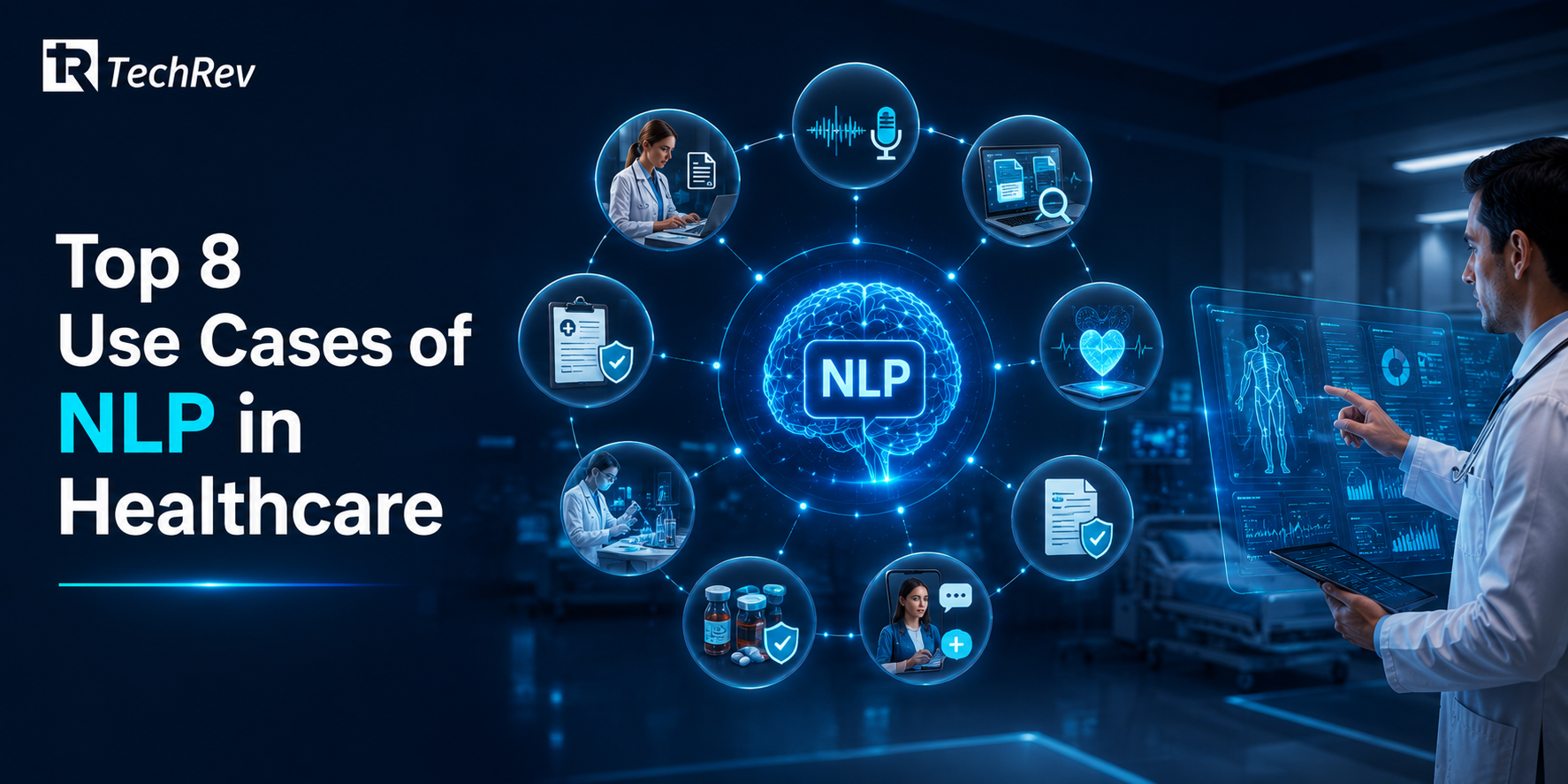
Below are eight of the most practical, revenue-relevant, and patient-impacting use cases of NLP in healthcare today. Each one includes a real deployment example so you can see the technology working outside of a lab setting.
1. Clinical Documentation and Ambient Voice-to-Text
Physicians spend a significant chunk of every shift on documentation instead of patients. Typing notes, mapping diagnoses to ICD-10 codes, and satisfying billing requirements pulls attention away from care, and it is one of the leading drivers of physician burnout.
How does NLP solve it?
- Converts spoken clinical conversations into structured notes in real time
- Recognizes medical entities such as symptoms, medications, and diagnoses (Named Entity Recognition)
- Auto-maps conditions to the correct ICD-10 codes
- Flags missing documentation elements before a chart closes
Real Deployment
Nuance’s Dragon Medical One, now part of Microsoft, was rolled out at Piedmont Healthcare to reduce after-hours charting.
Physicians reported saving roughly 45 to 60 minutes per day once ambient documentation and automatic ICD-10 mapping replaced manual note entry. This is one of the clearest examples of nlp in healthcare paying for itself within months of deployment.
Does NLP-based documentation require doctors to change how they talk to patients?
No. The system listens in the background and structures the conversation afterward, so clinical workflow stays the same.
2. EHR Text Mining and Clinical Insight Extraction
Electronic health records hold enormous volumes of narrative text: progress notes, consult summaries, and discharge instructions. Most analytics tools only read structured fields like lab values and diagnosis codes, so critical details written in plain sentences get missed entirely.
How does NLP solve it?
- Identifies diagnoses, symptoms, medications, and procedures inside free text
- Maps terms to standard vocabularies such as ICD-10 and SNOMED
- Uses negation detection to separate “no signs of infection” from an active diagnosis
- Applies temporal analysis to tell current conditions apart from historical ones
3. Clinical Decision Support and Early Risk Detection
Conditions like sepsis often show early warning signs in a physician’s written notes well before lab values cross a critical threshold. Traditional decision support tools that rely only on structured data miss those early signals, and that delay can cost lives.
How does NLP solve it?
- Detects symptom language and clinical concern phrases in real time
- Tracks symptom progression using temporal modeling
- Combines extracted signals with structured EHR data for risk scoring
- Triggers alerts before a patient’s condition fully deteriorates
Also Read – 7 Questions to Ask a Healthcare Software Development Company
4. Automated Medical Coding and Billing Accuracy
Every diagnosis and procedure has to be translated into standardized codes before a claim goes to insurance. Coders currently do this by reading through dense physician notes line by line, which is slow, expensive, and prone to error.
How does NLP solve it?
- Detects diagnoses and procedures inside physician documentation
- Maps clinical language to ICD-10-CM, CPT, and HCPCS codes
- Flags incomplete documentation before a claim gets denied
- Distinguishes active conditions from ruled-out or historical ones
Real deployment
3M Health Information Systems deployed its 360 Encompass Computer-Assisted Coding platform at a US pediatric health system, using NLP to pre-identify diagnoses and suggest codes automatically. Coders reviewed and validated suggestions instead of reading full charts, which improved productivity and coding consistency.
Leverage advanced NLP development services to reduce claim denials and speed up your revenue cycle. Talk to TechRev’s NLP development company about building this into your billing workflow.
5. AI-Powered Patient Triage and Virtual Health Assistants
Hospitals field thousands of patient questions daily, from appointment requests to medication concerns. Most of these do not need a physician, yet they still consume call center time and nursing hours that could go toward patients who actually need clinical attention.
How does NLP solve it?
- Understands patient intent instead of relying on rigid keyword matching
- Extracts symptoms, medications, and appointment details from conversational text
- Tracks context across multi-turn conversations
- Escalates urgent cases to a human care team automatically
Can a chatbot give unsafe medical advice?
A properly built NLP system is trained on clinical guidelines and escalation rules, so it defers to human staff the moment a query moves outside safe boundaries.
This is why choosing an experienced healthcare app development company for this build matters more than picking the cheapest vendor.
6. Clinical Trial Matching and Recruitment
Clinical trials have detailed eligibility rules covering disease stage, biomarkers, prior treatments, and lab thresholds. Most of that information sits inside unstructured pathology reports and physician notes, so manual screening is slow and many eligible patients simply get missed.
How does NLP solve it?
- Pulls staging, biomarker, and treatment history from unstructured notes
- Maps trial eligibility rules into machine-readable logic
- Continuously scans new patient records for potential matches
- Notifies research coordinators automatically when a match appears
7. Drug Safety Surveillance and Pharmacovigilance
Adverse drug reactions often show up first in physician notes, patient messages, or call center transcripts long before they appear in formal reporting systems. Catching these signals early is critical for both patient safety and regulatory compliance.
How does NLP solve it?
- Scans clinical notes and patient communication for adverse event language
- Links reported symptoms to specific medications and dosages
- Detects patterns across large patient populations that a single reviewer would miss
- Feeds structured signals into post-market surveillance systems
This is one of the fastest-growing applications of nlp in healthcare because pharmaceutical companies and health systems are both under pressure to catch safety issues earlier, not after a recall becomes necessary.
8. Population Health Surveillance and Patient Sentiment Analysis
Public health teams need to spot outbreaks and shifting symptom patterns quickly, but early disease signals usually appear in physician narratives before they show up in coded diagnosis data. Separately, patient feedback across surveys and call logs holds insight into satisfaction that structured survey scores alone cannot capture.
How does NLP solve it?
- Detects symptom clusters across large patient populations in near real time
- Compares current symptom frequency against historical baselines to flag anomalies
- Reads patient feedback and comments to detect sentiment and recurring complaints
- Surfaces urgent complaints for faster response from hospital administration
NLP Use Case in Healthcare!
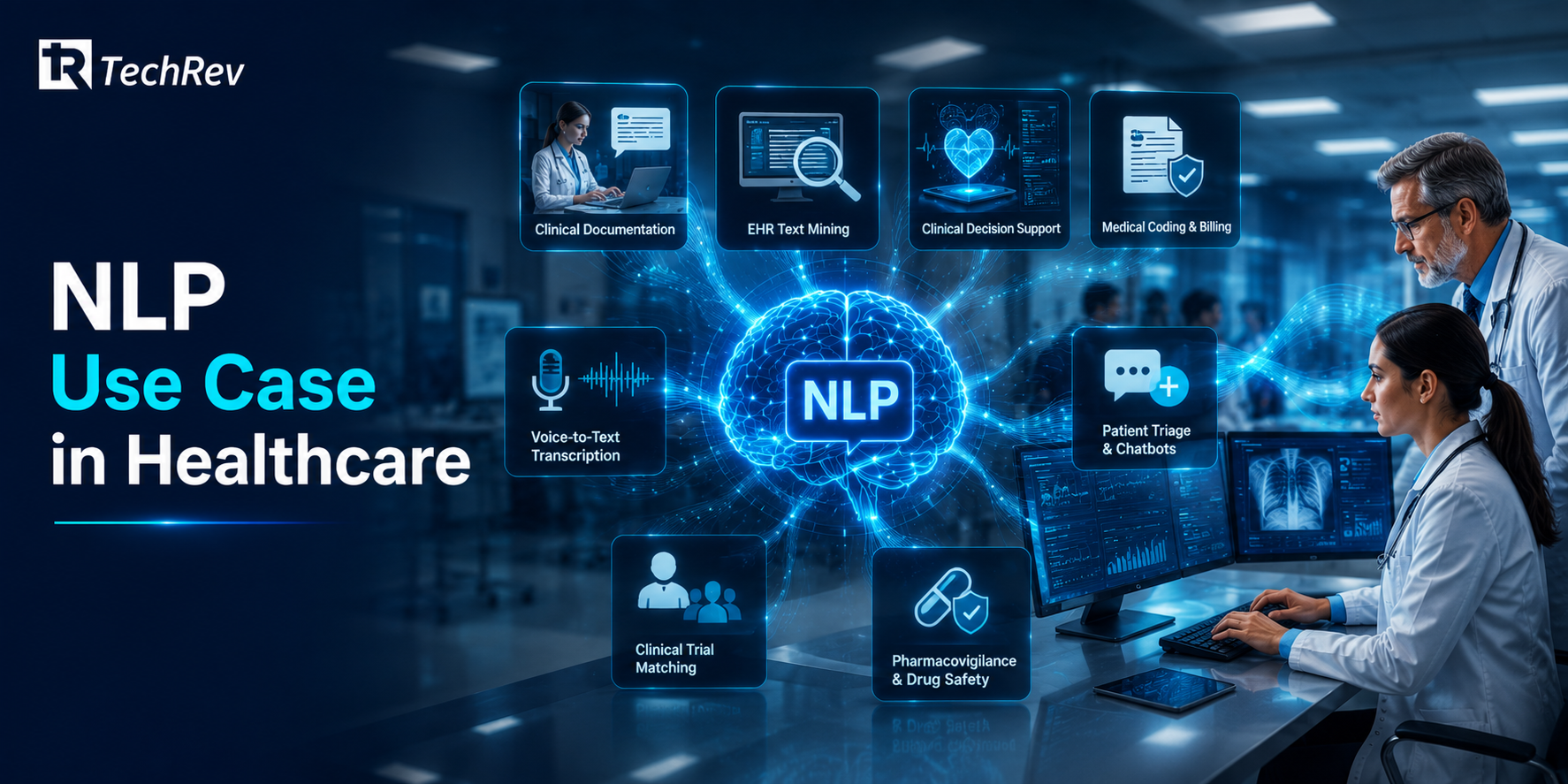
The following are some use cases of NLP in Healthcare industry:
| Use Case | Primary Beneficiary | Typical Impact |
| Clinical Documentation | Physicians | 45–60 minutes saved per clinician daily |
| EHR Text Mining | Clinical researchers | More complete risk factor data |
| Clinical Decision Support | Patient safety teams | Earlier detection of sepsis and deterioration |
| Medical Coding & Billing | Revenue cycle teams | Fewer denied claims, faster turnaround |
| Patient Triage & Virtual Assistants | Care access teams | Reduced call center load, faster response |
| Clinical Trial Matching | Research coordinators | ~20% improvement in trial enrollment |
| Drug Safety Surveillance | Pharmacovigilance teams | Earlier adverse event detection |
| Population Health Surveillance | Public health & quality teams | ~15% more symptomatic cases identified |
Build vs. Buy: Why Most Hospitals Partner With an NLP Development Company?
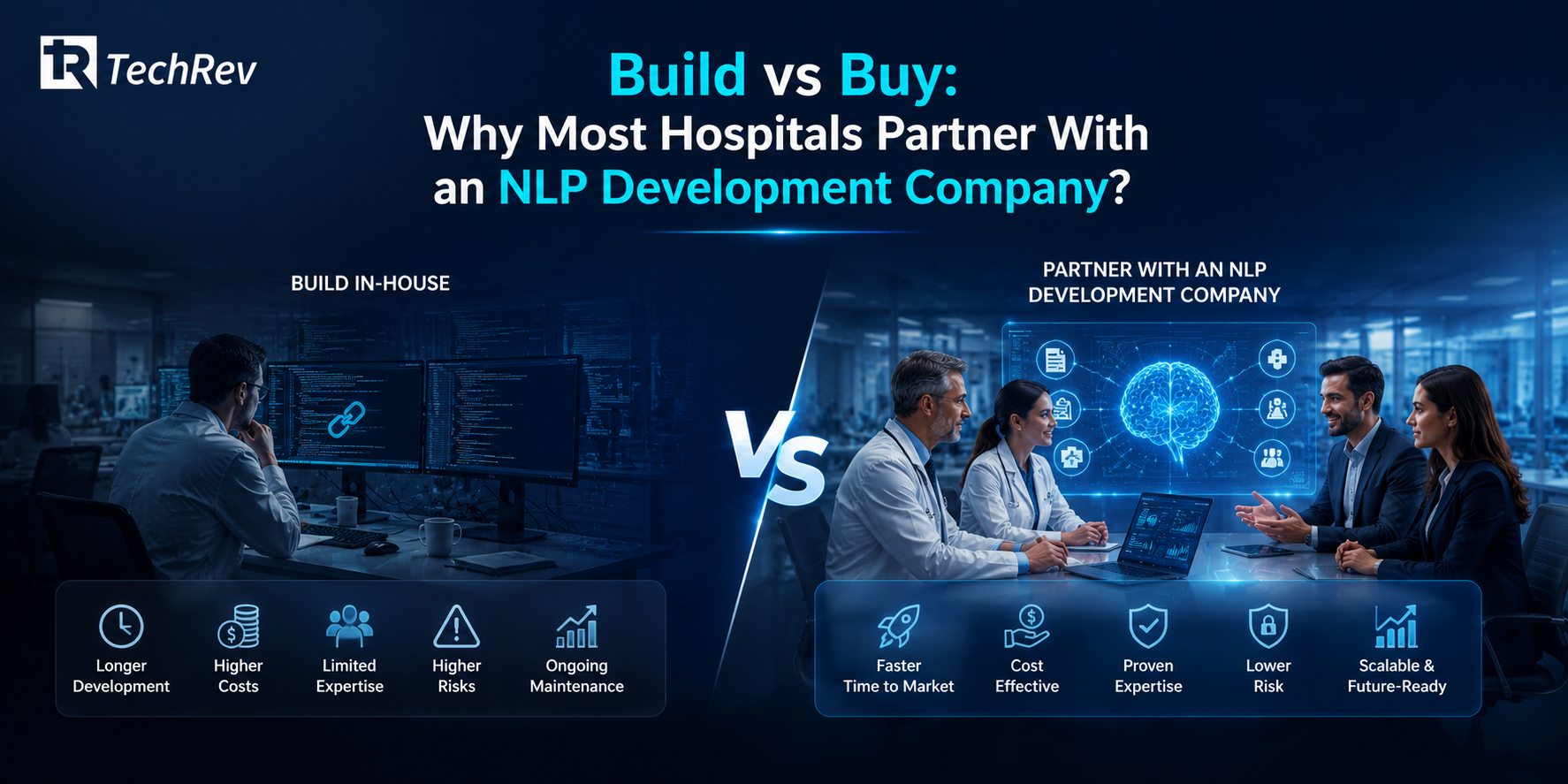
Building clinical-grade NLP in-house sounds appealing until a team runs into the real requirements: HIPAA compliance, EHR integration, medical vocabulary mapping, and model validation against real patient outcomes.
Most healthcare organizations do not have that expertise sitting in their internal IT department, and hiring it from scratch takes months.
| Factor | In-House Build | Partnering With an NLP Development Company |
| Time to first working model | 6-12 months | 8-14 weeks |
| HIPAA and compliance expertise | Needs to be hired separately | Built into the process |
| EHR integration experience | Limited, project-specific | Proven across multiple health systems |
| Ongoing model maintenance | Falls on internal team | Included in service scope |
| Upfront cost | High fixed cost regardless of outcome | Scoped to the actual use case |
This is exactly why healthcare organizations increasingly look for a specialized NLP development company instead of trying to build everything internally.
How TechRev Builds NLP Into Healthcare Applications?
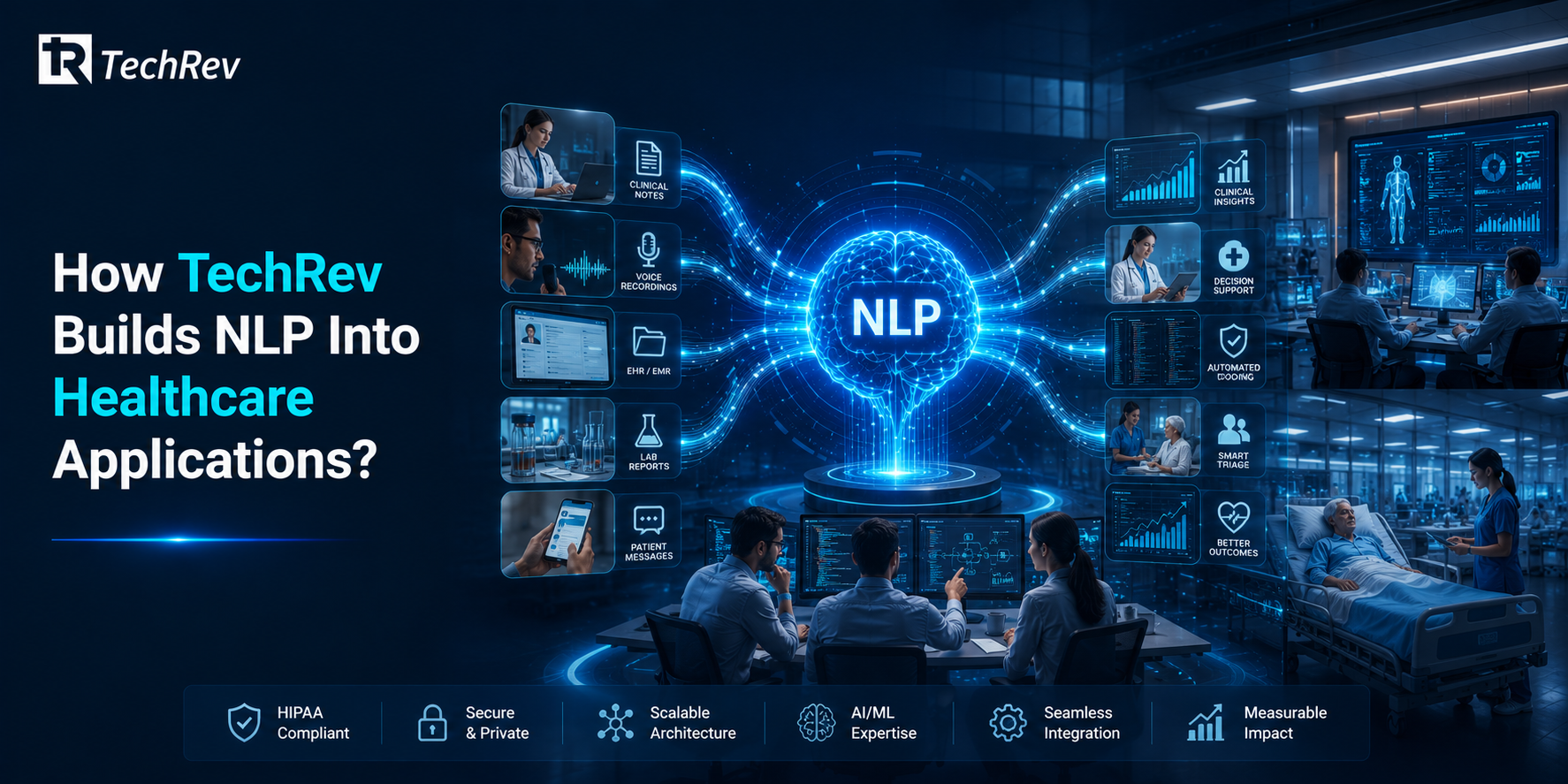
TechRev is a healthcare app development company based in Florida, serving hospitals, provider networks, and digital health startups across the United States.
Our NLP development services focus on solving the exact problems covered above: clinical documentation, EHR text mining, patient triage, coding automation, and trial matching, all built on HIPAA-compliant architecture from day one.
Our approach to NLP development follows a clear process:
- Discovery and workflow mapping. We study how your clinical or administrative team actually documents and communicates today, before writing a single line of code.
- Data and compliance planning. We define how patient data will be handled, stored, and protected under HIPAA, well before model development starts.
- Model development and testing. Our team builds and validates NLP models against your real clinical language, not generic datasets.
- EHR and system integration. We connect the NLP layer directly into your existing EHR, billing, or patient communication systems.
- Deployment and ongoing support. We monitor model performance after launch and refine it as your documentation patterns evolve.
As a healthcare app development company, we do not treat NLP as a bolt-on feature. We treat it as core infrastructure that has to work correctly the first time, because clinical and billing accuracy leave no room for guesswork.
If your organization is evaluating a healthcare app development company for an NLP project, or you already have a healthcare app development company on retainer and need a specialized NLP development partner to fill the gap, TechRev’s team can scope the project with you directly.
See how TechRev approaches healthcare projects end to end on our healthcare app development page, or explore our full NLP development services.
Conclusion
NLP in healthcare has moved past the pilot-project stage. Hospitals using it for documentation are saving nearly an hour per clinician per day. Research teams using it for trial matching are recruiting patients faster. Public health teams using it for surveillance are catching outbreaks earlier. The technology works, and the case studies above prove it works outside of a controlled lab environment.
The variable that decides whether your project succeeds is not the technology itself. It is the team building it. A healthcare app development company that understands both clinical workflows and HIPAA compliance will get you to a working, integrated system. A generic software vendor without that healthcare context usually will not.
TechRev has spent years building HIPAA-compliant software for hospitals, clinics, and digital health startups across the United States. If you are ready to explore what NLP development can do inside your organization, our team is ready to scope the project with you.
Talk to TechRev about your NLP development project →
FAQs
1. Does NLP actually improve EHR accuracy?
Yes. NLP reads free-text physician notes and converts them into structured data automatically, catching details like symptoms and comorbidities that would otherwise stay buried in narrative text. This reduces documentation errors and makes patient records more complete.
2. Will NLP change the way doctors write notes?
No. NLP systems are built to understand natural clinical language as it is already written or spoken, so physicians keep documenting the way they always have while the system structures the data in the background.
3. Can NLP detect high-risk patients earlier than traditional tools?
Yes. NLP reads unstructured notes for early warning language, such as clinician concern phrases, that structured lab data alone would miss, giving care teams more lead time before a patient deteriorates.
4. Does NLP replace human medical coders?
No. NLP pre-identifies likely codes from documentation, and human coders review and validate those suggestions. This speeds up the process without removing the human check that regulatory compliance requires.
5. Can NLP-powered chatbots handle patient inquiries safely?
Yes, when the system is trained on verified clinical guidelines and includes clear escalation rules for anything outside its scope. Poorly built systems without escalation logic are a genuine safety risk, which is why the choice of development partner matters.
6. Can NLP speed up clinical trial recruitment?
Yes. NLP scans unstructured medical records for eligibility markers like disease stage and biomarkers, then flags qualifying patients automatically, which has been shown to meaningfully improve trial enrollment rates.
7. What makes TechRev different from other NLP development companies?
TechRev combines HIPAA-first engineering with hands-on healthcare app development experience, so NLP models get built for real clinical and billing workflows instead of generic use cases, and get integrated directly into your existing EHR and patient systems rather than delivered as a standalone tool.
8. How long does a typical NLP development project take with TechRev?
Most healthcare NLP projects with TechRev take 8 to 14 weeks from discovery to a working, integrated model, depending on the complexity of the use case and the systems it needs to connect to.
9. Does TechRev only build NLP for large hospital systems?
No. TechRev works with hospitals, clinic networks, and digital health startups of every size, scoping the NLP development services to match the budget and workflow of the organization requesting them.
10. Is TechRev a HIPAA-compliant healthcare app development company?
Yes. Every healthcare project at TechRev, including NLP development work, is built around HIPAA-compliant architecture, secure data handling, and standard healthcare integration protocols from the first sprint.
11. Can TechRev integrate NLP into an EHR system we already use?
Yes. TechRev’s team builds NLP layers designed to connect directly into existing EHR, billing, and patient communication systems rather than requiring a full platform replacement.