


What if the biggest time thief in your hospital is not paperwork, not meetings, but the simple act of finding and counting things?
Here is a number that should stop you mid-scroll. According to a Nursing Times survey of roughly 1,000 nurses, more than one in three nurses spends at least an hour per shift just hunting for equipment and supplies.
Add that up and a single hospital can lose close to 6,000 staff hours every month to searching, sorting, and recounting items that should already be accounted for. This is exactly the kind of problem AI in healthcare was built to solve, and it is why hospitals that once needed half a day to sort and verify 80+ items can now do it in under 3 minutes.
Sounds too fast to be true? It is not magic. It is barcodes, smart workflows, and AI working together. In this blog, we will break down how it works, show you a real platform called CubeCare that TechRev helped modernize, and give you the numbers that make the business case impossible to ignore.
Let’s get into it.
What Does Sorting 80+ Items in Under 3 Minutes Actually Mean?
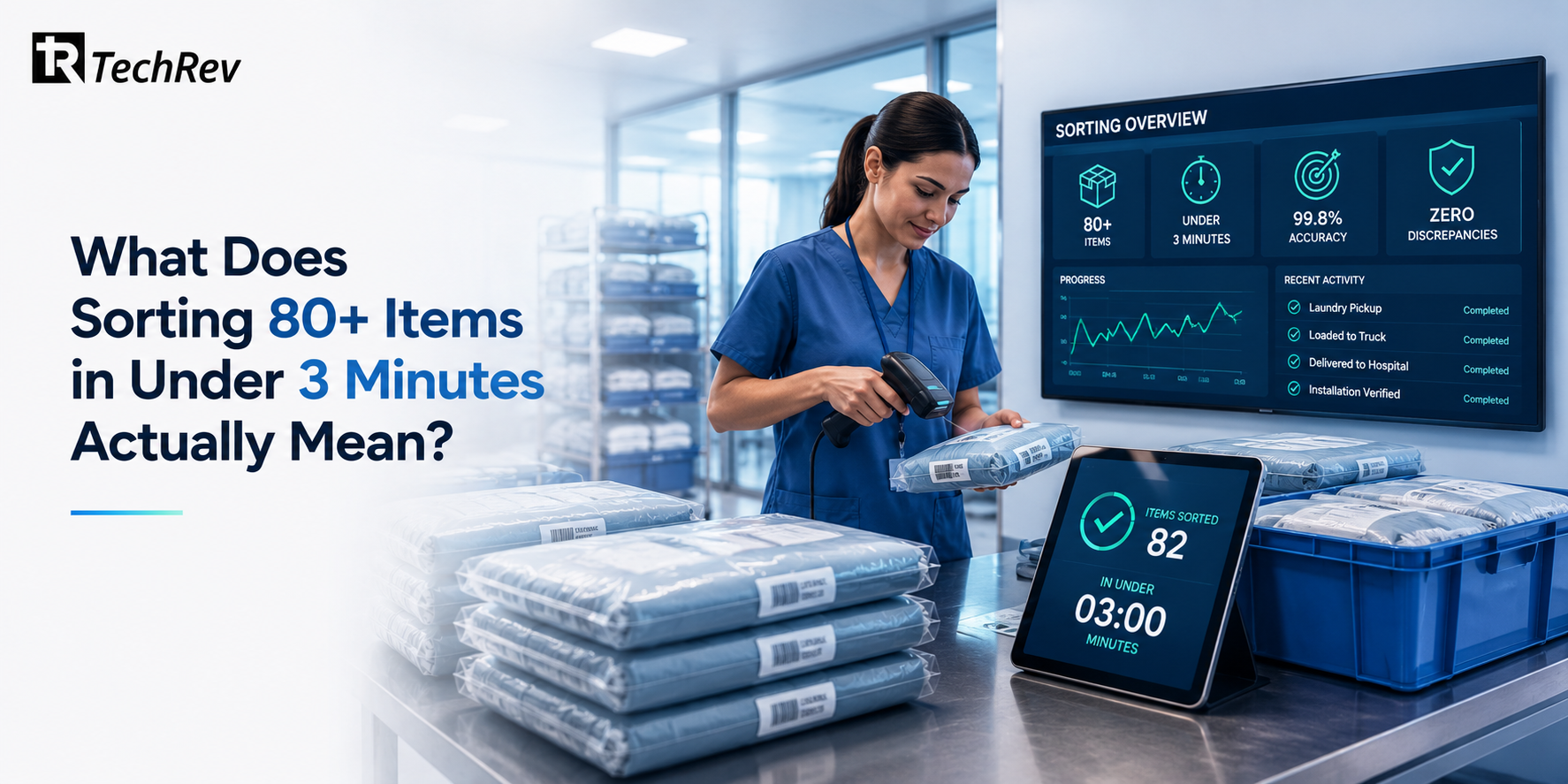
Sorting 80+ items in under 3 minutes means using barcode scanning, AI-driven workflows, and automated counting so that field staff can scan grouped items (like bags of hospital curtains), verify quantities, assign them to vehicles, and update inventory records instantly, instead of counting each item by hand.
Think about what manual sorting looks like. An installer picks up curtains from a laundry facility. Someone counts them one by one. Someone writes the count on a sheet. Someone types that sheet into a spreadsheet later, maybe. If two curtains go missing between the laundry and the hospital, nobody knows until a room is left without one.
Now flip the process. Curtains are grouped into bags. Each bag carries a barcode and a known curtain count. The installer scans each bag at pickup, scans it again while loading the truck, and the truck itself has its own barcode.
Three or four scans later, 80+ curtains are counted, verified, matched to a vehicle, and logged in the system. Total time: a couple of minutes. Total arguments about missing items: basically zero.
That is the chaos-to-clarity shift in one paragraph. And it is happening across the AI in healthcare industry right now.
Why Hospital Item Tracking Is Still Broken in 2026?
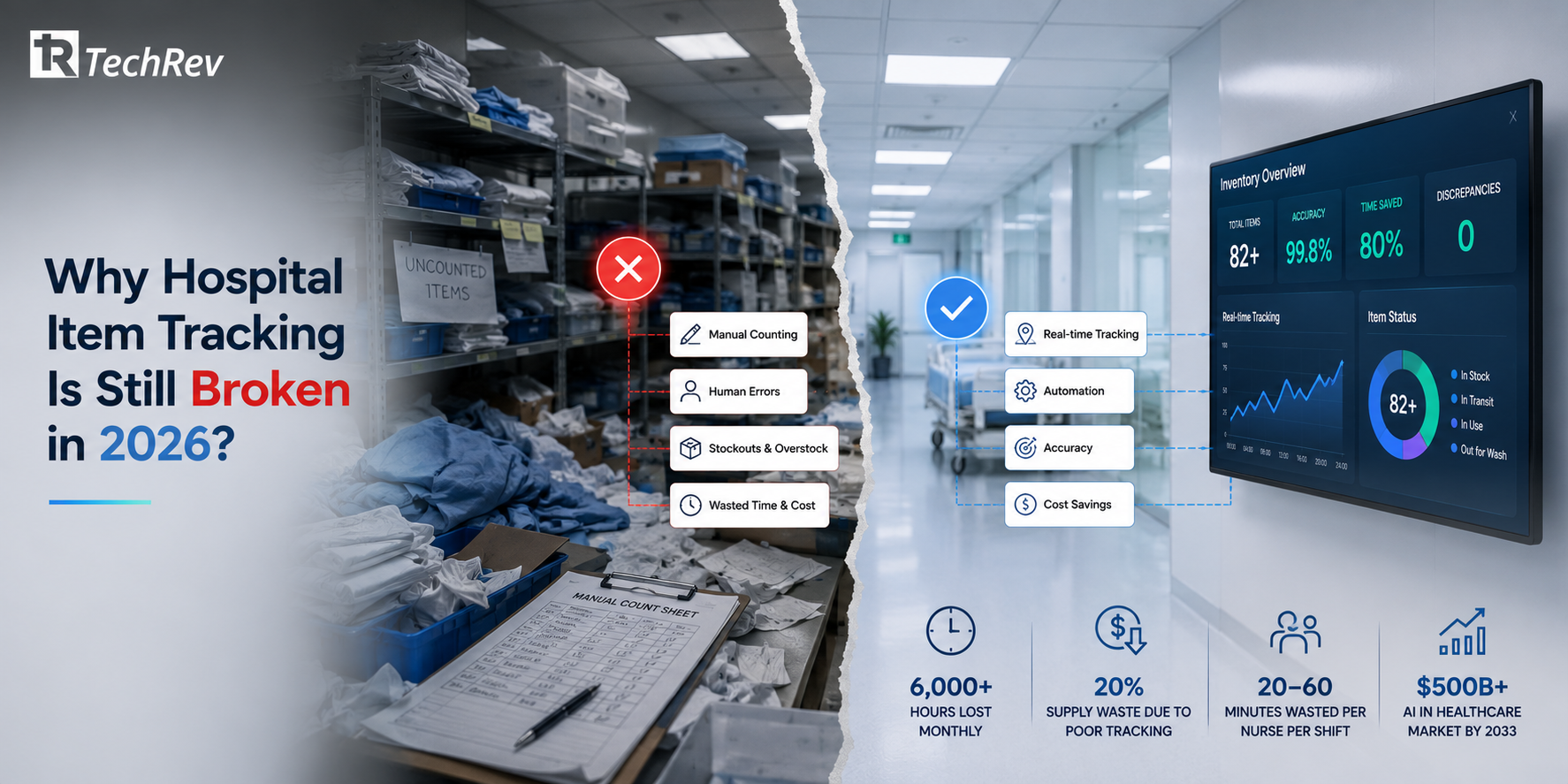
Before we talk about solutions, let’s be honest about the mess.
Hospitals are physically complicated. One facility can have multiple buildings, dozens of units, hundreds of rooms, and thousands of individual items that move constantly: curtains, linens, pumps, monitors, spare stock. Most facilities still track a shocking amount of this on paper, whiteboards, or tribal knowledge.
The cost of that mess is well documented:
- The Association for Health Care Resource & Materials Management found that nearly 20% of hospital supply expenses come from unnecessary overstocking or emergency orders caused by poor tracking.
- Industry research shows nurses can burn 20 to 60 minutes per shift locating equipment, which large hospitals translate into tens of thousands of lost working hours per year.
- When staff cannot find items, they hoard them or reorder them, which creates shortages in one wing and surplus in another.
Meanwhile, the money flowing into fixing this problem is enormous. Grand View Research values the global AI in healthcare market at 36.7 billion dollars in 2025, with projections crossing 500 billion dollars by 2033. North America alone holds about 54% of that market. Hospitals are not spending that money for fun. They are spending it because manual operations are bleeding them dry.
This is where hospital inventory management software and hospital facility management software development stop being nice-to-haves and start being survival tools.
How AI in Healthcare Sorts 80+ Items in Under 3 Minutes?
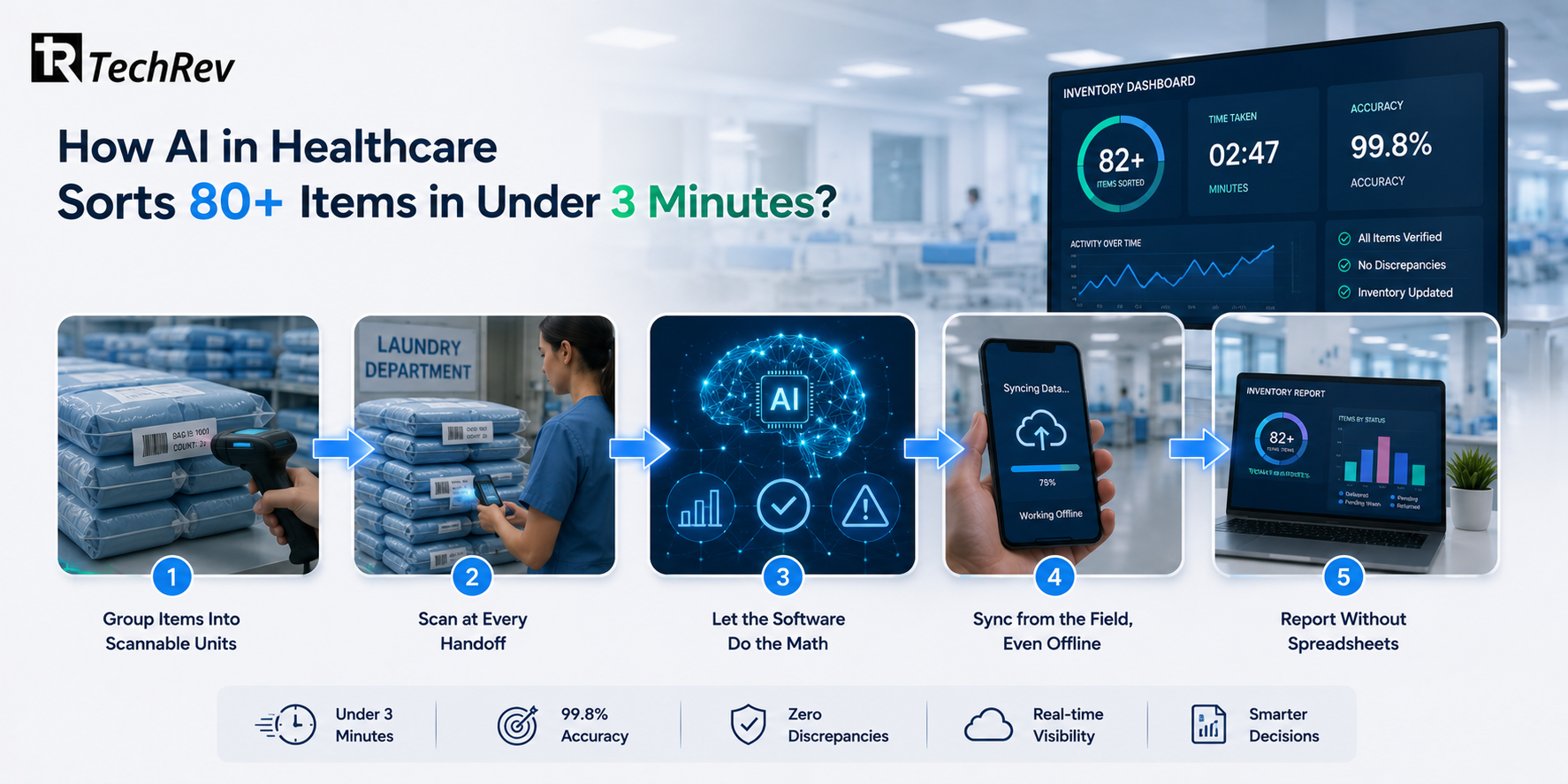
Here is the step-by-step process, optimized for anyone who wants the short version:
- Group items into scannable units. Individual curtains or supplies get bundled into bags, each with a barcode and a recorded item count.
- Scan at every handoff. Staff scan bags at the laundry, scan again at truck loading, and scan the vehicle barcode so the system knows exactly which items are on which truck.
- Let the software do the math. The platform totals counts automatically, flags mismatches instantly, and updates inventory in real time.
- Sync from the field, even offline. Mobile apps record scans, photos, and installation proof inside hospitals with weak connectivity, then sync when a signal returns.
- Report without spreadsheets. Dashboards show what was picked up, what is pending wash, what is ready for delivery, and what was returned.
This kind of healthcare workflow automation is the unglamorous side of AI, and honestly, it is where the fastest returns live. Industry data backs this up: the average ROI for AI in healthcare sits around 3.20 dollars for every dollar invested, with returns typically showing up within 14 months.
Also Read – How AI in Healthcare Cut Installation Errors by 90%?
CubeCare: A Real Example of AI Solutions in Healthcare at Work
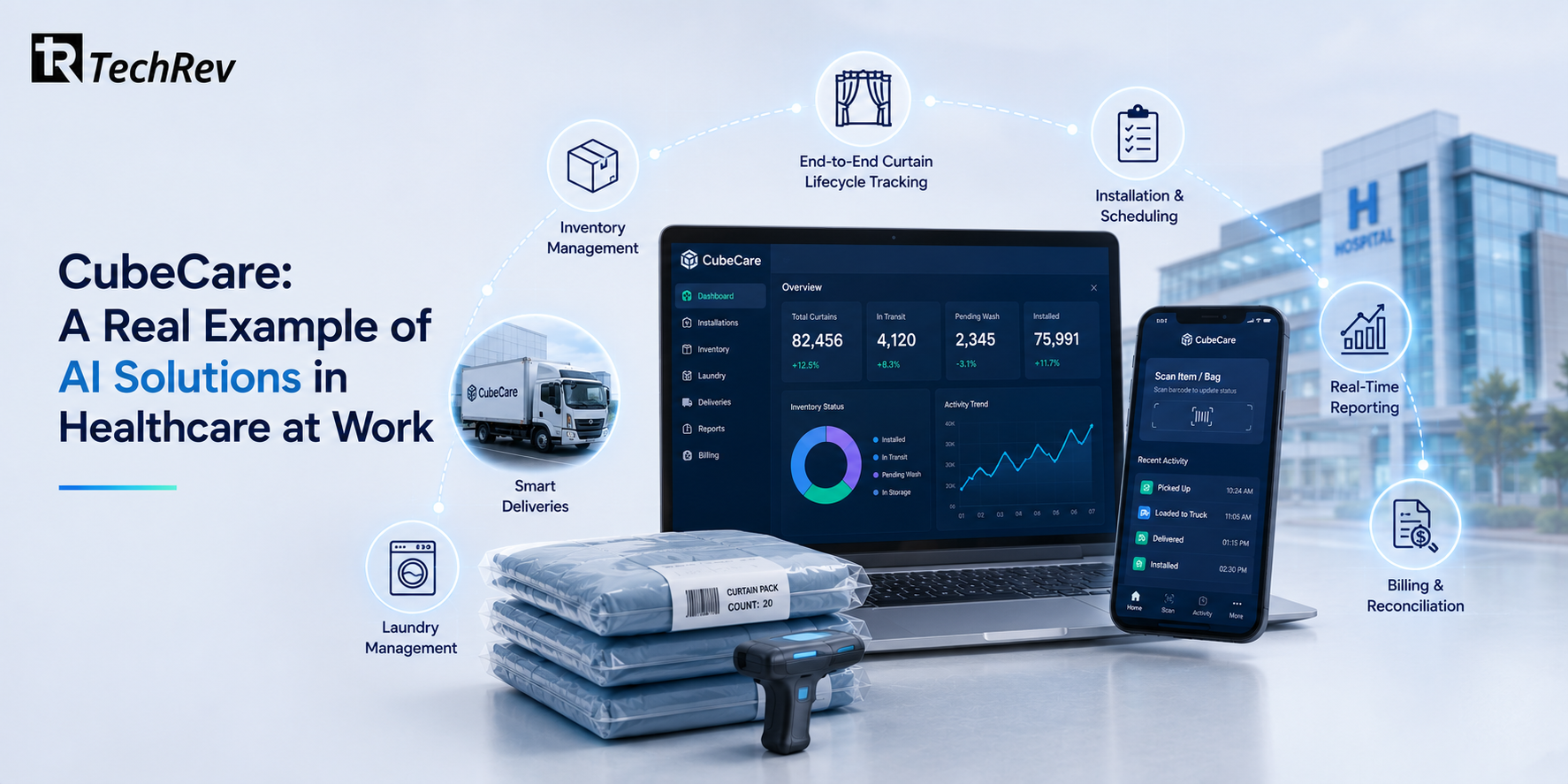
CubeCare is a business operations platform built over 10 years to solve one deceptively hard problem: managing hospital curtains at scale.
Tracking, washing, delivery, installation, scheduling, reporting, inventory, billing, barcode control, and accountability, all in one system. TechRev, a Florida-based custom software and AI agent development company, took on the job of modernizing this decade of hard-won business logic into a faster, cleaner, API-first platform.
Here is what CubeCare handles, and why each piece matters.
1. End-to-End Curtain Lifecycle Tracking
Every curtain gets tracked from installation to removal, washing, delivery, storage, reinstallation, and eventual retirement. The modernized platform organizes this lifecycle logic into clean APIs and domain modules, which makes tracking more reliable and far easier to extend.
This is the backbone of any serious Hospital Management software: if you cannot trace an item’s full life, you cannot manage it.
2. Barcode, Bag, and Truck Accountability
This is the “80+ items in under 3 minutes” engine. Earlier, CubeCare’s operators had no accurate count of how many curtains installers picked up from the laundry.
The bag system fixed that. Curtains are grouped into scanned bags, each bag’s curtain count is recorded, installers scan bags at laundry pickup and again at truck loading, and every vehicle has its own barcode.
The result: complete pickup-to-delivery accountability that can be audited in seconds.
3. Maintenance Schedules That Run Themselves
Hospitals need curtain maintenance on monthly, quarterly, yearly, or custom schedules. CubeCare plans visits, assigns work, tracks progress, and closes completed schedules automatically, with reminder logic and clean reporting built in. That is healthcare workflow automation doing the job a whiteboard never could.
4. Offline Mobile Work for Field Staff
Installers often work deep inside hospital buildings where connectivity dies. CubeCare’s mobile experience keeps working offline: curtain scanning, installation recording, photo capture, and visit updates all continue, then sync later.
For anyone evaluating healthcare application development services, offline-first field support is a detail that separates real operational software from demo-ware.
5. Proof of Work, Commissions, and Billing
The platform tracks who installed what, where, when, and with what photo proof. That feeds installer performance tracking and commission calculations.
On the money side, CubeCare supports pricing rules, invoice calculations, billing triggers, and a full audit trail of logs, comments, pricing changes, and user actions for dispute resolution. Accountability is not a feature here. It is the product.
6. Reporting That Answers Real Questions
- What was delivered?
- What is pending wash?
- Which hospital was serviced?
- Which installer completed the job?
- What inventory is missing?
- What needs billing?
CubeCare’s modernized reports answer these through fast Dapper-based queries and API-first delivery with filtering, sorting, and pagination. This is what a mature Service Management App looks like, and with intelligence layered on top, it becomes a true AI Service Management App.
Also Read – How Can AI in Healthcare Fix & Maximize Clinical Workflows?
Where Generative AI Fits Into All This?
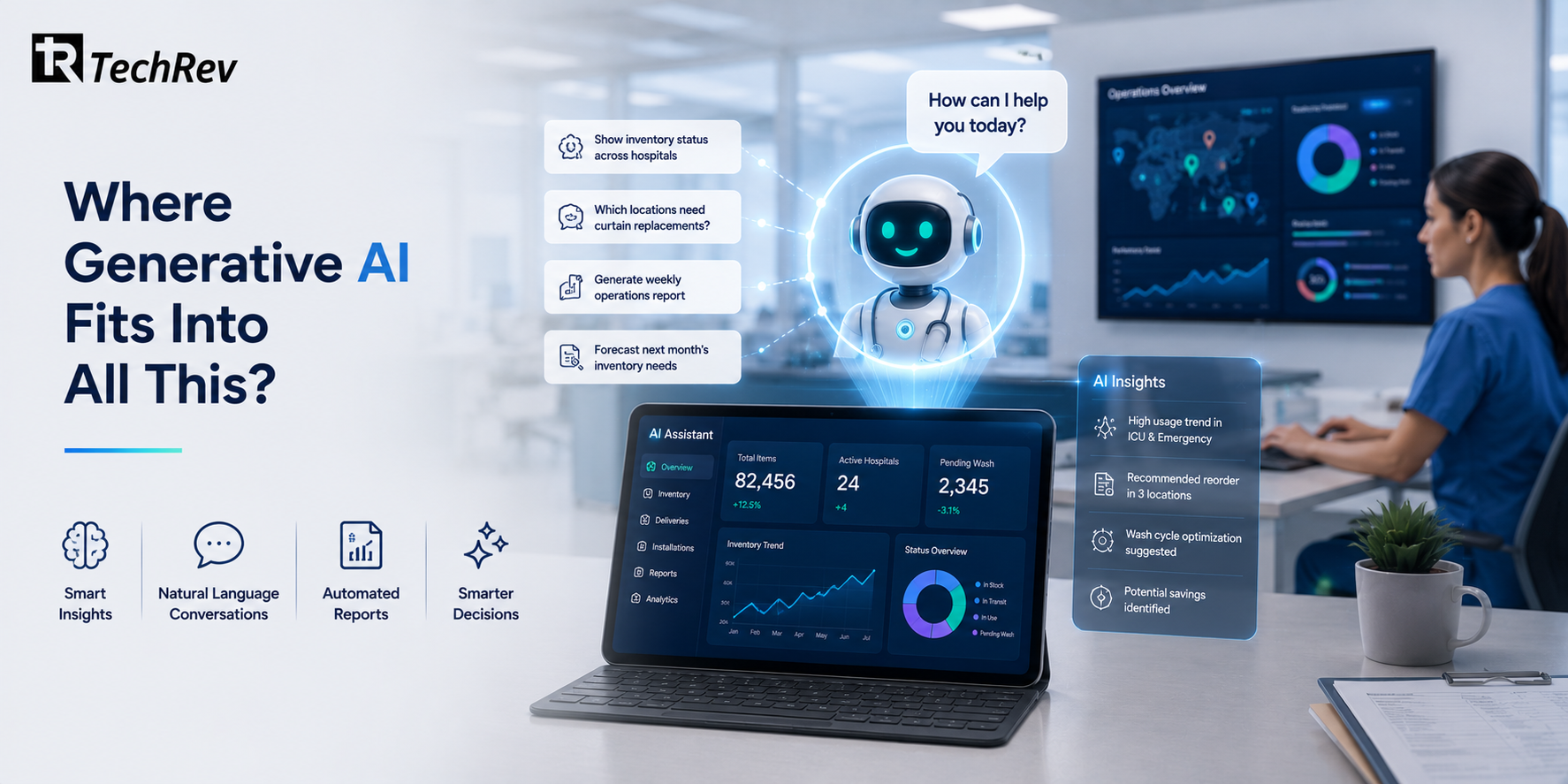
Barcode logistics is the foundation. Generative AI in healthcare is the next layer, and it is growing fast: from roughly 4.7 billion dollars in 2026 to a projected 39.8 billion dollars by 2035, according to Roots Analysis.
What does that layer look like in operational software?
- Conversational interfaces. Instead of digging through report filters, a manager asks, “Which hospitals have overdue quarterly visits?” and gets an answer. Conversational AI in healthcare turns dashboards into dialogue.
- AI agents for scheduling. AI agent development services can build agents that watch schedules, flag conflicts, rebalance installer workloads, and draft next month’s visit plan before a human even opens the calendar.
- LLM-powered reporting. Modern LLM development lets platforms summarize a month of operations in plain English, spot anomalies like a spike in missing items, and suggest fixes.
Adoption is not hypothetical anymore. A Doximity survey found 63% of US physicians were already using AI tools by early 2026, up from 47% just nine months earlier. The AI in healthcare industry has crossed from experiment to expectation.
How TechRev Helps You Get From Chaos to Clarity?
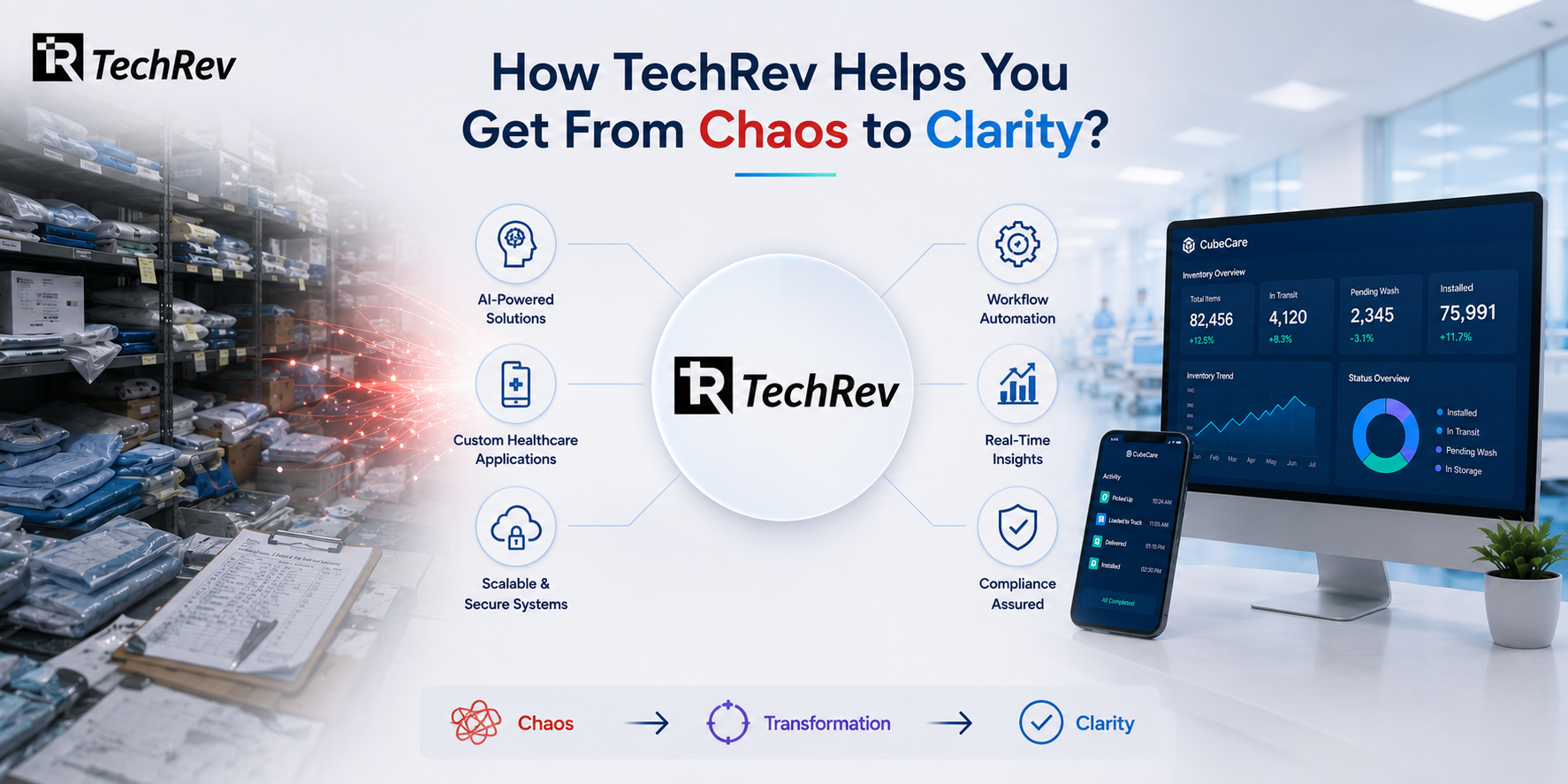
Here is the part where we tell you plainly what TechRev does, because after ten years of building and modernizing platforms like CubeCare, the team has earned the right to be direct.
TechRev is a USA-based company (established in 2016, headquartered in Florida) offering end-to-end AI development services and custom healthcare software development services. That includes:
- Generative AI development for chatbots, summarization, and intelligent automation
- AI application development services that embed intelligence into web and mobile products
- AI ML development services for predictive analytics, forecasting, and anomaly detection
- Healthcare software development services covering hospital inventory management software, scheduling systems, billing engines, and field service tools
- API development, cloud services, and IT staff augmentation to modernize legacy systems without pausing daily operations
What do clients actually get out of it?
- Lower operating costs. Cutting even a fraction of the 20% supply waste tied to poor tracking translates into six-figure annual savings for mid-sized facilities.
- Recovered staff hours. Replacing manual counting with barcode workflows returns hundreds of hours per month to patient-facing and revenue-generating work.
- Faster, cleaner billing. Automated billing triggers and audit trails shrink disputes and speed up cash flow.
- Realistic budgets. TechRev projects start around 5,000 dollars for simpler builds, with enterprise and AI-driven platforms starting near 25,000 dollars, and timelines run from 4 to 8 weeks for basic apps to 3 to 6 months for complex AI systems.
Modernizing does not mean throwing away your business logic. CubeCare proves that. Ten years of operational knowledge got preserved and made faster, not replaced.
Conclusion
Every hospital operations team lives somewhere on the spectrum between chaos and clarity. Chaos looks like clipboards, recounts, missing curtains, billing disputes, and 6,000 lost hours a month. Clarity looks like a scan, a sync, and a dashboard that already knows the answer.
The technology to make that jump is proven. The market data says the industry is sprinting toward it. And platforms like CubeCare show that even a decade-old operation can be modernized into something faster and more accountable without losing what made it work.
If sorting 80+ items still takes your team 80+ minutes, that is not a staffing problem. That is a software problem, and it is very fixable.
Ready to see what AI solutions in healthcare could do for your operations?
Talk to the TechRev team, share your messiest workflow, and get a concrete plan with real numbers attached. The chaos will not fix itself. The clarity part? That is where TechRev comes in.
FAQs
1. What AI development services does TechRev offer for healthcare companies?
TechRev builds AI chatbots and virtual assistants, machine learning and predictive analytics systems, computer vision tools, NLP solutions, recommendation engines, and robotic process automation.
For healthcare specifically, the team develops hospital operations platforms, inventory and scheduling systems, offline-capable mobile field apps, and AI-powered reporting, and can integrate AI into existing systems without a full rebuild.
2. How much does it cost to build Hospital Management software with TechRev?
Simple applications start around 5,000 dollars. Enterprise-grade or AI-driven platforms typically start at 25,000 dollars and up, depending on complexity, integrations, and design requirements. TechRev provides a detailed quote after understanding your exact operational needs.
3. How long does a custom healthcare software project take?
A basic app takes 4 to 8 weeks. A complex AI-powered platform usually needs 3 to 6 months, with a transparent timeline set at the start.
4. Can TechRev add AI to software my hospital already uses?
Yes. TechRev integrates AI features like automation, natural language processing, and predictive analytics directly into existing applications, so you modernize without losing years of built-in business logic.
5. Does TechRev provide support after launch?
Absolutely. Post-launch support covers bug fixes, performance optimization, security updates, and new feature development, so your platform keeps improving after day one.
6. Where is TechRev located?
TechRev LLC is headquartered in Florida, USA, and has been serving clients since 2016 with custom web, mobile, and AI solutions.