

Swift vs Kotlin is the first real decision you’ll make in any native mobile app development project, and it’s a decision that quietly shapes your budget, your hiring mobile app development team plan, and how fast you ship for the next three to five years. Pick wrong, and you’re not just rewriting code later. You’re rewriting your roadmap.
Here’s the good news: this isn’t actually about which language is better. Swift and Kotlin don’t compete for the same phone. One owns Apple’s ecosystem, the other owns Android’s, and the real question is which platform your users and your revenue live on.
This blog breaks down both languages with current 2026 data, real market numbers, performance facts, and hiring costs, so you can make this call with evidence instead of opinions.
Swift vs Kotlin: Quick Overview!
Swift is Apple’s official language for iOS app development, and Kotlin is Google’s preferred language for Android app development. Neither runs natively on the other’s platform.
- Choose Swift when your audience is iOS-first and revenue-focused.
- Choose Kotlin when you need Android’s massive global reach or shared code through Kotlin Multiplatform.
What Is Swift?
Swift is Apple’s open-source, statically typed programming language, introduced in 2014 as the modern successor to Objective-C. Today, Swift app development covers the entire Apple universe: iOS, iPadOS, macOS, watchOS, tvOS, and visionOS.
The current Swift 6.x generation is a big deal for anyone doing serious app development using Swift. It brought compiler-enforced concurrency that catches data races before your app ships, strict memory safety rules that reduce crashes, improved C++ interoperability for teams with legacy code, and even growing WebAssembly support. Paired with SwiftUI, Apple’s declarative UI framework, swift mobile app development in 2026 feels faster and safer than it ever has.
One thing Swift cannot do: build a native Android mobile app. There is no path from Swift to the Play Store. That single fact settles half of the Swift vs Kotlin debate before it starts.
What Is Kotlin?
Kotlin is a statically typed language created by JetBrains, first released in 2011, hitting version 1.0 in 2016. The turning point came in 2017, when Google announced Kotlin as its officially preferred language for Android app development. Since then, the majority of new Android code has been written in Kotlin, and it’s a first-class citizen in Android Studio.
The Kotlin 2.0 release and its stable K2 compiler made builds noticeably faster and smarter, which matters daily when your team is iterating. And Kotlin has one weapon Swift doesn’t: Kotlin Multiplatform (KMP), which is now production-ready and lets teams share business logic (networking, caching, validation) across Android, iOS, and even desktop, while keeping native UI on each platform. Companies like Netflix, Philips, and Cash App use it in production.
Swift vs Kotlin: What the 2026 Market Data Says?
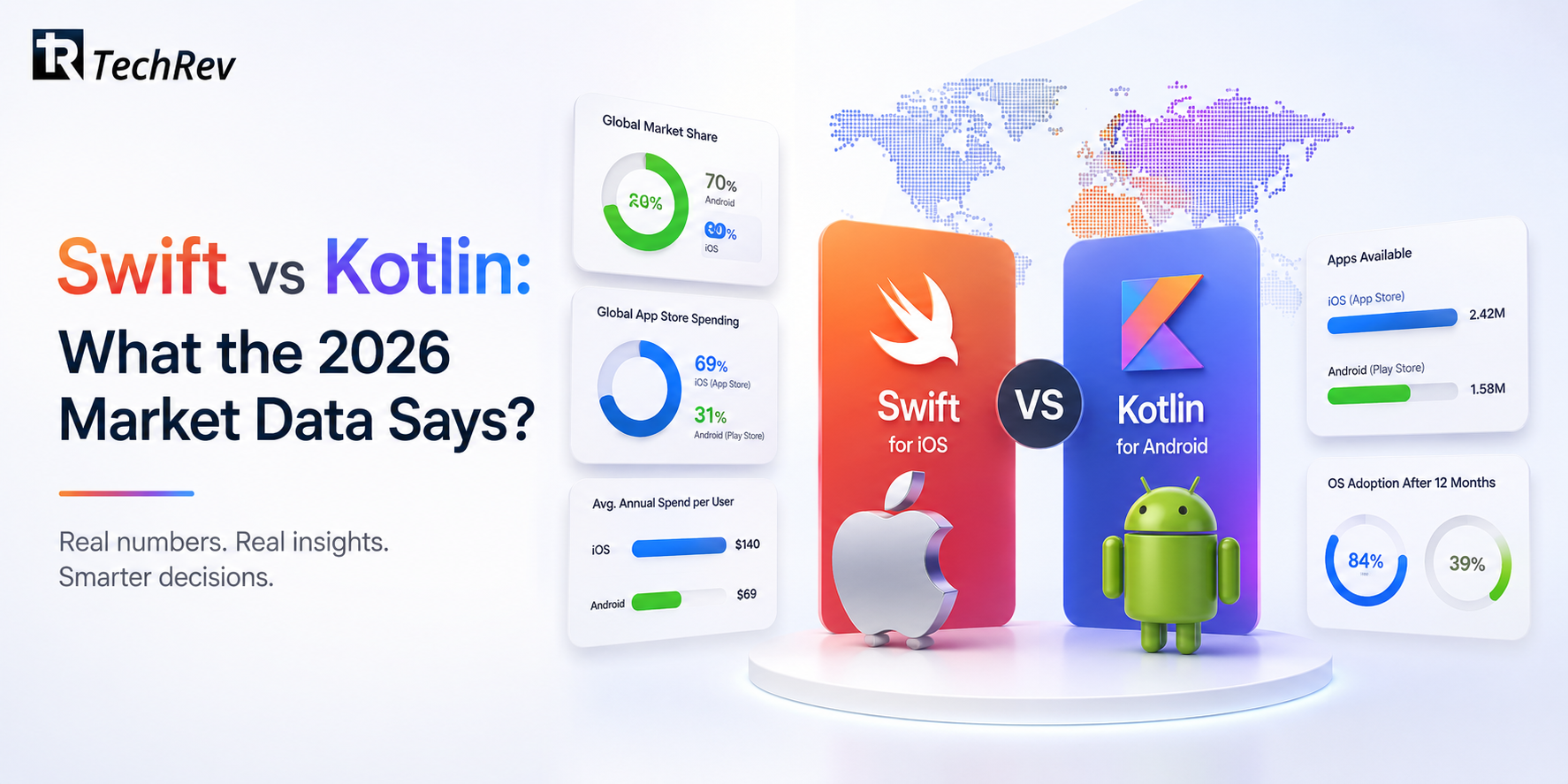
Before comparing syntax, look at where the users and the money actually are. This is the data that should drive your platform decision:
| Metric (2026) | Android / Kotlin Side | iOS / Swift Side |
| Global mobile OS share | ~68 to 70% (StatCounter) | ~29 to 32% |
| US market share | ~40% | ~60% (iPhone leads the US) |
| Global consumer app spending share | ~31% (Google Play, ~$52B in 2025) | ~69% (App Store, ~$115B in 2025) |
| Avg annual app spend per user | ~$69 | ~$140 |
| Apps available | ~1.58 million (Play Store) | ~2.42 million (App Store) |
| Latest OS adoption after 12 months | Android 15 at ~39% | iOS 18 at ~84% |
Read that table twice, because it tells two opposite stories that are both true:
- Android wins bodies. Roughly 7 of every 10 smartphones on Earth run Android, and in markets like India it’s around 95%. If reach is your business model, android app development is non-negotiable.
- iOS wins wallets. Despite holding under a third of devices, Apple’s App Store captured roughly 69% of the $167 billion in global in-app spending in 2025 (Sensor Tower). iPhone users spend about twice as much on apps per year.
So which platform makes more money per user? iOS, decisively. And which platform reaches more humans? Android, decisively. That’s why the honest answer to Swift vs Kotlin is usually it depends on your market, and eventually both.
Also Read – Top 15 Mobile App Development Challenges in 2026
Swift vs Kotlin: Language and Technology Compared
1. Swift vs Kotlin: Syntax and learning curve
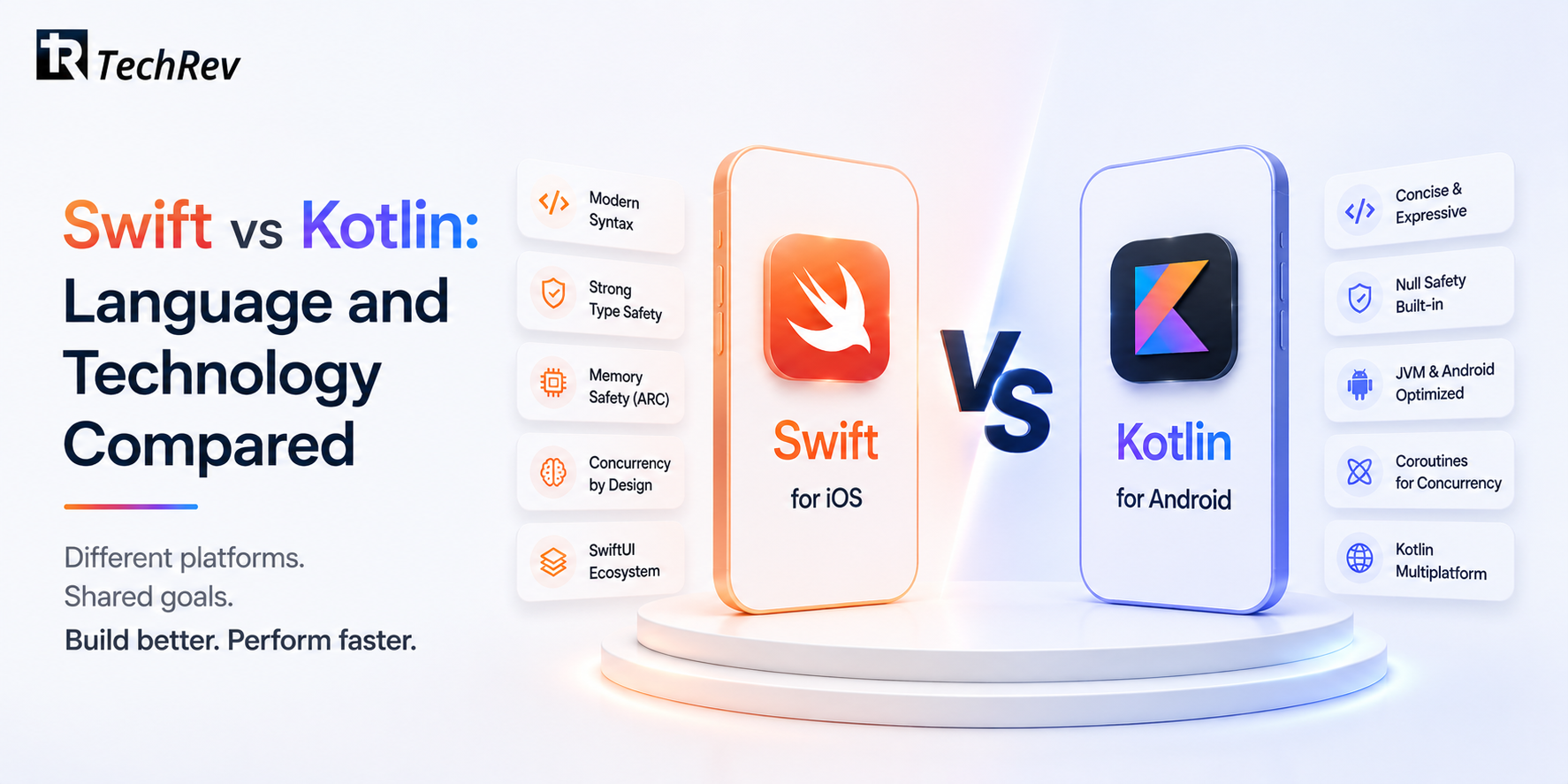
Both languages were designed to fix the pain of their predecessors (Objective-C and Java), so they feel surprisingly similar: clean, concise, expressive, and modern.
Developers switching between them report a short adjustment period, not a rewrite of their brain. If your team knows one, learning the other is weeks, not months.
2. Swift vs Kotlin: Null safety: the crash killer
Both Swift and Kotlin build null safety directly into the type system. In Kotlin, a variable can’t hold null unless you explicitly allow it.
Swift does the same through optionals. Why does this matter for your budget? Null pointer errors were historically among the most common crash causes in Java-era Android apps. Fewer null crashes means fewer 1-star reviews and fewer emergency patches.
3. Swift vs Kotlin: Memory management
Swift uses Automatic Reference Counting (ARC), which releases memory deterministically and predictably, one reason iOS apps feel smooth on relatively modest RAM.
Kotlin on Android runs on a garbage-collected runtime, which is highly optimized in 2026 but can introduce brief collection pauses in memory-heavy apps. For most business apps, users will never notice either. For animation-heavy or real-time apps, ARC’s predictability gives swift mobile app development a slight edge.
4. Swift vs Kotlin: Concurrency
Swift 6’s strict concurrency model is arguably the biggest recent leap in either language: the compiler itself refuses to build code containing data races.
Kotlin counters with coroutines, a mature, elegant system for asynchronous work that most Android developers genuinely love. Both are excellent. Swift’s is stricter; Kotlin’s is more flexible.
5. Swift vs Kotlin: Build times and daily productivity
Developer benchmarks published in 2026 put Kotlin slightly ahead: full builds around 1 to 3 minutes versus Swift’s 2 to 4, with faster incremental builds too, thanks largely to the K2 compiler. Neither is painful anymore, but over a six-month project, faster iteration compounds.
6. Swift vs Kotlin: The AI factor (this is the 2026 trend that matters)
On-device AI is now a standard user expectation, and each language has a home-field advantage. Swift integrates directly with Apple’s Core ML and on-device intelligence APIs, the only first-class route to Apple’s machine learning stack. Kotlin pairs with TensorFlow Lite and Google’s ML Kit for on-device AI in android app development.
If AI features are core to your product, your platform choice decides your AI toolkit too. (This is exactly the kind of decision TechRev’s dedicated developers help clients make, since AI-integrated apps are the core of what they build.
Performance: Is Swift Faster Than Kotlin?
Direct answer: in raw compiled performance, Swift and Kotlin are close enough that language speed should not drive your decision. Swift compiles to native binaries with no virtual machine, which gives it an edge in compute-heavy and graphics-heavy workloads. Kotlin’s JVM-based runtime carries slight overhead but is deeply optimized for Android hardware.
The performance question that actually matters is different: a well-architected app in either language will outperform a poorly architected app in the faster one, every single time. Architecture and developer skill matter far more than the language logo. Which is a polite way of saying: who you hire matters more than what they type.
Also Read – Top Programming Languages for iOS App Development in 2026
What About Hiring? Cost of Swift and Kotlin Developers
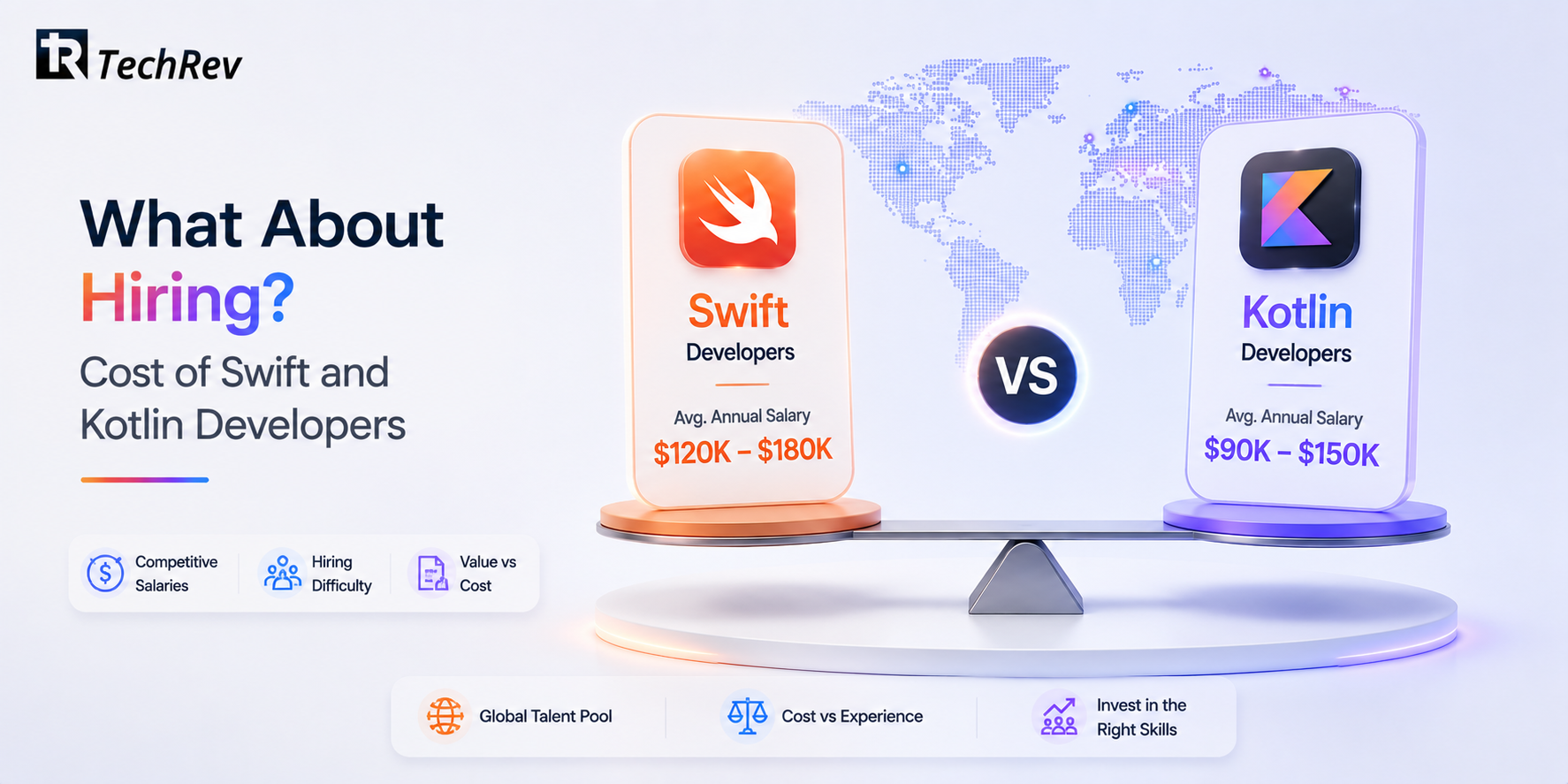
Here’s where Swift vs Kotlin gets practical. In 2026, US salaries for mid-to-senior mobile engineers are nearly neck-and-neck across platforms; the old iOS pays more gap has mostly closed. US mobile developers average roughly $101,000 to $134,000 in base salary depending on the source, before the 25 to 30 percent that benefits and overhead add.
That’s why so many companies choose to hire Kotlin developers or hire Swift developers through a development partner instead of building payroll:
- Talent pool. Android’s global dominance means when you hire Kotlin developers, you’re drawing from a larger worldwide pool, which typically means lower rates and faster hiring. Teams that hire Swift developers are fishing in a smaller, more Apple-specialized pond.
- Speed. Recruiting a senior native engineer in-house takes months. A partner that already employs both can start in days.
- Flexibility. Need app development using Swift for six months and then just maintenance? A dedicated-developer model lets you scale down without severance conversations.
Should you hire a freelancer or an agency for native development? For a production app, an established team wins on accountability: one contract covering design, development, QA, and support beats coordinating four freelancers and hoping their code styles agree. If you want to hire Kotlin developer talent or Swift specialists with a warranty attached, that’s the agency model’s entire pitch.
When Should You Choose Swift?
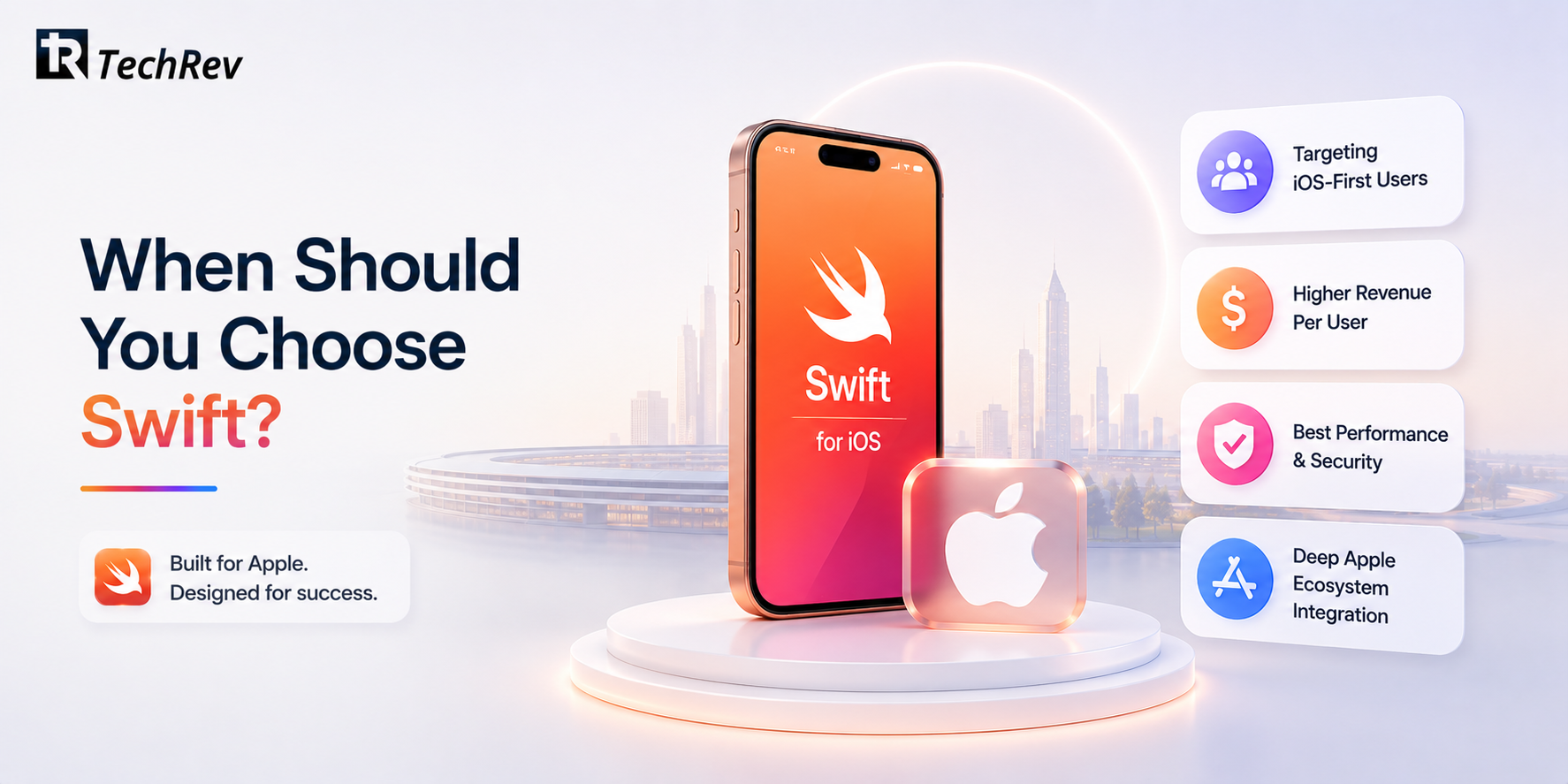
Choose Swift and iOS app development first when:
- Your market is the US, UK, Japan, or Australia, where the iPhone leads or dominates premium segments. The iPhone holds roughly 60% of the US market.
- Revenue per user is your model. Subscriptions and premium pricing convert dramatically better on iOS, which captures about two-thirds of global app spending.
- You want fast OS adoption. With iOS 18 reaching ~84% of iPhones within a year, swift mobile app development teams can target new APIs almost immediately instead of supporting five OS versions.
- You need Apple’s hardware and AI stack. HealthKit, Metal graphics, visionOS, Core ML. App development using Swift is the only first-class ticket to all of it.
When Should You Choose Kotlin?
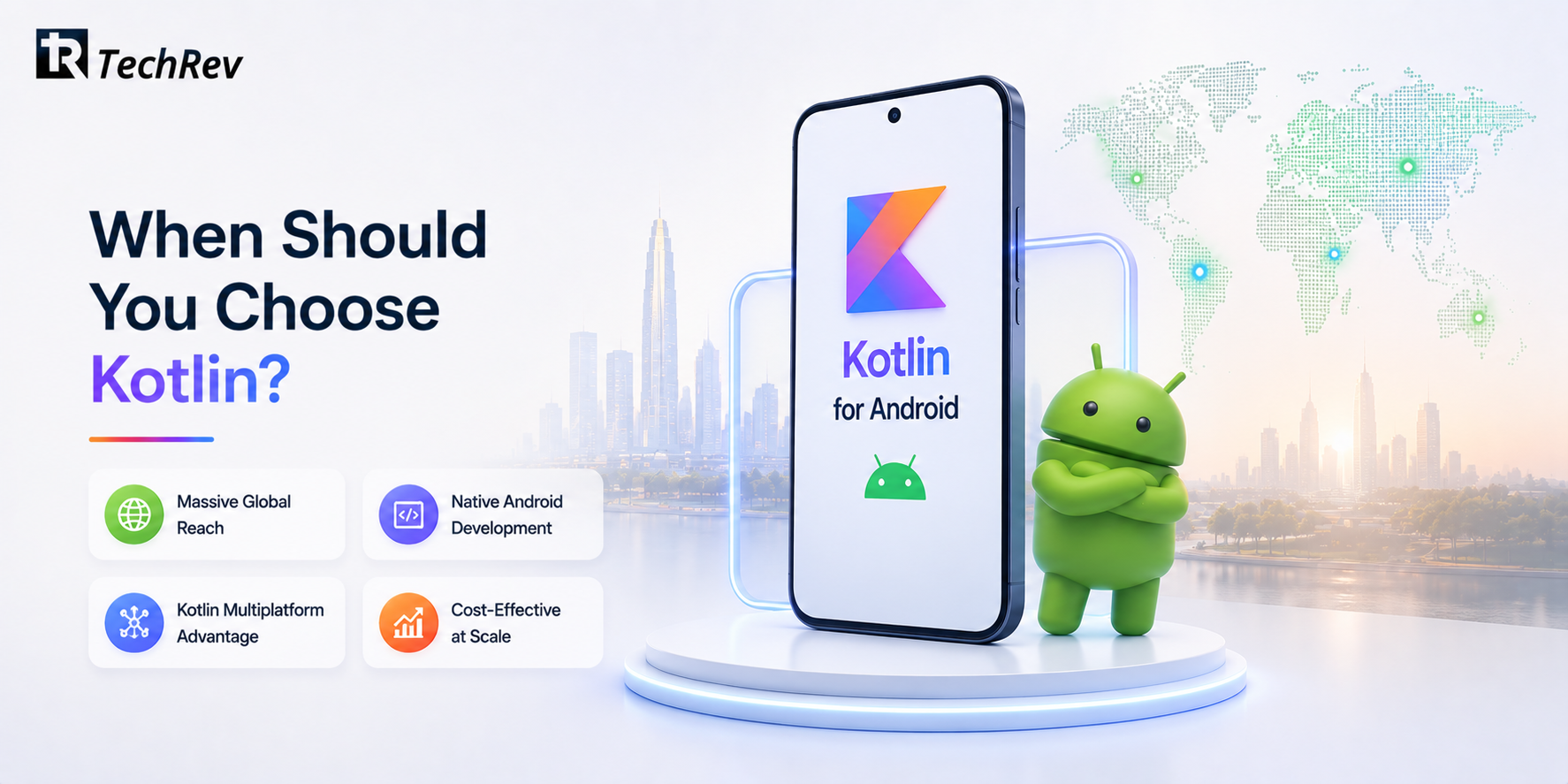
Choose Kotlin and android app development first when:
- Your market is global or emerging-market heavy. India (~95% Android), Brazil, Southeast Asia, Africa. Reach lives on Android.
- Your model is volume. Ad-supported apps and mass-market services need Android’s 3.9+ billion active users.
- You want shared code with a future iOS app. Kotlin Multiplatform lets kotlin app development services build your business logic once and reuse it when you expand to iOS, cutting long-term cost.
- You’re integrating with Java systems. Kotlin’s seamless Java interoperability makes Kotlin app development services the natural choice for enterprises with existing JVM backends, just as swift app development is the natural fit for Apple-centric stacks.
And if you need both platforms? Most funded products eventually do. Then the question stops being Swift vs Kotlin and becomes sequencing: which platform first, and whether KMP or a cross-platform framework bridges the gap. That’s a strategy conversation, not a syntax one.
Also Read – Top 10 Proven UI/UX Design Best Practices to Win Users in 2026
How TechRev Helps You Win on Either Platform?
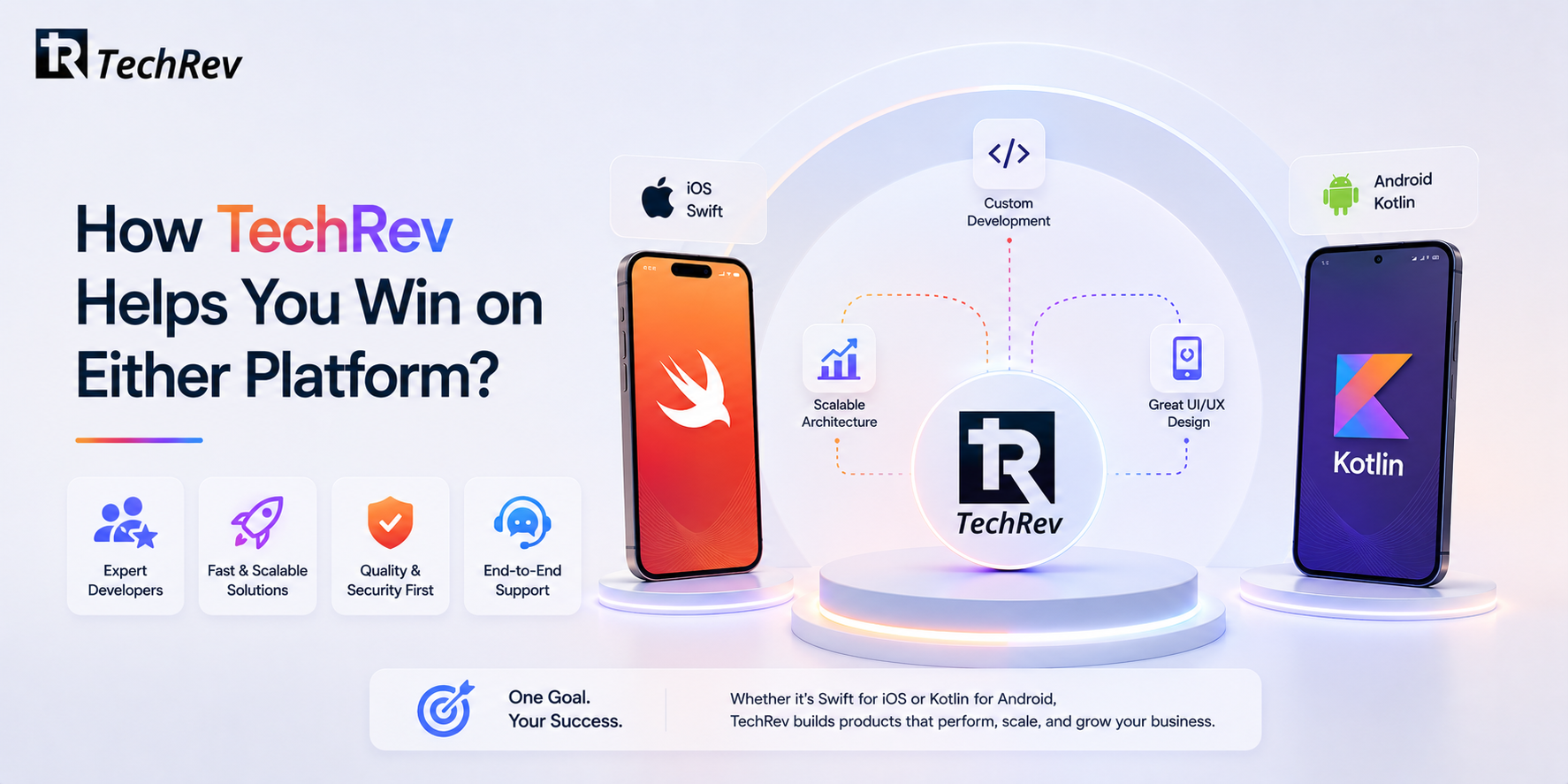
Time for the practical part. Knowing the Swift vs Kotlin landscape is useful; having a team that has shipped on both since 2016 is better. TechRev is a Florida-based, USA custom software development company that has spent a decade building exactly these products, including AI-powered apps for healthcare clients like remote patient monitoring platforms.
Here’s what that means for your project, in numbers:
- Lower entry cost. TechRev’s projects start from $5,000 for simple apps, with enterprise and AI-driven builds from $25,000+. Compare that with $130,000 to $175,000 per year for a single fully loaded US developer, and the math on your first version gets easy.
- Faster launch. A basic app ships in 4 to 8 weeks; complex AI-powered solutions run 3 to 6 months, with a transparent timeline set upfront. No hiring cycle, no ramp-up months.
- Both stacks under one roof. TechRev builds native iOS app development projects in Swift, delivers kotlin app development services for Android, and handles cross-platform builds too, so the platform recommendation you get is based on your market data, not on which developers they happen to have.
- Flexible team models. Through its Hire Dedicated Developers and IT staff augmentation services, you can hire Swift developers or hire Kotlin developers who work as an extension of your team, scaling up or down per sprint.
- AI built in, not bolted on. From chatbots and predictive analytics to image recognition and NLP, TechRev integrates AI into new or existing apps, on either platform’s native ML stack.
- Support after launch. Bug fixes, performance optimization, security updates, and feature enhancements are part of the engagement, which protects you from the maintenance surprise that wrecks most first-year app budgets.
The business outcome is simple: you get senior-level mobile app development at a project price instead of a payroll price, you launch months sooner, and you keep the flexibility to change direction without restructuring a team.
Also Read – Flutter vs React Native 2026: Best for AI-Powered Mobile Apps?
Conclusion
Here’s the truth most Swift vs Kotlin articles bury: the language comparison is a tie on quality. Both are modern, safe, fast, and here to stay. The comparison that actually decides your success is market data. Android’s ~70% device share versus iOS’s ~69% revenue share. Your users sit on one side of that split, and that’s your answer.
Get the platform right, then get the team right. If you’d rather have a decade-experienced partner run that analysis for your specific product, TechRev will scope your project, recommend Swift, Kotlin, or both with the reasoning attached, and give you a transparent quote to plan around.
Ready to build?
Talk to TechRev’s experts and turn the Swift vs Kotlin question into a launch date.
FAQs
1. Is Kotlin replacing Swift, or Swift replacing Kotlin?
Neither. They serve different platforms. Swift is the default for Apple platforms; Kotlin is the default for Android. In 2026 both rank among the world’s most used languages (TIOBE places Swift around #12 and Kotlin around #16), and both are actively evolving.
2. Which is easier to learn, Swift or Kotlin?
They’re comparably beginner-friendly, with clean modern syntax and strong official documentation. Kotlin is slightly easier for developers coming from Java; Swift is the natural path for anyone in the Apple ecosystem.
3. Can Kotlin build iOS apps?
Partially. Kotlin Multiplatform can share business logic with iOS, and it’s production-proven at companies like Netflix and Cash App. But the iOS user interface is still built natively, typically in Swift.
4. Is Swift only for mobile?
No. Swift app development spans iPhone, iPad, Mac, Apple Watch, Apple TV, and Vision Pro, and server-side Swift exists through frameworks like Vapor, though it remains niche compared to JVM backends.
5. Which is more cost-effective for a startup, Swift or Kotlin?
It depends on your first market. US-focused, revenue-first products usually earn faster on iOS. Global, volume-first products need Android’s reach. If the budget only covers one platform, follow your paying users, not the device count.
6. What does TechRev charge for native app development?
Simple apps start from $5,000, while enterprise or AI-driven apps start at $25,000+, with a detailed quote after scoping. Basic builds ship in 4 to 8 weeks.
7. Does TechRev handle both Swift and Kotlin projects?
Yes. TechRev develops native iOS apps in Swift, Android apps in Kotlin, and cross-platform apps, and has been doing it since 2016 from its base in Florida, USA.
8. Can I hire dedicated Swift or Kotlin developers from TechRev?
Yes. TechRev’s dedicated developer and staff augmentation models let you add native mobile engineers to your team without long-term commitments, scaling as your roadmap demands.
9. Will TechRev add AI features to an app I already have?
Yes. TechRev integrates AI into existing apps, including chatbots, recommendation engines, image recognition, NLP, and predictive analytics, using each platform’s native machine learning tools.