
Every founder who has shipped an app knows the truth. Mobile app development challenges do not show up one at a time. They show up together, usually in the last three weeks before launch.
The global mobile application market is projected to grow from roughly $322.6 billion in 2026 to $885.3 billion by 2033, expanding at a compound annual growth rate of 15.5%. That growth brings opportunity, but it also brings competition, higher user expectations, and more technical complexity than most businesses expect when they start.
At TechRev, we have spent years building mobile app development services for startups, SMEs, and enterprises across the USA. This blog breaks down the real mobile app development challenges teams face in 2026, backed by data, and shows you exactly how a capable mobile app development company solves each one. Bookmark this. You will need it before your next sprint.
What Are the Biggest Mobile App Development Challenges in 2026?
The most common mobile app development challenges include device and OS fragmentation, rising mobile app development cost, weak security practices, poor UX design, slow performance, AI integration complexity, cross-platform testing gaps, app store rejections, low user retention, and difficulty finding the right mobile app development agency. Businesses that plan for these challenges early reduce delays, control budgets, and launch apps that actually retain users.
Why Mobile App Development Challenges Matter More in 2026?
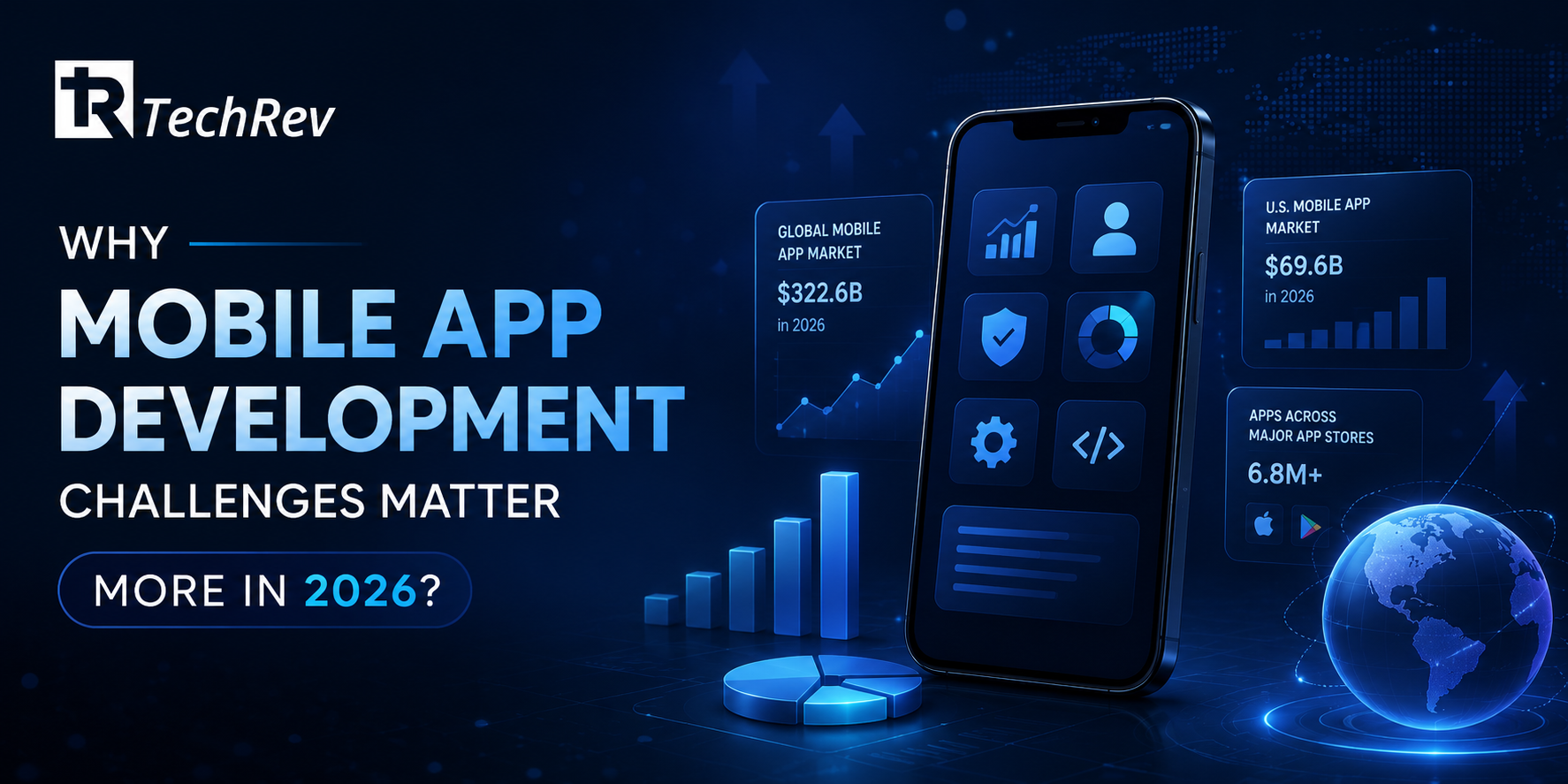
Mobile apps are no longer “nice to have.” They are the primary channel businesses use to reach customers. The U.S. mobile application market alone is projected to reach close to $70 billion in 2026, and Android now holds over 72% of the global operating system market compared to roughly 27% for iOS.
That split alone creates one of the earliest mobile app development challenges any business faces: which platform do you build for first, and how do you avoid doubling your budget?
Here is what else is shaping the landscape right now:
| Metric | 2026 Data Point |
| Global mobile app market size | $322.6 billion, growing to $885.3B by 2033 |
| U.S. mobile application market | Approximately $69.6 billion |
| Android global OS market share | 72.55% |
| iOS global OS market share | 27.04% |
| Typical mobile app development cost | $30,000 to $150,000 (enterprise apps often exceed $300,000) |
| Average annual app maintenance cost | 15% to 25% of original development cost |
| Apps available across major app stores | Over 6.8 million combined (Apple App Store and Google Play) |
| IT projects that go over budget | 45% (Gartner) |
These numbers explain why businesses cannot treat mobile app development as a side project. It requires strategy, the right technology stack, and a team that has actually solved these problems before.
The 15 Biggest Mobile App Development Challenges in 2026
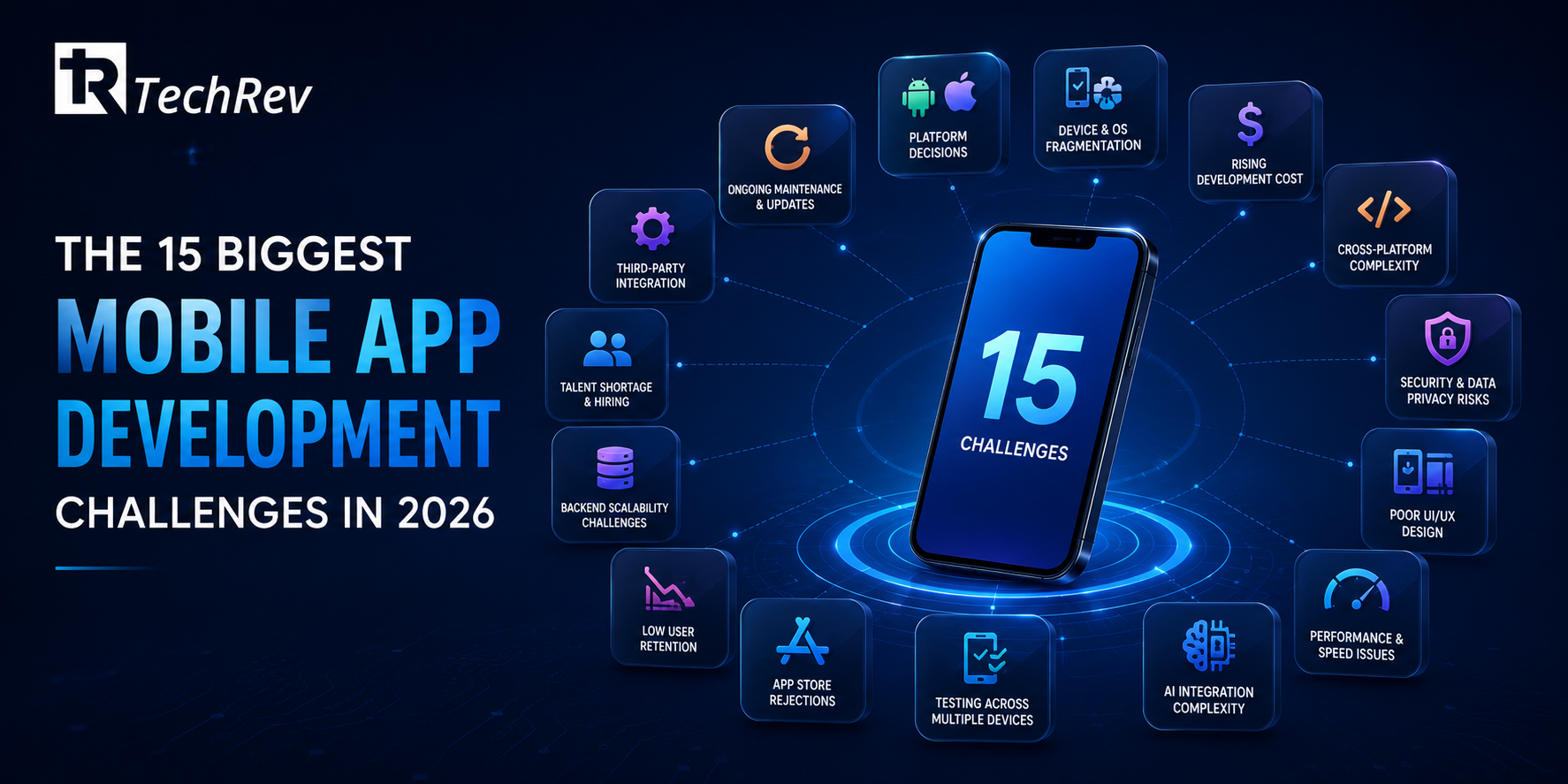
The following are some:
1. Choosing Between Android App Development and iOS First
This is usually the first decision founders get wrong. Android app development gives you access to a larger global audience, since Android runs on more than 72% of smartphones worldwide. iOS users, however, spend more per app and generate a disproportionate share of in-app revenue.
How to solve it?
Look at where your target audience actually spends money, not just where they exist. A B2B SaaS tool aimed at U.S. enterprise buyers often performs better starting on iOS. A consumer app targeting emerging markets usually needs Android app development first.
2. Device and OS Fragmentation
Android alone runs on thousands of device variations, different screen sizes, chipsets, and OS versions. An app that runs perfectly on one device can lag, crash, or misrender on another.
How to solve it?
Use responsive layouts built on relative units instead of fixed pixels, test on a representative device matrix, and rely on frameworks that abstract hardware differences instead of hardcoding for a single device profile.
3. Rising Mobile App Development Cost
Mobile app development cost is one of the most searched, and most misunderstood, topics in this industry. Most functional apps cost between $30,000 and $150,000, while enterprise-grade, AI-integrated platforms can exceed $300,000.
On top of that, businesses spend 15% to 25% of the original build cost every year on maintenance.
How to solve it?
Ask your mobile app development company for a detailed cost breakdown by feature, not a flat quote. Prioritize a lean first release, then expand based on real user data.
Here is a general cost range by app type:
| App Type | Estimated Mobile App Development Cost |
| Simple MVP (basic features) | $15,000 to $40,000 |
| Mid-complexity app (payments, APIs, custom UI) | $40,000 to $120,000 |
| Enterprise or AI-integrated app | $120,000 to $300,000+ |
| Ongoing annual maintenance | 15% to 25% of build cost |
4. Cross-Platform Complexity
Building separately for Android and iOS doubles your timeline and budget. This is why react native app development and flutter app development exist. Both let teams write one codebase and deploy to Android and iOS, cutting release cycles by up to 60% when paired with proper CI/CD pipelines.
How to solve it?
Use react native app development when you need strong third-party library support and a JavaScript-based team. Choose flutter app development when you want pixel-perfect custom UI and near-native performance from a single Dart codebase.
If your app is deeply tied to Apple’s ecosystem, native swift app development still delivers the smoothest performance on iPhone, iPad, and Apple Watch.
5. Security and Data Privacy Risks
Codebases frequently contain vulnerabilities, and fragmentation across devices and OS versions widens the attack surface. A single breach can expose sensitive user data and destroy trust permanently.
How to solve it?
Build encryption, secure authentication, and regular penetration testing into the development pipeline from day one. Do not treat security as a post-launch patch.
6. Feature Overload and Poor UX Design
Companies often try to include every feature at once. New features may grab attention initially, but they usually confuse first-time users, and confusion drives uninstalls.
How to solve it?
Launch with core features only. Use structured design systems like Material Design for Android app development to keep the interface consistent, then expand based on user feedback.
7. Performance and Battery Optimization
Slow load times, laggy animations, and high battery drain are some of the fastest ways to lose users. Performance issues usually come from inefficient code, oversized files, and excessive network calls.
How to solve it?
Move heavy processing to the cloud instead of the device. Use profiling tools like Xcode Instruments or Android Studio Profiler to catch bottlenecks before launch, not after.
8. AI Integration Without Breaking the App
AI is now expected in most apps, from personalization to smart search. But integrating large AI models directly on-device increases app size, slows installation, and can hurt performance if implemented poorly.
How to solve it?
Run heavy AI models on cloud servers instead of bundling them into the app. Lightweight frameworks like TensorFlow Lite work well for on-device tasks that need to run instantly.
9. Testing Across Thousands of Device and OS Combinations
Mobile testing is harder than website testing because apps must function across far more hardware and software combinations, plus varying network conditions including slow, unstable, or zero connectivity.
How to solve it?
Combine manual and automated testing. Do not rely on a single QA pass. Test under real-world network conditions, not just on office Wi-Fi.
10. App Store Approval and Compliance
Apple and Google both enforce strict review guidelines. Apps get rejected for privacy policy gaps, broken functionality, or misleading metadata, and every rejection delays your launch.
How to solve it?
Review the latest App Store and Play Store guidelines before submission, not after rejection. Build compliance checks into your QA checklist from the start.
11. User Retention and High Uninstall Rates
Some estimates suggest mobile apps lose up to 90% of users over time, often tied directly to poor UX, technical bugs, or weak onboarding.
How to solve it?
Invest in a frictionless onboarding flow, personalized push notifications, and lightweight gamification. Personalized notifications alone can lift engagement by roughly 20%.
12. Backend Scalability
An app that works fine with 500 users can collapse under 50,000. Weak backend architecture is one of the most expensive mobile app development challenges to fix after launch.
How to solve it?
Build on cloud-ready infrastructure from day one, using services like AWS or Google Cloud, so the backend scales with demand instead of buckling under it.
13. Budget and Timeline Overruns
Unclear scope is the number one reason mobile app development projects go over budget. Gartner reports that IT projects overshoot budgets by an average of 45%.
How to solve it?
Use a prioritization framework like MoSCoW to rank must-have versus nice-to-have features before development starts. Align every stakeholder on scope before writing a single line of code.
14. Finding the Right Mobile App Development Company
The market is full of agencies claiming expertise. Not every mobile app development agency has the technical depth to handle enterprise-scale apps, and choosing the wrong partner is one of the costliest mistakes a business can make.
How to solve it?
Ask for case studies, technical stack details, and direct references. A serious mobile app development company will show you real work, not just a portfolio slideshow.
15. Post-Launch Maintenance and Updates
Launch is the beginning, not the finish line. OS updates, new device releases, and security patches require continuous attention. Businesses that ignore this see apps degrade fast.
How to solve it?
Set up a maintenance plan before launch, covering crash monitoring, performance tracking, and scheduled feature updates.
Mobile App Development Tips That Actually Move the Needle
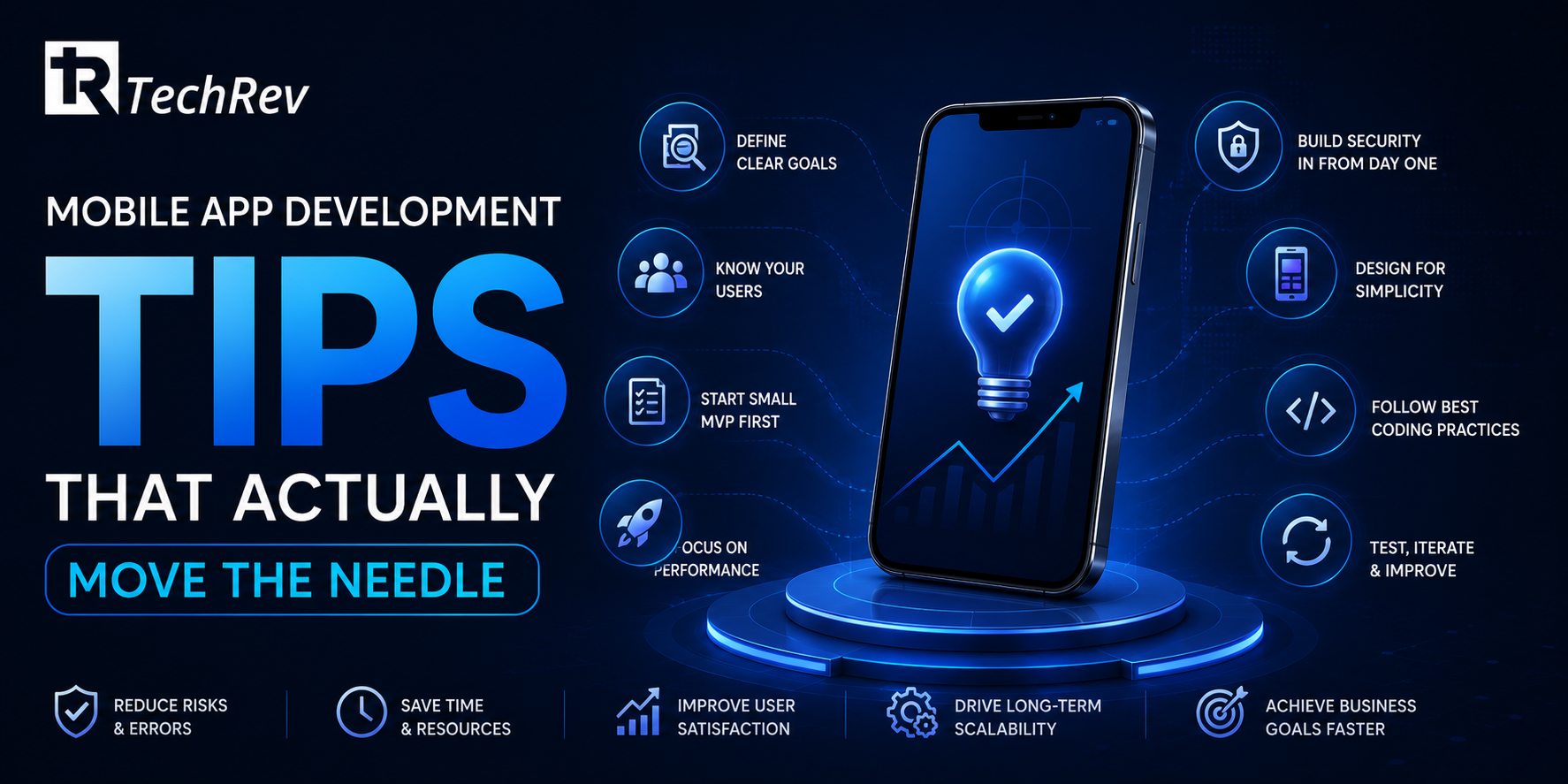
If you take nothing else from this guide, take these mobile app development tips. They come directly from what separates apps that scale from apps that quietly disappear from the app store.
- Start with an MVP. Launch with core features, then expand based on real usage data, not assumptions.
- Pick the right framework early. React native app development and flutter app development both support fast, cross-platform builds, while swift app development remains the strongest choice for iOS-only, performance-critical apps.
- Design for the slowest connection, not the fastest. Your app should still function on patchy 4G, not just office Wi-Fi.
- Automate testing. Manual QA alone cannot cover thousands of device and OS combinations.
- Track mobile app development cost by feature. This makes it easier to cut scope without derailing the whole timeline.
- Build security in from day one. Retrofitting encryption after launch is far more expensive than building it in from the start.
- Plan for maintenance before you plan for launch. Budget 15% to 25% of your build cost annually for updates and fixes.
How long does mobile app development actually take?
A simple MVP typically takes 4 to 8 weeks. A mid-complexity app with custom integrations usually takes 3 to 5 months. A large, AI-powered enterprise platform can take 6 months or longer, depending on scope and integrations.
How to Hire Mobile App Developers Without Wasting Your Budget?
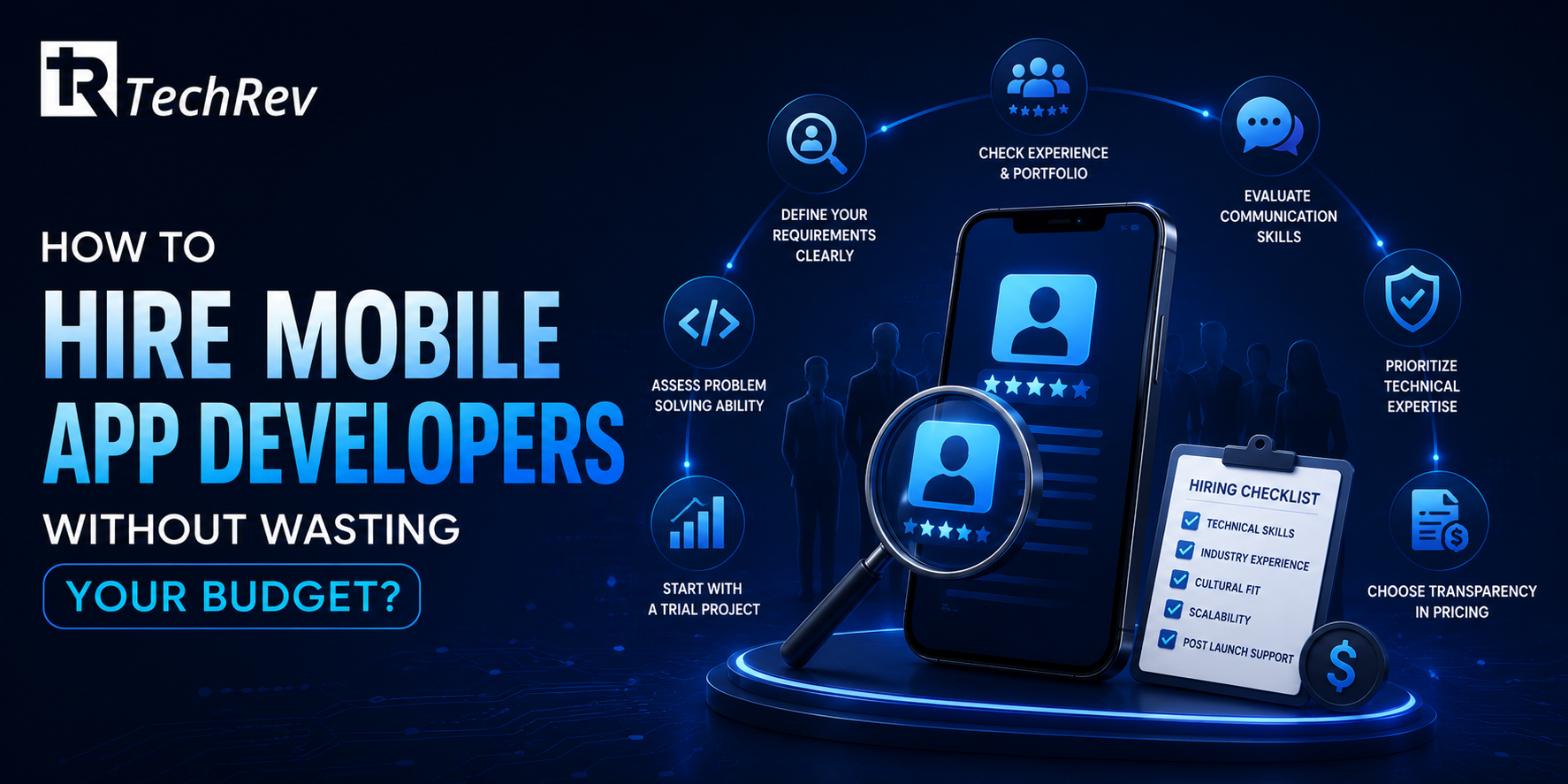
Businesses that hire mobile app developers without a clear evaluation process usually end up paying twice, once for the failed build, and again for the rebuild. Here is what to check before you sign a contract.
- Ask for platform-specific proof. Getting into the Apple App Store requires a different approach than Google Play. Confirm the team has shipped apps on both.
- Review their technology stack. A capable team should be comfortable across react native app development, flutter app development, and native swift app development, not locked into one framework regardless of project fit.
- Check communication structure. Poor cross-team communication is one of the top reasons mobile app development costs spiral out of control.
- Look at post-launch support. Ask directly how they handle bug fixes, OS updates, and scaling after the app goes live.
- Compare in-house teams versus a mobile app development agency. An agency gives you an entire team, design, backend, QA, and project management, without the overhead of hiring each role individually.
Should I hire an in-house developer or a mobile app development agency?
Most startups and SMEs get more value from a mobile app development agency, since it provides design, engineering, QA, and project management as one team, without the cost or delay of building an in-house department from scratch.
Why Do Businesses Choose TechRev as Their Mobile App Development Partner?
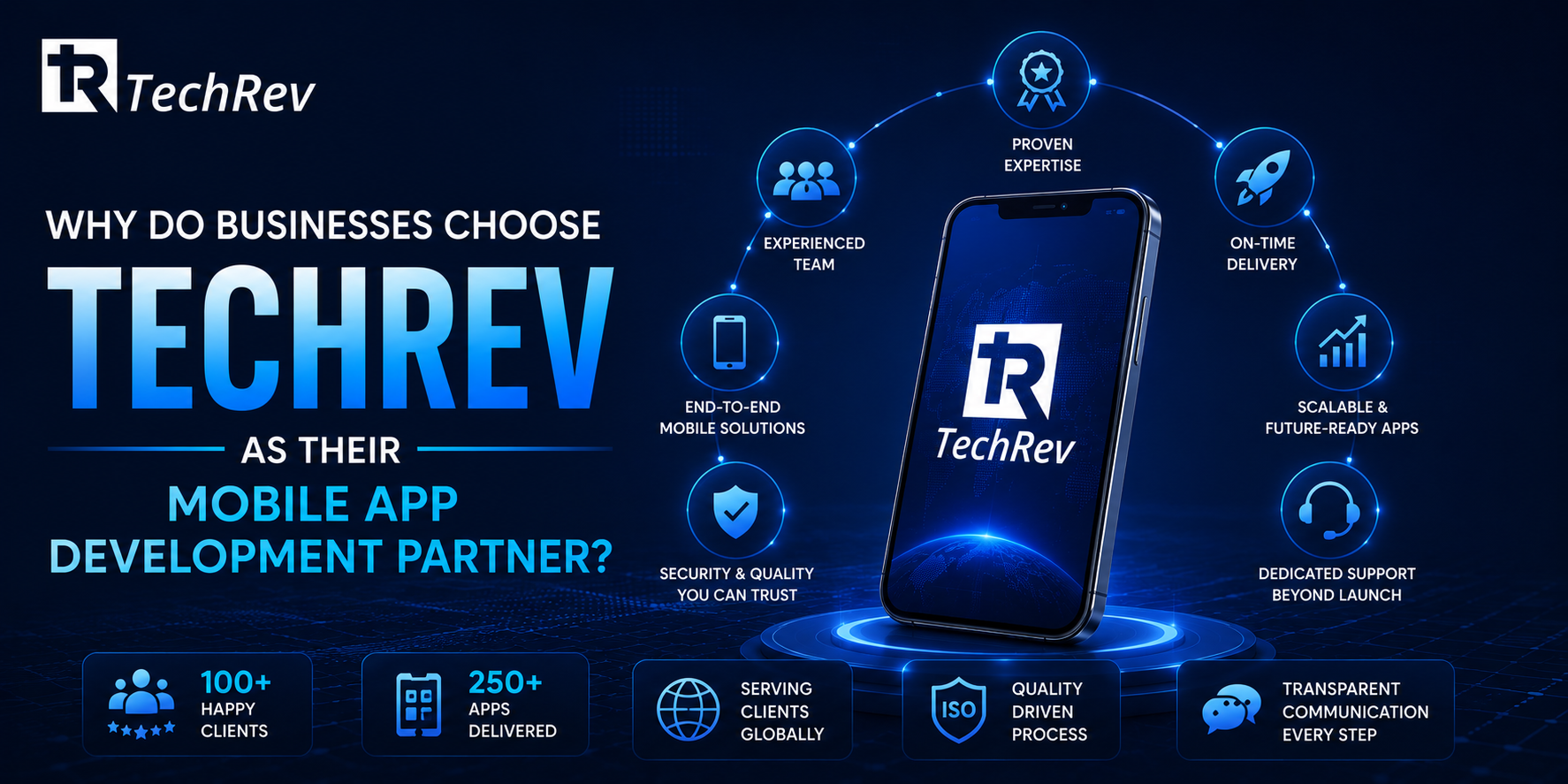
TechRev is a USA-based mobile app development company trusted by startups, SMEs, and enterprises for mobile app development services that focus on stability, not just speed. Here is how we directly solve the mobile app development challenges covered in this guide.
- Android app development and iOS coverage. We build native and cross-platform apps that perform consistently across devices.
- React native app development and flutter app development. Our teams build cross-platform apps using Flutter and React Native, giving you one codebase that performs like native software on both Android and iOS.
- Native swift app development. For iOS-first products, our Swift app development team builds fast, secure apps optimized for iPhone, iPad, and Apple Watch.
- Transparent mobile app development cost. We provide a detailed cost breakdown by feature before development starts, so there are no surprise invoices halfway through your project.
- Security built in from day one. Encryption, secure authentication, and compliance checks are part of our standard build process, not an afterthought.
- Post-launch support. Our team handles monitoring, updates, and scaling long after launch, because a mobile app development agency that disappears after delivery is not a real partner.
If you are comparing options and want a mobile app development company that treats your app like a long-term product instead of a one-time project, get in touch with TechRev for a free consultation.
Conclusion
Mobile app development challenges are not going away, they are getting more technical as AI, security requirements, and user expectations rise together. But every challenge covered in this guide has a proven solution, and businesses that plan ahead consistently outperform those that build reactively.
Whether you need android app development, react native app development, flutter app development, or native swift app development, the difference between an app that scales and one that quietly fails usually comes down to one decision: the mobile app development company you choose to build it with.
Ready to build something that actually lasts? Talk to TechRev’s mobile app development team today and get a clear, honest breakdown of your project before you spend a dollar.
FAQs
1. What are the biggest mobile app development challenges businesses face today?
The biggest mobile app development challenges include device fragmentation, rising development cost, security risks, poor UX, slow performance, AI integration complexity, and finding a reliable mobile app development company that can deliver on time and on budget.
2. How much does mobile app development cost in 2026?
Most apps cost between $30,000 and $150,000, depending on features and complexity, while enterprise-grade or AI-powered apps can exceed $300,000. Annual maintenance typically adds another 15% to 25% of the original build cost.
3. Is flutter app development better than react native app development?
Neither is universally better. Flutter app development offers strong custom UI control and near-native performance from a single codebase. React native app development offers wider library support and works well for teams with JavaScript experience. The right choice depends on your app’s design complexity and your team’s existing skill set.
4. Should I choose native swift app development or cross-platform frameworks?
Choose swift app development if your app is iOS-only and needs maximum performance, deep integration with Apple hardware, or advanced device features. Choose cross-platform frameworks like Flutter or React Native if you need to launch on Android and iOS quickly with a single codebase.
5. How do I hire mobile app developers I can actually trust?
Ask for case studies, platform-specific experience, and direct client references before you hire mobile app developers. A reliable mobile app development agency will walk you through their technology stack, timeline, and post-launch support plan without hesitation.
6. What makes a good mobile app development company different from a bad one?
A good mobile app development company gives you transparent pricing, a clear technology stack, real case studies, and ongoing post-launch support. A weak one hides costs, disappears after delivery, and cannot explain its own development process in plain terms.
7. Does TechRev provide mobile app development services outside the USA?
TechRev is based in Florida, USA, and works with clients across the country and internationally, delivering mobile app development services for startups, SMEs, and enterprise businesses in any industry.
8. What industries does TechRev build mobile apps for?
TechRev has delivered mobile apps across healthcare, finance, e-commerce, recruiting, and enterprise software, using Flutter, React Native, Kotlin, and Swift depending on each project’s requirements.
9. Can TechRev help if my current app is already built but has performance issues?
Yes. TechRev’s team audits existing codebases, identifies performance bottlenecks, and rebuilds or optimizes problem areas without requiring a full app rebuild in most cases.
10. How fast can TechRev start a new mobile app project?
Most projects begin within one to two weeks of the initial consultation, once TechRev’s team finishes scoping features, timeline, and technology stack with your business.