
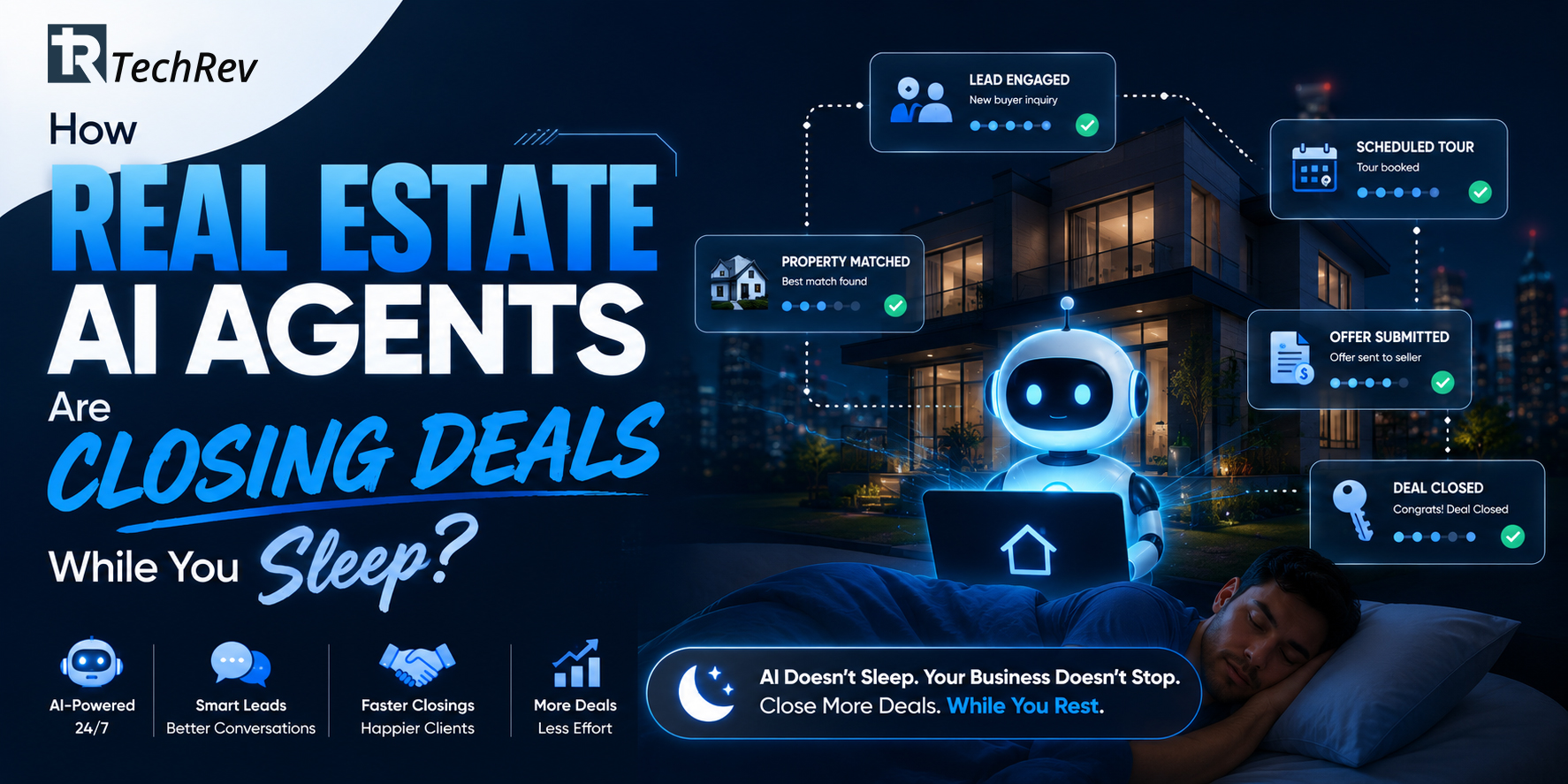
A buyer fills out a contact form on your listing at 9:47 PM on a Tuesday.
By 9:50 PM, they are scrolling through Zillow. By 10:02 PM, a competing agent has already texted them. By 10:18 PM, that buyer is booked for a weekend showing.
Your lead is gone.
Here is the number that makes this hurt more: 78% of homebuyers end up working with the first agent who responds to their inquiry. Not the most experienced agent. Not the one with the best listings. Simply the first one who responds.
And the average real estate agent takes 917 minutes, more than 15 hours, to respond to a new lead.
That gap is not just a missed opportunity. It is a structural leak in your revenue pipeline. And in 2026, real estate AI agents were built specifically to seal it.
The best AI agents today do not just answer inquiry forms. They qualify leads, score intent, schedule showings, run six-month nurture sequences, process lease applications, and walk prospects to a signed contract without a human needing to be awake.
This blog is a ground-level look at how real estate AI agents work across the entire pipeline, what the data says about their impact, and how TechRev builds the custom real estate mobile app development and AI infrastructure that makes all of this possible.
What Are Real Estate AI Agents? And Why Are They Nothing Like Old Chatbots?
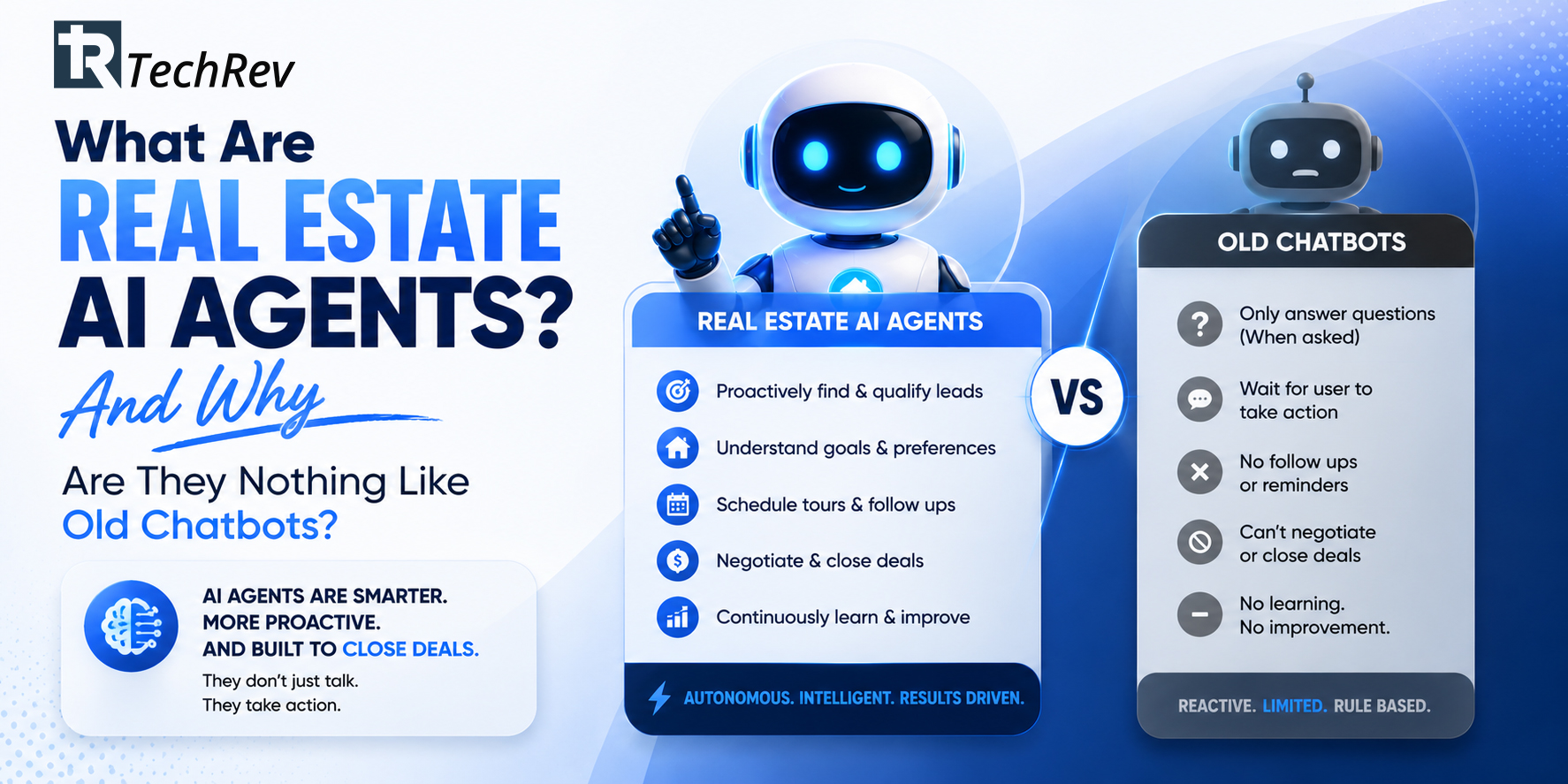
Most people hearAI agent and picture a customer service bot that answers FAQs and occasionally sends the wrong canned response.
Real estate AI agents in 2026 are something completely different.
A real estate AI agent is an autonomous, multi-step reasoning system. It receives a lead, asks qualifying questions, scores that lead against predefined criteria, books appointments directly into calendars, sends property matches based on stated preferences, follows up across SMS and email, and escalates to a human only when the lead crosses a threshold worth a live conversation.
The shift from chatbot to AI agent has happened in three clear phases:
| Phase | Period | What It Did? |
| Scripted bots | 2018 to 2022 | Rigid press 1 for sales flows that frustrated users |
| AI copilots | 2023 to 2024 | ChatGPT-powered tools that could draft emails and basic replies |
| Autonomous AI agents | 2025 to 2026 | Multi-step systems that qualify, score, nurture, and escalate independently |
The core difference is reasoning. A chatbot follows a script. A real estate AI agent reads context, adjusts questions mid-conversation based on what a lead already shared, detects intent signals across multiple platforms, and changes strategy accordingly.
For example, PropPhy’s 2026 research found that leads spending over three minutes on payment plan pages were five times more likely to convert. A well-built AI agent catches that signal automatically and escalates immediately.
Also Read – How Real Estate Automation Is Reshaping Property Businesses?
What Happens Without Real Estate AI Agents in 2026?
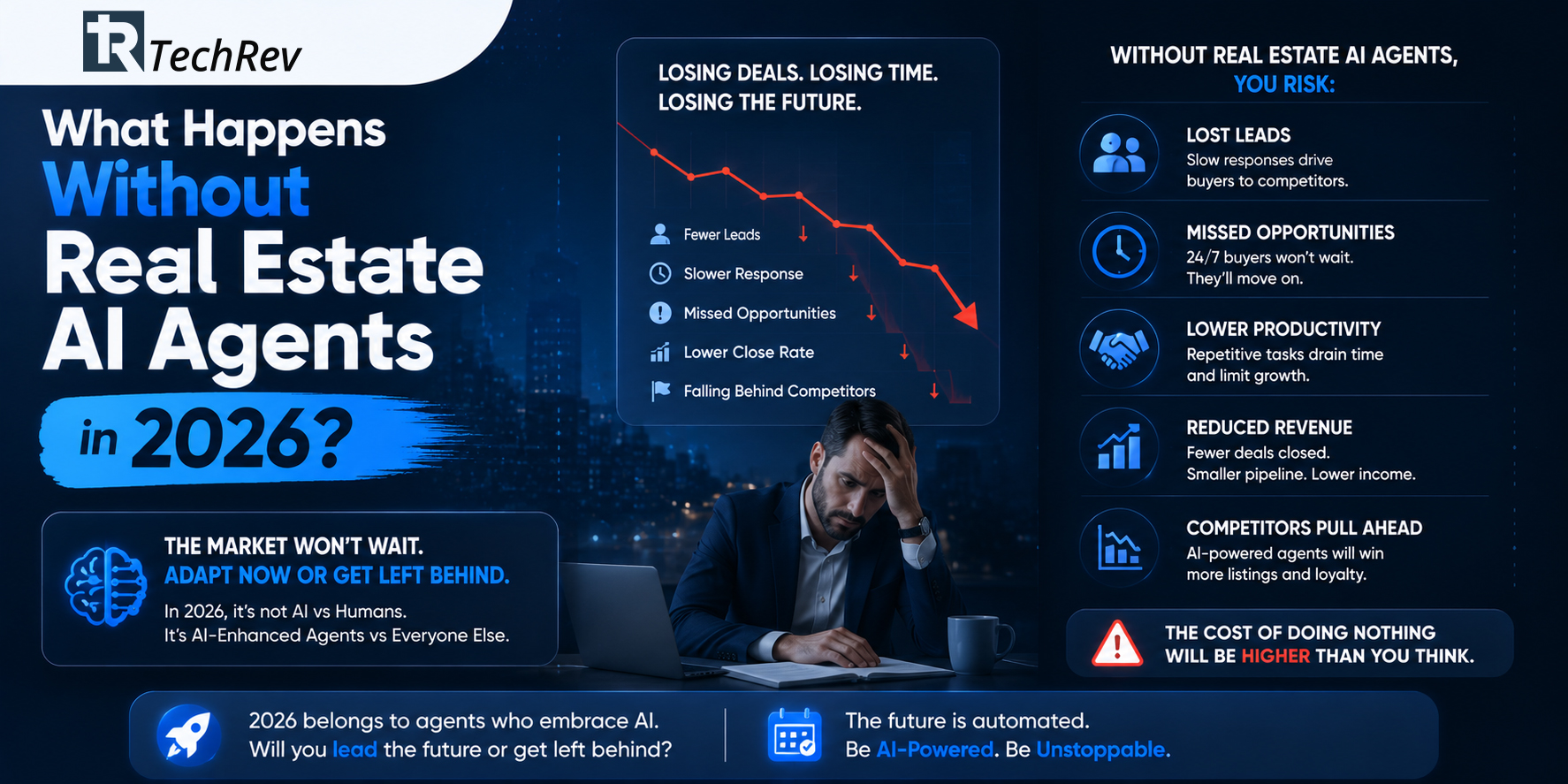
Before diving into what AI agents do, it is worth understanding what the absence of them actually costs.
The Industry’s Baseline Numbers Are Brutal
- Average real estate lead conversion rate: 0.4% to 1.2%
- Percentage of leads lost within the first five minutes if not contacted: 50%
- Average agent response time to a new lead: 917 minutes (over 15 hours)
- Leads captured after hours by agents using AI 24/7 engagement: 60% more
- Average lead response time with AI: under 30 seconds
Those numbers tell a clear story. The majority of real estate leads never become clients because nobody responded fast enough, followed up consistently enough, or stayed in contact long enough.
The Market Opportunity Is Massive
The global AI in real estate market was valued at $2.9 billion in 2024 and is projected to reach $41.5 billion by 2033, growing at a CAGR exceeding 30%.
Firms that have already adopted AI tools report up to 300% increases in lead volume and 40% higher conversion rates compared to those using traditional methods.
Morgan Stanley estimates AI could automate up to 37% of real estate operations, saving the industry roughly $34 billion in efficiency gains over the next five years.
How Real Estate AI Agents Work? Stage by Stage, From Inquiry to Signed Lease
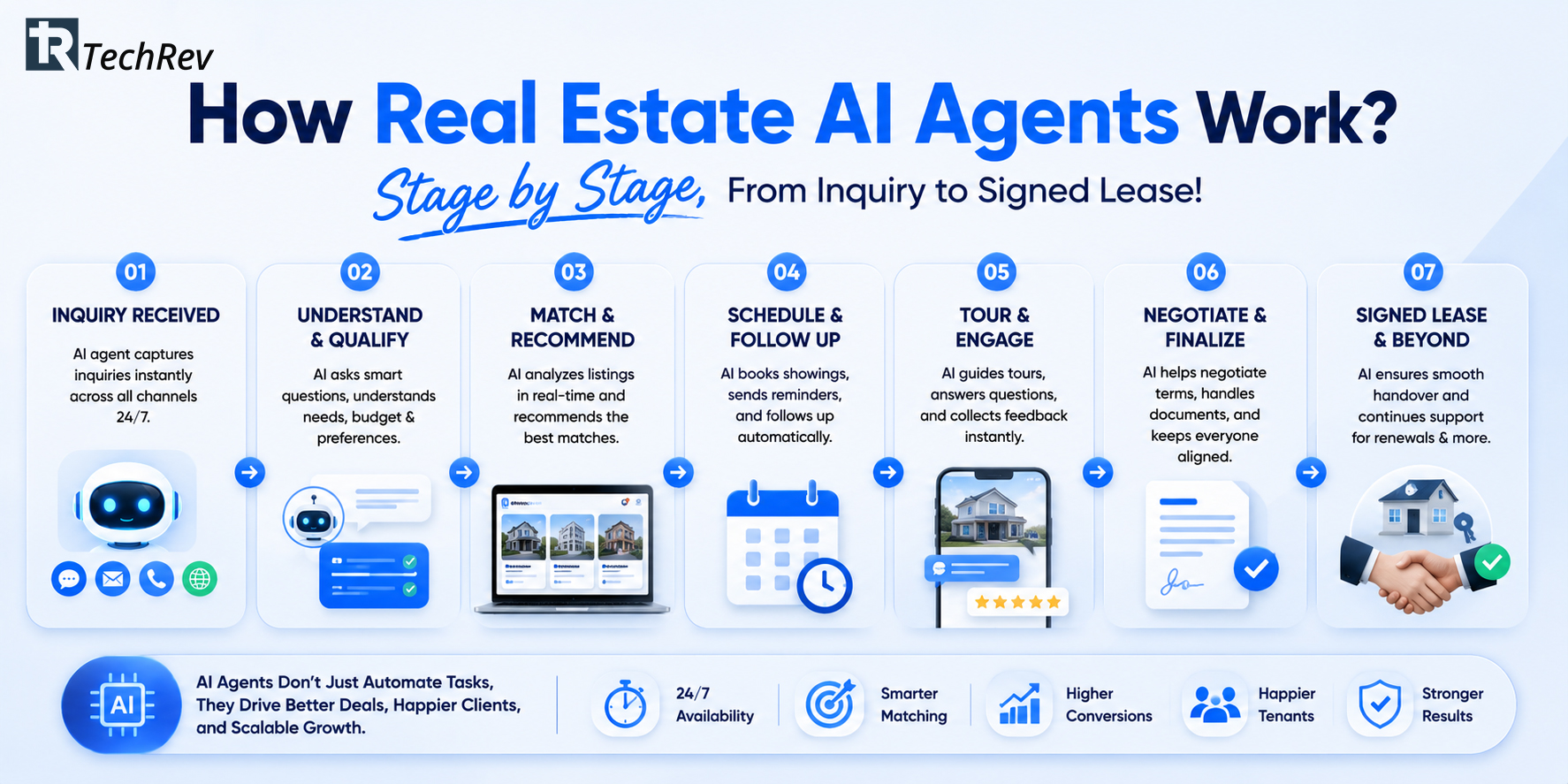
Stage 1: Lead Capture and Instant Qualification
The moment a lead submits a form, clicks a CTA, or messages through a listing portal, the AI agent activates. Not in minutes. In seconds.
Instead of routing the inquiry to an inbox where it sits until morning, the generative AI development opens a conversational qualification flow. It asks the questions a skilled human agent would ask:
- What is your buying or renting timeline?
- Are you pre-approved for financing?
- Which neighborhoods are you focused on?
- What are your must-have property features?
- Do you currently own or rent?
This is not a static form. The AI agent adjusts based on responses. If the lead says they are pre-approved, the agent moves directly to property preference questions. If they say they are just browsing, the agent shifts to a long-term nurture sequence.
The research on speed-to-lead is clear and consistent:
- Leads contacted within five minutes are 21 times more likely to convert than those contacted after 30 minutes
- Companies that respond within one hour are nearly seven times more likely to qualify a lead at all
Real estate AI agents make sub-5-minute responses a default, not an aspiration.
Stage 2: Lead Scoring and Prioritization
Not all leads are equal. The biggest productivity drain in real estate is agents spending time on leads that were never going to convert.
Real estate AI agents solve this through continuous behavioral scoring. The system tracks:
| Signal | What Does AI Do? |
| Number of listings viewed | Level of active search intent |
| Return visits to the same property | Strong interest in a specific listing |
| Time spent on mortgage calculator | Financial readiness and purchase intent |
| Email open speed after follow-up | Engagement level and responsiveness |
| Form submissions and document requests | Purchase stage and urgency |
Each signal is weighted and contributes to a composite score. The AI places leads into tiers:
- Hot leads: Pass qualification criteria and show high behavioral intent. Escalated immediately to a human agent with a full context summary.
- Warm leads: Show interest but are not yet ready. Enter a structured nurture sequence.
- Cold leads: Low intent. Receive periodic value-added content until behavior changes.
The result is that an agent starting their day no longer wades through 200 unqualified inquiries. Instead, they open their custom real estate mobile app to a prioritized list ranked by conversion likelihood, with conversation summaries already prepared.
Stage 3: Automated Nurturing Across the Full Buying Cycle
Real estate buying cycles are long. The average buyer begins their search six months to a year before they are ready to transact.
In a traditional model, those leads either get one or two follow-up calls before disappearing into a CRM nobody checks, or they require enormous manual effort to maintain over months.
Real estate AI agents handle the entire nurture sequence automatically:
- Send relevant property matches based on stated preferences
- Follow up after a showing with a personalized message referencing the specific property toured
- Notify leads when a property they viewed receives a price reduction
- Check in at regular intervals asking if their timeline has changed
- Re-engage naturally when behavioral signals indicate the lead is active again
Luxury Presence also documents that their AI tool increases lead reply rates to over 50% through fast, automatic inbound responses.
Also Read – How AI Property Management Software Reshapes Real Estate?
Stage 4: Showing Scheduling and Coordination
Getting a lead qualified is half the battle. Getting them into a property is where deals start to close.
Real estate AI agents handle showing coordination end-to-end. Here is exactly what that workflow looks like:
- Agent’s calendar is checked in real time for availability
- Property showing availability is verified automatically
- Lead receives a booking link or conversational scheduler inside the app
- SMS and email confirmations go out immediately upon booking
- Reminders are sent 24 hours and one hour before the appointment
- Post-showing follow-up is triggered automatically within two hours
Automated 24/7 self-service booking increases scheduled appointments by up to 33.5%.
When a buyer can book a showing at 11:30 PM without waiting for a callback, they book it. And the data shows they show up at higher rates because they chose the time themselves.
Stage 5: Document Collection, Lease Review, and Digital Signing
This is where most real estate AI systems stop. They handle lead capture and maybe some follow-up, but the document-heavy back end of a transaction remains a manual bottleneck.
Modern real estate AI agents built on custom real estate android app development platforms go further. They handle:
- Application processing: Tenant data is extracted automatically from submitted forms and cross-referenced for completeness
- Lease abstraction: Lease review that used to take a paralegal three hours now finishes in under ten minutes
- Compliance checking: Documents are flagged for issues before a human ever needs to review them
- E-signature routing: Contracts are sent to the right parties in the right sequence automatically
The AI Leasing Assistant model now in use across property management software provides 24/7 responses to prospective renters, handles data entry, schedules showings, processes applications, and routes lease documents for digital signature without any human involvement until final review.
The pipeline goes from a late-night inquiry to a signed digital lease without a single manual handoff dropping the ball.
Also Read – How Startup Founders Are Building AI-Powered Apps in 2026?
What Real Estate AI Agents Actually Deliver?
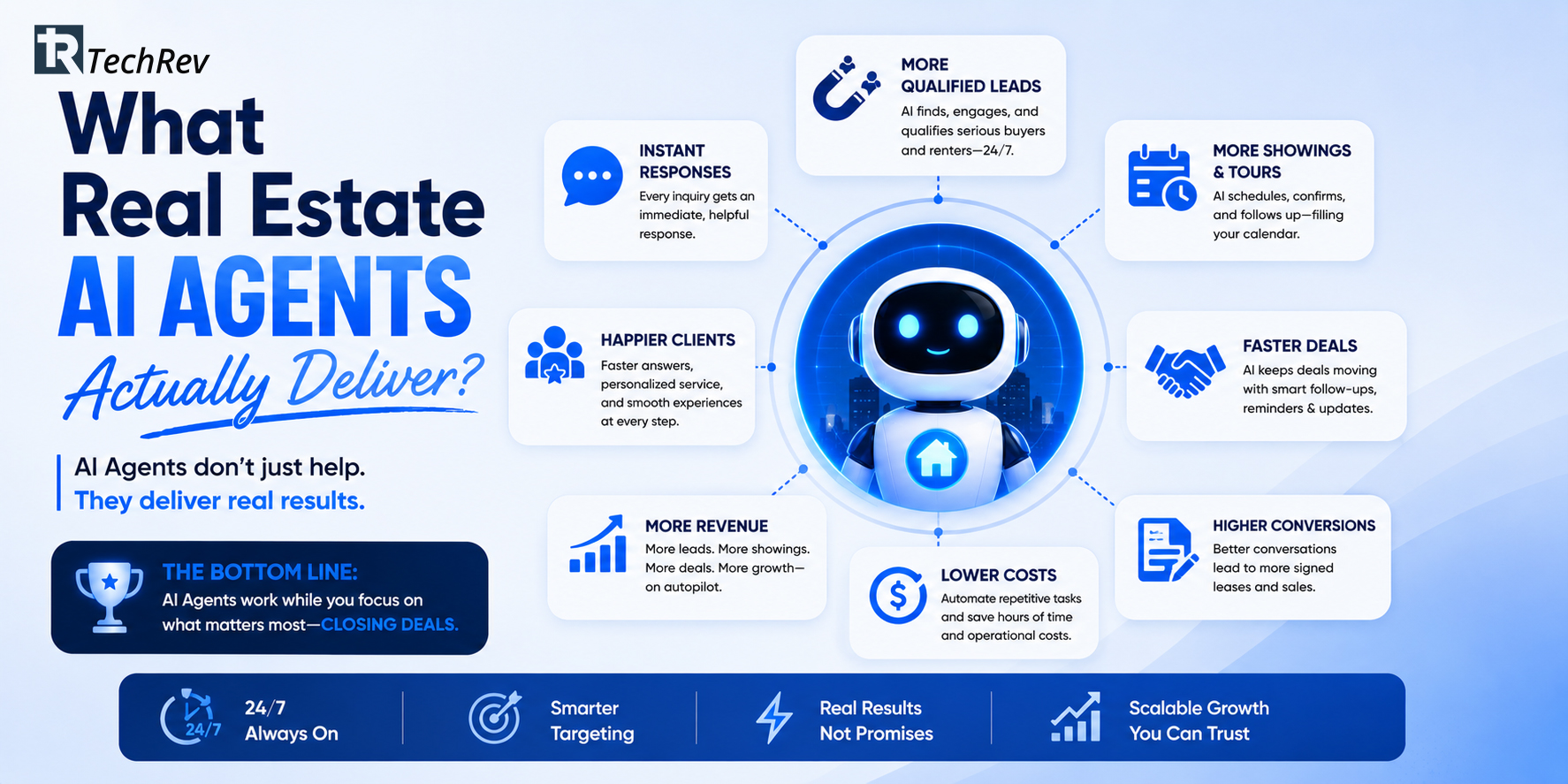
These are not projections or vendor claims. These are documented outcomes from real deployments and published research.
| Metric | Result | Source |
| Lead response time with AI | Under 30 seconds (vs. 39 min average) | AgentiveAIQ 2025 |
| Conversion lift in 90 days | 35% to 50% higher | AgentiveAIQ 2025 |
| After-hours leads captured | 60% more than without AI | AgentiveAIQ 2025 |
| Chatbot vs. manual follow-up conversion | Up to 3x higher | AgentiveAIQ 2025 |
| Showing appointments via self-service booking | Up to 33.5% increase | NextPhone 2026 |
| Operational cost reduction | 15% to 30% | Kognitos 2026 |
| Real estate businesses reporting revenue growth after AI | 63% | Biz4Group 2025 |
| Investors piloting AI with positive outcomes | 88% | GrowthFactor AI 2026 |
Top Must Have Features for Real Estate AI App
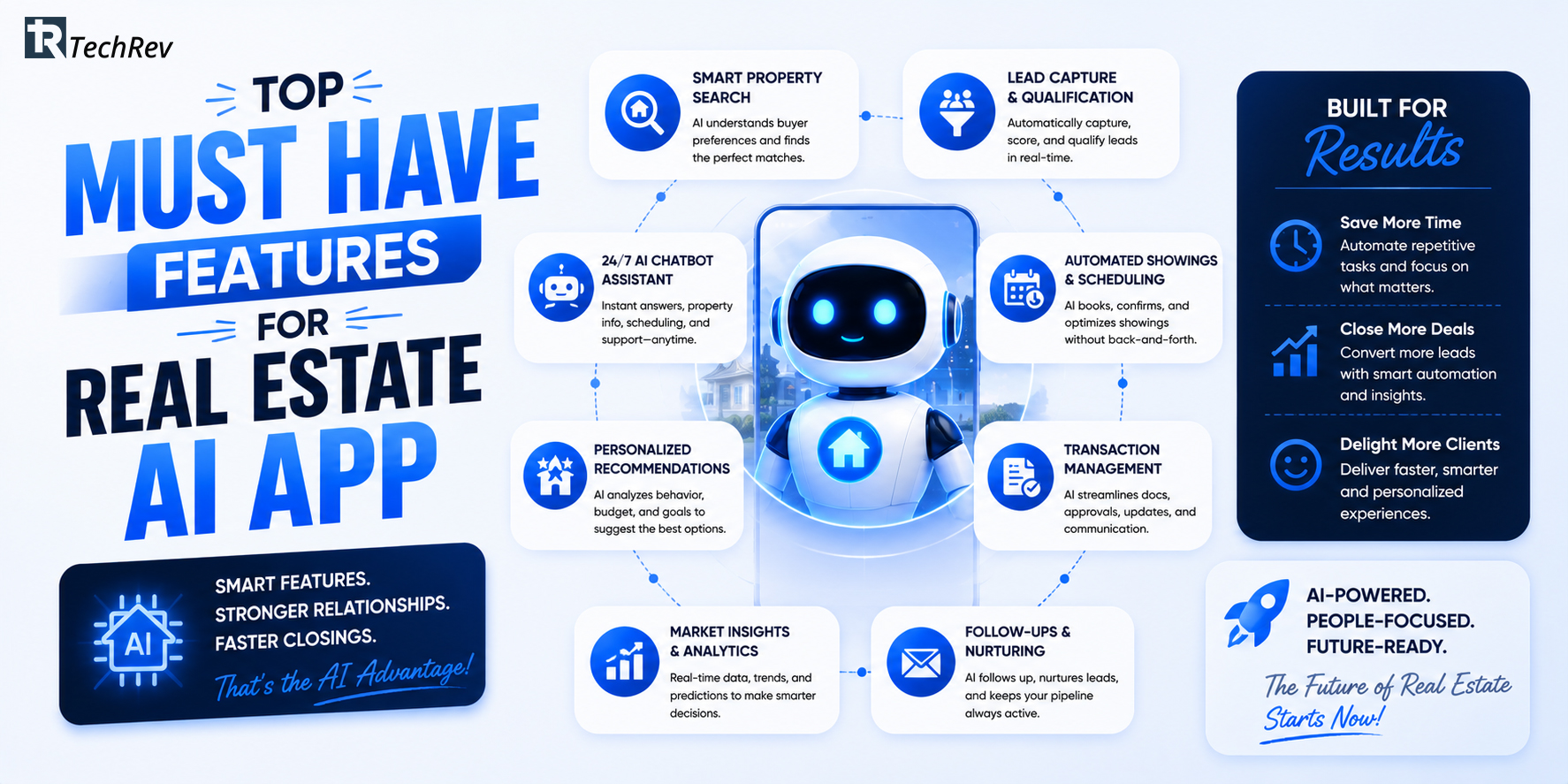
A real estate AI agent does not live in isolation. It runs on top of a mobile app and custom software development infrastructure that connects every stage of the lead-to-lease pipeline.
Based on production-grade real estate app deployments in 2026, here is the core feature stack that enables AI agents to function end-to-end:
Must-Have Features for a Custom Real Estate Mobile App
- Conversational AI layer: The interface where leads interact with the agent via website chat, in-app messenger, or SMS. Must feel natural, not scripted.
- MLS and IDX integration: Real-time access to listing data so the AI can match leads to properties and update them on price changes.
- CRM synchronization: Every AI interaction logged automatically. Agents cannot work from a context-free history.
- Behavioral tracking engine: Monitors listing views, email opens, time on page, and return visits to continuously update lead scores.
- Appointment scheduling integration: Direct calendar access so the AI books showings without routing through a human.
- Document processing and e-signature: Lease ingestion, data extraction, compliance checking, and e-signature routing built into the app.
- Push notification infrastructure: Buyers alerted the moment a property they viewed drops in price act faster than those who find out days later.
- Analytics dashboard: Clear visibility into lead volume, response rates, funnel drop-offs, and revenue attribution.
Why Mobile Is Non-Negotiable for Real Estate in 2026?
- 73% of new renters used a mobile app to search for properties in 2025
- 81% of buyers used a mobile website during their search
- 43% of buyers start their home search online
If your custom real estate app development is not built to convert that traffic through an AI-powered qualification layer, you are generating interest and losing it before a human ever gets involved.
How TechRev Builds Real Estate AI Apps?
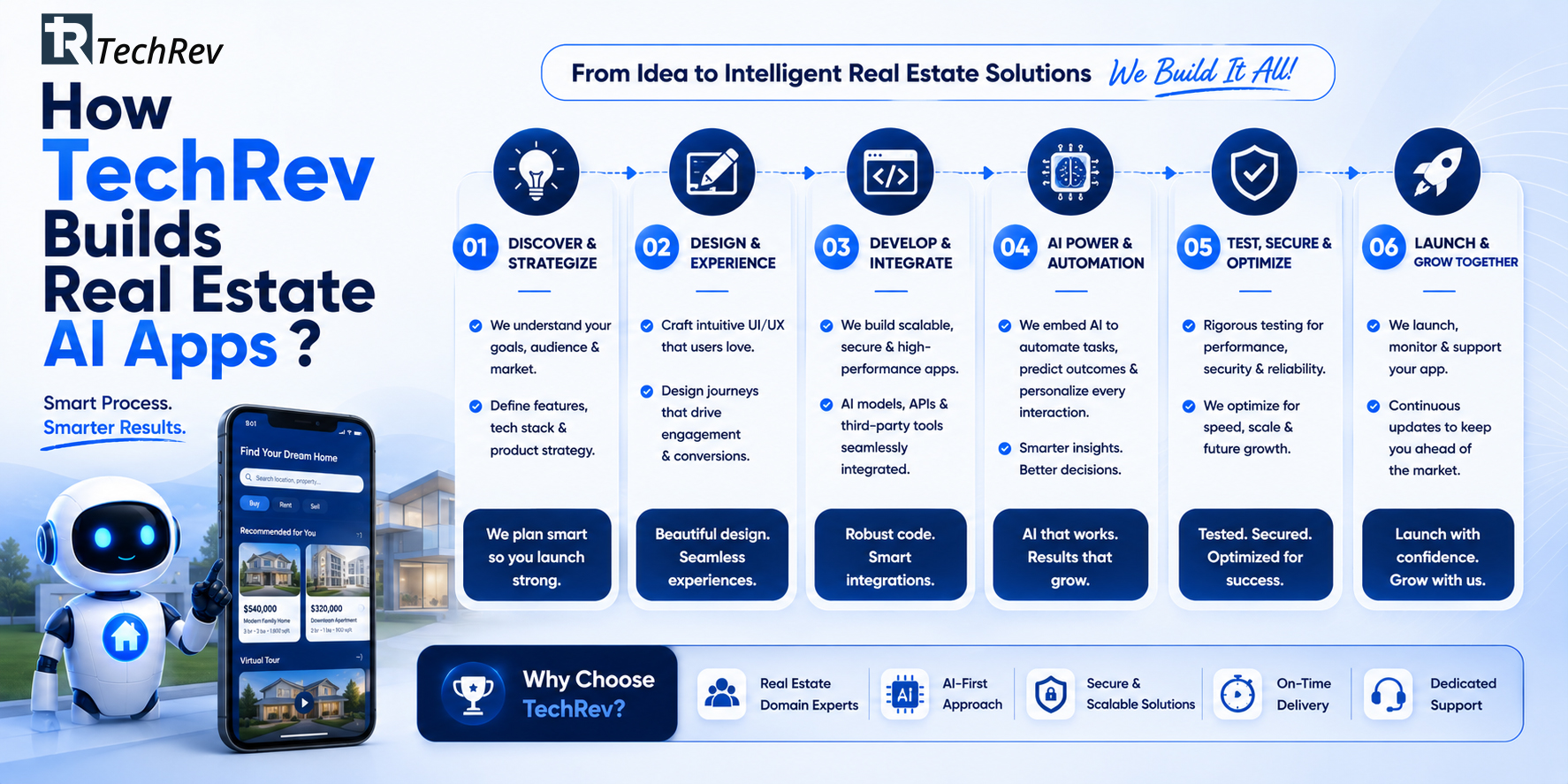
TechRev is a Florida-based custom software development and mobile app development company with over a decade of experience building production-grade AI systems for real estate, healthcare, legal, and HR technology clients.
When a real estate business works with TechRev, they do not get a generic lead generation tool with a logo swap. They get a custom real estate mobile app built around their specific agent workflows, their property portfolio, their lead sources, and their conversion goals.
Here is what that looks like in concrete, numbers-driven outcomes.
1. Growth in Sales: Up to 40% Higher Lead Conversion Within 90 Days
Speed-to-lead and qualification accuracy are the biggest revenue drivers in real estate. When leads are responded to in under 30 seconds, scored against behavioral data, and immediately matched to relevant listings, conversion rates follow.
Clients deploying TechRev’s real estate app development solutions with integrated AI qualification layers have seen lead-to-showing conversion rates improve by up to 40% within the first 90 days.
To put that in dollar terms: a brokerage generating 500 leads per month at an average commission of $8,000, converting at a baseline 1%, closes 5 deals and earns $40,000 monthly. A 40% lift on that conversion rate means 2 additional closings per month, adding $16,000 in monthly revenue from the same lead volume.
2. Increase in Productivity: 60% Reduction in Manual Follow-Up Time
Every hour an agent spends manually following up on unqualified leads is an hour not spent walking a buyer through a property or negotiating a contract.
TechRev’s AI agent systems automate the entire follow-up sequence, from the initial response to the six-month check-in, without agent involvement for leads that have not yet signaled high intent.
Agents using TechRev-built real estate mobile app platforms with AI nurturing integration report spending up to 60% less time on manual outreach. That time goes back to high-value conversations that actually close deals.
Also Read – How Digital Twin & AI Agents Improving Predictive Patient Care?
3. Increase in Efficiency: 33% Faster Showing Pipeline
From qualified lead to booked showing is where real estate businesses lose hours every week. Phone tag, calendar conflicts, availability checks, and confirmation messages all add friction.
TechRev’s showing scheduling automation, built directly into the custom real estate mobile app, handles the entire coordination workflow. Agents arrive at showings with complete lead profiles already in hand.
Clients report a 33% reduction in time from lead qualification to first showing appointment when the AI coordination layer is live.
4. Cost Reduction: 20% to 30% Drop in Operational Overhead
Manual lead management at scale is expensive. After-hours coverage, admin support for document processing, and coordination overhead all grow linearly with lead volume.
TechRev’s real estate app development approach automates these workflows so operational costs scale far more slowly than revenue does. Most clients see 20% to 30% operational cost reduction within the first year of deployment.
Conclusion
They stopped letting human availability determine lead response speed.
They stopped letting follow-up fall through the cracks during showings and closings. They stopped treating after-hours leads as tomorrow’s problem. And they stopped asking agents to manually maintain six-month buyer relationships in a spreadsheet.
They built systems that respond before a competitor can, qualify leads before an agent gets involved, and hand a human a warm, context-rich conversation exactly when that human adds the most value.
Real estate AI agents make all of that possible. But only when they are built on a mobile app and software foundation that can actually support it in production.
TechRev builds that foundation.
If your real estate business is ready to stop losing leads to agents who simply respond faster, or if you are building a PropTech platform and need a real estate app development partner who has delivered production AI systems before, the conversation starts here.
Talk to TechRev about your real estate app
FAQs
1. How quickly can a real estate AI agent respond to new leads?
A properly built real estate AI agent responds in under 30 seconds, around the clock. The industry average without AI is over 15 hours. That gap is exactly where most of the conversion opportunity lives.
2. Will my leads know they are talking to an AI agent?
This depends on how you position it. Many real estate teams deploy their AI agent transparently as a digital assistant. What buyers care about is receiving a relevant, helpful response quickly. The agent who responds first with useful information wins, regardless of whether the first response is AI-generated.
3. How does a real estate AI agent qualify leads without sounding scripted?
Modern real estate AI agents use a large language model infrastructure that produces conversational, contextually aware responses. They adjust questions based on what the lead has already shared and never ask for information already provided.
4. What does a custom real estate mobile app with AI agent features cost?
Based on 2026 market data, a production-grade custom real estate mobile app ranges from $25,000 for a basic MVP to $300,000+ for an enterprise platform depending on MLS/IDX scope, AI feature depth, and team structure.
TechRev provides detailed scoping consultations before any project begins so clients have a realistic cost estimate with no surprises.
5. Can TechRev integrate AI agents into an existing technology stack?
Yes. TechRev’s custom software development team specializes in connecting AI systems to existing CRMs, listing platforms, calendar tools, and e-signature infrastructure. Most real estate businesses do not need to replace their entire tech stack. They need an intelligent layer built on top of what they already have.
How long does deployment take?
- Focused AI lead qualification system: 8 to 12 weeks
- Full custom real estate mobile app with AI integration: 16 to 24 weeks depending on scope and data readiness
6. Does TechRev build for both residential and commercial real estate?
Yes. TechRev’s real estate app development practice covers residential brokerage, commercial real estate, property management, and PropTech startups.
7. What makes TechRev different from a generic mobile app development company?
TechRev has delivered production systems for healthcare tech, HR platforms, legal technology, and real estate across 30+ projects. That cross-industry experience means the team builds AI systems that perform under real production load, integrate with real-world data systems, and meet compliance requirements that a generic shop often overlooks.
8. Can a small brokerage afford a custom real estate mobile app with AI?
Yes, through a phased approach. TechRev often recommends starting with a focused MVP, typically an AI lead qualification and follow-up system, before expanding to a full mobile platform. This lets smaller teams see measurable ROI before committing to a full build.
9. What compliance standards does TechRev build to?
TechRev builds data privacy compliance into the architecture from day one. For real estate apps handling tenant financial data, lease documents, and personal identification, GDPR, CCPA, and SOC 2 compliance are foundational requirements, not add-ons.