
What if your doctor could test three different treatment plans on a virtual copy of your body before deciding which one to actually use on you?
What if a hospital could predict a patient crisis 48 hours before it happens, not by guessing, but by running thousands of real-time simulations on a digital replica of that patient’s physiology?
That is not science fiction. That is what digital twins in predictive patient care are doing right now, inside hospitals, research labs, and clinical systems across the world. And the healthcare industry is waking up to the fact that this technology does not just improve care.
- So what exactly is a digital twin in healthcare?
- Why is it becoming one of the most talked-about technologies in clinical settings?
And how are AI agent development, generative AI development, and LLM development making all of this possible at a scale nobody thought was achievable just five years ago?
Let us break all of it down.
What Is a Digital Twin in Healthcare?
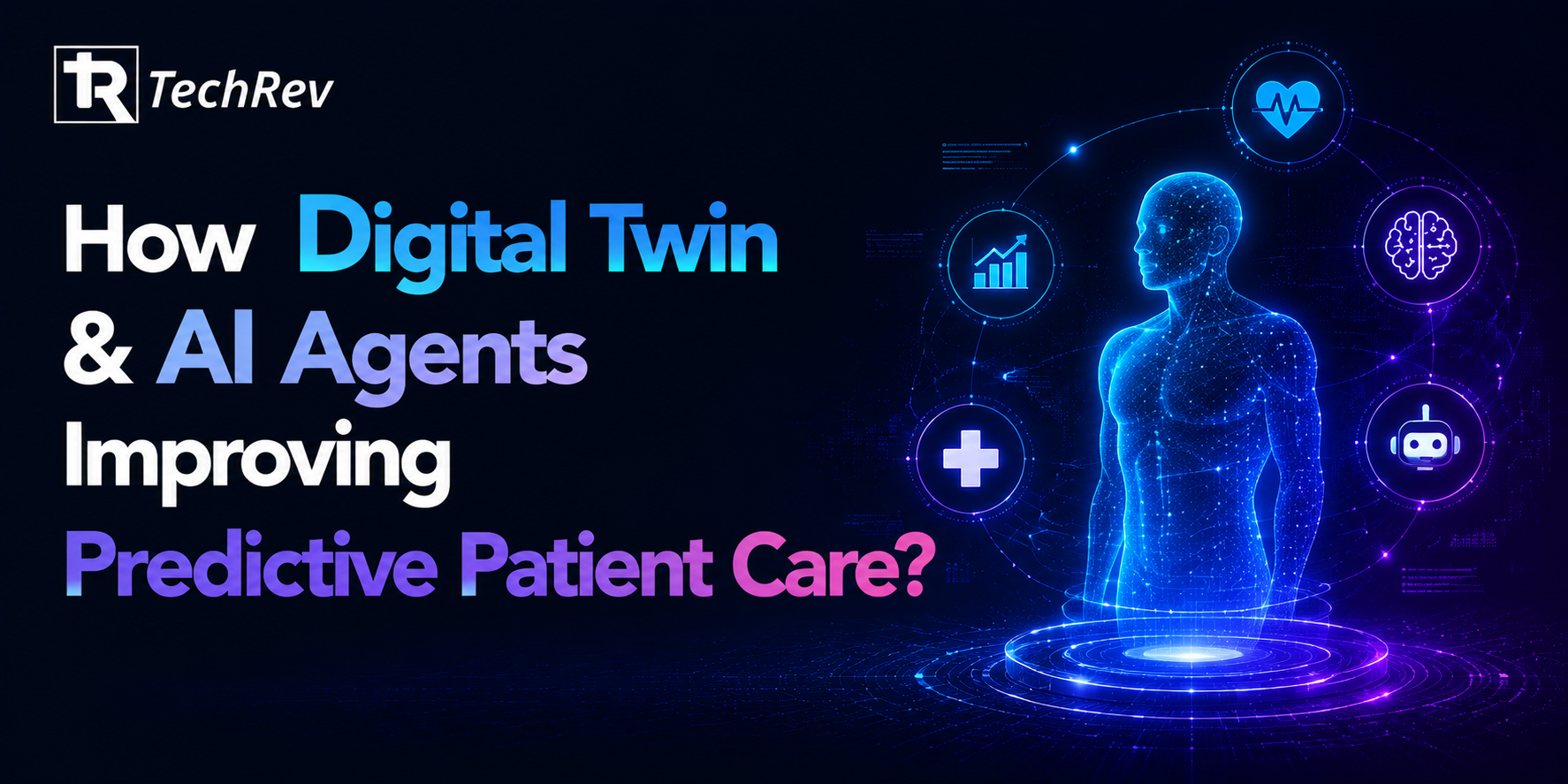
A digital twin in healthcare is a living, continuously updated virtual replica of a patient, a biological system, a clinical workflow, or an entire hospital operation. It pulls data from electronic health records (EHRs), wearable devices, medical imaging, genomics, lab results, and real-time physiological sensors. It then builds a dynamic model that not only mirrors the patient’s current state but actively simulates how that state will evolve under different conditions.
Think of it this way. A traditional medical record shows what happened to a patient in the past. A digital twin shows what is likely to happen next, and lets clinicians test different interventions digitally before committing to any one path in the real world.
The core components that make this possible are:
- Real-time data integration from wearables, IoT-connected devices, EHRs, and genomics platforms
- Predictive analytics powered by machine learning models trained on massive patient datasets
- Simulation engines that can model disease progression, drug interactions, and surgical outcomes
- AI agents that continuously monitor the twin and trigger alerts or recommendations when thresholds are crossed
- Generative AI development layers that allow the system to synthesize patient histories and generate scenario-based projections
Without AI agents development and robust generative AI development infrastructure beneath it, a digital twin is just a static model. It is the AI layer that makes it predictive.
Why Is the Healthcare Industry Moving So Fast on This?
The numbers tell the story clearly.
The global digital twins in healthcare market was valued at USD 2.81 billion in 2025. By 2031, it is projected to reach USD 14.12 billion, growing at a CAGR of 30.86%.
Some projections place the market even higher.
According to research from Towards Healthcare, the market could hit USD 77.4 billion by 2034 at a 42.2% CAGR.
And Accenture reports that 66% of healthcare executives already plan to increase their investment in digital twin technologies over the next three years.
Why the urgency?
Because the problems digital twins solve are not minor inconveniences.
- Reactive healthcare, where clinicians respond to problems after they appear, is expensive, slow, and often too late.
- Chronic disease management built on population-level averages fails individual patients who do not fit the average.
- Clinical trials that take years and cost billions could be shortened and made safer through virtual simulation.
- Drug interactions that hurt patients could be caught before a prescription is written.
Digital twins in predictive patient care address all of this. And with custom AI agents, LLM development infrastructure, and mobile app development platforms now bringing these capabilities to the bedside and into patients’ hands at home, the barriers to adoption are dropping fast.
Also Read – How Custom AI Agent Development Improves Enterprise Workflows?
But,
How Digital Twins Actually Work in a Clinical Setting?
This is the part most blog posts gloss over, so let us be specific.
1: Data Collection and Synchronization
A patient digital twin begins with multimodal data ingestion. The system continuously pulls from:
- Electronic health records covering diagnosis history, medications, and lab trends
- Wearable sensors tracking heart rate variability, oxygen saturation, blood pressure, glucose levels, and activity patterns
- Medical imaging from MRIs, CT scans, and echocardiograms
- Genomic and proteomic data for patients in precision medicine programs
- Social determinants of health such as diet, sleep, and environmental exposure
Building a healthcare digital twin without a robust custom software development layer to unify these data streams produces a model that is only as good as its worst data source.
2: Model Construction and Continuous Updating
Once data is flowing, the system builds a physiological model specific to that patient.
- Not a generic heart model.
- Not a population-level diabetes progression curve.
A model that reflects this patient’s specific biology, history, comorbidities, and behavioral patterns.
This is where generative AI development becomes the engine room.
- Generative AI models synthesize incomplete or sparse patient data, filling in gaps that would otherwise break a conventional simulation.
- LLM development tools have shown that fine-tuned large language models can forecast clinical trajectories across datasets with surprisingly high accuracy.
3: Simulation and Scenario Testing
With the model built and continuously updated, clinicians can now run simulations.
- What happens to this patient’s cardiac function if we increase their beta-blocker dose by 25%?
- How does this tumor respond to radiation over three months?
- Which surgical approach produces the least trauma for this specific patient’s anatomy?
Also Read – How Much Do Custom AI Agents Cost? A Complete Guide!
These simulations happen in seconds, not weeks. And they can be run dozens of times across different variables before a single clinical decision is made.
4: AI Agents Monitoring and Alert Generation
AI agents continuously compare the live patient data stream against the twin’s predictions. When a deviation appears, indicating that the patient’s real-world state is diverging from the model’s projection, the AI agent flags it, interprets it, and presents it to the clinical team with context.
An AI agent monitoring a post-surgical patient might detect that their heart rate variability pattern at 3:00 AM is trending toward a pattern historically associated with post-operative infection, 36 hours before any conventional symptom appears.
That early warning is the difference between a managed recovery and an ICU admission.
Custom AI agents in healthcare are not just alert systems. They are reasoning systems. They explain why they flagged something, what similar patterns have looked like in the past, and what the highest-probability interventions are. That is the value of bringing AI agents development and LLM development together in a clinical-grade platform.
Where Digital Twins Are Making the Biggest Clinical Impact Right Now?
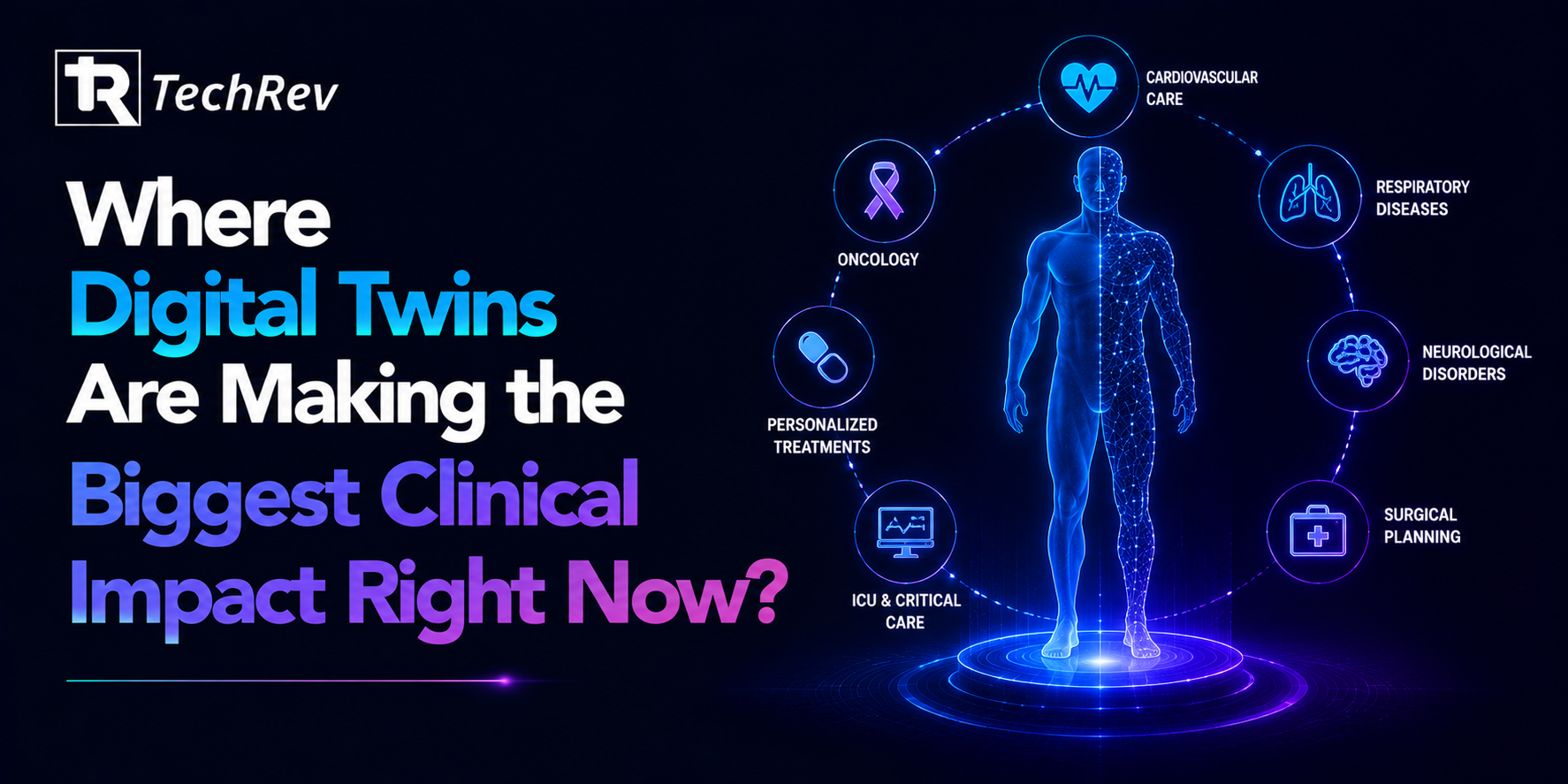
The following are some areas:
1. Cardiology
In cardiology, digital twin models of individual cardiac anatomy and function are being used to predict how specific patients will respond to heart failure therapies or interventions for arrhythmias.
These are not generic heart models. They are patient-specific simulations built from that patient’s echocardiogram data, genetic markers, and clinical history.
Surgeons can rehearse complex cardiac procedures on a patient’s digital twin before the patient ever enters the operating room.
2. Oncology
Cancer care has traditionally been guided by population-level clinical trial data. The problem is that individual tumors behave individually.
Digital twins allow oncologists to model how a specific patient’s tumor is likely to respond to chemotherapy, radiation, or immunotherapy, adjusting the simulation as new biopsy data, imaging results, and biomarker readings come in.
LLM development tools like TWIN-GPT, which fine-tune large language models on clinical trial datasets, can simulate counterfactual scenarios, showing clinicians what would have happened had they chosen a different path.
3. Chronic Disease Management
Digital twins are now being used to monitor the health of over 5 million patients remotely, according to market research from Credence Research.
The result is a 30% reduction in emergency visits and a 15% decrease in hospital readmissions for chronic disease management.
For diabetes patients specifically, digital twins support more accurate glucose prediction and therapy adjustments, showing clinicians how medication changes may affect HbA1c levels over months, not just days.
Also Read – Small Language Models vs LLMs: The Right AI for Your Startup?
How TechRev Helps Healthcare Organizations Build Digital Twin Solutions?
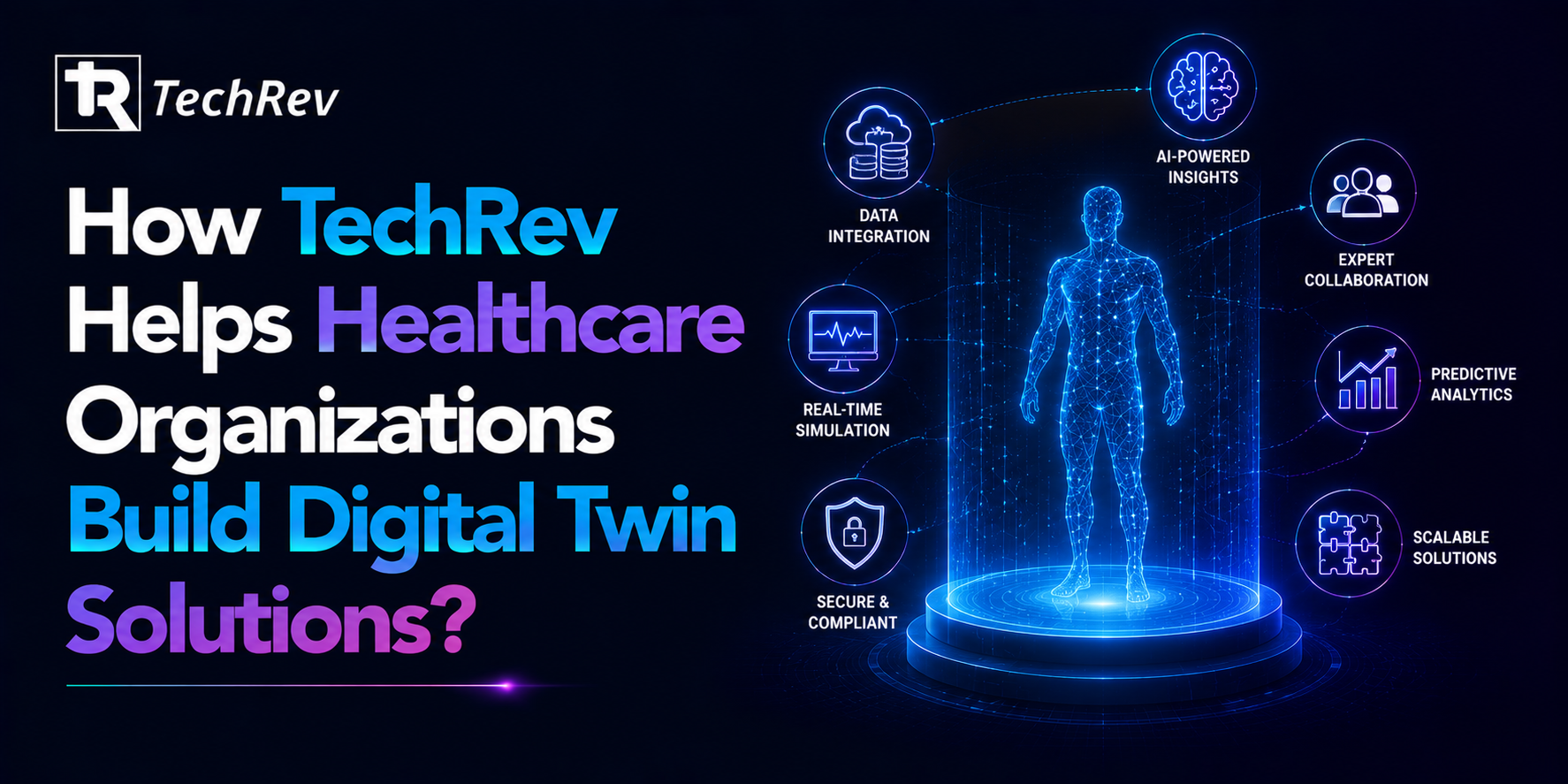
Building a clinical-grade digital twin is not a plug-and-play exercise. It requires deep integration work, compliant data architecture, clinical workflow alignment, and smart AI layers that meet the standards of healthcare demands.
This is exactly the kind of custom software development that TechRev has been delivering since 2016. Here is what working with TechRev on a healthcare digital twin program looks like, and what it delivers:
1. Growth in Sales and Revenue: Up to 35% Increase in Billable Clinical Utilization
When hospital capacity is optimized through digital twin-driven resource planning, the same physical infrastructure handles more patients more efficiently.
Organizations that have implemented AI-powered capacity management, which is a core part of TechRev’s hospital operations twin offering, have reported up to 35% increases in billable clinical utilization without adding a single bed or hiring additional permanent staff.
More efficient throughput means more patients served and more revenue captured from existing infrastructure.
2. Increase in Productivity: 40% Reduction in Administrative Burden for Clinical Teams
A significant portion of a clinician’s day is spent on documentation, data retrieval, and manual monitoring.
TechRev’s custom AI agents, integrated into digital twin platforms, automate continuous monitoring, surface relevant data at the point of care, and pre-populate documentation with AI-generated summaries drawn from the twin’s real-time data.
Clinical teams working with TechRev-built AI agent systems have reported up to 40% reductions in time spent on administrative tasks, freeing that time for direct patient care and complex decision-making.
3. Increase in Efficiency: 25% Faster Clinical Decision-Making
When a clinician no longer has to manually review hours of patient monitoring data, manually cross-reference drug interaction databases, or wait for specialist consultations before making a decision, the speed of care delivery improves substantially.
TechRev’s computer vision development and LLM development integrations within digital twin platforms have supported 25% reductions in time-to-decision for clinical teams, measured from the moment a patient flag is raised to the moment an intervention is initiated.
4. ROI: 20%+ Return on Digital Twin Investment Within 12 Months
The upfront cost of building a healthcare digital twin is real. But so is the return. Organizations that deploy digital twin systems for chronic disease management recover investment through:
- Reduced readmissions
- Lower emergency care costs
- Efficient staffing
- Fewer adverse events
Based on industry-wide data from Global Market Insights, more than half of organizations implementing digital twins report at least 20% ROI, and 92% report returns exceeding 10%.
5. Cost Reduction: Up to 30% Drop in Operational Costs
This is the number that gets hospital CFOs into the conversation. Digital twin applications have been shown to reduce operational costs by up to 30%.
TechRev’s custom software development approach ensures that the digital twin is not built as a standalone tool sitting outside the existing hospital information ecosystem.
It is integrated into the workflows clinicians already use, pulling from the EHR, feeding insights back into clinical decision support systems, and connecting to mobile app development interfaces that allow clinical staff to access twin data from any device in the facility.
The cost reductions come from multiple directions simultaneously.
- Fewer redundant tests because the twin already has the data.
- Lower agency staffing costs because scheduling is optimized by the twin’s demand predictions.
- Reduced readmission penalties because the twin’s monitoring catches deterioration before discharge.
- Shorter average length of stay because treatment plans are better calibrated from day one.
Also Read – AI Integration Services 2026: Custom LLM & Agentic Workflows!
Conclusion
We started with a question: what if your doctor could test treatment options on a virtual copy of you before making a decision?
The answer, in 2026, is that this is not a futuristic possibility. It is an engineering problem that has been solved. The technology exists. The data infrastructure exists. The AI agents development, generative AI development, LLM development, and custom software development capabilities exist. What is still being figured out is implementation, integration, and trust.
The healthcare organizations that are moving now on digital twins are gaining something that compounding technology advantages deliver over time: better models, more data, smarter AI agents, and clinical teams that are learning to work with these tools as standard instruments of care. The ones that wait will find themselves trying to catch up with institutions that have two, three, and five years of real-world digital twin deployment experience already behind them.
If your organization is ready to have an honest conversation about what building a digital twin program actually involves, what it costs, what it delivers, and how to do it right the first time, TechRev is the team to have that conversation with.
We have been building healthcare technology, AI agents, generative AI systems, and custom software solutions since 2016. We know what production-grade looks like, and we know what demo-grade looks like. We only build the former.
Book a free strategy consultation with TechRev and let us show you exactly what a digital twin program could look like for your organization.
FAQs
1. What is a digital twin in healthcare?
A digital twin in healthcare is a virtual, continuously updated model of a patient, organ, clinical process, or hospital operation. It is built from real-time data sources including EHRs, wearables, and imaging, and uses AI to simulate how the real-world entity will behave under different conditions.
2. How do digital twins improve predictive patient care?
By creating a patient-specific simulation that updates in real time, digital twins allow clinicians to detect health deterioration before symptoms appear, test treatment options virtually before applying them, and personalize care plans based on that individual patient’s data rather than population averages.
3. What role do AI agents play in a healthcare digital twin?
Custom AI agents act as the intelligent monitoring layer. They continuously compare live patient data against the twin’s projections, identify deviations that indicate risk, and alert clinical teams with context-rich explanations. AI agents development focused on healthcare produces systems that reason about clinical data, not just report it.
4. How does generative AI development improve digital twin accuracy?
Generative AI development allows the system to synthesize incomplete or sparse patient data, fill prediction gaps, model disease progression across different scenarios, and generate plain-language clinical summaries that clinicians can act on. Without generative AI development underneath it, a digital twin cannot produce the kind of scenario-based forecasting that makes it genuinely predictive.
5. How much does it cost to build a healthcare digital twin?
That depends significantly on scope. A digital twin focused on a single clinical use case, such as ICU patient monitoring or post-surgical recovery tracking, can be scoped and built more efficiently than a full hospital operations twin. TechRev provides detailed scoping consultations to give healthcare organizations an honest cost estimate before any development begins.
6. Can TechRev integrate a digital twin into an existing hospital system?
Yes. TechRev’s custom software development practice specializes in integrating AI-powered systems into existing clinical infrastructure, including major EHR platforms, medical device data streams, and clinical workflow tools. The integration work is often the most complex part of a digital twin deployment, and it is where TechRev’s decade of healthcare technology experience delivers the most value.
7. Does TechRev build mobile app development solutions for digital twin platforms?
Yes. TechRev’s mobile app development team builds clinical-grade iOS and Android applications that bring digital twin insights to clinical staff at the point of care and to patients managing their conditions remotely. All mobile app development for healthcare clients meets HIPAA compliance requirements by design.