
You’ve got the idea. You’ve validated the pain point. You may even have early users willing to pay.
But the moment you ask how do I actually build this with AI? The answers you get back are either too vague to act on, or come with a price tag that makes your stomach drop.
This is the part nobody prepares founders for.
The actual, practical reality of turning an AI-powered product idea into something that ships, scales, and doesn’t fall apart the moment 500 users show up at once.
This blog is missing conversation. No hype, no filler. Just what it actually takes to build an AI app as a startup in 2026 from deciding what to build, to choosing who builds it, to understanding why most AI projects fail before launch (and how yours doesn’t have to).
Why 2026 Is a Different Game for AI Startups?
A few years ago, AI was a differentiator. Today, it’s the floor.
According to McKinsey’s most recent Global AI Survey, more than 78% of enterprises globally have deployed AI in at least one business function.
Among startups, the number is even higher. Investors have poured over $32.9 billion into AI startups in just the first five months of 2025.
Stanford’s 2026 AI Index reports that global corporate AI investment more than doubled in 2025, with generative AI funding growing by over 200%.
What this means for you as a founder: users aren’t impressed by AI features anymore. They expect them. A product with no personalization, no automation, no intelligent layer feels dated before it even launches.
What Kind of AI App Are You Actually Building?
This is the question founders skip, and it costs them months and hundreds of thousands of dollars.
Before you write a single line of code or talk to a single developer, you need to be specific about your AI layer. Now we’ll use AI to improve the experience. That’s not a product decision, that’s a marketing line.
Here are the four most common AI app categories in 2026, and what they actually require to build:
1. AI Chatbot or Virtual Assistant
The most common starting point. You’re building a conversational layer that can answer questions, handle support, or guide users through a workflow.
What does it really require?
Good prompt design, a solid RAG (Retrieval-Augmented Generation) setup if you want it to pull from your own data, and careful guardrails to prevent hallucinations. This is genuinely buildable in 6-10 weeks with the right team.
Realistic cost: $40,000-$90,000 for a production-ready version with custom knowledge base integration.
2. AI-Powered Recommendation Engine
You want the app to surface the right product, content, doctor, job, or match based on user behavior.
What does it really require?
A clean, structured dataset to train on, a clear feedback loop so the model improves over time, and real users interacting with the system. This one takes longer and breaks badly if your data isn’t clean before development starts.
Realistic cost: $60,000 – $200,000 depending on data complexity.
3. Automation / Workflow AI
You want AI to take a multi-step process scheduling, document review, data extraction, reporting and run it autonomously or semi-autonomously. This is where agentic AI fits in.
What does it really require?
Careful workflow mapping before generative AI development begins, solid API integrations with your existing tools, and a clear human-in-the-loop design for edge cases. Agentic systems that run fully on autopilot without guardrails are where most enterprise AI projects go wrong.
Realistic cost: $80,000-$350,000 for a custom ML-backed system.
4. Generative AI Product (Content, Images, Code, Reports)
You’re building something that creates marketing copy, design assets, legal documents, data summaries. Your core product IS the generation.
What does it really require?
Strong UX to make the output usable, heavy prompt engineering, and a fine-tuning strategy if you need outputs that are specific to your domain or tone.
Realistic cost: $100,000-$500,000 for a production generative AI application.
Also Read – How Fintech Healthcare & SaaS Are Using AI in 2026?
In-House vs. Outsourcing: The Decision Founders Get Wrong
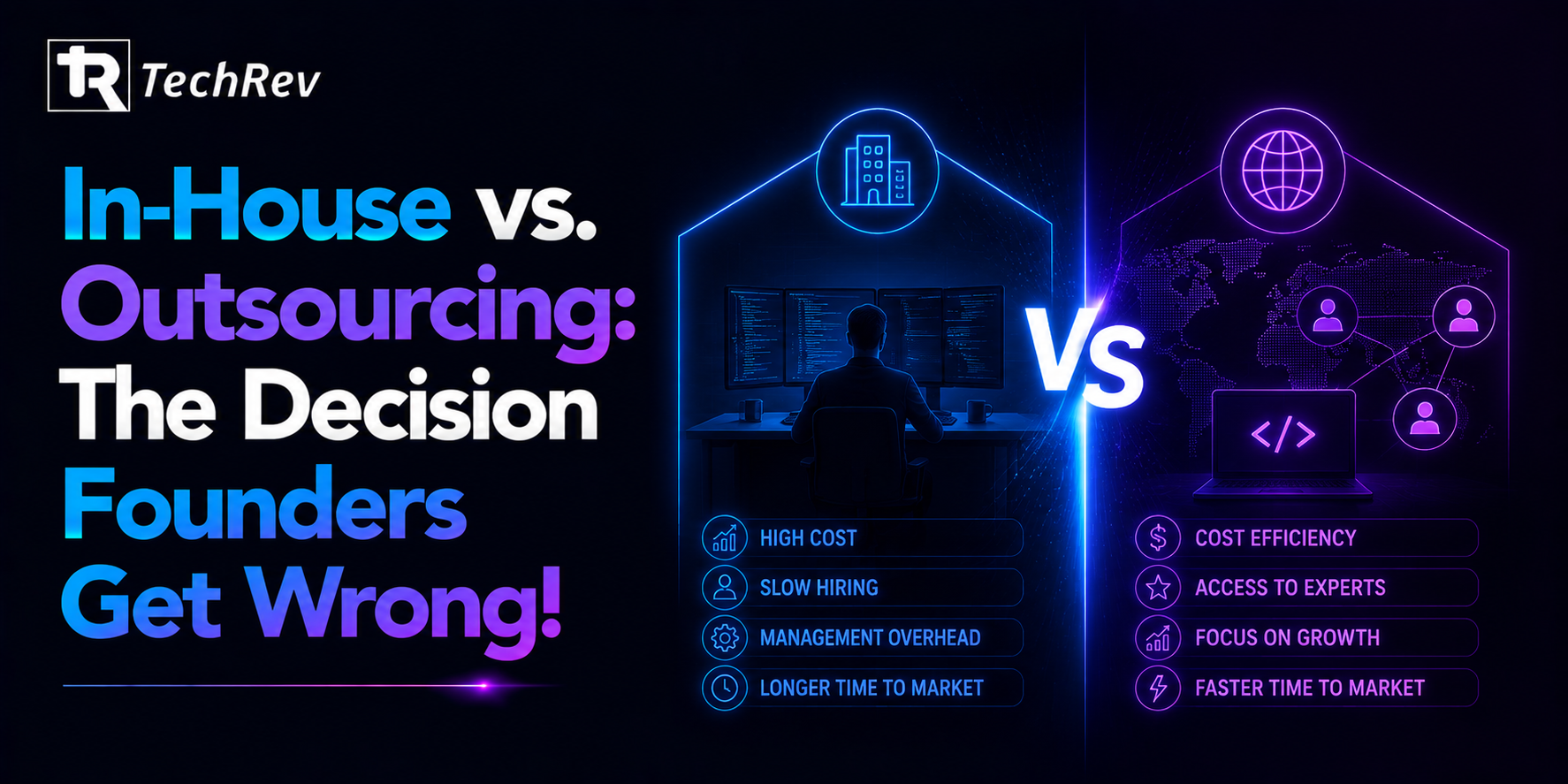
At some point, every founder faces this fork: build an internal team, or partner with a development agency.
Most startup advice frames this as a cost decision. It’s not. It’s a speed and risk decision.
1. Building In-House
Pros: Deep product context over time. Engineers who know your domain inside out. A team that’s fully aligned with your roadmap.
Cons: Hiring senior AI engineers takes 4-6 months on average. Competing for AI talent against companies offering packages that a funded seed-stage startup simply cannot match. And a single bad hire at the engineering lead level can derail your entire product timeline by 6-12 months.
For most early-stage startups, building a full in-house AI team before product-market fit is found is a way to spend runway without validating the core hypothesis.
2. Outsourcing to an AI Development Partner
Pros: You get access to a full team of machine learning engineers USA, data scientists, product designers, and QA from day one. No recruitment cycle, no onboarding lag. A well-scoped project can be in active development within weeks of signing.
Cons: The quality gap between AI development agencies is enormous. The market is flooded with vendors who can build a convincing demo with an off-the-shelf API call, but cannot architect a production system that handles real data complexity, security requirements, or scale.
The right question isn’t “should I outsource?” it’s “who actually knows the difference between a prototype and a production AI system?”
The founders who get burned by outsourcing almost always make one of these mistakes:
1. They chose the lowest bid
Cheap AI Agent development creates what’s called “technical debt” code that works in a demo but requires a full rebuild when real users show up. One mid-size retailer saved $50,000 upfront by choosing a budget vendor, then spent $300,000 unwinding the mess 18 months later.
2. They skipped the technical vetting
A legitimate AI development company will ask you detailed questions about your data, use cases, and success metrics before proposing anything. If someone promises “revolutionary AI” before asking what your data looks like, that’s a red flag, not a feature.
3. They treated outsourcing as a handoff
The founders who get real value from outsourced AI development are deeply involved throughout. They know the success metrics. They review milestones. They push back when scope creep starts. Outsourcing the execution doesn’t mean outsourcing the thinking.
Also Read – SOC 2 Type 2 for AI Startups: Building LLMs for Healthcare
What Actually Powers an AI App in 2026? The Tech Stack!
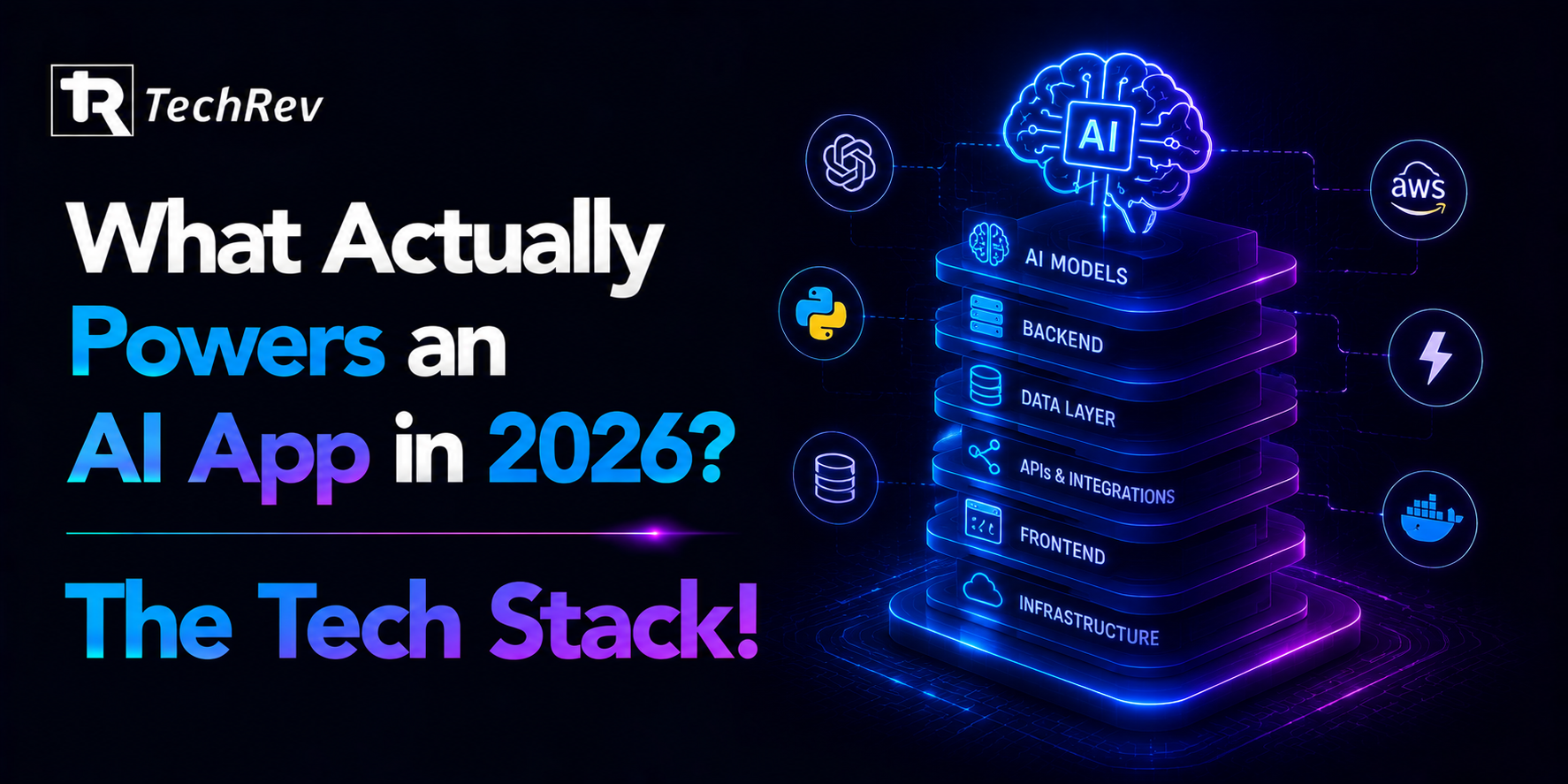
You don’t need to be a developer to understand this, but you do need to know enough to ask the right questions.
A modern AI startup is typically built in three layers:
1. Layer 1 – The Intelligence Layer
This is where the AI reasoning happens. In 2026, this almost always means accessing foundation models through APIs OpenAI GPT-4o, Anthropic Claude, or Google Gemini.
Very few startups train custom models from scratch, and most shouldn’t. The models are a commodity. What matters is how you use them.
2. Layer 2 – The Orchestration Layer
This is where your product actually lives. Retrieval-augmented generation (RAG) to pull from your own data. Fine-tuning on domain-specific datasets for accuracy.
Agent frameworks for multi-step autonomous workflows. Prompt engineering that produces consistent, usable outputs. This is what separates a clever demo from a product people pay for.
3. Layer 3 – The Interface and Data Layer
How users interact with your AI, and critically how you capture the feedback loops that make your AI smarter over time. A product that doesn’t get better with usage isn’t an AI product. It’s a static tool with a chatbot bolted on.
Understanding these three layers helps you evaluate any development partner. Ask them specifically how they approach Layer 2. That’s where real AI Agent development expertise shows up, and where most generic agencies fall short.
What to Expect: A Realistic AI Development Timeline!
Here’s a framework we use with startup founders to set honest expectations:
| Phase | Duration | What Happens? |
| Discovery & Scoping | 1-2 weeks | Define the problem, map the core user journey, assess data readiness |
| Data Audit & Architecture | 2-3 weeks | Audit existing data, design the data pipeline, identify gaps |
| MVP Development | 6-10 weeks | Core AI functionality, minimal UI, essential integrations |
| User Testing & Iteration | 2-4 weeks | Real users, real feedback, fix what’s broken |
| Full Feature Development | 3–4 months | Expand on validated MVP, scale infrastructure |
| Ongoing Optimization | Continuous | Model accuracy improves, edge cases handled, new use cases added |
Total time from zero to a production AI product: 4-6 months for most startup use cases. Anyone promising a complete, production-ready AI system in 3 weeks either doesn’t know what production-ready means, or hasn’t asked the right questions yet.
Also Read – How AI Workflow Automation Scales Finance App Development?
Conclusion
If you’re a startup founder sitting on a genuine AI product idea in 2026 you’re in the best position this space has ever offered. The models are powerful and accessible. The development tooling has never been better. The investor appetite is real.
But the founders who win aren’t the ones who moved fastest. They’re the ones who moved fastest in the right direction.
That means knowing what you’re building before you build it. Understanding your data situation honestly. Asking hard questions of anyone you bring in to build with you. And treating the MVP as a learning tool, not a finished product.
The question isn’t whether AI belongs in your product. It almost certainly does.
The question is whether you’re building it in a way that survives contact with real users.
TechRev is a custom AI development company based in Florida, USA. We’ve been building production-grade web and mobile applications since 2016, with a specialist focus on generative AI, RAG systems, LLM development, and enterprise-grade deployment.
If you’re at the idea-to-MVP stage and want a straight conversation about what it would take to build your product book a free strategy call.