

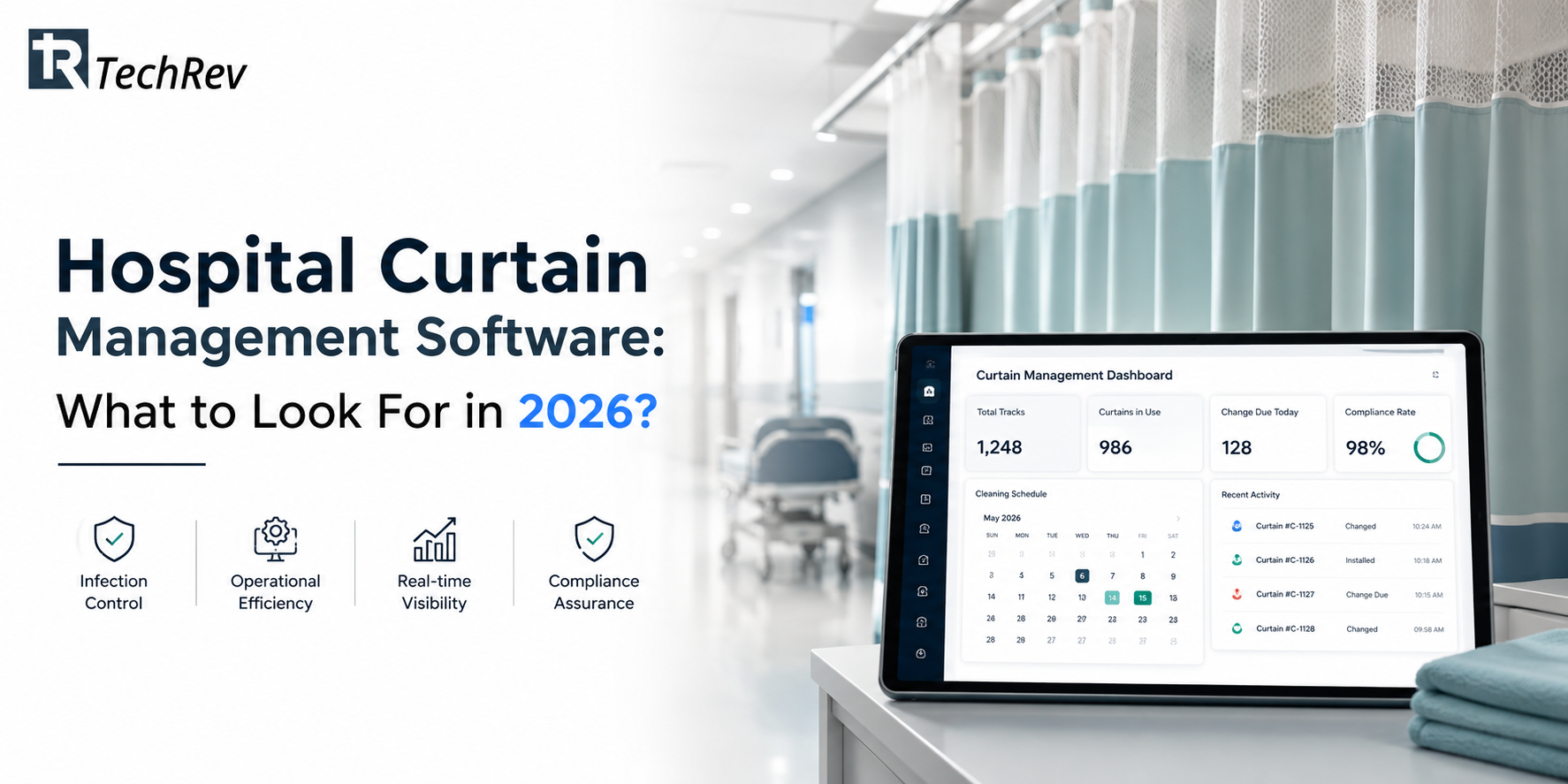
Picture this. An installer is standing in front of a hospital cart holding fifty curtains of nearly identical size and color, trying to figure out which one belongs on Track 14 of the ICU. Somewhere down the hall, a nurse is waiting for a clean curtain that was supposed to arrive an hour ago. This is not a rare scene. It happens in hospitals across the United States every single day, and it is exactly the kind of operational chaos that a modern hospital curtain management system is built to eliminate.
If you are researching healthcare app development for 2026, you already know the stakes are higher than they used to be. Curtains are not just fabric on a track anymore they are a direct line to infection control, patient safety, and facility compliance.
And yet most hospitals are still running this function on spreadsheets, verbal handoffs, and guesswork. Keep reading, because the features we are about to break down will change how you evaluate every vendor pitch you get this year.
Why Is Hospital Curtain Management Suddenly a Big Deal?

Privacy curtains are one of the most touched, least monitored surfaces in any hospital. Studies referenced by infection control bodies such as the CDC and APIC have repeatedly flagged high-touch curtains as a contamination risk, since they are handled constantly but changed far less often than other textiles.
According to CDC estimates, roughly 1 in 31 hospital patients has at least one healthcare-associated infection on any given day and contaminated privacy curtains are consistently named as a contributing surface in outbreak investigations.
That single statistic explains why hospital operations teams are no longer treating curtain changeouts as a housekeeping afterthought. It has become a compliance line item, a budget line item, and increasingly, a software line item.
This is exactly where a purpose-built hospital curtain management system earns its place next to your broader hospital management software development.
But here’s the part most buyers miss and it’s the part that decides whether your 2026 investment actually pays off.
The Real Problem Isn’t the Curtains. It’s the Process Behind Them
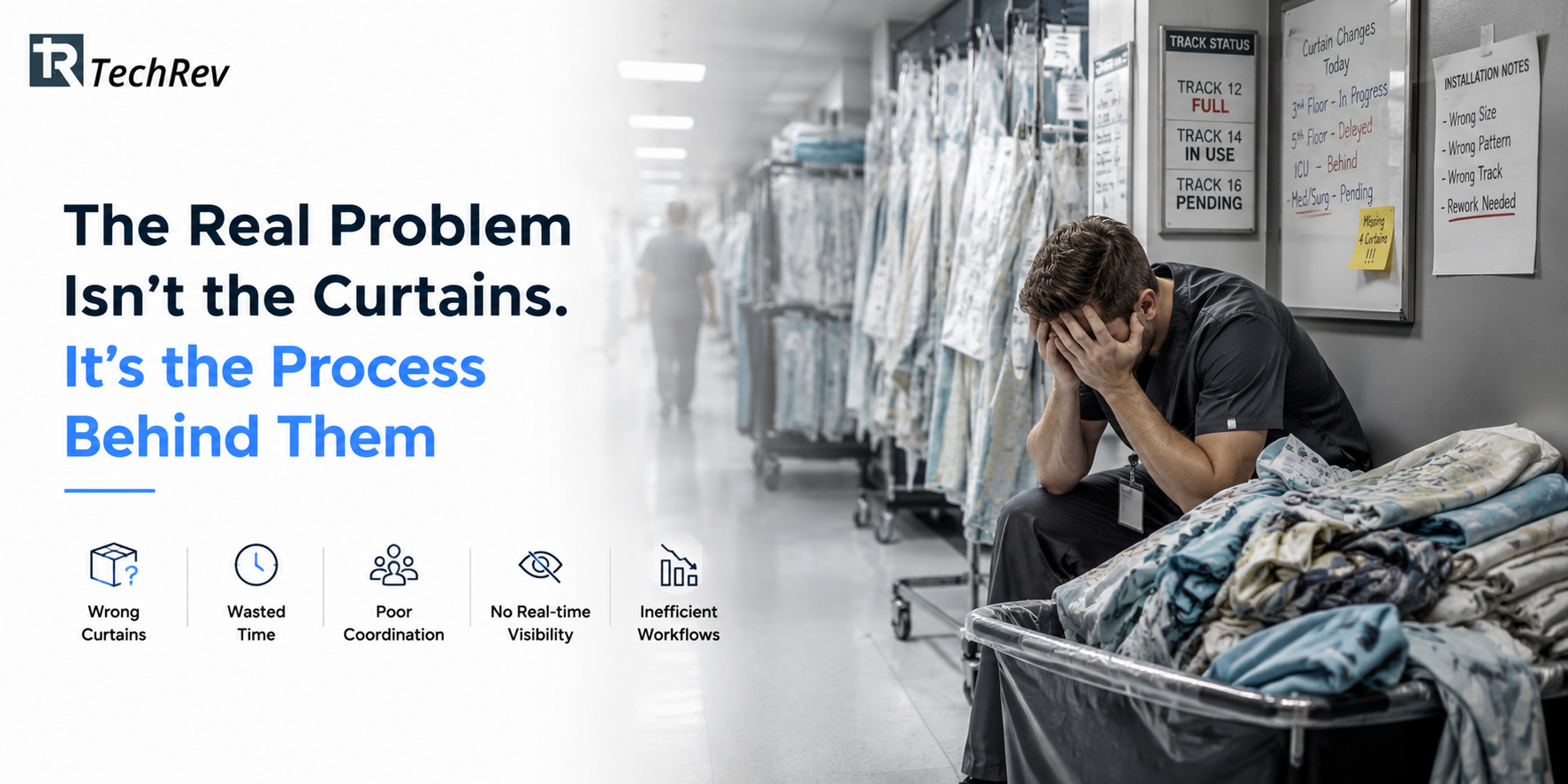
Here’s what almost nobody tells you before you sign a contract: most “curtain management” tools on the market today are just glorified checklists. They tell you a curtain was scheduled to be changed.
They do not tell you which curtain fits which track, whether that track is already full, or whether the installer is about to hang the wrong pattern in an ICU that requires a solid color for infection control reasons.
We know this because TechRev has been inside these workflows first-hand. Our team recently built an AI-powered installation and tracking solution for a leading U.S. hospital textile and curtain services provider, and the patterns we found were consistent across the industry:
- Installers spend the majority of a visit digging through mixed bags of curtains searching for the right size, type, pattern, and attachment.
- Wrong curtains get hung because nothing in the system tells the installer what belongs where, leading to costly repeat visits.
- Spare curtains disappear from visibility entirely, because most systems only track “original” inventory.
- Nobody has real-time insight into how much of a hospital’s cleaning cycle is actually complete.
- When multiple installers work one hospital, coordination happens by word of mouth, not by data.
If any of this sounds familiar, you are not managing curtains. You are managing chaos with a spreadsheet wrapper.
Also Read – How AI in Healthcare Sorts 80+ Items in Under 3 Minutes?
What to Look For in a Hospital Curtain Management Software in 2026?
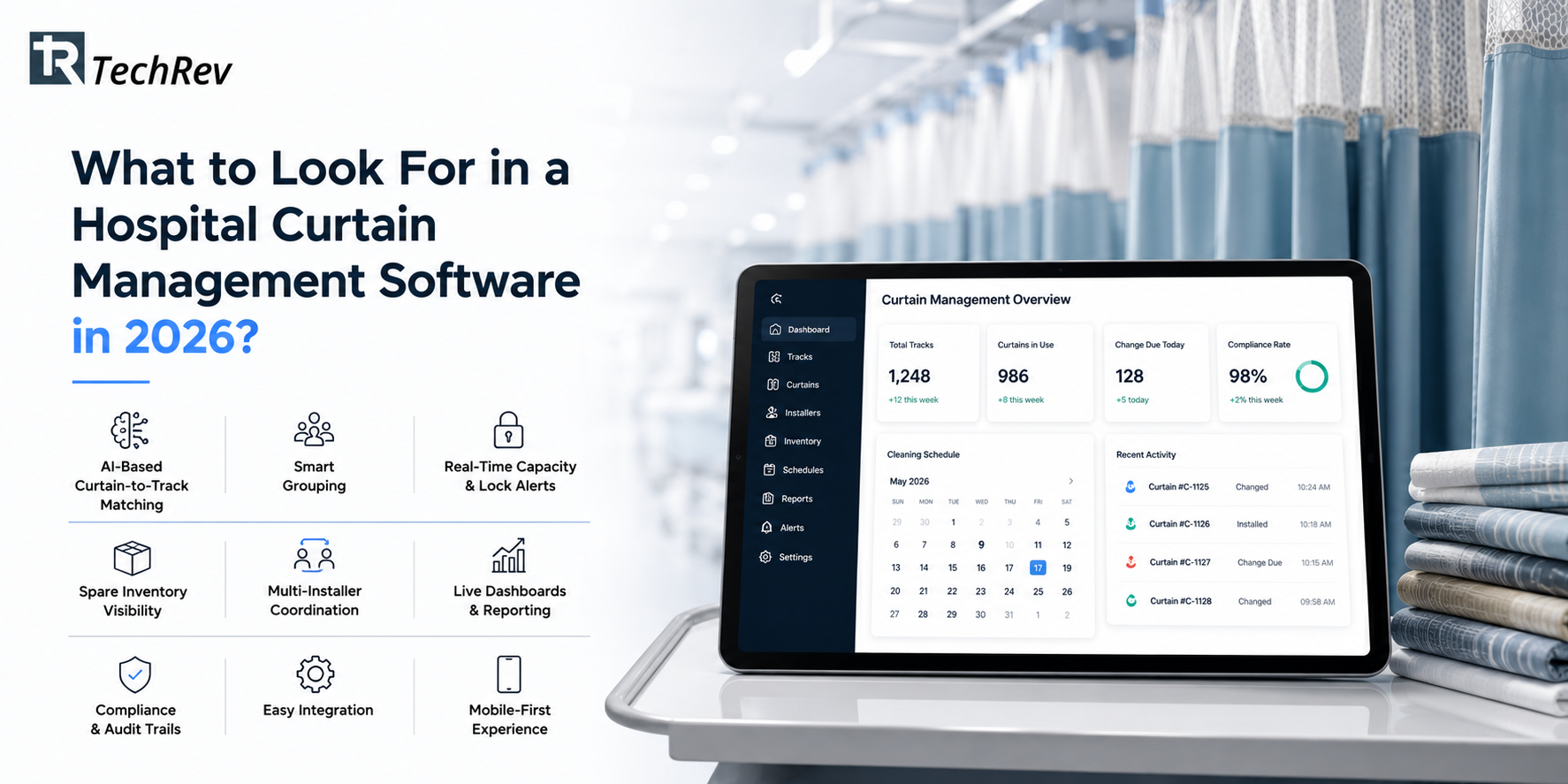
This is the checklist worth pinning above your desk before you take another vendor call.
1. AI-Based Curtain-to-Track Matching
The single biggest time sink in curtain servicing is manual searching. A modern hospital curtain management system should let an installer scan any curtain and instantly see where it belongs: building, floor, unit, room, and track based on historical installation data.
This single feature alone can cut visit time by 30 to 60 minutes per hospital, according to workflow analysis TechRev conducted while designing exactly this capability for a client.
2. Smart Grouping, Not Just Scanning
Look for software that lets installers scan one curtain and instantly see how many identical curtains exist in that batch and where they all go instead of scanning fifty curtains individually.
This “scan one, group many” logic can sort an entire cart of 50+ curtains into destination-ready piles in under three minutes, with only 3 to 6 scans total.
3. Real-Time Capacity and Lock Alerts
Every curtain track has a maximum capacity. The best systems flag full or already-serviced tracks before the installer walks there, preventing wasted trips and wrong installs.
This ties directly into broader hospital inventory management software capabilities, since curtain stock, spares, and track capacity are really one inventory problem wearing different hats.
4. Spare Inventory Visibility
Most legacy tools completely lose track of spare curtains once they leave the warehouse.
A well-built system links every spare bag to its visit with a single tap, giving 100% visibility into what an installer is physically carrying at any moment, closing one of the most common blind spots in curtain servicing.
5. Multi-Installer Coordination
When two or three installers are working at the same hospital, the software should let each one claim a floor range so the system automatically filters routes, suggestions, and progress tracking per person. No more verbal floor-splitting, no more overlapping work, no more missed rooms.
6. Live Dashboards for Operations Managers
Your operations team should never have to run a manual report to know how far along a hospital is in its cleaning cycle.
Look for dashboards that show visit-level and schedule-level completion percentages in real time, a feature that turns your hospital management system software from reactive to proactive.
7. Built on Generative AI and Custom Architecture, Not Templates
This is where most buyers get burned. Off-the-shelf platforms cannot adapt to a hospital’s unique track layouts, curtain types, or compliance rules.
You want a partner capable of true Generative AI development, one that trains models on your actual historical installation and inventory data, not a generic playbook.
This is precisely the kind of work TechRev specializes in as a custom hospital software development company in USA, building models around real operational data instead of forcing your hospital into someone else’s template.
Still not convinced software this specific is worth building custom?
Keep reading, because the numbers below tell a different story.
Also Read – AI Medical Scribe: How It Works, Costs, and Custom Builds
The ROI Hospitals Are Actually Seeing
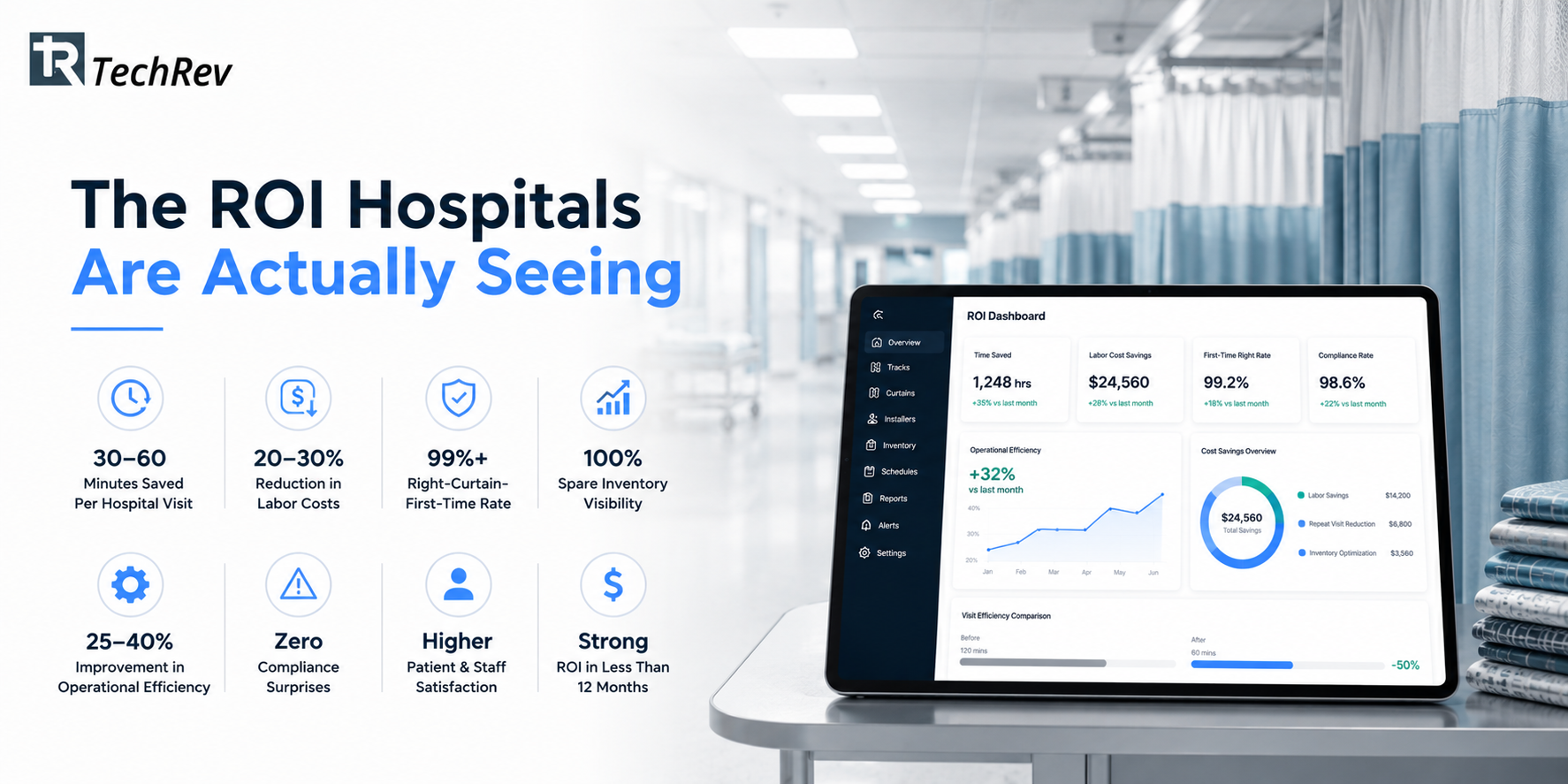
| Metric | Typical Improvement |
| Time saved per hospital visit | 30–60 minutes |
| Wrong-curtain installations | Reduced to near-zero |
| Spare/return visits | Significant reduction |
| New installer ramp-up time | Cut substantially with AI-guided routing |
| Manual reporting effort | Eliminated with live dashboards |
Translate that into business terms and the picture gets even clearer:
- Growth in Efficiency: Cutting 30 to 60 minutes per visit across hundreds of hospital cycles a year compounds into thousands of recovered labor hours annually.
- Increase in Productivity: New installers become productive faster because the app, not tribal knowledge, tells them where to go and what to pick.
- Reduction in Cost: Fewer wrong installs means fewer unbudgeted return trips, which directly protects margin on every service contract.
- Increase in Accuracy: Near-zero wrong-curtain installs means fewer compliance flags tied to pattern, type, or infection-control mismatches.
This is the same math that applies across the wider hospital management software category. When you fix one operational bottleneck with the right technology, the ROI rarely stays contained to that one function.
How TechRev Builds Software, Hospitals Actually Trust?
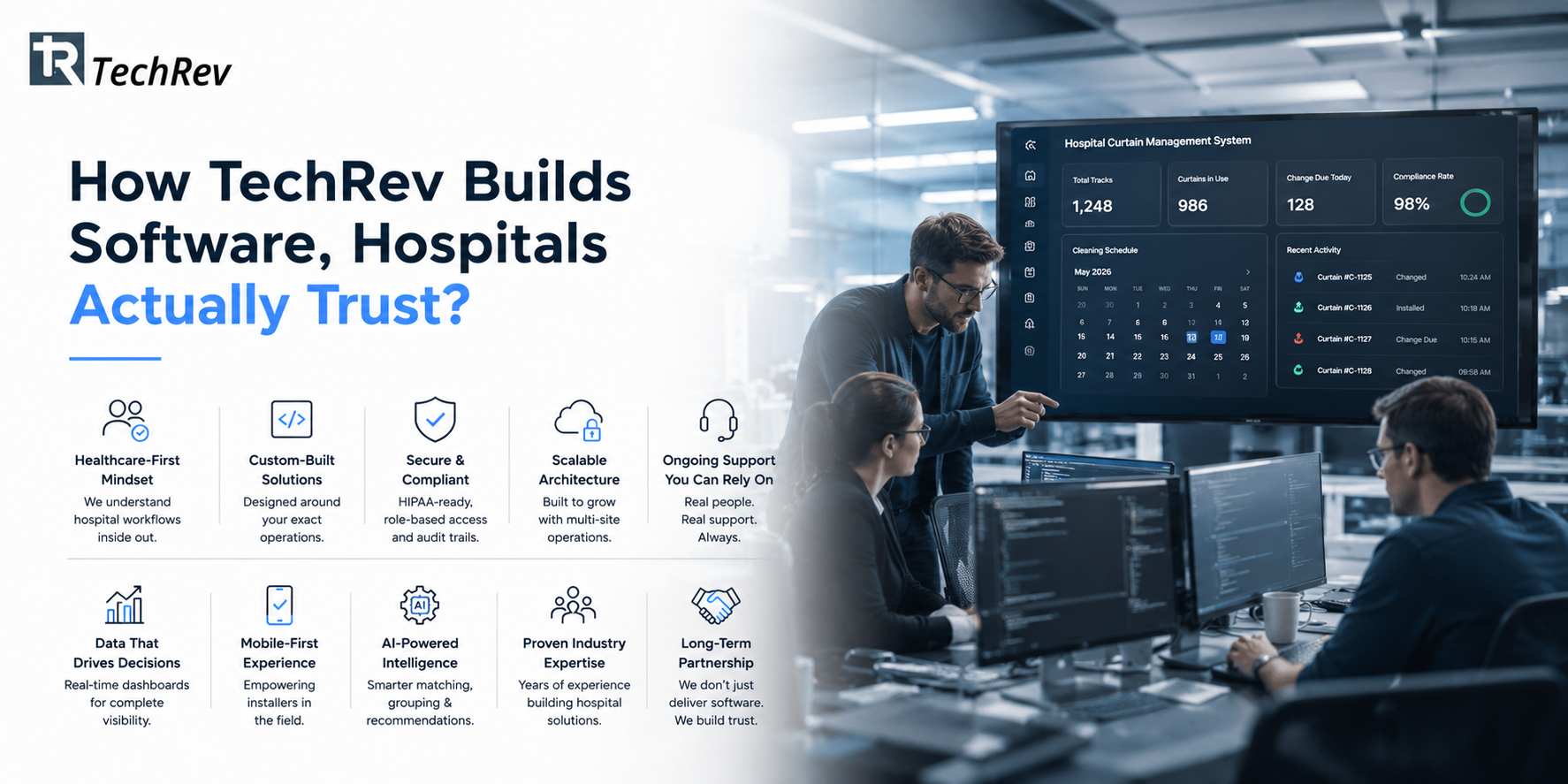
TechRev is a U.S.-based hospital software development company that works at the intersection of healthcare operations and applied AI. We are not a generic app shop that bolts a chatbot onto existing software and calls it innovation.
As an AI agents development company in USA, our engineering process starts by mapping the real, on-the-ground workflow the way installers move, the way laundry teams pack, the way operations managers schedule before a single line of code is written.
That approach is what led us to design the exact AI-driven curtain matching and smart-sorting system described above for a hospital textile services client.
The result was a system that used the client’s own years of historical installation data to power curtain-to-track recommendations, spare visibility, and real-time progress tracking, without requiring a single piece of new hardware.
If your organization is exploring a similar build, here is what working with TechRev typically looks like:
- Deep workflow analysis before any development begins
- Custom-built AI models trained on your actual operational data
- Full-stack AI app development services in USA, from mobile installer apps to manager dashboards
- Ongoing support as a true custom hospital software development company in USA partner, not a one-time vendor
Curious what an AI-powered curtain or facility management system could look like for your hospital network? Talk to TechRev’s team about a custom build.
Also Read – 7 Questions to Ask a Healthcare Software Development Company
Is a Custom Hospital Curtain Management System Worth the Investment?
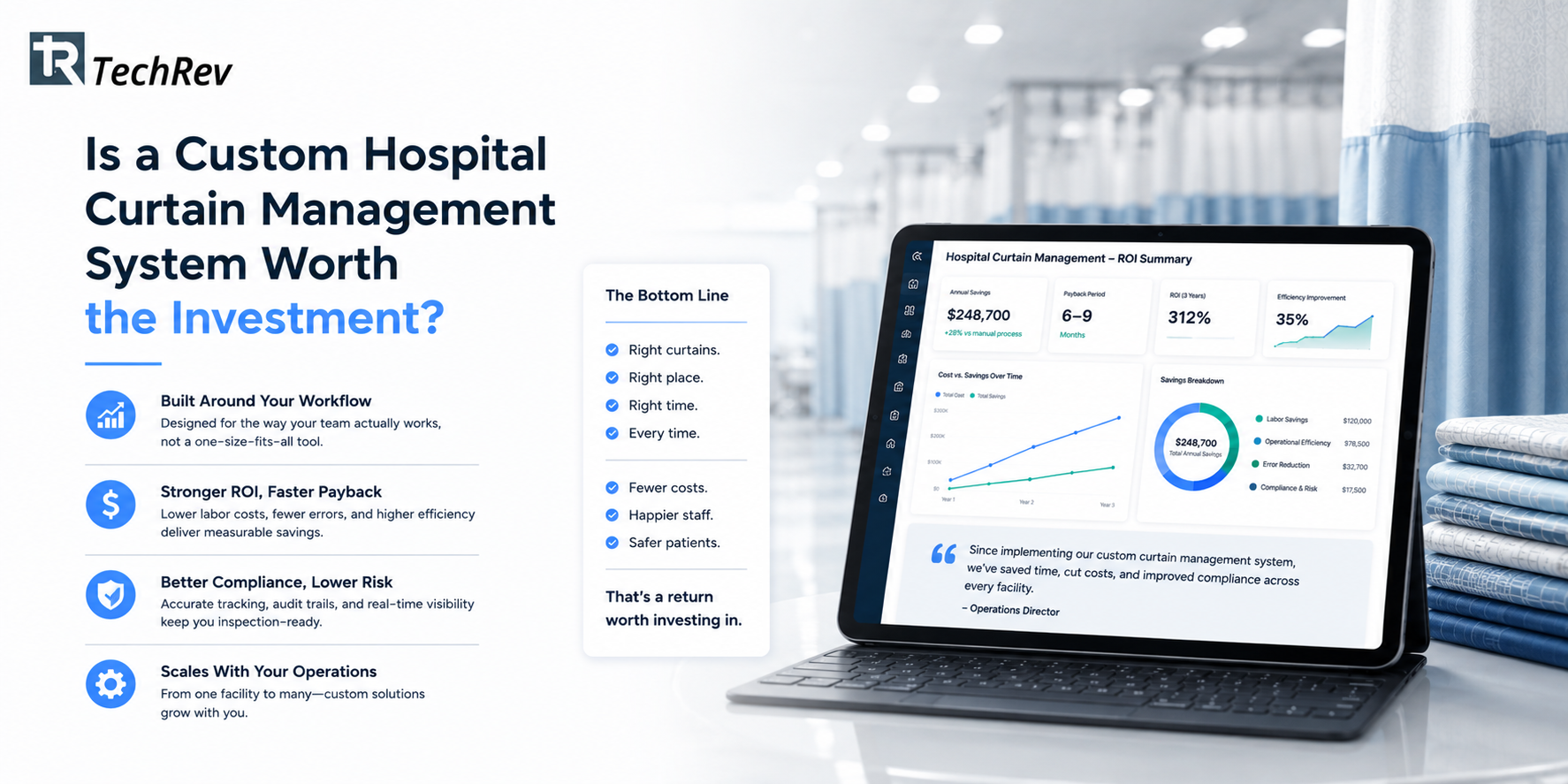
For hospital networks running dozens or hundreds of curtain tracks across multiple facilities, the answer is almost always yes.
Off-the-shelf hospital management system software rarely accounts for the operational nuance of curtain servicing the mixed bags, the spare inventory, the track locking rules.
A custom-built solution pays for itself through recovered labor hours, fewer repeat visits, and measurable infection-control compliance gains.
That said, not every facility needs a fully custom build on day one. Many hospitals start with a pilot on their highest-volume location, prove the ROI using the metrics above, and then scale the same AI logic across their full network.
TechRev structures engagements exactly this way, so you are never locking into a six-figure commitment before seeing real results.
Conclusion
Hospital curtain management is no longer a background task hiding inside your janitorial budget. In 2026, it sits at the crossroads of infection control, labor cost, and technology, and the hospitals that treat it that way are the ones pulling ahead on compliance and efficiency.
The right hospital curtain management software does more than schedule changeouts. It tells your team exactly where every curtain belongs, catches mistakes before they happen, and gives your operations managers a live picture of the entire facility.
TechRev has already built this exact kind of system for a real hospital services client, using the client’s own historical data to power AI-driven curtain matching, spare visibility, and real-time dashboards, without adding a single piece of new hardware. If you are evaluating vendors for 2026, that is the bar to hold every proposal against.
Ready to see what a custom-built system could do for your hospitals? Get in touch with TechRev and start the conversation today.
FAQs
1. What is hospital curtain management software?
Hospital curtain management software is a digital system that tracks the scheduling, cleaning, installation, and inventory of privacy curtains across a hospital, using scanning and AI to match the right curtain to the right track while reducing manual errors.
2. Why do hospitals need a hospital curtain management system instead of manual tracking?
Manual tracking cannot keep pace with hundreds of tracks, mixed curtain types, and infection-control rules. A hospital curtain management system automates matching, flags capacity or compliance issues in advance, and gives real-time visibility that spreadsheets simply cannot provide.
3. How does AI improve hospital inventory management software for curtains?
AI analyzes historical installation data to predict which curtain belongs on which track, groups similar curtains automatically, and flags spare inventory that would otherwise go untracked, turning static hospital inventory management software into a proactive, self-correcting system.
4. Does TechRev only build curtain management software, or full hospital management software too?
TechRev builds both. While curtain and textile tracking is one specialized use case, TechRev develops complete hospital management software, custom hospital management system software, and broader healthcare operations platforms tailored to each client’s workflow.
5. How long does it take to build a custom hospital curtain management system?
Timelines vary by scope, but a focused pilot module can typically be designed, built, and tested within a few months, with full-scale rollout following once the core AI matching logic is validated on real data.
6. Is TechRev an AI agent development company in USA that works with healthcare clients specifically?
Yes. TechRev is an AI agents development company in USA with direct experience building AI-driven operational tools for healthcare and hospital service providers, including installation tracking, inventory visibility, and workflow automation systems.
7. What makes TechRev different from other AI app development services in USA?
TechRev combines Generative AI development expertise with deep operational workflow mapping, meaning every build starts from how your teams actually work, not a generic software template, a distinction that matters most in specialized fields like hospital curtain servicing.