
Why does your equipment always break down at the worst possible time?
You know the feeling. A machine fails on a Friday afternoon. A delivery truck stalls mid-route. An HVAC unit dies in the middle of a heatwave. It always feels random, but it almost never is. Most equipment failures send out warning signs weeks before they actually happen, in the form of tiny vibration changes, slow temperature creep, or odd power draw. The problem is, nobody is listening for those signs until it’s too late.
That is exactly the gap that predictive maintenance software is built to close. And if you are reading this, you are probably trying to figure out one of two things: either how predictive maintenance software development actually works, or whether building one for your business is worth the investment. We will answer both, with real numbers, not vague promises.
We are TechRev, and we specialize in predictive maintenance software development in USA markets, building AI agents and predictive analytics platforms for companies across manufacturing, fleet, and healthcare sectors.
What Is Predictive Maintenance?
Maintenance has gone through four stages, and understanding them helps explain why predictive maintenance software is such a big leap forward.
- Reactive maintenance – you fix it after it breaks. Cheapest to plan, most expensive in practice, because unplanned downtime is brutal.
- Preventive maintenance – you service equipment on a fixed schedule, whether it needs it or not. Better than reactive, but wasteful, since you are replacing parts that still have life left in them.
- Predictive maintenance – sensors and machine learning models watch equipment behavior in real time and tell you when something is actually about to fail, not on a guessed schedule.
- Prescriptive maintenance – the system doesn’t just predict the failure, it recommends or automatically triggers the exact fix, the right technician, and the right part.
So, what is predictive analytics in this context? It is the engine underneath predictive maintenance. Predictive analytics models take historical and live sensor data, learn the normal “heartbeat” of a machine, and flag the moment that heartbeat starts sounding wrong.
This is the core of every modern predictive maintenance software platform, and it is why predictive analytics tools have become non-negotiable for any company running physical assets at scale.
Modern predictive analytics software goes a step further by combining these models with AI predictive analytics layers that learn and adjust over time instead of relying on static rules.
Also Read – Why 80% of AI Projects Fail and How to Fix It?
The Business Case: Why This Market Is Exploding?

This is not a niche trend anymore, and it is one of the biggest reasons demand for predictive maintenance software development in USA companies has accelerated so fast.
According to Grand View Research, the global predictive maintenance market was valued at roughly $14.29 billion in 2025 and is projected to reach $98.16 billion by 2033, growing at a CAGR of 27.9%.
The U.S. market alone is expected to grow at around 25.6% annually through 2033, driven mainly by manufacturing and energy companies trying to cut operational costs.
And the ROI numbers from Deloitte back this up clearly. Deloitte’s research shows predictive maintenance can:
- Increase equipment uptime by 10% to 20%
- Reduce overall maintenance costs by 5% to 10%
- Cut maintenance planning time by 20% to 50%
- Reduce unplanned breakdowns by as much as 70%, when paired with strong analytics
Separately, IBM has found that predictive maintenance adoption can reduce downtime by up to 30%, and the World Economic Forum reports that 75% of digitally mature companies already use predictive analytics for maintenance decisions.
For context on what downtime actually costs, large manufacturing facilities lose an average of 323 productive hours a year, with downtime costing roughly $532,000 per hour in lost sales, fines, and restart costs. That is not a rounding error in anyone’s budget.
That is the real reason predictive maintenance software development has stopped being a “nice to have” IT project and started being a board-level priority.
What is Predictive Analytics?
Predictive analytics is the use of historical data, statistics, and machine learning to estimate what is likely to happen next. In maintenance, that means estimating which machine is likely to fail, and roughly when, before it actually does.
How Predictive Maintenance Software Actually Works?
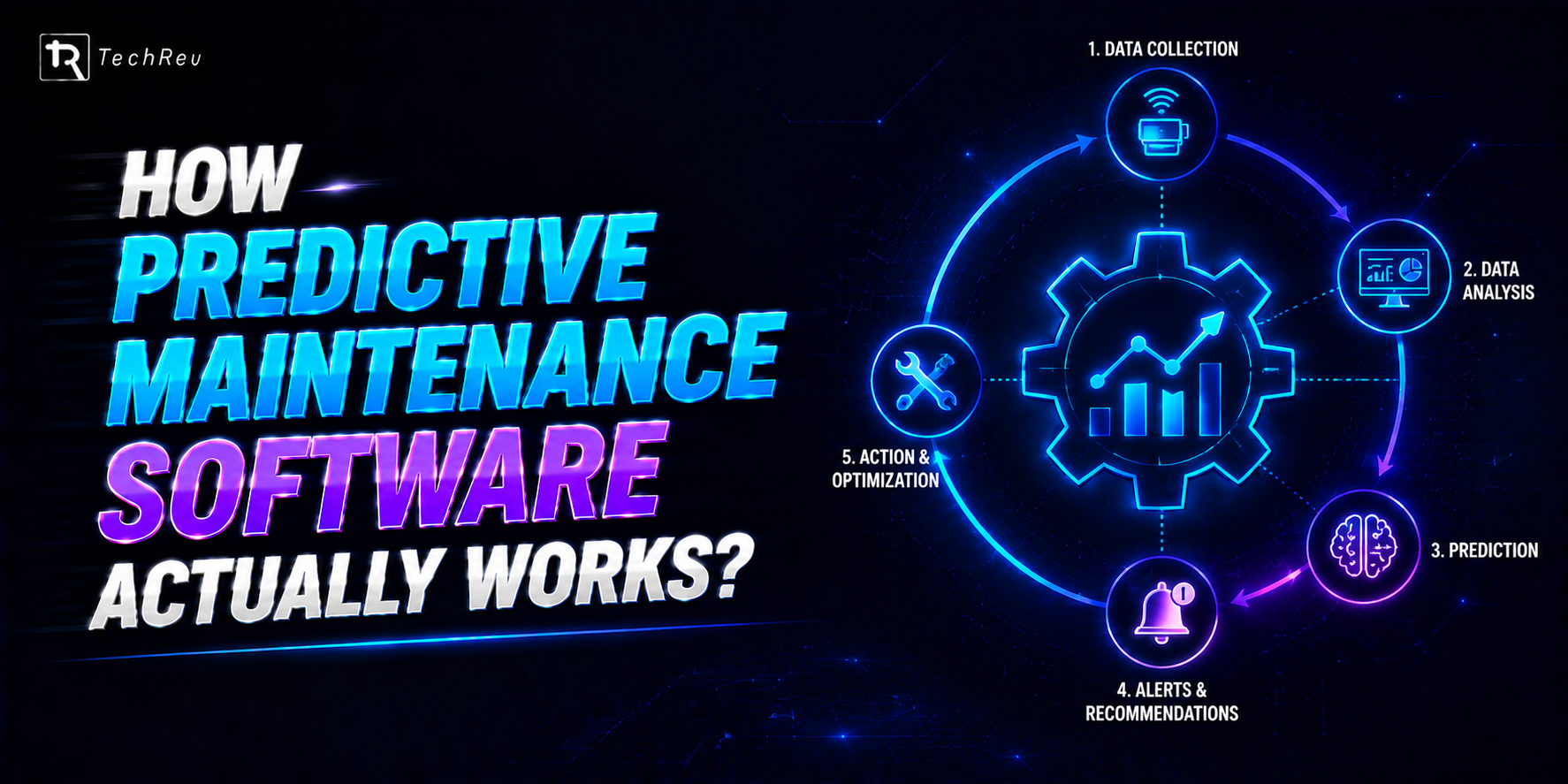
A predictive maintenance software platform is not one single tool. It is a pipeline, and each stage matters.
- IoT sensors collect data – Vibration sensors, temperature probes, pressure gauges, and current sensors sit on or near the equipment and stream readings continuously.
- Data is collected and cleaned – Raw sensor data is noisy. It gets normalized, time-stamped, and stored, usually through protocols like MQTT feeding into a cloud pipeline.
- Predictive analytics models process the data – Machine learning models trained on historical failure patterns compare live readings against “normal” behavior and calculate a failure probability.
- Alerts are generated – When the model crosses a risk threshold, it pushes an alert to the maintenance team, often ranked by urgency.
- Action is triggered – This is where predictive maintenance software development connects to your field service management (FSM) tools, automatically generating a work order, assigning a technician, and even pre-ordering the part that is likely to fail.
This last step is where a lot of predictive maintenance software falls short.
We have seen this happen again and again: companies build a model that predicts failures well but never wire it into the actual workflow, so technicians keep working off paper checklists anyway. The prediction is only valuable if it turns into action without extra manual steps.
Also Read – How Digital Twin & AI Agents Improving Predictive Patient Care?
Key Technologies Behind Predictive Maintenance Software
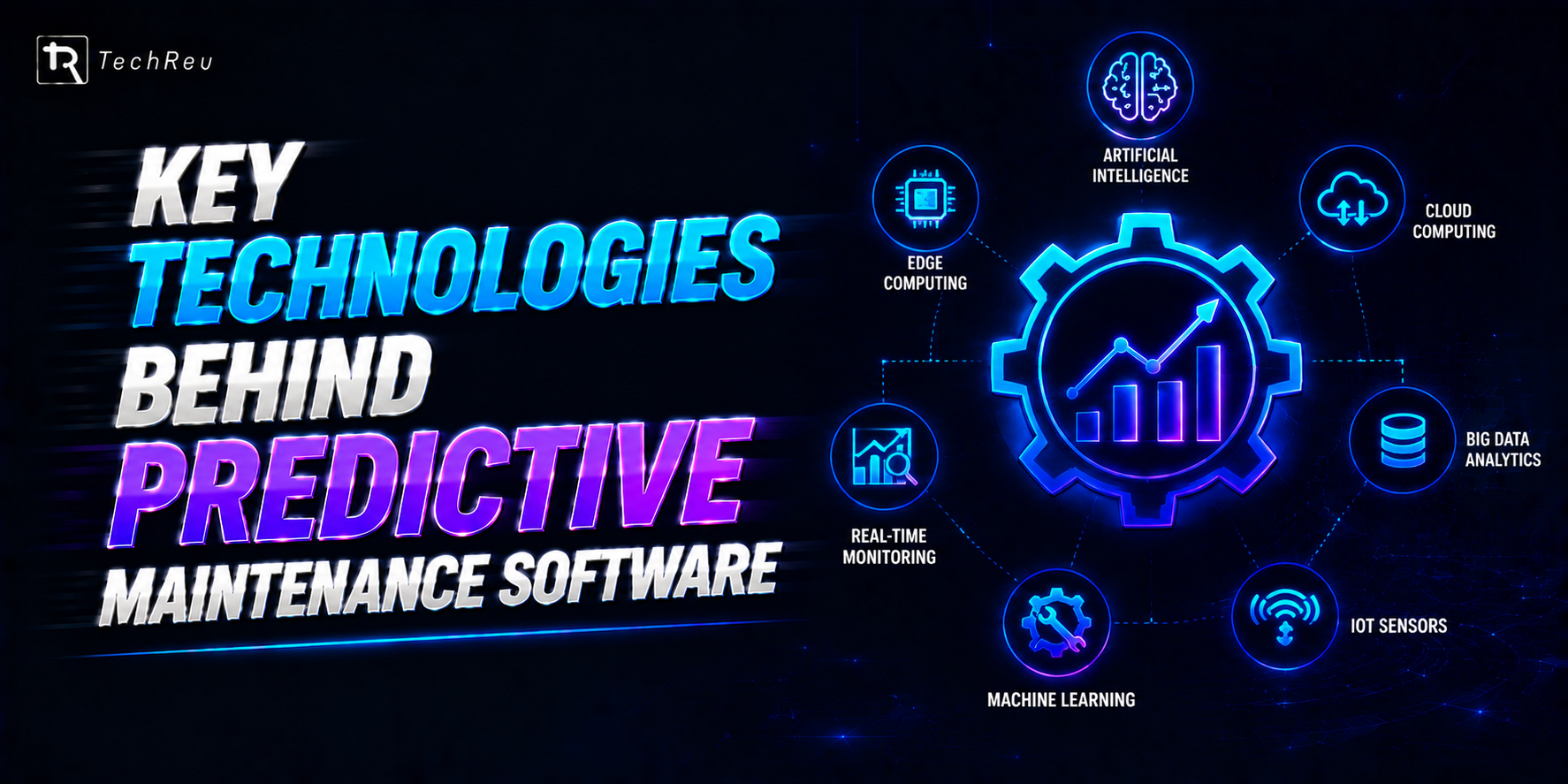
Building reliable predictive maintenance custom software development pipelines depends on stacking the right technologies together.
- IoT sensors – vibration, temperature, pressure, acoustic, and current sensors form the data layer.
- Machine learning and AI – algorithms like random forests, LSTMs, and gradient boosting models detect anomalies and forecast remaining useful life.
- Digital twins – virtual replicas of physical equipment that simulate behavior under different stress conditions, useful for training models when real failure data is limited.
- Edge computing – processing data closer to the machine instead of sending everything to the cloud, which cuts latency and is especially important for remote sites like wind farms or pipelines. Edge AI is actually the fastest-growing segment of the entire predictive maintenance market right now, at a projected 14.2% growth rate.
- AI Agent Development – this is where things have moved recently. Instead of a dashboard a human has to check, AI agents can monitor sensor streams continuously, reason about multiple data points at once, and decide on their own when to escalate, schedule, or even order parts. Gartner predicts that by 2026, 40% of enterprise applications will include task-specific AI agents, and maintenance is one of the categories where this is happening fastest.
- Generative AI Development – large language models are now being layered on top of time-series data so engineers can literally ask a system, “why is pump 4 trending toward failure,” and get a plain-language answer instead of digging through dashboards. This is one of the more practical real-world uses of Generative AI Development we have built for clients, and it pairs naturally with AI predictive analytics dashboards that already track equipment risk scores.
- LLM Development – purpose-built LLM Development work powers these conversational maintenance interfaces, letting non-technical staff query equipment health without needing a data science background.
Which Industries Benefit Most From Predictive Maintenance Software?
Almost any industry running physical assets benefits, but a few stand out clearly.
- Manufacturing – the single largest adopter, holding roughly 21% to 33% of the market depending on the report, because unplanned line stoppages are the most expensive failure mode in the entire economy. Manufacturers searching for the best predictive maintenance software usually prioritize vibration monitoring here first.
- Fleet management predictive maintenance software – logistics and trucking companies use sensor data from engines, brakes, and tires to predict breakdowns before a vehicle is stranded mid-route, which directly protects delivery SLAs and driver safety.
- Utilities and energy – predicting transformer or turbine failure before it causes regional outages.
- HVAC – commercial buildings use predictive maintenance to catch compressor and motor failures before tenants notice a problem.
- Plumbing and facilities – leak detection sensors combined with predictive models that flag pipe corrosion before it becomes a flood.
- Healthcare – predictive analytics in healthcare is increasingly used for both equipment uptime (MRI machines, ventilators) and clinical use cases like predicting patient deterioration, which shows how far predictive analytics tools have expanded beyond pure mechanical maintenance.
- Aerospace and defense – one of the fastest-growing end-use segments, where unplanned downtime is a safety issue, not just a cost issue.
- Supply chain and logistics – predictive analytics in supply chain is used to forecast equipment failures across warehouses, conveyor systems, and transport fleets so that one broken forklift doesn’t cascade into a missed shipment deadline. As predictive analytics in supply chain adoption grows, warehouse managers are increasingly using these alerts to re-route inventory before a bottleneck even happens.
Also Read – How Startup Founders Are Building AI-Powered Apps in 2026?
How to Build a Predictive Maintenance Software?
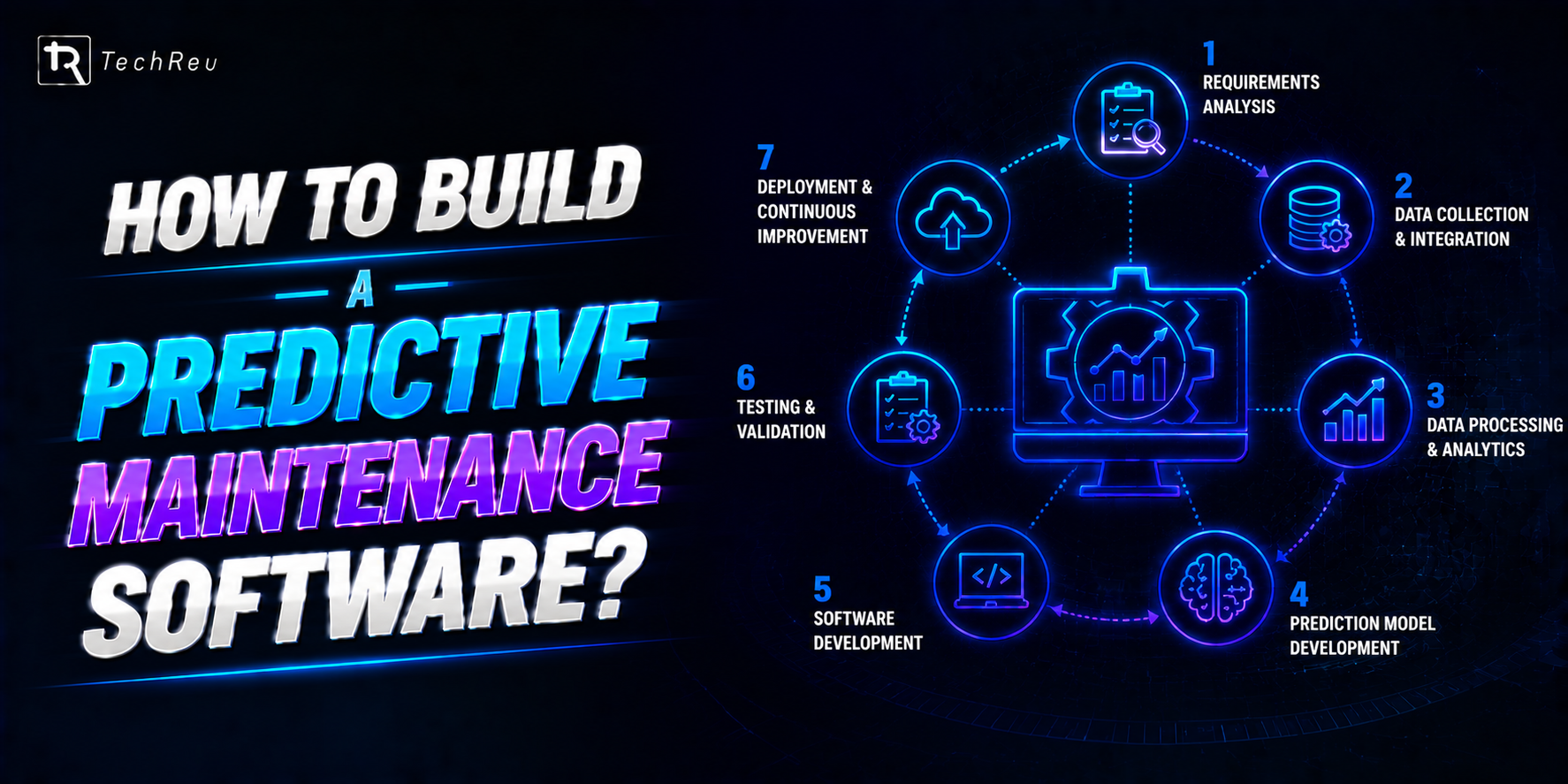
If you are evaluating predictive maintenance software development for your own business, here is roughly how the build process actually goes. Companies looking into predictive maintenance software development in USA facilities usually start with these same steps, regardless of industry.
1: Define the failure modes that matter
Not every part of a machine needs monitoring. Start with the components that cause the most downtime when they fail.
2: Choose and install sensors
Vibration and temperature sensors cover most rotating equipment. Pressure and flow sensors matter more for pipelines and HVAC systems.
3: Build the data pipeline
This usually runs through MQTT for lightweight messaging, feeding into cloud infrastructure like AWS IoT Core or Azure IoT Hub for ingestion and storage.
4: Train the predictive analytics models
Python remains the standard here, with scikit-learn for simpler statistical models and TensorFlow for deep learning approaches like LSTMs that handle time-series failure prediction well.
5: Build the alerting and workflow layer
This is the step we mentioned earlier that gets skipped too often. Alerts need to flow directly into your FSM or CMMS platform so a work order is created automatically, with the right technician and part already attached.
6: Test against real failure history
Before going live, the model needs to be validated against actual past failure events, not just simulated data, or you risk a system that looks accurate on paper but misses real-world failures.
7: Monitor and retrain
Equipment ages, conditions change, and a model trained once will drift. Continuous retraining is part of the cost of running this long-term, not a one-time expense.
What is the typical tech stack for predictive maintenance software development?
Most production-grade builds use Python (scikit-learn, TensorFlow) for modeling, AWS IoT Core or Azure IoT Hub for device connectivity, MQTT for sensor messaging, and a cloud data warehouse for historical storage and retraining.
Also Read – Why Does Your Business Need a Custom RAG Chatbot?
How Much Does Predictive Maintenance Software Development Cost?
Costs vary widely depending on scope, and we tell every client this upfront rather than quoting a number that won’t hold up. There is no single price tag for the best predictive maintenance software, because the right system depends entirely on your sensor count, facility size, and integration needs. A focused pilot covering one facility and a handful of sensor types typically falls in the $30,000 to $60,000 range.
A full enterprise rollout, with hundreds of sensors, custom ML models, digital twin integration, and FSM integration, generally runs from $100,000 to $200,000 or more.
The biggest cost drivers are the number of sensor points, the complexity of the ML development models, and how deeply the system needs to integrate with existing software.
How TechRev Builds Predictive Maintenance Software That Actually Pays Off?
We at TechRev have built predictive maintenance software, AI Agent Development pipelines, and predictive analytics software development projects for companies that needed more than a dashboard, they needed results they could put in a board report. Every predictive analytics software development engagement we run starts with the actual failure data, not a generic template. Here is what that has looked like in practice.
- Cost reduction: On a recent fleet management predictive maintenance software project, our client cut unplanned vehicle downtime by 32%, which translated into a 22% reduction in emergency repair spend within the first two quarters.
- Growth in sales: For a manufacturing client, moving from preventive to predictive maintenance freed up production capacity that had previously been lost to unplanned stoppages, contributing to an 18% increase in fulfilled order volume.
- Increase in productivity: Maintenance teams using our predictive analytics models spent 40% less time on manual inspections, since the system flagged exactly which equipment needed attention instead of requiring blanket checks.
- Increase in efficiency: One HVAC services client reduced average repair response time from 9 hours to under 3 hours after we connected their predictive alerts directly into their dispatch system.
- ROI: Clients typically see a return on their predictive maintenance software development investment within 9 to 14 months, largely because avoided downtime costs add up faster than the build cost itself.
This is the part of best predictive maintenance software that vendors don’t always talk about honestly: the model accuracy matters less than whether the prediction actually reaches a human, or an AI agent, in time to act on it.
That is the part we focus on building correctly, not just the algorithm, and it is also where most generic predictive analytics services fall short.
How is TechRev different from a typical predictive analytics services vendor?
We build the full pipeline, sensors, models, and workflow integration, instead of handing over a model and leaving the implementation gap for you to solve.
Unlike many predictive analytics services providers that stop at reporting dashboards, our AI predictive analytics systems connect directly into the workflows your team already uses.
Conclusion
Predictive maintenance software development is no longer an experimental technology reserved for Fortune 500 manufacturers. With the U.S. market growing at over 25% annually and real, documented ROI from Deloitte and IBM showing downtime cuts of up to 30%, the business case has moved from “interesting” to “expensive to ignore.”
The companies winning with this technology are not the ones with the fanciest models, they are the ones who built systems where predictions translate into action, automatically and quickly.
That is exactly what we focus on at TechRev. Whether you need fleet management predictive maintenance software, a predictive analytics platform for your manufacturing floor, or an AI agent that can talk through your equipment’s health in plain language, we have built it before and we can build it for you.
If you are ready to stop reacting to breakdowns and start predicting them, let’s talk.
FAQs
1. What is predictive analytics?
Predictive analytics is the use of historical data, statistics, and machine learning to forecast future outcomes. In maintenance, this means forecasting equipment failure before it actually happens.
2. What is the difference between preventive and predictive maintenance?
Preventive maintenance follows a fixed schedule regardless of equipment condition. Predictive maintenance software monitors actual equipment condition in real time and only flags maintenance when data shows it is genuinely needed.
3. How long does it take to build a predictive maintenance system?
A focused pilot can typically be built and deployed in 8 to 14 weeks. Full enterprise systems with deep FSM integration usually take 4 to 8 months.
4. Is predictive maintenance software worth it for small and mid-sized businesses?
Yes, particularly for fleet management, HVAC, and plumbing businesses where even a few avoided breakdowns can cover the cost of the system within the first year.
5. Can predictive analytics tools work without IoT sensors?
In some cases, yes, using existing operational data like run-hours, error logs, and service history, though accuracy improves significantly once live sensor data is added. This is especially relevant for predictive analytics in supply chain use cases, where order and shipment data alone can flag risk before sensors are even installed.
6. What industries use predictive analytics in healthcare?
Hospitals use predictive analytics in healthcare for both equipment uptime, like MRI and ventilator monitoring, and clinical applications such as predicting patient deterioration risk.
7. Does TechRev only build predictive maintenance software, or also AI agents and LLM-based tools?
TechRev builds across all three. We combine predictive maintenance software development with AI Agent Development, Generative AI Development, and LLM Development, because in 2026, the best maintenance systems are conversational, not just dashboards.
8. What makes TechRev’s approach to predictive analytics software development different?
We build sensor-to-action pipelines, not isolated models, so predictions actually generate work orders and results instead of sitting unread in a dashboard.