
Remote patient monitoring software has crossed the line from telehealth experiment to standard of care, and the numbers prove it. Medicare remote patient monitoring claims grew more than tenfold between 2019 and 2022 according to federal oversight data, and industry forecasts projected around 70 million Americans, roughly a quarter of the country, would be using remote patient monitoring tools by 2025.
Behind that surge is a simple clinical reality: 6 in 10 US adults live with a chronic disease, 4 in 10 live with two or more, and chronic conditions drive the overwhelming majority of the nation’s $4.5 trillion in healthcare spending, per CDC data. You cannot manage chronic disease with four office visits a year. Remote patient monitoring software fills the other 361 days.
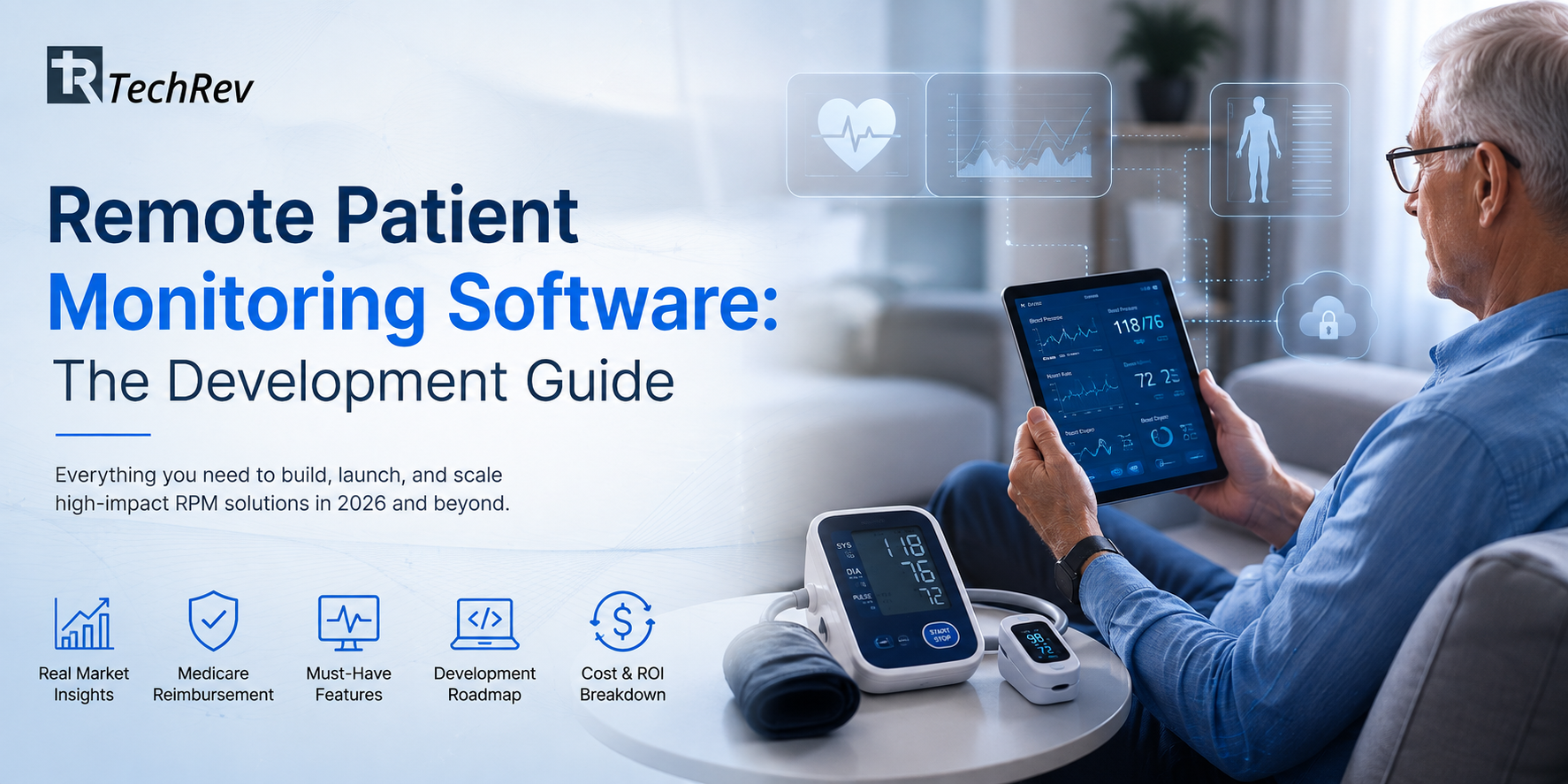
This guide is the complete picture for 2026: how AI in RPM works, the market stats that matter, Medicare reimbursement rules, the features RPM software needs, and what it takes to build one.
What Is Remote Patient Monitoring Software?
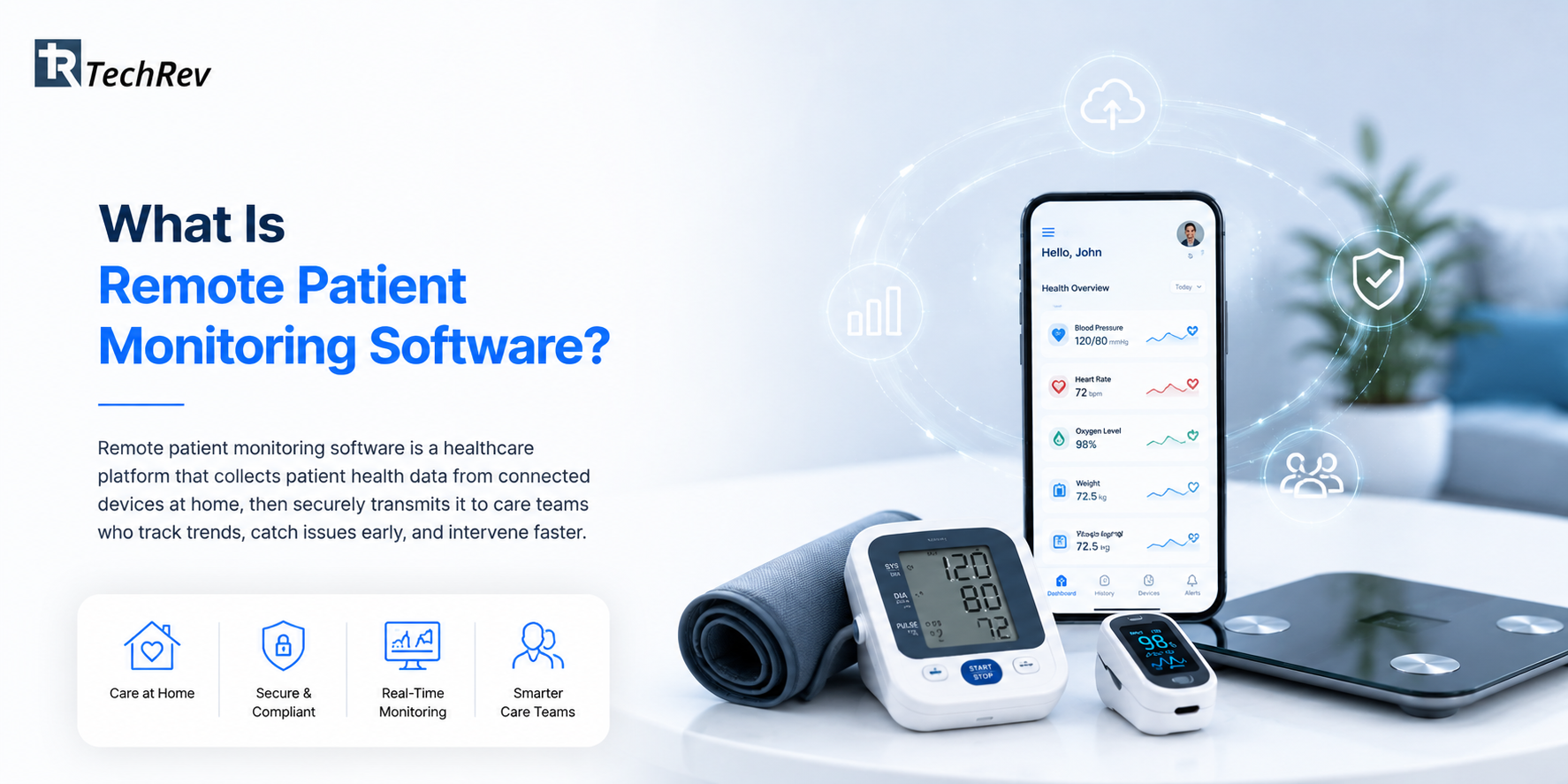
Remote patient monitoring software is a healthcare platform that collects patient health data from connected devices at home, such as blood pressure cuffs, glucose meters, pulse oximeters, and scales, then transmits it to care teams who track trends, catch deterioration early, and intervene before a problem becomes an emergency room visit.
The short version: RPM software turns a patient’s living room into an extension of the clinic.
How Does Remote Patient Monitoring Work?
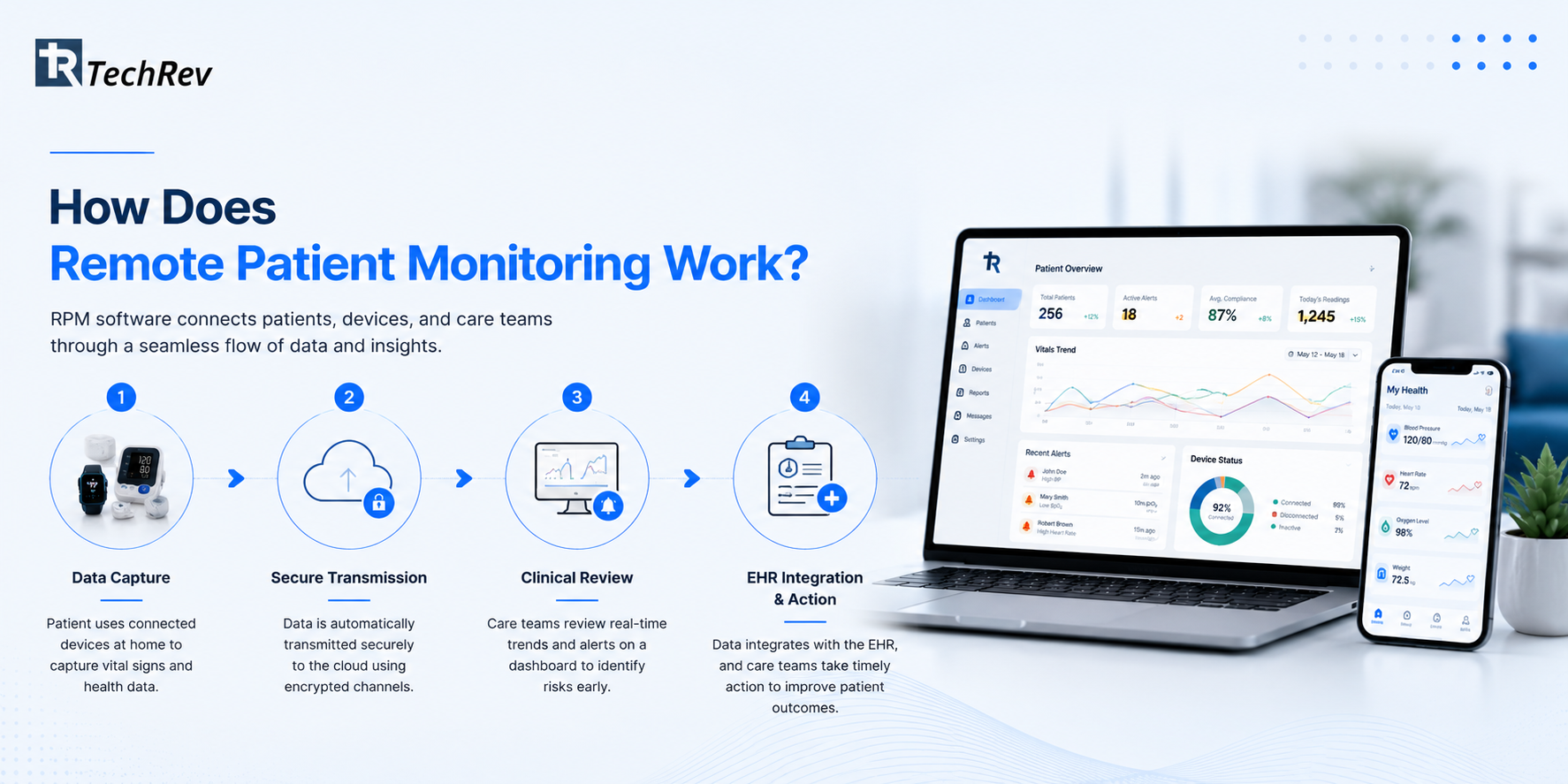
Remote patient monitoring works through four connected components: a patient-side device or app that captures readings, a secure transmission layer that sends data to the cloud, a clinical dashboard where care teams review trends and receive alerts, and integration into the EHR so monitoring data lives in the patient’s record.
A typical day in an RPM program looks like this: the patient takes a morning blood pressure reading, the device transmits it automatically, the software checks it against thresholds the care team set, and a nurse gets an alert only if something drifts out of range. Multiply that by hundreds of enrolled patients, and the software is doing the watching so clinicians can do the treating.
Where Does AI Change RPM?
AI moves remote patient monitoring from collecting data to predicting problems: flagging deterioration patterns across vitals before a single reading crosses a threshold, prioritizing which patients need attention today, and drafting the documentation that reimbursement requires. We cover this angle in depth in our companion piece on the role of AI in remote patient monitoring.
Why Is the RPM Market Exploding? The Real Numbers
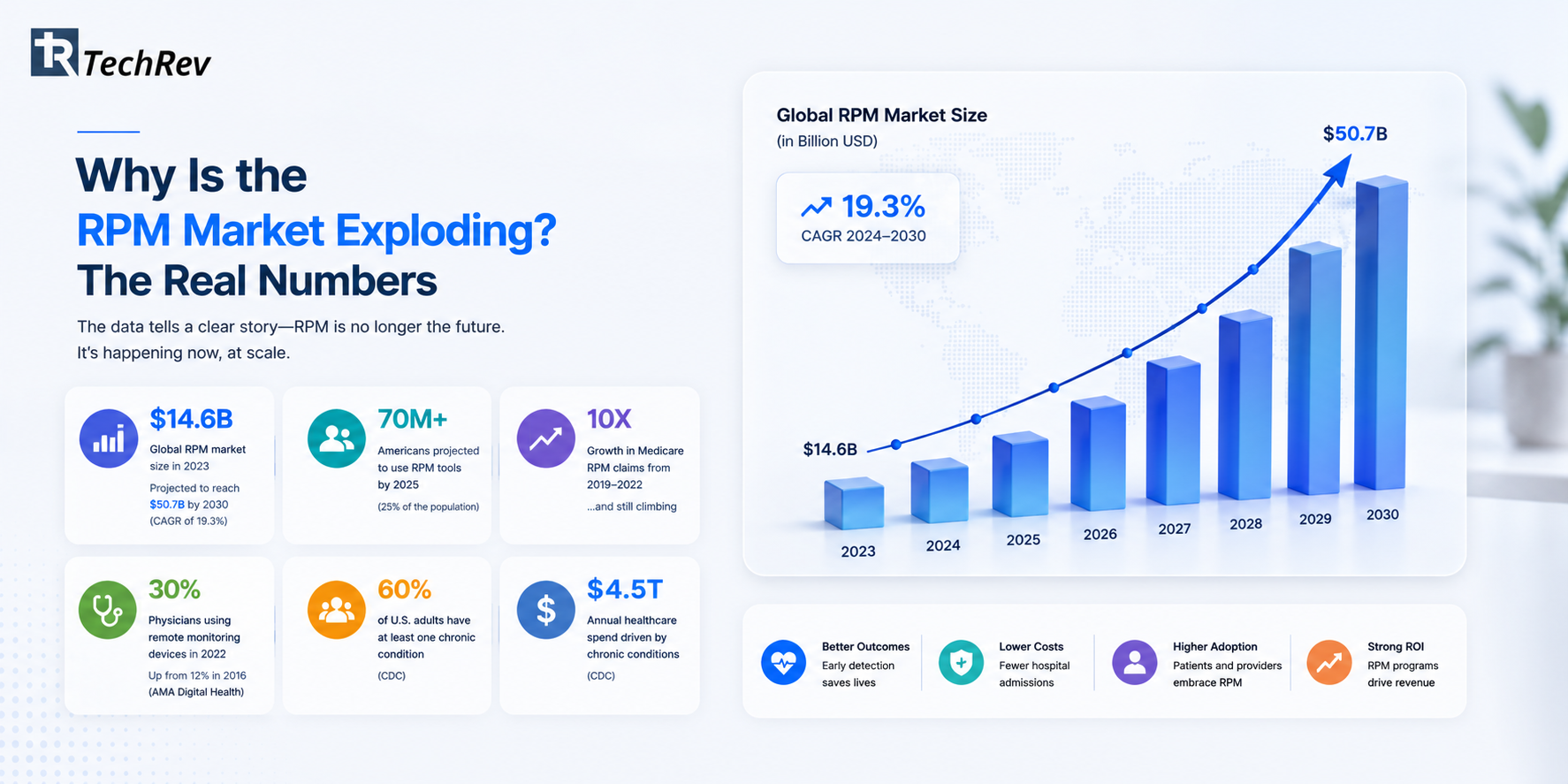
The market data tells a consistent story across every source:
- Market size: the global remote patient monitoring market was valued in the mid teens of billions of dollars in 2023 and is projected to grow at roughly 18 to 20% annually, putting it on a path past $50 billion by 2030, per major market research estimates.
- Patient adoption: industry forecasts projected about 70 million US patients, over a quarter of the population, using RPM tools by 2025.
- Medicare growth: federal oversight (HHS OIG) reported Medicare RPM utilization grew more than 10x from 2019 to 2022, and it has kept climbing since.
- Physician adoption: the AMA’s digital health research found the share of physicians using remote monitoring devices jumped from 12% in 2016 to about 30% by 2022, the fastest growth of any digital health tool it tracks.
- Clinical demand: with 60% of US adults managing at least one chronic disease (CDC), the patient population for remote patient monitoring is effectively the majority of the healthcare system.
Put those together and the conclusion writes itself: remote patient monitoring software is no longer a differentiator for providers and healthcare vendors. It is infrastructure, and reimbursement now pays for it.
What Are Medicare’s RPM Reimbursement Rules?
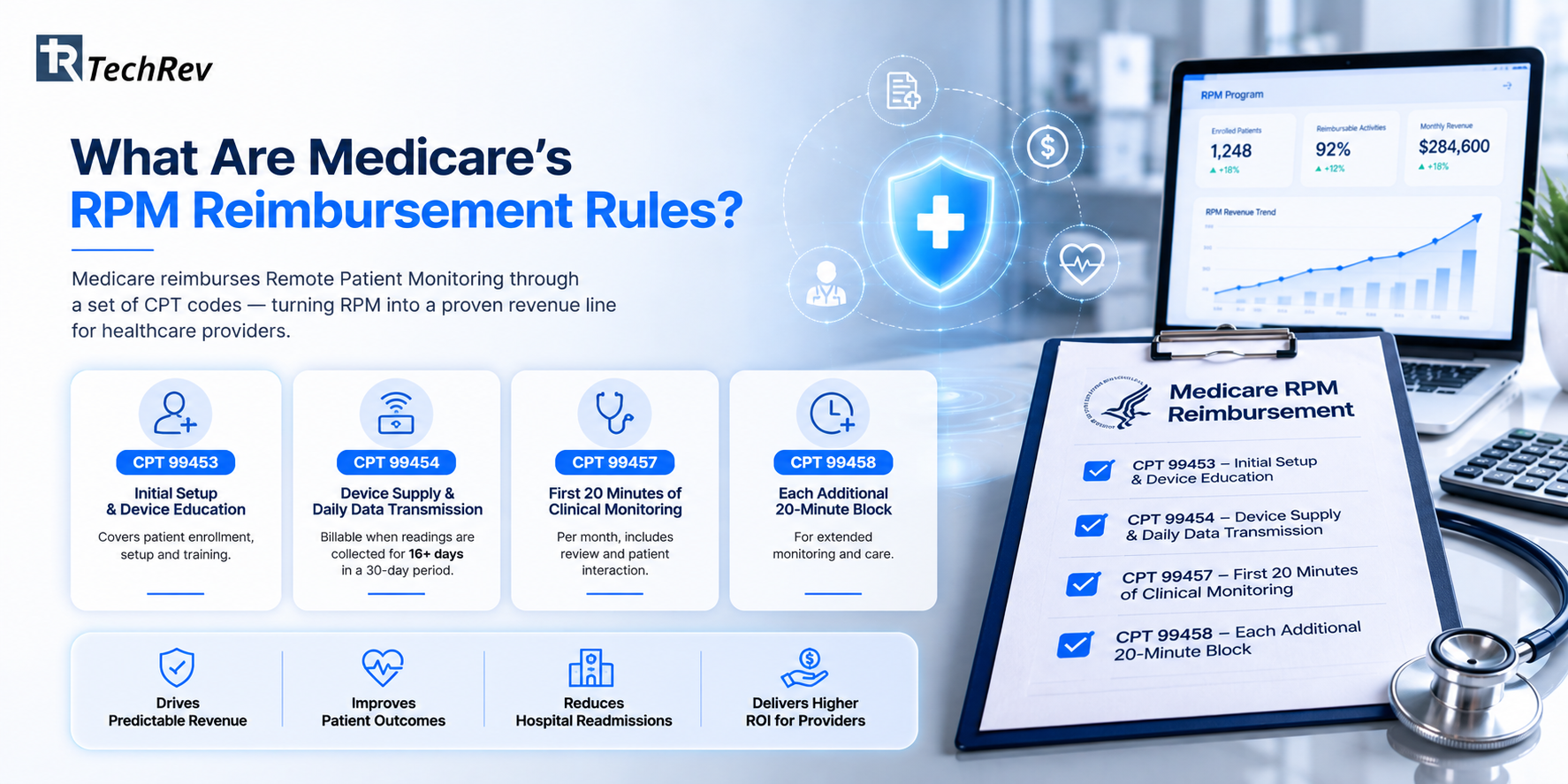
Medicare reimburses remote patient monitoring through a defined set of CPT codes, and understanding them is what turns an RPM program from a cost center into a revenue line:
- CPT 99453 covers initial patient setup and device education
- CPT 99454 covers device supply and daily recording transmission, billable when readings are collected on enough days in a 30-day period (16 days has been the standard threshold)
- CPT 99457 covers the first 20 minutes of clinical monitoring and patient interaction per month
- CPT 99458 covers each additional 20-minute block
Two design implications follow for anyone building or buying RPM software.
First, the platform must automatically track days-of-readings and minutes-of-care, because those are the billing units and manual tracking leaks revenue.
Second, patient engagement features are not cosmetic: if patients stop taking readings, the days threshold is missed and the reimbursement disappears. Compliance-grade time logging plus adherence nudges is where good RPM software pays for itself.
Always confirm current-year requirements against the CMS Physician Fee Schedule, since thresholds and payment rates get revisited annually.
Also Read – AI and Remote Patient Monitoring: What Every American Should Know About Healthcare’s Next Big Shift
What Features Does Remote Patient Monitoring Software Need in 2026?
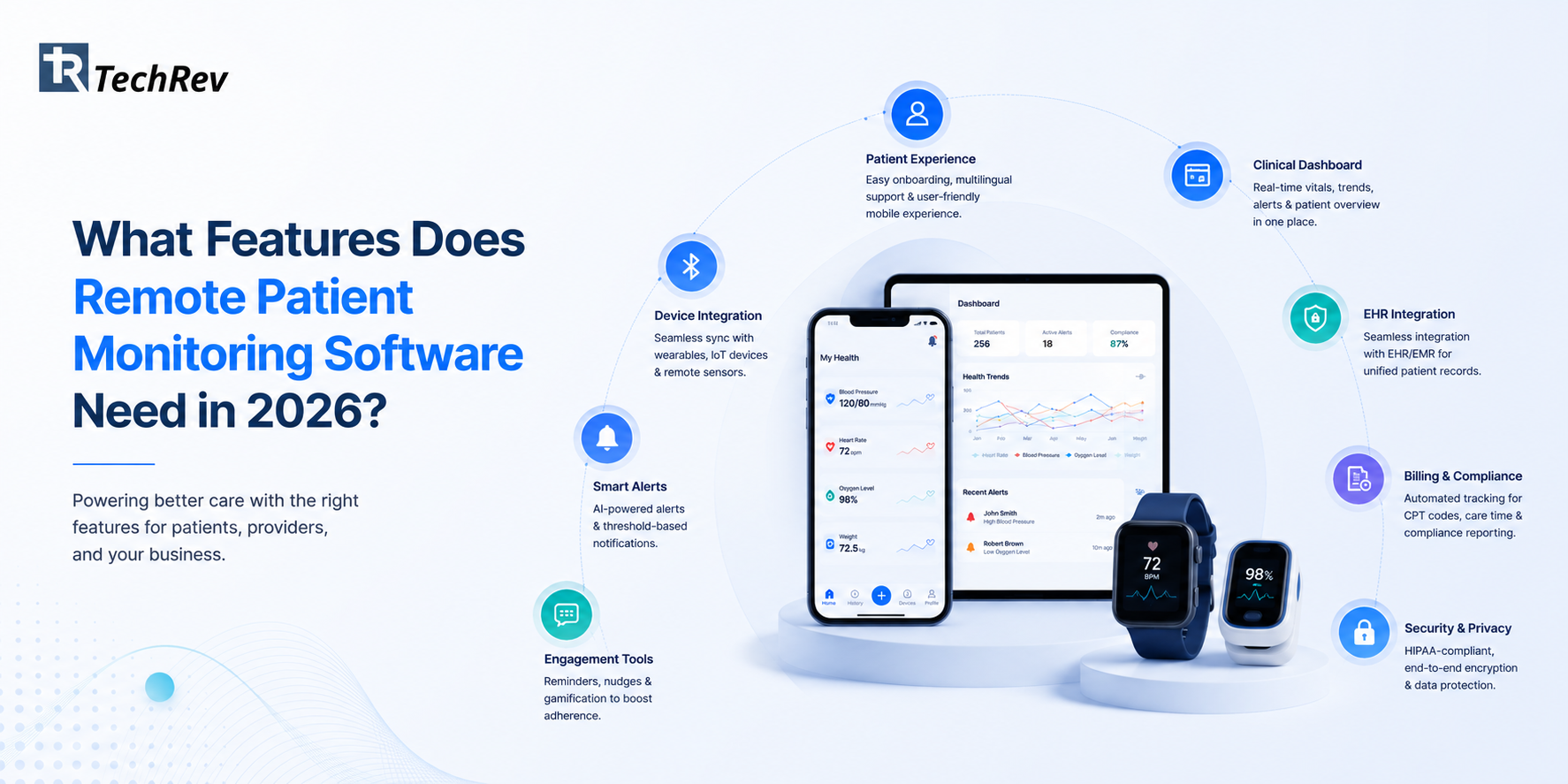
Patient side:
- Effortless onboarding, because enrollment friction kills programs before they start
- Automatic device syncing across Bluetooth and cellular devices, with cellular preferred for older and rural patients who should not need Wi-Fi troubleshooting
- Reminders and adherence nudges tied to the reimbursement day-count
- Simple two-way messaging with the care team
Clinical side:
- A dashboard that ranks patients by risk, not alphabetically
- Configurable alert thresholds per patient and condition, tuned to avoid alarm fatigue
- Automatic logging of monitoring time mapped to CPT 99457 and 99458
- Documentation that flows into the EHR through FHIR-based EHR integration rather than a separate silo
Platform side:
- HIPAA compliant architecture: encryption, role-based access, audit trails
- AI-driven trend analysis and deterioration prediction, the feature layer separating 2026 platforms from 2020 ones
- Billing-ready reports that make the monthly reimbursement claim a button, not a project
How Do You Develop Remote Patient Monitoring Software?
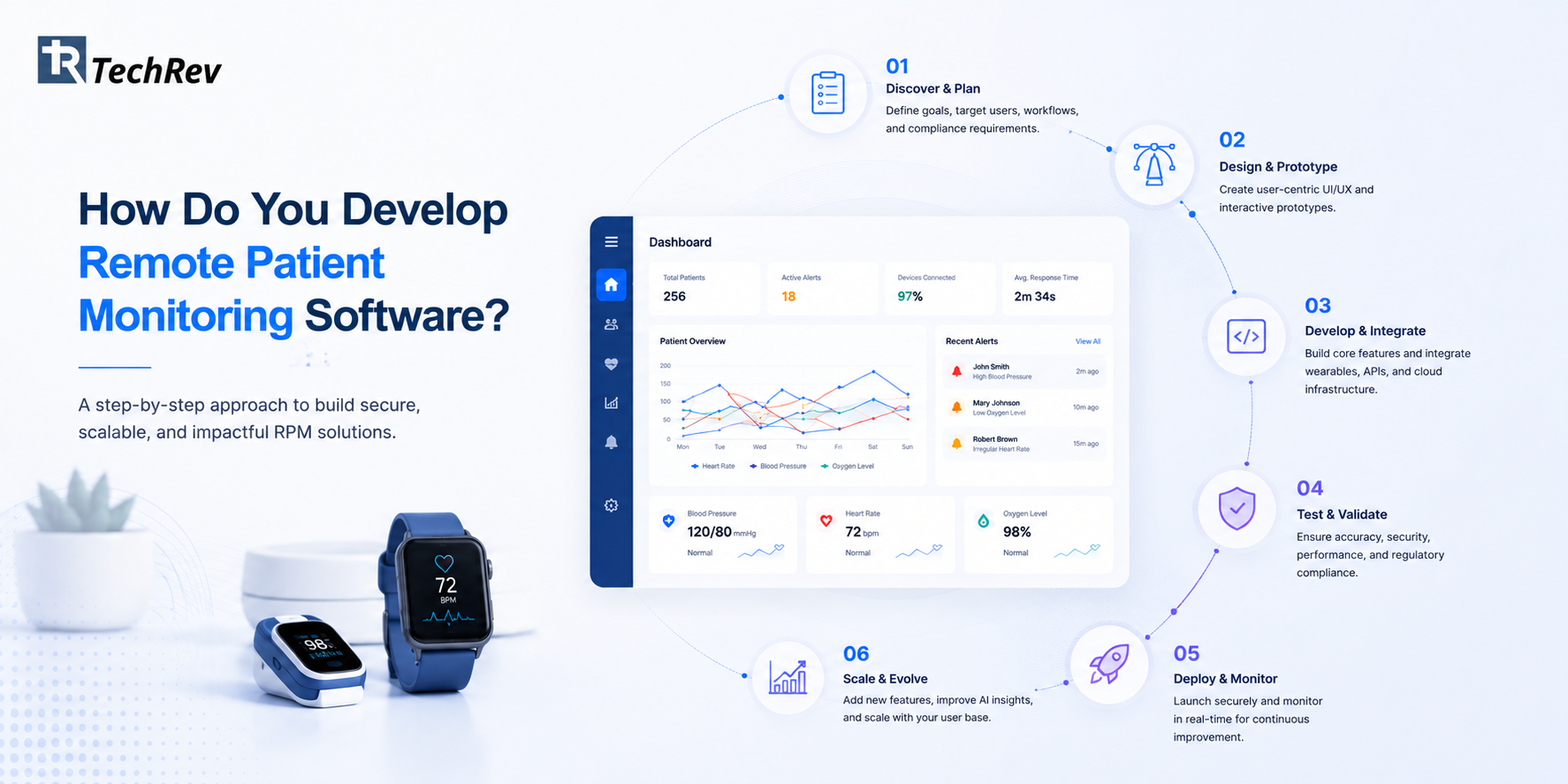
Remote patient monitoring app development follows the same discipline as any regulated health build, with three RPM-specific pressure points:
- Device strategy first. Decide which devices and connectivity standards you support before writing code; retrofitting device integrations is the most common budget overrun in RPM projects.
- Compliance architecture second. HIPAA safeguards and audit logging get designed in from the start, and if the software performs clinical analysis, FDA software-as-a-medical-device rules may apply, which changes the documentation burden.
- MVP with one condition, one workflow. The strongest RPM launches start with a single high-value population, commonly hypertension, heart failure, COPD, or diabetes, prove adherence and billing capture, then expand. It is the same MVP development sequencing that de-risks every serious health software project.
A focused RPM MVP typically takes 4 to 6 months to launch; full multi-condition platforms with device fleets, AI analytics, and deep EHR integration run longer and should be phased.
How Much Does RPM Software Development Cost?
Custom remote patient monitoring software typically starts in the low six figures for a focused, compliance-ready MVP covering one condition and core device integrations, and scales with device breadth, AI capability, and EHR integration depth.
Ongoing costs include hosting, device logistics, and maintenance, commonly 15 to 20% of build cost annually. Weigh that against the revenue side: RPM is one of the few digital health categories with a defined, recurring Medicare reimbursement stream attached, which is why healthcare organizations increasingly treat the build as an investment with a payback model rather than an IT expense.
How TechRev Helps You Build RPM Software?
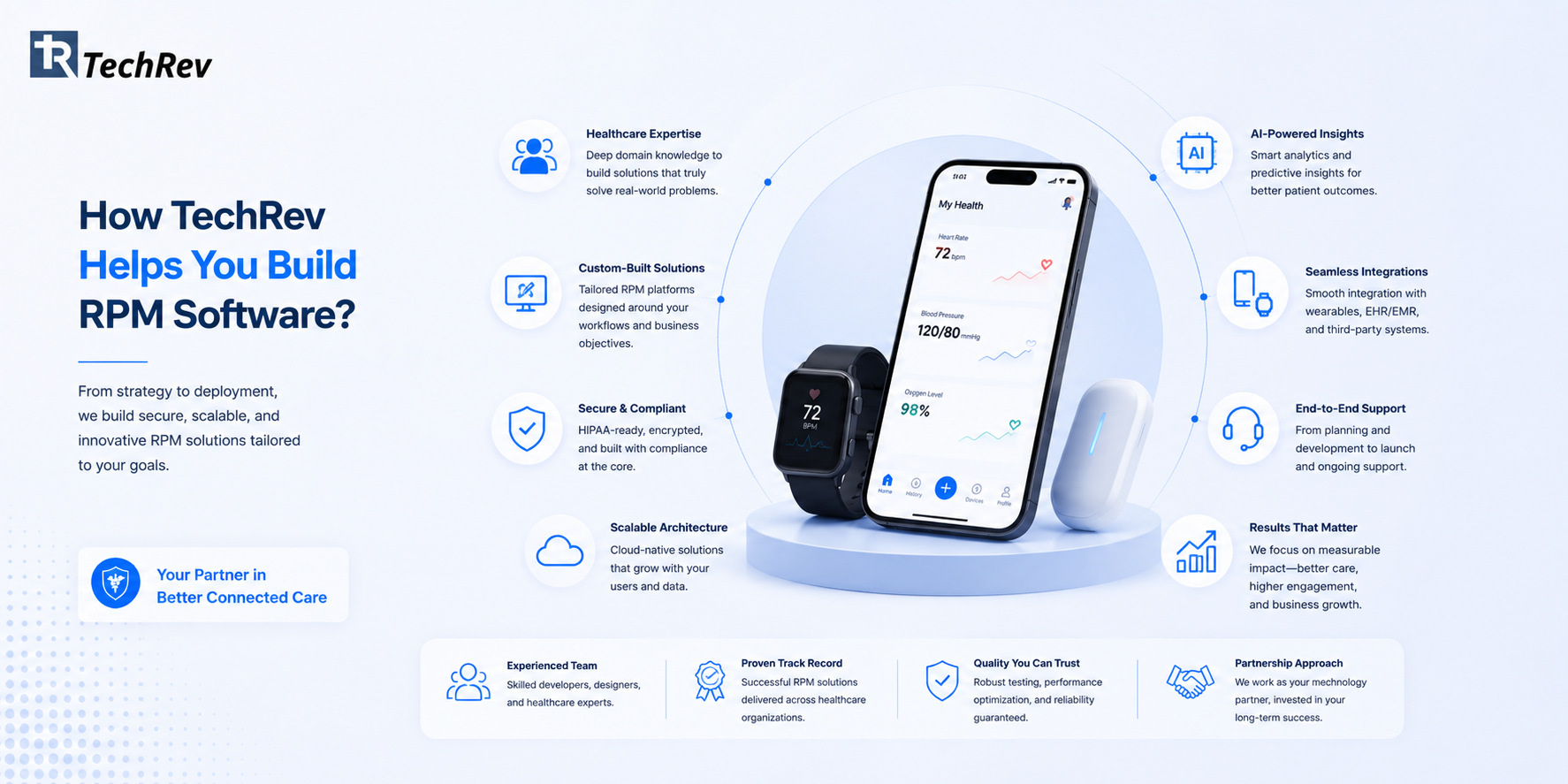
TechRev is a US-based healthcare software development company that builds HIPAA compliant remote patient monitoring platforms, from patient apps and device integrations to clinical dashboards, delivered through custom software development with healthcare-specific AI development expertise.
Q1: What does TechRev build in a remote patient monitoring platform?
The complete loop: patient apps with device syncing and adherence nudges, secure data pipelines, clinical dashboards with risk-ranked patient lists and configurable alerts, automatic CPT-mapped time and day tracking so billing captures every reimbursable minute, and FHIR-based integration into your existing EHR.
We scope MVP-first around one condition and one workflow, which is how RPM programs prove adherence rates and billing capture in months, then expand with evidence instead of hope. Compliance is architectural, not bolted on: encryption, role-based access, and audit trails from day one.
Q2: Is TechRev’s RPM software HIPAA compliant?
Yes. Every TechRev healthcare build is HIPAA compliant and SOC 2 aligned, with encrypted data handling, access controls, and complete audit trails built into the architecture.
Q3: Can TechRev integrate RPM with our existing EHR?
Yes. TechRev’s integration-first approach connects monitoring data, alerts, and documentation into the EHR you already run through FHIR APIs, so RPM extends your record instead of fragmenting it.
Q4: What measurable results has TechRev delivered in healthcare operations?
For a hospital services vendor, TechRev’s AI-powered tracking and workflow system cut installation errors by 90% and recovered billing evidence manual processes were losing.
Also Read – EHR Software Development in 2026: Features, Process, and Cost!
Conclusion
Every trend line points the same direction: tens of millions of patients monitored at home, Medicare paying for it through defined codes, physicians adopting it faster than any other digital health tool, and AI turning the data into foresight. The organizations building remote patient monitoring software in 2026 are not betting on the future of care delivery. They are catching up to its present.
If you are ready to build, talk to TechRev’s healthcare development team. We will map your patient population, scope the MVP around one condition, and show you the adherence and reimbursement model that makes the program pay for itself.
FAQs
1. What is the difference between RPM software and a telehealth app?
Telehealth replaces the visit; remote patient monitoring fills the time between visits. A telehealth app connects patient and clinician for a live encounter, while RPM software continuously collects device data and flags problems between encounters. Mature programs run both, and modern telehealth app development increasingly bundles them.
2. Which conditions benefit most from remote patient monitoring?
Hypertension, heart failure, COPD, and diabetes lead adoption because they combine high prevalence, measurable vitals, and costly hospitalizations that early intervention can prevent. That is also why most successful RPM programs launch with one of these before expanding.
3. Does insurance pay for remote patient monitoring?
Medicare reimburses RPM through CPT codes 99453, 99454, 99457, and 99458, and many commercial payers and state Medicaid programs follow similar structures. The software must track reading days and clinical minutes to substantiate claims.
4. How many patients does an RPM program need to be worthwhile?
Programs become sustainable when recurring reimbursement covers staffing and platform costs, which for many practices happens in the low hundreds of enrolled patients. Software that automates alerts, documentation, and billing capture lowers that break-even point substantially.
5. What devices work with remote patient monitoring software?
Blood pressure monitors, glucose meters, pulse oximeters, weight scales, thermometers, and wearables are the core fleet. Cellular-connected devices outperform Bluetooth for older populations because they remove pairing and Wi-Fi friction.
6. Is remote patient monitoring software regulated by the FDA?
The devices themselves are FDA-regulated, and software that analyzes data to inform clinical decisions may qualify as software-as-a-medical-device. Platforms that only display and transmit data face a lighter burden. A healthcare development partner can classify your concept in one scoping conversation.