
EHR software development is having a strange moment. Nearly every American hospital already runs an electronic health record system, yet demand for custom EHR development keeps climbing. How does that make sense?
Simple: adoption is done, but satisfaction never arrived. Clinicians fight clunky screens, specialty practices squeeze their workflows into software built for someone else, and new CMS interoperability rules are exposing systems that cannot talk to anything. That gap between “we have an EHR” and “our EHR actually works for us” is exactly where EHR software development lives in 2026.
This blog covers what it takes to build EHR software today: the difference between EMR and EHR, the features that are now mandatory, the healthcare app development process step by step, realistic costs, and the compliance rules you cannot skip.
What Is EHR Software Development?
EHR software development is the process of designing, building, and maintaining electronic health record systems that store patient data, support clinical workflows, and exchange information with other healthcare systems. It covers everything from full custom EHR platforms to specialty modules, integrations, and patient-facing extensions built on top of existing systems.
In practice, most EHR software development in 2026 is not “build a new Epic.” It is building the specialty workflows, integrations, and automation that big general-purpose systems handle poorly.
EMR vs EHR: What Is the Difference?
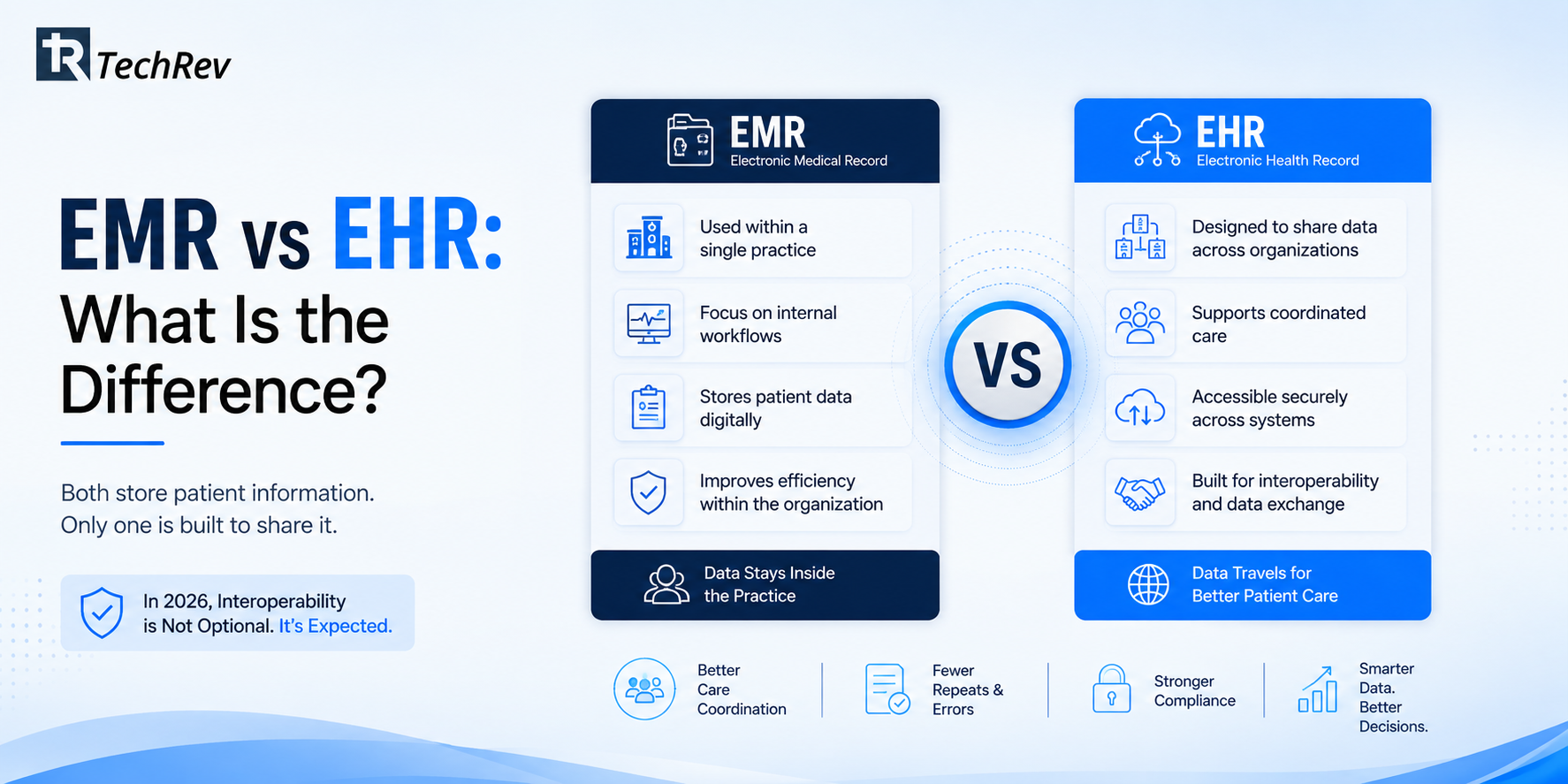
An EMR (electronic medical record) is a digital chart used inside one practice. An EHR (electronic health record) is designed to travel: it shares patient data across providers, labs, pharmacies, and hospitals. Every EHR contains an EMR, but an EMR becomes an EHR only when it can exchange data beyond its own four walls.
That distinction matters more than ever, because interoperability is now a legal expectation, not a feature. If you are planning EMR software development in 2026, you should build to EHR standards from day one.
Why Build Custom EHR Software in 2026?
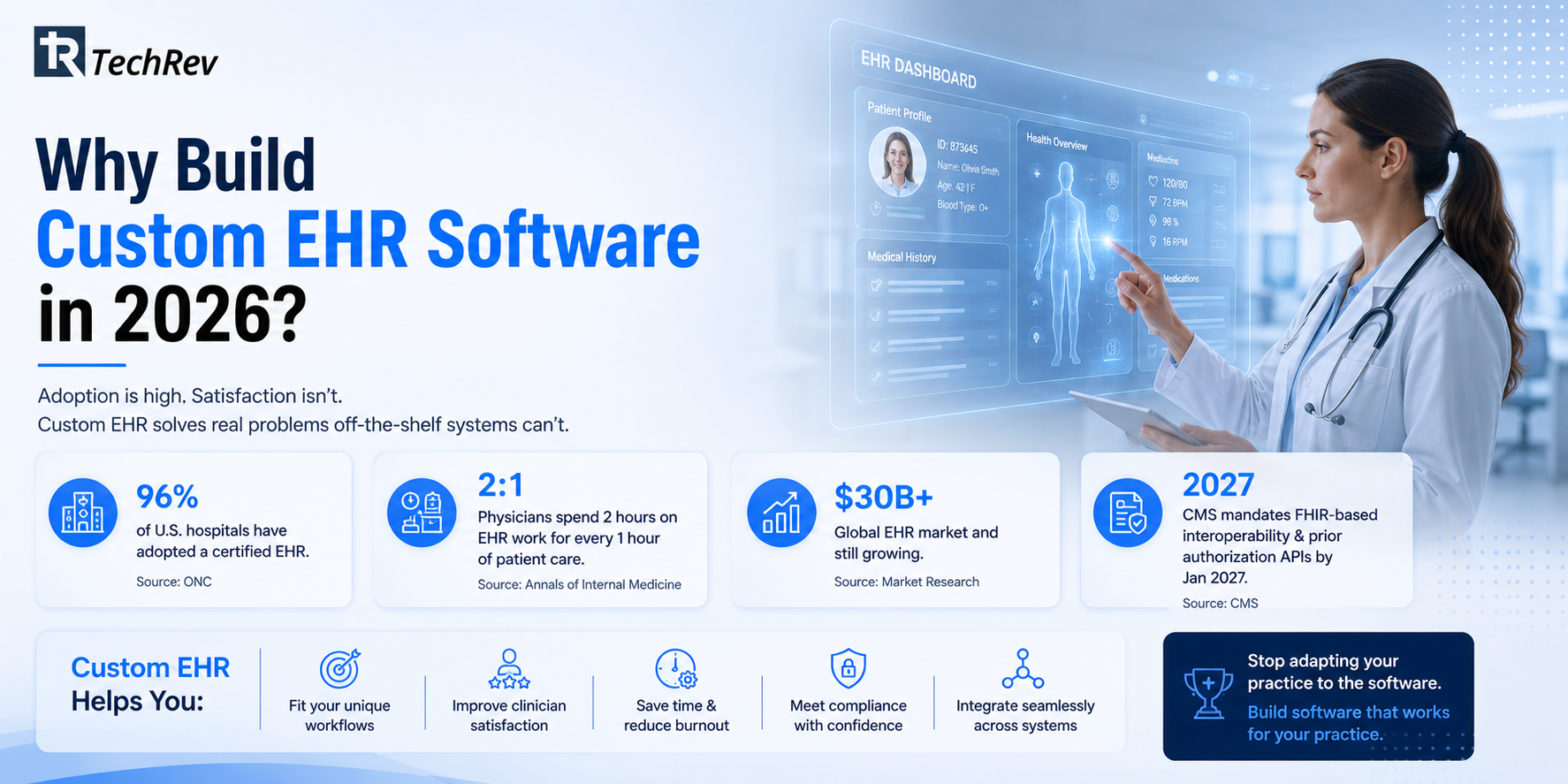
Because the adoption race is over and the usability race has barely started. Consider the numbers:
- 96% of US non-federal acute care hospitals and roughly 8 in 10 office-based physicians have adopted a certified EHR, per ONC data. The market is saturated with systems, not with good experiences.
- Time-motion research published in the Annals of Internal Medicine found physicians spend nearly 2 hours on EHR and desk work for every 1 hour of direct patient care, a ratio that fuels documented physician burnout.
- The global EHR market is valued at roughly $30 billion and still growing, driven not by first-time buyers but by replacements, specialty systems, and integration work.
- CMS interoperability rules now require FHIR-based data exchange, with payer prior authorization APIs mandated by January 2027.
Off-the-shelf systems were built for the average practice. If your workflows are not average, whether you run a behavioral health group, a specialty clinic, a telehealth company, or a healthcare services vendor, custom EHR development is how you stop paying staff to fight software.
Who Actually Needs Custom EHR Development?
Three groups get the strongest returns: specialty practices whose workflows do not fit general-purpose systems, digital health companies that need an EHR-grade backbone inside their product, and healthcare organizations that keep their main EHR but need custom modules, integrations, or automation around it. If your team maintains spreadsheets alongside the EHR to get work done, you are in one of these groups.
Also Read – Why Custom Healthcare Software Outperforms Off-the-Shelf Solutions?
What Features Must EHR Software Have in 2026?
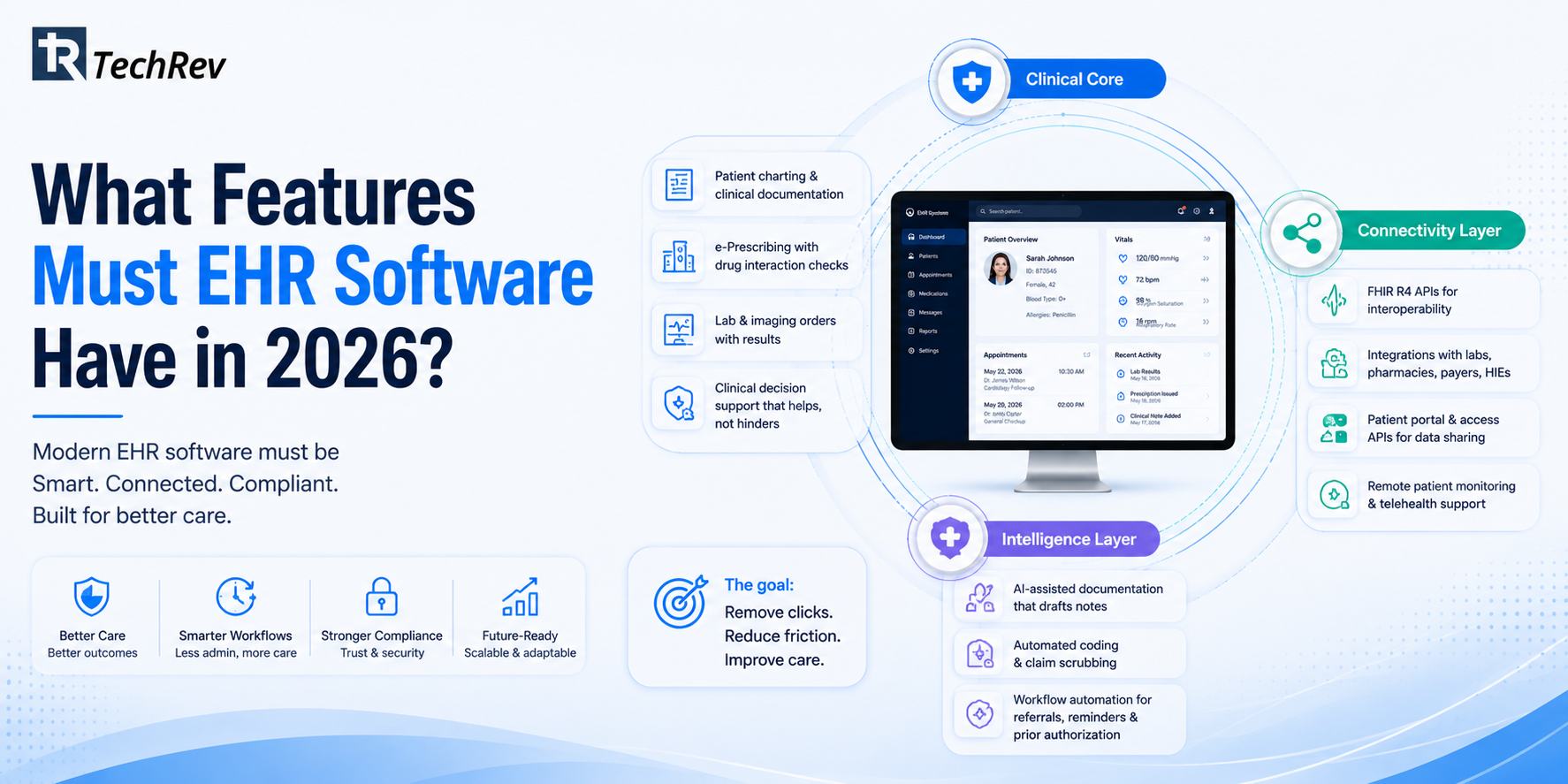
A competitive EHR system in 2026 needs three feature layers:
Clinical core:
- Patient charting and clinical documentation with specialty-specific templates
- e-Prescribing with drug interaction checks
- Lab and imaging orders with results routed into the chart
- Clinical decision support that flags rather than nags
Connectivity layer (now mandatory, not optional):
- FHIR R4 APIs for standards-based data exchange under the 21st Century Cures Act
- EHR integration with labs, pharmacies, payers, and health information exchanges
- Patient access APIs and a patient portal, since information blocking rules require sharing data with patients electronically
- Connections to remote patient monitoring devices and telehealth visits, which are now routine care channels
Intelligence layer (the 2026 differentiator):
- AI-assisted documentation that drafts notes from visits, attacking that 2-to-1 desk-time ratio directly
- Automated coding suggestions and claim scrubbing to cut denials
- Workflow automation for referrals, reminders, and prior authorization, the administrative bottleneck CMS is forcing payers to digitize (link this mention to the Prior Authorization Automation post once it is live)
The pattern across all three layers: the winning EHR features in 2026 remove clicks instead of adding modules.
How Do You Develop EHR Software? The 6-Step Process
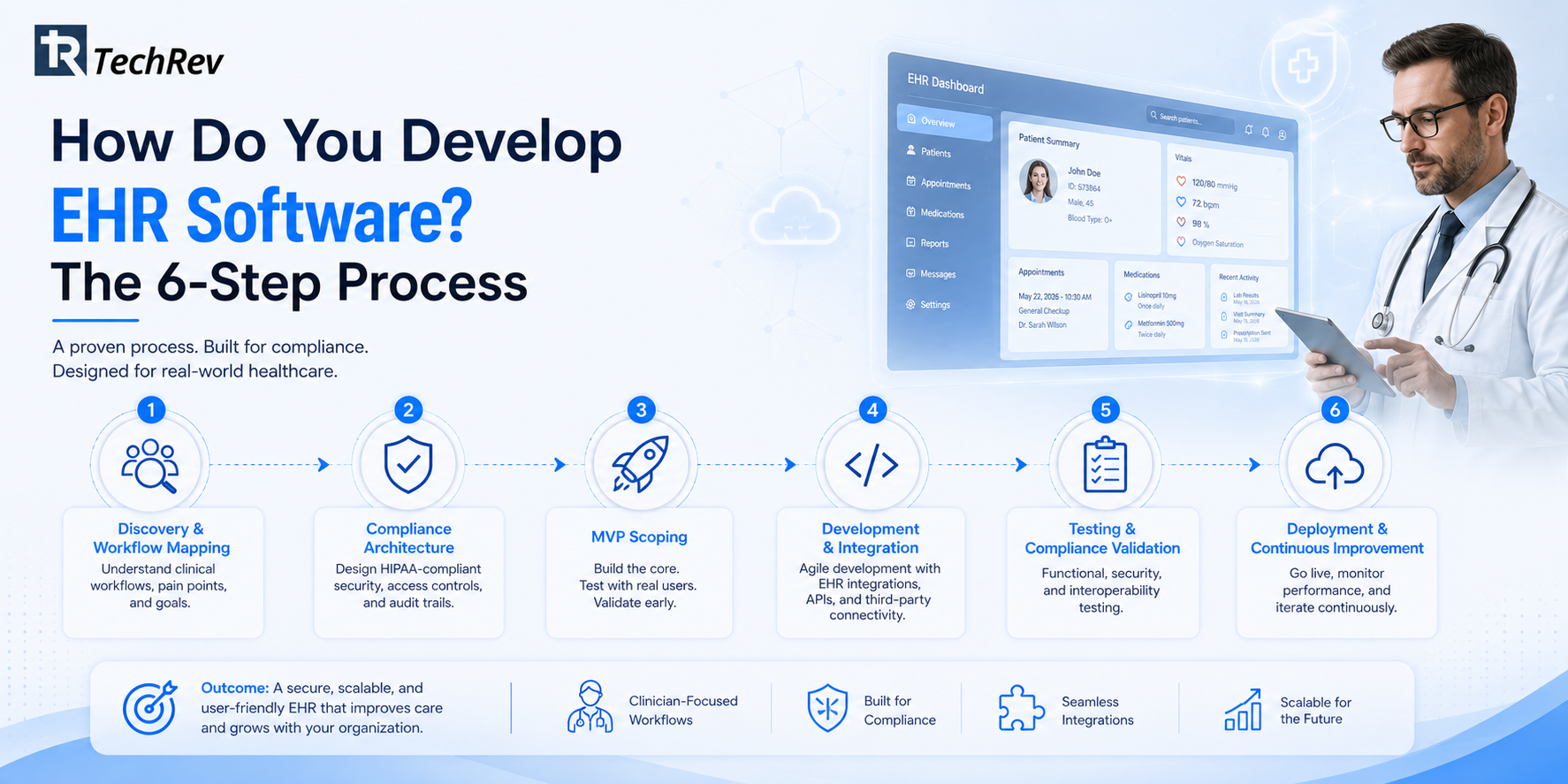
EHR system development follows six stages, and the order matters:
- Discovery and workflow mapping. Sit with the clinicians and staff who will use it. The most expensive EHR mistakes are workflow mistakes, not code mistakes.
- Compliance architecture. HIPAA safeguards, audit logging, role-based access, and encryption get designed in now, because retrofitting compliance costs multiples more.
- MVP scoping. Pick the core workflows that prove value first. The healthcare MVP development approach applies perfectly to EHR builds: validate with real users before funding every feature.
- Development and integration. Build the clinical core, then wire the FHIR APIs, lab interfaces, and billing connections. Integration typically consumes a third or more of the engineering effort, so budget for it honestly.
- Testing with clinical users. Usability testing with actual clinicians, security testing against HIPAA requirements, and load testing before go-live.
- Deployment, training, and iteration. Phased rollouts beat big-bang launches. Plan post-launch iteration cycles, because version one never survives contact with a Monday morning clinic schedule.
How Long Does EHR Software Development Take?
A focused EHR module or MVP typically takes 4 to 6 months. A full custom EHR platform with integrations, certification prep, and multi-role workflows generally runs 9 to 18 months depending on scope. Anyone quoting a full system in 8 weeks is selling you a demo.
Also Read – SaaS for Healthcare: Cost, Benefits, & How to Build It in 2026?
How Much Does EHR Software Development Cost?
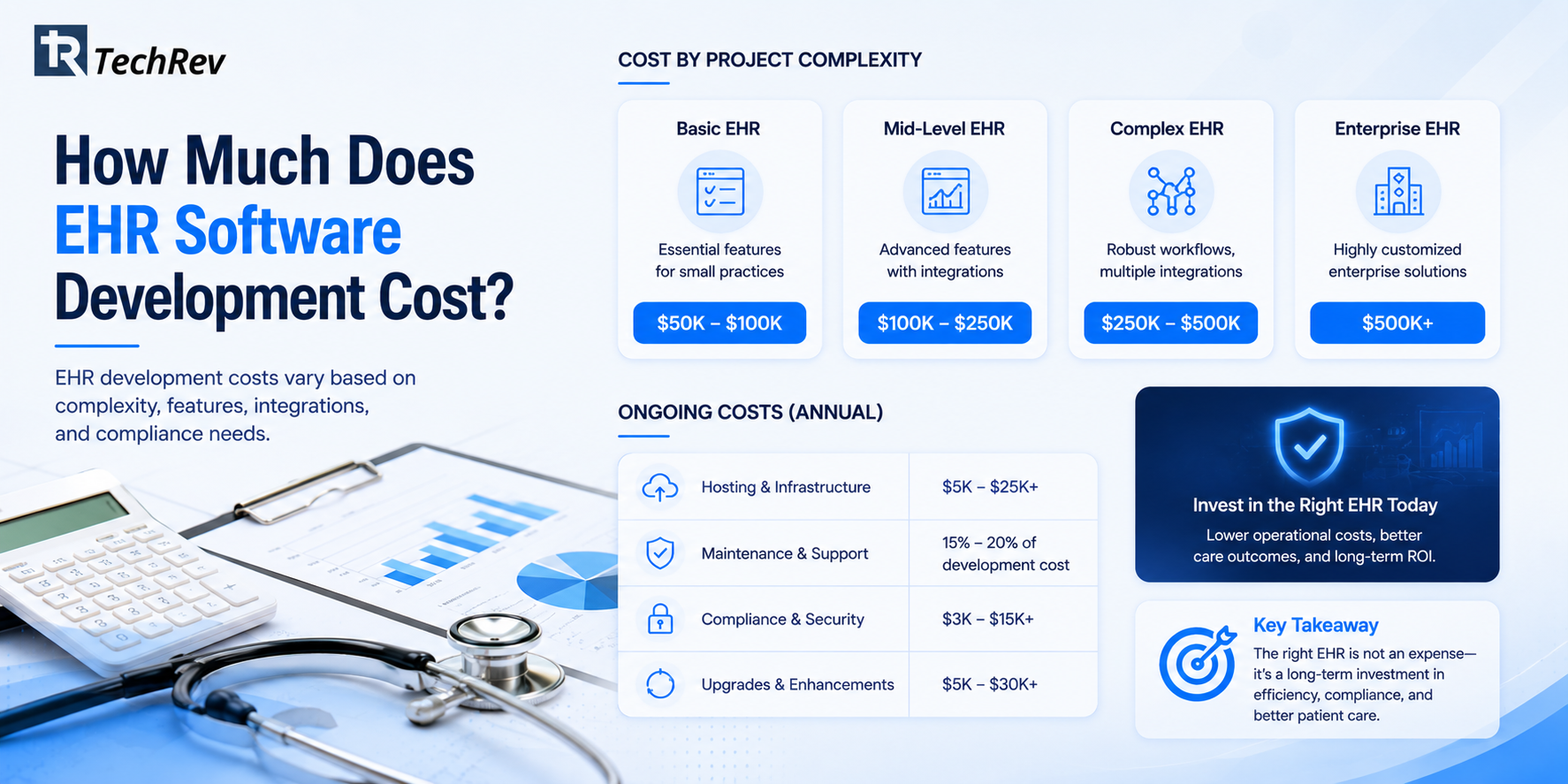
Custom EHR software development typically starts around the low six figures for a focused MVP with core clinical features and compliance basics, while full-scale platforms with deep integrations, AI features, and ONC certification support commonly reach mid six figures or more. Ongoing maintenance, hosting, and compliance updates usually add 15 to 20% of the build cost annually.
The honest cost drivers:
- Scope: a specialty module vs a complete EHR platform
- Integrations: each lab, pharmacy, payer, and device connection adds work
- Compliance depth: HIPAA is the floor; ONC certification and SOC 2 raise it
- AI features: ambient documentation and automation add cost up front and remove cost every day after
- Team model: US-based development with healthcare domain experience costs more per hour and dramatically less per mistake
Compare that against the status quo: two hours of clinician desk time per patient-care hour is a payroll line item you are already paying. EHR software that cuts documentation time does not have to be cheap to be profitable.
What Compliance Rules Apply to EHR Development?
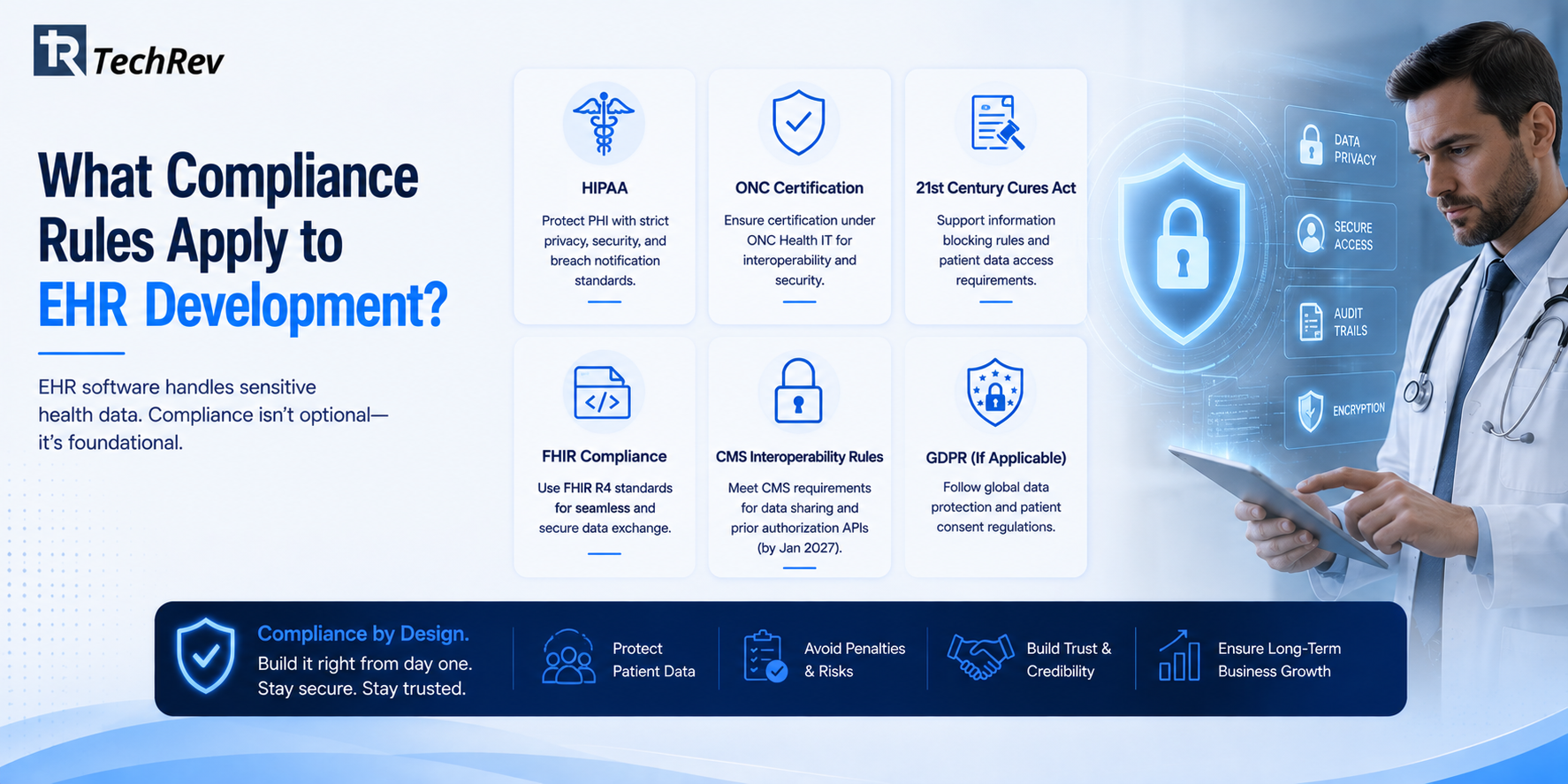
Four frameworks govern EHR software development in the US, and every serious build addresses all of them:
- HIPAA: encryption in transit and at rest, access controls, audit trails, breach procedures, and business associate agreements.
- 21st Century Cures Act information blocking rules: patients and authorized systems must be able to access data electronically; blocking it carries penalties.
- ONC Health IT Certification: required if providers will use your software for CMS quality programs; it dictates standardized APIs (FHIR R4) and data classes (USCDI).
- CMS Interoperability and Prior Authorization Final Rule: payer-facing APIs and decision timelines phase in through January 2027, which affects any EHR touching authorization or claims workflows.
Building these in from the architecture stage is the difference between a compliant product and an expensive rewrite.
Also Read – AI Medical Scribe: How It Works, Costs, and Custom Builds
How TechRev Helps You Build EHR Software?
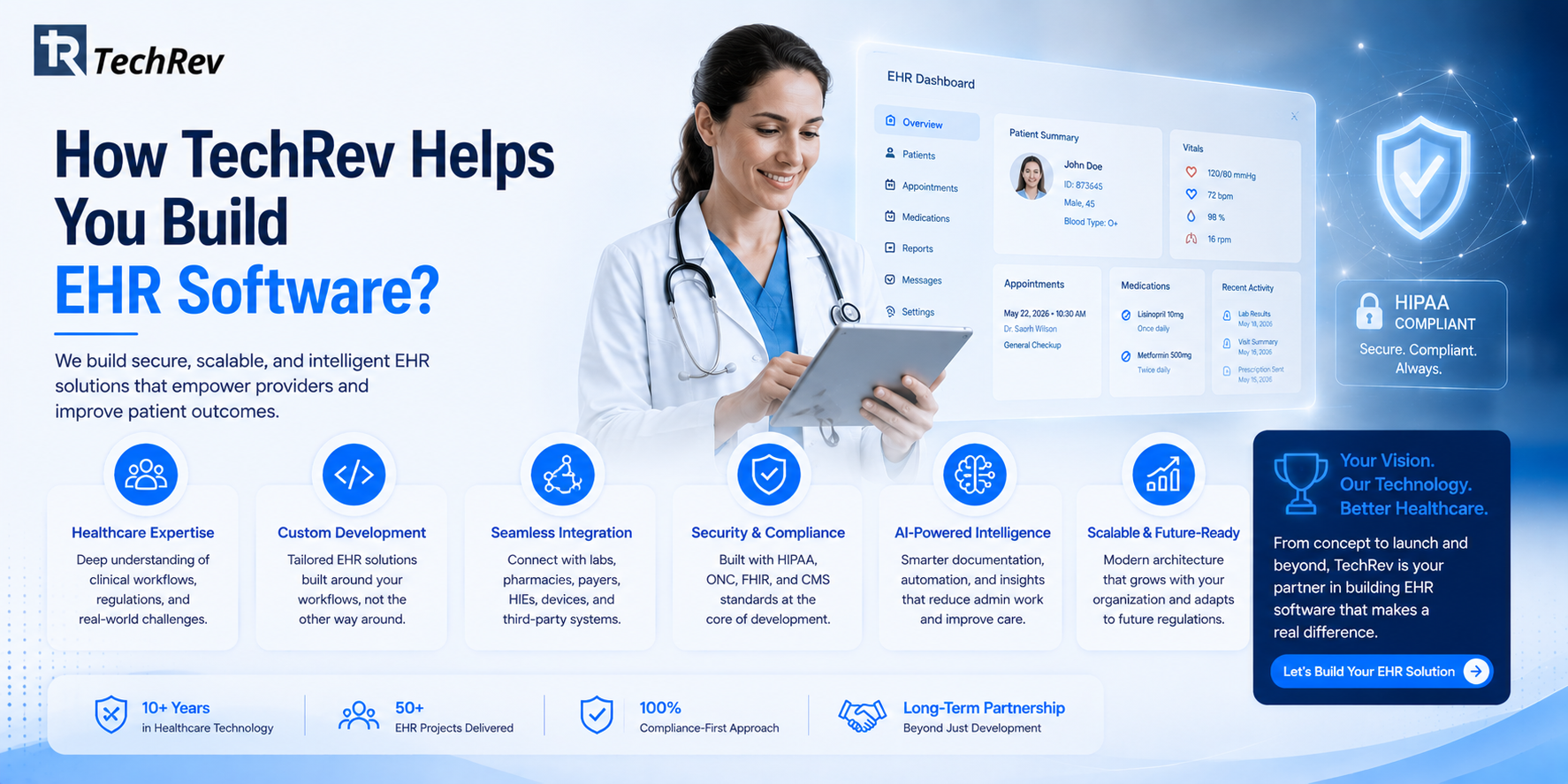
TechRev is a US-based healthcare software development company that designs HIPAA compliant EHR systems, specialty modules, and EHR-connected automation, combining custom software development with healthcare-specific AI development expertise.
Q1: What is TechRev’s approach to EHR software development?
Workflow first, technology second. TechRev maps how your clinicians and staff actually work, then builds the EHR functionality around those workflows with compliance designed in from the architecture stage: encryption, audit trails, role-based access, and FHIR-ready APIs.
We scope through MVP development so you validate the core system with real users before funding the full roadmap. That sequencing is why our healthcare builds in months, holds up under audits, and get adopted by the clinicians who were skeptical in the first meeting.
Q2: Does TechRev build HIPAA compliant EHR systems?
Yes. Every TechRev healthcare build is HIPAA compliant and SOC 2 aligned, with encrypted data handling, complete audit logs, and access controls that stand up to payer and regulator scrutiny.
Q3: Can TechRev integrate AI into an existing EHR instead of replacing it?
Yes. TechRev’s integration-first approach adds AI documentation, automation, and FHIR connectivity to the EHR you already run, so you gain modern capability without a disruptive migration.
Q4: What measurable results has TechRev delivered in healthcare?
For a hospital services vendor, TechRev’s AI-powered workflow system cut installation errors by 90% and recovered billing evidence that manual tracking was losing.
Conclusion
The EHR market’s first era was about getting everyone on a system. The second era, the one we are in now, is about making those systems worth using: specialty-fit workflows, real interoperability, and AI that gives clinicians their evenings back.
If your team is fighting its EHR instead of working with it, that is a solvable engineering problem. Talk to TechRev’s healthcare development team and we will map the workflows, scope the build, and show you what a system designed around your clinic actually looks like.
FAQs
1. How much does it cost to build an EHR system?
A focused EHR MVP typically starts in the low six figures, and full custom platforms with integrations and certification support commonly reach mid six figures or beyond. Scope, integrations, and compliance depth drive the range, and annual maintenance usually adds 15 to 20% of build cost.
2. How do you build an EHR system step by step?
Map clinical workflows, design the compliance architecture, scope an MVP, develop the clinical core plus FHIR integrations, test with real clinicians, then deploy in phases. Skipping the workflow mapping stage is the most common and most expensive mistake.
3. Is EMR software development different from EHR software development?
The engineering overlaps heavily, but EHR software development adds interoperability: FHIR APIs, health information exchange, and patient data access. In 2026, building to EMR-only standards is building technical debt, since interoperability is legally expected.
4. Do I need ONC certification for custom EHR software?
Only if providers will use it for CMS programs that require certified technology. Internal tools, specialty modules, and vendor operations platforms often do not need certification, but they still must be HIPAA compliant. A healthcare development partner can tell you which side your project falls on in one scoping call.
5. Can AI be added to EHR software?
Yes, and it is the highest-value addition in 2026: ambient documentation that drafts clinical notes, automated coding suggestions, and workflow automation for referrals and authorizations. These features directly attack the 2-hours-of-desk-work problem documented in physician time studies.
6. What is the biggest risk in EHR software development?
Building without clinician input. Systems designed in conference rooms get worked around in clinics, and workarounds create both safety risks and audit findings. Co-design with end users, then phase the rollout.