
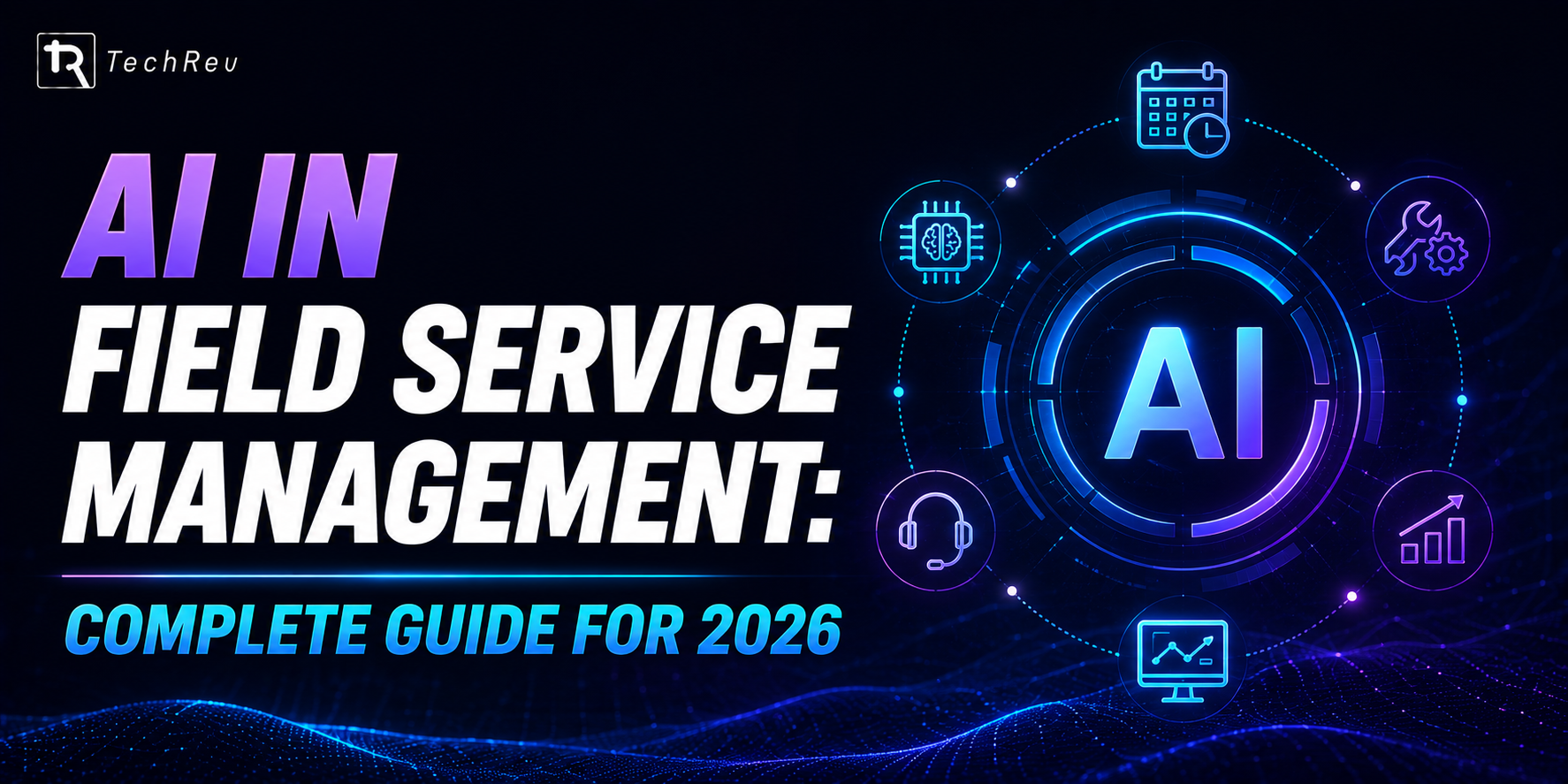
What Is Holding Your Field Service Team Back Right Now?
Think about the last time a technician showed up at a job site without the right part. Or when a customer called to ask where the technician was, and your dispatcher had to manually check three different systems to find out. Maybe a piece of equipment failed over the weekend and nobody knew about it until Monday morning, when the damage was already done.
These are not small inconveniences. They are the everyday reality of running a field service operation without the right intelligence baked into your systems.
AI in field service management is changing all of that, and the numbers are not subtle about it.
According to Mordor Intelligence, the global field service management market is expected to grow from $5.66 billion in 2025 to $9.87 billion by 2031. That growth is being driven almost entirely by one thing: the integration of artificial intelligence into how service companies plan, dispatch, maintain, and respond.
93% of service organizations have already implemented AI in some form. 88% report improved equipment uptime and better customer experiences as a direct result. And yet, most companies are only scratching the surface of what is actually possible.
This blog breaks down exactly how AI in field services management works in 2026, what results it produces, and how you can implement it in your own operation, whether you are an IT director evaluating platforms or a business owner thinking about a custom-built field service management custom software development project.
The Field Service Industry Is at an Inflection Point
The field service industry has been talking about digital transformation for years. What changed in 2025 and 2026 is that AI stopped being the theoretical future and became the operational present.
The predictive maintenance market alone is forecast to jump from $10.6 billion in 2024 to $47.8 billion by 2029. That is a four-and-a-half times increase in five years, driven by IoT sensors, machine learning models, and AI-powered analytics that are now affordable enough for mid-market companies, not just enterprise behemoths.
The self-service solutions segment, covering customer portals and automated scheduling, is on pace to expand from $12.9 billion in 2022 to $34.35 billion by 2027, reflecting just how much customer expectations have shifted toward on-demand, transparent service.
According to Gartner, 40% of enterprise applications will include task-specific AI agents by the end of 2026, up from less than 5% in 2025. That is an 8x increase in a single year, and field service management software is squarely in the middle of this shift.
For companies managing field technicians, service contracts, maintenance schedules, and customer communication, this is not a trend to watch from a distance. It is a competitive gap that is opening up between organizations that have moved and those that have not.
What does the AI revolution actually look like inside a real field service operation? That is what the rest of this blog covers.
7 Ways AI Is Transforming Field Services Management in 2026
1. AI-Powered Predictive Maintenance: Stop Reacting, Start Predicting
The single most impactful use of AI in field service management is the shift from reactive maintenance to predictive maintenance. Instead of waiting for equipment to fail and then dispatching a technician to fix it, AI systems monitor equipment in real time and predict failures before they happen.
Here is how it works. IoT sensors attached to machinery continuously track temperature, vibration, pressure, current draw, and usage patterns. This data feeds into machine learning models that have been trained on historical failure data.
When the model detects an anomaly pattern that has historically preceded a failure, it triggers an alert, automatically creates a work order, checks parts inventory, and schedules the appropriate technician.
The outcome is dramatic. McKinsey research shows that organizations implementing predictive maintenance achieve 18 to 25% reductions in maintenance costs and cut unplanned downtime by up to 50%.
Deloitte’s research backs this up, reporting 35 to 45% reductions in downtime and 70 to 75% elimination of unexpected breakdowns for companies that reach maturity with predictive maintenance.
McKinsey also found that leading organizations achieve 10:1 to 30:1 ROI ratios within 12 to 18 months of implementation. A Fortune 500 manufacturer that deployed AI-powered predictive maintenance reduced unplanned downtime by 45% and saved $2.8 million annually.
IBM reports that integrating AI into field service management has led to a 30% reduction in downtime through predictive analytics and automated fault detection. The company also found that AI-driven predictive maintenance extends asset operational life by 20 to 40%, which means you get significantly more value out of existing capital investments before replacement becomes necessary.
Why does this matter so much?
Because unplanned downtime is extraordinarily expensive. McKinsey puts the annual cost of unplanned downtime to industrial manufacturers at $50 billion. For individual factories, a single hour of downtime can cost $260,000. Predictive maintenance does not just save money on repair costs. It protects revenue that would otherwise evaporate the moment equipment stops.
For companies building custom field service management mobile app development solutions, predictive maintenance is now a table-stakes feature, not a premium add-on.
2. Smart Scheduling and AI Dispatch: End the Guesswork
Manual dispatching has always been a bottle neck. A dispatcher looks at a board, tries to remember which technician has which certifications, checks who is closest, estimates travel time, and makes a judgment call.
When volumes are high, mistakes happen. The wrong technician gets sent to a complex job. A senior tech burns two hours driving across town while a junior tech sits idle two miles from the job site.
AI-powered scheduling replaces this process with an algorithm that evaluates thousands of variables in real time. Technician skills, certifications, location, current workload, parts on their vehicle, traffic conditions, job priority, customer SLA requirements, and historical performance on similar job types all factor into the assignment.
According to SAP’s data from their Field Service Management platform, automations have already improved dispatcher productivity by about 50% and reduced errors by about 8%. One wholesale distribution company that implemented AI-driven scheduling saved 40 metric tons of carbon emissions per year through better routing and fuel use, and recovered 13 minutes of previously unbilled travel time per technician per hour.
AI route optimization typically cuts 30 to 35% off total drive time. For a field team of 10 technicians driving 80 miles per day each, that works out to 200 to 280 fewer miles across the fleet every single day. The fuel savings compound. The extra time capacity adds up to additional jobs completed without adding headcount.
Smart dispatch also dramatically reduces what the industry calls “truck rolls,” which is every instance a technician drives to a location. In the solar industry, a single unnecessary truck roll costs an average of $475, according to Solar Power World. When AI can pre-screen service requests, identify issues that can be resolved remotely, and ensure technicians arrive with the correct parts and information, the number of wasted truck rolls collapses.
Research from Fieldproxy shows companies using smart dispatch software achieve 30 to 40% reductions in fuel costs through optimized routing, a 25% increase in daily jobs completed per technician, and a 50% decrease in administrative time spent on scheduling.
3. Generative AI Development for Field Technician Copilots
This is one of the most interesting and practical applications of generative AI development in the field service world. Today’s AI copilots for technicians are essentially intelligent assistants that can read a work order, pull up the relevant equipment history, surface the most likely failure modes based on that history, and walk the technician through a diagnostic process in plain language.
When a technician is standing in front of a piece of equipment that is behaving unexpectedly, they can describe what they are seeing to the AI copilot, and the system synthesizes information from thousands of service manuals, past repair logs, and engineering specifications to suggest the most likely cause and the correct fix.
The impact on first-time fix rates is significant. First-time fix rate (FTFR) is one of the most important metrics in field services management. Every repeat visit costs money, frustrates customers, and reduces technician productivity. According to surveys, 75% of companies report that AI improves their first-time fix rates. That single improvement downstream drives lower costs, higher customer satisfaction scores, and better technician utilization.
Generative AI development also enables intelligent knowledge management. When an experienced technician who has been with a company for 20 years retires, a huge amount of institutional knowledge walks out the door. AI systems that capture, index, and surface that knowledge through natural language interfaces preserve it and make it accessible to the entire team.
In February 2025, PTC launched ServiceMax AI, a generative AI-powered FSM assistant that uses asset history and service data to guide technicians, streamline workflows, and increase operational productivity. This is the direction the entire industry is moving, and companies that build custom solutions now are able to tailor these capabilities to their specific equipment types, workflows, and service contexts.
4. Computer Vision and NLP in Field Service Operations
Computer vision is giving field technicians a completely new kind of diagnostic capability. A technician can point a smartphone camera at a piece of equipment, and AI vision models can identify wear patterns, detect cracks or corrosion, read gauges, and compare what they see against a baseline of healthy equipment to flag anomalies.
This technology eliminates the subjectivity of visual inspections and creates a documented, auditable record of equipment condition at every visit. For industries like utilities, oil and gas, manufacturing, and telecom, where regulatory compliance and safety audits are significant operational concerns, this capability is genuinely transformative.
Natural language processing (NLP development) plays a complementary role. Voice-activated work order updates let technicians dictate job notes, completion status, and parts used while their hands are occupied. NLP-powered customer service interfaces handle routine inquiries, appointment reminders, and status updates without requiring a human agent to be involved.
AI chatbots powered by NLP development now handle front-line customer communications for many field service companies, resolving common queries instantly and escalating to human agents only when the situation requires it. This reduces call center volume, improves response times, and keeps technicians focused on field work rather than administrative follow-up.
5. AI Agents Development for Autonomous FSM Workflows
This is the frontier that is generating the most excitement and the most genuine business value in 2026. AI agents development is about creating autonomous systems that do not just suggest actions but actually take them.
An AI agent in a field service context might receive an alert from an IoT sensor indicating that a compressor is showing signs of impending failure. The agent does not wait for a human to review the alert. It checks parts inventory, confirms the required components are available, identifies the best-qualified available technician, schedules the maintenance visit at the optimal time, notifies the customer, generates the work order, and logs everything in the service record. All of this happens without a dispatcher touching a keyboard.
Gartner predicts that 40% of enterprise applications will include task-specific AI agents by the end of 2026. In field services management, custom AI agents are already handling scheduling, parts ordering, customer notification, SLA monitoring, and escalation workflows in companies that have invested in building them properly.
The distinction between traditional automation and agentic AI is important. Traditional automation follows fixed rules. AI agents reason. They can handle situations that were not explicitly pre-programmed because they have the ability to understand context, evaluate options, and take the most appropriate action based on the goals they have been given.
Custom AI agents built for a specific field service operation, trained on that company’s service history, equipment types, customer contracts, and workflow rules, outperform generic out-of-the-box solutions because they are aligned with how that specific business actually operates. This is where partnering with a custom software development and AI agents development company like TechRev creates significant competitive advantage.
6. IoT Integration and Real-Time Asset Intelligence
AI in field service management does not work in isolation. It depends on data, and increasingly, that data comes from the equipment itself. The integration of IoT sensors with AI analytics platforms is what makes predictive maintenance possible at scale.
Nearly 60% of service companies now use IoT-based monitoring for assets, according to industry data. Sensors track temperature, vibration, pressure, acoustic emissions, power consumption, and dozens of other parameters depending on equipment type. This continuous stream of operational data feeds machine learning models that get smarter over time as they accumulate more examples of how failures actually develop.
The result is a shift from calendar-based maintenance to condition-based maintenance. Instead of servicing a machine every six months whether it needs it or not, the system services it exactly when the data says it should be serviced. This eliminates unnecessary maintenance visits while preventing unexpected failures, which is the ideal outcome from both a cost and reliability standpoint.
According to Deloitte, mature IoT-driven predictive maintenance implementations achieve 70 to 90% reductions in unplanned downtime. That range sounds almost too good to be true, but it reflects the reality of moving from a purely reactive posture to one where every significant failure has multiple warning signs that the AI catches weeks in advance.
7. AR-Assisted Remote Support and Field Training
Augmented reality is maturing from an experimental technology into a practical field service tool. Gartner predicts that nearly half of field service deployments will use AR tools by 2025.
When technicians use AR tools, whether through headsets or smartphone apps, they can see digital overlays, wiring diagrams, step-by-step instructions, and component labels superimposed on the actual equipment they are working on. A remote expert can see exactly what the field technician sees and guide them through a complex repair in real time without traveling to the site.
One organization that implemented AR for field support reported 37% faster repairs and 28% lower expert travel costs. VR simulations are also being used for technician training, allowing new hires to practice repairs in risk-free virtual environments. This approach reduces onboarding time by nearly 44%, according to research cited in the 2026 FSM trend analysis from Brocoders.
How to Build an AI-Powered Field Service Management App in 2026?
If you are an IT director or operations leader thinking about field service management software development, either by upgrading an existing platform or building something new, this section gives you a realistic picture of what is involved.
Step 1: Define Your Use Cases and Data Strategy
Before any development begins, the most important question is: what decisions do you want AI to make or support? Smart scheduling? Predictive maintenance? Customer communication automation? Each use case has different data requirements and different architecture implications.
Good AI requires good data. For predictive maintenance, you need historical equipment performance data and failure logs. For scheduling optimization, you need job history, technician skill records, and geographic data. For customer communication, you need interaction history and service records. If your data is scattered across legacy systems, a data integration and cleansing phase needs to happen before AI multi model development can begin.
Step 2: Choose the Right Architecture
Modern AI-powered FSM android app development are built on cloud-native architectures that can scale with data volume and processing demands. The core components typically include a field data layer (IoT sensors, mobile apps), a data pipeline layer (ingestion, storage, transformation), an AI/ML layer (prediction models, scheduling algorithms, NLP interfaces), and an application layer (dispatcher dashboard, technician mobile app, customer portal).
LLM development enables the conversational and knowledge management features. The right large language model, fine-tuned on your specific domain data, powers the technician copilot, customer chatbot, and knowledge retrieval features.
Step 3: Build the Mobile Application
Field technicians live on their phones. The mobile app is the primary interface through which they receive job assignments, access equipment history, record job notes, capture photos, and communicate with dispatchers.
For any mobile app development project in the FSM space in 2026, offline capability is non-negotiable. Technicians work in buildings, basements, and remote locations where connectivity is unreliable. The app needs to function fully offline and sync when connectivity is restored.
An android app development company or a cross-platform development team building your FSM mobile app needs to account for real-time GPS integration, camera-based documentation, voice-to-text note capture, AR capabilities, and integration with parts ordering and inventory systems.
Step 4: Integrate AI Scheduling and Dispatch
The scheduling engine is typically the most complex component to build correctly. It needs to balance multiple competing constraints simultaneously: technician skill requirements, geographic proximity, time windows, parts availability, customer SLA, and workload balancing across the team.
This is a combinatorial optimization problem, and modern approaches use AI and machine learning rather than simple rule-based engines. The system learns from historical outcomes to improve assignment quality over time.
Step 5: Deploy and Monitor
AI systems in field service management require ongoing monitoring and refinement. Prediction models drift as equipment ages, operational patterns change, and new failure modes emerge. A proper deployment includes model monitoring, retraining pipelines, and feedback loops that incorporate technician notes and job outcomes into future predictions.
The goal is a system that gets measurably better the longer it runs. This is the compounding advantage that makes early investment in AI FSM infrastructure so valuable.
How TechRev Builds AI-Powered Field Service Management Solutions?
TechRev is a custom software development and AI agents development company that has been building intelligent, scalable platforms for businesses since 2016. Trusted by companies across industries, TechRev specializes in AI-powered solutions that deliver measurable operational results, not just technical capabilities.
When it comes to field service management software development, TechRev takes a business-outcome-first approach.
The team starts by understanding the specific operational challenges, existing data infrastructure, and growth goals before designing any technical solution. This means every system built is aligned to real workflows rather than adapted from a generic template.
What TechRev Delivers for Field Service Operations?
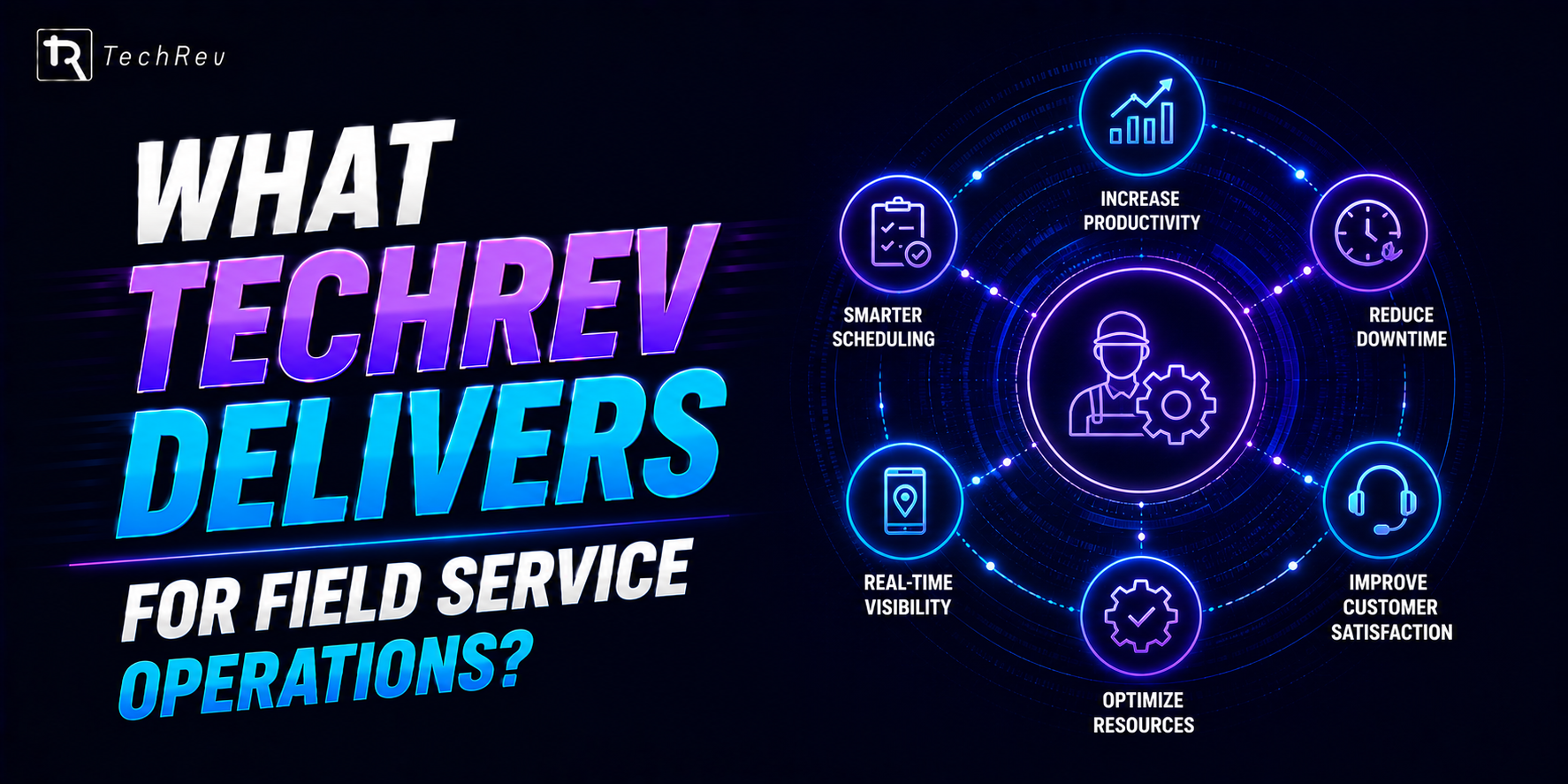
The following are some:
1. Custom AI Agents Development for FSM Automation
TechRev develops custom AI agents that handle end-to-end FSM workflows autonomously. These agents manage job assignment, parts verification, customer notification, and SLA monitoring without requiring dispatcher intervention for routine operations. Clients report productivity improvements of 40 to 50% in dispatch operations after deploying TechRev-built AI agents, as manual scheduling effort collapses when AI handles routine assignment decisions automatically.
2. Generative AI Development for Technician Copilots
TechRev’s generative AI development practice builds technician-facing AI assistants trained on client-specific equipment data, service history, and technical documentation. These copilots improve first-time fix rates by giving technicians instant access to relevant diagnostic guidance, reducing callbacks and repeat visits. Customers using TechRev-built technician copilot systems have seen first-time fix rates improve by 20 to 35%, directly translating to lower cost per job and higher customer satisfaction.
3. LLM Development for Knowledge Management and Customer Interaction
TechRev builds LLM development solutions that capture institutional knowledge and make it searchable through natural language. Technicians can ask a question in plain language and get a relevant answer drawn from thousands of past service records, equipment manuals, and engineering notes. On the customer side, TechRev-built LLM-powered chatbots handle tier-1 service inquiries, appointment scheduling, and status updates, reducing inbound call volume by 30 to 45% for clients operating high-volume service operations.
4. Mobile App Development for Field Technicians
As a mobile app development partner, TechRev builds offline-capable, GPS-integrated, AI-enhanced mobile applications for field technicians. Every app TechRev builds includes real-time job management, parts scanning, photo documentation, voice-to-text notes, and synchronization with back-end scheduling and inventory systems. For clients requiring Android-specific solutions, TechRev operates as a capable android app development company with deep experience in field-use mobile environments.
5. Custom Software Development for End-to-End FSM Platforms
For organizations that need a complete platform rather than point solutions, TechRev’s custom software development capability covers the full stack. From IoT data ingestion and processing to AI scheduling engines, customer-facing portals, and management dashboards, TechRev designs and builds systems that clients own entirely. There is no vendor lock-in, no black-box licensing, and no dependency on third-party platforms for core functionality.
Real Business Impact from TechRev Clients
TechRev has worked with service companies across industries to deliver measurable results through AI integration. Here is what clients have seen after partnering with TechRev for field service AI implementation:
35% Reduction in Operational Costs through predictive maintenance integration and optimized scheduling, eliminating unnecessary dispatches and reducing overtime from emergency callouts.
40% Improvement in Technician Productivity as AI agents handle job assignment and administrative tasks, freeing technicians to focus exclusively on service delivery.
28% Increase in First-Time Fix Rates after implementing TechRev-built AI technician copilots trained on client-specific equipment data and service history.
50% Reduction in Dispatch Administrative Time through automated scheduling, smart routing, and AI-driven workload balancing across technician teams.
25% Growth in Service Revenue as higher first-time fix rates, faster response times, and improved customer satisfaction scores drive contract renewals and referrals.
ROI of 8x to 15x within 18 Months for clients who implement TechRev’s predictive maintenance and smart scheduling solutions together, consistent with McKinsey’s documented 10:1 to 30:1 ROI benchmarks for AI-driven predictive maintenance programs.
Do you want to know what an AI-powered FSM system would look like for your specific operation? TechRev offers a free AI FSM strategy call where the team walks you through what is possible, what it would cost, and what outcomes you could realistically expect based on your current scale.
The ROI of AI in Field Service Management: Real Numbers
Let us put the business case together clearly.
1. Predictive Maintenance ROI
McKinsey reports that predictive maintenance reduces maintenance costs by 18 to 25% and cuts unplanned downtime by up to 50%. For a company with $2 million in annual maintenance spend, that means $360,000 to $500,000 in annual savings from maintenance cost reduction alone, before counting the revenue impact of downtime prevention.
Deloitte documents an additional 5 to 20% increase in labor productivity and 10 to 30% reduction in inventory levels when AI-driven predictive maintenance is mature. Less inventory sitting on shelves waiting for failures that never come is a real capital efficiency win.
2 Smart Scheduling ROI
A 25% increase in daily jobs completed per technician is documented in the field service management literature. For a 20-technician organization averaging 5 jobs per tech per day, that is 25 additional jobs completed daily. If each job generates $150 in margin, that is $3,750 in additional daily margin or roughly $975,000 in additional annual margin, without hiring a single additional technician.
30 to 40% fuel cost reduction through optimized routing compounds on top of this. For a fleet of 20 vehicles consuming $8,000 per year each in fuel, that is $48,000 to $64,000 in direct fuel savings annually.
3. First-Time Fix Rate ROI
Each repeat visit costs the company a full truck roll (minimum $250 in direct cost), technician time, and potentially an SLA penalty. If AI improves your first-time fix rate from 65% to 80% on 10,000 service calls per year, you eliminate 1,500 repeat visits. At $250 minimum cost per avoided truck roll, that is $375,000 in direct savings. Customer satisfaction and contract renewal rates improve as a further downstream benefit.
4. Aggregate Impact
Research consistently shows that companies combining predictive maintenance, smart scheduling, and AI-assisted technician support achieve 10 to 20% total inventory reduction, 5 to 10% overall maintenance cost reduction, 25 to 40% improvement in technician productivity, and 30 to 50% reductions in unplanned downtime. These are not hypothetical projections. They are documented outcomes from organizations that have made the investment.
Conclusion
AI in field service management is no longer a future investment. It is a present competitive reality. Companies that have deployed AI-powered predictive maintenance, smart scheduling, and custom AI agents are operating at a fundamentally different efficiency level than those still relying on manual dispatching and reactive maintenance.
The market is growing fast. The tools are mature. The ROI is documented and significant. What separates the companies winning in field services management right now from those falling behind is not access to AI. It is the quality and alignment of how that AI has been implemented.
Generic platforms give you generic results. Custom AI agents development, generative AI development, LLM development, and mobile app development built specifically for your operation give you a competitive advantage that compounds over time as the system learns from your data and improves its own performance.
TechRev has been building AI-powered platforms for service businesses since 2016. The team combines AI research expertise with product engineering experience to deliver field service management software development solutions that create measurable business impact, not just technical deliverables.
If your field service operation is ready to move from reactive to predictive, from manual to autonomous, and from operational drag to genuine efficiency, the right next step is a conversation.
Book a Free AI FSM Strategy Call with TechRev and discover exactly what AI-powered field service management could look like for your specific operation, what it would cost, and what results you could realistically expect.
FAQs
1. What industries benefit most from AI in field services management?
The industries seeing the highest ROI from AI in field service management are energy and utilities (which led with 21.65% market share in 2025), telecommunications, manufacturing, healthcare equipment servicing, HVAC, and construction. Any industry with a large mobile workforce, high-value equipment, and expensive downtime is an ideal candidate.
2. How long does it take to see ROI from AI FSM implementation?
McKinsey’s research documents ROI ratios of 10:1 to 30:1 within 12 to 18 months for organizations that implement predictive maintenance correctly. Scheduling optimization typically shows returns within 60 to 90 days as operational efficiency improves. The timeline depends heavily on data quality going into implementation.
3. Do I need to replace my existing FSM software to add AI?
Not necessarily. TechRev builds AI layers that integrate with existing FSM platforms through APIs, adding intelligent scheduling, predictive maintenance, and NLP capabilities without requiring a complete system replacement. For organizations where the existing platform is holding back growth, a full custom software development project may make more sense.
4. What data do I need to start with AI in field service management?
The minimum viable data set for most AI FSM applications includes work order history, technician records and skills, equipment asset registry, and service outcomes. Predictive maintenance additionally requires sensor data or at minimum historical failure logs. TechRev’s implementation team helps clients assess their data readiness as part of the initial strategy engagement.
5. How does TechRev approach field service management software development?
TechRev starts with a discovery phase to understand your current operations, data infrastructure, and business goals. The team then designs a solution architecture and builds in iterative sprints, with client teams involved throughout. Every solution is built for full client ownership, with no dependency on TechRev-proprietary platforms that could lock you in.
6. Can a small or mid-sized field service company afford AI FSM tools?
Yes. The economics of AI FSM have shifted dramatically. What required enterprise budgets and dedicated IT teams in 2024 is now available at significantly lower cost through purpose-built platforms and focused custom development. TechRev works with companies across the size spectrum and structures engagements to match the client’s scale and budget.
7. What is the difference between AI agents and traditional automation in field service?
Traditional automation follows fixed rules. If condition A, do B. AI agents reason. They evaluate context, weigh options, and take the most appropriate action based on goals they have been given. In field service, an AI agent can handle novel situations, like a technician unavailability caused by a traffic emergency, by re-evaluating the entire schedule rather than just applying a predefined rule.
8. Does TechRev build mobile apps for field technicians?
Yes. TechRev builds cross-platform and native mobile applications for field technicians, including offline-capable apps with GPS integration, AI copilot features, parts scanning, photo documentation, and real-time synchronization with back-end systems. TechRev operates as an experienced android app development company for clients requiring Android-specific solutions.
9. How does generative AI help field service technicians specifically?
Generative AI development for field technicians produces conversational AI tools that can answer diagnostic questions in plain language, surface relevant past service records, explain repair procedures, and generate job completion reports. The net effect is that technicians arrive better prepared and can resolve issues faster, improving first-time fix rates and reducing job completion time.
10. What makes TechRev different from buying an off-the-shelf FSM platform?
Off-the-shelf platforms offer breadth but not depth. They are designed to work for a wide range of use cases, which means they are optimized for none of them. TechRev builds custom solutions aligned to your specific equipment types, workflows, customer contracts, and business rules. The result is AI that actually understands your operation rather than a generic system that you have to adapt your operation to fit.