
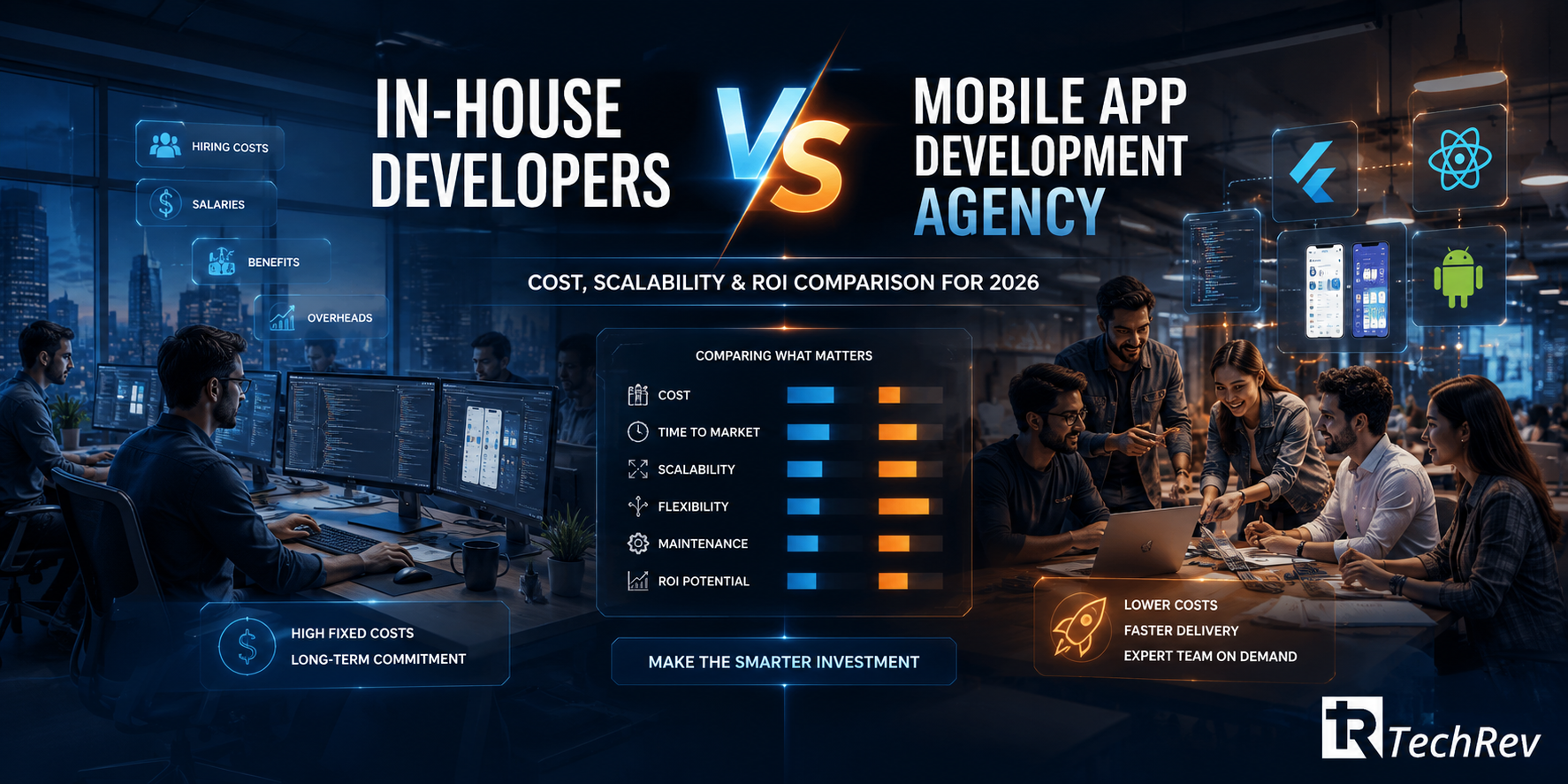
Choosing between in-house developers vs mobile app development agency is one of the most expensive decisions you will make this year, and most founders get the math wrong before they write a single line of code. On paper, hiring your own team looks like the serious move. In reality, the sticker price of a salary is only about half of what an in-house developer actually costs you, while agency pricing hides its own surprises inside vague quotes and shifting scopes.
So let’s do what most comparison posts refuse to do. Let’s put real, current numbers on the table, salaries, hourly rates, hidden overheads, maintenance, all of it, and figure out which model actually protects your budget in 2026.
Quick note before we dive in: if you’d rather skip the spreadsheet gymnastics and just talk to people who build apps for a living, the team at TechRev offers mobile app development services with transparent pricing, and they’ll walk you through this exact cost breakdown for your specific project. Now, the numbers.
In-House Developers vs Mobile App Development Agency: The Answer
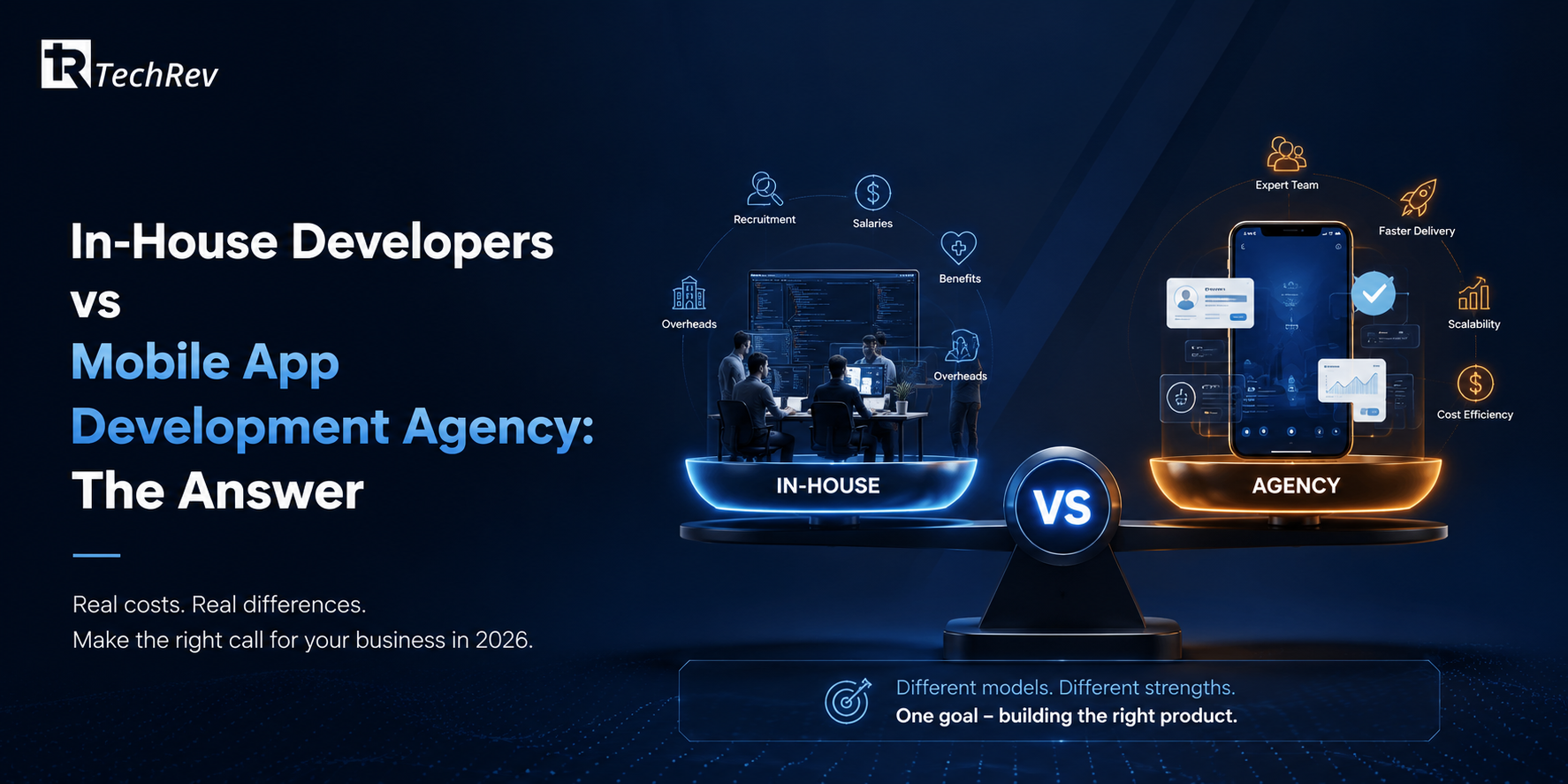
An in-house mobile developer in the US costs roughly $130,000 to $175,000 per year once you add salary, benefits, and overhead. A mobile app development agency typically charges $25 to $200 per hour depending on region, which usually works out cheaper for a single app build. In-house wins when the app is your core product and needs constant, long-term development.
That’s the answer Google’s AI Overview will love. But if you’re about to commit six figures either way, you deserve the full picture. Keep reading.
How Much Does Mobile App Development Cost in 2026?
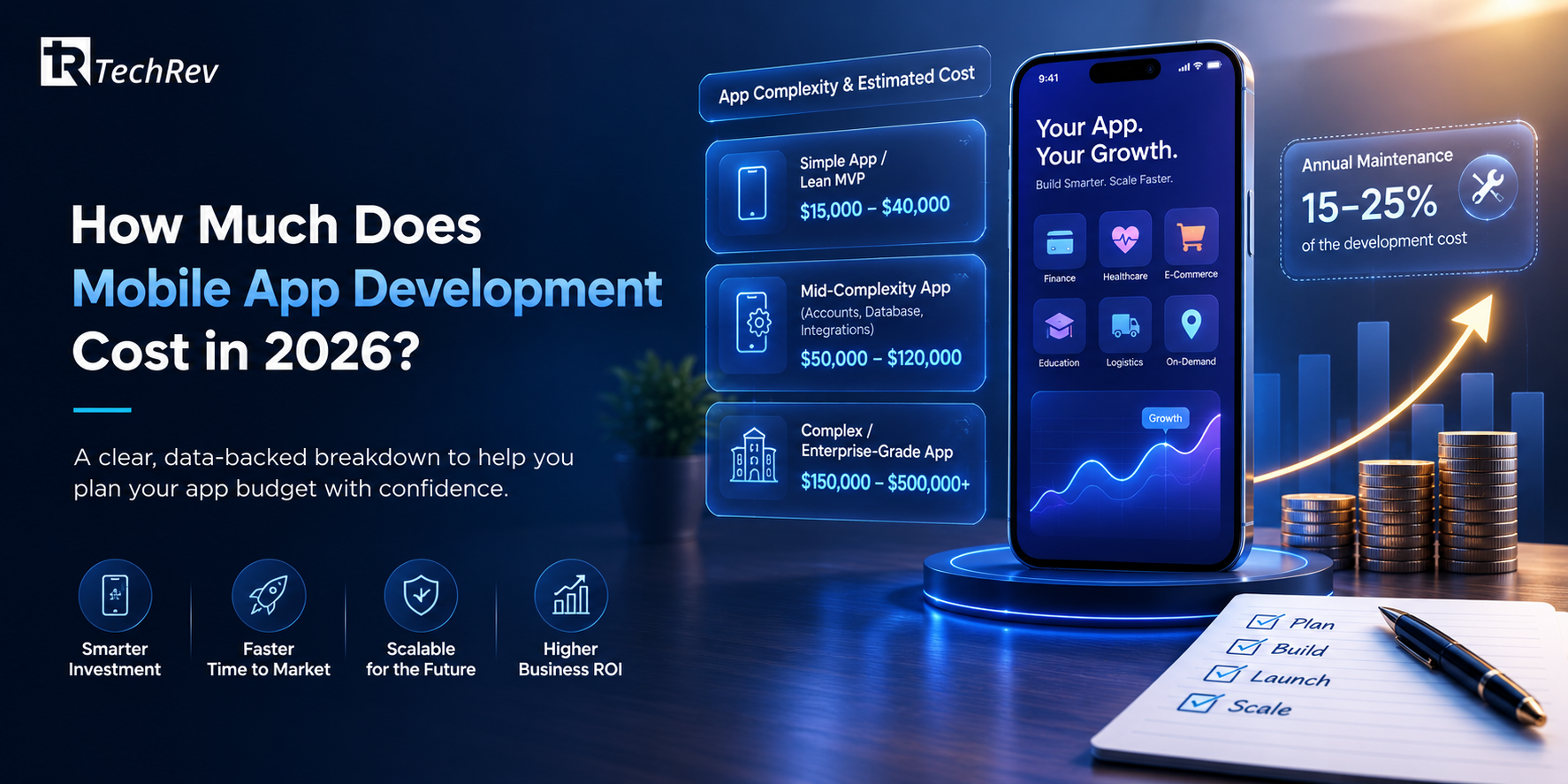
Before comparing teams, you need a baseline for the project itself. Across multiple 2026 industry pricing guides, mobile app development cost breaks down roughly like this:
| App Complexity | Typical Cost Range (2026) |
| Simple app / lean MVP | $15,000 to $40,000 |
| Mid-complexity app (accounts, database, integrations) | $50,000 to $120,000 |
| Complex or enterprise-grade app | $150,000 to $500,000+ |
One industry dataset compiled from over 5,000 projects puts the average custom build at around $171,450, though most small and mid-sized business apps land between $50,000 and $120,000.
And here’s the line item almost everyone forgets: maintenance. The industry standard is 15 to 25 percent of the original development cost, every single year. A $100,000 app quietly becomes a $115,000 to $125,000 annual commitment. Keep that number in your head, because it changes which team model makes sense.
The True Cost of In-House Developers in the USA
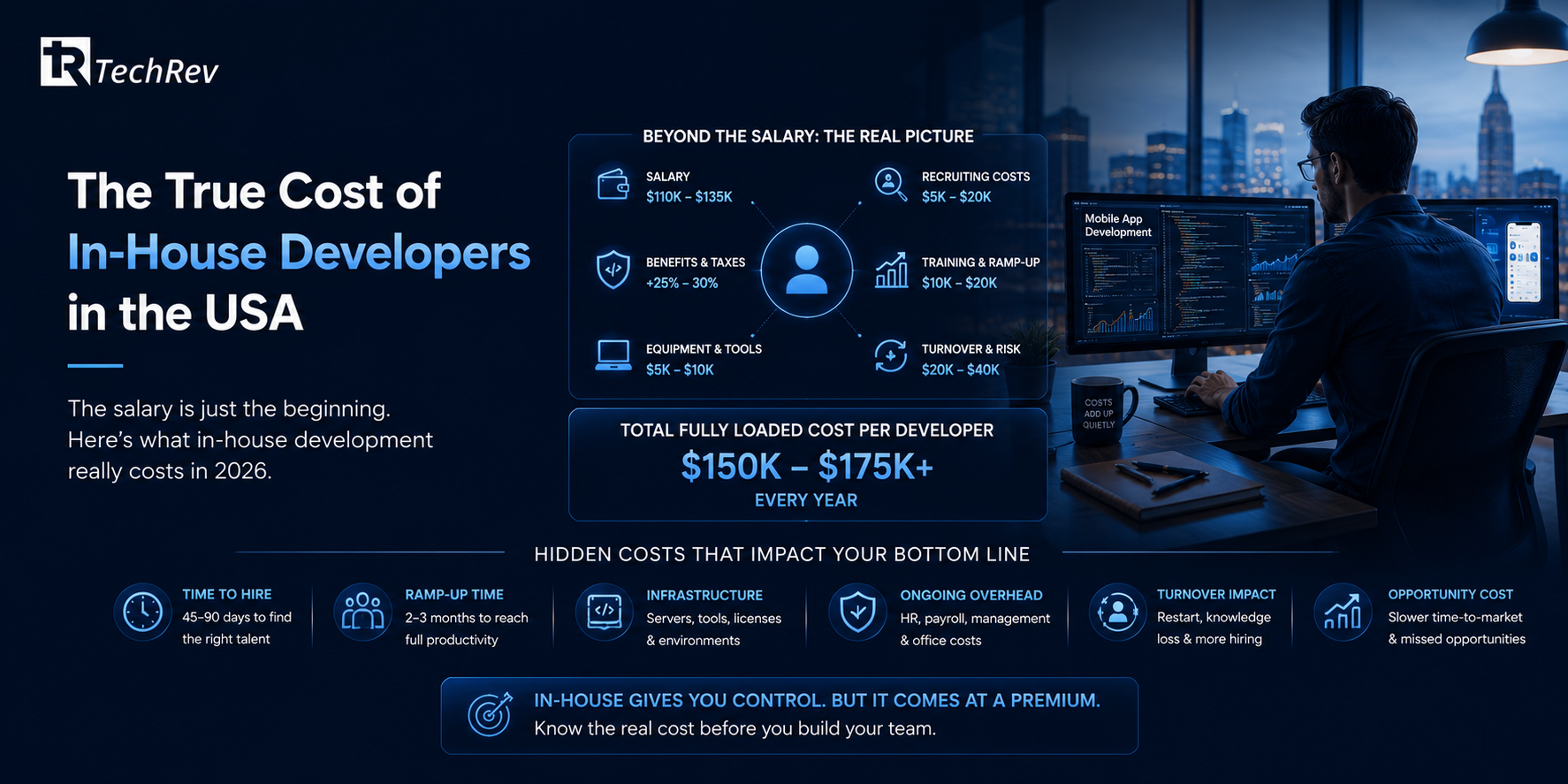
What do in-house mobile developers earn in 2026?
Let’s start with the number everyone Googles first. Depending on the source, the average US mobile developer salary in 2026 sits between roughly $101,000 and $134,000 per year:
- Glassdoor reports an average around $101,700 for mobile app developers, with mobile developers broadly averaging about $131,300
- ZipRecruiter puts the national average at about $110,482
- Salary.com lands at roughly $107,691
- Indeed data shows around $133,741
Split the difference and you’re realistically budgeting $110,000 to $135,000 in base salary for one solid developer. And you will need more than one. Which brings us to the part of the invoice nobody shows you upfront.
The hidden costs of an in-house team
What is the fully loaded cost of a developer? A fully loaded cost is the salary plus everything else an employer pays: benefits, payroll taxes, equipment, software licenses, office or remote stipends, and recruiting fees.
Benefits and overhead commonly add 25 to 30 percent on top of base pay, which pushes a $120,000 developer to roughly $150,000 to $156,000 in real annual cost.
Then stack on:
- Recruiting time and fees. Good mobile app engineers are in demand, and specialized recruiters typically charge a percentage of first-year salary.
- Ramp-up time. New hires need weeks to months before they ship at full speed, and you’re paying full price the whole time.
- Tooling. Device labs, CI/CD pipelines, testing tools, design software, App Store and Play Store accounts.
- Turnover risk. If your only iOS developers leaves mid-project, your roadmap doesn’t pause. Your costs do not either.
One developer is never enough
Here’s a question worth sitting with: can a single developer build a production app alone? Technically yes, practically no. A real product needs design, backend work, QA, and someone managing the roadmap.
A minimal in-house squad usually looks like two developers, a designer (even fractional), and QA support. At US rates, that’s a $350,000 to $500,000+ annual payroll before your app earns its first dollar.
This is exactly why so many companies hire iOS app developers through an agency for the initial build, then decide later whether an internal team is justified.
TechRev sees this pattern constantly: clients come in for the version 1.0 build, validate the product, and only then invest in a permanent headcount.
How Much Does a Mobile App Development Agency Charge?
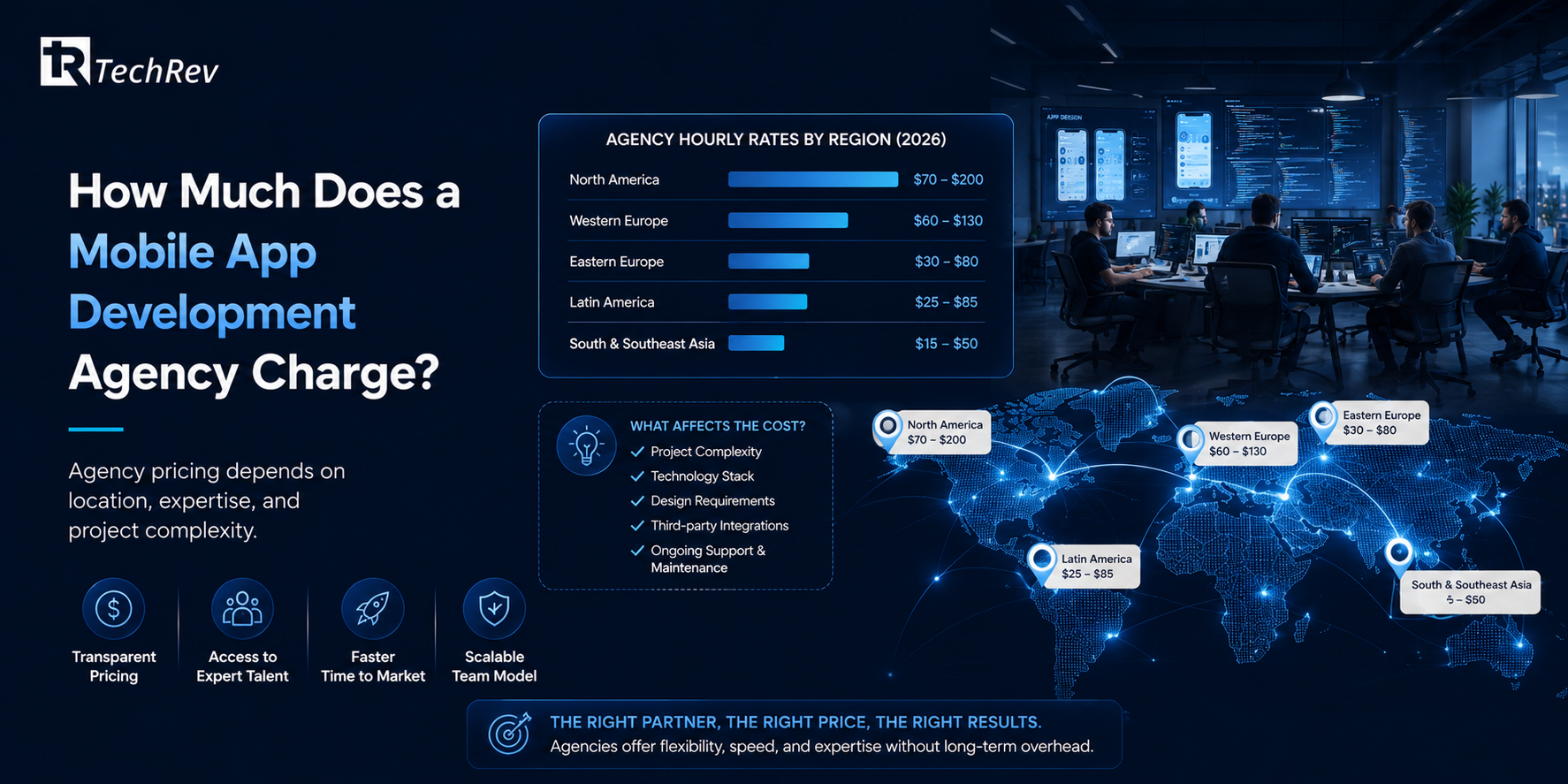
Agency pricing is driven almost entirely by geography and seniority. Here are the 2026 hourly ranges that show up consistently across rate surveys:
| Region | Typical Agency Hourly Rate (2026) |
| North America | $70 to $200 |
| Western Europe | $60 to $130 |
| Eastern Europe | $30 to $80 |
| Latin America | $25 to $85 |
| South and Southeast Asia | $15 to $50 |
A few things the rate card doesn’t tell you:
- The cheapest hourly rate is rarely the cheapest project. One 2026 analysis found a $25 per hour offshore developer often lands at an effective $35 to $40 per hour once management overhead, ramp-up, and rework are counted. Deloitte’s Global Outsourcing Survey found 70 percent of buyers name hidden fees as their top surprise in offshore contracts.
- Fixed price vs time and materials matters. Fixed price caps your risk but only if the scope is nailed down. A common 2026 playbook: fixed price for the MVP, then time and materials once the architecture is stable.
- Two quotes for the same app are almost never covering the same scope. A $40,000 quote and a $120,000 quote can describe identical briefs with wildly different assumptions about QA, design, and post-launch support.
So what does an agency-built app actually cost? For a production-ready MVP through a mid-market mobile app development company, expect $40,000 to $100,000. That’s a one-time project cost, compared to committing to $150,000+ per developer per year in-house.
In-House Developers vs Mobile App Development Agency: Side-by-Side Cost Comparison
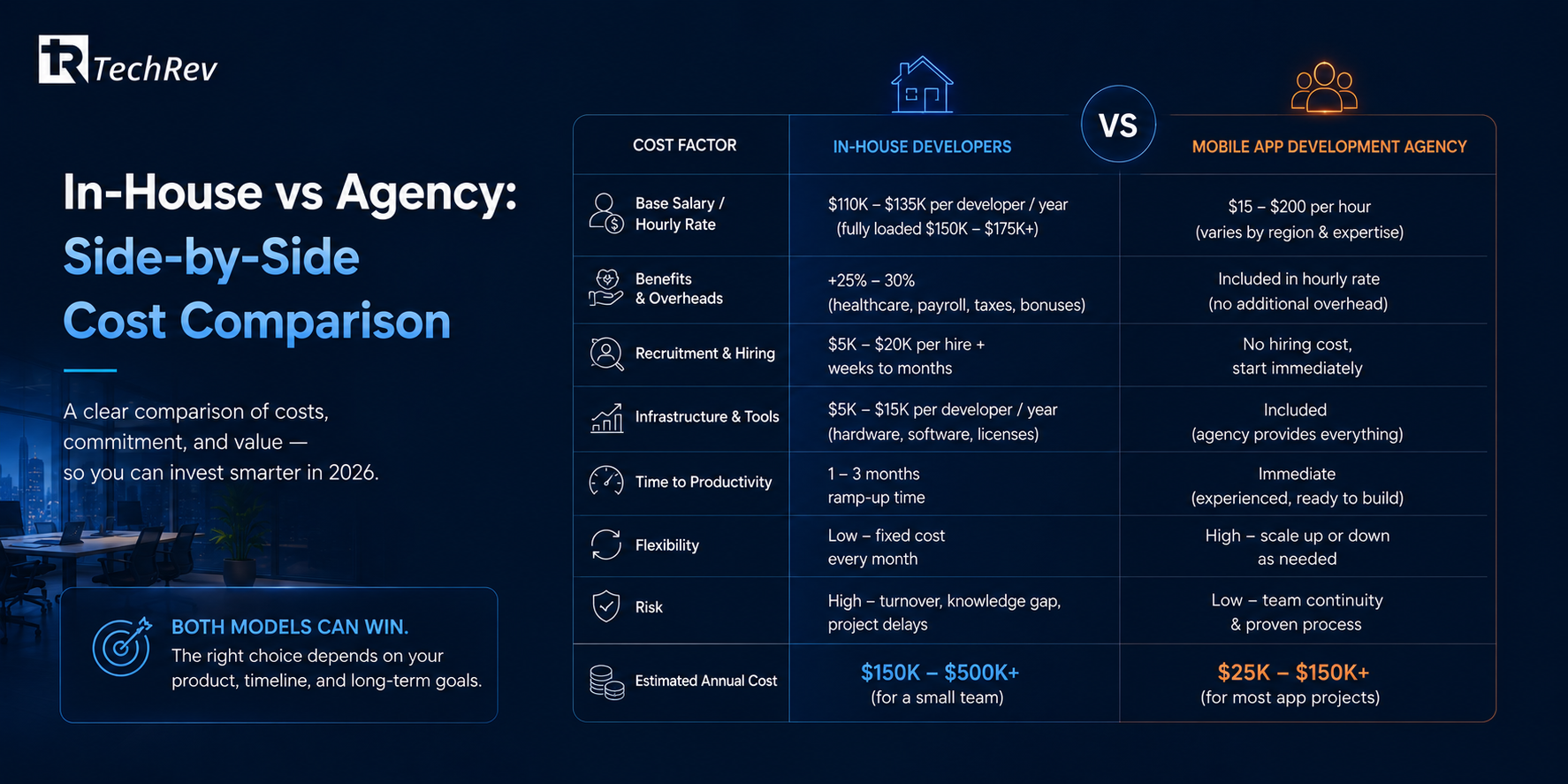
| Factor | In-House Team | Mobile App Development Agency |
| Upfront cost | Very high (salaries start before code does) | Project-based, pay for output |
| Annual cost (small team) | $350,000 to $500,000+ | $40,000 to $200,000 depending on scope |
| Time to start | 2 to 4+ months (hiring, onboarding) | Days to weeks |
| Specialized skills (AI, AR, payments) | Must hire or train for each | Included in the bench |
| Scaling up or down | Slow and expensive | Add or remove capacity per sprint |
| Product knowledge retention | Excellent, stays in the building | Depends on documentation and handover |
| Best for | Core-product apps with a long roadmap | MVPs, fixed-scope builds, fast launches |
Mobile App Development Challenges That Quietly Inflate Your Budget
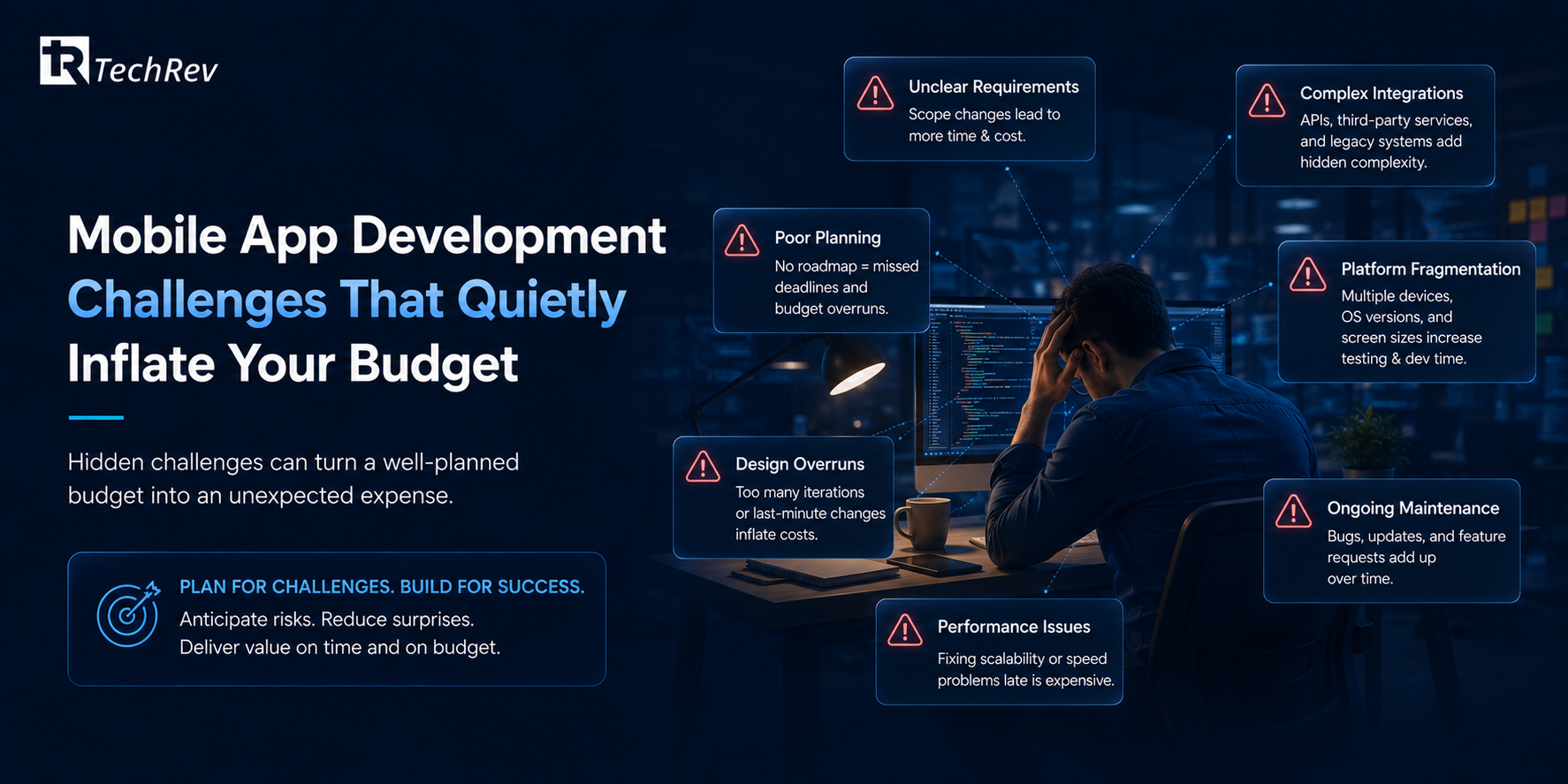
Whichever model you pick, the same mobile app development challenges show up on the invoice. Knowing them in advance is the difference between a budget and a budget disaster.
- Scope creep. The number one killer. Every small feature added mid-build costs design, development, QA, and regression testing.
- QA underestimation. Testing typically consumes 15 to 25 percent of total development hours. On a mid-complexity build, that can mean $10,000 to $37,500 for testing alone.
- Platform fragmentation. Android app development means supporting a huge spread of devices, screen sizes, and OS versions. That device matrix costs real testing hours.
- Store compliance. Apple’s $99 per year developer account and Google’s one-time $25 fee are trivial. The engineering time to meet review guidelines is not.
- Security and compliance. Fintech and healthcare apps carry regulatory overhead that can push builds past $300,000.
- Maintenance amnesia. As covered above, 15 to 25 percent of build cost per year, forever. Teams that don’t budget for it ship an app that slowly rots.
These mobile app development challenges hit in-house teams and agencies equally. The difference is that an experienced mobile app development agency like TechRev has already stepped on these rakes a few hundred times and prices them in from day one. In-house teams often learn each lesson at full retail price.
Also Read – Top Programming Languages for iOS App Development in 2026
Native or Cross-Platform? Your Tech Stack Changes the Math
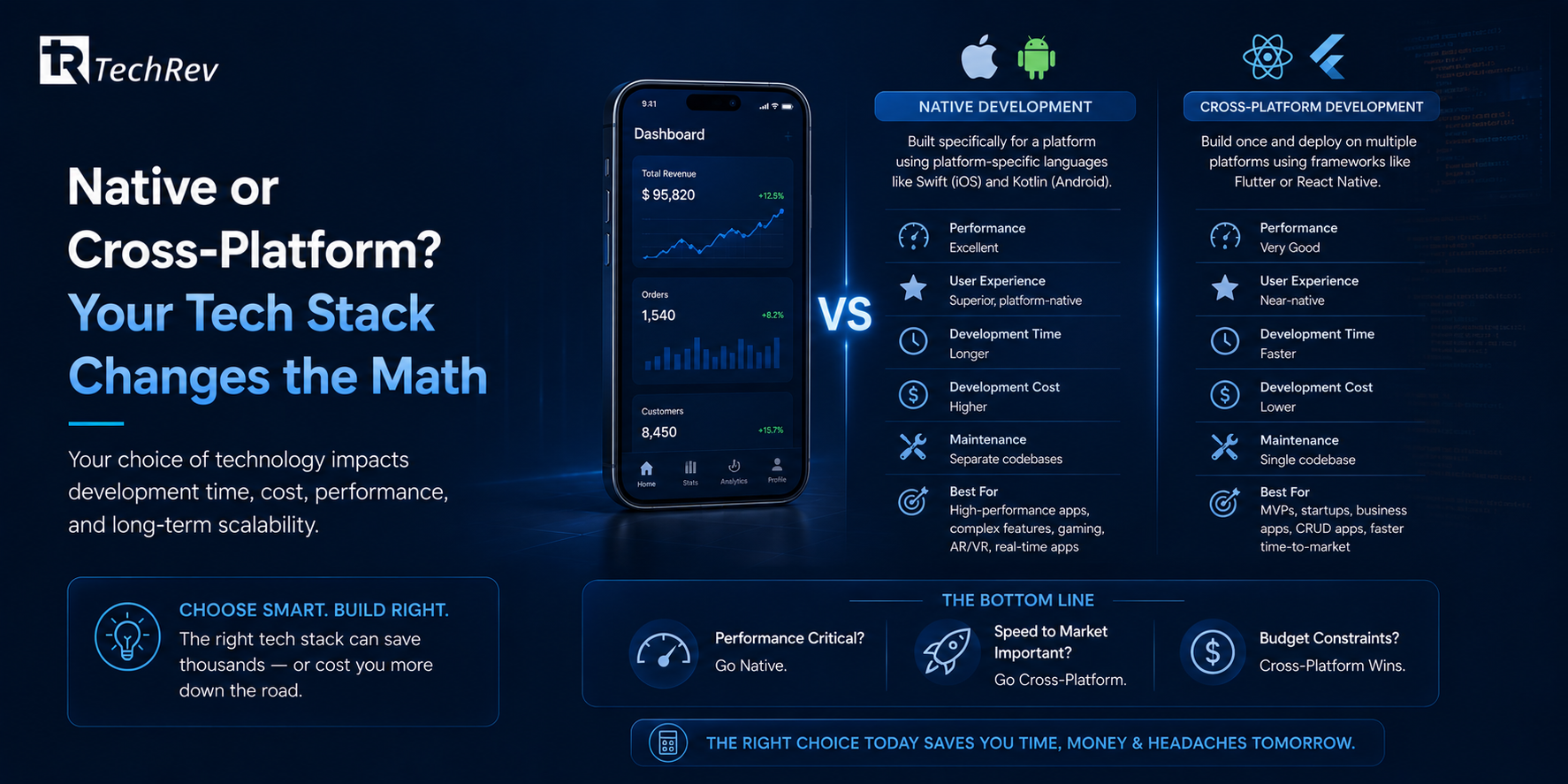
Which is cheaper: native or cross-platform development? Cross-platform is usually cheaper for reaching both stores. Building separate native apps means funding Swift app development for iOS and Kotlin-based Android app development in parallel, essentially two codebases, two test cycles, sometimes two teams.
Cross-platform builds in 2026 typically range from $25,000 to $200,000, generally below the cost of dual native builds with comparable features.
Here’s how the main options stack up:
- Swift app development (native iOS). Best performance and tightest hardware integration on Apple devices. The right call for animation-heavy, hardware-intensive, or iOS-first products, especially since iOS commands higher average revenue per user in the US market.
- Android app development (native Kotlin/Java). Essential when your audience skews Android or you need deep device-level features. Budget extra QA for device fragmentation.
- React Native app development. One JavaScript codebase for both platforms. For e-commerce, SaaS clients, and content apps, the framework’s overhead rarely shows up as a user-visible problem, and React Native app development cost often comes in below dual-native builds for the same feature set.
- Flutter app development. Compiled Dart code that performs close to native benchmarks, with pixel-perfect UI consistency across platforms. Flutter app development has become a default recommendation at several major agencies when cross-platform UI consistency is the priority.
This is also where the in-house vs agency decision gets sharper. Hiring in-house means betting on one stack; if you staff for Swift app development and later need Flutter, you’re recruiting again.
A full-service mobile app development company like TechRev keeps native iOS, Android app development, React Native app development, and Flutter app development skills on the same bench, so the stack decision follows the product’s needs rather than the résumés you happen to have hired.
When Should You Hire Mobile App Developers In-House?
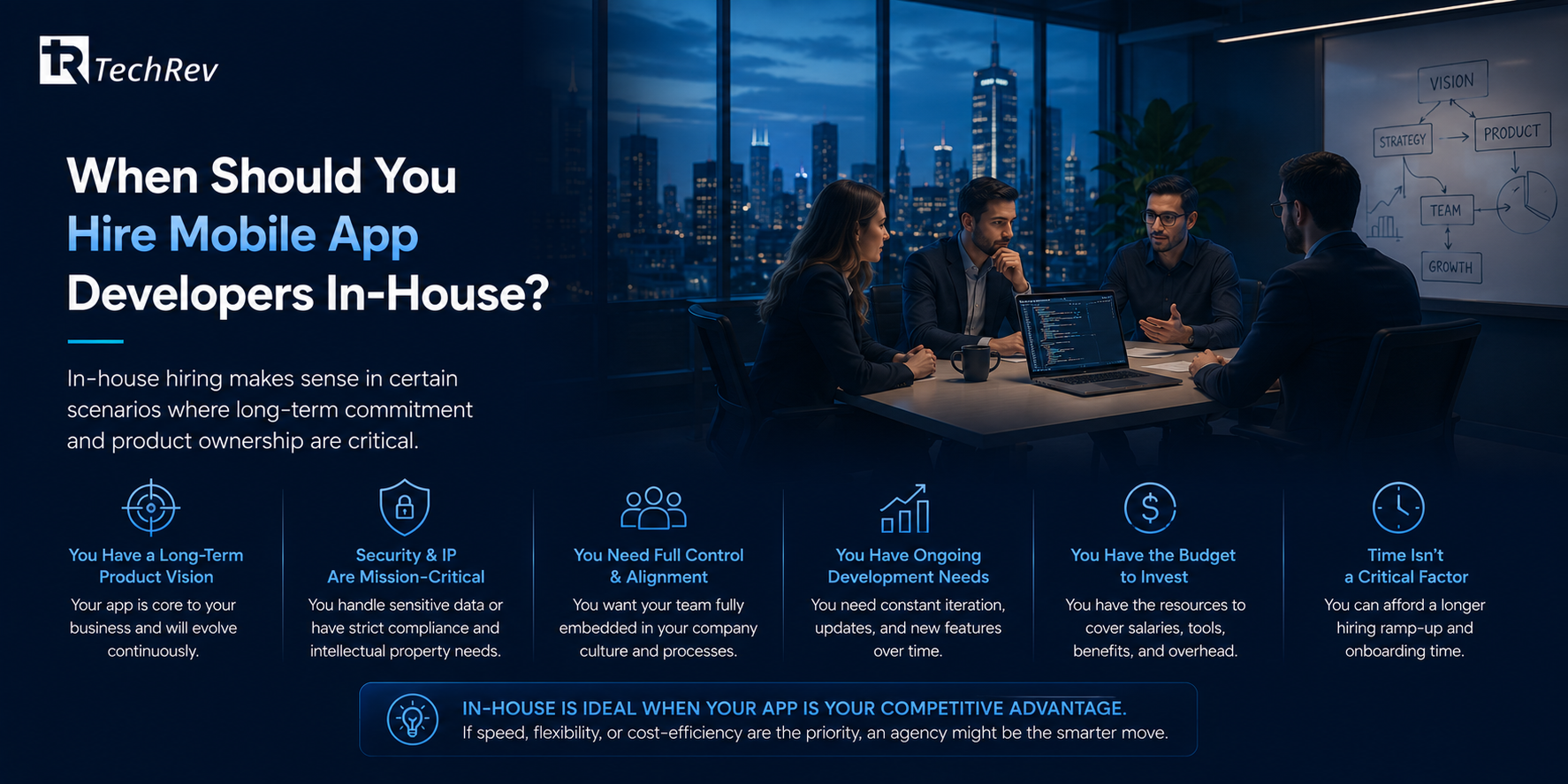
In-house is the right call when:
- The app IS the business. If your product is the app, a continuous internal team compounds product knowledge in a way no vendor can.
- You ship constantly. Weekly releases, live experiments, and a roadmap that never ends justify permanent payroll.
- You handle sensitive data at scale. Some regulated companies keep security-critical work internal as policy, and US-onshore, compliance-heavy roles remain largely insulated from outsourcing pressure.
- You’ve already validated the demand. Post-product-market-fit, converting agency spend into headcount often improves unit economics.
If that’s you, hire mobile app developers deliberately: senior first, and expect the search to take months, not weeks.
When a Mobile App Development Agency Makes More Sense?
An agency wins when:
- You need to launch fast. An agency team starts in days. An in-house team starts after a hiring cycle.
- The scope is definable. A fixed-scope MVP is the ideal agency project.
- You need many skills briefly. A typical build touches design, backend, iOS, Android, QA, and DevOps. Hiring all of that for a six-month project makes no financial sense.
- Your budget is a project, not a payroll. $60,000 buys a real MVP from a good agency. It buys about five months of one fully loaded US developer.
Is it safe to outsource your app to a mobile app development agency? Yes, if you vet properly: check shipped apps in the stores, talk to references, insist on IP assignment in the contract, and demand documented handover. The horror stories almost always trace back to skipped vetting, not to outsourcing itself.
This is where a company like TechRev is worth a conversation. As a US-based mobile app development company, TechRev covers the full cycle, discovery, UI/UX design, development, QA, launch, and post-launch support, so you’re not stitching together freelancers and hoping the seams hold.
Also Read – Swift vs Kotlin: Native App Development Compared (2026 Guide)
The 2026 Trend: The Hybrid Team Model
Here’s what’s actually trending in how successful companies structure development in 2026: they stopped treating this as either/or. The hybrid model keeps product vision, core architecture, and security in-house while an agency partner handles feature development, QA, and specialized builds.
Why it works:
- You keep strategic control and institutional knowledge internal.
- You rent expensive, occasional skills (AI features, AR, payment infrastructure) instead of owning them.
- You scale delivery capacity per sprint instead of per hiring cycle.
Even one strong technical hire plus an agency partner outperforms most fully in-house teams of the same budget. If you’re weighing mobile app development services for exactly this kind of arrangement,
TechRev structures engagements as dedicated teams that plug into your existing processes, which is precisely how the hybrid model is supposed to run.
Also Read – The 2026 Guide to Manual vs Automated Software Testing
7 Mobile App Development Tips to Keep Costs Under Control
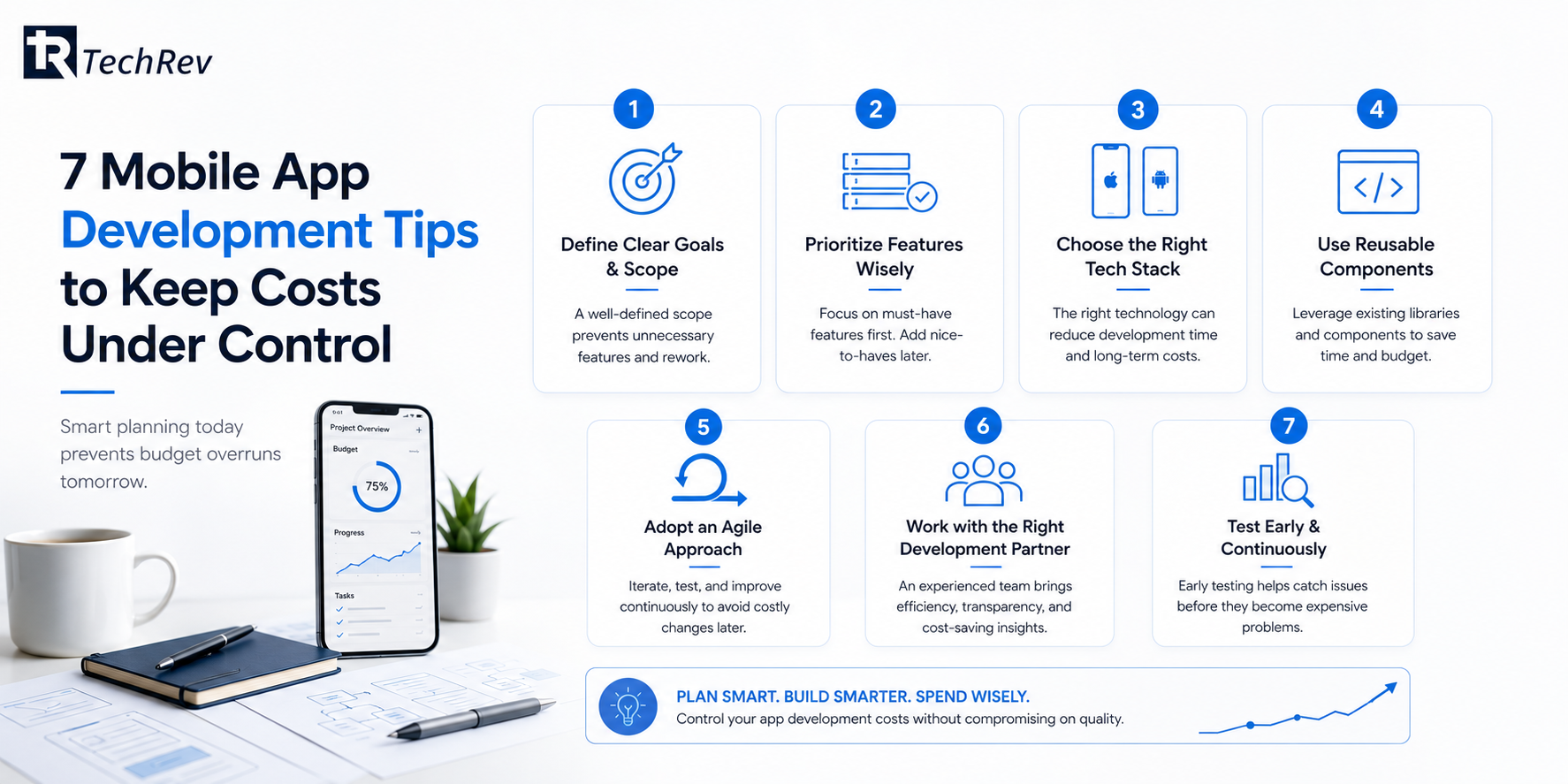
Whichever route you choose, these mobile app development tips will protect your budget:
- Start with an MVP, not a masterpiece. One core user flow, minimal screens, just enough to validate demand.
- Write the scope down in painful detail. Vague briefs are why a $40,000 quote becomes a $90,000 invoice.
- Compare quotes on scope, not price. Ask every vendor what’s included: QA hours, design revisions, post-launch support.
- Budget maintenance from day one. Add 15 to 25 percent of build cost per year to every projection you show stakeholders.
- Go cross-platform unless you have a specific reason not to. For most business apps, Flutter app development or React Native app development covers both stores for meaningfully less.
- Fix the price on the MVP, then switch to time and materials. Caps early risk, keeps later flexibility.
- Vet for process, not just portfolio. Ask how the team handles changes, testing, and handover. Process quality predicts final mobile app development cost better than the hourly rate does.
That last one deserves repeating, because it’s the most counterintuitive of all mobile app development tips: higher hourly rates from senior teams usually produce lower total project costs, thanks to fewer mistakes and less rework.
Conclusion
For most businesses building their first app, or their fifth, a mobile app development agency delivers a finished product for a fraction of the first-year cost of an in-house team.
The crossover point comes when your app needs continuous, heavy development for years; that’s when in-house payroll starts beating cumulative agency invoices, and when the hybrid model bridges the gap beautifully.
The summary:
- One app, defined scope, need it soon: agency, no contest.
- App is your core product with a multi-year roadmap: build in-house, gradually.
- Somewhere in between (most companies): hybrid.
And if you want a real quote instead of a blog post’s ranges, TechRev will scope your project and give you a transparent mobile app development cost estimate, so you can compare it against the in-house math above with your own numbers.
Ready to see what your app would really cost?
Skip the guesswork.
Talk to TechRev and get a transparent, line-item estimate for your mobile app development project.
FAQs
1. How much does it cost to hire an in-house mobile developer in 2026?
Between roughly $101,000 and $134,000 in base salary for a US developer, depending on the data source. Add 25 to 30 percent for benefits and overhead and the true annual cost lands around $130,000 to $175,000 per developer.
2. How much does a mobile app development agency charge per hour?
Rates range from $15 to $50 per hour in South Asia, $25 to $85 in Latin America, $30 to $80 in Eastern Europe, and $70 to $200 in North America. Seniority and specialization move the number as much as geography does.
3. What is the average mobile app development cost in 2026?
Simple apps run $15,000 to $40,000, mid-complexity apps $50,000 to $120,000, and complex or regulated products $150,000 to $500,000 or more. One large industry dataset puts the overall average around $171,450.
4. Is it cheaper to build an app with Flutter or React Native than natively?
Usually, yes. Cross-platform builds typically cost less than funding separate Swift app development and Android app development tracks, because one codebase serves both stores. Expect roughly $25,000 to $200,000 depending on complexity.
5. What are the biggest mobile app development challenges that increase cost?
Scope creep, underestimated QA (15 to 25 percent of total hours), Android device fragmentation, store compliance, security requirements, and unbudgeted maintenance, which runs 15 to 25 percent of build cost every year.
6. When should a startup hire mobile app developers instead of outsourcing?
After product-market fit, when the app needs continuous weekly development, or when regulatory requirements demand internal control. Before that point, agency or hybrid models almost always cost less.
7. What services does TechRev provide?
TechRev is a US-based mobile app development company offering end-to-end mobile app development services: discovery, UI/UX design, native iOS and Android app development, React Native and Flutter builds, QA, launch, and ongoing support.
8. Why choose TechRev over hiring an in-house team?
You get a full product team, developers, designers, and QA, from day one, without a hiring cycle or long-term payroll commitment. TechRev scopes projects transparently, so you can compare its quote directly against the in-house cost math in this article. For many companies, that comparison settles the debate quickly.
9. Does TechRev work with existing in-house teams?
Yes. TechRev supports hybrid engagements, plugging dedicated developers into your team to extend capacity while your internal staff keeps ownership of architecture and product direction.
10. How do I get a cost estimate from TechRev?
Share your feature list, even a rough one, and TechRev’s team will return a realistic cost range, a recommended platform approach, and a delivery timeline. No obligation, just numbers you can actually plan around.