
HIPAA compliant app development is the price of admission to American healthcare software, and 2026 is the year the price of skipping it became impossible to ignore. The Change Healthcare cyberattack exposed data belonging to roughly 190 million people, the largest healthcare breach ever reported, and it landed on top of a 2023 in which breaches reported to federal regulators already exposed more than 130 million records.
Meanwhile, IBM’s Cost of a Data Breach research has ranked healthcare the most expensive industry for breaches for 14 consecutive years, with the average healthcare breach costing close to $10 million. Regulators are responding: HIPAA’s Security Rule is in the middle of its biggest proposed update in two decades, moving long-recommended practices like encryption and multifactor authentication toward hard requirements.
If you are building anything that touches patient data, this blog is the map: who needs HIPAA compliant app development, the complete checklist, the mistakes that sink projects, what is changing, and what compliance actually costs.
What Is HIPAA Compliant App Development?
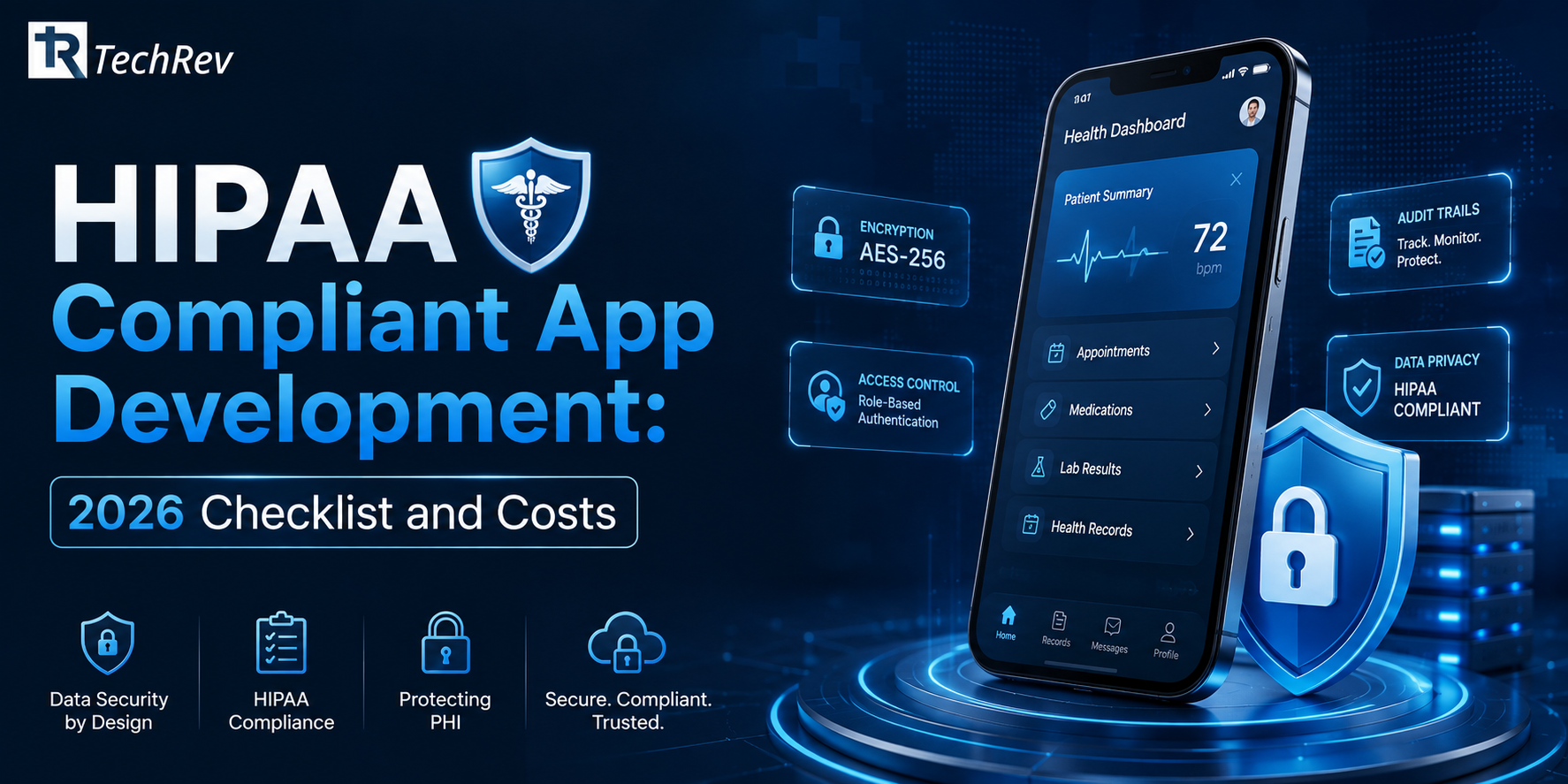
HIPAA compliant app development is the practice of designing and building software so that protected health information (PHI) is safeguarded according to the HIPAA Privacy and Security Rules: encrypted in transit and at rest, accessible only by authorized roles, logged in audit trails, and governed by signed agreements across every vendor that touches it.
Compliance is not a feature you add at the end. It is an architecture you build on from the first line of code.
The one-sentence version: HIPAA compliance means you can prove, at any moment, who saw what patient data, when, and why.
HIPAA Breach Stats: What Non-Compliance Costs in Real Numbers
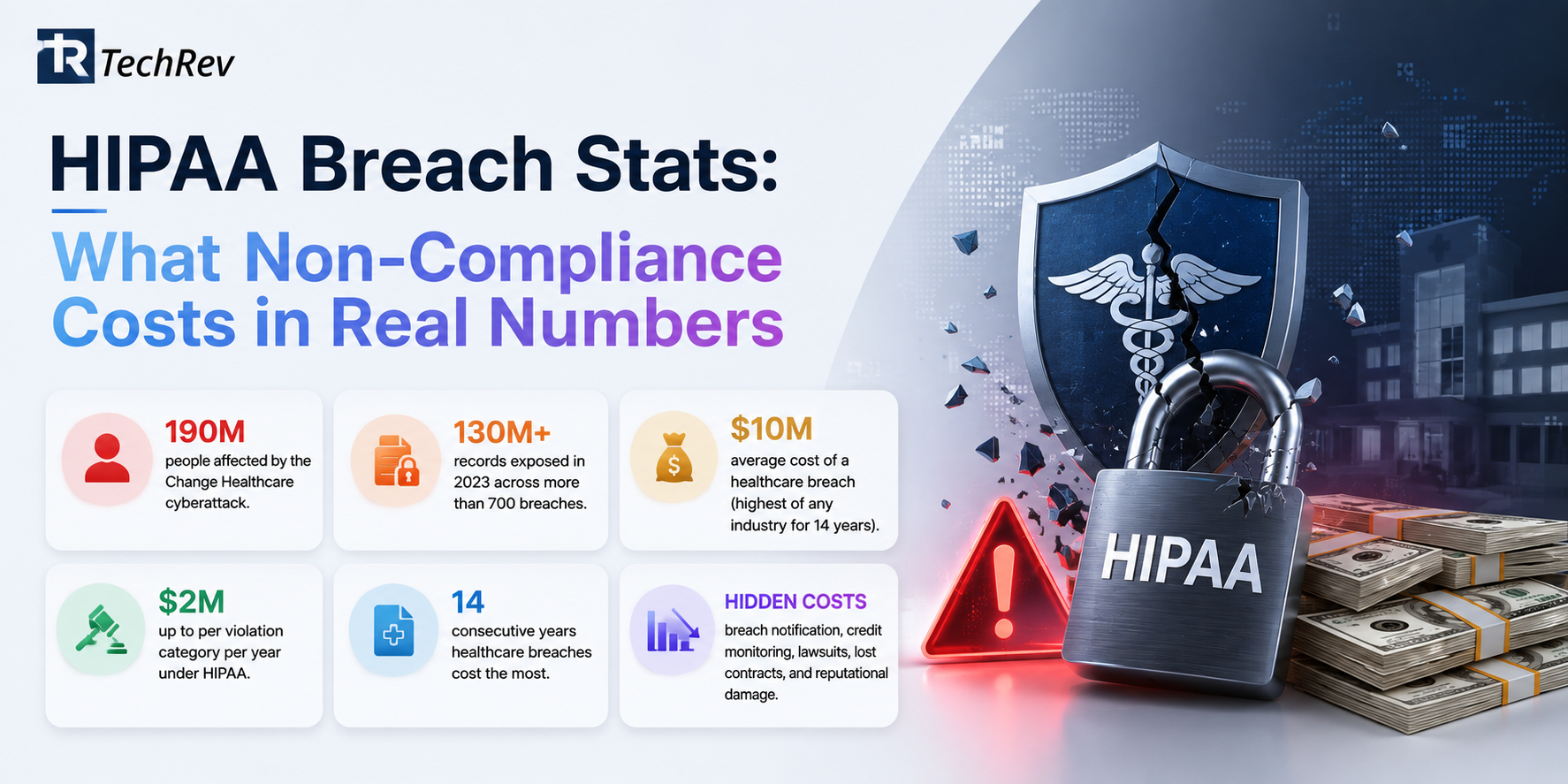
The enforcement and breach data make the business case brutally clear:
- 190 million people were affected by the Change Healthcare attack, per the company’s own regulatory filings, and its parent disclosed response costs running into the billions of dollars.
- Federal breach reporting showed over 130 million records exposed in 2023 alone, across more than 700 large breaches, and hacking now accounts for the overwhelming majority of incidents.
- IBM’s research puts the average healthcare breach near $10 million, the highest of any industry for 14 straight years.
- Civil penalties scale to roughly $2 million per violation category per year under current inflation-adjusted caps, and OCR enforcement increasingly targets smaller organizations, not just health systems.
- The quieter costs compound: breach notification, credit monitoring, class actions, lost contracts, and the diligence questions every future partner will ask.
Read those numbers as a design instruction: in healthcare software development, security architecture is not overhead on the product. It is the product’s license to exist.
Does Your App Need HIPAA Compliant Development?
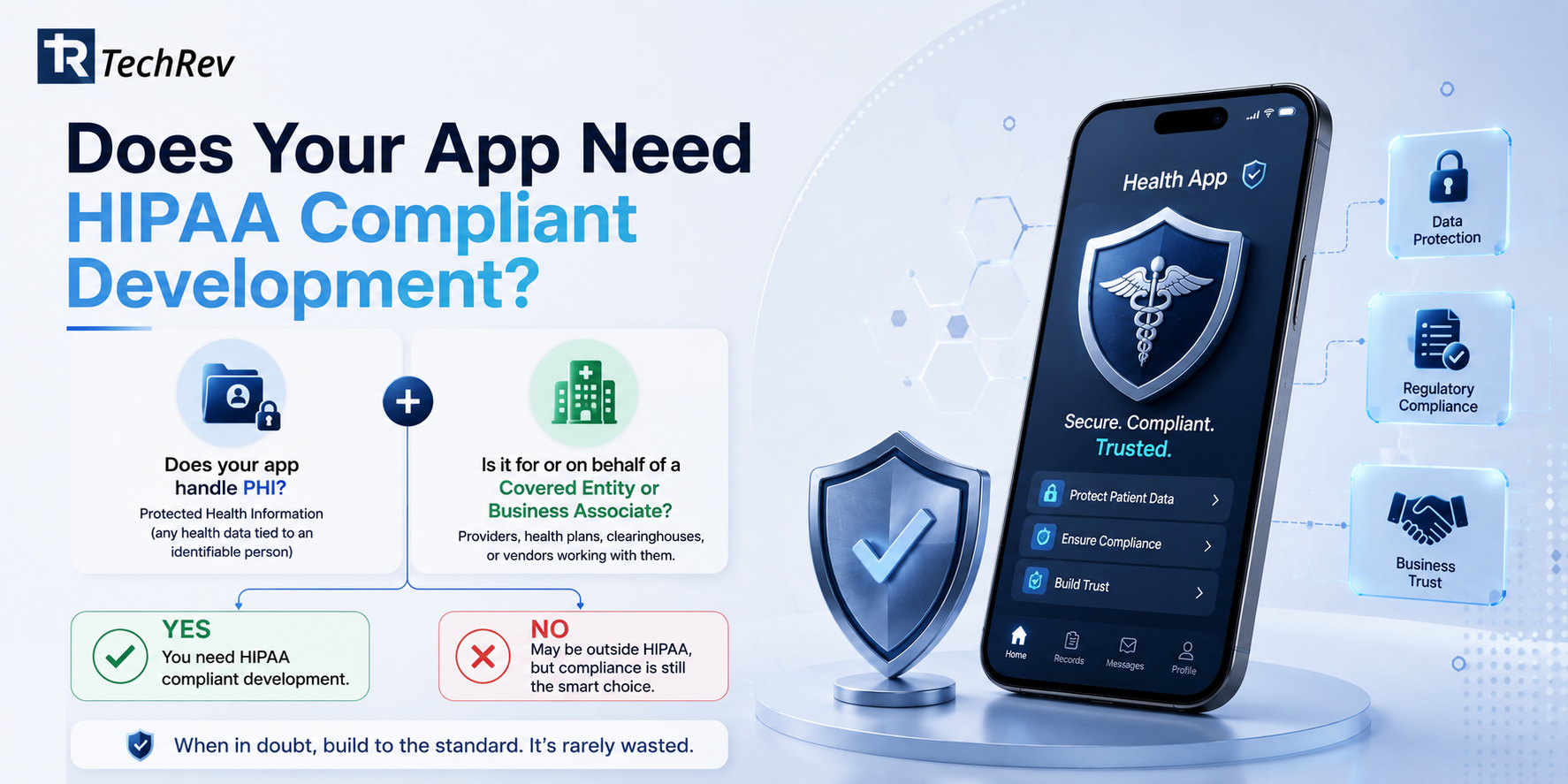
Your app needs HIPAA compliance if two things are true: it handles protected health information (any health data tied to an identifiable person, from diagnoses to appointment times), and it does so for or on behalf of a covered entity (providers, health plans, clearinghouses) or their business associates.
Build for a hospital, a practice, a payer, or a vendor serving them, and you are in scope, with a business associate agreement (BAA) to sign.
The common gray zone: direct-to-consumer wellness apps with no covered-entity relationship may sit outside HIPAA, but the FTC’s health data enforcement has been closing that gap, and investors and partners increasingly expect HIPAA-grade architecture regardless.
Building to the standard is rarely wasted.
Also Read – How to Build a Secure and Compliant Healthcare App: A Step-by-Step Guide!
The HIPAA Compliance Checklist for App Development
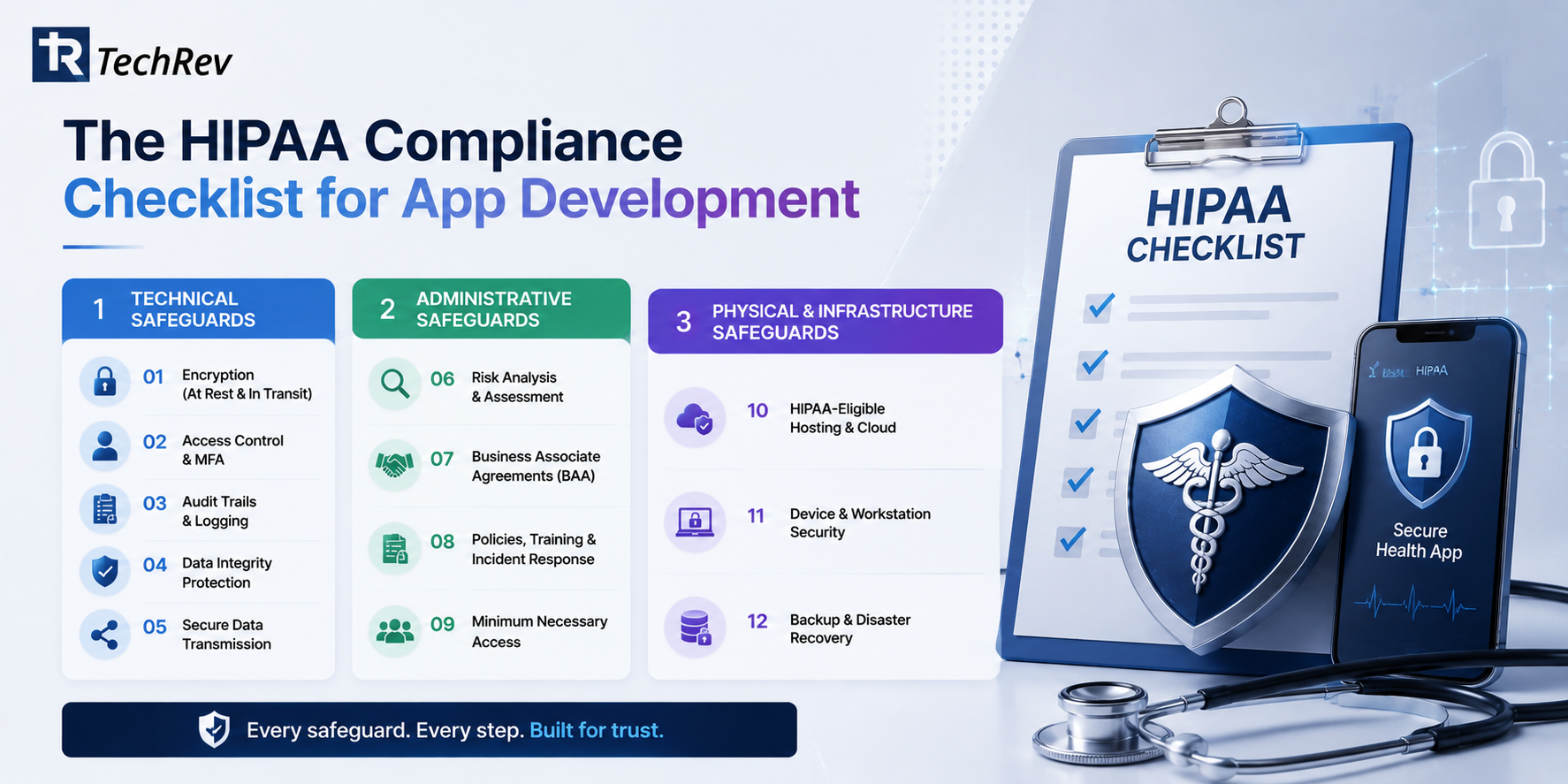
The Security Rule organizes safeguards into three families. Here is the developer’s version of the HIPAA compliance checklist:
1. HIPAA Technical Safeguards for Apps
- Encryption everywhere: TLS 1.2+ in transit, strong encryption (AES-256) at rest, including backups and logs
- Access control: unique user IDs, role-based permissions, automatic session timeouts, and multifactor authentication
- Audit controls: immutable logs of every PHI access, change, and export, retained and reviewable
- Integrity controls: protections against improper alteration or destruction of PHI
- Transmission security: no PHI in push notifications, SMS, standard email, or third-party analytics events
2. Administrative Safeguards
- Risk analysis: a documented, updated assessment of where PHI lives and what threatens it, the single most-cited gap in OCR enforcement
- Business associate agreements: signed BAAs with every vendor touching PHI, including cloud hosts, messaging providers, and AI services
- Policies, training, and incident response: written procedures, workforce training records, and a tested breach response plan
- Minimum necessary: systems designed so each role sees only the PHI its job requires
3. Physical and Infrastructure Safeguards
- HIPAA-eligible hosting: cloud infrastructure configured for compliance under a BAA, with hardening, monitoring, and backup/disaster recovery
- Device and workstation policies: for any managed endpoints that access PHI
Two architecture notes separate compliant builds from checkbox builds: design the audit trail and role model first, because retrofitting them touches every feature; and treat AI components with the same discipline, since patient data flowing to ungoverned AI services is the newest way to fail an audit.
The same integration principles apply whether the app is an EHR-connected platform, a patient engagement tool, or a monitoring system.
Common HIPAA Compliant App Development Mistakes
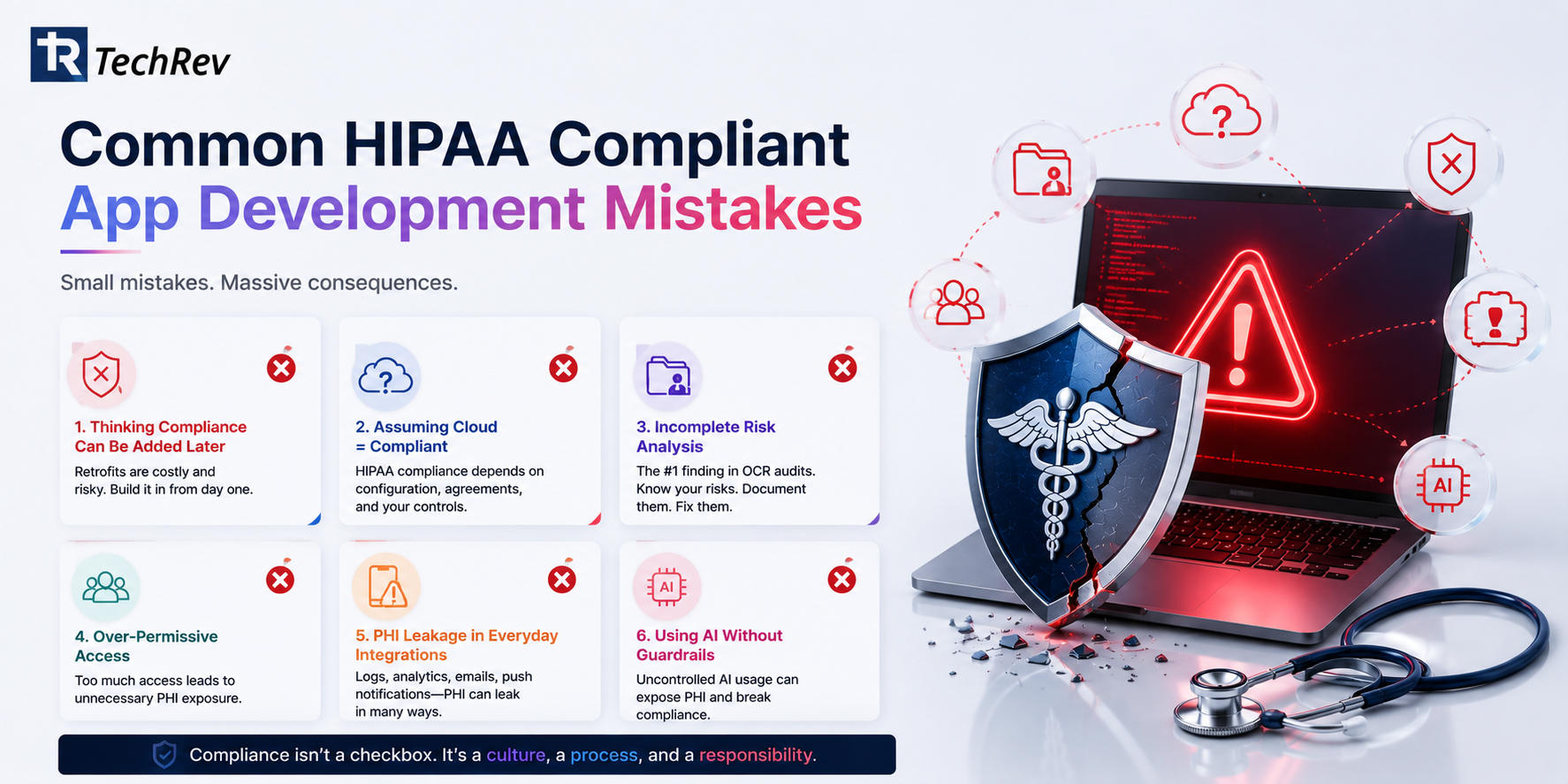
Five failures account for most compliance findings in app projects:
- PHI leaking through side channels: crash reports, analytics SDKs, push notification payloads, and support screenshots quietly transmitting patient data to vendors with no BAA
- Compliance bolted on late: encryption and access control retrofitted after the architecture hardened, at multiples of the designed-in cost
- No risk analysis on file: the first document OCR requests and the most common one missing
- Assuming the cloud provider’s compliance covers you: HIPAA-eligible infrastructure under a BAA is the floor; your configuration, code, and processes are still your responsibility
- Unsupervised AI integrations: models and vendors processing PHI without BAAs, logging, or output controls
Every one of these is cheaper to prevent than to remediate, which is the entire argument for choosing a development partner who has built under audit before.
Also Read – Prior Authorization Automation: How AI Is Fixing Healthcare?
What Is Changing: HIPAA Security Rule Updates for 2026
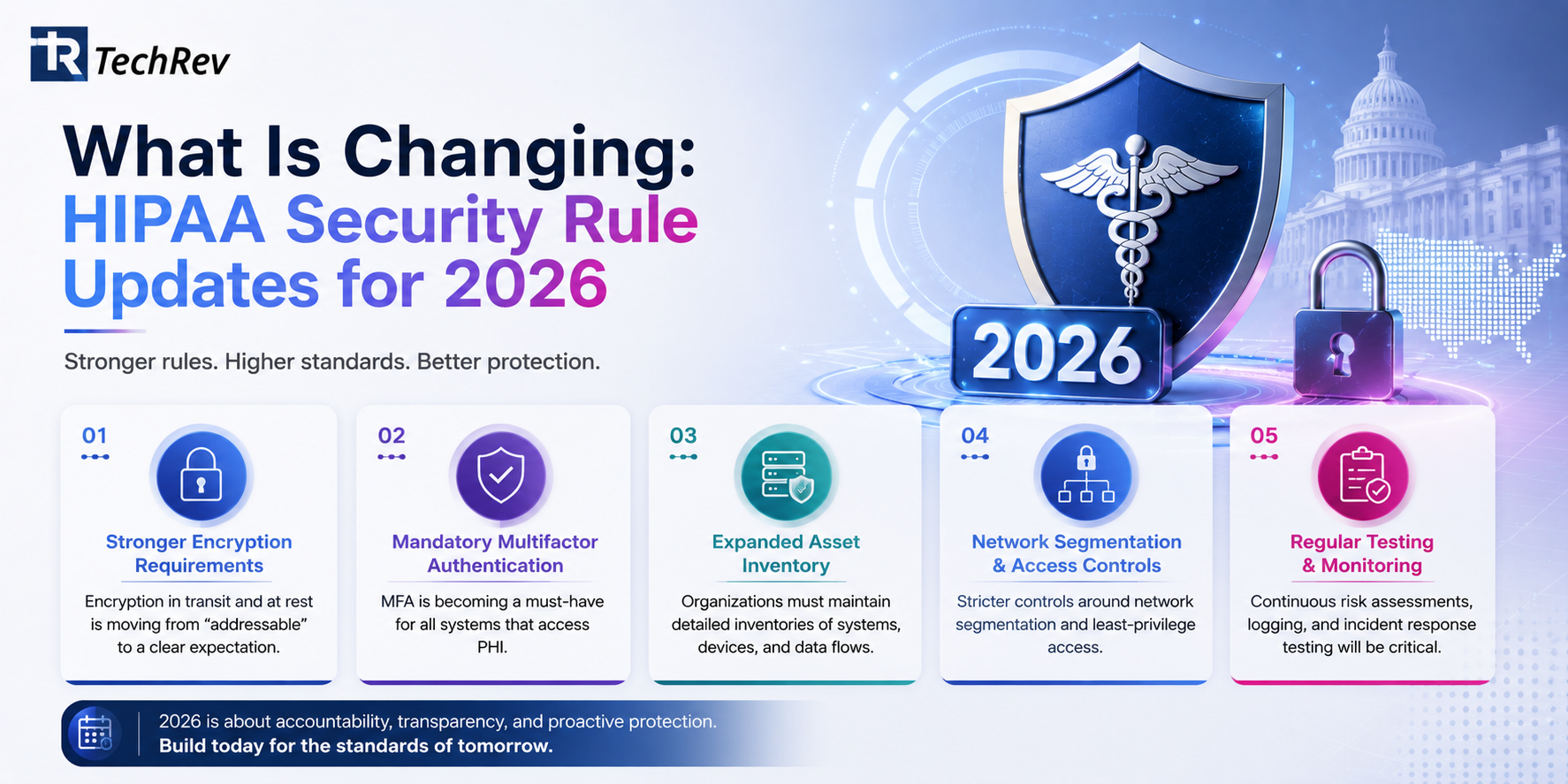
Regulators proposed the most significant Security Rule overhaul in twenty years, moving toward mandatory encryption, required multifactor authentication, asset inventories, network segmentation, and regular technical testing, effectively converting yesterday’s “addressable” best practices into tomorrow’s requirements.
Final timelines will settle through the rulemaking process, but the direction is unambiguous, and it matches where enforcement already leans.
The practical takeaway for anyone planning healthcare app development: build to the proposed standard now.
Apps architected in 2026 will live under these rules for their entire operating life, and retrofitting MFA, segmentation, and logging later is the expensive path this article keeps warning about. Verify current requirements against HHS guidance as the rule finalizes.
How Much Does HIPAA Compliant App Development Cost?
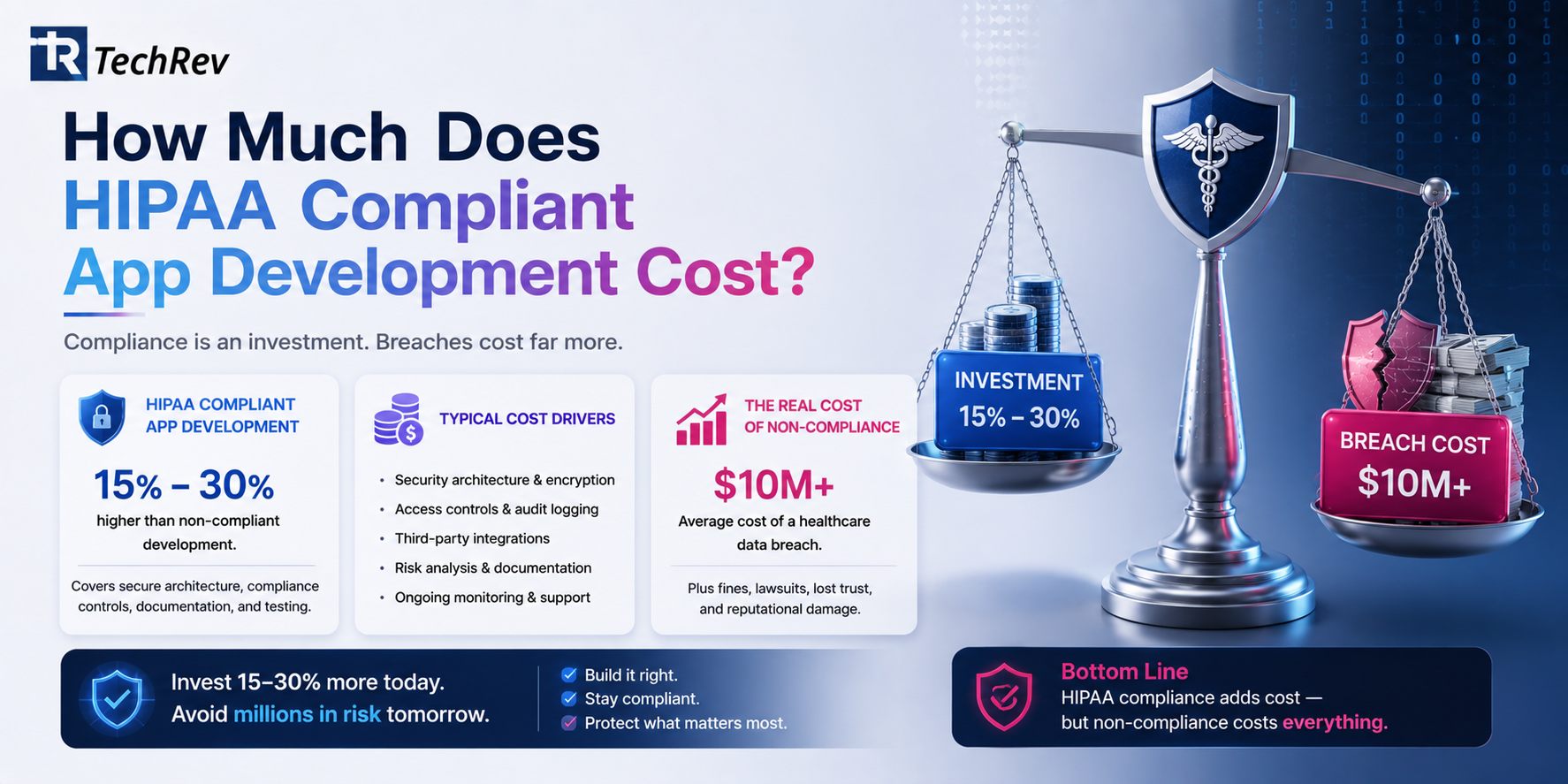
HIPAA compliance typically adds a meaningful but bounded premium to healthcare app budgets: for a focused application, expect the compliance layer (architecture, encryption, access and audit systems, BAA-covered infrastructure, documentation) to add roughly 15 to 30% over an equivalent non-regulated build, with focused HIPAA compliant apps commonly starting in the low six figures overall and scaling with integrations and AI capability.
Ongoing costs include compliant hosting, monitoring, annual risk analysis updates, and periodic testing.
Weigh that premium against the alternative the stats section priced: an average breach near $10 million, penalties to $2 million per category per year, and the deal-killing diligence failure.
Compliance is one of the few software investments where the downside case is fully quantified. The MVP development discipline applies here too: a compliant core with one workflow proves the model before the full roadmap, and compliance designed into the MVP scales with every feature after it.
Also Read – AI Automation Agency vs Custom AI Development: The Best?
How TechRev Builds HIPAA Compliant Healthcare Apps?
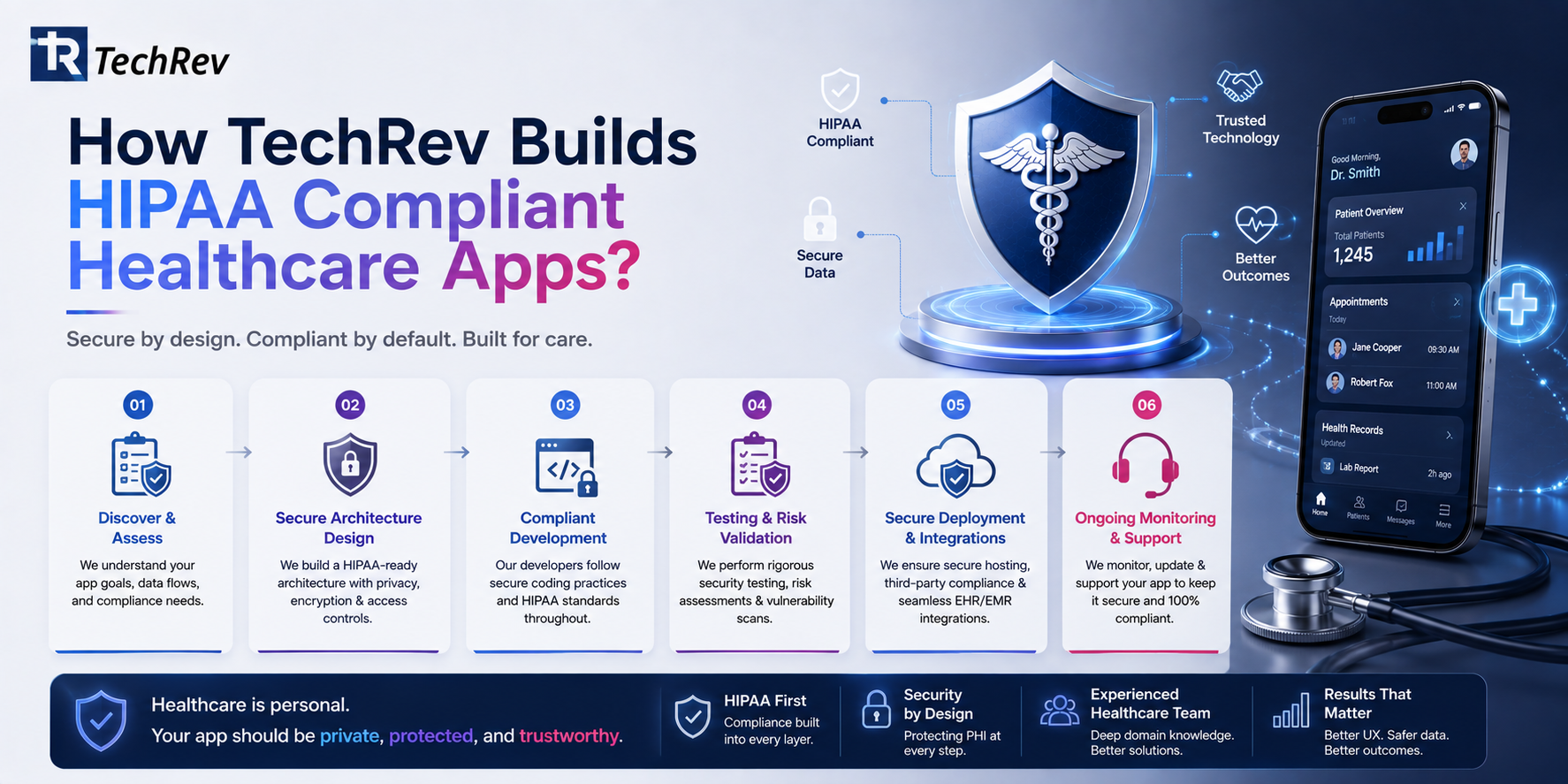
TechRev is a US-based healthcare software development company that builds HIPAA compliant applications as standard practice: EHR-integrated platforms, patient-facing tools, and AI-powered workflows delivered through custom software development with compliance as the architecture, not an add-on.
Q1: What does HIPAA compliant app development look like at TechRev?
Compliance leads the architecture: we design the role model, audit trail, and encryption strategy before feature work begins, host on HIPAA-eligible infrastructure under BAAs, and keep PHI out of side channels like analytics and notifications by design.
Every build ships with the documentation an audit expects, including the risk analysis, and our AI development work follows the same rules: models grounded in governed data, BAA-covered services, human review checkpoints, and full logging.
We scope MVP-first so the compliant core proves itself on one workflow, then every subsequent feature inherits the architecture instead of renegotiating it.
Q2: Does TechRev sign business associate agreements?
Yes. TechRev operates as a business associate where required, signs BAAs, and structures every vendor in the build chain under appropriate agreements so your compliance story has no gaps.
Q3: Can TechRev make our existing app HIPAA compliant?
Yes. We audit the current architecture against the checklist in this guide, remediate the gaps (encryption, access, audit, side channels), and deliver the documentation trail regulators and partners ask for.
Q4: Is TechRev experienced beyond HIPAA, like SOC 2?
Yes. TechRev builds HIPAA compliant, SOC 2 aligned systems, the combination healthcare vendors increasingly need for enterprise deals, with controls and audit trails designed once and evidenced for both.
The Final Words on HIPAA Compliant App Development
A 190-million-person breach, $10 million average incident costs, fourteen years as the most-breached industry, and a Security Rule tightening in real time: the era of treating HIPAA as paperwork is over.
HIPAA compliant app development in 2026 means architecture that proves who saw what, when, and why, built that way from the first commit.
If you are building or fixing a healthcare app, talk to TechRev’s healthcare compliance team. We will audit your concept or codebase against the checklist in this guide, show you exactly where the gaps are, and scope a compliant build that is ready for the audit before anyone asks.
FAQs About HIPAA Compliant App Development
1. What makes an app HIPAA compliant?
Architecture and process together: encryption in transit and at rest, role-based access with MFA, immutable audit logs, PHI kept out of side channels, HIPAA-eligible hosting under BAAs, a documented risk analysis, training, and an incident response plan. No single certification grants it; you build and evidence it.
2. Is there an official HIPAA certification for apps?
No. HHS certifies no apps and endorses no vendors; “HIPAA certified” badges are marketing. What exists is compliance you can demonstrate: documentation, safeguards, and agreements that survive an OCR audit or a partner’s diligence review.
3. Can HIPAA compliant apps use cloud hosting?
Yes. Major cloud providers offer HIPAA-eligible services under BAAs, and most modern healthcare apps run on them. The provider secures the infrastructure; your configuration, application code, and processes remain your responsibility, which is where most cloud-era violations actually occur.
4. Can AI be used in HIPAA compliant app development?
Yes, with governance: AI services under BAAs, models grounded in controlled data, no PHI to consumer AI tools, human review on clinical-adjacent outputs, and logging of AI interactions. AI does not change HIPAA’s rules; it adds new places to break them.
5. What is the penalty for a HIPAA violation?
Civil penalties tier by culpability up to roughly $2 million per violation category per year under current inflation-adjusted caps, with criminal liability possible for knowing misuse. The larger financial exposure is usually the breach itself: response, notification, litigation, and lost business, averaging near $10 million per healthcare incident in IBM’s research.
6. How long does HIPAA compliant app development take?
Compliance designed in from the start adds modest time, typically weeks across a build, mostly in architecture and documentation. Retrofitting compliance into a finished app is the slow path, often a rebuild of access, logging, and data flows. Start compliant; it is faster in every timeline that matters.