
What if your best technician could predict a breakdown before your customer even notices the problem?
That is not a hypothetical anymore. In 2026, that is exactly what AI-powered Field Service Management software does, every single day, for thousands of companies across the globe.
Think about where field service was five years ago. Dispatchers were juggling spreadsheets, technicians were driving blind, and customers were waiting in 4-hour windows that stretched into the afternoon. The entire operation depended on memory, phone calls, and experience. And when something went wrong, there was no early warning. You found out when a machine stopped.
If you are a CTO, product manager, or business owner in a field service company, this blog was written specifically for you. We are going to walk through everything you need to know about AI in Field Service Management, from the market numbers that prove this shift is real, to the specific features that matter, the honest cost of building a custom software development, and exactly how TechRev helps businesses like yours build smarter, faster, and leaner.
The FSM Market in 2026: Why the Numbers Demand Your Attention
Before we get into the how, let us ground this in the why.
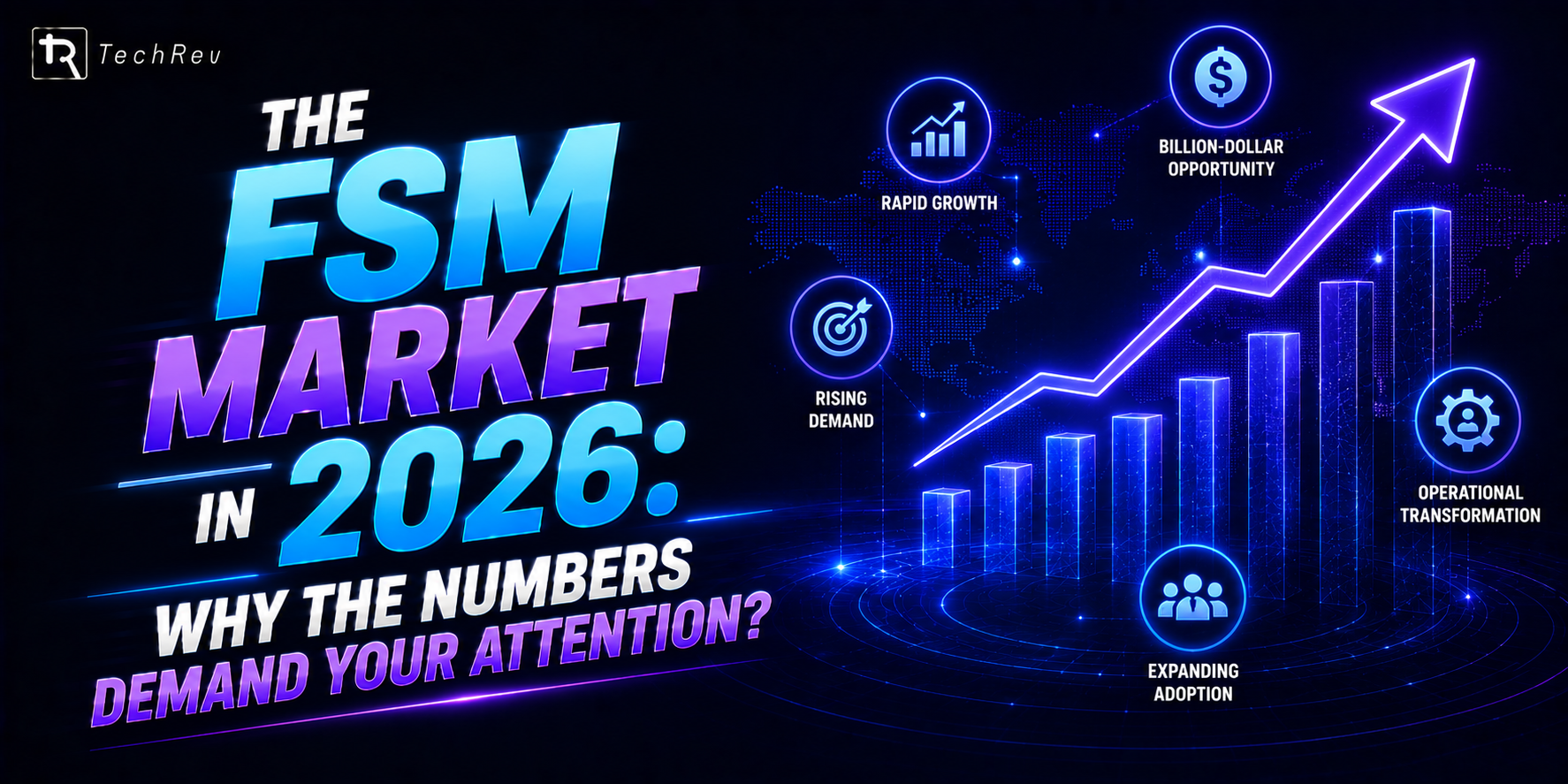
The global Field Service Management market was valued at approximately $6.21 billion in 2026 and is projected to reach $23.61 billion by 2035, growing at a compound annual growth rate of 16%.
What is driving it?
Three things, moving in lockstep: affordable cloud infrastructure, an explosion of IoT-connected assets generating real-time field data, and AI tools that no longer require a team of data scientists to operate.
These three forces have converged to make intelligent field service accessible not just to enterprise giants like Salesforce and SAP, but to mid-market companies and regional operators who could never afford it before.
Here are some numbers that should stop you mid-scroll:
- 93% of service organizations have already implemented AI in some form, according to multiple 2026 industry surveys
- 72% of field service teams are actively using AI tools in live field operations today
- 75% of companies that implemented AI in field service report improved first-time fix rates as a direct result
- 88% of organizations report better equipment uptime and improved customer experience after AI adoption
- 40% of enterprise applications will include task-specific AI agents by the end of 2026, up from less than 5% in 2025 (Gartner)
- The predictive maintenance segment alone is exploding from $10.6 billion in 2024 to a projected $47.8 billion by 2029
What does all of this mean for you? It means your competitors are not waiting. They are building. And every quarter you delay, the gap between where they are and where you are gets wider.
Also Read – AI in Field Service Management: Complete Guide for 2026
What Is Field Service Management Software?
Field service management software is the operational backbone for any company that sends people into the field to install, repair, inspect, or maintain equipment or assets.
Think HVAC companies, telecom contractors, utilities, medical device maintenance teams, construction inspection firms, and property maintenance businesses.
At its core, FSM software coordinates three things: people, jobs, and assets. But the traditional version of this, the clipboard-and-phone-call version, left enormous operational gaps. Jobs got assigned to the wrong technician. Parts were not in the truck. Customers did not know when anyone was arriving. Invoices sat in email drafts for days.
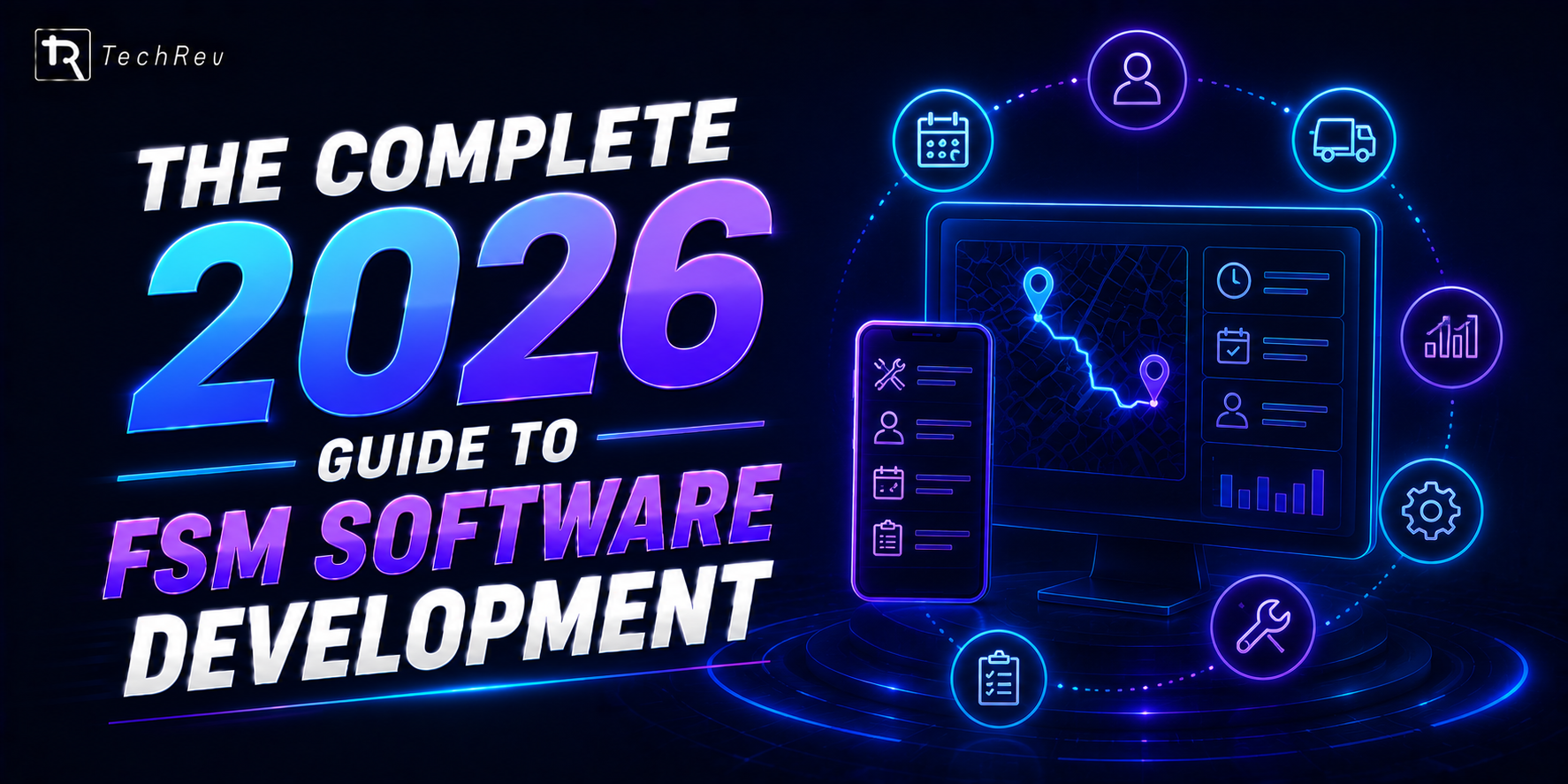
Modern Field Service Management Software Development has moved well beyond basic scheduling. Today, a well-built FSM platform handles:
- Intelligent job scheduling based on technician skills, location, availability, and priority
- Real-time dispatch and GPS-based route optimization
- Digital work orders that technicians complete on mobile devices
- Automated customer notifications and self-service portals
- Inventory and parts management with automated reorder triggers
- IoT-driven predictive maintenance alerts
- AI-powered analytics dashboards for operations leaders
- Integration with ERP, CRM, and accounting systems
And the companies investing in custom FSM mobile app development are doing it because off-the-shelf tools like ServiceTitan, Salesforce Field Service, or ServiceNow cannot cover their specific workflows, their industry compliance requirements, or their long-term scaling ambitions without costing a fortune in licensing fees and workarounds.
Why Custom FSM Software Beats Off-the-Shelf in 2026?
This is the question most CTOs ask first: should we build or buy? Here is an honest comparison that most vendors will not show you.
| Factor | Off-the-Shelf (e.g., ServiceTitan) | Custom FSM Development |
| Upfront Cost | $250–$500/technician/month | $25,000–$150,000 one-time build |
| 3-Year Total Cost (10 techs) | $90,000–$180,000 | $35,000–$180,000 (including maintenance) |
| Workflow Fit | Generic, forces your team to adapt | Built around your exact processes |
| AI Customization | Limited to vendor’s roadmap | Fully custom AI agents, LLM workflows |
| Data Ownership | Vendor controls your data | You own everything |
| Integration Flexibility | Rigid APIs, limited options | Connects to any system you use |
| Competitive Differentiation | None (competitors use same tool) | Your platform becomes your advantage |
| Scalability | Priced per seat, costs scale up | Fixed infrastructure, costs stay flat |
When you are running 8 to 10 technicians, paying $400 per technician per month to ServiceTitan adds up to nearly $40,000 to $50,000 per year before a single custom feature request. At that rate, a custom FSM build typically pays for itself within 18 to 24 months.
More importantly, a custom platform built with AI agents development at its core does not just replicate what off-the-shelf tools do. It is designed around your specific dispatch logic, your compliance requirements, your customer communication style, and your growth targets.
How AI Is Actually Transforming Field Service Management in 2026?
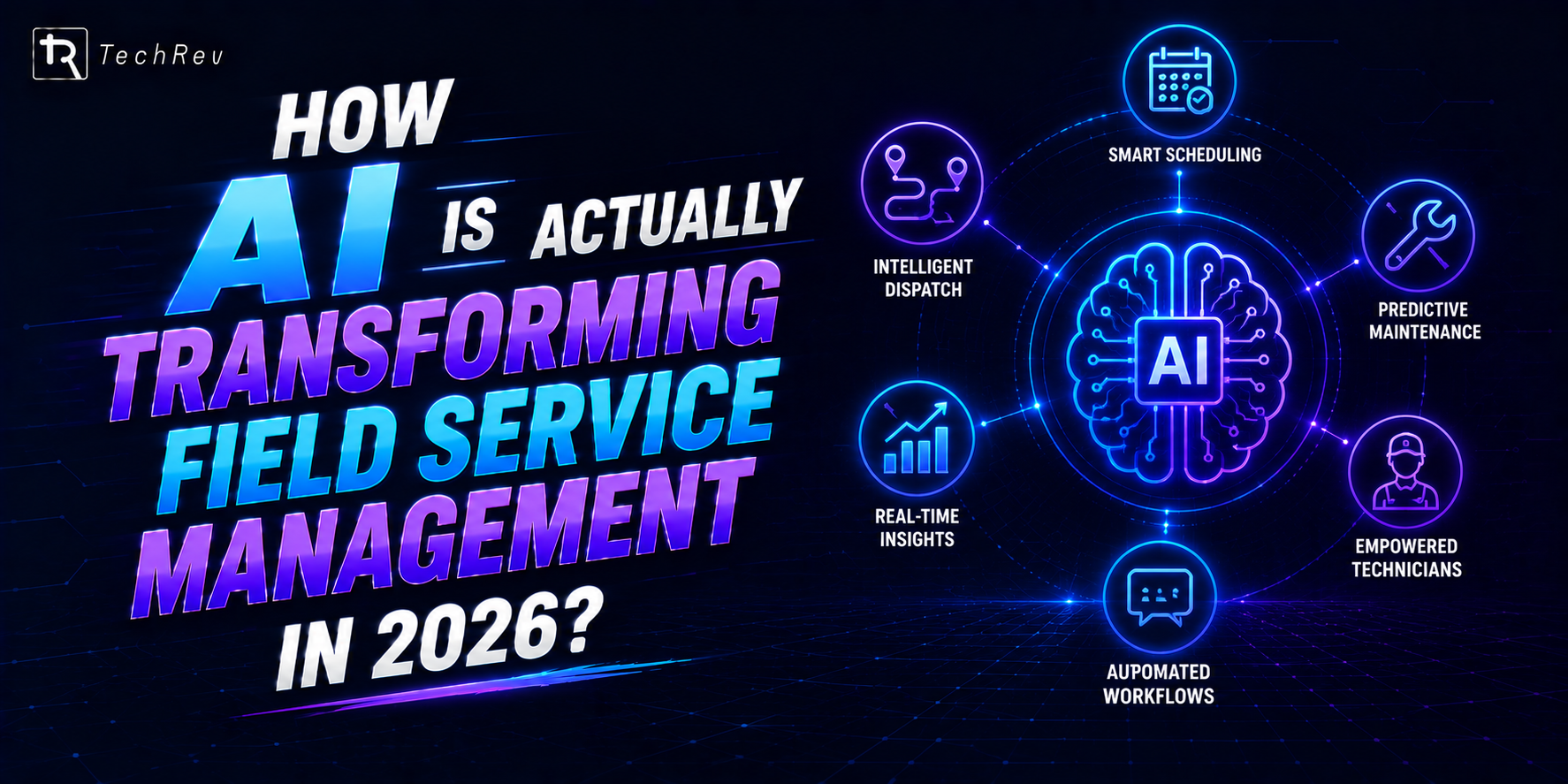
Let us get specific. Because “AI in field service” is a phrase that gets thrown around a lot, and it means very different things depending on what you actually build.
1. AI-Powered Smart Scheduling and Dispatch
Traditional scheduling was a dispatcher manually matching jobs to technicians based on availability and a rough sense of who was closest. This took time, created conflicts, and resulted in suboptimal routes that burned fuel and wasted hours.
AI-driven scheduling changes this entirely. Modern FSM platforms use machine learning to analyze dozens of variables simultaneously: technician skills and certifications, real-time GPS location, traffic conditions, job duration estimates based on historical data, customer availability windows, and parts inventory in each vehicle.
The result is a schedule that no human dispatcher could build manually. And when something changes mid-day (a job runs long, a technician calls in sick, a new emergency comes in), the AI reschedules the entire day automatically and notifies customers, with no manual intervention required.
The impact: Companies using AI-powered scheduling report 25% to 35% reductions in travel time, 20% more jobs completed per technician per day, and dramatic improvements in first-time fix rates.
2. Predictive Maintenance Powered by AI Agents
This is where field service management gets genuinely exciting, and where the ROI case closes itself.
Predictive maintenance means your system knows a piece of equipment is about to fail before it actually does. IoT sensors on HVAC units, industrial compressors, refrigeration systems, or manufacturing equipment stream real-time data on vibration, temperature, pressure, and current draw. Machine learning development models trained on historical failure patterns detect anomalies in that data weeks or even months before a breakdown occurs.
When the system flags a developing problem, it automatically creates a work order, checks parts inventory, orders what is needed, and schedules the right technician. Your customer’s equipment gets fixed before they ever experience a failure.
McKinsey research confirms that organizations implementing predictive maintenance reduce overall maintenance costs by 10% to 40% and decrease equipment downtime by up to 50%. Leading early adopters are reporting ROI ratios of 10:1 to 30:1 within just 12 to 18 months.
Also Read – The Real Cost of Predictive Maintenance Software Development
Custom AI agents development built into your FSM platform makes predictive maintenance work at scale. Generic tools offer it as a feature. A custom build makes it core to your operations.
The impact: One manufacturing implementation achieved a 67% reduction in unplanned downtime, a 45% decrease in overall maintenance costs, and 92% accuracy in predicting failures 30 days before they would occur.
3. Generative AI for Field Technicians
This one is newer, and it is changing what it means to be a field technician in 2026.
Generative AI development within FSM platforms now powers what are being called AI copilots for technicians. When a technician arrives on-site, they can describe the symptom in plain language, and the AI pulls from service manuals, historical repair logs, parts databases, and fault codes to surface the most likely diagnosis and the recommended fix.
Less experienced technicians can now perform at levels that used to require years in the field. Knowledge that lived only in the heads of senior staff is now accessible to every person in your fleet.
Large language models (LLMs) and generative AI development also handle back-office tasks that used to eat hours of administrative time: automatically drafting work order summaries from technician voice notes, generating customer-facing service reports, producing invoice line items, and sending post-service follow-ups.
LLM development integrated into FSM platforms is not about replacing technicians. It is about removing the friction between doing the job and documenting it, so your team can take more jobs, close them faster, and spend less time on paperwork.
The impact: Companies using generative AI for field documentation report 30% reductions in admin time per technician and 40% faster invoice turnaround.
4. Real-Time GPS Tracking and Route Optimization
This is table stakes in 2026, but the way it is implemented matters enormously.
Basic GPS shows you where your vehicles are. AI-powered route optimization tells your entire fleet where to go, in what order, and how to adjust when reality changes. It accounts for traffic, priority levels, technician skill match, appointment windows, and even fuel costs across the fleet.
Field services management platforms built with this capability from the ground up outperform bolt-on GPS solutions because the routing logic is connected directly to the scheduling engine, the customer notification system, and the work order database.
The impact: AI-driven route optimization typically reduces fuel costs by 15% to 20% and allows dispatchers to handle 30% to 40% more jobs per day without adding headcount.
5. Customer Self-Service and AI-Powered Communication
Your customers do not want to call you to check on their technician. They want a text message when the technician is 20 minutes away. They want to see the invoice before the technician leaves. They want to reschedule without talking to anyone.
AI-powered FSM platforms handle all of this automatically. When a technician marks “in transit,” the customer gets an automated notification. When the job closes, the system generates an invoice and sends a review request. Inbound service requests handled through chatbots powered by custom AI agents get triaged and scheduled without touching a dispatcher’s queue.
The impact: Teams using AI-automated customer communication report 35% reductions in inbound customer calls and 20% higher customer satisfaction scores.
Essential Features for FSM Software Development in 2026
Whether you are building your first custom platform or rebuilding an outdated one, these are the capabilities your FSM software must include to compete in 2026.
Core FSM Features
1. Job Scheduling and Dispatch Engine
The heart of any FSM platform. Must support AI-driven auto-scheduling, skill-based job matching, real-time rescheduling, and multi-day planning. Manual override should always be available.
2. Digital Work Orders
Technicians should be able to receive, update, complete, and close work orders entirely from a mobile device. Forms should be customizable by job type, with photo capture, e-signature, and checklist functionality.
Also Read – Top 10 Features of the Best Medical Billing Software in 2026
3. Inventory and Parts Management
Track parts across warehouses and individual vehicles. Set automatic reorder thresholds. Connect to your supplier APIs for real-time pricing and availability. Predictive models should anticipate parts needs before jobs are assigned.
4. Customer Portal
Self-service booking, real-time technician tracking, service history, invoicing, and communication in a branded web or mobile interface.
5. Invoicing and Payments
Generate invoices automatically at job completion. Integrate with accounting platforms like QuickBooks or Xero. Support digital payments, payment plans, and automated follow-ups on outstanding balances.
6. Reporting and Analytics Dashboard
Executive-level visibility into first-time fix rates, technician productivity, revenue per job, SLA compliance, customer satisfaction scores, and fleet efficiency.
Also Read – 20 Features Every Plumbing Mobile App Needs in 2026
Best Tech Stack for Custom FSM App Development
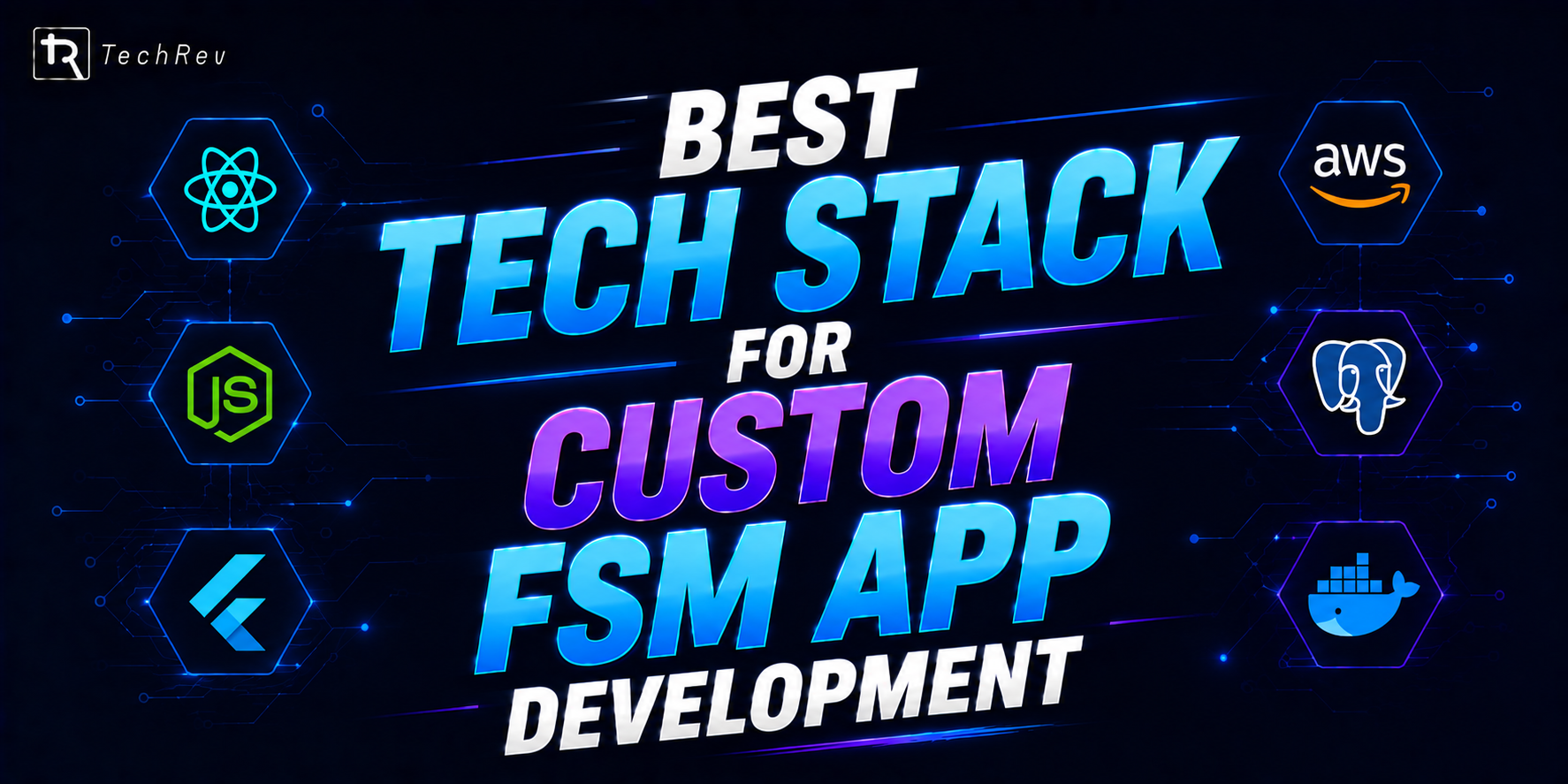
Choosing the right technology matters as much as the features you build. Here is what TechRev recommends for custom FSM software development in 2026 based on real deployments.
1. Mobile (Technician App)
React Native or Flutter are the two leading cross-platform options. Both allow you to build a single codebase that runs on iOS and Android, which matters because your technician fleet will almost certainly be split across devices.
Flutter has an edge in offline performance, which is critical for field technicians working in low-connectivity zones. React Native has a larger developer ecosystem and integrates cleanly with web-based admin panels.
If you have iOS-only or Android-only requirements, native mobile development (Swift or Kotlin) delivers the best performance and deepest platform integration. As an android app development company with experience in both native and cross-platform builds, TechRev evaluates the right choice based on your specific field environment.
2. Backend
Node.js for high-concurrency API services and real-time event handling (dispatch updates, technician location streams, notification triggers).
Python for AI and machine learning components. The ML ecosystem in Python (TensorFlow, PyTorch, scikit-learn) is unmatched for building predictive maintenance models and custom AI agents.
GraphQL for flexible data querying between the mobile app, web admin panel, and third-party integrations.
3. Cloud Infrastructure
AWS or Google Cloud Platform (GCP) are the two dominant choices for FSM deployments at scale. Both offer the managed services needed for AI workloads: auto-scaling compute, managed databases, IoT data ingestion (AWS IoT Core, GCP IoT), and managed ML training infrastructure.
AWS tends to win for enterprises already in the Microsoft or Oracle ecosystem. GCP is preferred for teams leaning heavily on BigQuery for analytics and Vertex AI for model training.
4. AI and LLM Layer
Custom AI agents development on top of foundation models (GPT-4, Claude, Llama) using retrieval-augmented generation (RAG) to ground model responses in your specific equipment manuals, service history, and operational data.
LLM development for FSM is best approached with a RAG architecture rather than fine-tuning. This keeps the model current without expensive retraining cycles and ensures responses are grounded in your actual data rather than general knowledge.
5. Database
PostgreSQL for transactional job and work order data. TimescaleDB (a PostgreSQL extension) for time-series IoT sensor data. Redis for real-time caching and session management.
Also Read – Top Programming Languages for iOS App Development in 2026
The FSM App Development Process: From Discovery to Launch
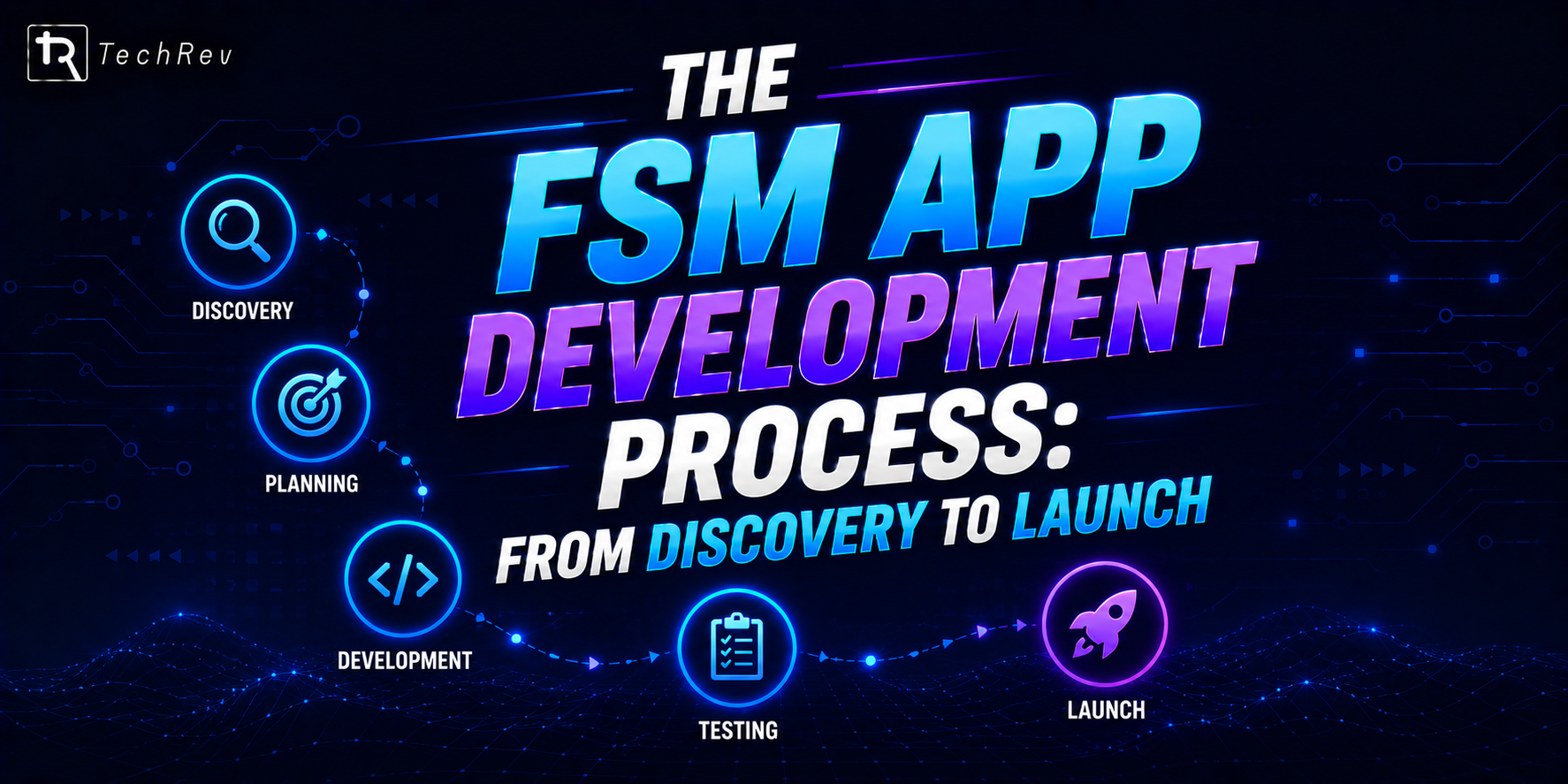
Building a custom Field Service Management platform is not a weekend project. But with the right field service management app development team and the right process, you can go from discovery to a live MVP in 8 to 12 weeks. Here is how TechRev approaches it.
Phase 1: Discovery and Requirements
This is the most important phase and the one most development teams rush. We do not.
TechRev conducts structured discovery sessions with your dispatchers, operations managers, technicians, and customer service team. We map your current workflows, identify the breakdowns (where jobs get delayed, where data gets lost, where customers get frustrated), and define the feature set that actually solves your problems rather than the feature set that looks impressive in a demo.
Deliverables: Technical requirements document, user story map, system architecture diagram, integration list, and a phased development roadmap.
Phase 2: UI/UX Design
Field service software has two very different user types: the dispatcher in the office who needs density and control, and the technician in the field who needs simplicity and speed.
Our mobile app development design process handles both. We prototype both interfaces, conduct usability testing with real technicians where possible, and iterate before a single line of production code is written.
Deliverables: Wireframes, high-fidelity UI mockups, interactive prototype, design system.
Phase 3: Development
Custom software development at TechRev follows agile sprint cycles with two-week releases. This means you see working software every two weeks, not at the end of a six-month black box.
An MVP covering core scheduling, dispatch, work orders, mobile app, and basic customer notifications can go live in 8 to 10 weeks. Adding AI scheduling, predictive maintenance, and LLM-powered copilots typically adds 6 to 10 more weeks depending on integration complexity.
Phase 4: QA and Testing
Manual QA, automated regression testing, performance testing under realistic load, and security testing run throughout development rather than being bolted on at the end.
For Field Service Management Software Development, offline functionality testing is critical. Technicians work in basements, rural areas, and industrial facilities with poor connectivity. Your app must work gracefully when the network disappears.
Also Read – The 2026 Guide to Manual vs Automated Software Testing
Phase 5: Deployment and Integration
Go-live is not the end. It is the beginning of the operational phase.
TechRev handles deployment to your chosen cloud environment, integration with your ERP, CRM, and accounting systems, staff training for dispatchers and technicians, and monitoring setup so you have full visibility into system health from day one.
Phase 6: Ongoing Optimization
AI models improve with data. Predictive maintenance models get more accurate the longer they run. Scheduling algorithms improve as they learn your specific job patterns.
TechRev provides post-launch support packages that include model retraining cycles, feature iteration based on real-world usage, and quarterly performance reviews.
Cost of Custom FSM Software Development in 2026
Let us be honest about money. Here is a realistic breakdown.
| Scope | Timeline | Estimated Cost |
| MVP (scheduling, dispatch, basic work orders, mobile app) | 8–10 weeks | $25,000–$50,000 |
| Mid-Market Platform (above + AI scheduling, customer portal, invoicing, GPS) | 14–18 weeks | $60,000–$100,000 |
| Enterprise FSM (above + predictive maintenance, LLM copilot, BI dashboard, ERP integration) | 20–28 weeks | $100,000–$180,000 |
| AI-Native Full Platform (full custom AI agents, generative AI, multi-region, IoT layer) | 28–36 weeks | $150,000–$300,000+ |
These ranges assume a hybrid development model (senior architects and tech leads combined with offshore software development resources), which reduces costs by 30% to 40% compared to a fully US-based agency build without sacrificing quality.
Annual maintenance typically runs 15% to 20% of the initial build cost, covering hosting, security updates, model retraining, and ongoing feature iteration.
What affects cost most?
The number of third-party integrations is usually the biggest variable. Each ERP, payment gateway, or legacy system integration adds $5,000 to $20,000 depending on the quality of the API documentation and the age of the system being connected.
AI integration adds 15% to 25% to development costs for mid-to-large platforms but delivers the highest ROI, often paying for itself within the first year of operation through reduced scheduling overhead, lower fuel costs, and improved first-time fix rates.
How TechRev Has Helped Field Service Businesses Transform Their Operations?
TechRev is a custom software development company with deep expertise in AI agents development, generative AI development, LLM development, and mobile app development for field service and operations-heavy industries.
We have built Field Service Management Software Development solutions across HVAC, utilities, telecommunications infrastructure, commercial cleaning, and industrial equipment maintenance.
Here is what our clients actually see after going live.
1. Growth in Sales: 28% Average Revenue Increase
When technicians complete more jobs per day (because routing is optimized and work orders are digital), and when first-time fix rates improve (because AI recommends the right parts and diagnosis), revenue per technician goes up without adding headcount. Our FSM clients report an average 28% increase in billable jobs completed within the first six months of launch.
The customer self-service portal drives upsell opportunities too. When customers can see their full service history and receive AI-generated maintenance recommendations, they book preventive service packages at significantly higher rates.
2. Increase in Productivity: 35–40% More Jobs Per Day
Before a TechRev FSM platform, dispatchers were spending 3 to 4 hours per day manually building schedules and communicating updates. After launch, that drops to under 30 minutes. AI-driven scheduling handles the rest.
Technicians who used to spend 45 minutes per day on paperwork, parts lookup, and reporting now spend under 10 minutes. The difference goes directly into billable field time. Across a team of 15 technicians, that is over 100 additional billable hours per week.
3. Increase in Efficiency: 30% Reduction in Fuel and Travel Costs
AI-optimized routing consistently reduces fleet travel distance by 20% to 30% compared to manually planned schedules. Combined with reduced failed visits (because parts are confirmed before dispatch), fuel and vehicle wear costs drop significantly.
One TechRev client in Field Service Management Software Development in Florida reduced their monthly fuel spend by $18,000 within 90 days of going live, on a fleet of 22 vehicles.
4. ROI and Cost Reduction: 40–45% Lower Operational Overhead
The combination of reduced dispatcher headcount (or redeployment to higher-value roles), lower fuel costs, faster invoicing, and reduced failed visits translates to significant cost reduction. Most TechRev clients recover their full development investment within 14 to 20 months.
For platforms with predictive maintenance built in, the ROI timeline is even shorter. Avoiding a single major unplanned equipment failure can recover months of platform costs in a single event.
Conclusion
AI in Field Service Management Software Development has crossed from early adoption into operational necessity, and the companies treating it that way are pulling ahead.
Off-the-shelf tools will always be one-size-fits-most. Custom FSM software development, done right, is built for you specifically, with AI agents trained on your data, LLMs tuned to your equipment types, and workflows that reflect how your team actually works.
TechRev has the technical depth in AI agents development, generative AI development, LLM development, and mobile app development to take your FSM vision from concept to live platform. We have done it for HVAC companies, telecom contractors, utility operators, and industrial maintenance teams.
And we have the numbers to show for it: 28% average revenue growth, 35% productivity improvement, 40% operational cost reduction, and investment recovery in under 20 months.
Whether you are starting from scratch, replacing a legacy system, or adding AI capabilities to an existing platform, TechRev is the custom software development partner built for this work.
Ready to talk through what your FSM platform should look like?
Schedule a free 45-minute consultation with the TechRev field service software team.
Get Your Free FSM Software Consultation Today.
FAQs
1. What is AI in Field Service Management, and how does it actually work?
AI in Field Service Management refers to the use of machine learning, large language models, predictive analytics, and intelligent automation built directly into FSM software.
In practice, this means AI handles scheduling and dispatch decisions automatically, predicts equipment failures before they occur using IoT sensor data, guides technicians through repairs using generative AI recommendations, automates customer communication, and produces analytics reports in plain English.
It works by training models on your historical job data, equipment behavior data, and operational patterns, then using those models to make better decisions faster than any human dispatcher could.
2. How much does it cost to build custom FSM software with AI in 2026?
A well-scoped custom FSM platform with core scheduling, dispatch, mobile work orders, and basic customer communication starts at around $25,000 to $50,000. Adding AI scheduling, predictive maintenance, and LLM-powered technician tools brings a mid-market platform to $60,000 to $120,000.
Enterprise deployments with full AI agents, IoT integration, multi-region support, and deep ERP connectivity range from $150,000 to $300,000 or more. Annual maintenance runs 15% to 20% of the initial build. Most clients recover their investment within 14 to 24 months.
3. How long does it take to build a custom FSM app?
An MVP with core functionality goes live in 8 to 12 weeks. A full mid-market platform with AI scheduling, customer portal, and analytics takes 14 to 20 weeks.
Enterprise platforms with predictive maintenance, LLM copilots, and complex integrations run 24 to 36 weeks. Timelines depend heavily on the number and complexity of third-party integrations.
4. What is the difference between AI agents and standard automation in FSM?
Standard automation follows fixed rules: if job X is created, send notification Y. AI agents are decision-making systems that evaluate context, learn from outcomes, and take action without being explicitly programmed for every scenario.
An AI scheduling agent, for example, does not just follow rules. It weighs dozens of variables, considers historical performance data, and makes a judgment call.
This distinction matters because field service operations are unpredictable, and rule-based systems break under edge cases that AI agents handle gracefully.
5. What is predictive maintenance and what ROI can I expect?
Predictive maintenance uses IoT sensors and machine learning models to detect early warning signs of equipment failure before a breakdown occurs. Instead of scheduling maintenance on a fixed calendar or reacting to failures, the system intervenes when data signals a developing problem.
McKinsey research documents 10% to 40% reductions in maintenance costs and 30% to 50% reductions in unplanned downtime. Leading organizations see ROI ratios of 10:1 to 30:1 within 12 to 18 months of implementation.
6. Can TechRev build FSM software for my industry specifically?
Yes. TechRev has built Field Service Management Software Development solutions for HVAC, utilities, telecommunications, commercial cleaning, industrial equipment maintenance, and property services.
Our custom AI agents development, generative AI development, and LLM development capabilities mean the AI layer is trained on your industry-specific data, not generic models. Whether you need Field Service Management Software Development in Florida or a national deployment, TechRev scopes, builds, and supports the platform end-to-end.
7. What tech stack does TechRev use for FSM app development?
TechRev uses React Native or Flutter for cross-platform mobile app development, Node.js and Python for backend services, AWS or GCP for cloud infrastructure, PostgreSQL and TimescaleDB for data storage, and foundation models with RAG-based LLM development for AI features. We select the specific stack based on your existing infrastructure, team capabilities, and performance requirements.