
Have you ever waited on hold for twenty minutes, only to repeat your problem three times to three different agents? Or messaged a brand at midnight expecting silence, and got a helpful answer in under ten seconds instead?
That gap between those two experiences is exactly why AI tools for customer service have stopped being a “nice to have” and turned into the reason some companies grow while others quietly lose customers every single day. If you run a business today and you’re not asking which AI tools for customer service fit your team, you’re already behind someone who is.
This blog breaks down the best AI tools for enhancing customer engagement in 2026, backed by real market data, so you know exactly what’s working, what’s hype, and how a AI chatbot development company like TechRev actually builds these systems for businesses that want more than just a chatbot bolted onto their website. Stick with this one till the end, because the ROI numbers in the middle of this article will probably change how you budget for customer experience this year.
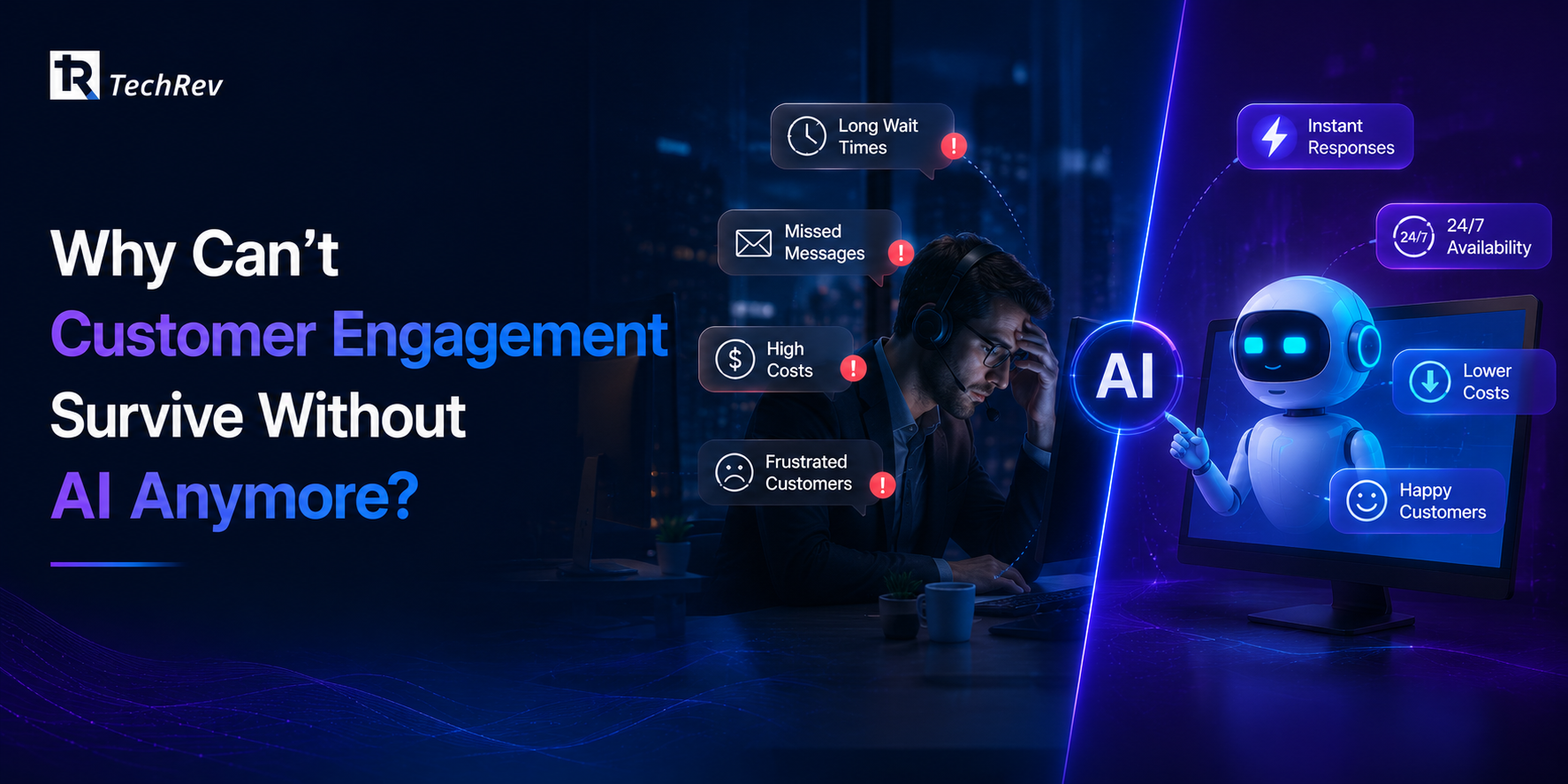
Why Can’t Customer Engagement Survive Without AI Anymore?
Let’s start with the numbers, because they explain everything else in this article.
The global AI customer service market is projected to hit $15.12 billion in 2026, up from $12.06 billion in 2024, and it’s climbing toward $47.82 billion by 2030 at a 25.8% compound annual growth rate. That’s not a slow, cautious trend. That’s an industry-wide sprint.
Here’s what’s driving it:
- 91% of customer service leaders say they are under direct pressure from executive leadership to implement AI this year.
- 9 out of 10 contact centers already use AI in some form, though only about 25% have fully integrated it into daily operations, which tells you there’s still a massive opportunity for businesses that get it right early.
- Cost per customer interaction has dropped 68%, from roughly $4.60 to $1.45, after AI implementation.
- Companies see an average return of $3.50 for every $1 invested in AI customer service, with top performers reporting up to 8x returns by year three.
- Telecom leads adoption at 95%, followed by banking at 92% and healthcare at 79%, because these industries deal with massive volumes of repetitive queries where AI naturally shines.
So here’s the real question. If AI is already cutting costs by more than half and paying back $3.50 for every dollar spent, why are so many businesses still stuck with outdated support systems? Usually it’s not a budget problem.
It’s that they picked the wrong tool, or worse, tried to force a generic chatbot into a role that needed real generative AI development and a proper strategy behind it. That’s exactly the gap TechRev fills for growing businesses across the USA.
What Actually Makes an AI Tool Good for Customer Engagement?
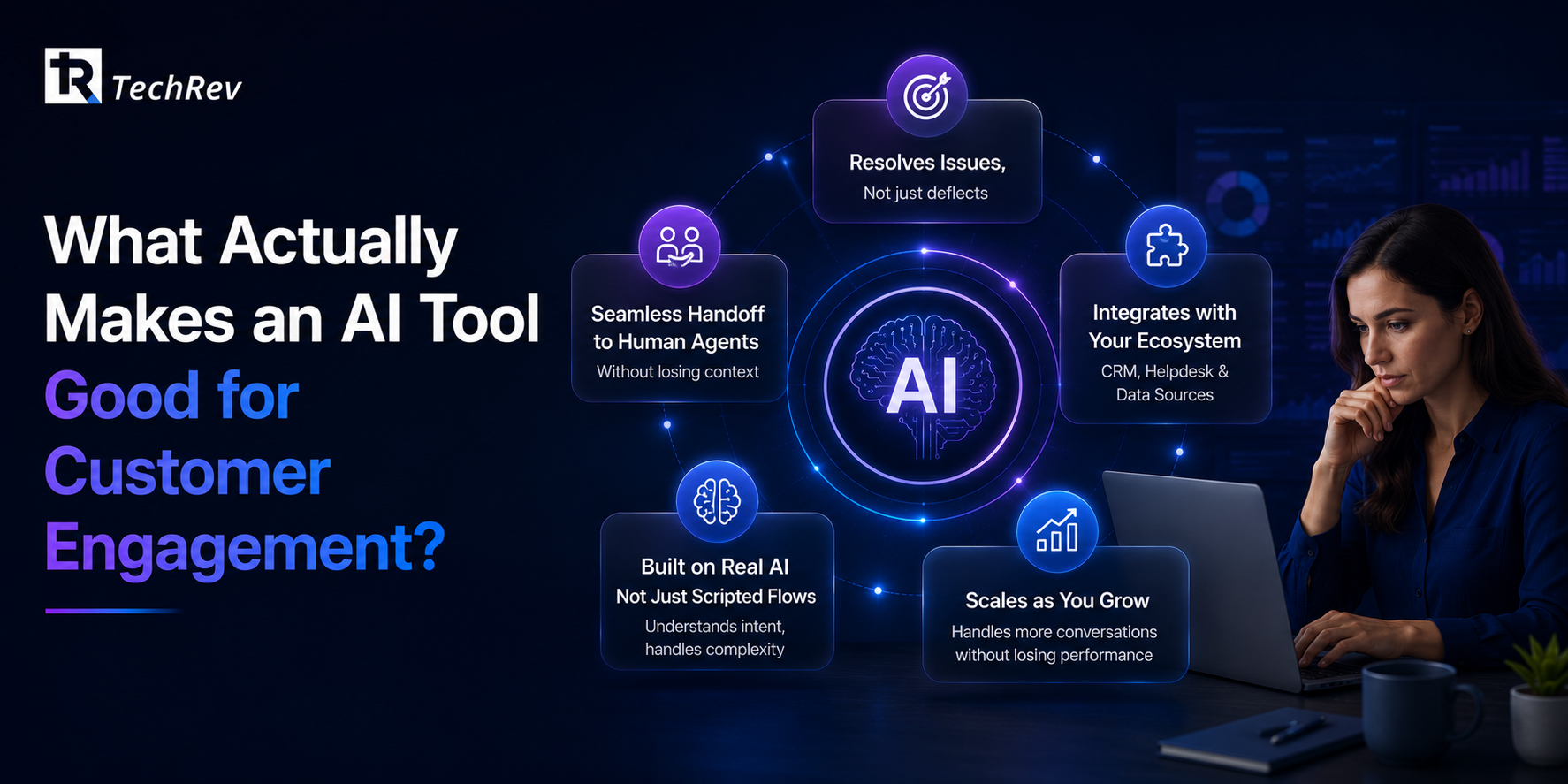
Before jumping into specific platforms, you need a filter. Not every shiny AI product labeled as a customer engagement tool deserves a place in your stack. Ask these five questions before you commit budget to anything.
1. Does it resolve issues, or just deflect them?
Some tools look impressive in a demo but only redirect customers to an FAQ page. The best ai tool for customer support actually closes the loop.
2. Can it hand off to a human without losing context?
89% of customers still want a human option available, and losing conversation history during handoff is one of the fastest ways to frustrate someone.
3. Does it integrate with your existing CRM, helpdesk, and data sources?
A tool that lives in isolation from your customer data will always underperform.
4. Is it built on real generative AI development, not just scripted flows?
Scripted bots break the moment a customer phrases something unexpectedly. Generative AI development allows systems to actually understand intent.
5. Can it scale as your business grows?
A tool that works for 50 tickets a day might completely fall apart at 5,000.
If a platform, or a development partner, can’t answer all five with a straight yes, keep looking.
Also Read – Innovative AI Solutions for E-commerce Success in 2026
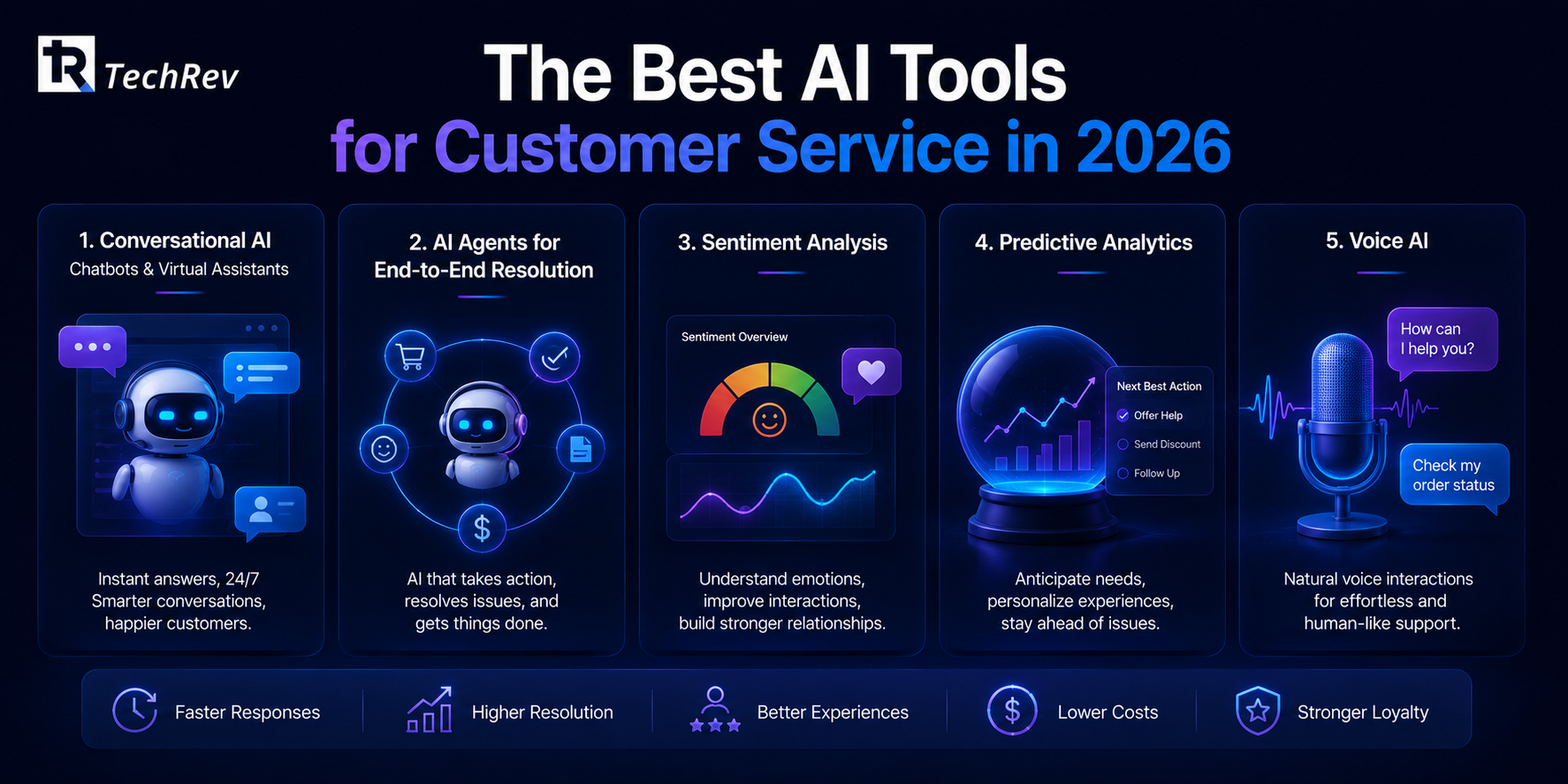
The Best AI Tools for Customer Service in 2026
Here’s where most “top AI tools” articles just throw a list at you and move on. Instead, let’s break these down by what they’re actually good at, because picking one AI tool for every job is one of the most common and expensive mistakes businesses make.
1. Conversational AI Chatbots and Virtual Assistants
These remain the front door of most customer service AI tools. Platforms like Intercom Fin, Zendesk AI, and Freshdesk Freddy AI handle first-line queries such as order tracking, account questions, and basic troubleshooting.
- Live chat powered by AI achieves around 87% customer satisfaction, compared to 61% for email and 44% for phone support.
- Autonomous AI agents in ecommerce now achieve 76% to 92% resolution rates, depending on the type of ticket.
Best for: High-volume, repetitive queries where speed matters more than nuance.
2. AI Agents for End-to-End Ticket Resolution
This is where the market has moved fastest. Agentic AI doesn’t just answer questions, it takes action: processing refunds, updating records, and escalating only when genuinely necessary. The agentic AI sub-market alone is valued at roughly $9.14 billion in 2026 and is projected to grow at a staggering 40.5% CAGR, with customer service representing the largest single segment of that market.
If you’re evaluating vendors here, this is also exactly the kind of work an experienced AI agents development company in USA teams should be building for you, custom to your workflows, not a generic template that half fits your business. TechRev works as an AI agents development company in USA businesses turn to when they want agents that actually understand their internal processes, not just a chat widget with a friendly name.
Best for: Businesses that want to reduce headcount pressure without sacrificing resolution quality.
3. Sentiment Analysis and Real-Time Coaching Tools
Tools like Balto and CallMiner listen to live conversations and flag frustration, compliance risks, or upsell opportunities in real time. This is less about replacing agents and more about making every human interaction sharper.
- Emotional AI now catches customer frustration with roughly 85% accuracy.
- Hybrid human-AI support models report CSAT scores as high as 93%, consistently outperforming both fully automated and fully human setups.
Best for: Contact centers that already have agents but want to improve consistency and quality.
4. Predictive Analytics and Churn Prevention Platforms
These tools scan usage patterns, support history, and engagement data to flag customers who are about to leave, before they actually do. Vendasta and Gainsight are common names here.
Question worth asking yourself right now: do you know which of your customers are silently disengaging this month? If the honest answer is no, this category of customer service AI tools deserves your attention before your next quarterly review.
Best for: Subscription businesses and SaaS companies where retention is the whole game.
5. Voice AI for Phone-Based Support
Voice is the fastest-growing segment in this space, expanding at a 34.8% CAGR, faster than the overall AI customer service market. Contractors and service businesses reportedly miss 60 to 80% of incoming calls, and each missed call can represent $200 to $2,000 in lost revenue. Voice AI agents are closing that gap by picking up, qualifying, and routing calls around the clock.
Best for: Service-based businesses that lose revenue every time a call goes unanswered.
AI Tools for Customer Service, Compared by Use Case
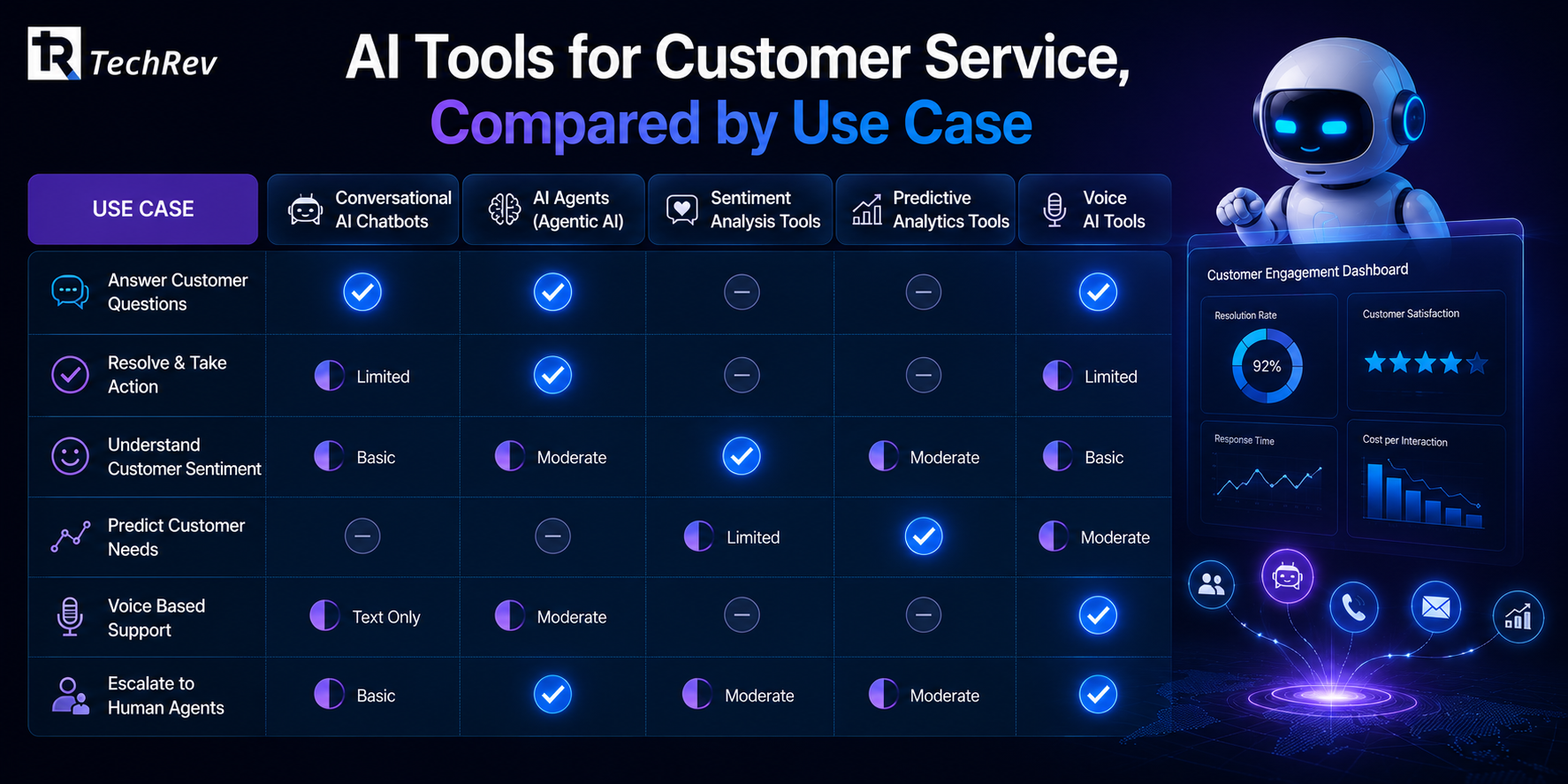
The following are some use cases:
| Use Case | What Does It Solves? | Typical Impact |
| Conversational chatbots | First-line query deflection | 76-92% resolution rate |
| Agentic AI | End-to-end ticket resolution | Up to 97% faster response times |
| Sentiment analysis | Live agent coaching | 85% frustration detection accuracy |
| Predictive analytics | Churn prevention | Early flagging of at-risk accounts |
| Voice AI | Missed call recovery | Recovers 60-80% of previously missed calls |
Notice a pattern here?
None of these AI tools for customer service operate well in isolation. The businesses winning in 2026 are not buying one all-in-one tool and hoping for the best. They’re building a connected stack, or working with a partner who can custom-build one for them.
Also Read – AI in Field Service Management: Complete Guide for 2026
Generative AI Development: The Engine Behind Every Serious Tool on This List
Here’s something most “best tools” articles skip entirely. Every single platform mentioned above, from chatbots to voice agents, runs on the same underlying foundation: generative AI development.
Generative AI development is what allows a system to understand that “my order hasn’t shown up” and “where’s my package” mean the exact same thing, without a developer manually programming every possible phrasing. It’s the difference between a bot that frustrates your customers and one that genuinely feels like talking to a sharp, well-trained support rep.
This matters more than most businesses realize when they’re shopping for tools off the shelf. A pre-built SaaS chatbot might work fine for a generic use case. But the moment your business has specific workflows, unique product terminology, or industry-specific compliance needs, generic tools start to crack. That’s the exact point where custom generative AI development stops being a luxury and becomes the only realistic path forward.
TechRev’s generative AI development team builds systems trained on your actual business data, your tone of voice, and your specific customer journeys, not a one-size-fits-all model wearing your logo.
Curious what a custom-built AI support system would look like for your business? Talk to TechRev’s AI team and get a real answer, not a sales script.
The ROI Numbers Nobody Tells You Upfront
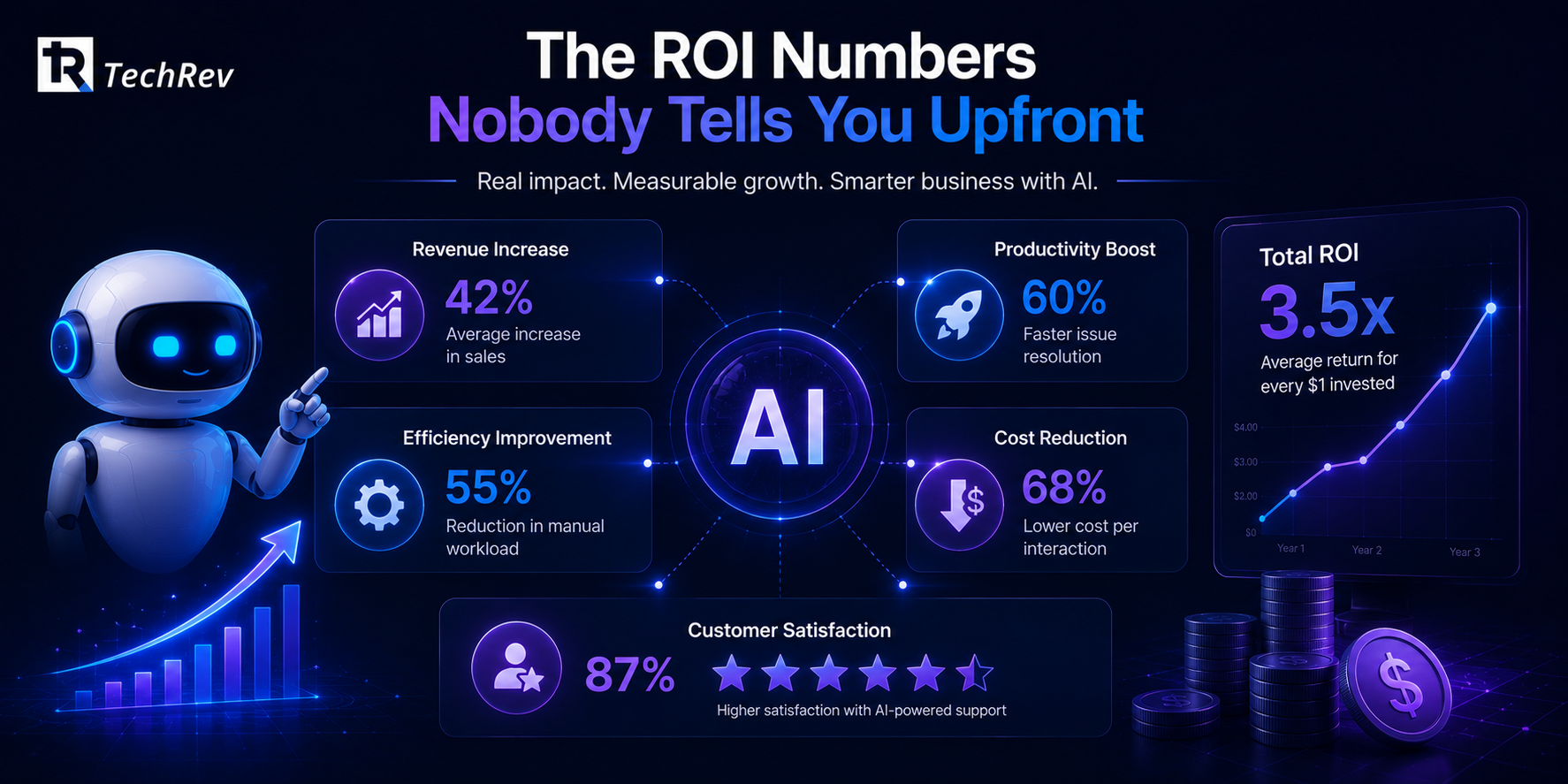
Let’s get specific, because AI improves customer experience is a vague sentence that convinces nobody with a budget to approve. Here’s what businesses are actually reporting, broken down by the metrics that matter to decision-makers.
1. Growth in Sales
Personalization powered by AI can lift revenue in some sectors, like telecom, by 5% to 15%.
Proactive AI support that recommends products and identifies upsell opportunities during service interactions is quietly turning support desks into secondary revenue channels rather than pure cost centers.
2. Increase in Productivity
AI helps support agents save roughly one hour per day by automating routine, repetitive tasks like status checks and FAQ responses.
Multiply that across a 10-person team and you’re recovering nearly 50 hours of productive work every single week.
3. Increase in Efficiency
Modern AI systems now handle up to 80% of recurring support tasks without human involvement.
First response times have dropped by 37% to 97% in documented implementations, with some companies going from a 15-minute average wait down to 23 seconds.
4. ROI and Cost Reduction
This is the number that gets budgets approved. Companies see an average return of $3.50 for every $1 invested in AI customer service tools, with mature implementations reporting returns as high as 8x. Self-service resolutions cost around $1.84 per contact, compared to $13.50 for a fully agent-assisted interaction, according to Gartner benchmarks. Operating costs overall have dropped by roughly 30% in businesses with mature AI deployments.
These aren’t projections from a vendor’s pitch deck. These are documented, sourced figures from Gartner, Zendesk, Freshworks, and MarketsandMarkets research published through 2026. The pattern is consistent everywhere you look: businesses that implement the right customer service AI tools, correctly, are pulling ahead financially, not just operationally.
Also Read – How AI in Supply Chain Management Operations Reduces Costs?
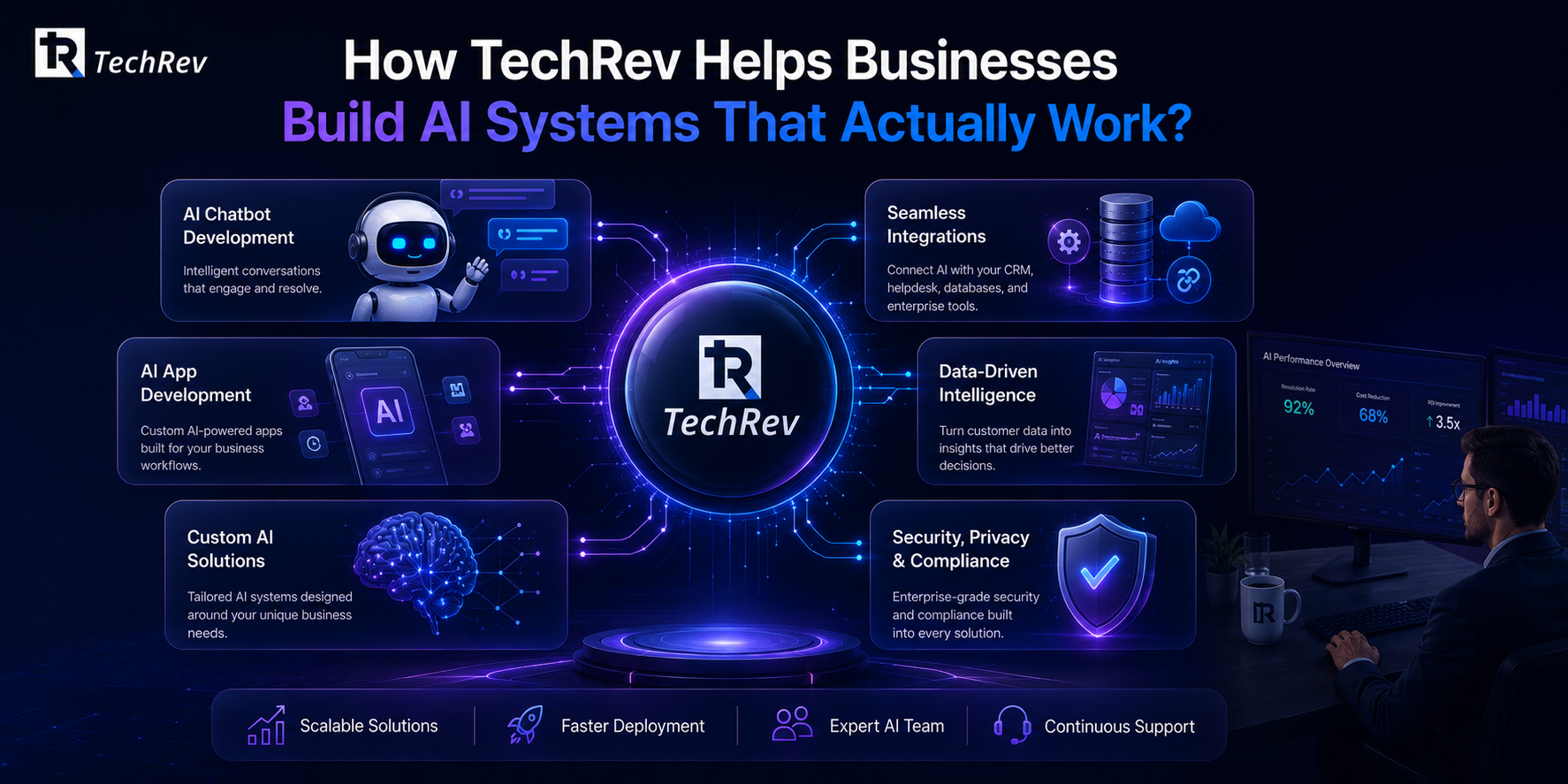
How TechRev Helps Businesses Build AI Systems That Actually Work?
Here’s the honest part most agencies won’t tell you. A huge share of AI customer service failures don’t happen because AI doesn’t work. They happen because businesses buy a generic tool, plug it in, and expect magic without any real customization to their workflows, data, or customer base.
TechRev has been building custom software since 2016, and over the last few years, AI-powered customer engagement has become one of the most requested parts of that work. Here’s what that looks like in practice:
1. AI chatbot app development services
In the USA , businesses rely on an off-the-shelf chatbot that simply won’t understand their product catalog, their compliance requirements, or their customer tone. TechRev builds chatbots trained specifically on your business, not a generic script pulled from a template library.
2. AI app development services
In the USA clients use to embed AI features like natural language processing, recommendation engines, and predictive analytics directly into their existing mobile or web applications, not as a separate add-on, but as a native part of the product experience.
3. Custom software development
In USA companies count on when they need customer engagement systems that integrate cleanly with their CRM, their support desk, and their internal databases, instead of forcing teams to juggle five disconnected tools.
Post-launch support including bug fixes, performance monitoring, and continuous feature upgrades, because an AI system that isn’t maintained degrades in quality fast.
One client put it simply after their project wrapped up: the AI-driven solutions TechRev developed for them completely transformed how they analyze data and serve their clients, turning complex requirements into practical tools their team could actually use daily. Another described the integration of AI features into their custom software as something that streamlined operations enough to exceed expectations, delivered on time and within budget.
That’s the difference between buying “an AI tool” and building an AI system that fits the way your business actually runs.
If your current customer support setup feels like it’s held together with tape, get in touch with TechRev and see what a properly built solution looks like.
Also Read – How AI Workflow Automation Scales Finance App Development?
How to Choose the Right AI Partner for Customer Engagement?
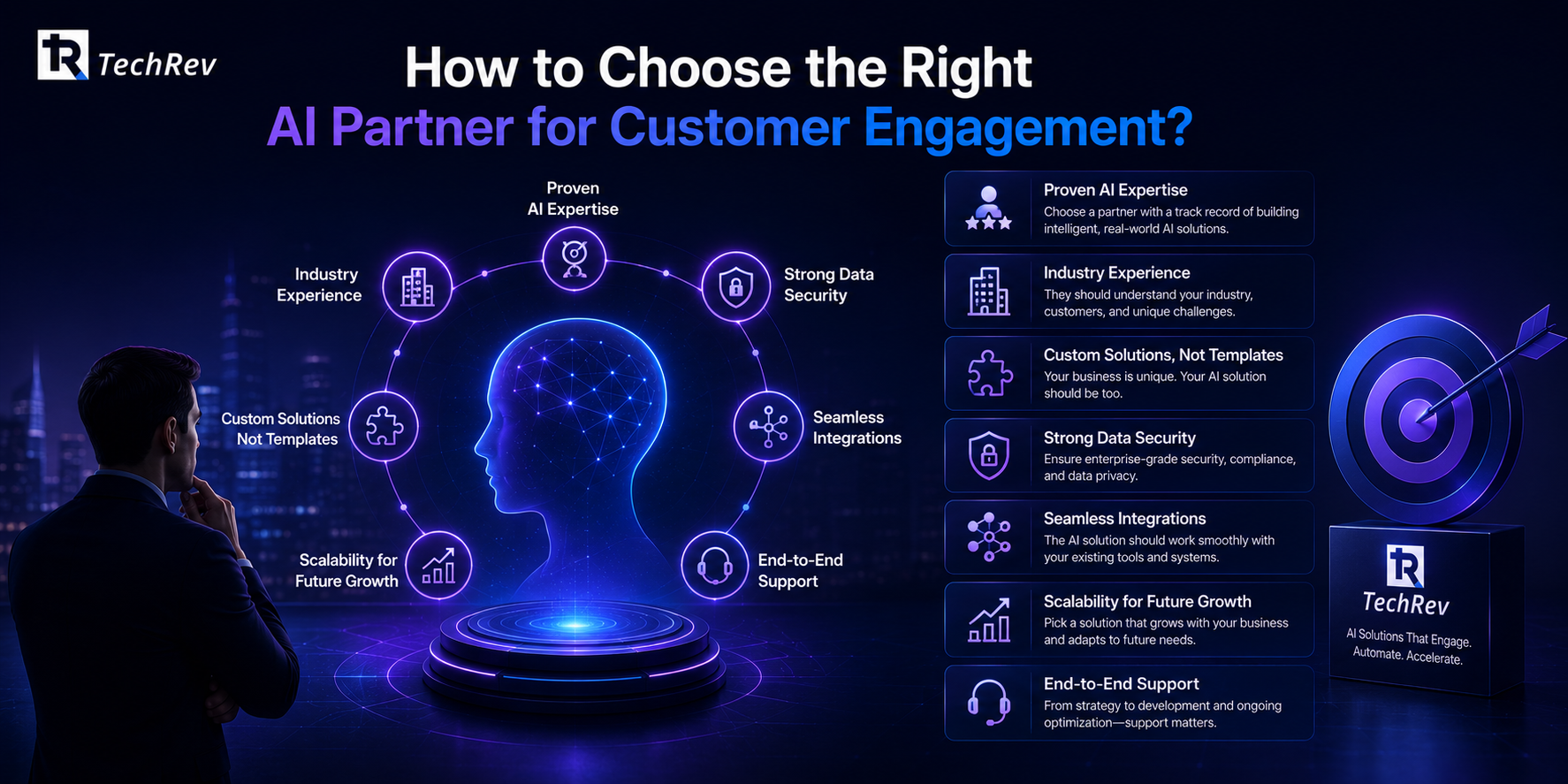
Not every development company that says “we do AI” actually knows how to build production-ready systems. Here’s a quick checklist before you sign anything:
- Do they have documented experience with generative AI development, not just chatbot templates?
- Can they show real client integrations with CRMs, helpdesks, and existing tech stacks?
- Do they offer ongoing support after launch, or do they disappear the moment the invoice clears?
- Are they transparent about timelines? A basic app typically takes 4 to 8 weeks, while a complex AI-powered solution can reasonably take 3 to 6 months.
- Do they understand your industry’s specific compliance and data handling needs?
TechRev has spent over ten years building custom web, mobile, and AI solutions for businesses across healthcare, ecommerce, SaaS, and professional services, which is exactly why so many of these AI tools for customer service conversations end up circling back to a custom-built approach rather than another generic subscription tool.
Also Read – How AI Route Optimization is Reducing Logistics Costs in 2026?
Conclusion
AI tools for customer service aren’t a future trend anymore. They’re already running in the background of nearly every industry, cutting costs by more than half, resolving issues faster than any human team could alone, and quietly turning support desks into revenue drivers instead of expense lines. The businesses pulling ahead in 2026 aren’t the ones that bought the flashiest chatbot. They’re the ones that picked the right tool for the right job, or built a custom system that actually fits how they operate.
That’s the exact work TechRev does every day, as an AI agents development company in USA businesses trust, building generative AI development projects, AI app development services in USA teams rely on, and custom software development in USA companies count on when generic tools stop being good enough.
If you’re ready to stop patching together disconnected tools and build something that actually works for your customers, reach out to TechRev today and let’s talk about what your customer engagement stack could actually look like.
FAQs
1. What are the best AI tools for customer service in 2026?
The best AI tools for customer service depend on your use case. Conversational chatbots work well for high-volume queries, agentic AI handles end-to-end ticket resolution, and voice AI recovers missed calls. Most businesses need a combination, not a single tool.
2. What is the best AI tool for customer support if I’m a small business?
For small businesses, the best ai tool for customer support is usually one that’s affordable, quick to deploy, and doesn’t need heavy technical maintenance. Many small businesses start with a lightweight chatbot before scaling into custom-built AI as their support volume grows.
3. How much does it cost to build a custom AI chatbot?
Costs vary based on complexity. Simple apps can start around $5,000, while enterprise-grade or AI-driven solutions with deep integrations can run $25,000 or more. TechRev provides a detailed quote after understanding your exact requirements.
4. Can AI customer service tools actually replace human agents?
Not entirely, and most data suggests they shouldn’t. While Gartner predicts 20-30% of service agents could be replaced by generative AI in 2026, roughly half of companies that cut staff are expected to rehire by 2027 as AI handles routine volume while humans manage complex, high-empathy cases.
5. Why should I choose a custom-built AI solution over an off-the-shelf tool?
Off-the-shelf tools are fast to launch but rarely fit unique workflows, compliance needs, or brand tone. Custom software development in USA companies like TechRev provide gives you a system built specifically around your business instead of forcing your business to adapt to generic software.
6. Does TechRev only build chatbots, or full AI systems?
TechRev builds full systems, not just chatbots. This includes AI chatbot app development services in USA clients need for support automation, plus predictive analytics, recommendation engines, computer vision, and natural language processing integrated directly into existing apps.
7. Is generative AI development expensive compared to traditional software?
It depends on complexity, but generative AI development often pays for itself quickly through cost reduction. With average returns of $3.50 per dollar invested in AI customer service, most businesses recover their investment well within the first year or two.
8. How long does it take TechRev to build an AI customer engagement solution?
Timelines depend on scope. A focused chatbot integration might take a few weeks, while a full AI agent system with CRM integration typically takes a few months. TechRev provides a transparent project timeline before work begins.
9. What industries benefit most from customer service AI tools?
Telecom, banking, healthcare, and ecommerce see the fastest returns due to high query volume, but every business with recurring customer questions can benefit from properly implemented customer service AI tools.