
MERN stack development is still one of the most searched, most hired for, and most debated approaches to full stack mobile app development in 2026, and honestly, the debate makes sense. New frameworks keep showing up, AI has changed how code gets written, and every founder wants to know one thing before spending a single dollar: is this stack going to hold up for the next three years?
Short answer: yes, if your product fits its strengths. Long answer: keep reading, because knowing where MERN wins and where it struggles can save you tens of thousands of dollars before you write your first line of code.
What Is MERN Stack Development?
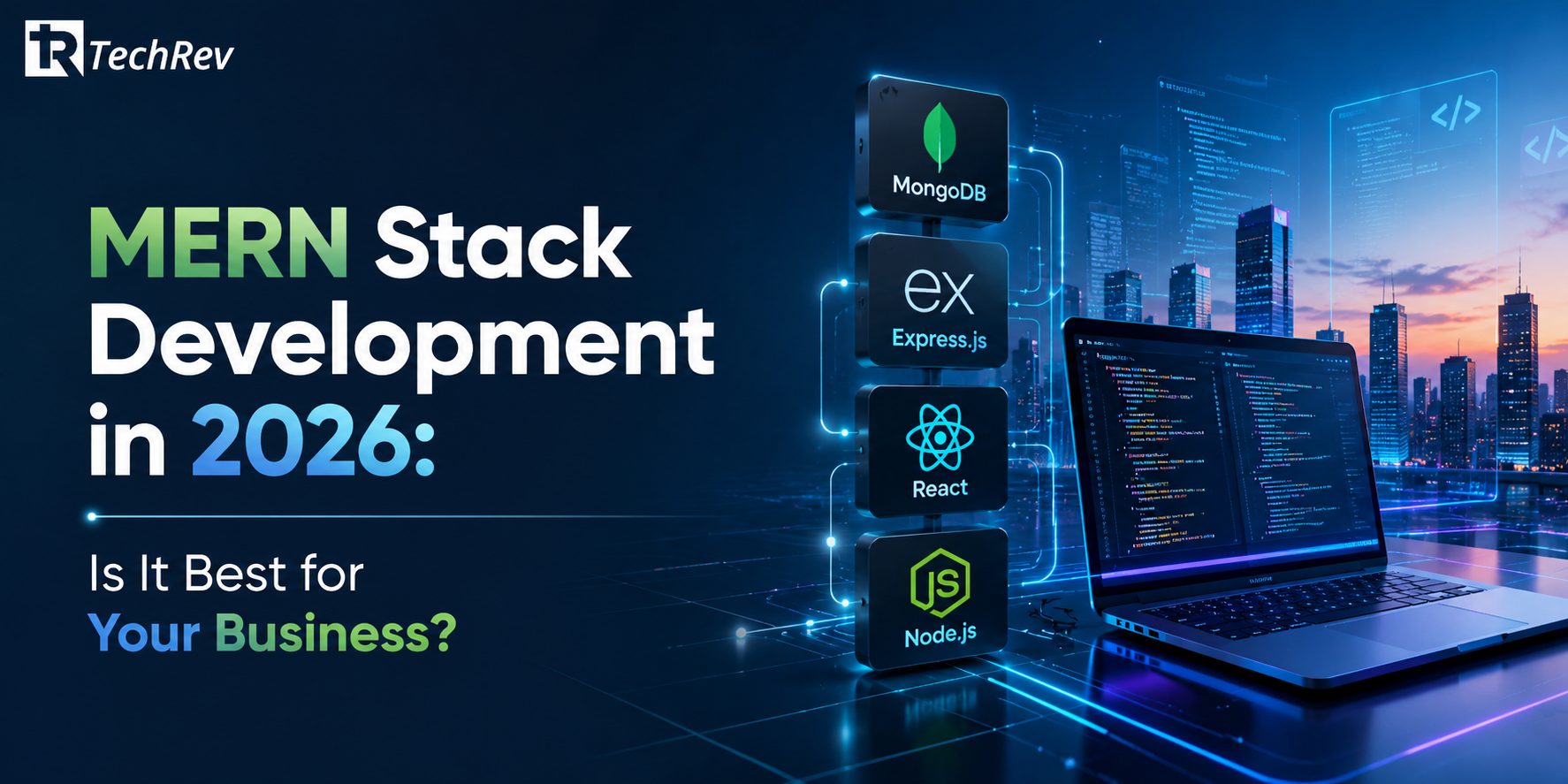
MERN stack development is a full stack development approach that builds complete web applications using four JavaScript technologies: MongoDB (database), Express.js (backend framework), React (frontend library), and Node.js (runtime environment). Since every layer runs on JavaScript, one team can build the entire product, which speeds up delivery and cuts costs.
That single language advantage is the whole reason MERN became popular in the first place. Your frontend team and your backend team speak the same syntax, share the same utilities, and debug the same way. Fewer handoffs, fewer misunderstandings, faster shipping.
Is MERN Stack Still Relevant in 2026?
Yes, and the numbers back it up. According to the Stack Overflow 2025 Developer Survey, Node.js and React lead all web frameworks at 49.1% and 46.9% usage among developers.
Express still sits among the most used backend frameworks in the world, and MongoDB Atlas now ships native Vector Search, which makes it a genuinely strong database for AI powered products.
Think about what that means in practice:
- Talent is everywhere. React plus Node.js is the deepest full stack development talent pool on the planet. If a developer leaves your project, you can replace them in weeks, not months. Try doing that with a niche framework.
- The ecosystem is mature. React 19, Node.js 22 LTS, Express 5, MongoDB 8. These are stable, battle tested releases. Companies like Netflix, LinkedIn, and PayPal run Node.js in production at massive scale.
- AI fits in natively. MongoDB Atlas Vector Search stores AI embeddings right next to your application data. No separate vector database, no extra vendor, no sync layer that breaks at 2 AM.
So no, MERN is not dying. What has changed is that it is no longer the automatic default for every web app development project. In 2026, it is one of a few strong options, and picking the right one depends on what you are building.
What Does a Modern MERN Stack Application Look Like in 2026?
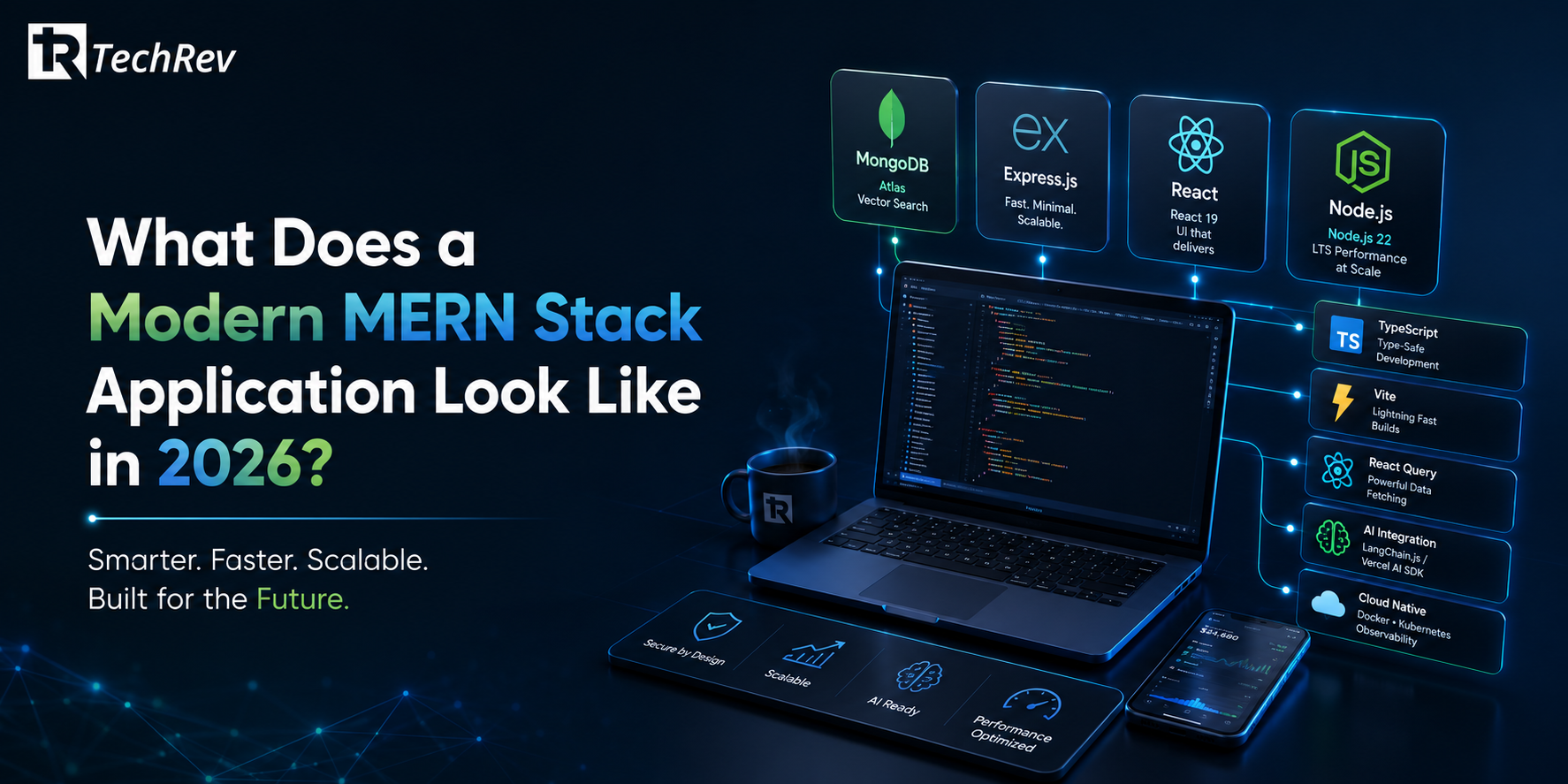
A 2026 MERN stack application looks very different from the 2019 version, even though the initials are the same. If your development partner is still shipping Create React App with plain JavaScript, that is a red flag.
Here is what a modern MERN stack application should include today:
- TypeScript everywhere. It is table stakes now, not a bonus skill.
- Vite for frontend builds. Faster builds, faster feedback, happier developers.
- React Query plus Zustand or Redux Toolkit for clean state management.
- Express 5 or Fastify on the backend, depending on performance needs.
- MongoDB Atlas with Vector Search for AI features and Atlas Search for in app search.
- AI integration layers like LangChain.js or the Vercel AI SDK for chatbots, RAG pipelines, and intelligent workflows.
- Modern deployment on container platforms or edge runtimes, with real observability from day one.
Why does this matter to you as a business owner? Because a modern toolchain directly affects your budget. Faster builds mean faster iterations. Type safety means fewer bugs reaching your users. Native AI support means you are not paying for a second database vendor just to add a smart feature.
Also Read – An Ultimate Guide on Custom Web Development Services in US
When Is MERN Stack Development the Right Choice?
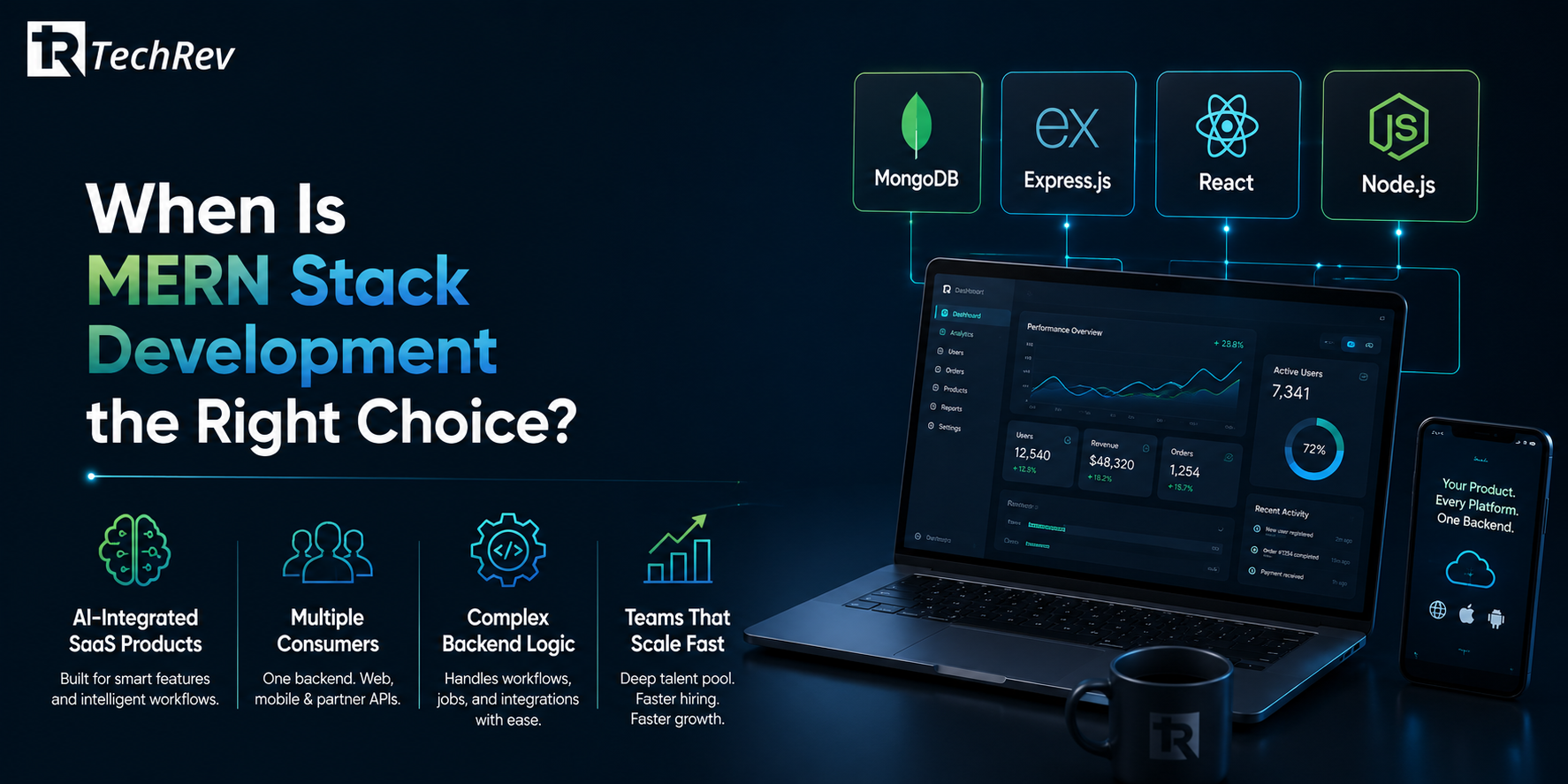
MERN stack development is the right choice when you are building an API driven product, working with flexible data, or planning AI features as part of your core offering. Here are the scenarios where it genuinely shines.
1. AI Integrated SaaS Products
Planning a chatbot, a recommendation engine, or a RAG based assistant inside your product? MongoDB’s document model plus Vector Search gives MERN a real structural advantage.
Your embeddings and your application data live in one place, under one query interface, with one backup policy. Simpler architecture, lower vendor count, more predictable costs.
2. Products With Multiple Consumers
Got a web app today but planning iOS, Android, and partner API access tomorrow? A decoupled Express backend serves all of them independently.
Your web app development track and your backend track can deploy on their own schedules without blocking each other. That separation feels like a small thing until your product grows, and then it feels like the smartest decision you ever made.
3. Complex Backend Logic
Background jobs, webhooks, multi step payment flows, custom middleware chains. Express handles all of it without fighting you.
This is why so many marketplaces, logistics platforms, and healthcare products still run on MERN.
4. Teams That Need to Scale Fast
Because MERN stack developers are the most widely available full stack development talent worldwide, growing from 3 engineers to 15 is realistic. With rarer stacks, hiring alone can add months to your web app development roadmap.
If custom software development speed matters to your business, and it always does, talent depth is a competitive advantage on its own.
When Should You Skip MERN?
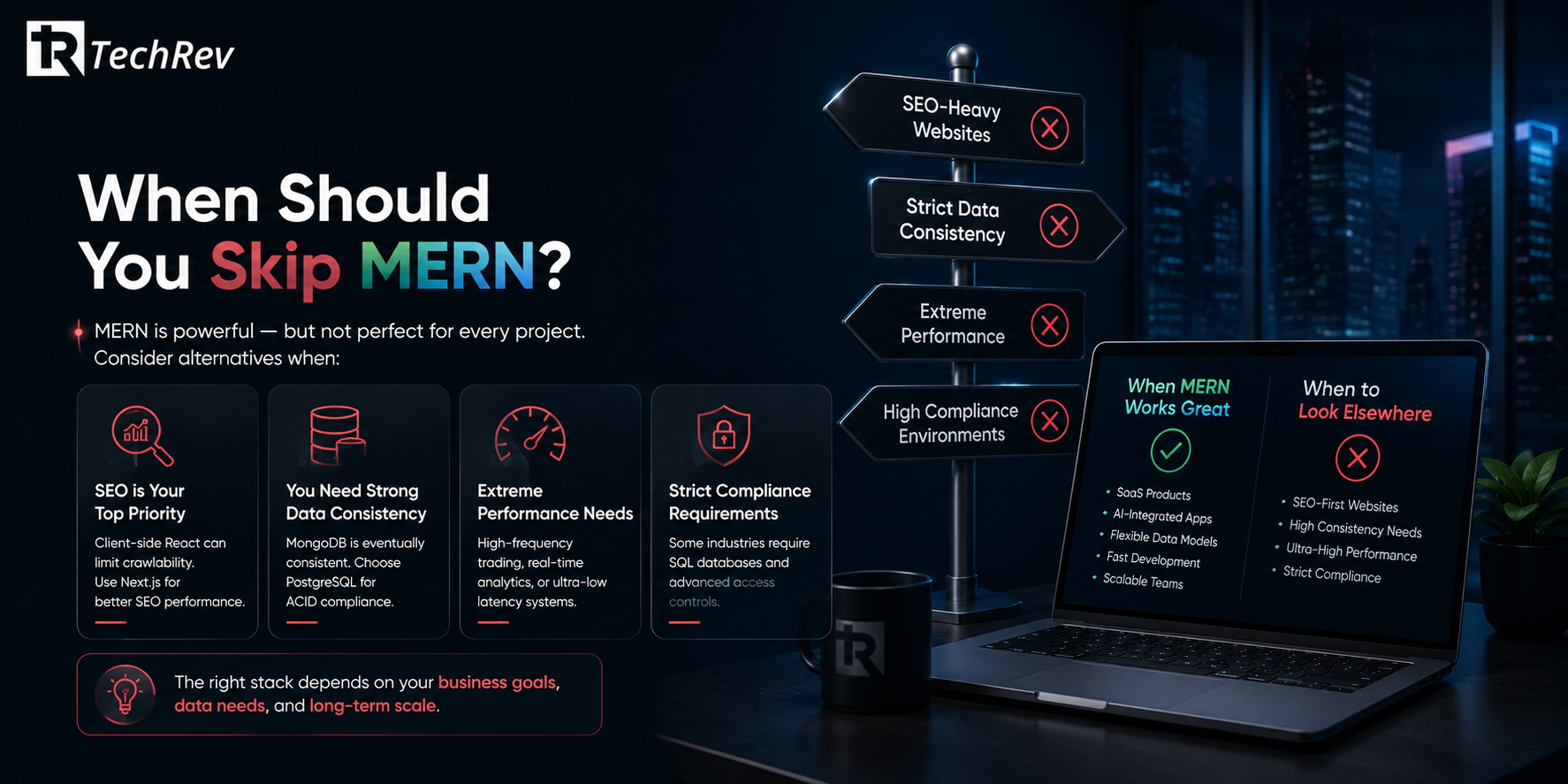
Honesty time. MERN is not the answer to everything, and any agency that tells you otherwise is selling, not advising.
1. Skip MERN
If organic search traffic is your primary growth channel. Default client side React makes search crawlers work harder. Next.js, with built in server side rendering, is simply better for content heavy sites, blogs, and marketing driven e-commerce.
2. Skip MERN
If your data is heavily relational. Accounting ledgers, inventory systems with constant multi table joins, strict ACID requirements. PostgreSQL based stacks handle that shape of data with less friction.
3. Skip MERN
If you are two people racing to launch an MVP in 30 days. A backend as a service platform like Supabase can collapse months of backend work into weeks for standard CRUD products.
Does that shrink MERN’s territory compared to 2020? A little. But the territory it holds, it holds firmly.
How Much Does MERN Stack Development Cost in 2026?
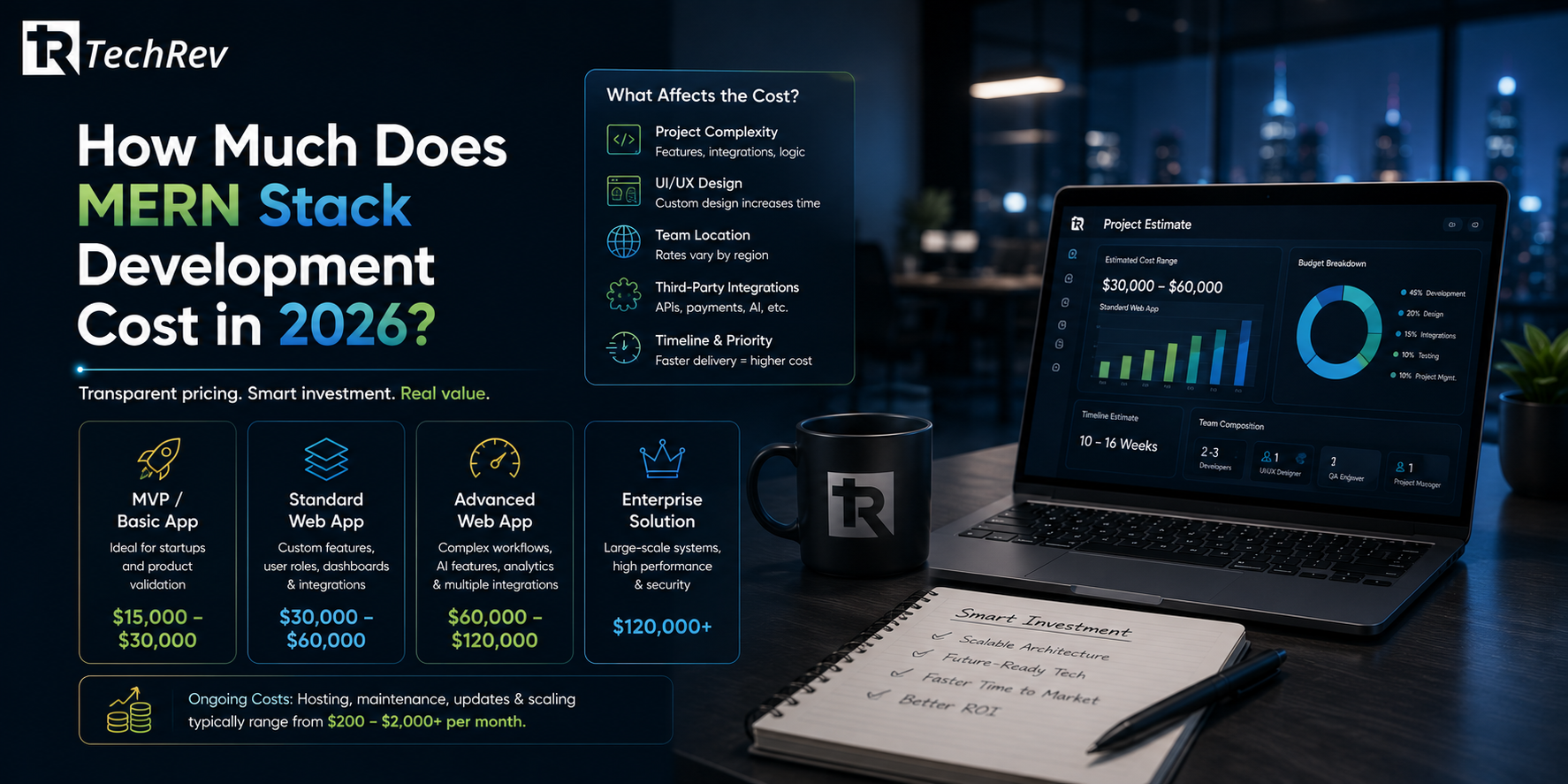
Here is the honest range: a simple MERN stack application can start around $5,000 to $15,000, a mid complexity SaaS product typically lands between $25,000 and $100,000, and enterprise grade platforms with deep AI integration can go well beyond that. The final number depends on three things: feature scope, team location, and how much AI you are baking in.
The biggest cost lever is geography. US based senior developers commonly bill $85 to $160 per hour, while equally capable offshore and nearshore MERN stack developers often cost 60 to 70% less.
That is exactly why working with a development partner that offers flexible engagement models matters so much. You should not be paying Silicon Valley rates for work that a vetted dedicated team can deliver at a fraction of the price.
One more custom software development tip most blogs will not tell you: the cheapest build is rarely the cheapest product. A poorly architected MERN stack application will bleed money in maintenance for years. Paying for solid architecture upfront usually recovers its cost within the first year of operation.
Also Read – Frontend vs Backend: Choosing the Popular Web App Frameworks!
How Can TechRev Help With Your MERN Stack Development?
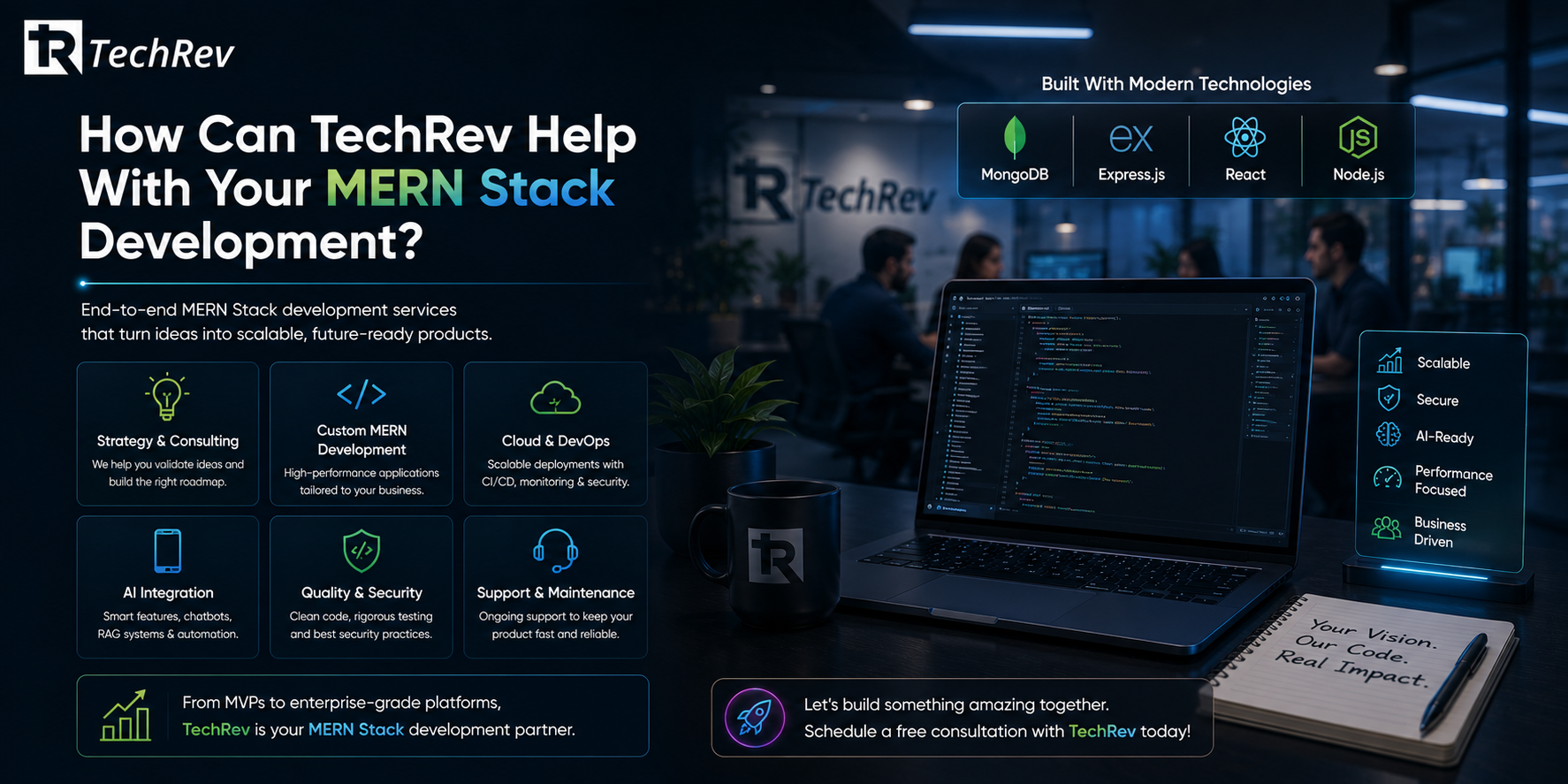
This is where we stop talking theory and start talking about results. TechRev is a Florida based custom software development company that has been building AI powered web and mobile products since 2016, with a decade of delivery behind us and a client roster spanning healthcare, e-notary, patient monitoring, and nonprofit platforms.
Here is what partnering with TechRev actually gets you:
- Real cost reduction, not vague promises. Our custom web app development projects start from $5,000 for straightforward builds, and our IT staff augmentation model lets you scale your team up or down without long term hiring commitments. No recruiter fees, no 3 month hiring cycles, no severance risk.
- Faster time to market. A basic application ships in 4 to 8 weeks with us. A complex AI powered platform typically takes 3 to 6 months with a transparent timeline from day one. Every week saved in development is a week your product is earning instead of costing.
- AI baked in, not bolted on. We integrate chatbots, predictive analytics, NLP, computer vision, and recommendation engines directly into new or existing applications. If your MERN stack application needs a RAG pipeline or an intelligent automation layer, that is exactly the kind of custom software development work we do daily.
- End to end ownership. UI/UX design, web app development, cloud services, API development, post launch maintenance, and even the digital marketing to drive traffic once you launch. One partner, one point of accountability.
- Dedicated MERN stack developers who work as your team. Hire dedicated developers who focus entirely on your goals, your timeline, and your growth. You get the depth of the world’s largest full stack development talent pool with the accountability of an in house team.
Want to know what your project would actually cost? Talk to a TechRev expert and get a detailed, no obligation quote based on your exact requirements.
FAQs
1. Is the MERN stack dying in 2026?
No. Node.js and React remain the two most used web frameworks in the world according to the Stack Overflow 2025 survey. MERN is no longer the default for every project, but for API first products, AI integrated SaaS, and apps with flexible data, it remains a top tier choice.
2. MERN stack vs Next.js: which should I choose?
Choose Next.js if organic search is your main growth channel or you only need a single web client. Choose MERN stack development if you need multiple API consumers, complex backend logic, or native AI and vector search capabilities. Many production systems actually combine both: a Next.js marketing site in front of a MERN backend.
3. Is MongoDB good for AI applications?
Yes. MongoDB Atlas Vector Search stores AI embeddings alongside your application data, removing the need for a separate vector database. For RAG pipelines and AI features that depend on fresh data, this is a genuine architectural advantage.
4. How long does it take TechRev to build a MERN stack application?
A basic application takes 4 to 8 weeks. A complex, AI powered MERN stack application typically takes 3 to 6 months. TechRev provides a transparent timeline before development begins.
5. What types of applications can TechRev develop?
TechRev handles web app development and mobile apps for Android and iOS, enterprise software, AI powered tools like chatbots and predictive analytics, e-commerce platforms, on demand service apps, and fully custom software development solutions.
6. Can TechRev add AI features to my existing MERN application?
Yes. TechRev integrates AI into existing apps, including automation, natural language processing, image recognition, recommendation systems, and predictive analytics, without requiring a full rebuild.
7. Does TechRev provide support after launch?
Absolutely. TechRev offers post launch support covering bug fixes, performance optimization, security updates, and new feature development, so your product stays fast, secure, and up to date.
8. How do I hire MERN stack developers through TechRev?
Simple. Reach out through the TechRev contact page, share your requirements, and get matched with dedicated MERN stack developers who integrate directly into your workflow. You can start small and scale the team as your product grows.