
Why does one vendor quote $40,000 for an AI service management app cost while another quotes $400,000 for what sounds like the exact same thing?
If you have asked that question, you are not alone, and you are right to be suspicious of both numbers. The honest answer is that AI service management app cost depends on a handful of decisions you make before a single line of code is written: what the app manages, how much intelligence it actually needs, how messy your data is, and how regulated your industry happens to be.
In 2026, most AI-powered service management platforms land between $30,000 and $500,000 or more. That is a wide range, and this blog exists to narrow it down for your specific situation. We will walk through real cost drivers, real market data, and a real-world story of what a decade of service management logic looks like inside a healthcare app development.
So, let’s get into it.
What Is an AI Service Management App?
An AI service management app is software that plans, tracks, and automates field service operations, things like scheduling, dispatching, inventory, delivery, billing, and reporting, while using artificial intelligence to predict demand, route work, flag exceptions, and reduce manual decision-making.
Think of the difference this way. A traditional service management app tells you what happened. An AI service management app tells you what is about to happen and what to do about it.
It can forecast which client sites need service next month, suggest optimal technician routes, spot inventory shortages before they cause missed appointments, and answer plain-English questions like “which deliveries are pending this week?”
In healthcare settings, this category overlaps heavily with healthcare workflow automation, where the same principles apply to hospital logistics, equipment servicing, linen and textile management, patient room turnover, and maintenance scheduling.
AI Service Management App Cost: The Answer
Here is the quick reference table before we go deeper.
| Build Tier | What You Get | Typical Cost Range | Timeline |
| MVP / Pilot | One core workflow, pre-built AI APIs, basic dashboard | $30,000 to $80,000 | 2 to 4 months |
| Mid-Market Platform | Multiple workflows, custom reporting, mobile app, RAG-based AI features | $100,000 to $250,000 | 4 to 8 months |
| Enterprise Platform | Full service lifecycle, custom AI models, offline mobile, compliance, integrations | $250,000 to $600,000+ | 6 to 18 months |
Industry data backs these ranges up. Recent 2026 pricing research puts lightweight AI MVPs between $40,000 and $80,000, mid-market RAG-based platforms between $100,000 and $250,000, and enterprise-grade systems with advanced governance regularly past $500,000. On top of the build, plan for 15 to 25 percent of the initial cost every year for maintenance, model monitoring, and inference.
One more number worth knowing before you flinch at those figures: the average return on AI investment in healthcare settings is $3.20 for every $1 invested, with returns typically realized within 14 months. The question is rarely whether the investment pays off. It is whether you scope it correctly.
Why is AI in the Healthcare Industry Driving These Investments?

Service management might sound like a back-office concern, but the money flowing into AI in healthcare says otherwise.
The global AI in healthcare market was valued at $36.7 billion in 2025 and is projected to reach roughly $505.6 billion by 2033, growing at a 38.9 percent CAGR according to Grand View Research. North America alone accounts for about 54 percent of that revenue, which makes the United States the center of gravity for the entire AI in healthcare industry.
Adoption is not theoretical anymore either. American Medical Association data shows 66 percent of physicians used health AI in 2024, up from 38 percent just one year earlier. And it is not only clinical tools. Hospitals are pouring budget into operational AI: scheduling, supply chain, logistics, and administrative workflow, because that is where labor shortages hurt most and where ROI shows up fastest.
The generative side is growing even faster in percentage terms. The generative AI in healthcare market is projected at around $4.7 billion in 2026 and expected to reach nearly $39.8 billion by 2035. So when hospital vendors and service companies invest in AI solutions in healthcare operations, they are not chasing a trend. They are keeping pace with where their clients already are.
7 Factors That Decide Your AI Service Management App Cost
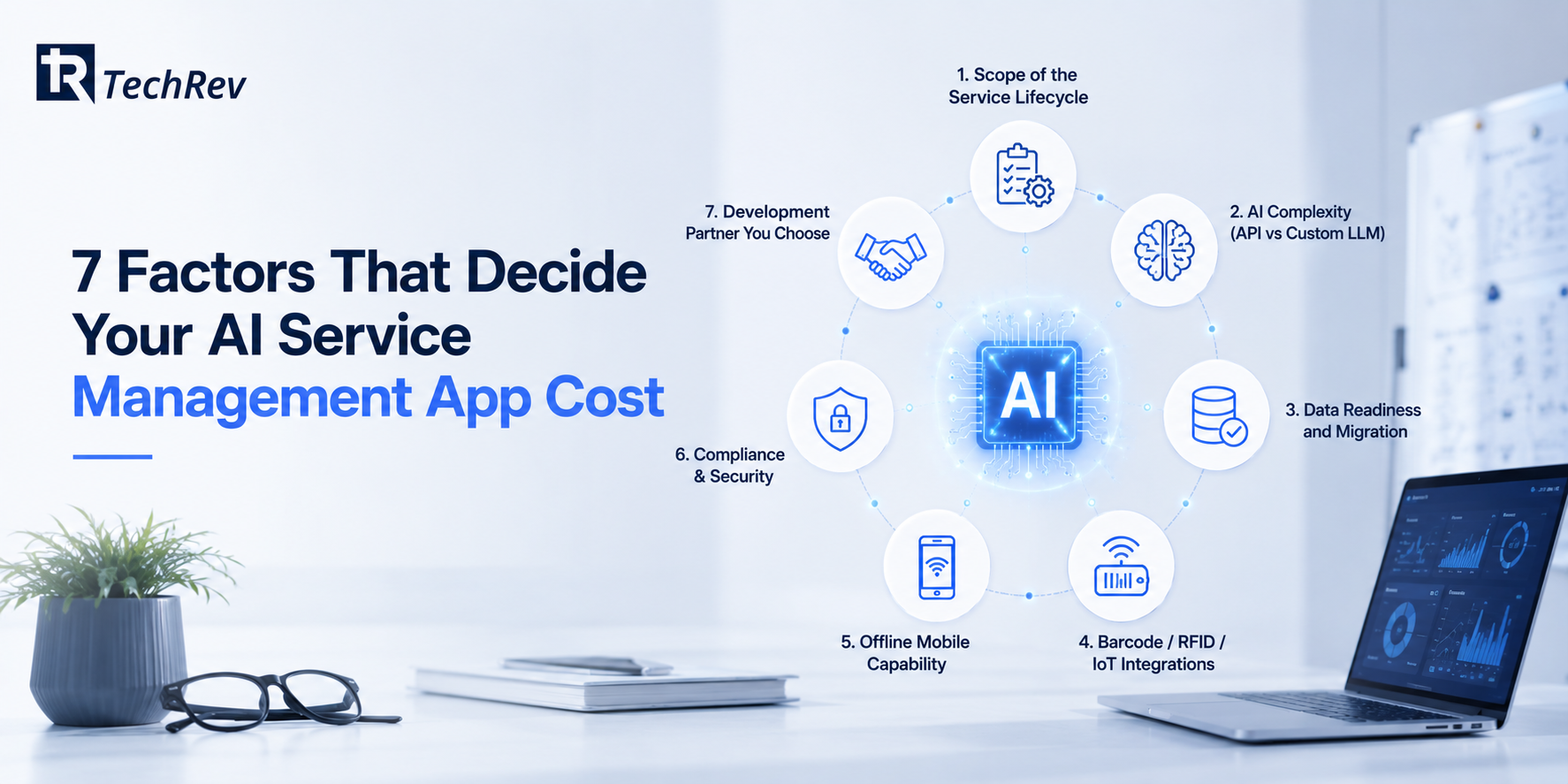
The following are some factors:
1. Scope of the Service Lifecycle You’re Automating
A service management app that only handles scheduling is cheap. One that handles the full lifecycle, from asset installation to pickup, processing, delivery, reinstallation, inventory, and billing, is not. Every additional workflow means more screens, more business rules, more edge cases, and more testing.
A practical rule: list every question your operations team asks daily. What was delivered? What is pending? Who completed what? What needs billing? Each question your app must answer adds measurable cost, and each one it answers well removes hours of manual work forever.
2. AI Complexity: API Integration vs. Custom LLM Development
This is the single biggest fork in the road for your budget.
Connecting to pre-built models through an API keeps costs low and lets you ship fast. Full custom LLM development, where a model is fine-tuned or trained on your proprietary service data, adds serious money but delivers answers no off-the-shelf tool can.
Most 2026 estimates show custom model work pushing projects from the tens of thousands into the hundreds of thousands.
The smart play for most operations businesses: start with API-driven generative AI development for features like report summarization and natural-language queries, then invest in custom models only after the basic platform proves its value.
3. Data Readiness (the Cost Everyone Underestimates)
Here is a statistic that should shape your entire budget conversation: data preparation accounts for 25 to 40 percent of total AI project budgets, and it is the most commonly underestimated cost factor in the industry.
If your service history lives in spreadsheets, paper logs, or a fifteen-year-old database with inconsistent naming, that data must be cleaned, structured, and mapped before AI can learn anything useful from it.
Skipping this step is why an estimated 70 to 85 percent of AI projects fail, and it has nothing to do with the technology.
4. Barcode, IoT, and Physical Asset Tracking
Service management apps that track physical assets need barcode or RFID scanning, mobile camera integration, and asset-to-location mapping.
Every scan event, bag count, vehicle assignment, and chain-of-custody record needs backend logic and audit trails. This layer typically adds $20,000 to $60,000 depending on how granular the accountability needs to be.
5. Offline Mobile Capability for Field Staff
Field technicians often work in buildings where connectivity dies, hospital basements being a classic example. An app that lets staff scan assets, record installations, capture photos, and sync later requires offline-first architecture, local storage, and conflict resolution logic.
It is one of the most valuable features you can build and one of the most technically demanding, often adding 15 to 25 percent to mobile development cost.
6. Compliance and Security Requirements
If your service management app touches healthcare facilities, HIPAA-adjacent requirements, audit trails, role-based access, and security reviews come with it.
Compliance-heavy industries like healthcare add roughly 25 to 35 percent to baseline development cost.
This is exactly why generic AI application development services often underquote healthcare projects: they price the software, not the regulatory reality around it.
7. Who Builds It and Where?
Blended hourly rates for competent AI development teams range from around $60 per hour offshore to $200 or more for senior US-based engineers.
But the deciding factor is rarely the rate. It is whether the team has shipped in your domain before.
A partner offering true AI ML development services with prior service-operations experience will scope in weeks what a generalist shop discovers painfully over months.
Also Read – How Can AI in Healthcare Fix & Maximize Clinical Workflows?
Cost Breakdown by Build Phase
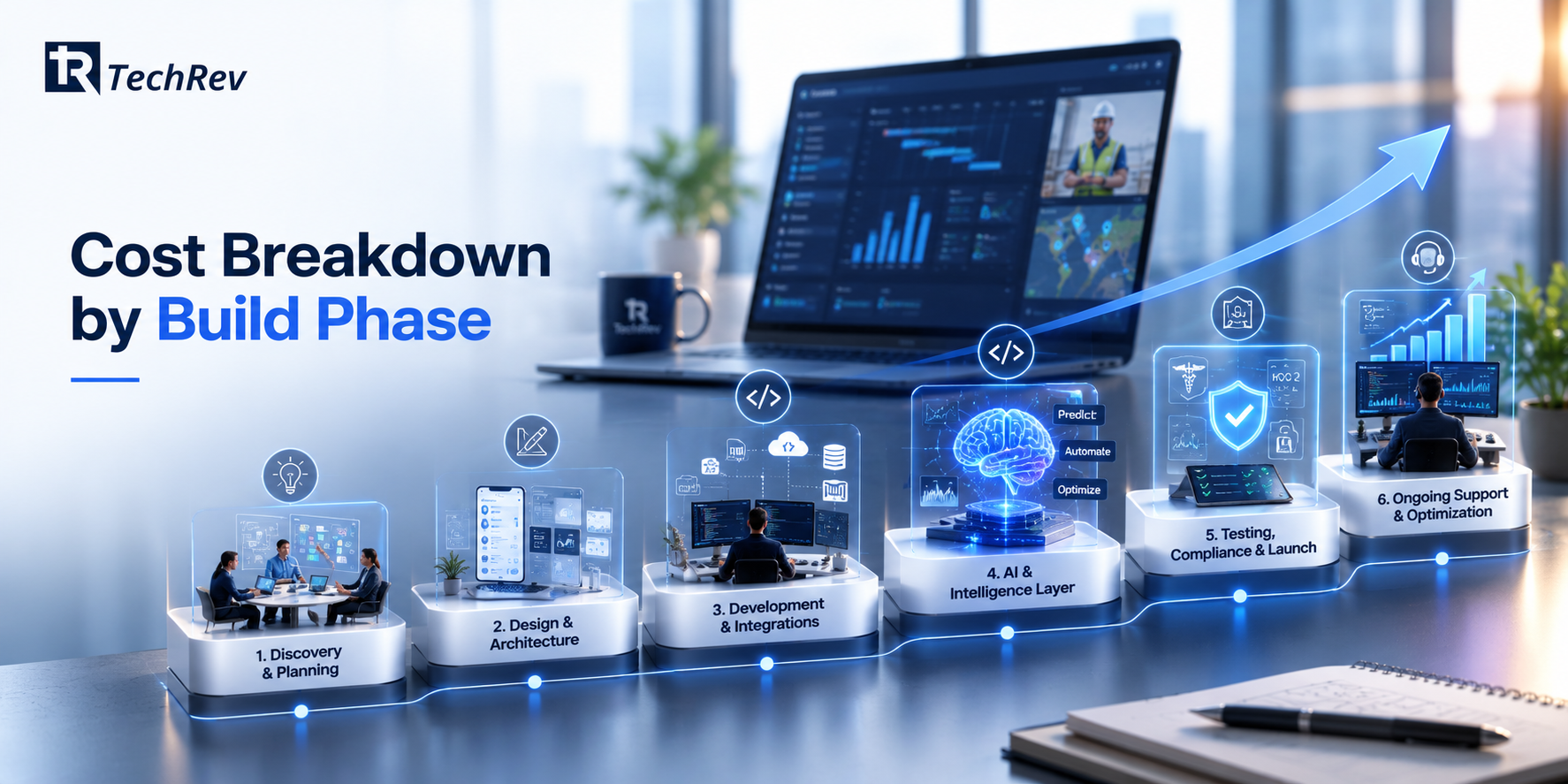
Here is roughly where the money goes on a typical mid-market build:
| Phase | Share of Budget | What Happens |
| Discovery and scoping | 5 to 10% | Workflow mapping, data audit, technical architecture |
| UI/UX design | 10 to 15% | Dashboards, mobile screens, admin panels |
| Core development | 35 to 45% | Backend, APIs, mobile app, integrations |
| AI features | 15 to 25% | Model integration, prediction logic, natural-language reporting |
| Testing and QA | 10 to 15% | Field testing, offline sync testing, security review |
| Deployment and training | 5 to 10% | Rollout, staff onboarding, documentation |
Then the ongoing costs: cloud hosting, model inference, monitoring, and feature updates at 15 to 25 percent of build cost annually.
But,
Where Generative AI Fits Into a Service Management Budget?
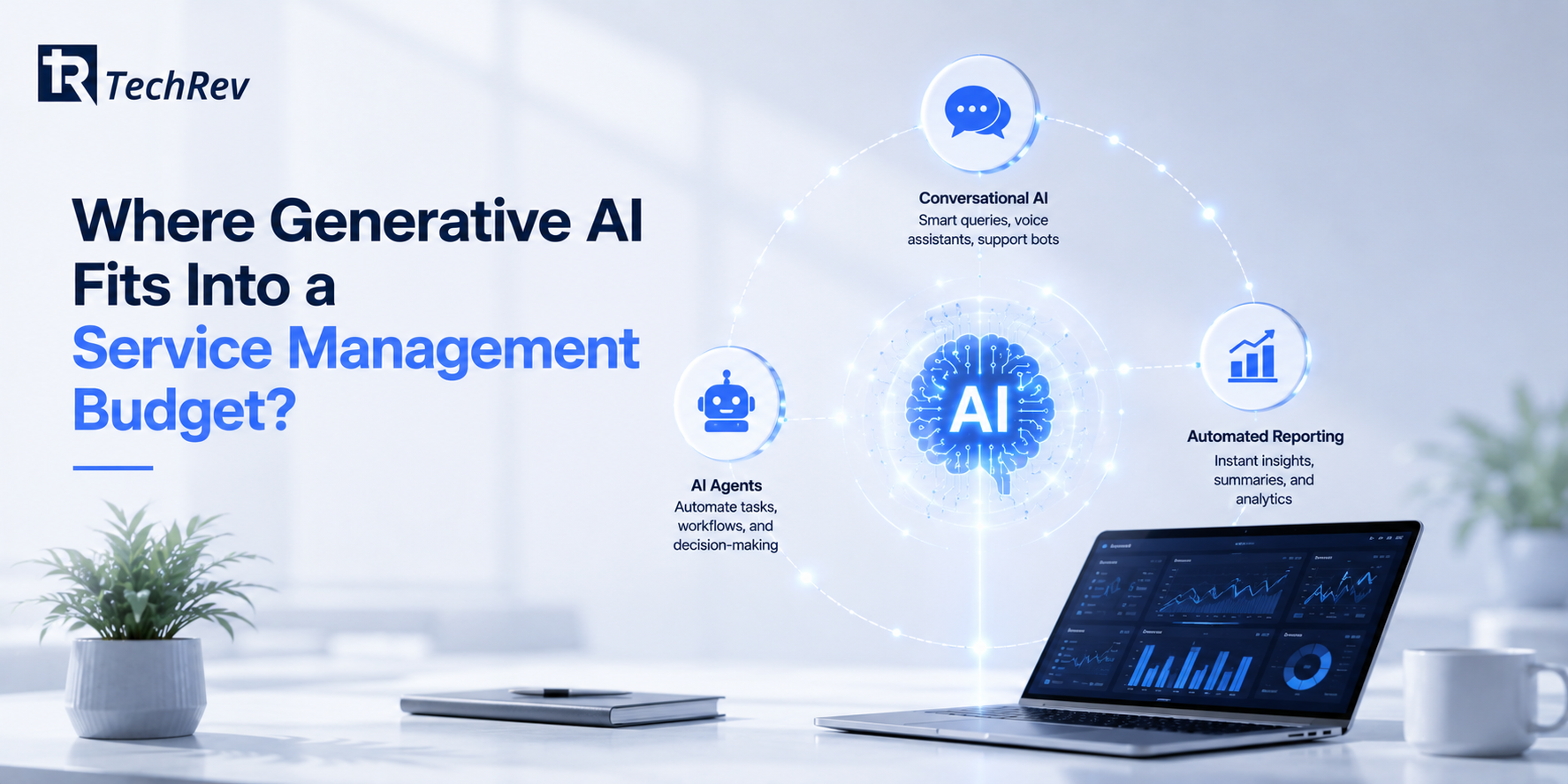
Generative AI in healthcare operations is where the newest budget line items appear, and three deserve attention.
1. Conversational AI
Conversational AI in healthcare is no longer limited to patient chatbots. Operations teams now ask their platforms questions in plain English: “Show me every unit at Memorial that missed its quarterly service.”
Building this typically means a RAG pipeline over your operational data, usually $15,000 to $40,000 as a standalone feature.
2. AI Agents for Scheduling and Dispatch
AI agent development services build systems that do not just answer questions but take actions: drafting next month’s visit schedule, reassigning work when a technician calls out, or flagging invoices that do not match service records.
Business-process agents typically run $60,000 to $150,000 in 2026.
3. Automated Reporting and Documentation
Generating service summaries, client-ready reports, and billing narratives from raw operational data is one of the highest-ROI generative features, and one of the cheapest to add once your data layer is solid.
The sequencing matters. Companies that invest in clean data architecture first find that adding these AI solutions in healthcare operations later is incremental. Companies that bolt AI onto messy systems pay twice.
Also Read – The Role of AI in Healthcare App Development: A Complete Guide!
How to Keep the Cost Under Control?
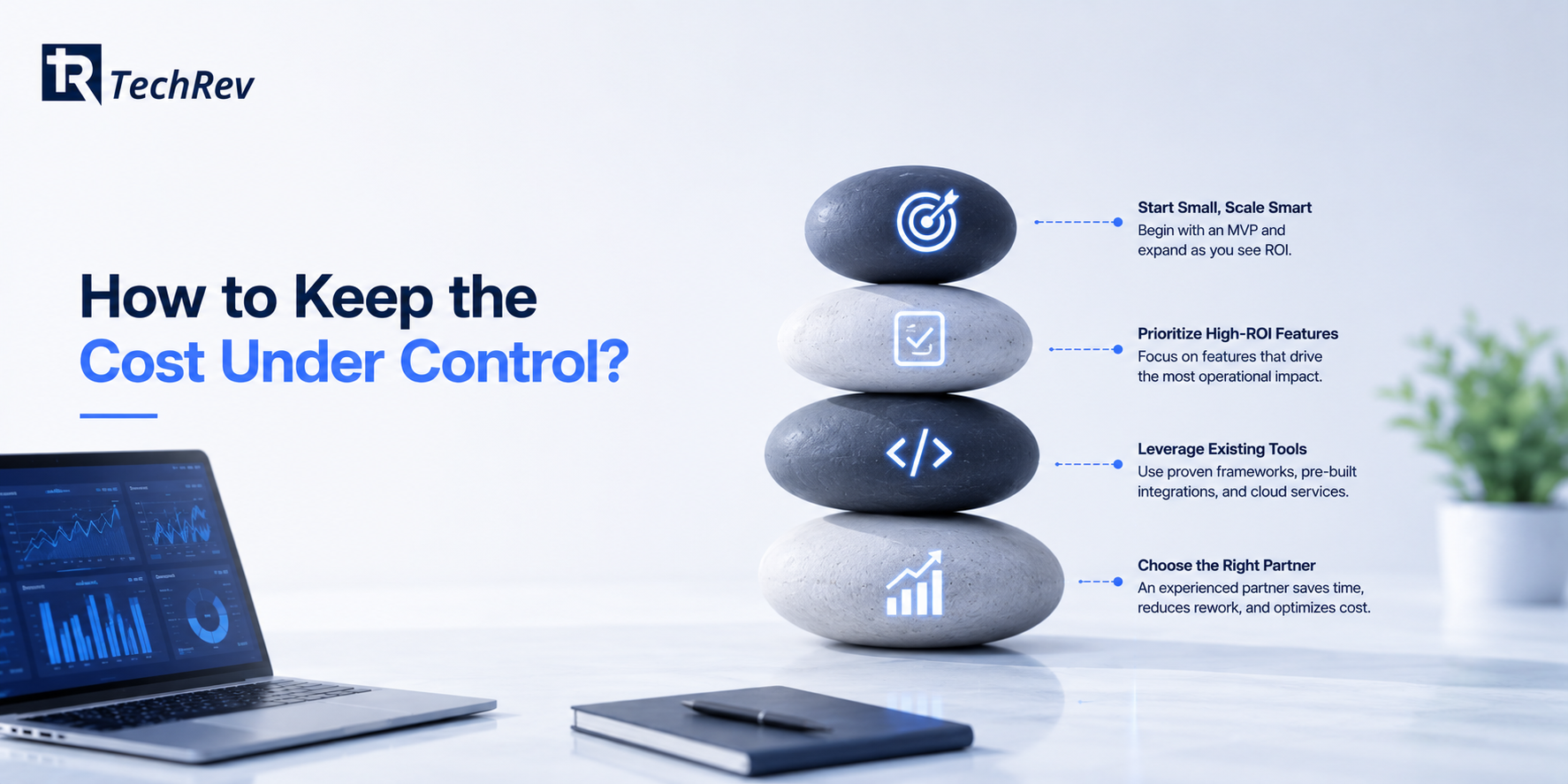
Five moves that consistently save money without gutting the product:
- Start with an MVP that solves one painful workflow. Prove value on scheduling or tracking before building the full lifecycle.
- Use pre-trained models before custom ones. Off-the-shelf LLM APIs cover 80 percent of use cases at a fraction of custom training cost.
- Audit your data before signing anything. A two-week data audit costs a few thousand dollars and can save six figures in mid-project surprises.
- Budget production from day one. Moving from proof-of-concept to production typically requires a 3 to 6 times cost increase that teams routinely fail to plan for.
- Pick a partner with domain experience. The most expensive decision in AI development is hiring the wrong team and paying twice.
Where TechRev Fits In?
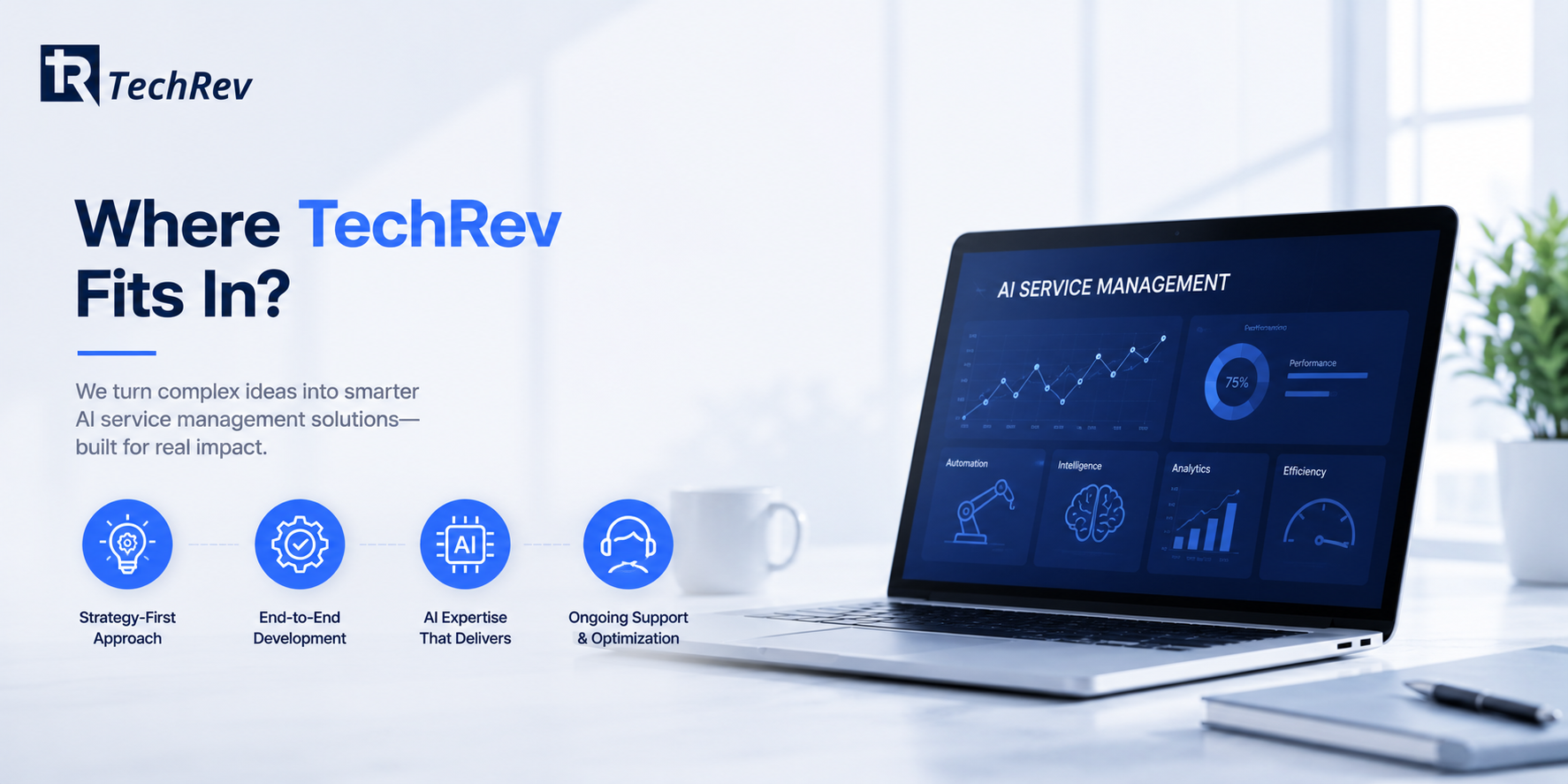
TechRev is a Florida-based custom web and mobile app development company that has been building software since 2016, with deep experience in AI development services, healthcare application development services, and enterprise platform modernization.
The team has delivered projects across remote patient monitoring, hospital service operations, e-notary platforms, and AI-powered business tools.
What sets the approach apart is the order of operations: business logic first, technology second. TechRev’s AI application development services start with workflow mapping and data audits, so the AI you pay for actually has something accurate to reason over.
For companies modernizing legacy service platforms, that discipline is the difference between a rebuild that preserves ten years of operational knowledge and one that quietly throws it away.
Also Read – How AI in Healthcare Sorts 80+ Items in Under 3 Minutes?
Conclusion
So, what does an AI-powered service management app actually cost to build? The truthful range is $30,000 to $500,000 or more, but the number that matters is yours, and it is shaped by five decisions: how much of the service lifecycle you automate, whether you use pre-built or custom AI, how ready your data is, how strict your compliance environment is, and who you hire to build it.
The businesses getting the best returns are not the ones spending the most. They are the ones that scope honestly, respect their own operational logic, and build in phases.
With healthcare AI adoption accelerating and returns averaging $3.20 for every dollar invested, the cost of building thoughtfully is almost always smaller than the cost of waiting.
If you want a grounded estimate for your specific operation instead of a generic quote, talk to the team at TechRev. Bring your messiest workflow. That is usually where the biggest ROI is hiding.
FAQs
1. How much does it cost to build an AI service management app in 2026?
Most projects land between $30,000 and $500,000 or more. An MVP handling one workflow with pre-built AI APIs runs $30,000 to $80,000. A full enterprise platform with custom models, offline mobile, barcode tracking, and compliance typically starts around $250,000.
2. What is the most underestimated cost in AI development?
Data preparation. It consumes 25 to 40 percent of typical AI project budgets, and poor data quality is the leading reason 70 to 85 percent of AI projects fail. Audit your data before you budget anything else.
3. Does TechRev build AI-powered service management apps?
Yes. TechRev provides end-to-end AI development services covering discovery, UI/UX, backend and mobile development, AI integration, and post-launch support, with specific experience modernizing service operations platforms in healthcare environments.
4. How long does TechRev take to build a custom application?
A basic app typically takes 4 to 8 weeks, while a complex AI-powered platform may require 3 to 6 months or longer depending on integrations. TechRev provides a transparent timeline before development begins.
5. Can TechRev add AI to my existing service management software?
Yes. TechRev integrates AI into existing applications, including natural language processing, predictive analytics, automation, recommendation systems, and conversational features, without requiring a full rebuild in most cases.
6. What AI solutions does TechRev specialize in?
TechRev builds AI chatbots and virtual assistants, machine learning and predictive analytics, computer vision, NLP, recommendation engines, and robotic process automation, delivered through both new builds and integrations into existing systems.
7. Does TechRev offer support after launch?
Absolutely. Post-launch support includes bug fixes, performance optimization, security updates, and ongoing feature enhancements, so the platform keeps improving after go-live.
8. Is offline mobile capability worth the extra cost for field teams?
For teams working in hospitals, basements, or rural sites, yes. Offline scanning, installation recording, and photo capture with later sync prevents lost work and data gaps, and it typically pays for itself in recovered field productivity.