

AI in healthcare reduced installation errors by 90% for a hospital service company by replacing manual counting and paper tracking with barcode scanning, offline mobile apps, and automated workflow logic. Every curtain, bag, and truck got a scannable identity, so the system always knew what was picked up, what was installed, and what was missing, in real time. But,
The problem nobody talks about at hospitals
Here is a question most people never think about: who counts the curtains?
Every hospital has hundreds of privacy curtains hanging around beds, in units, in surgery prep areas. They look boring. They are not. Two weeks after a fresh curtain goes up, roughly 87.5% of hospital privacy curtains test positive for MRSA, according to a study published in the American Journal of Infection Control. Another University of Michigan study found that about 22% of privacy curtain samples carried multi-drug resistant organisms.
Around 1.7 million healthcare-associated infections happen in the US every year, roughly 1 in every 31 hospitalized patients gets one, and the cost to the system runs between $28 billion and $45 billion annually depending on how you count it. Curtains are only one piece of that, but they are a piece nobody was tracking properly.
So these curtains have to be pulled down, washed, delivered back, reinstalled, and logged, on a strict schedule, across huge buildings. That entire lifecycle is a logistics nightmare, and for years it ran on clipboards, memory, and hope. That is exactly the kind of problem AI in healthcare was built to fix, and it is the problem a client of ours had been solving through hard-won business logic for over a decade before we modernized the whole thing.
But,
Where did the 90% Error Come From in the First Place?
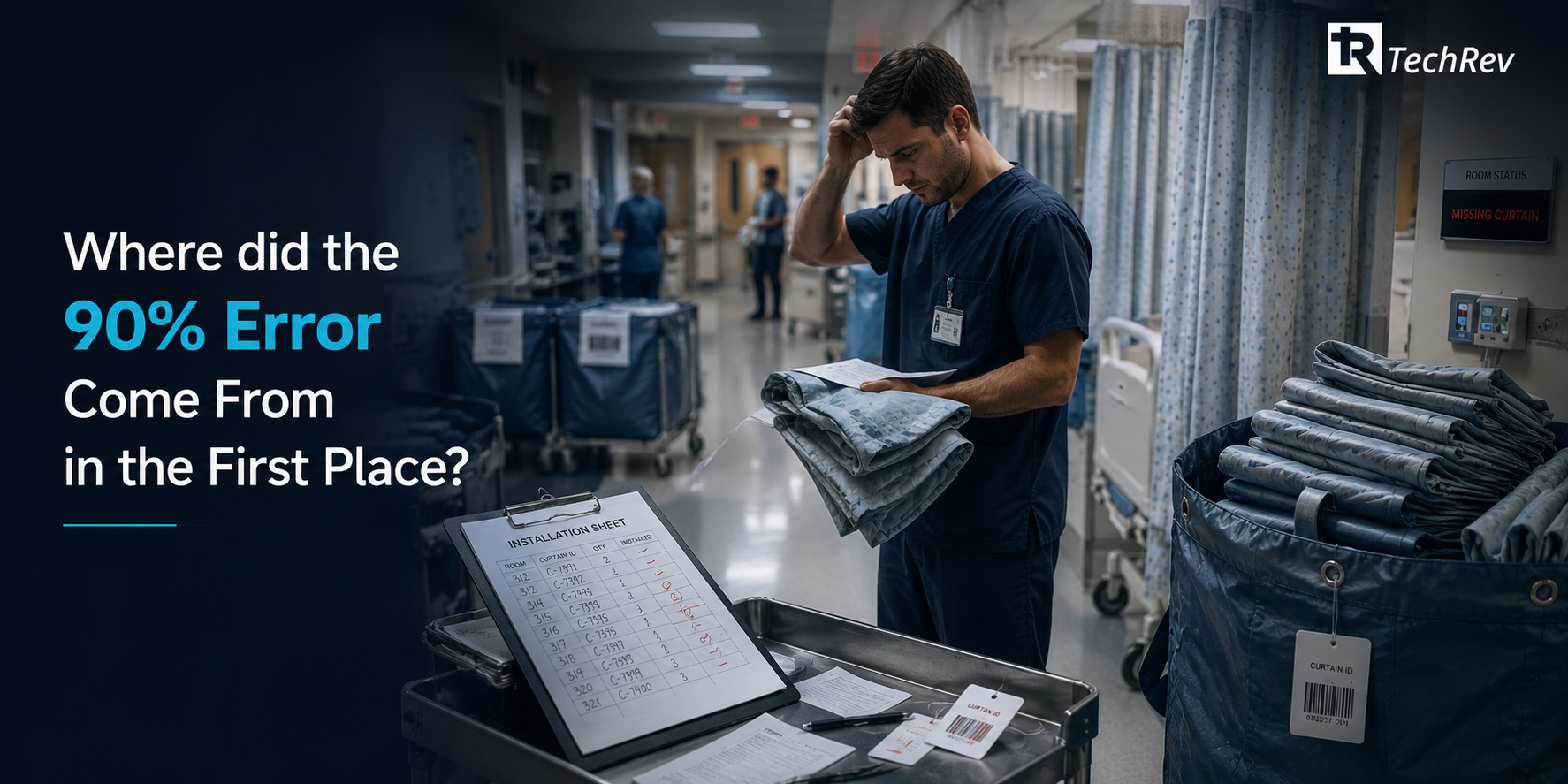
Before automation, the biggest hole was accountability during pickup and transport.
Installers would grab curtains from the laundry, load them into a truck, drive to a hospital, and install them.
Except there was no reliable count of how many curtains actually left the laundry, how many made it into the truck, and how many got installed at the correct track in the correct room. If a curtain went missing, nobody knew where in the chain it vanished. If the wrong curtain got hung on the wrong track, it might not surface until a billing dispute weeks later.
That gap created a cascade of
- Errors: wrong installs
- Missing inventory
- Double billing
- Incomplete maintenance visits
- Zero proof of who did what.
When your whole operation depends on humans manually counting soft fabric across dozens of rooms, error rates climb fast. This is the operational chaos that good healthcare software development services are supposed to eliminate, and it is where AI development services genuinely earn their keep.
How AI Solutions in Healthcare Rebuilt the Entire Workflow?
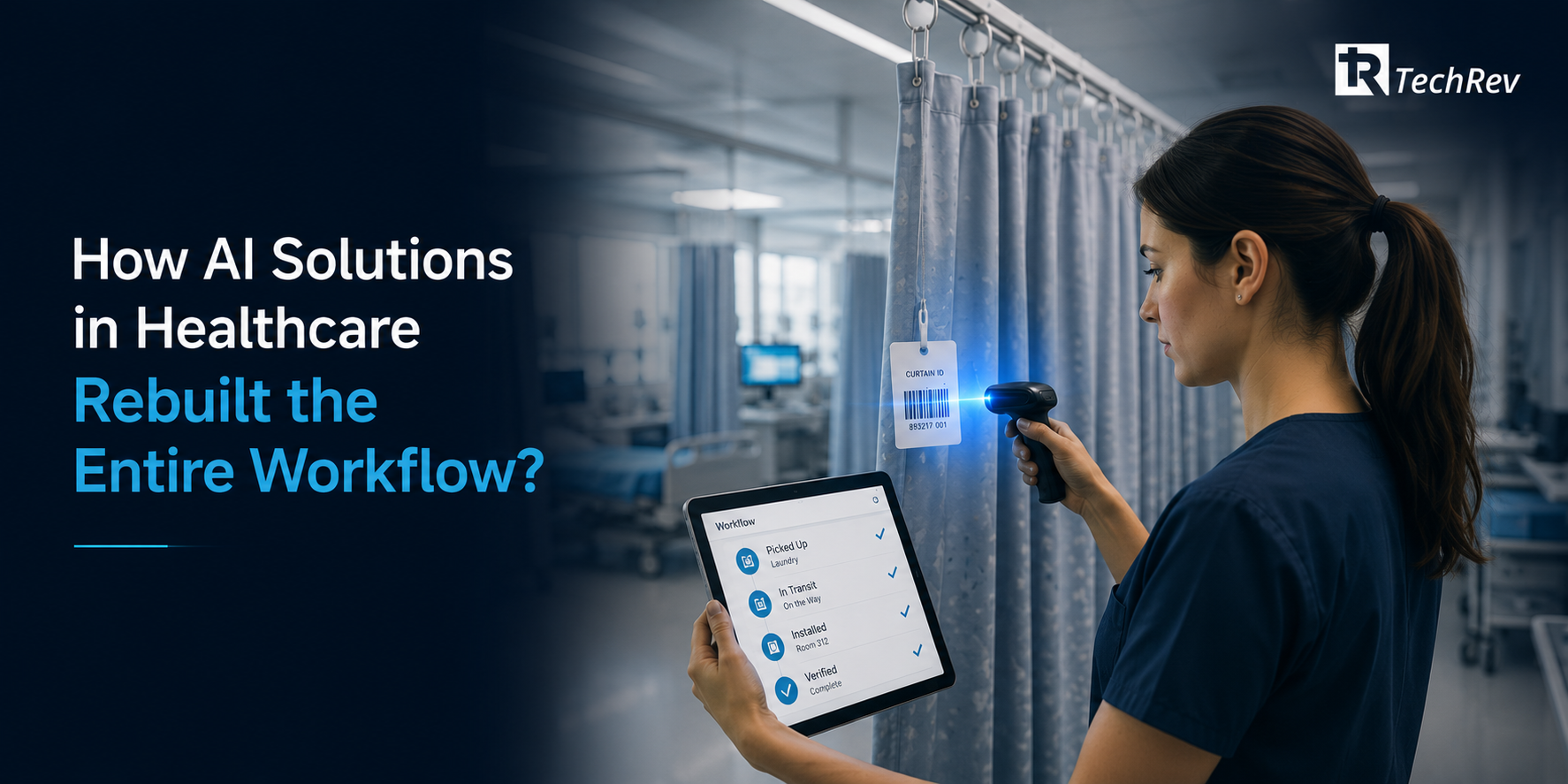
The fix was not one magic feature. It was a stack of AI solutions in healthcare working together, each closing a specific gap. Let me break down what actually moved the needle.
1. Barcode and bag tracking killed the counting problem
Every curtain now gets grouped into a scanned bag, and each bag carries a tracked curtain count. Installers scan each bag when they take it from the laundry, then scan again when they load it into the truck.
Each truck has its own barcode too, so the system knows exactly which bags and which curtains went into which vehicle.
That single change is where most of the 90% error reduction lives. When a machine confirms the count at every handoff, human miscounts basically disappear. This is healthcare workflow automation doing the boring, critical work of making sure the numbers always add up.
2. Offline mobile apps kept field staff accurate inside dead zones
Hospitals are famous for terrible signals. Installers often work in basements, surgical wings, and concrete-heavy buildings where connectivity drops to nothing.
So we built the mobile side to work fully offline: curtain scanning, install recording, photo capture, and visit updates all happen without the internet, then sync automatically once the device reconnects.
Building reliable offline-first field tools is a specialized slice of healthcare application development services, and it matters more than people expect. If the app freezes the moment the signal dies, staff go back to paper, and paper is where errors breed.
A modern mobile API foundation, exactly the kind delivered through solid AI application development services, keeps the data clean even in a signal dead zone.
3. Proof-of-work verification made every install accountable
The platform now tracks who installed what, where, when, and with what photo proof. It also feeds installer performance tracking and commission calculation, so payments match reality.
When accountability is baked into the workflow, sloppy installs stop being invisible. People get careful when the system remembers everything, which is a quiet but powerful driver of error reduction.
4. Smart scheduling stopped missed and duplicate visits
Hospitals need curtain maintenance on monthly, quarterly, yearly, or custom schedules. The modernized platform handles automated schedule calculations, reminder logic, filtering, and cleaner reporting, so visits get planned, assigned, tracked, and closed without slipping through the cracks.
Missed visits and accidental repeat visits both count as errors, and automating the calendar wiped out a big chunk of them.
TechRev rebuilt this business logic into cleaner APIs and domain modules, which is the unglamorous backbone of custom software development services. The old system had ten years of real operational wisdom trapped inside it.
We did not throw that away. We migrated it into a modern, maintainable architecture and made it faster and easier to extend.
Why is the timing perfect: the AI in healthcare industry is exploding?
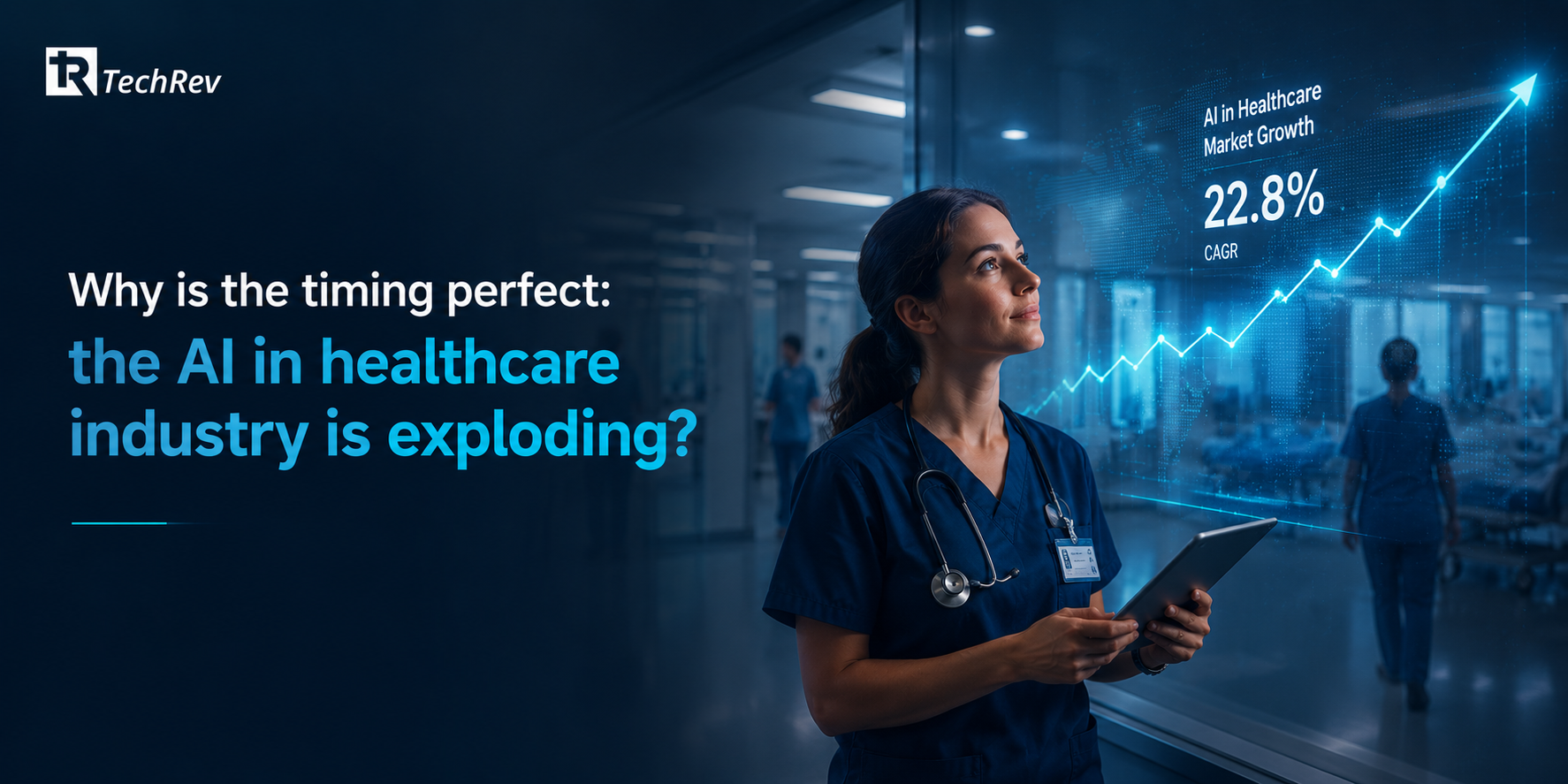
If you think this is a niche story, look at the money. The AI in healthcare market was valued at roughly $36.7 billion in 2025 and is projected to hit somewhere between $50 billion and $56 billion in 2026, with long-range forecasts pushing past $500 billion by the early 2030s at a CAGR near 39%. North America alone commands the largest share, sitting around $24.78 billion in 2026.
Adoption is racing to catch up. Depending on the survey, 63% to 81% of US physicians reported using AI tools by early 2026, and roughly 75% of US health systems now run at least one AI application. The AI in healthcare industry is not experimenting anymore, it is operating.
And the return is real. Reported averages land around $3.20 back for every $1 invested in AI in healthcare, with many organizations seeing payback inside 14 months. When you pair that ROI with a documented 90% drop in installation errors, the business case writes itself. This is why demand for AI development services and AI ml development services in the healthcare space keeps climbing.
Where does generative AI in healthcare fit into all this?
Barcode tracking and workflow automation are the foundation. The next layer is smarter.
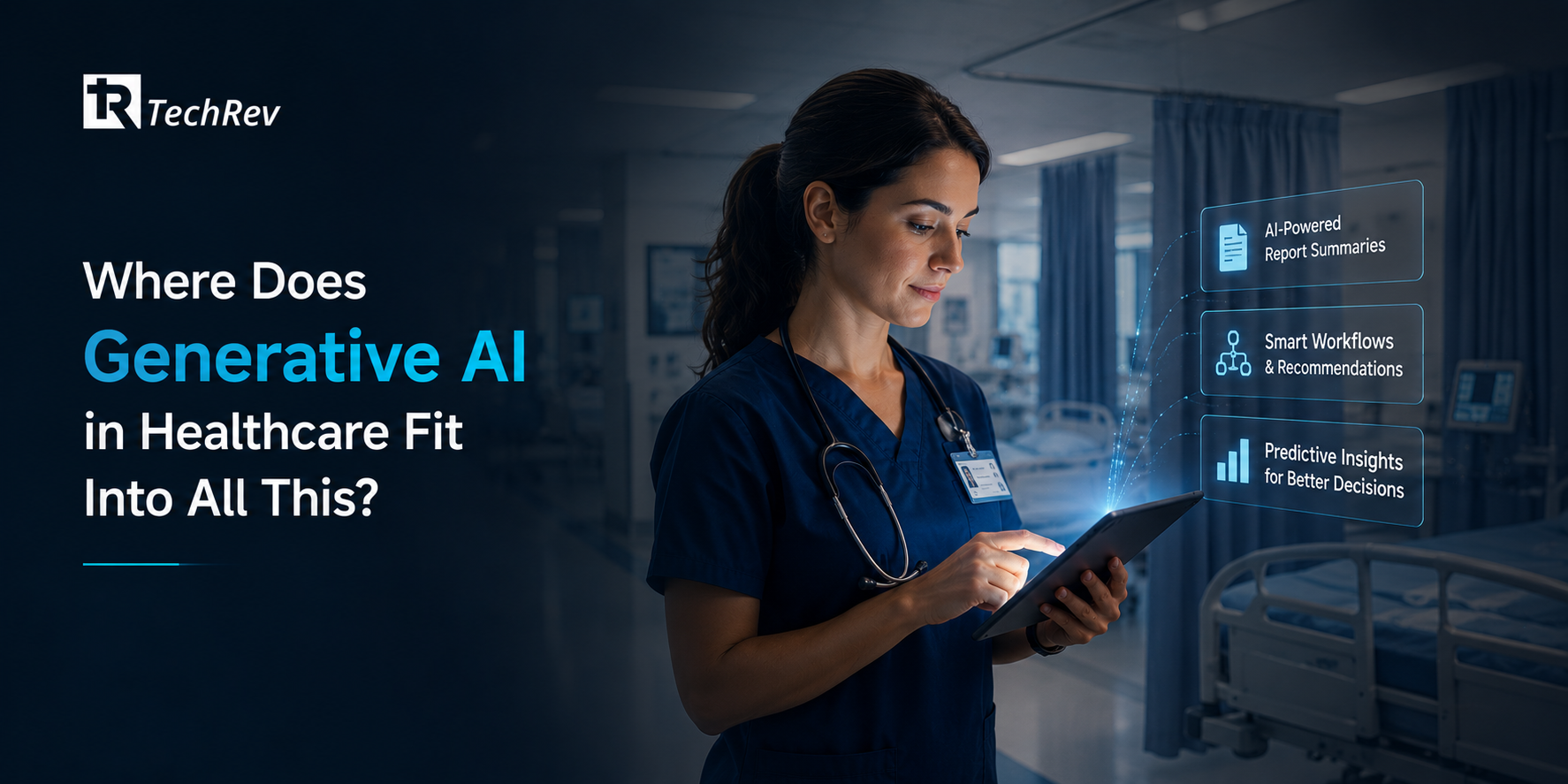
Generative AI in healthcare is one of the fastest-growing segments in the whole market, projected to grow from about $4.7 billion in 2026 to nearly $39.8 billion by 2035. On the operations side, that opens doors that used to be impossible.
Picture a manager typing “show me every hospital where a scheduled curtain visit was missed last month and flag the ones with billing impact,” and get a clean answer in seconds. That is generative AI development applied to messy operational data. Add conversational AI in healthcare, and field staff can ask the system questions in plain language instead of digging through menus. LLM development makes those natural-language reports and summaries genuinely usable, not gimmicky.
The frontier beyond that is AI agent development services, where software agents proactively watch the data, notice when a truck’s scanned count does not match the delivery count, and raise a flag before it becomes a billing dispute. That is the direction TechRev builds toward: not just automation, but systems that catch problems on their own.
Conclusion
The headline number, a 90% reduction in installation errors, sounds like magic, but it is really just AI in healthcare doing what it does best: removing the guesswork from work that humans were never meant to track by hand. Barcode accountability, offline mobile tools, proof-of-work verification, and automated scheduling turned a chaotic, error-prone operation into a system that always knows where every curtain, bag, and truck stands.
The bigger lesson is that the AI in healthcare industry is not just about hospitals and patients on the clinical side. It is about the messy operational reality behind the scenes, where smart healthcare software development services quietly save millions and prevent the kind of errors that hurt both budgets and safety. That is the space TechRev lives in.
FAQs
1. How did AI reduce installation errors by 90% for a hospital service company?
AI reduced errors by replacing manual curtain counting with barcode scanning at every handoff, offline mobile install recording, photo-based proof of work, and automated scheduling.
Machines confirmed counts and locations at each step, so human miscounts and missed visits nearly disappeared.
2. What is AI in healthcare actually used for beyond diagnosis?
Beyond diagnosis, AI in healthcare powers workflow automation, inventory tracking, scheduling, billing accuracy, logistics accountability, and reporting.
Operational use cases like these often deliver faster ROI than clinical AI, because they attack daily inefficiencies that quietly cost hospitals millions.
3. Does TechRev build custom healthcare software, or only add AI features?
TechRev does both. We build custom healthcare software development services from scratch and also integrate AI into existing platforms, including automation, predictive analytics, NLP, and computer vision.
The CubeCare project was a full modernization of a decade-old operational system.
4. How long does a project like this take with TechRev?
It depends on scope. A focused app can take 4 to 8 weeks, while a complex AI-powered platform typically runs 3 to 6 months. TechRev gives a transparent timeline upfront so you know exactly what to expect from start to finish.
5. Can TechRev integrate AI into an app we already have?
Yes. TechRev integrates AI into existing apps, adding features like automation, natural language processing, recommendation systems, image recognition, and predictive analytics, without forcing you to rebuild everything from zero.
6. Is offline functionality really necessary for hospital field apps?
Hospitals are full of connectivity dead zones. If a field app fails without signal, staff revert to paper and errors return. Offline-first design, a core part of TechRev’s healthcare application development services, keeps data accurate everywhere.
7. What does TechRev charge for AI and software development?
Cost depends on complexity and features. Simpler apps can start around $5,000, while enterprise or AI-driven builds may run $25,000 or more. TechRev provides a detailed quote after understanding your exact requirements.
8. Which AI services does TechRev offer for healthcare?
TechRev offers AI chatbots and virtual assistants, machine learning and predictive analytics, computer vision, NLP, recommendation engines, and process automation, delivered as end-to-end AI development services and AI ML development services tailored to healthcare operations.