

Picture a hospital storage room at 6 a.m. A staff member is holding a clipboard, counting curtains by hand, trying to remember which unit sent back three items instead of four. Now picture the same room with a barcode scanner that already knows the answer before anyone asks the question.
That gap, between guessing and knowing, is exactly what AI in healthcare operations is closing right now, and barcode scanning sits right at the center of it.
If you run hospital operations, manage a facilities team, or oversee any business where physical items move between locations every single day, you have probably felt the pain of not knowing where something is.
Not because your team isn’t working hard, but because the system they’re working with was never built to track anything in real time.
This blog breaks down what AI barcode scanning actually does in operations, why it matters more in 2026 than it did even two years ago, and how healthcare organizations specifically are using it to fix problems that have existed for decades.
What Is AI Barcode Scanning, and Why Isn’t It Just a Faster Barcode Reader?
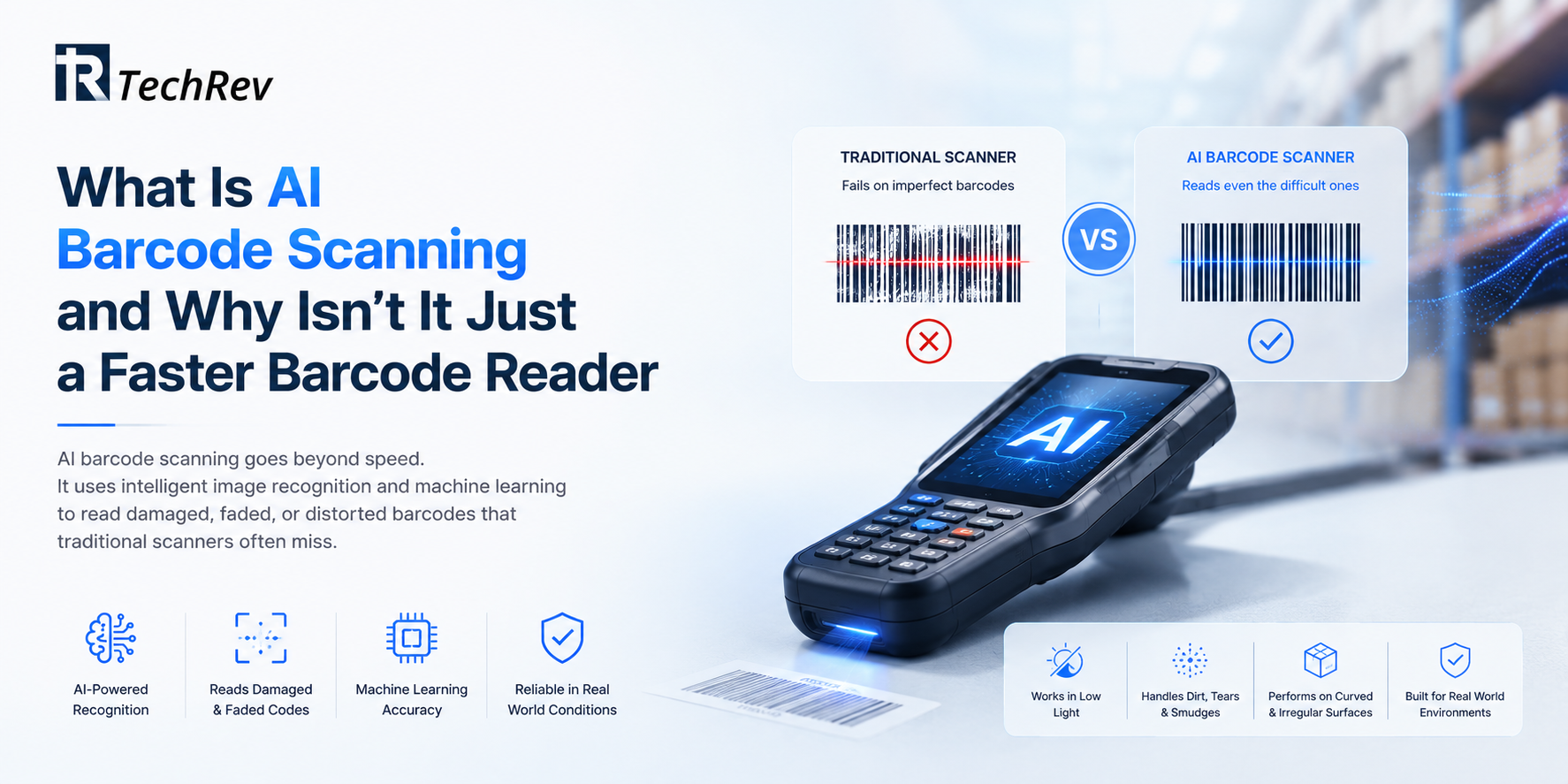
A traditional barcode scanner does one job: it reads a code and sends the data somewhere. That’s useful, but it’s also limited. If the barcode is smudged, torn, or printed on a curved surface like a curtain hook or a medical device casing, a standard scanner often just fails and someone has to key the number in by hand.
AI barcode scanning changes that equation. Instead of relying on a perfect, clean code, AI-assisted scanners use image recognition and machine learning to reconstruct damaged, partial, or low-contrast barcodes in real time.
According to a 2026 healthcare technology report, AI-powered barcode scanners deployed in bedside medication verification and patient identification workflows are being trained to identify damaged, partial, or low-contrast barcodes that conventional laser-based systems would reject, reducing scan failures at the point of care.
The Numbers Behind the Shift
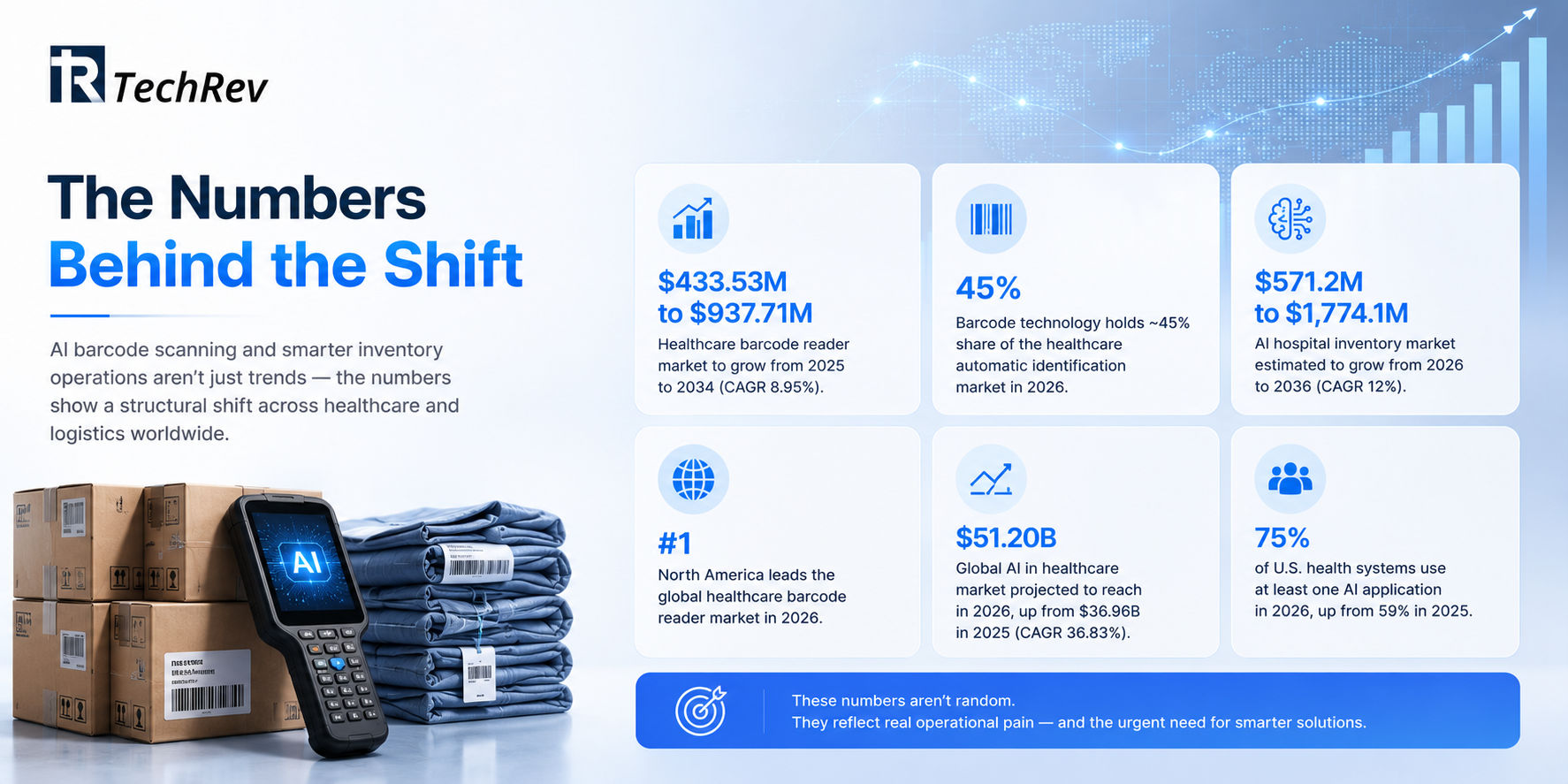
Growth Marketer perspective aside, the data tells its own story. This isn’t a niche trend, it’s a structural shift happening across healthcare and logistics simultaneously.
- The global healthcare barcode reader market is projected to grow from USD 433.53 million in 2025 to USD 937.71 million by 2034, at a CAGR of 8.95%.
- Barcode technology dominates the healthcare automatic identification market with about 45% share, ahead of RFID and biometric systems.
- The global AI hospital inventory market is estimated to be valued at USD 571.2 million in 2026, and is projected to reach USD 1,774.1 million by 2036, growing at a 12% CAGR.
- North America leads global adoption. North America is the leading region in the healthcare barcode reader market in 2026.
- On the broader AI in healthcare side, the global AI in healthcare market is projected to reach 51.20 billion dollars in 2026, up from 36.96 billion dollars in 2025, growing at a 36.83% CAGR.
- Adoption is accelerating fast among providers. 75% of U.S. health systems use at least one AI application in 2026, up from 59% in 2025.
Numbers like these don’t move because technology is trendy. They move because hospitals, laundries, logistics teams, and administrators are tired of losing track of physical inventory and paying for it in wasted labor, missing equipment, and billing errors that could have been avoided.
Where AI Barcode Scanning Actually Solves Real Operational Problems?
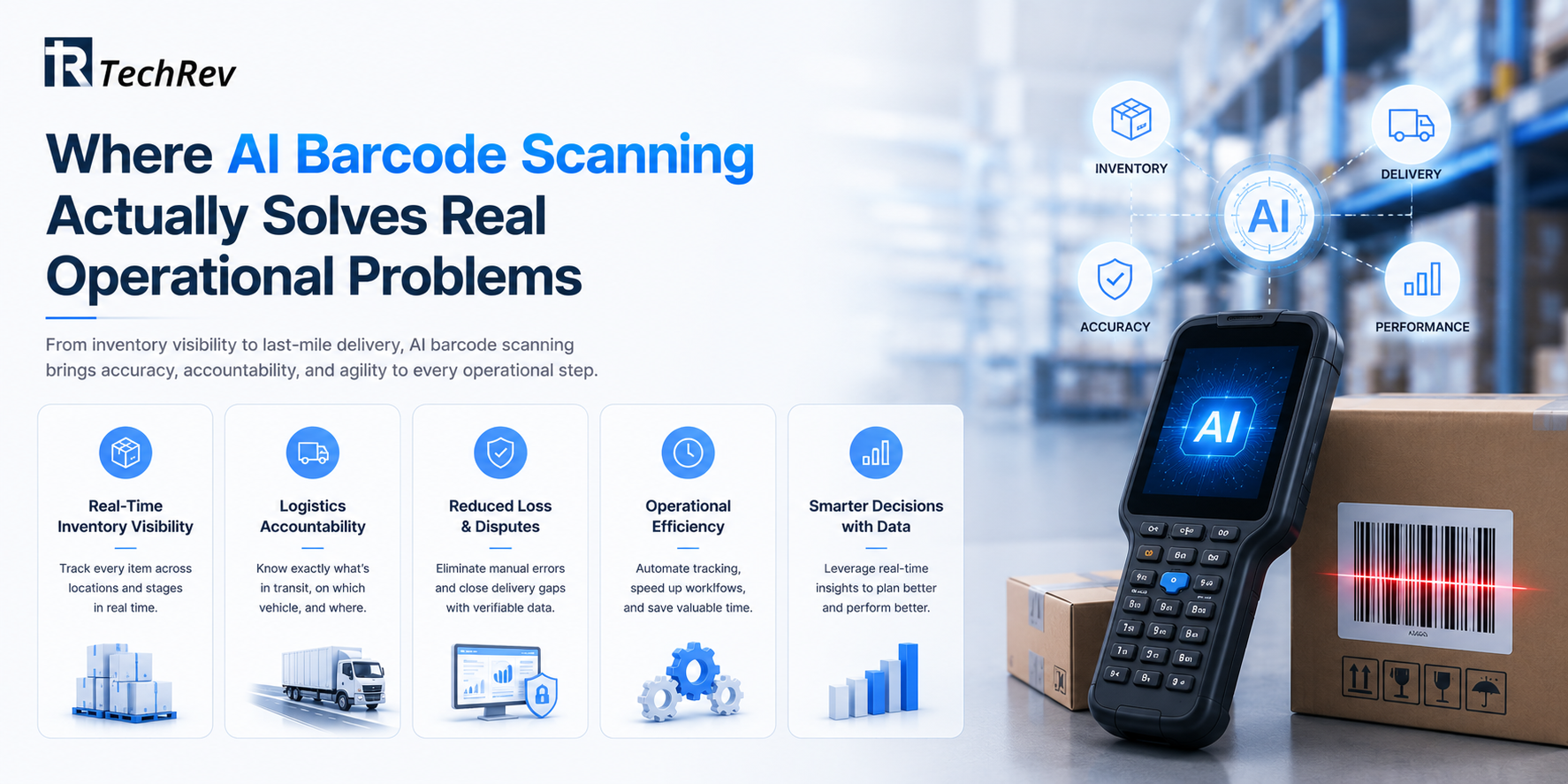
Let’s get specific, because AI barcode scanning can sound abstract until you see it applied to an actual daily operation.
1. Knowing exactly where every item is, at every stage
In any facility managing physical assets, be it curtains, surgical trays, or spare equipment, the hardest question to answer is usually the simplest one: where is it right now? Is it in storage, mid-wash, on a truck, or already installed?
A barcode-and-bag system solves this by scanning items into groups the moment they leave one stage and scanning them again the moment they enter the next. This is exactly the kind of gap that hospital inventory management software is designed to close, replacing manual counts with a continuous, verifiable chain of custody.
This is a place where TechRev’s healthcare app development work stands out. In one long-running healthcare operations platform, curtains are grouped into scanned bags before they even leave the laundry facility. Installers scan each bag when picking it up, scan it again when loading it into a vehicle, and every vehicle carries its own barcode too, so the system always knows which bags and curtains rode in which truck.
That’s not a theoretical workflow. It’s a working accountability system that turns “we think we delivered four bags” into “we know we delivered four bags, and here’s the timestamp.”
2. Logistics accountability at the vehicle level
Most businesses that move physical inventory between locations eventually hit the same wall: they know what left the warehouse, but they lose visibility the moment it’s in transit. Vehicle-level barcode tagging, combined with AI route optimization, closes that gap.
When each truck has its own scannable identity, dispatchers can match exactly which items are on which vehicle, at which stop, at any given time.
The payoff on the routing side alone is significant. Companies deploying AI across supply chain operations are seeing measurable results.
Companies deploying AI across their supply chain operations see 10-15% reductions in fuel costs, 15-20% faster average delivery times, and approximately 30% fewer late shipments.
In more mature deployments, the numbers get even bigger. Companies using AI route optimization report 15-25% reduction in transportation costs, 10-20% fuel savings, and ROI within 3-6 months. UPS is the most cited example, and the scale is worth understanding.
You don’t need to be UPS to benefit from this logic. A regional facility managing pickups, laundering, and deliveries across dozens of hospital locations can apply the same principle at a smaller, still meaningful scale.
3. Offline scanning for field teams working without signal
Hospitals are notorious for weak connectivity in basements, storage rooms, and older wings. A field technician installing equipment or curtains can’t wait for a signal bar to appear before scanning an item.
Modern AI-assisted mobile scanning solves this by capturing the scan, photo, and installation record locally, then syncing everything automatically the moment a connection returns.
This kind of offline-first mobile architecture is part of what separates real-world healthcare software development services from apps that only work in ideal conditions.
4. Verified proof-of-work and accurate commission calculation
When installation, delivery, or service work is tied to payment, whether that’s a technician’s commission or a client’s invoice, unclear records create disputes.
Barcode-tied proof-of-work, timestamped and photo-verified, removes the ambiguity. It also feeds directly into billing accuracy, since every scan becomes a data point that supports what was actually done, where, and when.
5. Reporting that reflects what’s actually happening on the ground
Operational reporting is only as good as the data feeding it. When barcode scans populate a reporting layer directly, instead of relying on someone typing numbers into a spreadsheet at the end of the day, reports on what was delivered, what’s pending wash, what’s overdue, and what needs billing become accurate in near real time.
This is where API-first, Dapper-based reporting architecture makes a measurable difference over legacy systems that were bolted together over the years.
The CubeCare: A Decade of Operational Logic, Modernized
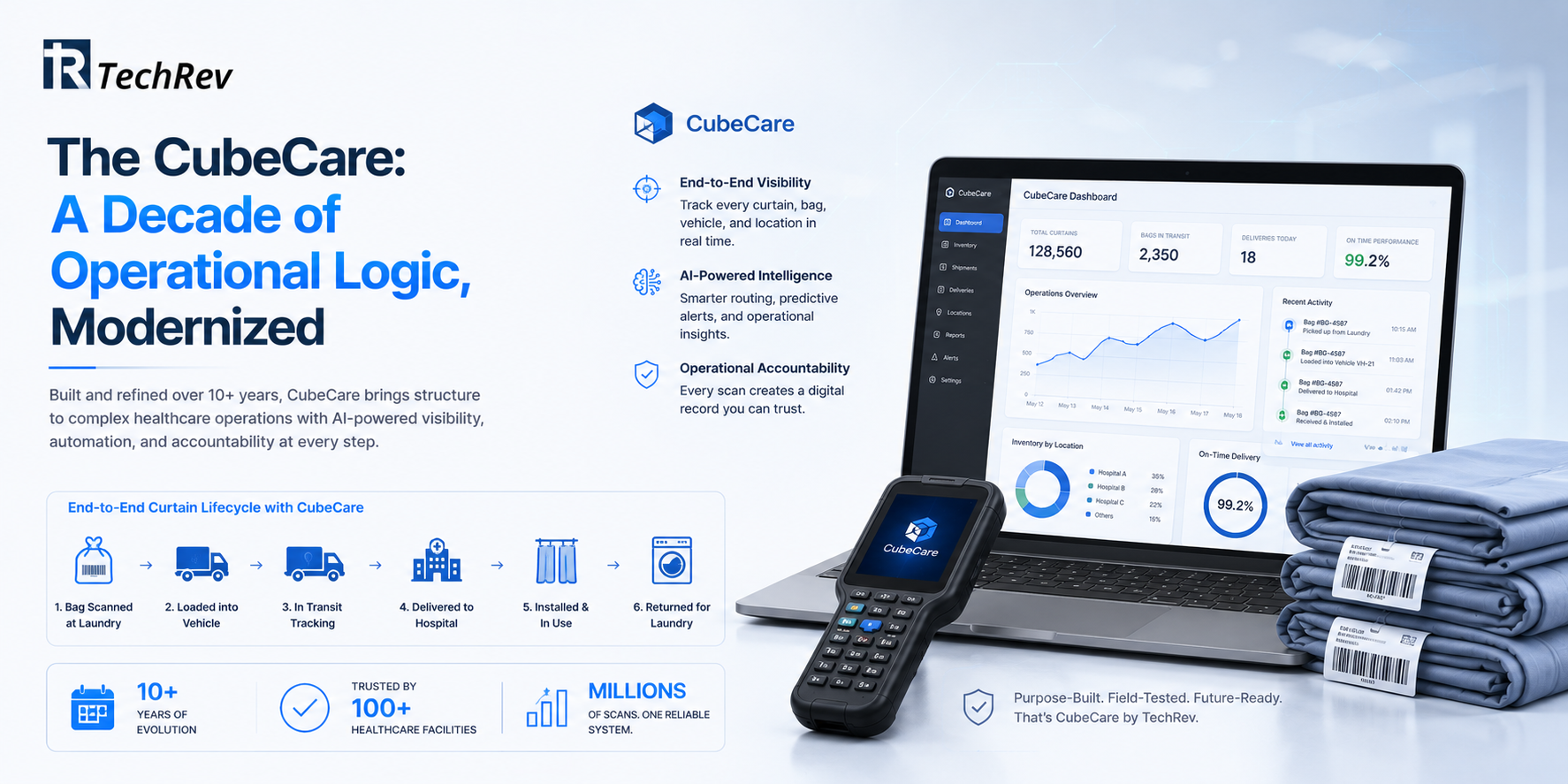
One of the clearest examples of this kind of transformation is a platform TechRev has worked on for over ten years: a business operations system built specifically to solve hospital curtain service problems.
What started as a way to track curtains from installation to laundering to reinstallation has grown into a full operational backbone covering scheduling, inventory, billing, and accountability.
The barcode and bag system inside this platform is a good case study in solving a very unglamorous but very expensive problem. Before it existed, there was no accurate way to count how many curtains installers picked up from the laundry and transported to a hospital. Curtains now get grouped into scanned bags.
Each bag gets scanned when it leaves the laundry, scanned again when it’s loaded into a truck, and the truck itself carries a barcode too. That means a facilities manager can trace a single curtain’s entire journey, laundry to vehicle to hospital room, without a single phone call to confirm it.
The modernization effort didn’t throw out years of hard-earned business logic. Instead, it reorganized curtain lifecycle tracking into cleaner APIs, added automated schedule calculations and reminder logic for hospital maintenance visits, and mapped complex hospital structures, buildings, units, rooms, and tracks into structured data instead of tribal knowledge held by a few employees.
It also rebuilt reporting around faster, Dapper-based queries so operational questions like “what’s pending wash” or “what needs billing” get answered in seconds instead of end-of-day spreadsheet reconciliation.
This is the kind of work that sits underneath a lot of conversations about AI in healthcare industry transformation. It’s rarely the flashy diagnostic AI headline. It’s the unglamorous, high-volume operational logic that keeps a hospital’s physical supply chain from quietly falling apart.
How TechRev Approaches This Kind of Build?
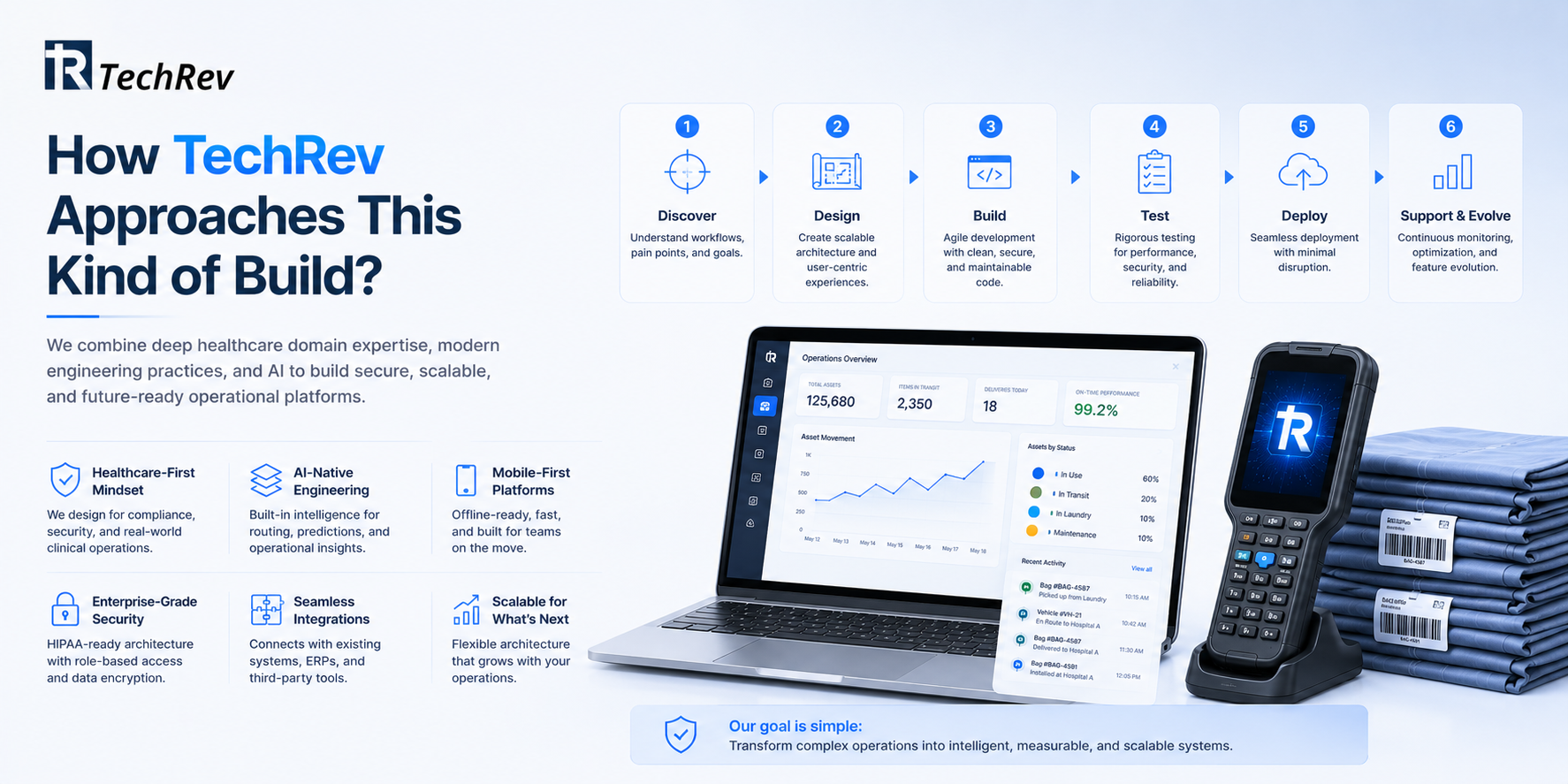
TechRev has spent close to a decade building and refining custom operations platforms for healthcare and service-based businesses, and the CubeCare-style barcode and logistics system is representative of a broader capability: turning messy, manual, paper-based or spreadsheet-based operations into structured, trackable, auditable software.
That capability spans several connected services:
- Custom healthcare software development services built around HIPAA-aware architecture, so scanning, tracking, and reporting workflows stay compliant from day one.
- AI application development services and AI ML development services that bring damaged-barcode reconstruction, predictive restocking, and anomaly detection into existing operational software.
- AI agent development services for autonomous workflows, like automatically flagging a hospital unit that’s behind on its maintenance schedule, without a human needing to check a dashboard.
- AI development services and generative AI development for the reporting and documentation side, turning raw scan data into readable operational summaries.
- LLM development for natural-language reporting interfaces, where a manager can ask “which hospital units are behind schedule this month” and get a direct answer instead of digging through a spreadsheet.
- Healthcare mobile app development services and broader healthcare workflow automation, connecting barcode data to scheduling, billing, and inventory in one system instead of five disconnected tools.
- A Service Management App or AI Service Management App layer that ties field technicians, dispatch, scheduling, and proof-of-work into a single mobile-first experience.
What does this actually deliver?
Clients working with TechRev on operational platforms like this typically see results across a few consistent categories: cost reduction from fewer manual reconciliation hours, better accountability from barcode-verified proof-of-work, and cleaner audit trails for billing disputes.
On the broader AI-in-operations side, the market data backs up why this investment pays off. Global AI in healthcare market is projected to reach 194.79 billion dollars by 2031 from 36.67 billion dollars in 2026, at a 39.7% CAGR.
That’s not a market healthcare organizations can afford to sit out of, especially when competitors are already automating the operational side of the business while yours is still counting inventory by hand.
Conversational AI and Route Intelligence: The Next Layer
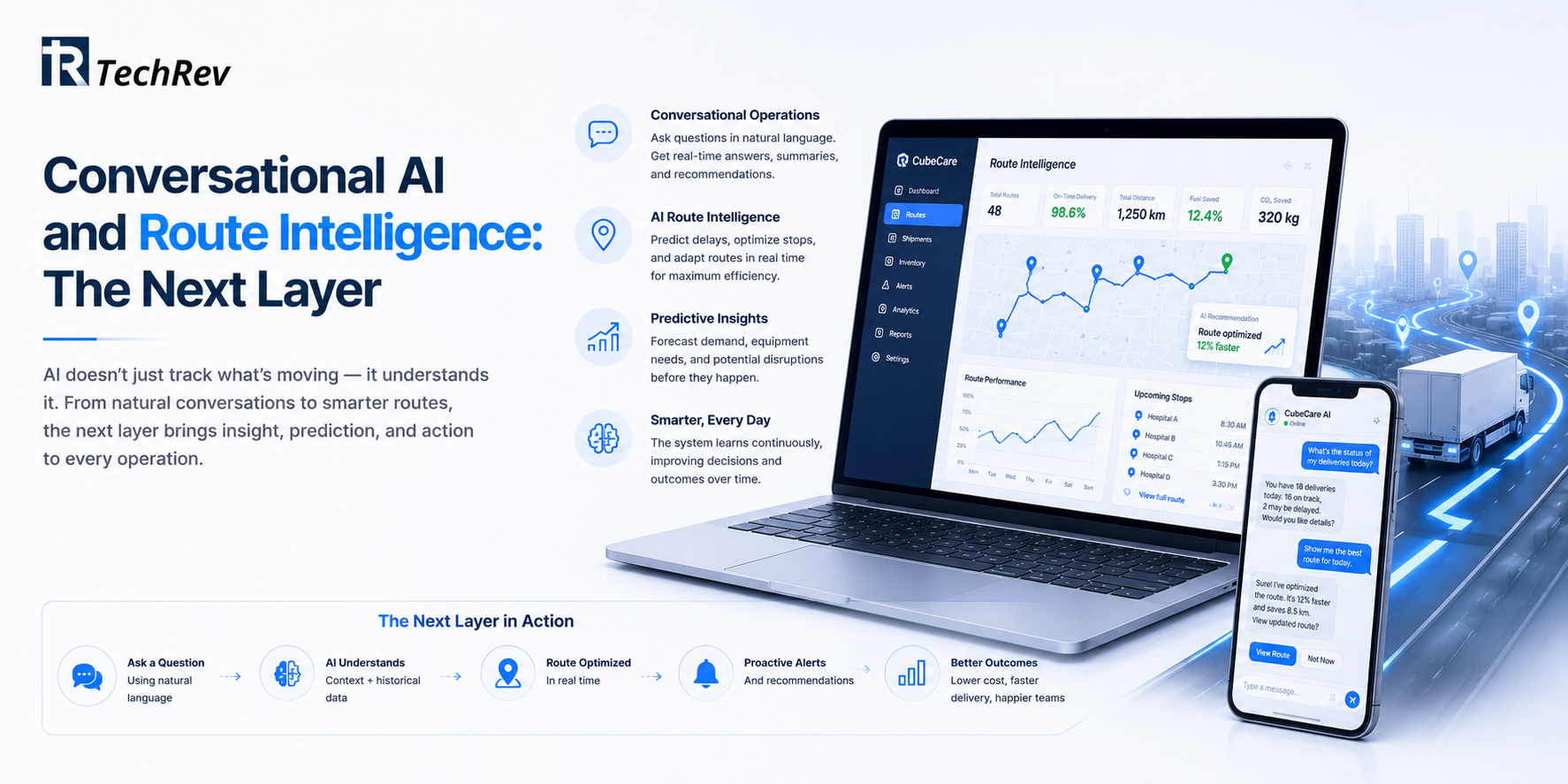
Barcode data doesn’t have to sit in a database waiting for someone to run a report. Increasingly, it feeds directly into two other fast-growing categories: conversational AI in healthcare and route intelligence.
On the conversational side, the shift is happening quickly. The global conversational AI in healthcare market was valued at USD 17.2 billion in 2025, projected to reach USD 21.62 billion in 2026, and forecast to expand to USD 212.92 billion by 2036 at a 25.7% CAGR.
Picture a facilities manager typing “how many curtain bags are overdue for pickup at Building C” into a chat interface and getting an instant, accurate answer pulled straight from scan data. That’s not science fiction. It’s a natural extension of systems that already have clean, structured barcode data to draw from.
On the routing side, AI route optimization connects directly back to barcode-scanned inventory. Once a system knows exactly what’s in each bag and which truck it’s loaded onto, it can plan the most efficient pickup and delivery sequence across dozens of hospital locations, factoring in traffic, time windows, and vehicle capacity simultaneously. Businesses implementing delivery optimization AI consistently report fuel savings of 15 to 30% within the first operational quarter.
A Practical Rollout Plan for Operations Teams
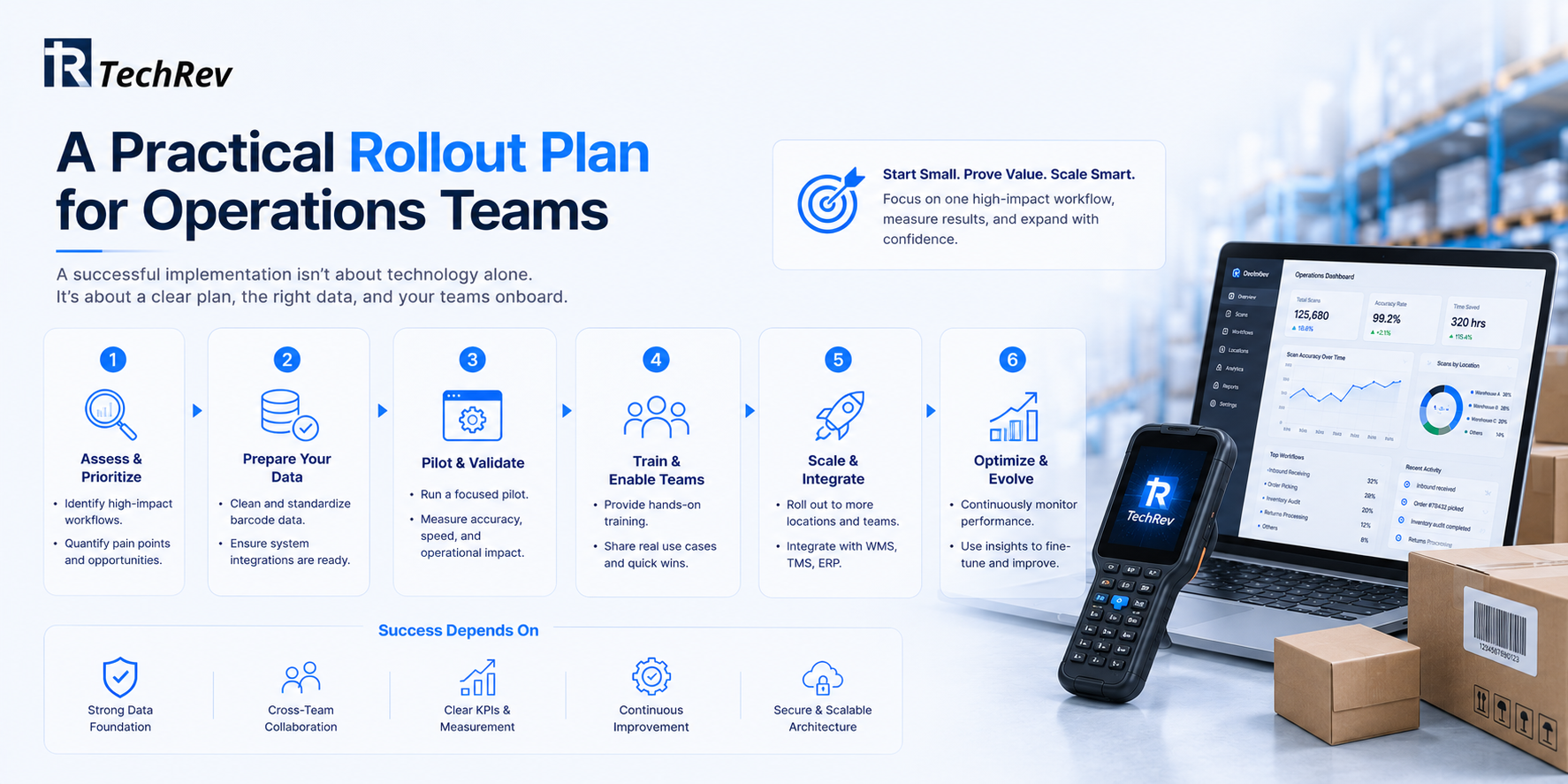
If you’re considering this kind of system for your own operation, here’s a realistic sequence, based on how platforms like this actually get built and adopted:
- Map your physical workflow first. Before any scanning technology gets introduced, document every stage an item passes through, pickup, wash, storage, delivery, installation, return. You can’t digitize a process you haven’t mapped.
- Start with barcode-and-bag grouping, not item-by-item scanning everywhere. Grouping items into scanned units, the way curtains get grouped into bags, cuts scanning volume dramatically while keeping accountability intact.
- Add vehicle-level tracking next. Once items are grouped and bagged, tagging the vehicles that move them closes the loop between “what left the facility” and “what arrived.”
- Layer in offline mobile capability for field staff. Any hospital-based rollout needs to assume weak or no connectivity in parts of the building.
- Connect scan data to reporting last, but make it a priority. This is where operational blind spots disappear, and where the reporting layer becomes the tool a CEO or operations director actually checks every morning.
Conclusion
AI barcode scanning isn’t a flashy headline technology, and that’s exactly why it matters. It’s the quiet infrastructure that turns guesswork into certainty: knowing where every curtain, every piece of equipment, and every delivery actually is, without a phone call or a manual count.
The market data makes it clear this shift is accelerating, not slowing down, and the organizations that build this kind of operational backbone now will be the ones running leaner, faster, and with far fewer costly blind spots in two years.
If your operation is still relying on spreadsheets, memory, and manual counts to track physical inventory, the technology to fix that already exists and it’s already been tested at scale.
TechRev has spent nearly a decade building exactly this kind of system for healthcare operations, and the same logic applies well beyond hospital walls. Talk to the team about what a barcode-driven, AI-assisted operations platform could look like for your business.
FAQs
1. Does AI barcode scanning actually reduce costs, or is it mostly about convenience?
It reduces measurable costs. Fewer re-scans, fewer manual data entry hours, faster reconciliation, and fewer disputes over missing inventory all translate directly into labor savings and reduced write-offs from lost or unaccounted-for items.
2. How is TechRev different from a general software development agency when it comes to healthcare operations?
TechRev has spent close to a decade specifically working on healthcare operations platforms, including a curtain-service system that already contains years of tested business logic around scheduling, inventory, barcode tracking, and billing. That means the team isn’t learning hospital workflow logic from scratch; it’s modernizing logic that’s already been proven in the field.
4. Can TechRev integrate AI barcode scanning into a system we already have, or does it require starting over?
Integration into existing systems is usually possible. TechRev’s approach favors exposing existing business logic through cleaner APIs rather than ripping out systems wholesale, which keeps disruption low while still modernizing the technology underneath.
5. What’s the typical timeline for building a custom barcode and inventory tracking system?
It depends on scope, but a focused module, like barcode-and-bag tracking for a single workflow, can move faster than a full platform rebuild. TechRev typically scopes this during an initial consultation based on your specific operational complexity.
6. Does TechRev only work with hospitals, or can other service-based businesses use this approach?
Any business that moves physical inventory between locations on a schedule, whether that’s medical equipment, uniforms, tools, or supplies, can apply the same barcode, routing, and reporting logic. Hospitals are one strong use case, not the only one.
7. Is this kind of system HIPAA compliant?
Yes. Barcode and inventory tracking systems built for healthcare environments are designed around role-based access, encrypted data handling, and audit logging from the start, which are core requirements for any system touching hospital operational data.