
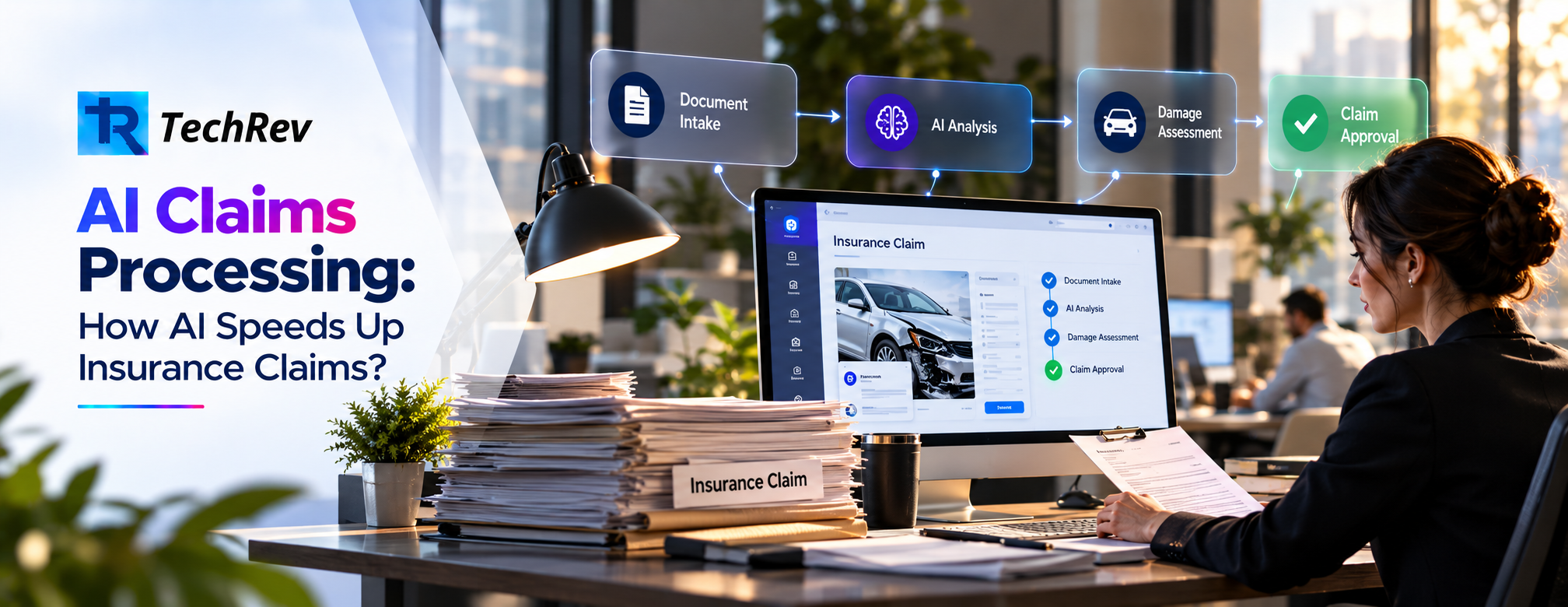
AI claims processing helps insurers move a claim from first report to payment in a fraction of the usual time. Instead of adjusters reading every form, photo, and invoice by hand, AI extracts the data, checks coverage, scores fraud risk, and fast-tracks simple claims. People still make the hard calls, but they spend far less time on paperwork.
Adoption is already broad. The NAIC’s Journal of Insurance Regulation reported in May 2026 that more than 70% of auto, homeowners, and health insurers use, plan to use, or are exploring AI, and that claims ranks among the most common uses.
The stakes are high too: the Coalition Against Insurance Fraud estimates that insurance fraud costs Americans about $308.6 billion a year.
What Is AI Claims Processing?
AI claims processing uses machine learning, computer vision, and language models to handle the steps of an insurance claim, from intake to settlement.
It reads documents and photos, pulls out key details, compares them with the policy, flags risk, and routes each claim to the right path. Simple, low-risk claims can move straight through to payment, while complex or suspicious ones go to an adjuster.
Now let’s see how it works.
How Does AI Claims Processing Work?
The following are some use cases:
1. First Notice of Loss
Claimants report losses through an app, web form, or chat assistant. AI asks follow-up questions, collects photos and documents, and creates a complete claim file from the start.
2. Document and Image Extraction
Optical character recognition and language models read police reports, medical bills, repair estimates, and invoices. Computer vision models can review photos of vehicle or property damage and estimate severity.
3. Coverage Check and Triage
The system compares claim details with policy terms, then scores each claim by complexity and risk. Low-risk claims follow a fast track, and complex ones go to experienced adjusters.
4. Fraud Detection
Models look for unusual patterns, such as repeated claimants, duplicate invoices, or links between parties across claims. Flagged claims go to special investigation teams for review.
5. Adjuster Support
Generative AI summarizes long claim files, drafts letters, and answers questions about policy language. With AI agents development, agents can also send status updates and request missing documents automatically.
Can AI approve claims on its own? For simple, low-value claims with clear coverage, many insurers allow straight-through processing. Denials and complex decisions should always involve a qualified person.
So that’s the workflow. But what rules shape how insurers use it?
What Rules Apply to AI Claims Processing?
1. The NAIC AI Model Bulletin
The National Association of Insurance Commissioners adopted its Model Bulletin on the Use of Artificial Intelligence Systems by Insurers in December 2023. More than half of US states and the District of Columbia have since adopted it.
It expects insurers to keep a written AI program with governance, risk controls, testing for bias, oversight of third-party AI, and notice to consumers.
2. Health Claims and Prior Authorization
California’s SB 1120, effective January 1, 2025, requires a licensed physician or qualified health professional to make medical necessity decisions, so AI alone cannot deny care.
Federally, the CMS Interoperability and Prior Authorization rule requires impacted payers to issue prior authorization decisions within 72 hours for urgent requests and seven calendar days for standard ones, starting in 2026.
3. Privacy and Security
Health claims fall under HIPAA, and many claims also touch state privacy laws. A healthcare app development company building claims tools must encrypt data, control access, and keep audit trails.
Rules set the guardrails. Moving on to the main point of this blog: the benefits.
What Are the Benefits of AI Claims Processing?
- Faster approvals: automated intake and triage cut the wait on simple claims.
- Lower costs: less manual data entry means adjusters handle more claims.
- Better fraud control: pattern detection catches suspicious claims earlier.
- Better customer experience: claimants get updates without calling in.
- More consistent decisions: the same rules apply to every claim, with a clear record of why.
What are the risks? Biased training data, opaque models, and over-automation of denials. Insurers reduce these risks with explainable models, regular bias testing, and human review.
That brings us to how TechRev helps.
How TechRev Builds AI Claims Processing Systems
TechRev is a US-based AI development company in Hollywood, Florida, shipping software since 2016 with 50+ products launched.
TechRev builds finance platforms with security and regulatory awareness built into the architecture, and business process automation that cuts manual data entry and handoffs.
What you get:
- Lower starting cost: lean MVPs start around $5,000; full AI or enterprise platforms start at $25,000.
- Clear timelines: compliance-heavy platforms usually take 3 to 6 months.
- Smarter intake: computer vision and NLP that read photos, forms, and documents.
- Compliance strength: a 94% compliance pass rate on HealthTech builds, backed by work as a healthcare app development company that ships HIPAA compliant apps.
As an AI app development company and a Generative AI development company in USA, TechRev offers AI development services, AI automation services, and AI agents development tied to a measurable outcome.
If you want to hire AI agent developers who use the best coding tools in 2026 with senior oversight,
TechRev gives you a US-based team. Clients work with TechRev through Software Development Services in Florida and Software Development Services in Texas.
Still have questions? Here are quick answers.
FAQs
1. Does AI claims processing replace adjusters?
No. It removes paperwork so adjusters can focus on complex claims, negotiations, and customer care.
2. Can TechRev add AI to my existing claims system?
Yes. TechRev integrates AI into existing products, wired into your real data and workflows. As an AI development company, it tests every AI build against a real business outcome.
3. What AI automation services does TechRev offer insurers?
TechRev’s AI automation services include document extraction, chatbots for intake and updates, predictive analytics, and business process automation.
4. Can I hire AI agent developers from TechRev for claims workflows?
Yes. You can hire AI agent developers from TechRev for AI agents development that requests documents and sends updates, delivered through its AI development services.
5. Do the best coding tools in 2026 make claims software compliant?
No. The best coding tools in 2026 speed up development, but compliance needs clear rules, testing, and human review.
6. Is TechRev a good healthcare app development company?
Yes. As a healthcare app development company and AI app development company, TechRev designs HIPAA compliance and EHR integration in from the start.
7. Where does TechRev serve clients?
As a Generative AI development company in USA, TechRev offers Software development services in Florida and Software development services in Texas.
Conclusion: AI Claims Processing Pays Off When People Stay in the Loop
AI claims processing helps insurers approve simple claims faster, catch fraud earlier, and free adjusters for the work that needs judgment. The winners pair automation with clear governance, explainable models, and human review on every denial.
Whether you need an AI development company, a Generative AI development company in USA,
AI development services, AI automation services, an AI app development company, or Software development services in Florida or Software development services in Texas, book a free call with TechRev and get a clear scope, timeline, and cost first.