
The most interesting enterprise AI agent use cases in 2026 are no longer ideas sitting inside innovation labs. Companies are putting agents into customer service, IT operations, sales, software development, finance, analytics, manufacturing, and internal knowledge workflows, then measuring what happens.
That shift matters.
Gartner forecasts worldwide AI spending will reach $2.59 trillion in 2026, up 47% year over year. AI services alone are projected at roughly $586 billion, while AI software spending is forecast at more than $453 billion. Gartner also expects enterprises to increase their use of AI agents across multiple workflows as multistep processes and integrations become more common.
But spending does not automatically equal transformation.
Forrester’s 2026 research found that about three-quarters of enterprise leaders say they are adopting agentic AI, while only a small minority have moved beyond limited or “agentish” deployments into meaningful production at scale.
That creates an important distinction:
Talking about AI agents is easy. Shipping an AI agent that works inside a real business is much harder.
This blog focuses on the second category.
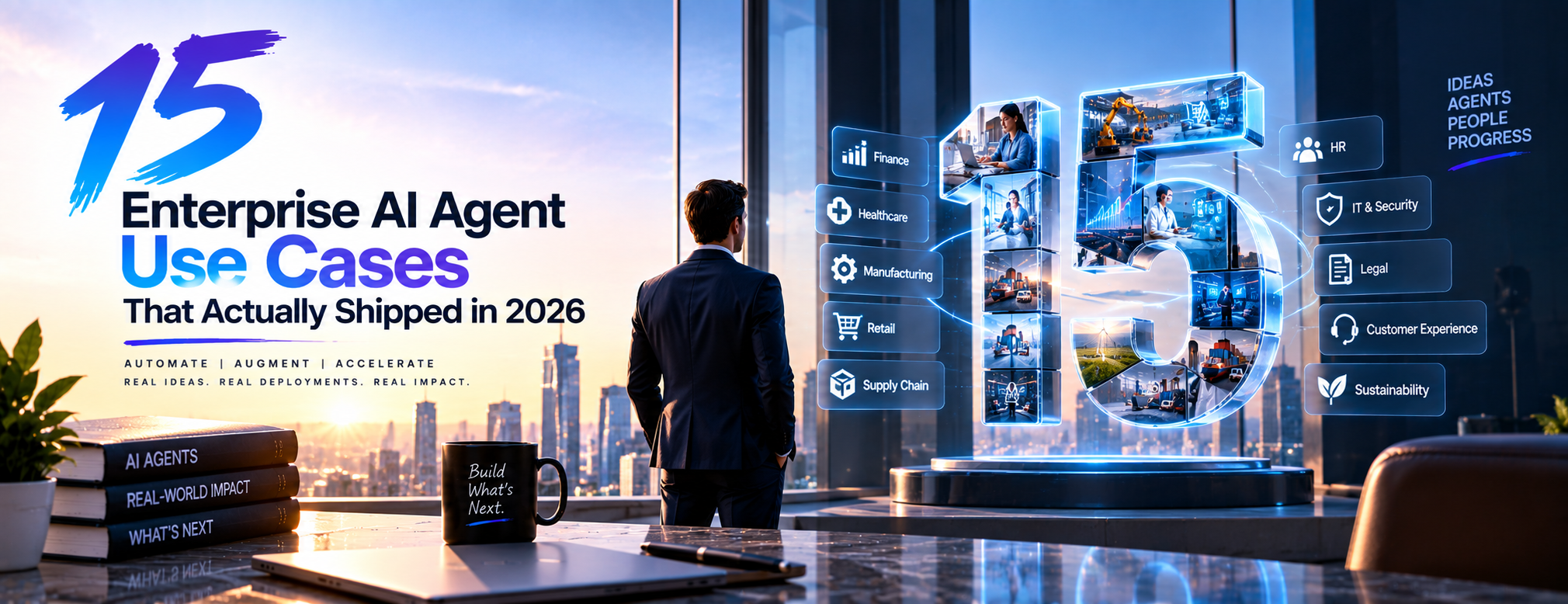
Below are 15 enterprise AI agent use cases backed by documented deployments, production examples, or enterprise implementations reported during 2026. The examples cover different industries and show where AI agents are generating measurable operational value.
What Is an Enterprise AI Agent?
An enterprise AI agent is software that can understand a business objective, reason over available information, use approved tools or systems, perform multiple steps, and complete an action with limited human intervention.
A traditional chatbot might answer:
“What is the status of my order?”
An AI agent can potentially:
- Identify the customer.
- Retrieve the order.
- Check inventory.
- Review shipping information.
- Detect a delay.
- Create a support ticket.
- Notify the customer.
- Escalate the issue if it crosses a defined threshold.
That difference explains why AI in enterprise environments is moving beyond simple question answering.
The agent becomes part of the workflow.
Modern enterprise agents commonly combine:
- Large language models
- Retrieval-augmented generation
- Enterprise search
- Vector databases
- APIs
- Function calling
- Workflow orchestration
- Business rules
- Identity and access controls
- Human approval checkpoints
- Observability
- Evaluation frameworks
- Audit logs
- Cloud infrastructure
This is also why AI agents development requires much more than connecting an LLM to a chat interface.
The difficult part is usually not generating text. It is giving the system the right context, permissions, tools, data, guardrails, and feedback mechanisms.
Why 2026 Is the Year Enterprise AI Agents Moved Into Production?
The market numbers tell only part of the story.
Contentstack’s 2026 Agentic Enterprise Report surveyed 621 enterprise digital leaders. It found that 58% had agentic AI programs actively running in production, while another 33% were in pilot or active testing. Among companies with production programs, 69% said those programs were being used across multiple departments or business units.
The same research also exposed the difficult side of enterprise adoption:
- 78% encountered content or data readiness issues.
- 82% encountered at least one significant adoption barrier.
- 37% cited integration with existing processes or technology as a major barrier.
- 34% cited governance and security concerns.
- 42% said the lack of a clear internal owner had delayed an agentic AI initiative.
- Only 48% had clearly defined KPIs and actively measured agentic AI impact.
This explains why the best AI in enterprise deployments tend to follow a simple pattern:
Specific workflow + measurable problem + controlled system access + clear KPI.
The winning strategy is not “put an agent everywhere.”
It is “give an agent one important job, connect it to the systems it needs, measure the outcome, then expand.”
15 Enterprise AI Agent Use Cases That Actually Shipped
1. Customer Service Agents Handling High-Volume Queries
Customer service remains one of the clearest enterprise AI agent use cases because the workflow contains enormous volumes of repetitive questions, structured data, predictable policies, and measurable outcomes.
Air India provides one of the strongest examples.
According to Microsoft, Air India’s AI.g system handles approximately 40,000 customer queries every day across more than 1,300 different questions. The system supports requests ranging from booking changes to refund-related questions and reached a viable product within six months of development.
That is not simply a chatbot answering FAQs.
The system operates within a customer-service environment where the quality of the interaction affects both operating costs and customer satisfaction.
What the agent can do
A mature customer service agent can:
- Understand customer intent
- Retrieve account information
- Search policies
- Check transaction status
- Retrieve order information
- Initiate approved workflows
- Summarize conversations
- Escalate complex cases
- Maintain conversational context
This is one area where Generative AI development services can create measurable operational value when the model sits inside a controlled workflow rather than operating as a standalone chat window.
Why businesses care?
If an organization handles hundreds of thousands or millions of customer interactions every month, even a modest automation rate can materially affect cost per interaction.
The KPI should not simply be “number of conversations handled by AI.”
Better metrics include:
- First-contact resolution
- Average handling time
- Escalation rate
- Cost per resolved interaction
- Customer satisfaction
- Repeat contact rate
- Revenue recovered
- Internal Employee Support Agents
The second major category is internal support.
Regal Rexnord used Microsoft Copilot Studio to build an enterprise-wide employee agent. Microsoft reports that the agent handles more than 2,000 employee inquiries per month and saves approximately 2,400 hours annually. The company also deployed a customer-facing agent serving more than 1,000 weekly users with satisfaction often reaching 90%.
This illustrates an important lesson about AI agents development.
You do not always need an entirely new AI application.
The agent can sit on top of systems employees already use.
Common internal support workflows
An enterprise agent can help employees:
- Find policies
- Search knowledge bases
- Troubleshoot common issues
- Submit IT requests
- Check application status
- Locate documentation
- Answer HR questions
- Start approval workflows
- Retrieve information from enterprise systems
The ROI becomes particularly attractive when employees repeatedly ask the same questions.
If 10,000 employees each spend several minutes searching for information every week, the cumulative cost becomes substantial.
- IT Helpdesk and Incident Management
IT operations are another strong fit for agentic AI development.
Iberdrola implemented agentic architectures for IT operations using Amazon Bedrock AgentCore and ServiceNow. The deployment targeted thousands of change requests and incident tickets and focused on change-request validation, incident enrichment, and conversational change-model selection.
This use case is particularly interesting because IT tickets already contain structured information.
An agent can examine:
- Previous incidents
- System logs
- Configuration information
- Change history
- Knowledge articles
- Service dependencies
- User information
Then it can recommend or execute approved actions.
A practical enterprise workflow
A production IT agent might:
Detect → investigate → classify → recommend → request approval → execute → verify → document
That is much more powerful than generating a troubleshooting paragraph.
For high-risk actions, enterprises should keep humans in the approval loop.
- AI Agents for Software Development
Software engineering became one of the most visible areas of agentic AI in 2026.
OpenAI reported that Codex usage inside the company expanded significantly across engineering, research, customer support, legal, and recruiting. By June 2026, research usage had increased 56 times compared with November 2025, while engineering usage had increased 27 times.
Endava also uses Codex across its software delivery lifecycle. The company reported reducing requirements-analysis work from weeks to hours and compressing other work from weeks into days.
This is a major shift in AI in enterprise.
The agent is not simply autocomplete.
It can work across multiple stages:
- Requirements analysis
- Code generation
- Code explanation
- Repository search
- Test generation
- Debugging
- Documentation
- Pull request preparation
- Code review support
- Migration work
Why this matters financially
Engineering time is expensive.
If an agent reduces repetitive development work without compromising quality, the company can potentially:
- Ship features faster
- Reduce backlog
- Increase developer capacity
- Shorten release cycles
- Reduce time spent on maintenance
- Improve documentation coverage
The correct KPI is not “lines of code generated.”
Measure:
time from requirement to production-ready change.
- Sales Agents That Give Reps More Selling Time
Sales teams spend enormous amounts of time researching accounts, preparing meetings, updating CRM records, and finding information.
That makes sales one of the strongest enterprise AI agent use cases.
AWS reported deploying more than 20 domain-specific agents across its global sales organization before creating Field Advisor to orchestrate those capabilities. The objective was to reduce the cognitive burden of switching between specialized agents and systems.
OpenAI has also reported a large investment company using agents end-to-end across its sales process, creating more than 90% additional time for salespeople to spend with customers.
A sales agent can:
- Research an account
- Summarize recent activity
- Identify buying signals
- Prepare meeting briefs
- Draft follow-ups
- Update CRM records
- Recommend next actions
- Surface relevant products
- Coordinate internal approvals
The key is integration.
A sales agent disconnected from Salesforce, HubSpot, email, calendar, product databases, and internal knowledge will remain an assistant.
A connected agent can become part of the revenue workflow.
- Lead Qualification and Re-Engagement
Another commercially valuable use case is lead qualification.
Cars24 reported that its OpenAI-powered agents handle more than 1 million monthly conversation minutes, increase customer-support resolution rates by 50%, reduce turnaround time across key service workflows by 80%, and recover 12% of previously lost seller leads through AI-powered re-engagement.
That last metric is particularly important.
An agent does not have to create a new lead to generate value.
It can recover revenue already sitting inside the database.
A lead agent can:
- Respond immediately.
- Ask qualifying questions.
- Determine intent.
- Match the lead against business rules.
- Score the opportunity.
- Schedule a meeting.
- Update the CRM.
- Trigger follow-up.
- Re-engage dormant prospects.
- Escalate high-value opportunities.
This is where AI agents development can directly connect technology spending to revenue.
- Finance and Accounts Payable Automation
Finance contains some of the most valuable but sensitive AI agent workflows.
OpenAI and PwC announced a collaboration focused on AI agents for the office of the CFO, covering planning, forecasting, reporting, procurement, payments, treasury, tax, and accounting close. The stated focus is on real finance workflows, governance, and human oversight rather than theoretical demonstrations.
AWS also documented an enterprise deployment that used agentic AI to replace manual exception handling in direct-ship billing. The solution reportedly improved issue resolution and revenue realization within five weeks of deployment.
Why finance is a good fit
Finance processes often have:
- Structured records
- Defined policies
- Approval thresholds
- Repetitive reconciliation
- Clear audit requirements
- High transaction volumes
An agent could investigate an invoice exception, compare records, identify discrepancies, retrieve supporting documents, recommend a resolution, and route the case for approval.
The agent should not automatically approve every financial transaction.
That is where governance matters.
- HR and Employee Administration
HR departments process large volumes of repetitive requests.
Works Human Intelligence worked with AWS to build two AI agents for business support around its HR system. AWS reported that the resulting solution could reduce costs by up to 97% in the targeted business-support workflows while improving operational efficiency.
Potential workflows include:
- Employee information requests
- Policy questions
- Organizational changes
- HR system updates
- Workflow initiation
- Document retrieval
- Case classification
- Employee onboarding
This is an excellent example of where Generative AI development services can move beyond content creation and become operational infrastructure.
- Enterprise Knowledge and Research Agents
Enterprise knowledge is often scattered across SharePoint, PDFs, databases, emails, CRM records, documents, and internal applications.
An employee may technically have access to all of this information but still spend hours finding it.
Sanofi’s Concierge demonstrates how a large organization can turn AI into an enterprise access layer.
AWS reports that Sanofi’s AI-powered Concierge reached 72,000 monthly users, generated approximately 11 million conversations, and achieved a 90% positive-feedback rating. The system evolved into an agentic hub connecting employees to specialized agents for data retrieval, system write-back, and workflow automation.
This changes the user experience.
Instead of asking:
“Which application contains this information?”
Employees can ask:
“Find the latest manufacturing transfer report, compare it with last quarter’s data, and summarize the risks.”
The agent handles the retrieval and orchestration.
- Business Intelligence Agents
Executives do not always want another dashboard.
Sometimes they want an answer.
AWS described NarrateAI, an agentic conversational intelligence solution that connects business data with a conversational interface. The system allows leaders to ask natural-language questions about business performance and receive contextual insights.
OPLOG also built a production-ready AI-agent-based business intelligence system to address fragmented data and time-consuming manual reporting.
The shift from dashboards to questions
Traditional BI:
Open dashboard → filter data → export report → analyze → ask another question
Agentic BI:
Ask question → retrieve data → analyze → explain → drill down → recommend next action
This does not mean dashboards disappear.
It means the interface becomes more flexible.
For enterprise AI, the real opportunity lies in connecting natural-language interaction with governed data and deterministic business logic.
- Manufacturing and Production Optimization
Manufacturing is another area where agents can influence physical business outcomes.
OpenAI reported that a major manufacturer used agents to reduce production optimization work from six weeks to one day. It also reported an energy producer using agents to increase output by up to 5%, representing more than $1 billion in additional revenue.
These examples demonstrate why agentic AI development is moving beyond customer-facing chat.
Manufacturing agents can potentially work across:
- Production data
- Maintenance schedules
- Quality information
- Supply chain signals
- Inventory
- Equipment data
- Forecasts
- Engineering documentation
The agent can analyze the situation, recommend changes, simulate options, and route decisions to operators.
The architecture becomes more sophisticated when the agent interacts with physical systems.
That is where permissions, monitoring, simulation, and human approval become essential.
- Supply Chain and Procurement Agents
Supply chain decisions require information from multiple sources.
Athena Intelligence, for example, has developed agentic back-office automation for regulated environments that can pull information from Excel, PowerPoint, email, SharePoint, and SQL systems, then synthesize that information into forecasts used for purchasing and supply chain decisions.
A supply chain agent could:
- Monitor inventory
- Detect anomalies
- Review supplier performance
- Compare purchase orders
- Analyze demand forecasts
- Identify potential shortages
- Prepare procurement recommendations
- Trigger approved purchase workflows
The important phrase here is recommendation with controlled execution.
An agent should not automatically spend millions of dollars because a model interpreted a spreadsheet incorrectly.
Enterprise-grade AI requires policy boundaries.
- SAP and ERP Process Automation
ERP systems contain enormous amounts of enterprise logic, but they also contain complex workflows that require significant manual effort.
KTern.AI used Amazon Bedrock AgentCore to build agents for SAP transformation workloads. AWS reports that the agents can autonomously orchestrate workflows covering reverse engineering, fit-to-standard analysis, code analysis, and exception mining across finance and sales processes.
This is one of the most important enterprise patterns in 2026:
AI agents are becoming an orchestration layer over existing enterprise software.
Companies do not necessarily need to replace their ERP.
They can build an intelligent layer around it.
That opens opportunities for AI agents development across:
- SAP
- Salesforce
- ServiceNow
- Microsoft Dynamics
- Oracle
- Custom CRMs
- Data warehouses
- Internal applications
- IT and Business Operations Orchestration
UNACEM provides another useful industrial example.
IBM reported that the company adopted an agentic AI operating model with watsonx Orchestrate to address a logistics bottleneck and improve productivity across its operations. UNACEM operates across five countries and more than 40 subsidiaries.
The lesson is bigger than one company.
Enterprise automation increasingly needs orchestration.
A single agent can perform one task.
An orchestrated system can coordinate several specialized agents.
For example:
Customer request → identity agent → policy agent → finance agent → fulfillment agent → notification agent
That is where multi-agent architecture starts to become useful.
But companies should not build multi-agent systems simply because they sound advanced.
If one well-designed agent can solve the workflow, one agent is usually the better engineering choice.
- Agentic Applications for Customer and Operational Workflows
The final category brings several patterns together: agents embedded directly into the product experience.
OpenAI’s 2026 enterprise work around agents emphasizes systems that can answer questions, resolve issues, use company systems, take approved actions, and escalate to humans when necessary.
This represents a broader transition.
The AI agent does not necessarily live on a separate AI website.
It can live inside:
- A healthcare application
- A financial platform
- A logistics system
- A legal application
- A SaaS product
- A mobile application
- An enterprise portal
- A CRM
- An eCommerce platform
This is where an AI app development company can create significantly more value than simply adding a chatbot.
The agent becomes part of the product’s core workflow.
What Technology Powers Enterprise AI Agents?
A production AI agent usually needs considerably more than an LLM.
1. Foundation Models
The reasoning layer may use models from OpenAI, Anthropic, Google, Meta, or other providers.
Enterprises increasingly use model routing rather than committing every workflow to one model.
The right model depends on:
- Accuracy
- Latency
- Cost
- Context requirements
- Privacy
- Reasoning performance
- Multimodal requirements
- Retrieval-Augmented Generation
RAG allows agents to retrieve relevant information from enterprise sources before generating a response.
This becomes critical when the agent needs current company information.
TechRev’s LLM development services include RAG-based architectures, enterprise knowledge systems, LLM application development, and secure integrations.
- APIs and Tool Calling
An agent becomes useful when it can take action.
Examples include:
- Create a CRM record
- Update a ticket
- Retrieve an invoice
- Schedule an appointment
- Check inventory
- Send a notification
- Generate a report
- Trigger an approval
Tool calling turns language intelligence into operational capability.
- Agent Orchestration
The orchestration layer manages:
- Task planning
- Tool selection
- State
- Memory
- Agent coordination
- Failure handling
- Retry logic
- Human escalation
This is one reason businesses exploring AI agents development company options should evaluate engineering capability, not just model expertise.
- Identity and Access Management
Enterprise agents should never have unlimited permissions.
Access should follow least-privilege principles.
An agent that can read payroll data should not automatically have permission to modify payroll.
An agent that can create a purchase order should not necessarily have authority to approve it.
- Evaluation and Observability
A production agent needs continuous evaluation.
Teams should track:
- Task success rate
- Hallucination rate
- Tool-call errors
- Escalation rate
- Latency
- Token consumption
- Cost per task
- User satisfaction
- Policy violations
This becomes even more important as AI systems become autonomous.
What Should Enterprises Automate First?
Not every process deserves an AI agent.
A practical prioritization framework is:
| Factor | Strong Candidate |
| Volume | High |
| Business rules | Clear |
| Data availability | Good |
| System integrations | Available |
| Human intervention | Repetitive |
| Risk | Manageable |
| KPI | Easy to measure |
| ROI | Visible within months |
The strongest candidates usually sit somewhere between customer service, IT, sales operations, finance operations, knowledge management, and internal support.
High-risk autonomous decision-making should come later.
What Are the Biggest Risks of Enterprise AI Agents?
Enterprise adoption creates a new security challenge.
An agent may have access to databases, APIs, documents, internal applications, and customer information.
That means a compromised or poorly configured agent could cause more damage than a simple chatbot.
Current 2026 reporting has highlighted concerns around agent permissions, vulnerabilities, and expanded attack surfaces as agents gain access to enterprise systems.
Key risks include:
- Prompt injection
- Excessive permissions
- Data leakage
- Hallucinated actions
- Incorrect tool calls
- Insecure API access
- Model drift
- Poor auditability
- Shadow AI
- Uncontrolled agent proliferation
- Unexpected inference costs
The answer is not to stop using agents.
The answer is to engineer them properly.
Where Does TechRev Fit Into Enterprise AI Agent Development?
Businesses rarely need another generic chatbot.
They need an AI system connected to the software they already use.
That is where TechRev positions its AI agents development capabilities.
TechRev’s AI Agent Development Company service covers AI agent consulting, custom agent development, conversational agents, enterprise integrations, agentic AI development, optimization, and deployment.
The approach focuses on connecting agents with enterprise workflows rather than treating AI as an isolated feature.
What TechRev Can Help Build
TechRev’s AI agent capabilities include:
- Customer support agents
- Recruitment agents
- Sales agents
- Marketing agents
- Finance agents
- Fraud and compliance agents
- Knowledge assistants
- Workflow automation agents
- Conversational agents
- Multi-agent systems
That makes TechRev relevant for organizations evaluating an AI development company for a specific production workflow.
Why Choose TechRev for AI Agent Development?
A serious enterprise deployment needs more than developers who know how to call an LLM API.
It needs product engineering.
TechRev combines AI capabilities with software development, integrations, cloud infrastructure, and application engineering. Its AI agent service covers architecture, data preparation, integration, testing, optimization, deployment, and continuous improvement.
1. Build Around Existing Systems
Instead of forcing a business to replace its CRM, ERP, or operational platform, agents can connect through APIs and integration layers.
2. Start With One Measurable Workflow
This reduces the risk of spending heavily before proving value.
3. Build for Enterprise Data
TechRev works with LLMs, vector databases, APIs, orchestration, and cloud infrastructure including AWS, Azure, and GCP.
4. Add Human Oversight
High-risk decisions can require approval before execution.
5. Optimize After Launch
Agent performance changes as data, users, models, and workflows change.
That makes monitoring and optimization part of the product rather than an afterthought.
When Should You Hire AI Agent Developers?
You should consider whether to hire AI agent developers when your organization has a workflow that:
- Runs frequently
- Requires contextual decisions
- Uses multiple enterprise systems
- Consumes significant employee time
- Has measurable financial impact
- Needs customization that off-the-shelf tools cannot provide
Do not hire a large AI team simply because competitors are talking about agents.
Start with one workflow.
Prove the economics.
Then scale.
If you need a broader engineering team, TechRev also offers software development resources for USA businesses, including access to specialized developers and scalable development capacity.
How Much Does AI Agent Development Cost?
There is no single price.
A basic agent connected to one knowledge base can cost dramatically less than a regulated multi-agent platform integrated with ERP, CRM, payment, identity, and analytics systems.
TechRev’s existing AI agent development cost guide explains how architecture, RAG, integrations, reasoning complexity, and deployment requirements affect project scope.
Typical cost drivers include:
Agent complexity
A simple support agent is easier than a multi-agent orchestration system.
Number of integrations
Every additional enterprise system introduces engineering and security requirements.
Data requirements
Messy enterprise data can become one of the largest hidden costs.
Model usage
High-volume workflows can create significant inference expenses.
Compliance
Healthcare, financial services, legal, and other regulated environments require stronger controls.
Monitoring
Production systems need evaluation, logging, analytics, and optimization.
The best approach is to price the workflow rather than the buzzword.
Conclusion: Enterprise AI Agents Are No Longer a Science Project
The most important lesson from these 15 deployments is simple.
The enterprise AI market is moving from AI that talks to AI that works.
Air India is handling tens of thousands of customer queries daily. Regal Rexnord is saving thousands of employee hours. Cars24 is recovering lost leads and improving resolution rates. Sanofi is putting an AI companion in the hands of tens of thousands of employees. Iberdrola is applying agents to IT operations. Endava is using agents across software delivery. Manufacturers are applying agents to production optimization.
These are not predictions.
They are signals of where enterprise software is going.
The opportunity for businesses is not to deploy the most agents.
It is to identify the workflows where an agent can create measurable economic value.
That could mean fewer support hours.
- Faster sales cycles.
- Lower operational costs.
- More productive engineers.
- Faster incident resolution.
- Better customer experiences.
- More accurate business intelligence.
Or revenue that previously slipped through the cracks.
For companies evaluating AI agents development, the smartest starting point is still a focused workflow with a clear KPI.
TechRev can help businesses move from that workflow assessment to architecture, development, integration, deployment, and optimization through its AI Agent Development services.
If the business case is strong, build the first agent.
- Then prove it.
- Then scale it.
That is how enterprise AI becomes a business system instead of another technology experiment.