
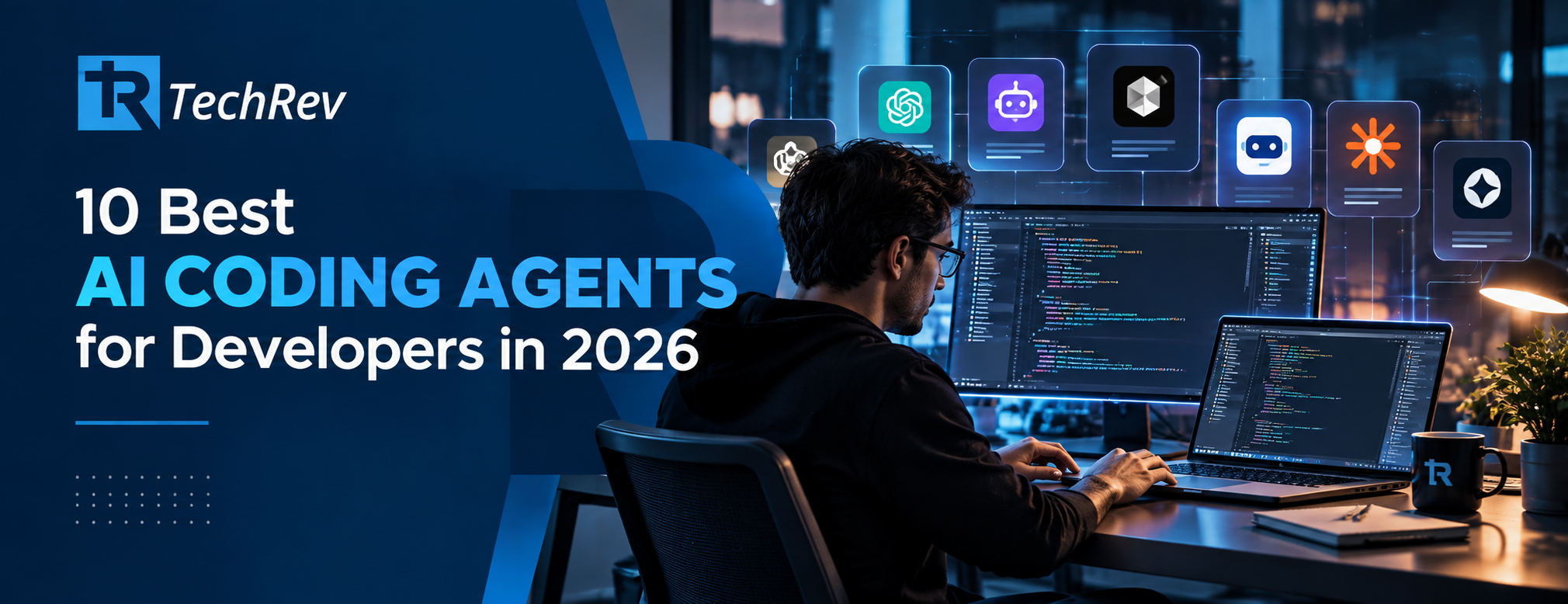
The best ai coding agents 2026 are no longer simple autocomplete tools that suggest the next line of code. They can inspect repositories, plan multi-file changes, write and test code, run terminal commands, review pull requests, refactor legacy systems, and work across long-running engineering tasks.
That shift is changing what enterprise software teams expect from AI.
Cursor crossed a $2 billion annualized revenue run rate in February 2026. GitHub moved Copilot to usage-based billing on June 1, 2026, tying usage to GitHub AI Credits. Replit’s Agent 4 introduced parallel task execution, with Replit reporting that its AI resolves merge conflicts automatically about 90% of the time. The same month, Replit announced a $400 million Series D at a $9 billion valuation.
The enterprise market is moving in the same direction.
Gartner forecasts that 40% of enterprise applications will include task-specific AI agents by the end of 2026, compared with less than 5% in 2025. Gartner also expects more than 70% of enterprise software engineers to rely on AI coding agents for synchronous and asynchronous development tasks by 2028.
But there is an important catch.
The best AI coding agent for a startup developer is not automatically the best AI coding agent for a 500-person engineering organization.
Enterprise teams have to consider security, governance, code ownership, model access, auditability, cost controls, deployment options, developer adoption, CI/CD integration, context management, MCP access, and human review.
So, which tools actually deserve attention in 2026?
This blog compares Claude Code, Cursor, GitHub Copilot, Devin, Codex, Windsurf, Cline, Replit Agent, Codegen, and Amazon Q Developer from an enterprise perspective.
Why AI Coding Agents Matter More in 2026?
AI-assisted software development has moved well beyond code completion.
According to Stack Overflow’s 2025 Developer Survey, 84% of respondents use or plan to use AI tools in their development process, while 51% of professional developers use AI tools daily. At the same time, 46% of developers said they actively distrust the accuracy of AI output.
That combination tells enterprise leaders something important:
Adoption is rising faster than trust.
Developers want AI because it removes repetitive work. They still want humans involved because production software carries real consequences.
Stack Overflow found that roughly 70% of AI agent users agreed that agents reduced time spent on specific development tasks, while 69% said agents increased productivity. Yet 87% of respondents expressed concerns about AI agent accuracy, and 81% had concerns about security and privacy.
That is exactly why enterprise AI coding agents need a governance layer.
A coding agent that can change 40 files in five minutes can also introduce a security flaw in five minutes.
The opportunity and the risk grow together.
Also Read – How to Build an AI Agent for Real Business Use?
What Is an AI Coding Agent?
An AI coding agent is a software system that can understand a development objective, inspect a codebase, use tools, modify files, execute commands, run tests, evaluate results, and continue working toward the requested outcome.
Traditional AI coding assistants typically help with:
- Autocomplete
- Code suggestions
- Documentation
- Simple debugging
- Natural-language questions
- Small code edits
AI coding agents go further.
They can:
- Understand repository context
- Create implementation plans
- Modify multiple files
- Run tests
- Debug failures
- Use terminal commands
- Interact with APIs
- Work with MCP servers
- Create pull requests
- Review code
- Refactor applications
- Migrate legacy systems
- Run tasks asynchronously
- Coordinate multiple tasks
That difference matters enormously for enterprise software development.
AI Coding Assistants vs AI Coding Agents
AI coding assistants usually help developers perform individual tasks.
AI coding agents can take ownership of a defined software task and execute multiple steps with limited supervision.
Think of the difference this way:
An assistant helps you write the code.
An agent helps you complete the engineering task.
The distinction will become even more important as organizations move toward agentic software development workflows.
How We Ranked the Best AI Coding Agents 2026?
We evaluated these tools using enterprise-focused criteria rather than simply asking which tool generates the prettiest code.
Our evaluation criteria
| Criteria | Why Enterprise Teams Care |
| Agent autonomy | Determines how much work the agent can complete independently |
| Codebase context | Critical for large repositories and legacy systems |
| Security | Protects proprietary source code and credentials |
| Governance | Controls models, permissions, users and tools |
| Enterprise administration | Helps IT and engineering leaders manage adoption |
| Integration | Determines how well the agent fits existing workflows |
| Testing | Reduces risk from AI-generated changes |
| Multi-file execution | Important for real engineering tasks |
| Parallel execution | Increases throughput across large teams |
| Cost controls | Prevents unpredictable AI spending |
| Deployment flexibility | Matters for regulated and security-sensitive environments |
| Developer experience | Determines adoption across engineering teams |
Based on these factors, here are our 10 best ai coding agents 2026 for enterprise teams.
- Claude Code
Best for: Complex repository work, terminal-first engineering, refactoring and security
Claude Code has become one of the most serious choices for engineering organizations that want an autonomous coding workflow without abandoning developer control.
The tool works directly with a codebase and can search files, edit code, run commands, execute tests, interact with Git, and handle multi-step development tasks.
Anthropic has also added enterprise administration around Claude Code. Enterprise and Team customers can use premium seats, usage analytics, managed policies, spend controls and a Compliance API. Organizations can control tool permissions, file access and MCP server configurations.
Claude Code also moved further into security engineering in 2026. Anthropic introduced Claude Code Security as a limited research preview for Enterprise and Team customers. The system scans codebases for vulnerabilities and proposes patches for human review.
Why enterprises should consider Claude Code?
Claude Code works particularly well when engineering teams need to:
- Understand unfamiliar repositories
- Refactor large codebases
- Debug difficult issues
- Generate tests
- Automate repetitive terminal workflows
- Work with Git
- Connect tools through MCP
- Investigate security vulnerabilities
Anthropic also reports enterprise adoption through organizations such as ServiceNow, Accenture, Cognizant, TCS and Infosys.
Enterprise watchout
Autonomy increases the importance of permissions.
Do not give an AI coding agent unrestricted production credentials simply because it can execute commands.
A sensible enterprise setup separates:
- Development access
- Testing access
- Deployment access
- Production access
Human approval should remain mandatory for high-impact operations.
Enterprise verdict: Excellent for engineering teams that prefer terminal-first, repository-level agentic development.
Also Read – The Role of AI Agents for Fraud Detection
- Cursor
Best for: Enterprise developers who want an AI-native IDE
Cursor has arguably become the most visible AI-native coding environment in the market.
The financial numbers explain why.
Cursor’s annualized revenue exceeded $2 billion in February 2026, according to Bloomberg.
Its enterprise positioning has also matured quickly.
Cursor says more than 50,000 enterprises use the platform and reports more than 100 million lines of enterprise code written with Cursor each day. Its enterprise offering includes SSO, usage analytics, policy controls, model controls, MCP controls, SOC 2 Type II certification and Privacy Mode.
What makes Cursor different?
Cursor feels familiar to developers who already use VS Code.
That lowers adoption friction.
Developers can:
- Understand entire codebases
- Edit files using natural language
- Run coding agents
- Work with multiple models
- Apply repository rules
- Review diffs
- Use MCP
- Run agents in parallel
- Manage enterprise policies
Cursor’s current enterprise environment supports centralized model access, MCP controls and system-level agent rules.
Why Cursor is attractive to CTOs
Enterprise adoption fails when developers hate the tool.
Cursor’s IDE-first experience gives engineering teams a familiar environment while adding agentic capabilities.
Cursor also reports strong adoption across Fortune 500 companies and enterprises.
Enterprise watchout
AI usage can become expensive when developers run long autonomous tasks or use premium models heavily.
Finance and engineering leadership should track:
- AI requests per developer
- Token consumption
- Agent execution time
- Model usage
- Code accepted
- Rework rates
- Production defects
Enterprise verdict: One of the strongest choices for organizations that want to standardize an AI-native development environment.
- GitHub Copilot
Best for: Enterprises already standardized on GitHub
GitHub Copilot remains one of the safest enterprise choices when the mobile app development organization already lives inside GitHub.
But 2026 changed its economics.
On June 1, 2026, GitHub moved Copilot to usage-based billing across its plans. AI usage now consumes GitHub AI Credits, while Copilot code review also consumes GitHub Actions minutes. Enterprise administrators can use user-level budgets and other controls to manage spending.
That is a significant change for procurement teams.
Instead of treating an AI coding tool as a simple fixed seat cost, enterprises now need to think about usage.
What Copilot does well
GitHub Copilot can support:
- Code completion
- Coding chat
- Agentic development
- Pull request review
- Security workflows
- Repository workflows
- GitHub Actions
- Enterprise administration
GitHub has also expanded Copilot code review so organizations can enable reviews across pull requests, including contributions from users who do not hold Copilot licenses, with usage charged to the organization through AI Credits.
Why enterprise teams still choose Copilot
The biggest advantage is ecosystem integration.
If your organization already manages:
- GitHub Enterprise
- GitHub Actions
- Pull requests
- Code owners
- Security policies
- Repository permissions
then Copilot fits naturally into the existing software development lifecycle.
Enterprise watchout
Usage-based billing changes the ROI calculation.
Engineering leaders should establish budgets before broad deployment.
A good enterprise Copilot program should define:
- Who receives premium access
- Which teams need agentic workflows
- Maximum AI spend per user
- Which repositories allow agentic execution
- How code review usage gets measured
- What security policies apply
Enterprise verdict: A strong choice for GitHub-centered organizations that want AI integrated into the existing SDLC.
- OpenAI Codex
Best for: Long-running engineering tasks and multi-agent workflows
Codex has moved from an AI coding experiment into a broader engineering platform.
OpenAI’s Codex app supports multiple agents working in parallel, with isolated worktrees that allow agents to operate on the same repository without interfering with each other’s local Git state.
In June 2026, OpenAI reported that more than 5 million people use Codex every week.
OpenAI also reports that more than 4 million developers were using Codex every week in April 2026.
What makes Codex interesting for enterprise engineering?
The workflow goes beyond autocomplete.
A developer can delegate:
- Bug investigation
- Feature development
- Test generation
- Refactoring
- Migration
- Documentation
- Code review
- Debugging
OpenAI positions Codex for engineering teams that want to move from issue to tested, review-ready code while keeping engineers in control.
Enterprise admins also get security features including data retention and residency controls, Compliance API integration and no training on enterprise data.
Codex and multi-agent development
This is where the platform becomes especially interesting.
Instead of asking one agent to do everything sequentially, teams can divide work:
- Agent 1: Backend implementation
- Agent 2: Frontend implementation
- Agent 3: Test generation
- Agent 4: Documentation
Engineer: Review, merge and ship
That model changes the economics of software development.
The engineering manager’s job starts shifting from assigning every implementation task to designing a reliable system in which humans supervise multiple AI workers.
Enterprise watchout
Parallel agents require strong repository discipline.
Teams need:
- Clear branch strategies
- Automated testing
- Strong CI/CD
- Code ownership
- Security scanning
- Human review
- Agent permissions
Enterprise verdict: One of the most important AI coding agents to watch if your organization is moving toward multi-agent engineering.
- Devin
Best for: Delegating software engineering tasks to an autonomous AI engineer
Devin takes the “AI software engineer” approach seriously.
Instead of focusing primarily on an IDE, Devin emphasizes autonomous task execution.
Enterprise teams can use Devin to handle software development work through sandboxed environments, repository access and organizational controls.
Devin Enterprise supports organizations, user roles, SSO, integrations, RBAC and multi-organization setups.
Where Devin fits
A team could delegate tasks such as:
- Fixing bugs
- Updating dependencies
- Writing tests
- Investigating issues
- Building smaller features
- Creating pull requests
- Handling repetitive engineering work
This makes Devin particularly interesting for organizations that have a backlog of engineering tasks but limited developer capacity.
Devin vs traditional staff augmentation
Traditional staff augmentation adds humans to your engineering team.
An autonomous coding agent adds software execution capacity. That does not mean AI replaces engineers. Instead, an enterprise can combine:
Senior engineers + AI coding agents + staff augmentation
This model can give a small core team more execution capacity without forcing every senior engineer to spend their day on repetitive implementation.
Enterprise watchout
Do not evaluate Devin only by how many tasks it completes.
Measure:
- Acceptance rate
- Rework
- Defect rate
- Review time
- Test coverage
- Production incidents
- Cost per completed task
Enterprise verdict: Strong option for organizations that want to delegate defined engineering work instead of simply improving IDE autocomplete.
- Windsurf
Best for: Agentic IDE workflows and regulated environments
Windsurf has developed a strong position around its Cascade agent and enterprise security story.
Its enterprise and government positioning makes it especially relevant to organizations that operate under strict security requirements.
Windsurf says its government offering supports FedRAMP High and DoD IL4, IL5 and IL6 requirements.
The platform supports an agentic workflow where Cascade can reason across the codebase and execute multi-step tasks.
Why enterprises consider Windsurf
Windsurf can support:
- Multi-file editing
- Codebase context
- Agentic coding
- Refactoring
- Documentation
- Terminal workflows
- Enterprise controls
- Security-sensitive development
It also supports government-focused deployments where compliance requirements can eliminate otherwise popular AI coding tools.
The strategic issue
Windsurf’s position changed significantly after its corporate transition into Cognition’s ecosystem.
That means enterprise buyers should evaluate the current product roadmap, contract structure, deployment model and support commitments before making a large organizational commitment.
Enterprise watchout
Do not select an AI coding agent based solely on model benchmarks.
For regulated organizations, evaluate:
- Data residency
- Retention
- SSO
- RBAC
- Audit logging
- Deployment architecture
- MCP controls
- Incident response
- Compliance documentation
Enterprise verdict: A serious option for security-conscious and regulated engineering organizations.
- Cline
Best for: Open-source flexibility and bring-your-own-model strategies
Cline takes a different approach.
Instead of locking organizations into one proprietary model ecosystem, Cline’s enterprise offering emphasizes open-source architecture and bring-your-own-inference.
Cline says its enterprise platform keeps code within the organization’s environment while allowing customers to use their own inference arrangements and negotiated model rates. It also provides governance and observability capabilities for organization-wide deployment.
Why that matters
Enterprise AI budgets increasingly depend on model economics.
A team might prefer:
- One model for complex reasoning
- Another for routine coding
- A smaller model for simple transformations
- A private model for sensitive workloads
A bring-your-own-model approach can provide more flexibility.
Cline’s strengths
Cline works well for teams that value:
- Open-source tooling
- Model flexibility
- MCP
- Developer control
- Cost transparency
- Custom inference strategies
Enterprise watchout
Open architecture creates more responsibility.
Your organization may need to manage:
- Model providers
- Inference infrastructure
- Security policies
- Monitoring
- Access controls
- Model governance
Enterprise verdict: An attractive option for engineering organizations that want more control over the AI stack.
- Replit Agent 4
Best for: Rapid application development and collaborative building
Replit Agent 4 is one of the most interesting developments of 2026 because it pushes AI-assisted development beyond traditional IDE workflows.
On March 11, 2026, Replit announced a $400 million Series D at a $9 billion valuation.
Agent 4 introduced parallel task execution and collaborative workflows.
Replit explains that multiple tasks can run at the same time, with changes tracked through Git while the system assists with conflict resolution. In its March 2026 launch coverage, Replit said its AI resolves merge conflicts automatically about 90% of the time, leaving the remaining edge cases for human decisions.
Why enterprise teams should care
Replit shows where software development is heading:
Describe → build → test → review → iterate
The developer does not have to manually perform every intermediate action.
That makes Replit especially interesting for:
- Internal tools
- Prototypes
- MVPs
- Business applications
- Proofs of concept
- Rapid product experiments
Enterprise watchout
Rapid development does not automatically equal production readiness.
Enterprise applications still need:
- Architecture reviews
- Security testing
- Access control
- Observability
- CI/CD
- Compliance
- Data governance
Enterprise verdict: Excellent for fast product experimentation and collaborative application development, with production governance still requiring attention.
- Codegen
Best for: AI coding agent orchestration and enterprise workflows
Codegen occupies an interesting position because it focuses heavily on orchestration rather than simply replacing the traditional IDE.
Its 2026 comparison framework distinguishes between editor assistants, autonomous repository-level agents and orchestration infrastructure.
That distinction matters.
An enterprise may eventually run dozens or hundreds of AI coding agents.
At that point, the problem changes from:
“Which AI writes the best code?”
to:
“How do we manage thousands of AI-generated engineering tasks safely?”
Codegen focuses on that orchestration layer through sandboxed environments, task context, cost tracking, analytics and code review workflows.
Where Codegen becomes useful
Think about a large engineering organization with:
- 1,000 repositories
- Hundreds of developers
- Thousands of open issues
- Thousands of pull requests
- Multiple AI models
- Different security policies
The organization needs more than an AI assistant.
It needs an AI engineering operating layer.
Enterprise watchout
Orchestration becomes valuable only when your organization has enough agent workload to justify the additional platform layer.
Enterprise verdict: One of the more interesting choices for organizations building an agentic SDLC rather than simply adopting an AI coding assistant.
- Amazon Q Developer
Best for: AWS-heavy enterprise environments
Amazon Q Developer is particularly compelling for organizations already invested heavily in AWS.
Q Developer supports agentic coding in the IDE and CLI, including reading and writing files, running shell commands, generating diffs and interacting with AWS APIs.
It can also work with GitHub Enterprise Cloud workflows, where teams can assign GitHub issues to Q Developer to implement features, review pull requests and modernize legacy Java applications.
Why AWS teams should consider it
Amazon Q Developer can support:
- Coding
- Testing
- Debugging
- Security scanning
- Infrastructure work
- AWS resource analysis
- Java modernization
- Data engineering
- Generative AI development
Amazon lists a Pro tier at $19 per user per month, alongside a free tier with limited agentic requests.
Enterprise watchout
Q Developer makes the most strategic sense when AWS already forms a major part of your architecture.
If your organization runs a highly heterogeneous environment across multiple clouds, you should compare its integration advantages against more platform-neutral alternatives.
Enterprise verdict: A strong option for AWS-centered engineering teams that want AI embedded across software and cloud operations.
Best AI Coding Agents 2026: Quick Comparison
| AI Coding Agent | Best For | Enterprise Strength |
| Claude Code | Complex engineering tasks | Excellent |
| Cursor | AI-native IDE development | Excellent |
| GitHub Copilot | GitHub-centered enterprises | Excellent |
| OpenAI Codex | Long-running and parallel tasks | Excellent |
| Devin | Autonomous engineering delegation | Excellent |
| Windsurf | Agentic IDE and regulated environments | Strong |
| Cline | Open-source and model flexibility | Strong |
| Replit Agent 4 | Rapid application development | Strong |
| Codegen | Agent orchestration | Strong |
| Amazon Q Developer | AWS engineering | Excellent |
Which AI Coding Agent Is Best for Enterprise Teams?
There is no universal winner.
The right choice depends on your engineering environment.
Choose Claude Code if:
You need deep repository reasoning, terminal workflows, refactoring and sophisticated engineering tasks.
Choose Cursor if:
You want to standardize developers on an AI-native IDE.
Choose GitHub Copilot if:
GitHub already sits at the center of your development lifecycle.
Choose Codex if:
You want long-running tasks and multiple AI agents working in parallel.
Choose Devin if:
You want to delegate well-defined engineering work to autonomous software agents.
Choose Windsurf if:
You care strongly about agentic development plus enterprise and regulated-environment controls.
Choose Cline if:
You want open-source flexibility and more control over model providers.
Choose Replit Agent 4 if:
Your priority is rapid application development, prototyping and collaborative building.
Choose Codegen if:
You are designing a broader agentic software development operating model.
Choose Amazon Q Developer if:
Your engineering organization is deeply integrated with AWS.
What Should Enterprise Leaders Look for in AI Coding Agents?
Choosing the best AI coding agents 2026 is less about the demo and more about the operating model.
Here are the questions CTOs, CIOs and engineering leaders should ask.
1. Can the agent understand our entire codebase?
A tool that performs beautifully on a small repository may struggle with a 15-year-old enterprise platform containing millions of lines of code.
Evaluate:
- Repository indexing
- Context windows
- Dependency understanding
- Cross-repository context
- Documentation retrieval
- Architecture awareness
2. What can the agent actually execute?
Ask whether the agent can:
- Read files
- Edit files
- Run commands
- Run tests
- Open pull requests
- Access APIs
- Use MCP
- Deploy software
The more actions an agent can take, the more important governance becomes.
3. How does it handle sensitive source code?
Enterprise code can contain:
- Intellectual property
- Customer data
- Credentials
- Business logic
- Security configurations
- Proprietary algorithms
Before deployment, security teams should understand exactly where prompts, code and metadata travel.
4. Can we control AI spending?
AI coding agents create a new technology cost category.
The cost does not simply come from seats.
It can come from:
- Token consumption
- Premium model usage
- Agent execution
- Cloud compute
- API calls
- Tool calls
- Storage
- CI/CD workloads
GitHub’s 2026 move to AI Credits makes this particularly clear.
5. Can humans review high-risk actions?
The strongest enterprise architecture does not remove humans.
It assigns humans to the decisions where judgment matters most.
A practical model looks like this:
AI plans → AI executes → automated tests validate → security tools scan → engineer reviews → human approves production
That is much safer than:
AI writes → AI deploys
What Are the Biggest Risks of AI Coding Agents?
The biggest mistake companies make is treating AI coding agents like ordinary productivity software.
They are not.
An AI coding agent can access source code, execute commands and interact with external systems.
That makes it closer to a software worker than a simple editor plugin.
Risk 1: Prompt injection
Malicious instructions can hide inside:
- Documentation
- Issues
- Code comments
- External webpages
- Dependency metadata
- MCP responses
The agent may interpret those instructions as part of its task.
Risk 2: Excessive permissions
An agent that only needs to edit a development repository should not automatically receive production database credentials.
Use least-privilege access.
Risk 3: Vulnerable generated code
AI-generated code can introduce:
- Authentication flaws
- Injection vulnerabilities
- Broken access controls
- Dependency risks
- Secret exposure
- Incorrect business logic
Stack Overflow’s 2025 data reinforces the point: developers expressed substantial concern about AI accuracy and security.
Risk 4: Uncontrolled AI spending
A developer running a short code completion and an autonomous agent working for several hours create very different cost profiles.
Set budgets.
Track usage.
Measure ROI.
Risk 5: Technical debt at AI speed
AI can accelerate bad engineering just as quickly as good engineering.
If your architecture is messy, agents can generate more code on top of the mess.
That is why architecture governance matters more, not less, in an AI-first development environment.
How Much Can AI Coding Agents Improve Developer Productivity?
This is where enterprise leaders need to separate credible evidence from marketing claims.
McKinsey estimates that generative AI could create software engineering productivity value equivalent to 20% to 45% of current annual spending on the function, depending on how organizations deploy it.
But enterprise results vary dramatically.
McKinsey’s 2025 research found that many organizations see use-case-level cost and revenue benefits, yet only 39% reported any enterprise-level EBIT impact from AI.
That gap is critical.
Buying an AI coding agent does not create ROI by itself.
Workflow redesign creates ROI.
A developer who uses an AI agent exactly like a chatbot may gain a few hours each week.
A team that redesigns its SDLC around AI agents can potentially change how work gets assigned, implemented, tested and reviewed.
What Does an AI-First Enterprise Development Workflow Look Like?
A modern engineering organization can divide work into several layers.
Layer 1: Product definition
Humans define:
- Business objectives
- User requirements
- Acceptance criteria
- Constraints
- Security requirements
Layer 2: AI planning
The agent:
- Reads relevant repositories
- Understands dependencies
- Proposes architecture
- Creates implementation steps
Layer 3: AI implementation
Agents handle:
- Code generation
- Refactoring
- Test creation
- Documentation
- API integration
Layer 4: Automated verification
CI/CD systems run:
- Unit tests
- Integration tests
- Security scans
- Static analysis
- Dependency checks
- Performance checks
Layer 5: Human review
Senior engineers review:
- Architecture
- Business logic
- Security
- Data handling
- Production impact
Layer 6: Deployment
Only approved changes move into production.
This approach gives AI more autonomy without giving it unlimited authority.
AI Coding Agents Are Changing the Meaning of Team Capacity
There is another major business implication.
For years, software organizations measured capacity primarily through headcount.
More developers meant more engineering capacity.
AI coding agents complicate that equation.
A senior developer equipped with strong AI agents can potentially manage more implementation work than before. The exact gain varies by task, codebase, developer experience and workflow quality.
This creates three workforce strategies.
Strategy 1: Hire AI Developers
You can hire AI developers who already know how to work with agentic coding systems.
These engineers can establish:
- AI coding standards
- Agent policies
- Prompt and context practices
- Evaluation systems
- Code review workflows
- Model selection strategies
When you hire AI developers, you are not simply hiring someone who knows Python or JavaScript.
You are hiring engineers who can combine software architecture with AI-enabled execution.
Strategy 2: Use Staff Augmentation
Staff augmentation remains useful when your internal team understands the product but needs more execution capacity.
For example:
- Your CTO owns architecture
- Your senior engineers own product decisions
- AI agents handle repetitive implementation
- Augmented engineers handle delivery
- Internal QA owns release quality
This creates a hybrid model.
Strategy 3: Build an Offshore Development Center
An offshore development center can provide a longer-term engineering extension when your organization needs a dedicated team rather than individual resources.
An AI-enabled offshore development center can combine:
- Software engineers
- AI developers
- QA engineers
- DevOps engineers
- Product specialists
- AI coding agents
The objective is not simply lower labor cost.
The objective is to create more engineering output per dollar.
Can AI Coding Agents Replace Software Developers?
No.
At least not in the simplistic way many headlines suggest.
The evidence points in a different direction.
Stack Overflow found that developers still distrust AI output more often than they trust it, and 75% said they would still ask another person for help when they do not trust an AI answer.
AI agents can generate code.
Humans still need to determine:
- What should be built
- Why it should be built
- Whether the architecture makes sense
- Whether the business logic is correct
- Whether the system is secure
- Whether the result complies with regulations
- Whether customers actually need it
The role of the developer is changing from writing every line to directing, validating and owning the system.
Why Enterprise AI Coding Needs More Than an AI Tool?
An AI coding agent is only one component of an AI-enabled engineering organization.
You also need:
- Model strategy
- Data governance
- Security controls
- Evaluation frameworks
- Observability
- Workflow design
- Architecture standards
- Human approval
- Developer training
- Cost management
This is where enterprise AI strategy becomes important.
Gartner forecasts global AI spending of $2.59 trillion in 2026, up 47% year over year.
That amount includes infrastructure and broader AI spending, not just coding agents. But it demonstrates the scale of investment organizations are making in AI systems.
The question is no longer whether enterprises will spend on AI.
The question is whether that spending produces measurable business outcomes.
How TechRev Can Help Enterprises Adopt AI Coding Agents?
Buying licenses is easy. Building an AI-enabled engineering organization is harder. This is where TechRev can help.
TechRev combines software engineering, AI development and enterprise application development rather than treating AI coding as a standalone tool purchase.
Its current service portfolio includes AI agent development, LLM development, AI chatbot development, IT staff augmentation and custom application development.
Explore TechRev AI Agent Development Services
1. TechRev Can Help You Design an AI Coding Strategy
Before choosing between Cursor, Claude Code, Codex, Copilot or another platform, TechRev can help map:
- Existing development workflows
- Repository structure
- Security requirements
- Cloud architecture
- AI use cases
- Developer skill levels
- Integration requirements
- Cost constraints
The goal is simple:
Choose the workflow before choosing the tool.
2. TechRev Can Build Custom AI Agents
Not every enterprise problem fits an off-the-shelf coding agent.
TechRev’s AI agents development capabilities cover custom agents, workflow automation, agent integration, multi-agent systems and optimization.
For example, a company could build an internal engineering agent that:
- Reads a Jira ticket
- Retrieves technical documentation
- Searches the relevant repository
- Creates an implementation plan
- Generates code
- Runs tests
- Opens a pull request
- Requests human review
- Logs the entire workflow
That is a custom AI agents development use case rather than simply buying another coding assistant.
3. TechRev Can Connect AI to Enterprise Systems
Enterprise engineering rarely exists inside one application.
Developers work with:
- Jira
- GitHub
- GitLab
- Slack
- Confluence
- Salesforce
- ServiceNow
- AWS
- Azure
- Internal APIs
- Data platforms
TechRev’s AI integration approach focuses on connecting AI to existing applications, workflows and proprietary data.
Read TechRev’s AI Integration Services guide
4. TechRev Can Provide AI-Enabled Staff Augmentation
If your team knows what it wants to build but lacks enough engineering capacity, staff augmentation can help fill specific gaps.
TechRev’s IT staff augmentation service supports dedicated developers, remote development teams and engineering specialists.
Explore TechRev IT Staff Augmentation
The stronger model combines staff augmentation + AI coding agents.
Your engineers get additional human capacity while AI handles repetitive engineering tasks.
5. TechRev Can Help You Hire AI Developers
If your organization wants permanent AI engineering capability, you can hire AI developers who understand both software development and modern AI systems.
TechRev can support organizations that need developers across:
- AI
- Machine learning
- LLMs
- Backend engineering
- Cloud
- Mobile
- Web
- DevOps
The goal when you hire AI developers should not be to add another title to the organization chart.
It should be to build a team that can design, implement and govern AI-enabled software.
6. TechRev Can Build a Long-Term Offshore Development Center
For companies that need sustained engineering capacity, an offshore development center can provide a dedicated team rather than a project-by-project arrangement.
An AI-enabled offshore development center can combine:
- Dedicated developers
- AI engineers
- QA
- DevOps
- Product engineering
- AI coding agents
- Cloud engineering
This structure can help businesses increase development capacity while maintaining a predictable delivery model.
For companies considering an offshore development center, TechRev can align team composition with the technology stack, product roadmap and expected workload.
What Are the Business Benefits of TechRev’s AI-Enabled Development Model?
The biggest benefit is not “AI-generated code.”
It is increased engineering leverage.
Faster development cycles
AI coding agents can handle repetitive implementation, testing and documentation work while developers focus on higher-value engineering decisions.
Lower repetitive engineering costs
When agents automate routine tasks, companies can redirect expensive engineering time toward architecture, product development and innovation.
This does not mean every project will suddenly cost 50% less.
It means companies can measure where engineering time goes and automate the tasks that consume the most low-value effort.
Better developer utilization
Senior developers should not spend most of their week writing boilerplate, updating documentation or fixing trivial test failures.
AI agents can absorb some of that workload.
Faster product experimentation
Teams can move from idea to prototype faster.
That matters particularly for startups and enterprises testing new products.
TechRev’s MVP development services already focus on rapid validation, lean development and iterative scaling.
Explore TechRev MVP Development Services
More scalable engineering capacity
A combination of human engineers, AI coding agents, automation and strong architecture can create a more scalable development model.
That becomes especially valuable when hiring cannot keep pace with product demand.
What Technology Stack Should Enterprises Use With AI Coding Agents?
AI coding agents work across many technology stacks, but enterprises should standardize their surrounding engineering environment.
A typical modern stack might include:
| Layer | Example Technologies |
| Frontend | React, Angular, Next.js |
| Mobile | Flutter, React Native, Swift, Kotlin |
| Backend | Node.js, Python, Java, .NET |
| APIs | REST, GraphQL, gRPC |
| Databases | PostgreSQL, MySQL, MongoDB |
| AI Models | OpenAI, Anthropic, Google, AWS models |
| Vector Search | pgvector, Redis, managed vector databases |
| Agent Frameworks | LangChain, custom orchestration, MCP |
| Cloud | AWS, Azure, Google Cloud |
| CI/CD | GitHub Actions, GitLab CI, Jenkins |
| Security | SAST, DAST, secrets management, dependency scanning |
| Observability | Grafana, Prometheus, Sentry, cloud-native monitoring |
Stack Overflow’s 2025 survey found that Redis was used by 43% of developers working with AI-agent memory and data management, while ChromaDB and pgvector also appeared among commonly used options. For agent orchestration, Ollama and LangChain led the surveyed open-source tools.
The exact stack should follow the product rather than the trend.
How Should Enterprises Measure AI Coding Agent ROI?
Do not measure success using the number of AI-generated lines of code.
That metric can encourage the wrong behavior.
Instead, measure business and engineering outcomes.
Developer productivity
Track:
- Cycle time
- Lead time for changes
- Pull request throughput
- Review time
- Developer wait time
Code quality
Track:
- Defect rate
- Rework
- Test coverage
- Security findings
- Rollbacks
- Production incidents
AI efficiency
Track:
- Agent acceptance rate
- Successful task completion
- Human intervention rate
- Token usage
- Cost per task
- Time saved
Business impact
Track:
- Release frequency
- Time to market
- Engineering cost per feature
- Customer-impacting defects
- Revenue from faster launches
The important question is not:
“How much code did AI write?”
It is:
“How much valuable software did the organization ship, and at what cost?”
A Practical Enterprise AI Coding Agent Adoption Roadmap
Phase 1: Audit
Document:
- Current engineering workflow
- Repository landscape
- Developer roles
- Security requirements
- Existing AI usage
- Major bottlenecks
Phase 2: Select
Test two or three AI coding agents against real enterprise tasks.
Do not use toy examples.
Give each tool:
- A real bug
- A real feature
- A real refactoring task
- A real testing task
- A real legacy-code problem
Phase 3: Pilot
Choose a small group of developers.
Track actual metrics for 30 to 60 days.
Phase 4: Govern
Create policies around:
- Approved models
- Data access
- MCP servers
- Production access
- Code review
- Security testing
- AI spending
Phase 5: Scale
Expand only after the pilot demonstrates measurable value.
Phase 6: Automate
Once the organization understands the workflow, connect AI agents to:
- Jira
- GitHub
- CI/CD
- Testing
- Documentation
- Security
- Monitoring
This is where an AI agents development strategy can move beyond individual productivity and become an enterprise operating model.
Are AI Coding Agents the Future of Software Development?
Yes, but probably not in the way the hype suggests.
The future will not simply be:
Humans versus AI.
It will be:
Humans directing networks of specialized AI systems.
Gartner expects more than 70% of enterprise software engineers to rely on AI coding agents by 2028.
The organizations that benefit most will not necessarily be the ones that buy the most AI licenses.
They will be the ones that redesign software development around the technology.
That means:
- Better task decomposition
- Better repository context
- Better testing
- Better security
- Better governance
- Better developer training
- Better measurement
- Better human oversight
Conclusion: Which Are the Best AI Coding Agents 2026?
If you want the shortest answer:
- Claude Code stands out for deep engineering work.
- Cursor stands out for AI-native IDE adoption.
- GitHub Copilot stands out for GitHub-centered enterprises.
- Codex stands out for long-running and parallel agent workflows.
- Devin stands out for autonomous engineering delegation.
- Windsurf stands out for agentic development with a strong enterprise and regulated-environment focus.
- Cline stands out for open-source and model flexibility.
- Replit Agent 4 stands out for rapid application development and collaboration.
- Codegen stands out for agent orchestration.
- Amazon Q Developer stands out for AWS-centric organizations.
But there is no single “best” tool for every company.
The best ai coding agents 2026 strategy depends on your architecture, engineering culture, security requirements and business objectives.
And that is where implementation matters more than the tool itself.
TechRev can help organizations evaluate AI coding workflows, build custom AI agents, integrate enterprise AI into existing systems, provide staff augmentation, help hire AI developers, and establish an AI-enabled offshore development center for sustained engineering capacity.
If your goal is to move from AI experimentation to measurable engineering output, the next step is not simply buying another AI license.
It is designing the development system around it.
Explore TechRev AI Agent Development Services
FAQs
What are the best AI coding agents 2026?
The leading enterprise options include Claude Code, Cursor, GitHub Copilot, OpenAI Codex, Devin, Windsurf, Cline, Replit Agent 4, Codegen and Amazon Q Developer. The best choice depends on security, integrations, autonomy, developer workflow and cost requirements.
Which AI coding agent is best for enterprise teams?
Cursor, Claude Code, GitHub Copilot and Codex are among the strongest choices for broad enterprise adoption. Devin and Codegen become particularly interesting when teams want more autonomous or orchestrated engineering workflows.
Is Cursor better than GitHub Copilot for enterprise development?
It depends on your environment. Cursor provides an AI-native IDE with strong enterprise controls, while GitHub Copilot offers deep integration with GitHub’s repositories, pull requests, Actions and security ecosystem. Cursor reports more than 50,000 enterprise customers, while GitHub provides extensive enterprise administration across its existing platform.
Is Claude Code good for large enterprise codebases?
Yes. Claude Code is designed for repository-level work and supports terminal workflows, code editing, testing, Git operations and enterprise administration. Anthropic also provides enterprise controls for permissions, usage and compliance.
Is Codex suitable for enterprise software development?
Yes. Codex supports cloud-based software engineering tasks, parallel execution and enterprise security controls. OpenAI also positions Codex for engineering teams working on bugs, features, tests, refactoring and migrations.
Can AI coding agents replace developers?
AI coding agents can automate significant portions of software implementation, but enterprises still need developers for architecture, requirements, security, validation, business logic and production ownership. Current developer research also shows substantial concern about AI accuracy and security.
How much can AI coding agents reduce development costs?
There is no universal percentage. Results depend on the task mix, engineering maturity, AI usage, codebase complexity and review process. McKinsey estimates that generative AI could create software engineering productivity value equivalent to 20% to 45% of current annual spending on the function, but actual enterprise ROI varies considerably.
Should companies hire AI developers or use AI coding agents?
Most enterprises should consider both. When you hire AI developers, you gain people who can design, govern and implement AI-enabled systems. AI coding agents then increase the execution capacity of those engineers.
Can TechRev help us hire AI developers?
Yes. TechRev can support organizations that need AI and software engineering capacity across AI, LLM, backend, cloud, mobile and web development. Its broader engineering model can combine hire AI developers, dedicated engineering resources and AI-enabled development workflows.
Does TechRev offer staff augmentation?
Yes. TechRev provides IT staff augmentation services that can extend engineering teams with dedicated developers, cloud engineers and specialists.
Can TechRev build custom AI coding agents?
Yes. TechRev’s AI agent development services include custom AI agents, AI agent integration, workflow automation, multi-agent systems and agent optimization.
Can TechRev create an offshore development center?
TechRev can support organizations looking for longer-term engineering capacity through dedicated and remote development models. An offshore development center can combine software engineers, AI developers, QA, DevOps and other specialists into a dedicated delivery structure.
Does TechRev provide generative AI development services?
Yes. TechRev provides generative AI and LLM development capabilities that can support custom LLM applications, RAG architectures, AI integrations and enterprise AI workflows.
What is the difference between AI coding agents and AI agents development?
AI coding agents focus specifically on software engineering tasks.
AI agents development is broader. It involves designing custom autonomous systems that can reason, use tools, access enterprise data and execute business workflows. TechRev supports both areas through its AI agent development services.