
Application modernization services have become one of the highest-priced searches in enterprise software, with buyers paying over $56 per click just to find providers, and the reason is simple arithmetic. The Consortium for Information and Software Quality pegged accumulated technical debt in US systems at roughly $1.5 trillion, Stripe’s widely cited developer research found engineers spend around 42% of their time wrestling with maintenance and bad code, and every quarter that debt sits, it compounds.
So companies are buying their way out. This blog explains exactly what application modernization services include, the market data behind the surge, what these engagements cost, and how to choose an application modernization company that ships results instead of assessments.
What Are Application Modernization Services?
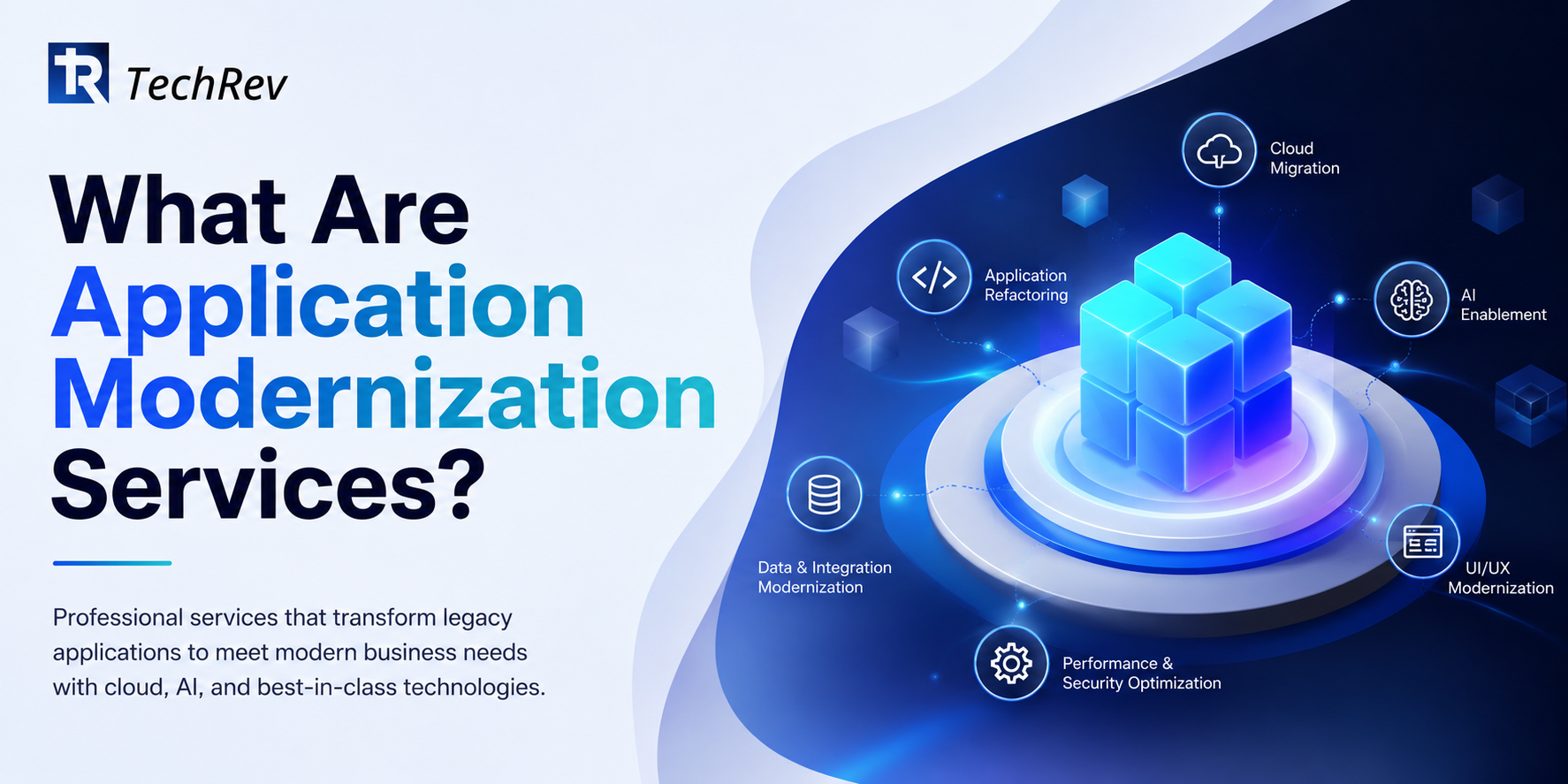
Application modernization services are professional engagements that update legacy applications for current business needs: assessing the portfolio, migrating apps to the cloud, replatforming and refactoring code, rebuilding user interfaces, modernizing data layers, and adding AI capability, delivered by an outside team with the specialized skills most in-house teams cannot staff full time.
The simplest framing: modernization strategies are the what. Application modernization services are the who and how.
Why Businesses Buy Application Modernization Services: The Real Numbers
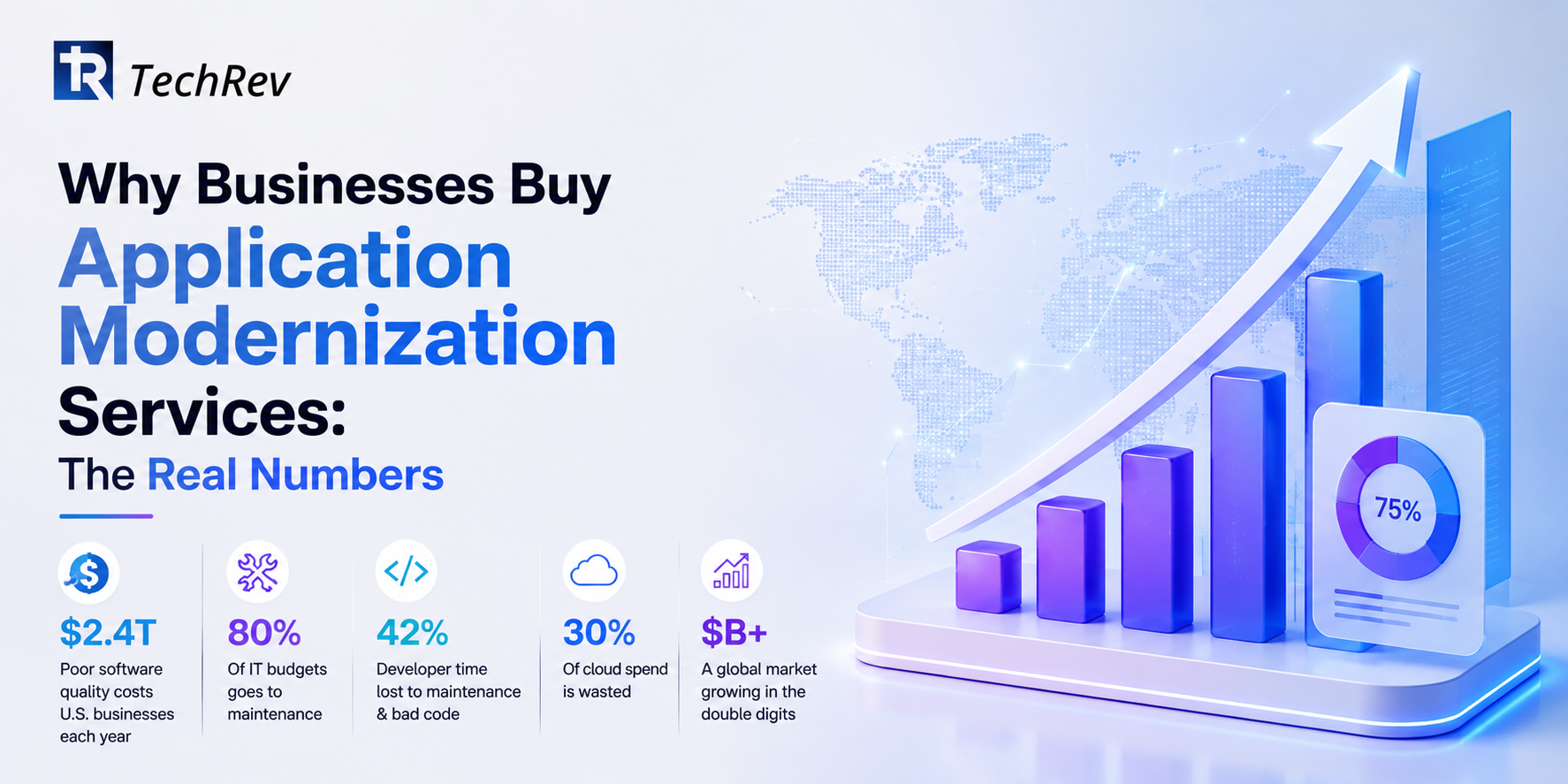
The market signals all point the same direction:
- The debt is national-scale. CISQ’s research put the cost of poor software quality in the US at about $2.41 trillion in a single year, with technical debt around $1.5 trillion of it.
- Maintenance already owns the budget. The US GAO has repeatedly found roughly 80% of federal IT spending goes to operating and maintaining existing systems, and enterprise budgets commonly show similar splits, which means modernization is funded by redirecting money already being burned.
- Engineering time is bleeding. Stripe’s Developer Coefficient research estimated developers spend about 42% of their week on maintenance, debugging, and bad code, a figure the study valued in the tens of billions of dollars in lost capacity annually.
- Cloud waste proves the skills gap. Flexera’s State of the Cloud reporting consistently finds organizations estimate around 30% of cloud spend is wasted, evidence that lifting apps to the cloud without modernizing them just relocates the inefficiency.
- The services market is compounding. Application modernization services have grown into a global market measured in the tens of billions of dollars, with analyst firms projecting mid-teens annual growth through 2030.
One more signal hides in plain sight: that $56-and-up cost per click. Companies do not bid premium prices on searches unless the buyers behind them convert. Modernization budgets are real and being spent now.
What Do Application Modernization Services Include?
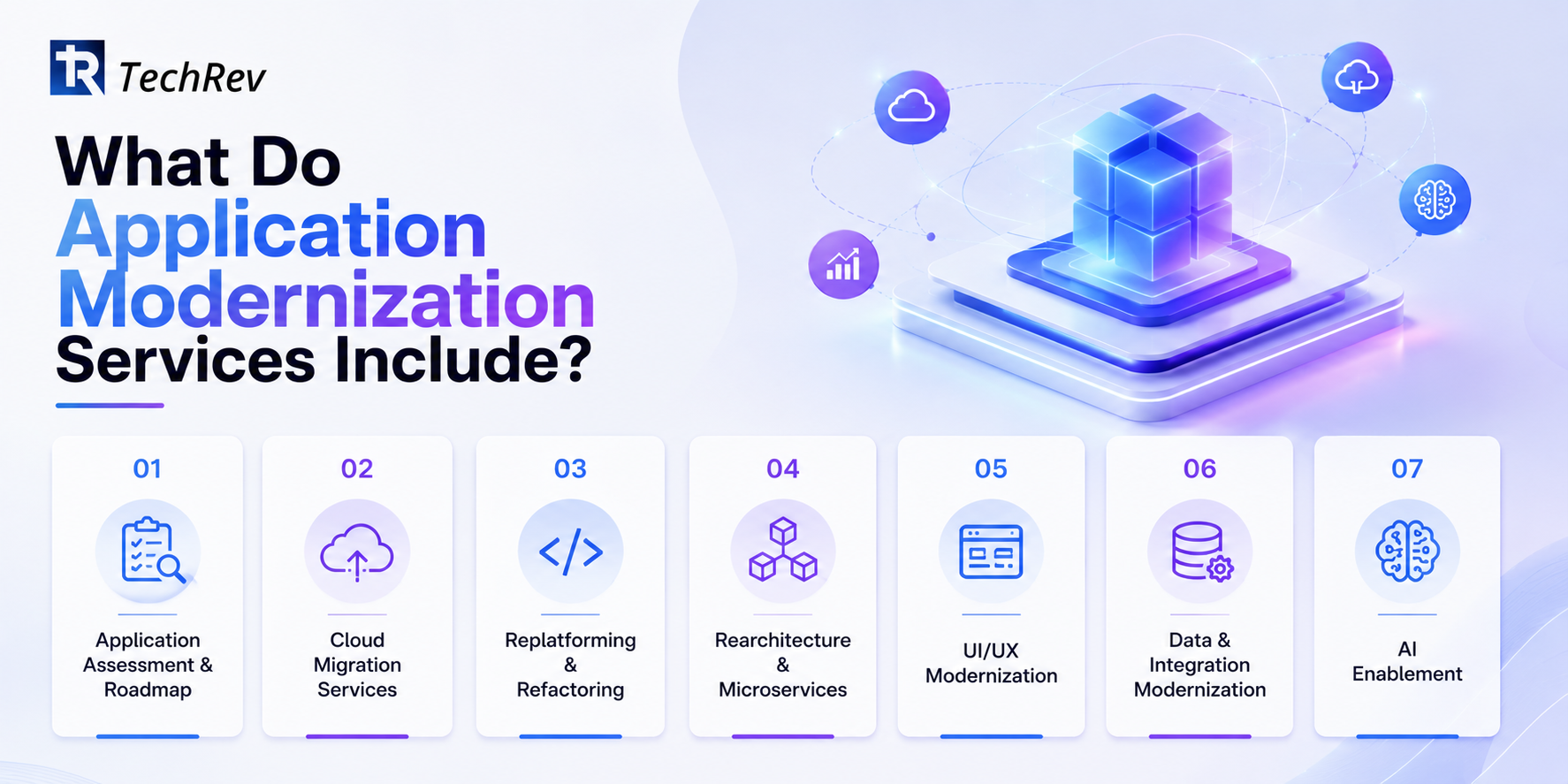
A full-service engagement covers seven workstreams. Strong providers scope them individually; weak ones sell them as one opaque blob.
1. Application Assessment and Modernization Roadmap
Portfolio analysis that scores each application on business fit, technical health, and change velocity, producing an application modernization roadmap: which apps to encapsulate, migrate, refactor, rebuild, or retire, in what order, and why. This is where AI-assisted code analysis now compresses months of discovery into weeks.
2. Cloud Migration Services
Rehosting and replatforming applications onto cloud infrastructure, the highest-volume request in the category. Done well, cloud migration services include right-sizing and cost governance, because migration without optimization is how companies join Flexera’s 30% waste statistic.
3. Replatforming and Refactoring
Moving applications to modern runtimes, databases, and frameworks with targeted code changes, or restructuring the codebase itself to remove technical debt while preserving behavior. Choosing the target stack matters here; our breakdown of the most popular web app frameworks shows where modern builds are landing.
4. Rearchitecture and Microservices
Decomposing monoliths into services that deploy independently and scale on demand. The most invasive workstream and the one most worth phasing.
5. UI/UX Modernization
Rebuilding dated interfaces into modern, mobile-ready experiences. Frequently the fastest visible win, and often what finally gets internal users to stop working around the system.
6. Data and Integration Modernization
Untangling legacy databases, building APIs, and establishing the integration layer that lets the modernized application talk to everything else. This is also the foundation for the next workstream.
How to Choose an Application Modernization Company?
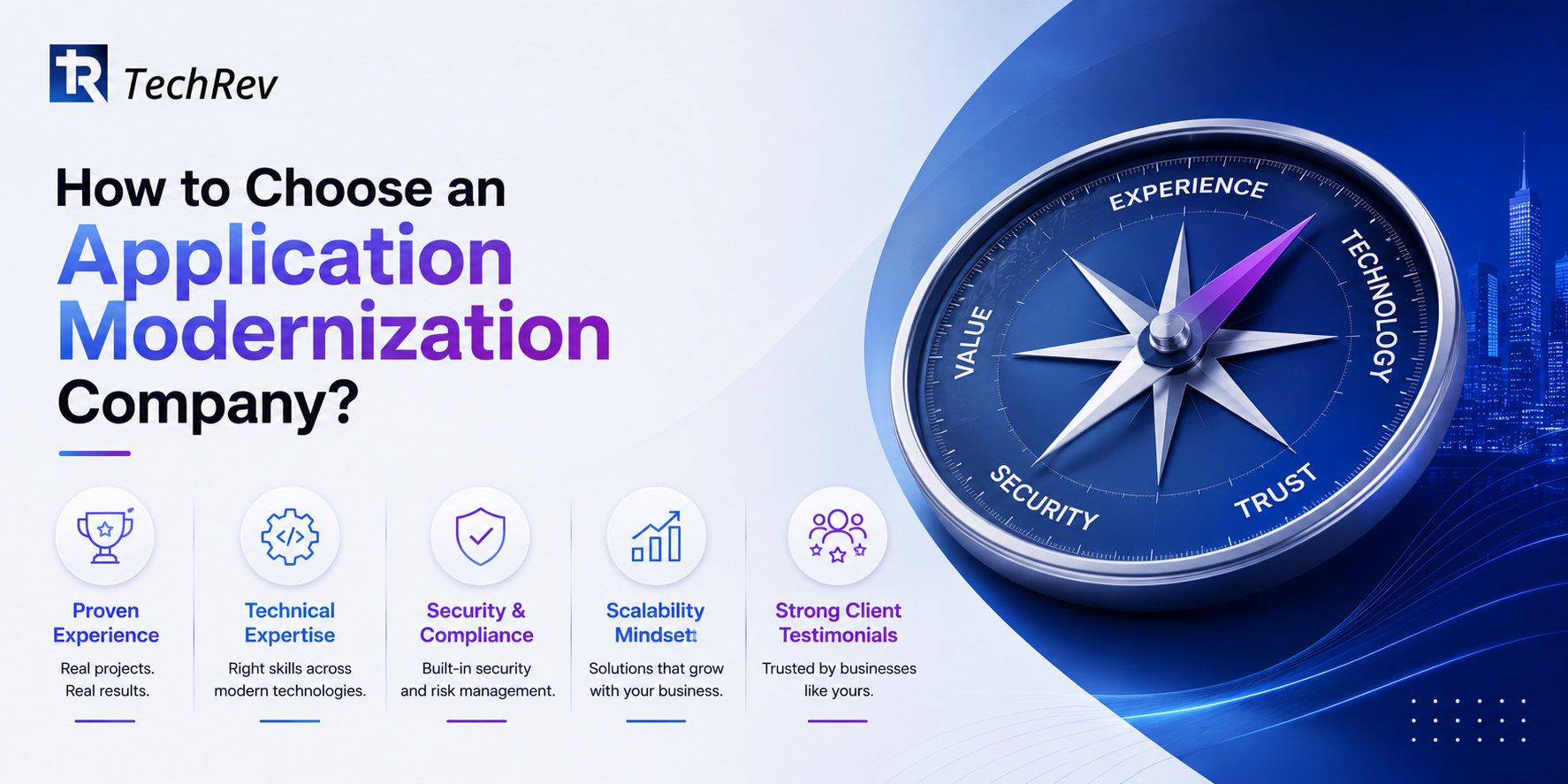
Six evaluation criteria separate delivery-grade providers from slideware:
- Phased contracts, not big bangs. Real modernization ships in measurable phases with defined outcomes. A single monolithic contract is a risk transfer onto you.
- Assessment that ends in a decision. The roadmap should say encapsulate, migrate, refactor, rebuild, or retire per application, with costs. Assessments that end in “it depends” are billable stalling.
- Integration depth. Ask how they connect modernized apps to the systems that stay. API and integration capability is where modernization value actually flows from.
- Regulated-industry evidence. If you handle health, legal, or financial data, demand HIPAA and SOC 2 experience, since compliance retrofits are modernization’s most expensive surprise.
- Parallel-run methodology. Legacy systems hide undocumented behavior. Providers should pin behavior with tests and run old and new in parallel before cutover.
- A team model that fits. Whether a project team, a dedicated development team, or blended staffing through an offshore development center, the model should match your timeline and budget, and you should know exactly who is doing the work.
What Questions Should You Ask Before Signing?
Four questions expose most weak providers fast: Which of our applications would you NOT modernize, and why? What happens when you discover undocumented behavior mid-project? Show us a modernization where the client kept running during cutover. What are the success metrics for phase one, in numbers?
A provider with crisp answers to all four has done this before. A provider who answers with adjectives has not.
How Much Do Application Modernization Services Cost?
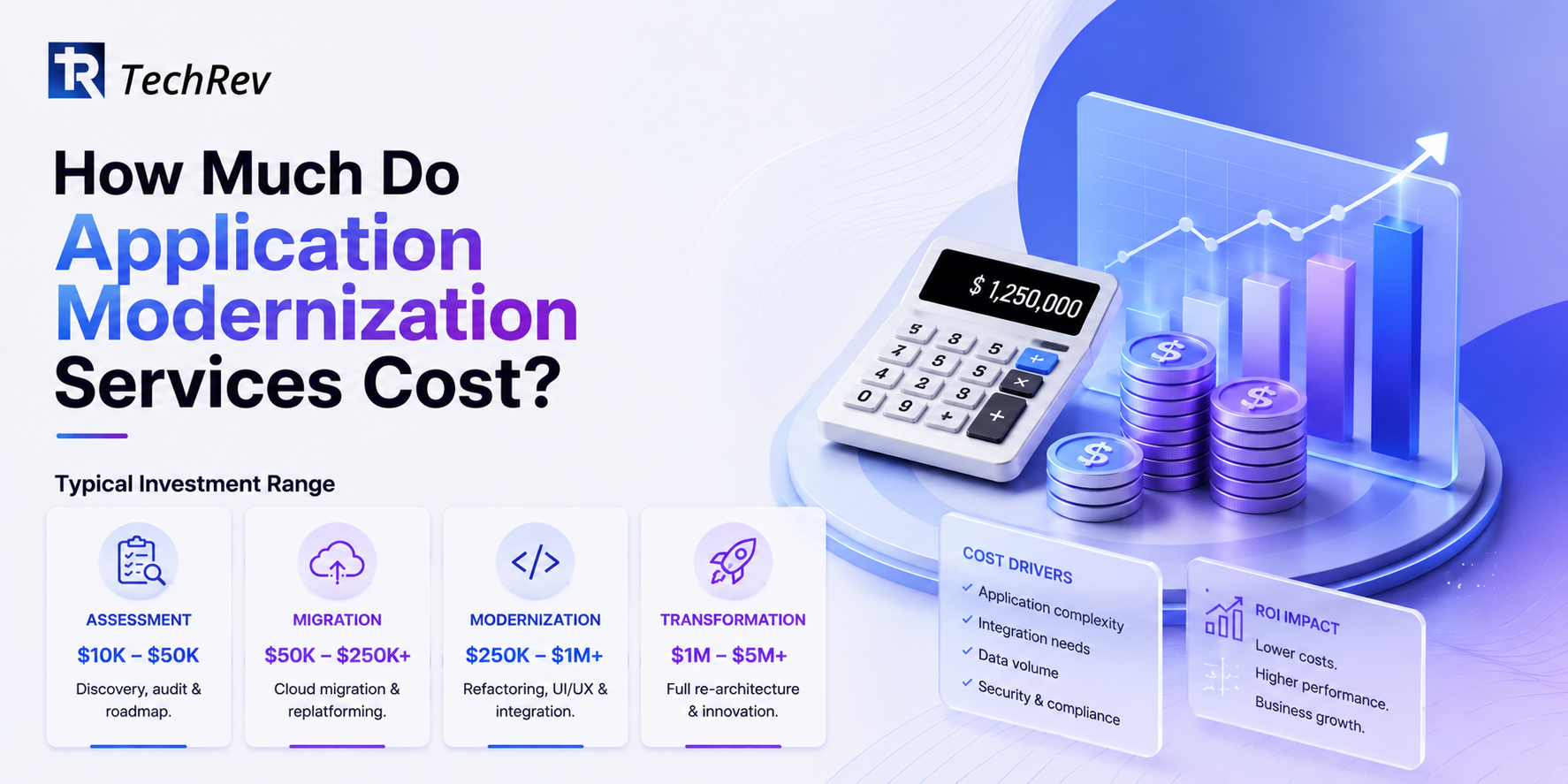
Pricing tracks the workstream. Assessments and modernization roadmaps typically run five figures. Cloud migration services commonly land in the five-figure to low six-figure range per application depending on complexity. Refactoring and replatforming engagements typically run low to mid six figures, and full rearchitecture or rebuild programs are mid six figures and up, phased across quarters. Ongoing support usually adds 15 to 20% of build cost annually.
Anchor the evaluation to two baselines, not zero: what the legacy application already costs you in maintenance, developer drag (recall Stripe’s 42%), and blocked initiatives, and what the same scope would cost as an internal hire-and-build effort, which for specialized modernization skills routinely exceeds the services price. The right first engagement is small by design: one application, one phase, success metrics in writing, exactly the MVP development discipline that de-risks every serious software project.
How TechRev Delivers Application Modernization Services?
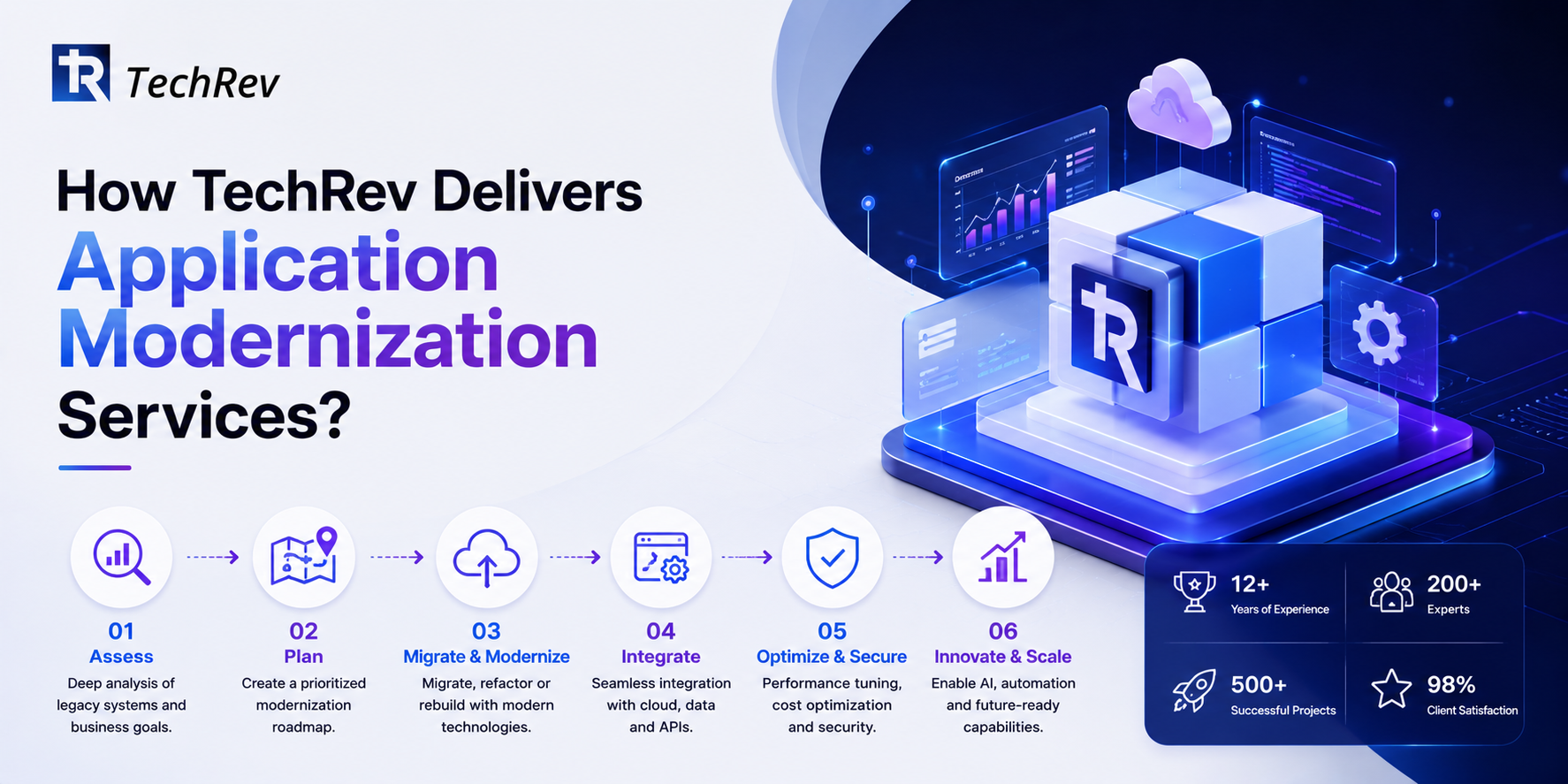
TechRev is a US-based software modernization company that delivers legacy application modernization services through an integration-first method: assessment, cloud migration, replatforming, rebuilds, and AI enablement, executed by custom software development teams with deep regulated-industry experience.
Q1: What is included in TechRev’s application modernization services?
The full seven workstreams, scoped individually: portfolio assessment with a decision-grade roadmap, cloud migration with cost governance, replatforming and refactoring, rearchitecture, UI/UX modernization, data and API modernization, and AI enablement layered on top.
Every engagement is phased with success metrics agreed upfront, behavior-pinning tests, and parallel runs before cutover, so the business never stops while the platform underneath it improves.
And because our roots are in building for HIPAA and SOC 2 environments, compliance is architecture from day one, not an audit finding later.
Q2: Does TechRev modernize applications without business downtime?
Yes. TechRev runs modernized systems in parallel with legacy ones, using staged cutovers and rollback paths, so operations continue uninterrupted through every phase.
Q3: Can TechRev add AI to a modernized application?
Yes, and we recommend it: our integration-first approach builds the API layer during modernization, then deploys AI agents and automation on top, turning infrastructure spend into workflow gains.
Q4: What measurable results has TechRev delivered replacing legacy workflows?
For a hospital services vendor, TechRev replaced error-prone manual tracking with an AI-powered barcode and workflow system, cutting installation errors by 90% and recovering lost billing evidence.
The Bottom Line on Application Modernization Services
Technical debt in the trillions, developers losing 42% of their week to it, maintenance eating most budgets, and a services market compounding in the mid teens: application modernization services exist because the math of doing nothing stopped working.
The buyers winning in 2026 are not purchasing “digital transformation.” They are buying one phased engagement at a time, with metrics attached, from providers who can prove the last one worked.
If you have an application the business keeps working around, talk to TechRev’s modernization team. We will assess it, hand you a decision-grade roadmap, and scope a first phase with numbers it has to hit, so the modernization proves itself before you fund the rest.
FAQs About Application Modernization Services
1. What is the difference between application modernization services and cloud migration services?
Cloud migration services move applications onto cloud infrastructure; application modernization services cover the full spectrum, of which migration is one workstream.
Migrating without modernizing relocates technical debt, which is why migration-only engagements often disappoint.
2. How long do application modernization services take?
Assessments run two to six weeks. Single-application migrations commonly complete in weeks to a few months. Refactoring and replatforming typically span one to two quarters, and full rearchitecture programs run multi-quarter by design, in phases.
3. What is an application modernization roadmap?
A prioritized plan scoring each application on business fit, technical health, and change velocity, then assigning a strategy (encapsulate, rehost, replatform, refactor, rearchitect, rebuild, retire) with sequencing, cost ranges, and success metrics.
It is the deliverable that turns modernization from a debate into a schedule.
4. Should we use one application modernization company or build an internal team?
Hybrid wins most often: a services partner supplies the specialized modernization skills and methodology, while your team supplies system knowledge and inherits the modernized platform.
Fully internal efforts struggle to hire niche skills for a temporary need; fully outsourced efforts lose institutional knowledge.
5. What are legacy application modernization services?
The same discipline aimed at aging systems specifically: mainframe and monolith migration, dead-language codebases, unsupported platforms, and applications only one veteran employee understands.
Expect heavier emphasis on code archaeology, behavior-pinning tests, and parallel runs.
6. Is application modernization worth it for small and mid-sized businesses?
Yes, scoped correctly. SMBs rarely need rearchitecture programs; they need one or two blocking applications encapsulated, migrated, or rebuilt. Phase-one engagements sized in the five figures frequently unlock integrations and automation worth multiples of that.