

The Nuxt vs Next js debate is one of the most searched framework questions in web development right now, and for good reason. Both promise fast websites, great SEO, and happy developers. But pick the wrong one for your project, and you could be staring at slow builds, painful hiring, and a rewrite bill nobody budgeted for.
So how do you actually decide? In this blog, we break down the Nuxt vs Next js comparison with real 2026 numbers, honest pros and cons, and practical advice from our team at TechRev, a US based web development company that has been building custom web and mobile apps since 2016.
Let’s settle this the right way.
Nuxt vs Next js: Quick Comparison
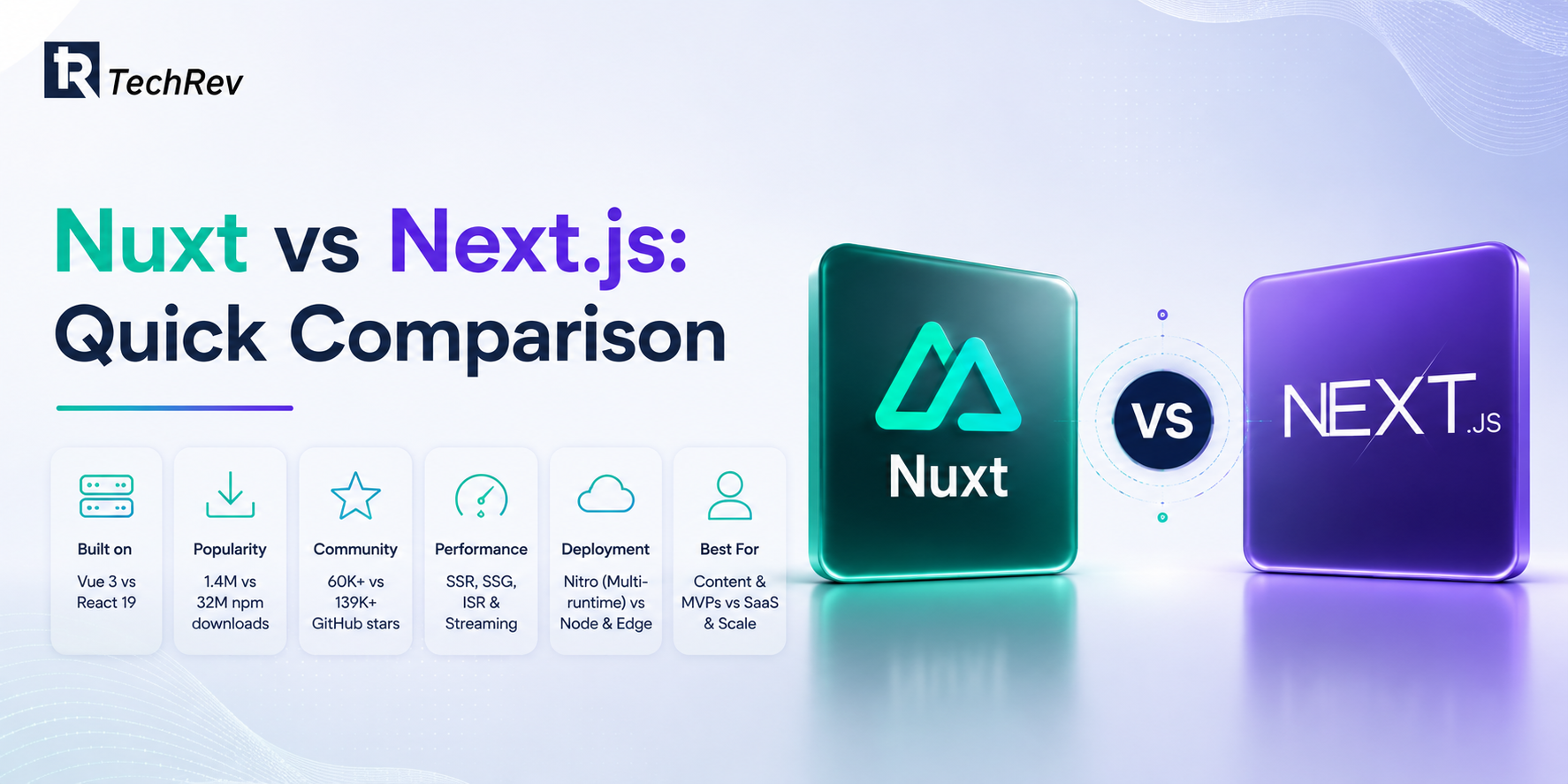
| Factor | Nuxt | Next.js |
| Built on | Vue 3 | React 19 |
| Weekly npm downloads (2026) | ~1.4 million | ~32 million |
| GitHub stars | 60K+ | 139K+ |
| Server engine | Nitro (runs on Node, Cloudflare, Deno, Bun) | Node and Edge, tuned for Vercel |
| Rendering | SSR, SSG, ISR, hybrid via routeRules | SSR, SSG, ISR, React Server Components |
| Learning curve | Easier, Vue is beginner friendly | Steeper, React concepts take time |
| Best for | Content sites, MVPs, multi cloud hosting | SaaS, dashboards, AI products, large teams |
Keep this table handy. Now let’s dig into what these numbers actually mean for your business.
What is the Next js Framework?
Next.js is a full stack React framework maintained by Vercel. It handles server-side rendering, static generation, routing, and API endpoints out of the box, which is why it has become the default choice for React based web app development.
As of 2026, the Next js framework pulls in roughly 32 million weekly npm downloads, making it the most used meta framework on the planet.
Big names like Netflix, TikTok, and Nike run on it. That kind of adoption matters when you are hiring, because finding React talent is simply easier than finding anything else.
What is the Nuxt js Framework?
Nuxt is the Vue equivalent. The Nuxt js framework gives you server-side rendering, file based routing, auto imports, and a genuinely pleasant developer experience with far fewer configuration decisions. Its Nitro server engine is the standout feature, because the same codebase deploys to Node servers, Cloudflare Workers, AWS Lambda, Deno, or Bun without rewriting anything.
Nuxt sits at around 1.4 million weekly downloads and 60K+ GitHub stars. Smaller than Next.js, yes, but the community is loyal, stable, and growing steadily year over year.
Is This Really Just a Vue vs React Decision?
Mostly, yes. And that is not a bad thing.
The Vue vs React question decides your talent pool before anything else. The Stack Overflow Developer Survey consistently shows React usage above 40 percent of developers, while Vue sits closer to 17 percent. Translation: there are roughly two to three React developers on the market for every Vue developer.
But here is the part most blogs skip. The Vue vs React gap matters less if your existing team already knows one of them. A productive Vue team shipping on Nuxt will beat a React team learning Next.js from scratch every single time. Framework switching to chase popularity is one of the most expensive mistakes we see companies make.
Also Read – MERN Stack Development in 2026: Is It Best for Your Business?
Nuxt vs Next js Performance: Which One is Actually Faster?
Here is the honest answer: in well built production apps, both are fast. Google research shows that 53 percent of mobile visitors abandon a page that takes longer than 3 seconds to load, so performance is non-negotiable either way. The good news is that both JavaScript frameworks handle server-side rendering, static generation, and streaming HTML extremely well.
The real differences show up in three places:
1. Rendering control
Next.js with React Server Components and Turbopack gives you finer control over what ships to the browser. For complex dashboards with heavy interactivity, that control pays off.
2. Edge portability
Nuxt’s Nitro engine wins here. You can move the exact same app between Cloudflare, AWS, and a self hosted server without re-architecture. Next.js runs everywhere too, but it performs best on Vercel, and you lose some optimizations the further you move away from it.
3. Bundle size on content sites
Nuxt’s recent improvements to async data handling cut bundle sizes significantly on prerendered pages, which means faster first paint on blogs, marketing sites, and content platforms.
Bottom line on Nuxt vs Next js performance: your hosting setup and code quality will affect speed far more than the framework logo does.
Also Read – Top 10 Proven UI/UX Design Best Practices to Win Users in 2026
What Does It Cost to Build With Nuxt or Next.js?
Money talk. This is where most comparison posts get vague, so let’s be specific.
1. Developer salaries
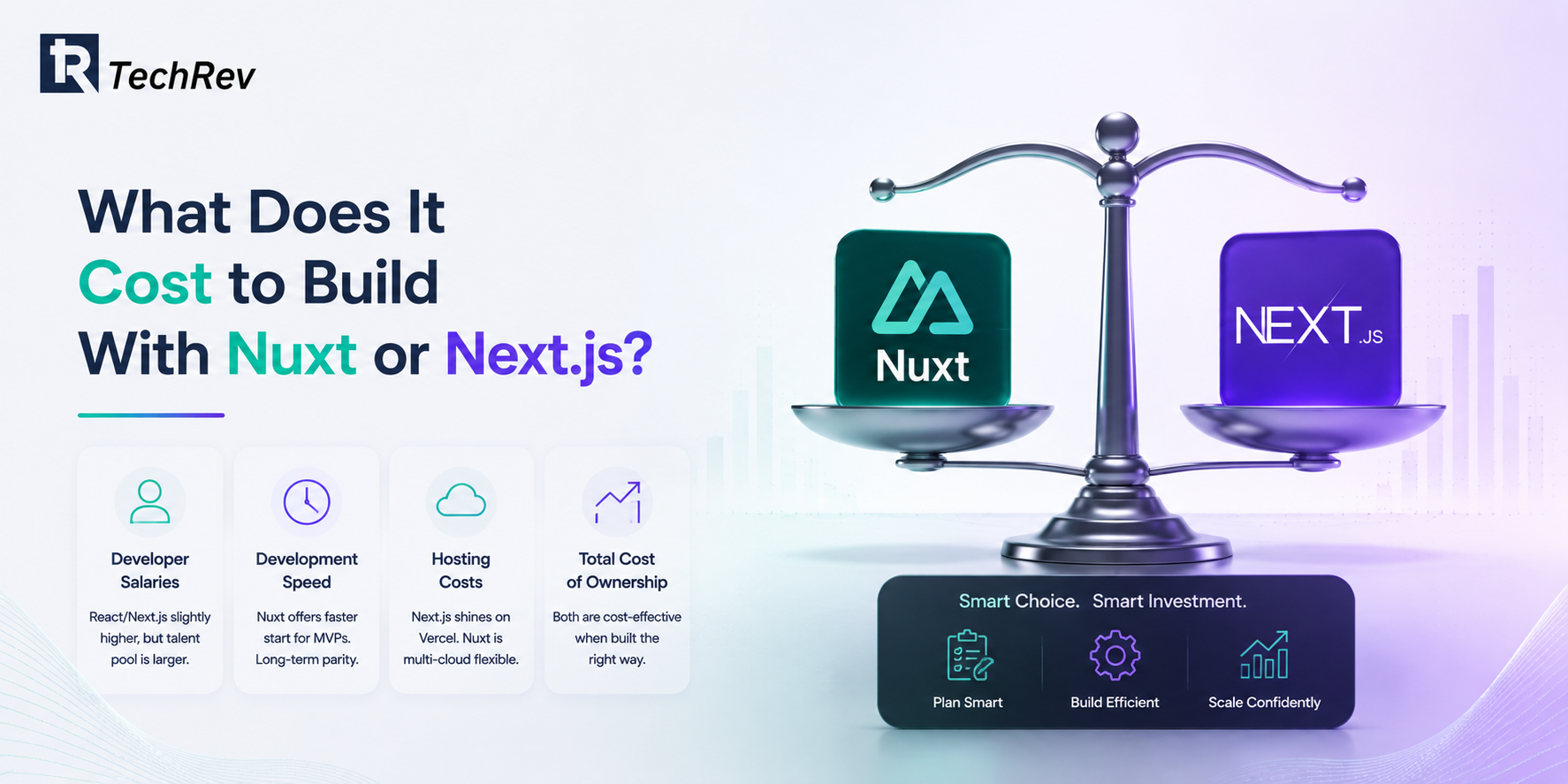
US salary data puts React and Next.js developers at roughly $110,000 to $120,000 per year on average, with Vue and Nuxt developers slightly lower at around $105,000 to $110,000. The bigger cost driver is : React roles fill faster because the pool is deeper.
2. Development speed
Nuxt’s convention first setup, with auto imports and preconfigured structure, genuinely compresses the first weeks of a build. For an MVP shipping in 8 to 12 weeks, that head start is real. For a multi year platform, the gap disappears.
3. Hosting
Next.js is the cheapest and smoothest on Vercel. Nuxt’s multi runtime flexibility lets you shop between cloud providers and negotiate pricing, which matters at scale or under compliance requirements.
4. The hidden cost
Teams over engineer Next.js on simple sites, and teams outgrow Nuxt conventions on backend heavy products. Both problems come from choosing the framework before scoping the architecture. This is exactly why working with an experienced web development company before writing code saves five figures later.
At TechRev, basic custom builds start around $5,000 and take 4 to 8 weeks, while complex AI powered platforms typically run $25,000+ over 3 to 6 months. You get a transparent quote before anything starts, so there are no surprise invoices halfway through.
Also Read – Flutter vs React Native 2026: Best for AI-Powered Mobile Apps?
Which is Better, Nuxt or Next.js?
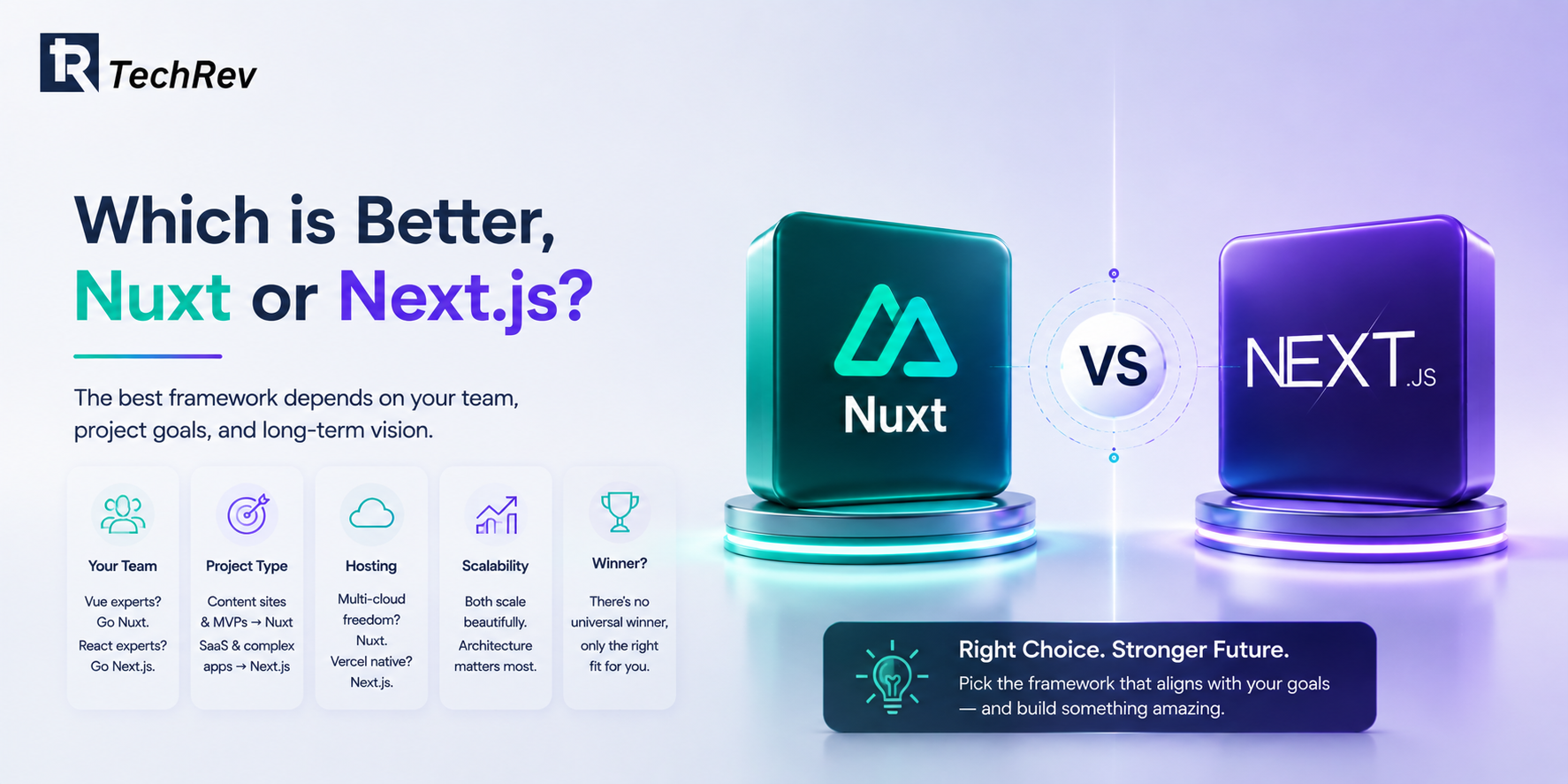
Choose:
Choose Next.js if you are building:
- A SaaS product, enterprise dashboard, or AI driven application
- Anything where the Vercel AI SDK, streaming UIs, or LLM chat interfaces sit on your roadmap
- A product where hiring at scale in the US or EU is critical
Choose Nuxt if you are building:
- A marketing site, blog, content platform, or headless commerce storefront
- A fast MVP with a small team
- A multi region product where portable, low cost edge hosting is a business requirement.
Also Read – Dart vs JavaScript in 2026: Which One To Use for Mobile App?
Does the Vercel and NuxtLabs Deal Change Anything?
This is the newest wrinkle in the Nuxt vs Next js story. Vercel acquired NuxtLabs, the company behind Nuxt, in mid 2025. Both JavaScript frameworks now live under the same corporate roof, and their roadmaps are visibly converging on server first architecture and AI native tooling.
What it means for you in 2026: Nuxt is getting faster access to the AI tooling that used to be React only territory, and the risk of Nuxt becoming abandonware is essentially gone. Next.js still leads on AI ecosystem depth today, but the gap is closing quarter by quarter.
If your AI features launch within the next 12 to 18 months, Next.js remains the safer bet. Beyond that window, either framework will serve you well.
How TechRev Helps You Get This Decision Right?

Choosing between JavaScript frameworks is only step one. Building it right is where projects live or die, and this is where TechRev comes in.
TechRev is a Florida based web development company that has been delivering custom web app development, mobile apps, and AI powered solutions since 2016. Here is what partnering with us actually gets you:
1. Lower cost, faster launch
Hiring one in house senior developer in the US costs $110,000+ per year before benefits, recruiting fees, and onboarding time. Through our dedicated developers and IT staff augmentation services, you get vetted Next.js and Nuxt talent working on your project within days, not months, at a fraction of that overhead.
2. Architecture before code
We scope your rendering strategy, hosting plan, and data flow before the first line is written, so you avoid the expensive refactors that kill 8 out of 10 rushed builds.
3. AI baked in, not bolted on
From chatbots and recommendation engines to predictive analytics, we integrate AI into new or existing apps so your product ships modern, not dated.
4. Support after launch
Bug fixes, performance optimization, security updates, and feature enhancements keep your web app development investment earning long after go live.
Whether you land on the Next js framework or the Nuxt js framework, our team builds it to scale, rank, and convert.

Conclusion
The Nuxt vs Next js decision comes down to three things: your team’s existing skills, your product type, and your 3 year roadmap. Next.js brings the massive React ecosystem, deeper AI tooling, and the biggest talent pool in web development. Nuxt brings structure, speed to MVP, and unmatched hosting flexibility through server-side rendering on any runtime.
There is no universal winner. There is only the right fit for your project. And if you want an expert second opinion before you commit, TechRev is one conversation away. Talk to our experts today and get a free consultation on your next web app development project.
FAQs
1. Which is better for SEO, Nuxt or Next.js?
Both are excellent for SEO because both support server-side rendering and static generation, which let search engines crawl fully rendered pages. Your content quality, Core Web Vitals, and site structure will influence rankings far more than the framework choice.
2. Is Nuxt easier to learn than Next.js?
Yes, for most developers. Vue’s template syntax and Nuxt’s auto imports flatten the learning curve, while Next.js requires comfort with React hooks, server components, and multiple rendering strategies.
3. Can I migrate from Nuxt to Next.js later?
You can, but plan carefully. Components, CSS, and design systems transfer well. Data fetching logic, routing, and middleware need rewrites. A 40 page content site takes roughly 4 to 12 weeks, while a complex SaaS migration can stretch to 6 months.
4. Which framework do most companies use in 2026?
Next.js, by a wide margin. It records around 32 million weekly npm downloads versus roughly 1.4 million for Nuxt, and React remains the most used frontend library in developer surveys.
5. Does TechRev build apps with both Nuxt and Next.js?
Yes. TechRev builds production apps on both frameworks, along with mobile apps, AI integrations, and cloud infrastructure. We recommend the stack that fits your product and team, not the one that is trendy.
6. How much does it cost to build a web app with TechRev?
Simple custom apps start around $5,000 and take 4 to 8 weeks. Enterprise grade or AI powered platforms typically start at $25,000 with a 3 to 6 month timeline. Every project gets a detailed quote upfront.
7. Why choose TechRev over hiring in-house developers?
You skip recruiting costs, benefits overhead, and months of hiring time. Our dedicated developers integrate with your team within days and scale up or down as your project demands.
8. Does TechRev provide support after my app goes live?
Absolutely. We handle bug fixes, security updates, performance tuning, and new feature rollouts, so your app stays fast, secure, and competitive long after launch.