
Figuring out how to choose an AI development company is really a bet on odds, not on code. MIT’s Project NANDA studied 300 public AI deployments and found that 95% of enterprise generative AI pilots produced no measurable impact on profit and loss. Only 5% moved a number anyone in finance cared about. So the question is not who can build you a chatbot. Almost anyone can. The question is who lands you in the 5%.
Here is the part most buyers miss. That same MIT research found the single biggest predictor of success was not budget, model choice, or industry. It was who built the thing. External partnerships reached deployment roughly 67% of the time. Internally built tools reached deployment roughly 33% of the time. Picking the right partner is worth more than doubling your odds.
This checklist is built for people who are days away from a shortlist. It covers the 12 things to verify, the exact questions to ask an AI development company, the red flags that should end a conversation, and what the work actually costs across the US, UK, India, Canada, and Australia.
How to Choose an AI Development Company?
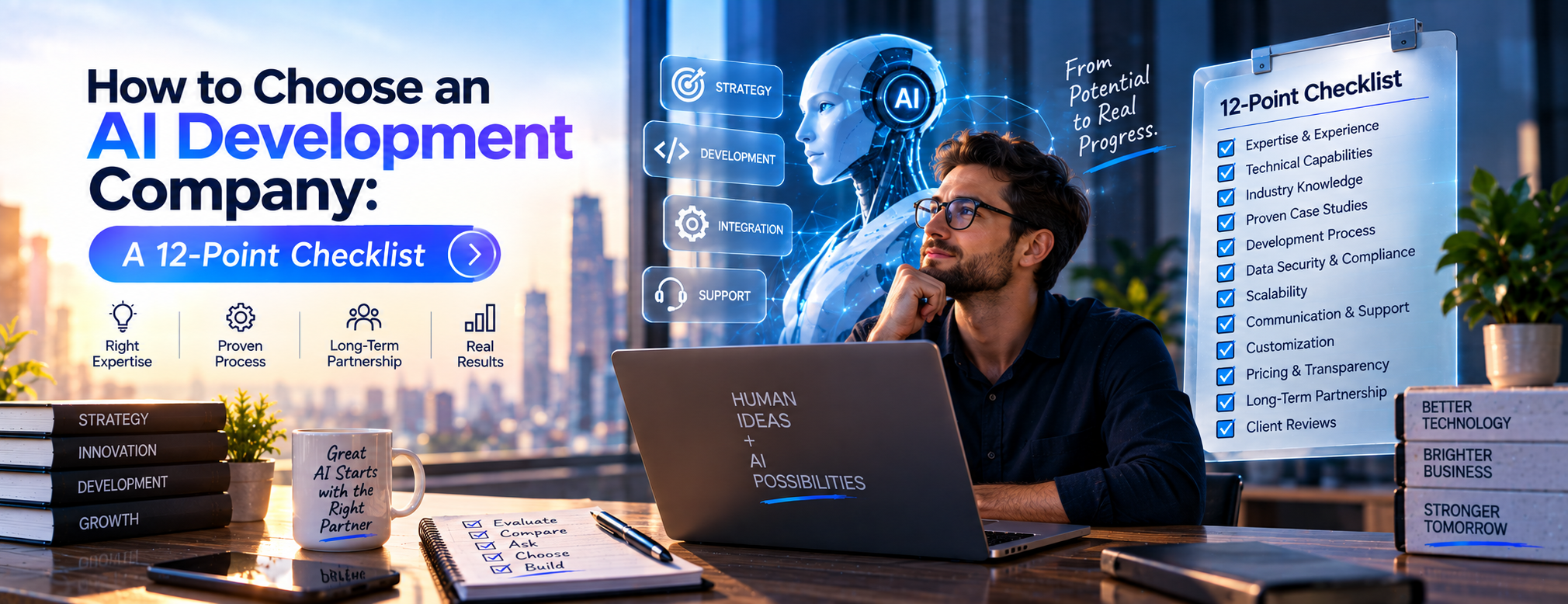
To choose an AI development company, verify twelve things in order: a business metric attached to the build, data readiness work before development, a documented path from pilot to production, live production references, integration history with your stack, clear IP and data ownership, a written evaluation method, regulatory readiness, transparent cost structure including inference spend, named senior engineers, no forced model lock-in, and a post-launch ownership plan.
If a vendor cannot answer all twelve in a single call, they are selling AI development services they have not shipped often enough.
Why Choosing an AI Development Company Is Harder in 2026?
Two years ago, hiring an AI development company meant finding someone who knew what a vector database was. That filter is gone. Everyone claims the capability now, which means the burden of judgement has shifted entirely to you.
The spending is enormous and the returns are not
Grand View Research puts the global artificial intelligence market at 390.9 billion dollars in 2025, growing to 539.5 billion in 2026, and forecasts 3.49 trillion by 2033 at a 30.6% CAGR. North America held 35.5% of that in 2025. Gartner’s forecast for worldwide AI spending in 2026 is 2.52 trillion dollars, up 44% year over year, with infrastructure alone at 1.37 trillion.
Now put that next to what the same market is getting back. McKinsey’s research found that 88% of organisations use AI in at least one function, but only 39% report any EBIT impact at all, and roughly 6% qualify as high performers with more than 5% of EBIT attributable to AI.
PwC’s 29th Global CEO Survey, covering around 4,500 chief executives, found 56% reported neither revenue growth nor cost savings from AI so far.
That gap between spend and return is the whole reason this checklist exists. The money is not the constraint. Execution is.
The agentic wave is where the cancellations are coming
Gartner predicts that over 40% of agentic AI projects will be cancelled by the end of 2027, citing escalating costs, unclear business value, and inadequate risk controls. Not model failure. Scoping and governance failure.
Gartner also expects 33% of enterprise software applications to include agentic AI by 2028, up from under 1% in 2024, and at least 15% of day-to-day work decisions to be made autonomously by then.
So the demand is real and so is the failure rate. If you are evaluating an AI agent development company, the cancellation statistic is your negotiating leverage. Ask them directly how they avoid becoming part of it. For background on where agent architectures currently stand, TechRev’s breakdown of agentic AI frameworks and agentic AI use cases across sectors are both useful pre-reads before a vendor call.
The 12-Point Checklist for Choosing an AI Development Partner
This is the practical answer to how to choose an AI development partner rather than just a vendor. Work through the points in order. The first four will eliminate most of your list before you get anywhere near pricing.
1. They start with a business metric, not a model
Why it matters: MIT’s research found that more than half of enterprise generative AI budgets went to sales and marketing use cases, while the strongest measurable returns showed up in back-office automation, business process outsourcing reduction, and operational efficiency. Visibility beats value when nobody sets a metric first.
What good looks like: the first meeting is about your process, not their stack. They ask what the current cycle time is, what the error rate is, how many hours a week the task consumes, and what a 20% improvement is worth in currency.
Ask this: “What baseline will we measure against, and who on your side owns that number?”
Red flag: they open with a capabilities deck.
2. They do data readiness before they do development
Why it matters: in agentic projects specifically, data preparation routinely consumes the majority of total project effort. If nobody scopes that, it comes out of your timeline later, at your cost.
What good looks like: a paid discovery phase that audits data quality, access, lineage, and gaps, and produces a written go or no-go before anyone opens an IDE.
Ask this: “What happens if discovery shows our data is not ready? Do we stop, and what do we owe you?”
Red flag: they quote a full build price before seeing your data.
3. They can show the pilot-to-production path
Why it matters: MIT found roughly 5% of custom enterprise AI tools reached production at all. The demo is not the hard part. The handoff to production is.
What good looks like: they describe the deployment architecture, monitoring, rollback plan, and support model in the proposal, not after signature.
Ask this: “Walk me through the last three builds you took from pilot to production. What broke in each?”
Red flag: every reference project is described as a pilot or POC.
4. Their references are live, in production, and reachable
Why it matters: Gartner’s own commentary flags widespread “agent washing,” where non-agentic products are rebranded as agents. Logo walls are not evidence.
What good looks like: named products you can open, and at least one client who will take a 20-minute call.
Ask this: “Which of these are live today, and can I speak to the person who owned the budget?”
Red flag: NDA is cited for everything. Some confidentiality is normal. Total opacity is not.
TechRev’s own portfolio is a reasonable example of what this should look like: named products including eNotary On Call, DocVoice, Akesa Health, and CubeCare, each with the problem, the build, and the outcome stated.
5. They have integration scars, not just model experience
Why it matters: MIT’s researchers described the core failure pattern as brittle workflows and misalignment with day-to-day operations. Models are commodities. The integration into your CRM, EHR, ERP, or billing system is where projects die.
What good looks like: demonstrated work with the systems you already run, and an API development and integration practice that is not an afterthought.
Ask this: “Which of our existing systems have you integrated with before, and what was the hardest one?”
Red flag: they treat integration as a phase-two conversation.
6. IP, model weights, and data ownership are written down
Why it matters: when you use a generic plug-in, your data can end up training a model your competitor benefits from later. Custom builds should give you full ownership of the intellectual property.
What good looks like: a contract clause that names you as owner of the source code, fine-tuned weights, prompt libraries, evaluation sets, and training data, with no residual licence back to the vendor for commercial reuse.
Ask this: “After final payment, what exactly do we own, and what do you retain?”
Red flag: vague language about “joint IP” or “platform components.”
7. They have an evaluation method they can show you
Why it matters: an LLM engineer’s real job is managing non-deterministic output. Without evals, you have no way to know whether a change improved or degraded the system.
What good looks like: a golden dataset, regression tests, hallucination and grounding checks, drift monitoring, and a named accuracy threshold that must hold before release.
Ask this: “Show me the evaluation harness from your last project. What was the pass threshold and what happened when it failed?”
Red flag: the answer is “we test it manually.”
8. They are fluent in governance and the regulation that applies to you
Why it matters: see the EU AI Act timeline above. Add HIPAA if you touch patient data, PCI-DSS for payments, GDPR and India’s DPDP Act for personal data, and frameworks like ISO/IEC 42001 and the NIST AI Risk Management Framework as the governance scaffolding buyers increasingly ask for. McKinsey found that nearly two-thirds of respondents cite security and risk as the top barrier to scaling agentic AI, ahead of both regulation and technical limits.
What good looks like: compliance treated as an architecture decision made in week one, not a checklist in the final sprint.
Ask this: “Which of our AI systems would classify as high-risk under Annex III, and what documentation would we need?”
Red flag: “Our legal team handles that.”
Regulated builds are where an AI development company with sector history genuinely outperforms a generalist. TechRev’s work in healthcare software and legal application development is built around that constraint, including a legally binding, identity-verified remote notarization platform where the compliance bar was non-negotiable.
9. The cost structure is transparent, including inference
Why it matters: rates vary enormously by region, and the headline rate is not your landed cost. Independent 2026 rate surveys put agency rates at roughly 22 to 55 dollars an hour in South and Southeast Asia, 35 to 75 in Eastern Europe and Latin America, and 95 to 220 in the US, UK, and Western Europe. AI and ML specialisation adds a premium of roughly 25% to 50% on top. Several guides note that true cost lands at 1.4 to 1.8 times the quoted rate once management, ramp-up, and attrition are priced in.
Then there is the part nobody quotes: token and inference spend. An inefficiently prompted model can generate serious monthly API overhead, which is why prompt and retrieval optimisation is a cost line, not a nicety.
Ask this: “What is the estimated monthly inference cost at our expected volume, and how do you reduce it?”
Red flag: a fixed price with no volume assumptions stated.
10. You know exactly who writes the code
Why it matters: the classic agency failure is that the senior team wins the pitch and juniors deliver the work.
What good looks like: named engineers, their seniority, their time allocation, and a contractual no-substitution clause.
Ask this: “Name the engineers on this project and their allocation. What happens if one leaves mid-build?”
Red flag: “We will assign the team after kickoff.”
11. They are not locking you into one model vendor
Why it matters: model pricing, capability, and licensing shift constantly. The inference cost of GPT-3.5-level performance fell more than 280 times between November 2022 and October 2024. Architecture that assumes one provider forever is architecture that ages badly.
What good looks like: an abstraction layer, documented model swap procedure, and a clear position on open weights versus API models for your use case.
Ask this: “If we needed to switch model providers in twelve months, what would that cost and how long would it take?”
Red flag: the answer requires a rebuild.
12. Post-launch ownership is contracted, not implied
Why it matters: AI systems degrade. Data drifts, user behaviour shifts, upstream models get deprecated. A build with no maintenance plan becomes a liability on a schedule.
What good looks like: a defined support scope covering monitoring, retraining triggers, security patching, performance tuning, and a response SLA.
Ask this: “What is your support model at month 13, and what does it cost?”
Red flag: support is a separate conversation you have not been invited to yet.
15 Questions to Ask an AI Development Company Before You Sign
Print this. These are the questions to ask an AI development company that separate operators from presenters.
- What business metric will this build move, and what is our baseline today?
- What does your discovery phase produce, and can we stop after it?
- How many of your AI builds are running in production right now?
- Can I speak to a client whose project did not go smoothly?
- Which of our existing systems have you integrated with before?
- Who owns the source code, fine-tuned weights, and training data after payment?
- What is your evaluation method, and what accuracy threshold gates a release?
- How do you handle hallucination, grounding, and model drift in production?
- Would any part of this be classified as high-risk under the EU AI Act?
- What is the estimated monthly inference and infrastructure cost at our volume?
- Which named engineers will build this, and what is their allocation?
- What happens if we need to change model providers next year?
- What is included in support after launch, and for how long?
- What is the smallest version of this that proves value, and how fast can it ship?
- What would make you tell us not to build this?
Best AI Development Companies: How to Build a Shortlist That Is Actually Yours?
Searching for the best AI development companies returns directories, and directories are ranked by who pays for placement. Use them for discovery, never for decisions. Build the shortlist yourself.
Where to look
- Case studies in your sector, not your size. A firm that shipped compliant health software understands your constraints better than a firm that shipped a bigger app in an unregulated space.
- Engineering output. Technical blogs, open-source contributions, conference talks. Teams that write about failure modes have seen them.
- Client-side references. The most reliable signal is a peer who has already paid one of these firms.
- Directories, filtered hard. Clutch, GoodFirms, and G2 are fine starting points if you ignore the ranking and read only the detailed reviews.
Which AI Development Services Do You Actually Need?
Most buyers ask for a chatbot when they need a retrieval system, or ask for an agent when they need a rules engine. Getting the category right before you brief anyone saves weeks. Here is a plain map of AI development services and what each is genuinely for.
- Generative AI development for content, code, and creative production at volume. Best where output is high-volume and human-reviewed.
- AI agent development for multi-step work that takes action across systems. Highest value and highest cancellation risk, so scope narrowly.
- LLM development for models fine-tuned or grounded on your own knowledge base. This is where retrieval-augmented generation lives.
- Machine learning development for prediction on structured data: churn, demand, risk, pricing.
- NLP development for classification, extraction, and understanding of documents and messages.
- Predictive analytics for forecasting that feeds planning and inventory decisions.
- AI chatbot development for support deflection and lead qualification.
- Computer vision for inspection, recognition, and monitoring where speed and accuracy matter.
- AI voice agents for inbound and outbound call automation, appointment handling, and support.
If you already have a product and want intelligence inside it rather than beside it, the category you want is AI integration services, not a new build. That distinction alone changes the budget conversation.
FAQs
1. How do I choose an AI development company?
Verify a business metric, data readiness work, production references, integration history, IP ownership, evaluation method, regulatory readiness, transparent costs including inference, named senior engineers, model portability, and a contracted support plan. Then buy a paid discovery before a full build.
2. What should an AI development company cost in 2026?
Published 2026 rate surveys put senior AI and ML agency rates at roughly 22 to 55 USD per hour in South and Southeast Asia, 35 to 75 in Eastern Europe and Latin America, and 95 to 220 in the US, UK, and Western Europe, with an AI specialisation premium of 25% to 50%. Budget 1.4 to 1.8 times the quoted rate for landed cost.
3. Why do most AI projects fail?
MIT’s Project NANDA found 95% of enterprise generative AI pilots delivered no measurable profit and loss impact, attributing it to brittle workflows, tools that do not learn, and misalignment with daily operations rather than weak models. Gartner cites cost, unclear value, and weak risk controls for agentic cancellations.
4. Is it better to build AI in-house or hire an AI development company?
MIT’s data found external partnerships reached deployment about 67% of the time versus about 33% for internal builds. In-house makes sense when AI is your core product and you already have an ML platform team. Otherwise a partner is the higher-probability route.
- What are the biggest AI development company red flags?
No business metric in the proposal, pricing before data review, a pilot-only portfolio, vague IP ownership, manual-only quality assurance, inability to discuss applicable regulation, unnamed engineers, and a bid far below every other quote.
Conclusion
Choosing an AI development company in 2026 is a risk management decision wearing a procurement costume. The market is spending trillions and most of it is not landing. The teams that land in the 5% are not the ones with the best model access. They are the ones who picked a boring, measurable workflow, worked with a partner who had shipped it before, and refused to start building until the number was agreed.
Run the 12 points. Ask the 15 questions. Walk on the red flags. Then buy discovery before you buy a build.
If you want a straight answer on whether your problem is worth solving with AI, tell us what is slowing your business down. We will tell you honestly what it would take, what it would cost, and whether you should build it at all.