
The GTA 6 development cost is currently estimated between $1 billion and $2 billion, according to multiple industry reports, making it one of the most expensive entertainment projects ever attempted. Rockstar Games has not confirmed an official number, but the scale of the production, the size of the team, and the technology involved all point to a budget that dwarfs almost every other video game ever made.
If you have spent any time online in the past year, you already know GTA 6 is not just a game release. It is a cultural event. The first trailer alone pulled in more than 90 million views within 24 hours, a record confirmed by Guinness World Records, and every leak, screenshot, and rumor since then has turned into its own news cycle.
But behind the hype sits a genuinely fascinating business question: how does a video game end up costing as much as a Hollywood blockbuster franchise, or more?
In this blog, we break down the estimated GTA 6 cost to develop, the factors driving that number, how it compares to other AAA titles, and what the entire situation reveals about where game mobile app development services are headed in 2026 and beyond.
How Much Does GTA 6 Cost to Develop?
Most industry estimates place the GTA 6 development cost somewhere between $1 billion and $2 billion when you combine development, marketing, and pre-launch operational spend.
Some analysts separate the figures, citing roughly $1 billion for core development alone, with total investment (including years of marketing and live-service infrastructure) pushing toward the higher end.
Rockstar’s parent company, Take-Two Interactive, has never released an official figure, so every number circulating online remains an informed estimate rather than a confirmed fact.
That single detail is worth repeating because it tells you something important: even a rumored gta 6 cost to develop this large is still just an estimate built from industry benchmarks, insider reports, and comparisons to Rockstar’s previous titles.
How GTA 6 Became One of the Most Expensive Games Ever Made?
GTA 5 launched back in 2013. Since then, players have lived through more than a decade of leaks, fan theories, and speculation, and that decade-plus gap is part of the reason the GTA 6 development cost climbed so high in the first place.
A few things happened during that stretch that pushed the budget upward:
- Player expectations evolved dramatically. A bigger map is no longer enough. Fans want living, breathing worlds with smarter NPCs, dynamic weather, realistic traffic, and interiors players can actually enter.
- Hardware capabilities jumped multiple generations, forcing Rockstar to rebuild systems from the ground up rather than reuse GTA 5’s foundation.
- Talent and production costs across the entertainment industry rose significantly, from motion capture actors to senior engineers.
- Marketing for a release this size now spans years, not months, with global campaigns across every social platform.
Once you stack android app development, technology, talent, and marketing on top of each other, a billion-dollar estimate stops sounding absurd and starts looking like simple math.
GTA 6 Development Cost vs. Other AAA Games: Full Comparison
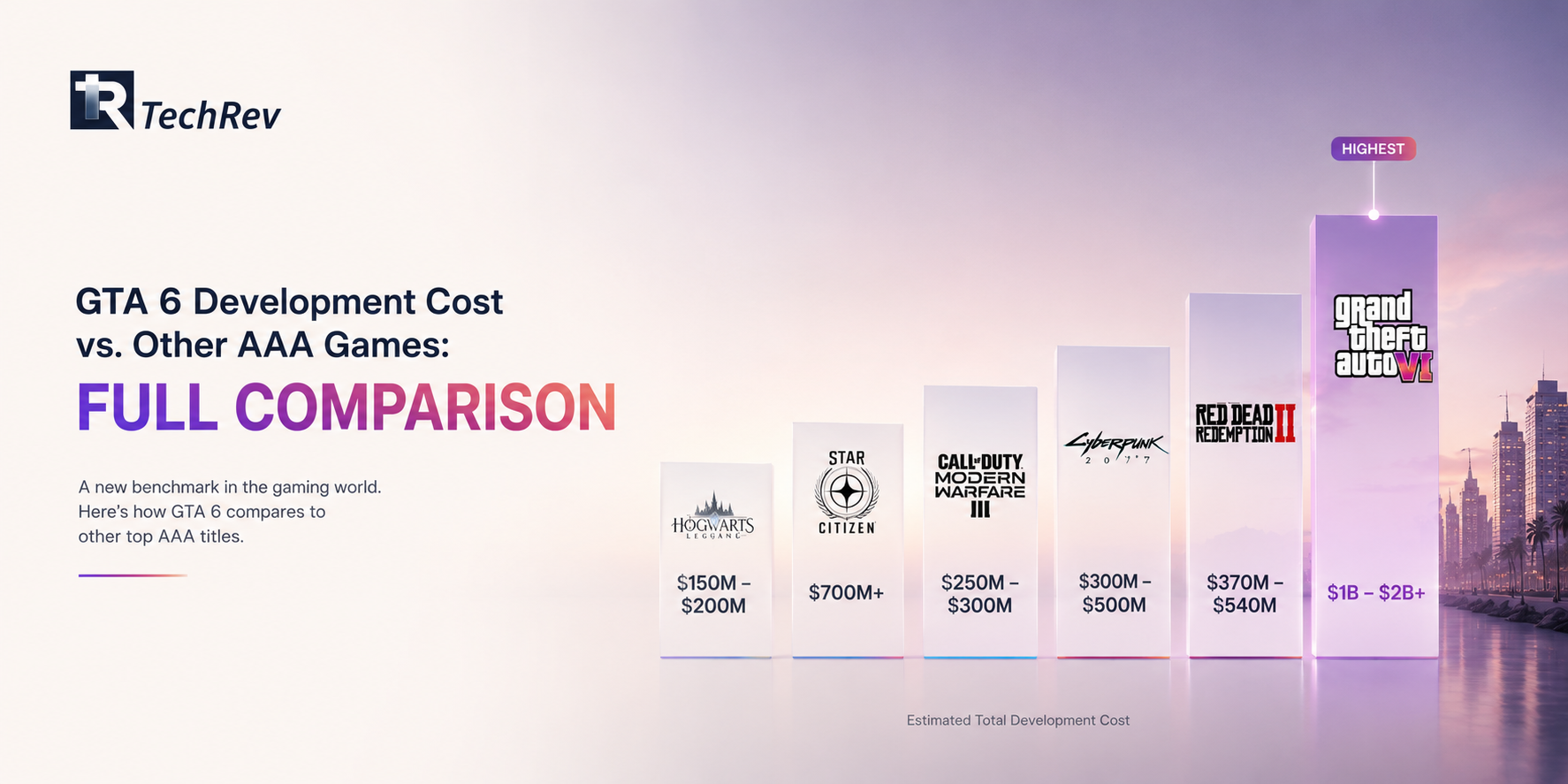
To understand how enormous the GTA 6 development cost really is, it helps to see it next to other well-documented AAA budgets.
| Game | Estimated Total Cost | Notable Detail |
| GTA 6 | $1 billion – $2 billion | Reportedly Rockstar’s largest production ever |
| Red Dead Redemption 2 | $370 million – $540 million | Featured over 500,000 lines of dialogue |
| Cyberpunk 2077 | $300 million – $500 million | Sold roughly 35 million copies by 2025 |
| Call of Duty: Modern Warfare II | $250 million – $300 million | Franchise has generated over $30 billion in lifetime revenue |
| Star Citizen | $700+ million (crowdfunded) | Ongoing project, funded entirely by community backers |
Even Red Dead Redemption 2, one of the most expensive games in history at the time of its release, sits at roughly a quarter to a half of what GTA 6 is rumored to cost.
That gap alone explains why every gaming outlet, financial analyst, and competitor is watching this release closely.
Key Factors Driving the GTA 6 Development Cost
A budget in the billions only makes sense once you understand exactly what Rockstar is building. Here are the core cost drivers behind the GTA 6 development cost.
1. Extended Development Timeline
Longer development cycles mean more years of salaries, licensing fees, infrastructure costs, and iterative testing. A project spanning most of a decade accumulates costs that a two or three-year production never touches.
2. A Massive Global Studio Network
GTA 6 reportedly draws on Rockstar Studios teams worldwide, coordinating hundreds of developers, artists, writers, animators, and QA testers. Managing that many people across time zones adds significant operational overhead on top of raw salary costs.
3. The Proprietary RAGE Engine and Advanced Physics
Rockstar continues to invest heavily in its in-house RAGE engine, refining physics, lighting, and animation systems specifically for this title. Building and testing proprietary game engine development at this scale requires specialized engineering talent that does not come cheap.
4. World Density, AI, and NPC Behavior
Modern players expect NPCs that react intelligently, traffic that behaves realistically, and environments packed with interactive detail. Programming and testing these interconnected systems is one of the single most resource-intensive parts of any large-scale production.
5. Motion Capture and Cinematic Performance
Rockstar is known for cinematic, story-driven experiences. Achieving that level of realism requires professional actors, specialized motion capture studios, facial animation technology, and extensive post-production work, all of which carry a steep price tag.
Technologies Powering the GTA 6 Development Cost
A large portion of the GTA 6 development cost comes down to technology investment rather than headcount alone.
- Advanced Graphics and Rendering – Realistic lighting, reflections, weather, and shadow systems that need to run smoothly across platforms without sacrificing visual fidelity.
- AI-driven NPC Systems – Traffic patterns, pedestrian behavior, and law enforcement responses that feel dynamic instead of scripted.
- Motion Capture and Animation Pipelines – Specialized equipment and long recording sessions to translate real performances into believable in-game characters.
- Next-Generation Engine Upgrades – Continuous refinement of RAGE to handle physics, environmental simulation, and animation at a scale few studios attempt.
How GTA 6 Is Expected to Generate Revenue?
With a budget this size, game sales alone will not carry the return on investment. Rockstar is expected to lean on multiple revenue streams:
- Day-one sales: GTA 6 is projected to sell tens of millions of copies within its first weeks, similar to or exceeding GTA 5’s launch performance.
- Online multiplayer: If GTA 6 follows the GTA Online blueprint, ongoing content drops, seasonal updates, and optional in-game purchases will generate revenue for years after launch.
- Special editions and DLC: Additional content packs and collector’s editions typically extend a title’s earning window well past its release date.
This is also why the global games market, valued at over $180 billion in 2026 according to industry estimates, continues to attract this level of investment. Mobile gaming alone generated roughly $92.6 billion in a single recent year, proving that a well-built game, AAA or indie, can produce returns that justify serious upfront investment.
What GTA 6 Means for the Wider Game Development Industry?
The following are some aspects:
1. Setting New AAA Budget Standards
What once looked “too expensive” for a video game may soon become the new normal at the top tier. Studios chasing AAA status will feel pressure to match Rockstar’s production values, even without matching its budget.
2. Rising Player Expectations Across the Board
Once players see what a billion-dollar budget can produce, expectations shift industry-wide, even for mid-size and indie titles. That means every studio, from AAA publishers to mobile game development services providers, now competes against a higher visual and technical bar.
3. A Renewed Focus on Efficient, Scalable Production
Not every studio has Rockstar-level resources, and that is exactly why outsourcing and specialized game development services have become so valuable.
The Global Game Development Service Market was valued at approximately $0.69 billion in 2026 and is projected to reach $2.18 billion by 2035, growing at a CAGR of roughly 13.67%, largely because studios are turning to experienced partners to control costs while still hitting AAA-adjacent quality benchmarks.
You Don’t Need a Billion-Dollar Budget to Build a Great Game
Here is the part most headlines skip: the GTA 6 development cost is an outlier, not a benchmark. The vast majority of successful games, including chart-topping mobile titles and beloved indie hits, are built on budgets that are a tiny fraction of Rockstar’s spend.
This is exactly where working with the right game development company changes the outcome. At TechRev, our game development services are built to help studios and founders create polished, competitive games without needing nine-figure funding rounds.
Our Game Development Services Cover the Full Production Cycle
- Unity game development services for cross-platform 2D and 3D titles, from casual mobile games to more complex simulation and strategy projects
- Mobile game development services covering iOS, Android, and cross-platform releases built for performance and monetization from day one
- Custom game mechanics, level design, and multiplayer architecture
- AI-driven NPC behavior and procedural content systems inspired by the same principles powering AAA titles, scaled to fit realistic budgets
- Post-launch support, live-ops tooling, and content update pipelines
Whether you are building a mobile puzzle game or a more ambitious open-world project, our game development service is structured around transparent pricing, realistic timelines, and technology choices that match your actual budget instead of an inflated one.
Where AI Agents and Generative AI Fit Into Modern Game Development?
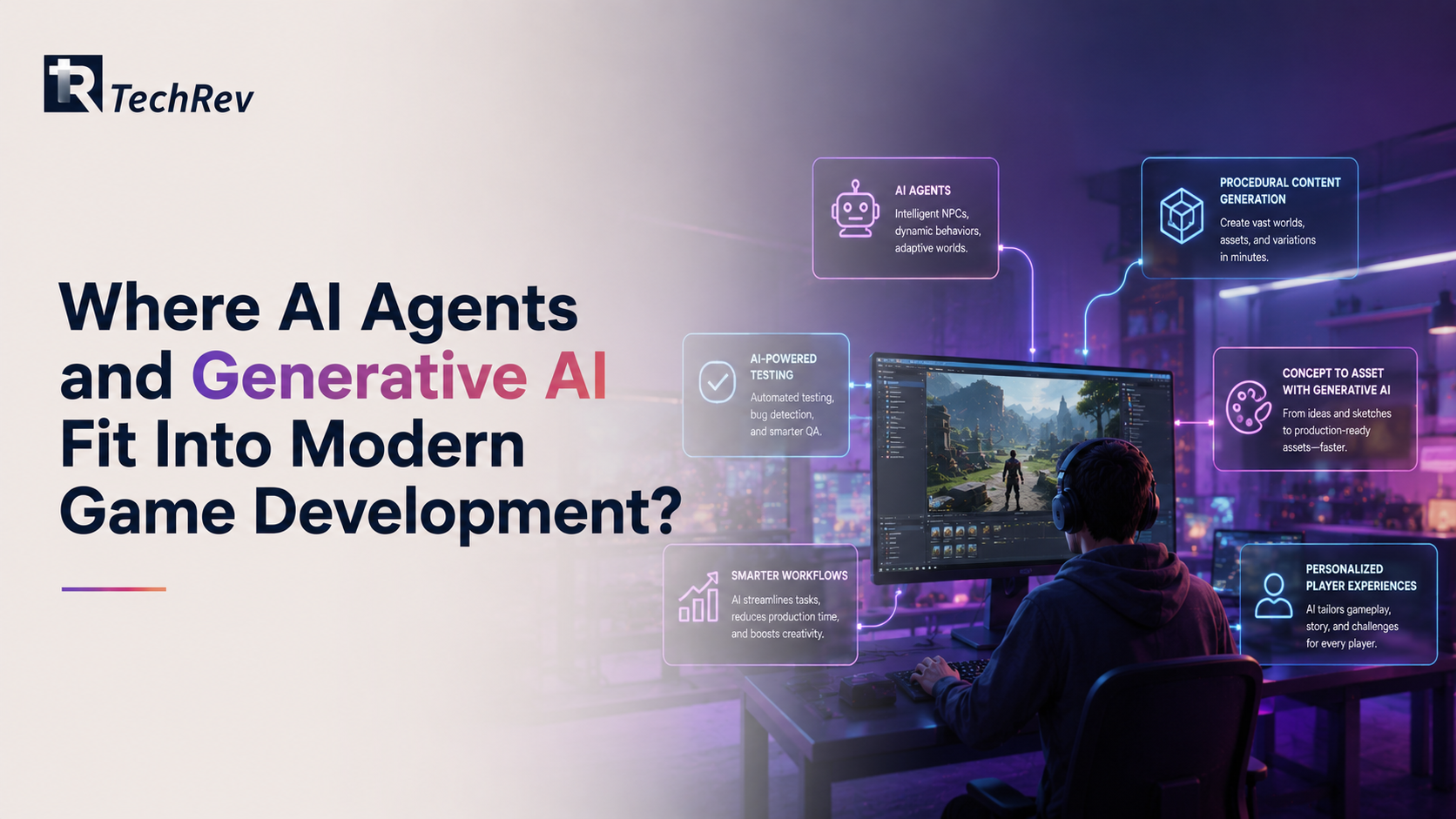
One of the biggest shifts since GTA 5 launched in 2013 is how much artificial intelligence now shapes game production itself, not just in-game NPC behavior.
The AI agents market was valued at roughly $7.6 billion in 2025 and is projected to reach $10.9 billion in 2026, with forecasts pointing toward $182.9 billion by 2033 at a compound annual growth rate near 49.6%, according to Grand View Research.
Generative AI follows a similarly steep curve, valued at around $22.2 billion in 2025 and expected to climb toward $324.7 billion by 2033. That growth is not limited to chatbots and marketing tools. It is actively reshaping how game studios build content, test systems, and manage live operations.
As an experienced AI agent development company, TechRev helps studios apply this same technology in practical, budget-conscious ways:
- AI agent development services for smarter in-game NPCs, dynamic quest systems, and automated QA testing that catches bugs faster than manual testing alone
- Generative AI development services for procedural asset creation, dialogue generation, and rapid prototyping that shrinks production timelines
- Player behavior analysis agents that help live-service games personalize content and retention campaigns automatically
Working with a genuine generative ai development company means your studio gets access to the same category of technology driving Rockstar’s NPC systems, minus the billion-dollar engineering budget required to build it from scratch.
As a generative AI development company themselves, TechRev builds these systems to be modular, so studios can adopt AI incrementally instead of committing to a total production overhaul.
In practice, most studios start small: a single AI agent for QA testing or one generative ai development services module for asset creation, then expand once the results prove out. Pairing our AI agent development services with our existing game development services means you are not managing two separate vendors for one connected pipeline.
Realistic Cost to Build a Game With TechRev
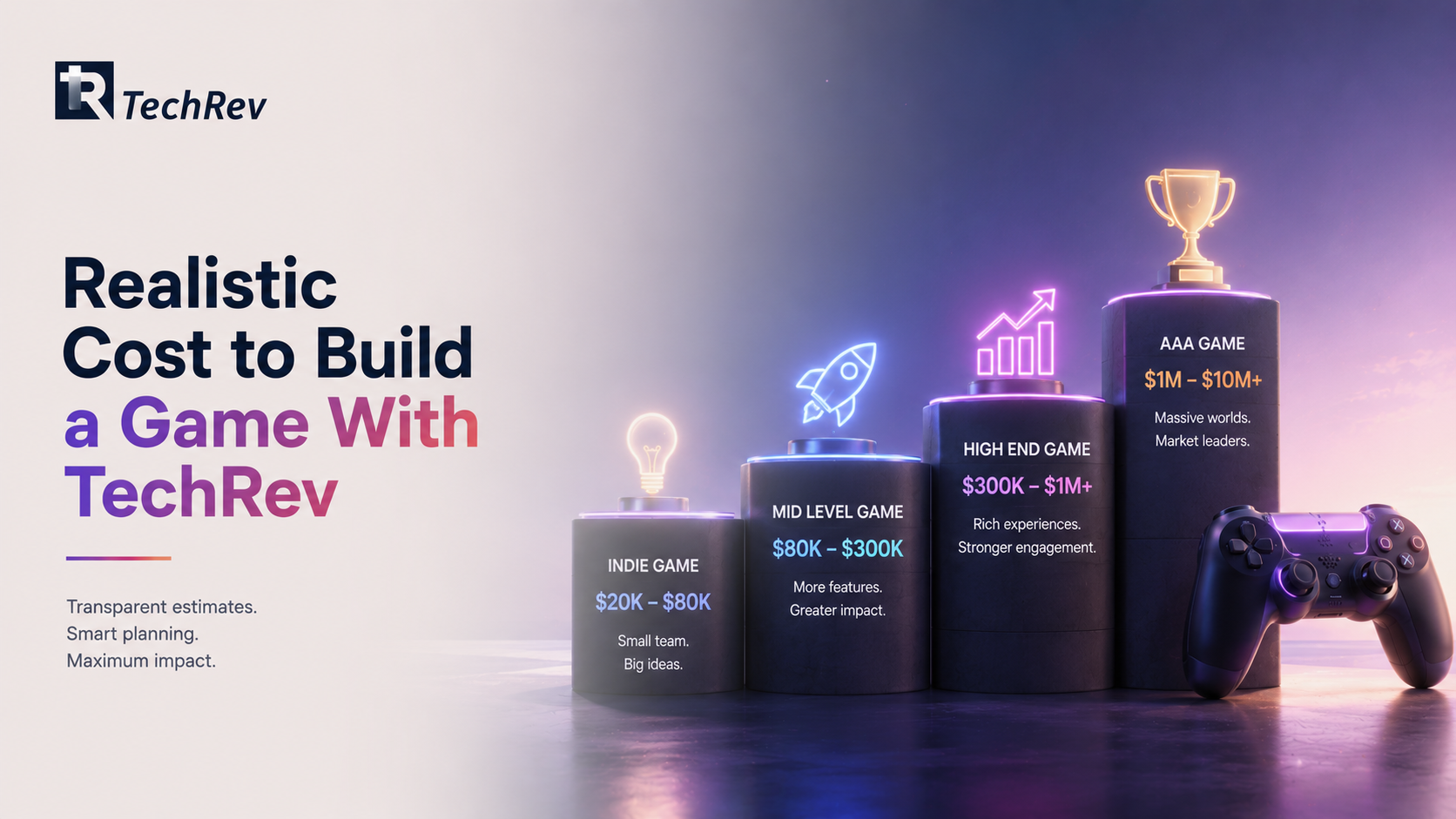
Unlike GTA 6, most game projects fall into much more manageable budget ranges. Here is a general breakdown based on project scope:
| Project Type | Typical Investment Range | Timeline |
| Simple mobile game (casual, hyper-casual) | $10,000 – $40,000 | 6-12 weeks |
| Mid-complexity mobile or Unity 2D/3D game | $40,000 – $150,000 | 3-6 months |
| Feature-rich multiplayer or AI-integrated game | $150,000 – $500,000+ | 6-12 months |
These figures will vary based on platform, art style, multiplayer complexity, and how much AI integration is involved, but they illustrate a simple point: quality game development does not require Rockstar-sized funding. It requires the right game development services partner and a scope that matches your resources.
Is the GTA 6 Development Cost Actually Worth It?
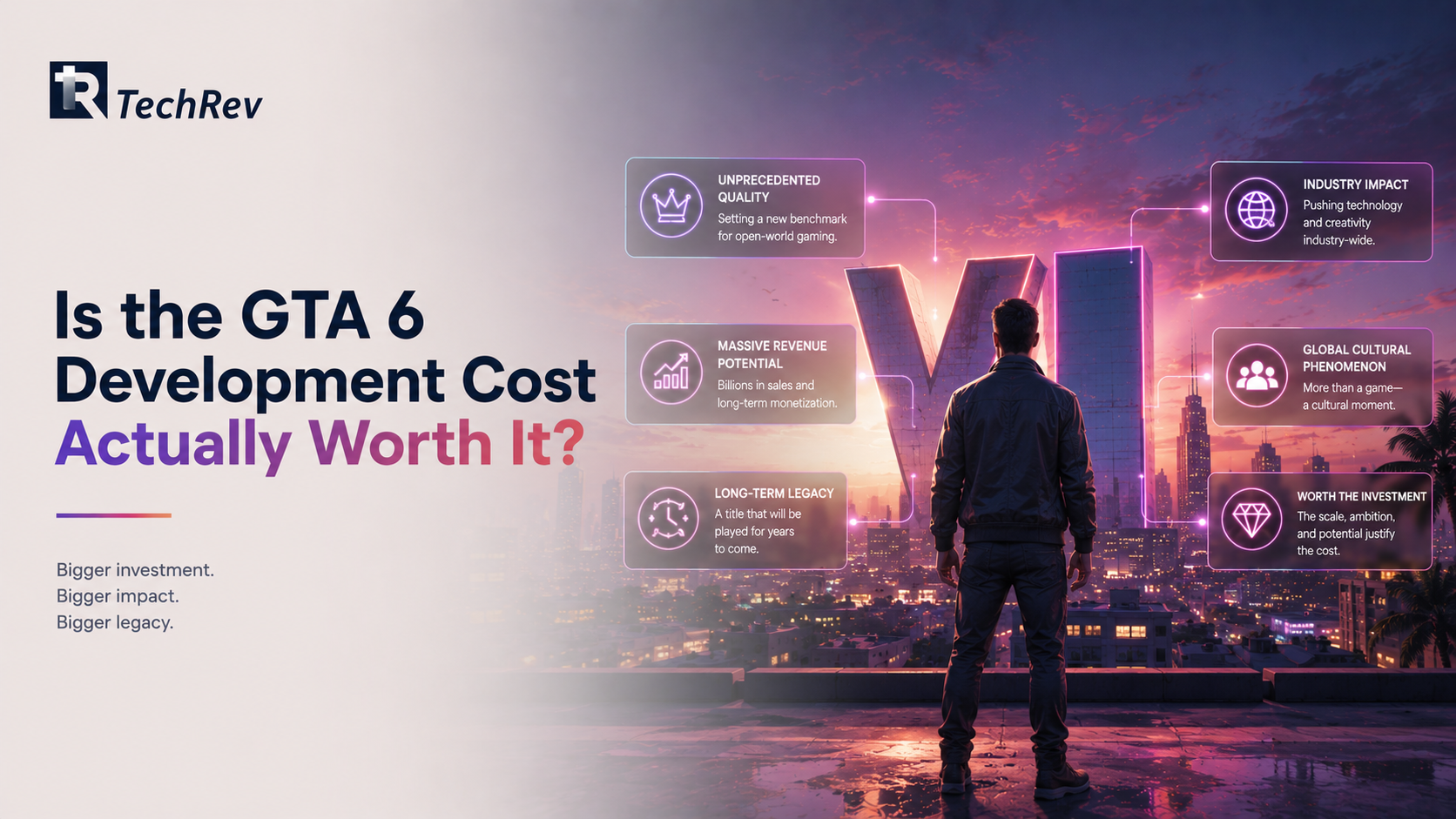
When rumors first put the number near $1 billion, the reaction across gaming communities was some version of “wait, they’re spending how much?” But Rockstar has earned a track record that supports the bet. GTA 5 was considered wildly expensive at launch too, and it went on to generate billions in lifetime revenue, largely thanks to GTA Online’s staying power.
Whether the final GTA 6 development cost lands closer to $1 billion or crosses $2 billion, the project has already proven one thing: audiences are willing to invest years of anticipation into a title they believe will deliver. For Rockstar, that translates directly into commercial confidence. For everyone else in the industry, it is a reminder that ambition, not just budget size, is what actually earns player trust.
Conclusion
The GTA 6 development cost tells a story bigger than one game. It shows how far player expectations have shifted, how much technology now shapes production budgets, and how AI, motion capture, and world-building tools that once seemed exclusive to Rockstar-sized studios are becoming accessible to teams of every size.
You do not need a billion dollars to build something players genuinely love. You need the right game development services partner, a realistic scope, and technology choices that fit your budget instead of straining it.
If you are ready to build your next mobile game, Unity project, or AI-powered gaming experience, TechRev’s game development services are built to take you from concept to launch without the guesswork. Talk to our team and let’s scope your project properly, budget included.
FAQs
1. Why is GTA 6 so expensive to develop?
GTA 6 has been in production for years and involves thousands of developers, engineers, writers, and artists working across a massive open world with advanced graphics, motion capture, and AI-driven systems. Each of those elements adds significant cost, and combined, they explain why the GTA 6 development cost has climbed into the billions.
2. What is the actual GTA 6 cost to develop, according to reports?
No official figure exists. Most credible estimates place the gta 6 cost to develop between $1 billion and $2 billion when combining development and marketing spend, based on comparisons to Rockstar’s past titles and industry analyst reports.
3. Will GTA 6 be more expensive than Red Dead Redemption 2?
Yes. RDR2 cost an estimated $370–$540 million, while GTA 6 is expected to cost roughly two to four times that amount, potentially making it the most expensive video game ever produced.
4. How long does it typically take to develop a large open-world game?
Large open-world titles like GTA 6 typically take five to ten years, involving planning, world design, programming, motion capture, voice acting, and extensive testing across hundreds or thousands of team members.
5. What game engine powers GTA 6?
GTA 6 is expected to run on Rockstar’s proprietary RAGE engine, which handles physics, animation, and world simulation. Many independent studios instead rely on Unity game development services or Unreal Engine to achieve strong results without building a custom engine from scratch.
6. Can a small studio realistically compete after seeing a budget like this?
Yes. Most successful games, including many mobile hits, are built on a small fraction of AAA budgets. Working with an experienced game development company that understands lean production, smart tooling, and AI-assisted workflows lets smaller studios ship competitive titles without needing nine-figure funding.
7. Does TechRev offer both mobile and Unity game development services?
Yes. TechRev provides mobile game development services for iOS and Android, along with Unity game development services for cross-platform 2D and 3D titles, covering everything from concept to post-launch support.
8. How is AI actually used in modern game development?
AI agents now handle NPC behavior, automated testing, and procedural content generation, while generative AI tools speed up asset creation and dialogue writing, cutting production time significantly for studios of any size.
9. What does TechRev’s AI agent development company offer game studios specifically?
As a dedicated AI agent development company, TechRev’s AI agent development services include smart NPC logic, automated QA agents, and player behavior analysis tools tailored to a studio’s existing game engine and budget.
10. Is generative AI expensive to add to an existing game?
Not necessarily. Generative ai development services can often be layered onto existing systems for asset generation or dialogue, keeping added costs proportional to the scope of the feature rather than requiring a full rebuild. Because TechRev operates as a full generative ai development company alongside its game and AI teams, studios can add these capabilities without switching vendors mid-project.