
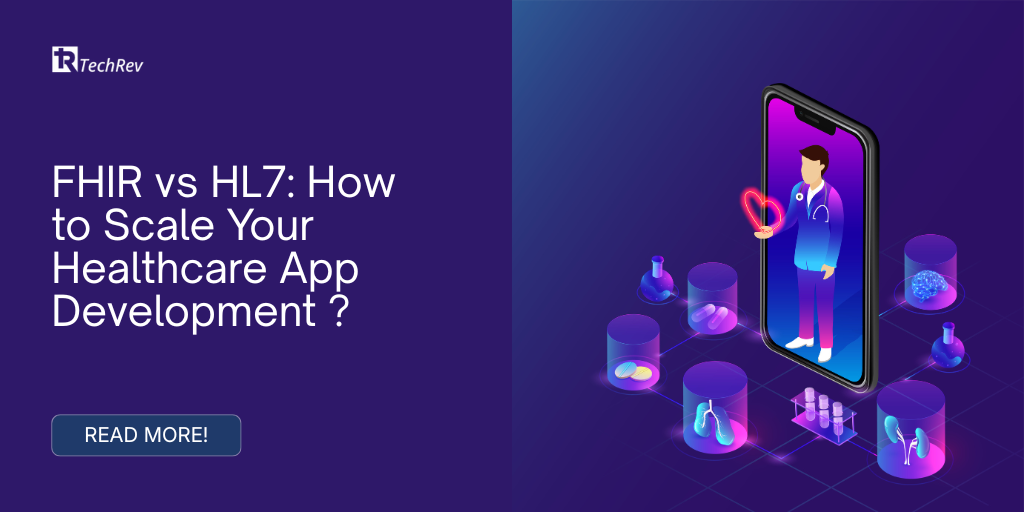
Have you ever wondered why connecting a simple mobile app to a hospital database feels like deciphering ancient code? If you are a founder or a lead engineer, you have likely stood at the crossroads of the FHIR vs HL7 debate. Why does one standard seem to hold everyone back while the other promises a revolution?
It is the difference between a product that scales and one that dies in a silo. Recent industry data suggests that the lack of effective interoperability in healthcare costs the global system over $30 billion annually in administrative waste.
Whether you are deep into healthcare app development or planning a new project, understanding the nuances of FHIR vs HL7 is your first step toward success.
Today, we are going to dive deep into how these standards impact clinical data interoperability, the role of a modern FHIR API, and why choosing the right healthcare interoperability solutions can make or break your market entry.
FHIR vs HL7 – Quick Overview!

To build a product that hospitals actually want to use, you need to understand the evolution of these standards. Health Level Seven International created both, but they serve very different eras of technology.
When we talk about FHIR vs HL7, we are usually comparing the legacy HL7 v2 messaging system with the modern, web-based Fast Healthcare Interoperability Resources framework.
Legacy HL7 acts like a fax machine. It sends a burst of data that the receiving system must interpret. On the other hand, the modern framework acts like a website. It uses a FHIR API to allow systems to request exactly what they need.
A Quick Look: FHIR vs HL7 Comparison
| Feature | Legacy HL7 (v2/v3) | Modern FHIR (v4/v5) |
| Data Format | Custom Pipe-delimited or XML | JSON, XML, and RDF |
| Communication | TCP/IP Minimal Layer Protocol | RESTful HTTP (Modern Web) |
| Flexibility | Rigid, requires custom mapping | Highly modular and extensible |
| Developer Ease | High learning curve | Easy for web developers |
| Implementation | Slow and expensive | RAPId and cost-effective |
Choosing between FHIR vs HL7 is not always an either-or situation. Many legacy systems still rely on HL7 v2, which means your healthcare mobile app development strategy must often account for both.
Role & Importance of Interoperability in Healthcare

Why are we so obsessed with interoperability in healthcare? Because data is only valuable when it moves. In the current landscape, the global market for healthcare interoperability solutions is projected to reach $6.2 billion by 2028.
When you invest in robust healthcare interoperability solutions, you are not just moving data. You are creating a foundation for better care. Here are the primary benefits of interoperability in healthcare that every AI developers USA should understand –
- Real-time Patient Insights – Doctors get immediate access to historical records, reducing the risk of diagnostic errors.
- Operational Efficiency – Automated data flows eliminate the need for manual data entry, which is a major source of burnout.
- Seamless Transitions of Care – When a patient moves from a GP to a specialist, their data moves with them instantly.
- Cost Reduction – Better clinical data interoperability reduces redundant testing, saving thousands of dollars per patient.
These benefits of interoperability in healthcare are the main selling points when you are pitching your product to hospital CIOs. If your medical app development project cannot prove these benefits, you will struggle to gain traction in the enterprise market.
Mastering EHR Integration and the FHIR API
If you are involved in custom healthcare app development, your biggest hurdle is almost certainly EHR integration. Connecting to systems like Epic, Cerner, or Allscripts is the final boss of medical app development. This is where the power of a standardized FHIR API becomes clear.
By utilizing a FHIR API, developers can treat the EHR as a database. Instead of waiting for the EHR to send a message, your app can query specific resources. This is the cornerstone of modern EHR integration services. However, the path is rarely straight. You often need specialized HL7 FHIR integration tools healthcare experts use to translate legacy data into modern formats.
Without the right HL7 FHIR integration tools healthcare vendors provide, your team will spend months writing custom data mappers. This is why many companies outsource to specialized healthcare Android app development services that already have these frameworks built.
The Checklist for EHR Integration –
- Select the Right HL7 FHIR integration tools healthcare vendors recommend – Do not reinvent the wheel.
- Follow the FHIR implementation guide – Each EHR has a specific FHIR implementation guide that defines how they have mapped their data.
- Prioritize Security – Ensure your EHR integration services comply with HIPAA and SOC 2 standards.
- Test for Edge Cases – Medical data is messy. Your custom healthcare app development must handle missing fields gracefully.
Advancing to Smart on FHIR App Development
The true holy grail of healthcare mobile application development is smart on FHIR app development. The SMART (Substitutable Medical Applications, Reusable Technologies) framework allows your app to run directly inside the EHR interface.
Engaging in smart on FHIR app development means your application becomes a native part of the physician’s workflow.
They do not have to log into a separate portal. They just click a button inside their patient chart. This level of medical device app development and software integration is what leads to high adoption rates.
To succeed in smart on FHIR app development, your team must be experts in both OAuth2 security and the specific FHIR implementation guide for your target EHR. This is a high-level skill set that often requires specialized FHIR certification or HL7 certification to prove competence to hospital boards.
But,
Is HL7 certification or FHIR certification more valuable?
Actually, having both an HL7 certification and a FHIR certification is the gold standard. An HL7 certification proves you can handle the legacy systems that still run 90% of hospitals, while a FHIR certification shows you are ready for the future of healthcare app development.
How TechRev Revolutionizes Healthcare App Development?
At TechRev, we understand that navigating the FHIR vs HL7 landscape is a massive undertaking. We have seen innovative custom software development ideas fail because the team could not handle the complexities of EHR integration.
That is why we provide end-to-end healthcare app development services designed to bridge the gap between legacy data and modern innovation.
Whether you are building a new patient portal or a complex medical device app development project, TechRev ensures your architecture is built for clinical data interoperability from day one. We do not just write code.
Here is how TechRev delivers measurable results for your healthcare business –
- 45% Cost Reduction – By utilizing our proprietary HL7 FHIR integration tools healthcare frameworks, we drastically reduce the billable hours spent on custom mapping.
- 60% Increase in Efficiency – Our streamlined EHR integration services get your product live in months, not years, accelerating your time to market.
- 75% Increase in Productivity – We handle the heavy lifting of interoperability in healthcare, allowing your internal team to focus on core product features.
- 120% Growth in Sales – Apps that are SMART-ready see much higher adoption. Our smart on FHIR app development expertise unlocks enterprise hospital contracts.
- 350% ROI – By avoiding the pitfalls of poor clinical data interoperability, our clients see a massive return on their development investment within the first year.
TechRev is more than a vendor. We are your partner in custom healthcare app development. We follow the FHIR implementation guide to the letter, ensuring your healthcare mobile application development project meets every security and data standard required by modern medicine.

Conclusion
The choice between FHIR vs HL7 is one of the most consequential decisions you will make in healthcare app development. The industry is moving rapidly toward a future defined by the FHIR API, but the legacy of HL7 remains a reality for many.
By mastering clinical data interoperability and leveraging professional healthcare interoperability solutions, you position your company at the forefront of the medical revolution. Whether you are focused on medical app development or a niche medical device app development project, your success depends on how well you move data.
Partnering with experts like TechRev ensures you have the technical strength, the EHR integration services, and the ROI-focused strategy to dominate the market. Stop struggling with fragmented data and start building the future of care today.
FAQs
1. Why is clinical data interoperability so expensive to implement?
It is expensive because of the mapping problem. Every hospital uses different codes for the same thing. Professional EHR integration services are required to normalize this data so it becomes usable.
2. What are the main benefits of interoperability in healthcare for startups?
For a startup, the biggest benefit is credibility. If your app has seamless clinical data interoperability, enterprise hospitals view you as a serious player, which significantly shortens your sales cycle.
3. Does TechRev help with FHIR certification for my internal team?
While we do not provide the exams, our healthcare app development services include mentoring and architectural reviews that prepare your team for the rigors of FHIR certification and HL7 certification.
4. Can you use a FHIR API with an old legacy system?
Yes, but you need a facade. You use HL7 FHIR integration tools healthcare middleware to translate the old HL7 v2 messages into a modern FHIR API format that your app can understand.
5. How does TechRev handle complex EHR integration?
We use standardized frameworks and deep knowledge of the FHIR implementation guide to map data accurately. This ensures your app talks to Epic, Cerner, or any EHR without breaking the clinical workflow.
6. Why is smart on FHIR app development better for doctors?
It keeps them on one screen. By integrating your app directly into the EHR, you eliminate toggle fatigue, leading to higher usage rates and much better clinical outcomes for patients.
7. What makes TechRev’s medical device app development different?
We focus on real-time clinical data interoperability. We ensure your device data flows securely and instantly into the patient’s record using a robust FHIR API, meeting all regulatory and technical standards.