
Databricks vs Snowflake comes down to one question: does your business need to build machine learning models and run AI agents development at scale, or does it need fast, governed SQL analytics with zero cluster management? Databricks wins for AI, data engineering, and generative AI development. Snowflake wins for business intelligence, reporting, and high-concurrency SQL. Most enterprise teams in 2026 use both.
If you have spent the last few weeks reading vendor pages, watching demo videos, and asking your engineering team which one should we actually pick, you are not alone. Databricks vs Snowflake is one of the most searched cloud computing data warehouse comparisons of 2026, and for good reason.
Both platforms promise to turn raw data into revenue. Both platforms are backed by billions in funding. And both platforms will tell you they are the better choice, because that is what vendor marketing does.
In this blog, we will break down Databricks vs Snowflake across architecture, machine learning models, generative AI development, pricing, and security, using real 2026 data instead of guesswork. By the end, you will know exactly which platform fits your workload, or whether you need both.
Databricks vs Snowflake: Market Stats in 2026
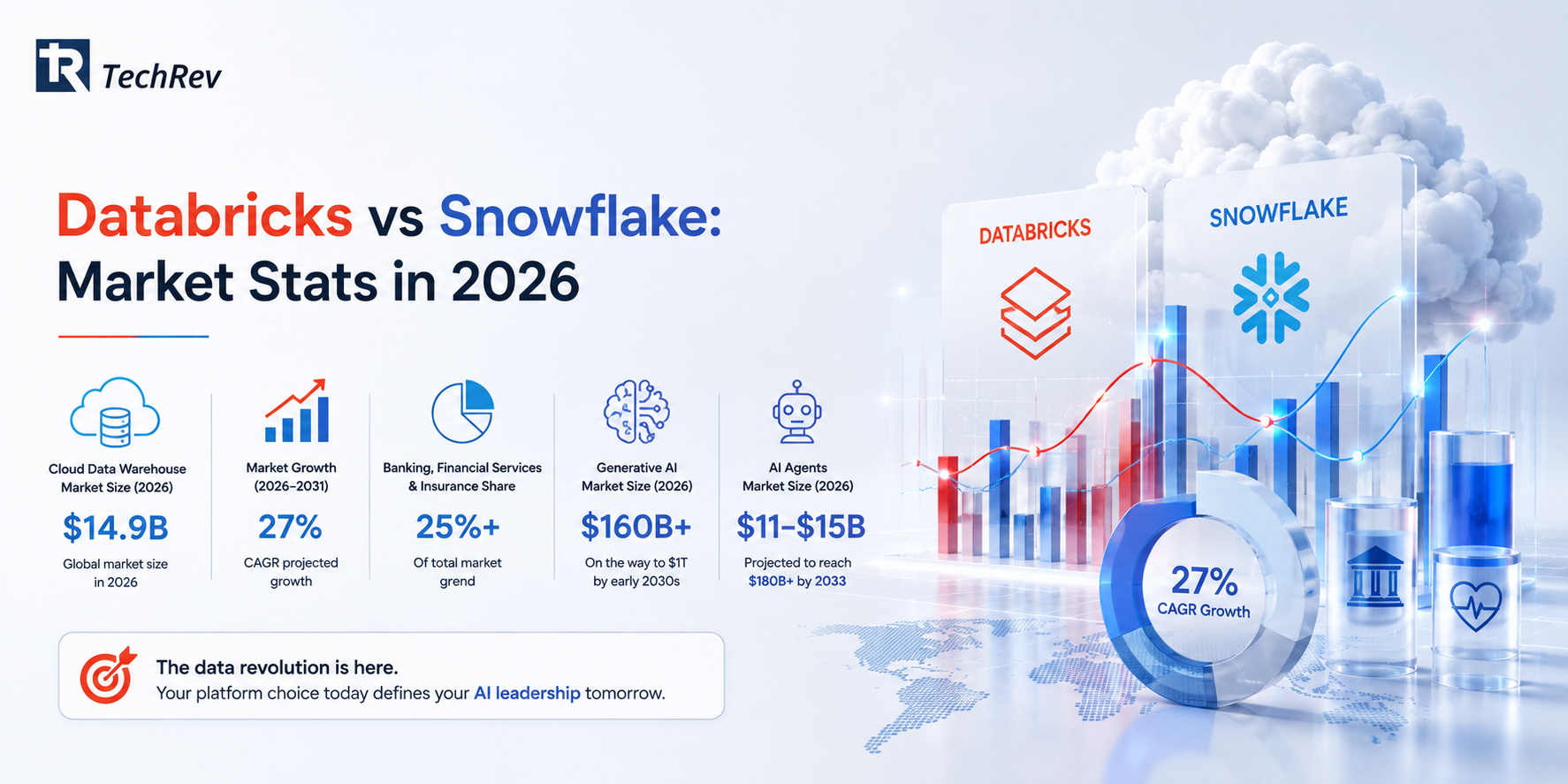
Before we compare features, look at the scale of what is at stake. The global cloud data warehouse market sits at roughly $14.9 billion in 2026 and is projected to reach $49.1 billion by 2031, growing at a compound annual rate near 27%. Banking, financial services, and insurance companies alone account for over a quarter of that spend, and healthcare is catching up fast.
At the same time, the generative AI development market has exploded past $160 billion in 2026 on its way toward the trillion-dollar mark by the early 2030s, and the AI agents market has climbed from under $8 billion in 2025 toward an estimated $11 to $15 billion this year, with some forecasts placing it above $180 billion by 2033.
This matters directly to the Databricks vs Snowflake decision, because the platform you choose today determines how ready your data is for machine learning models, generative AI development, and AI agents development tomorrow.
Neither Databricks nor Snowflake is a passive storage box anymore. Both are racing to become the operational core for AI, not just a warehouse that sits quietly in the background.
Databricks vs Snowflake: Key Differences!
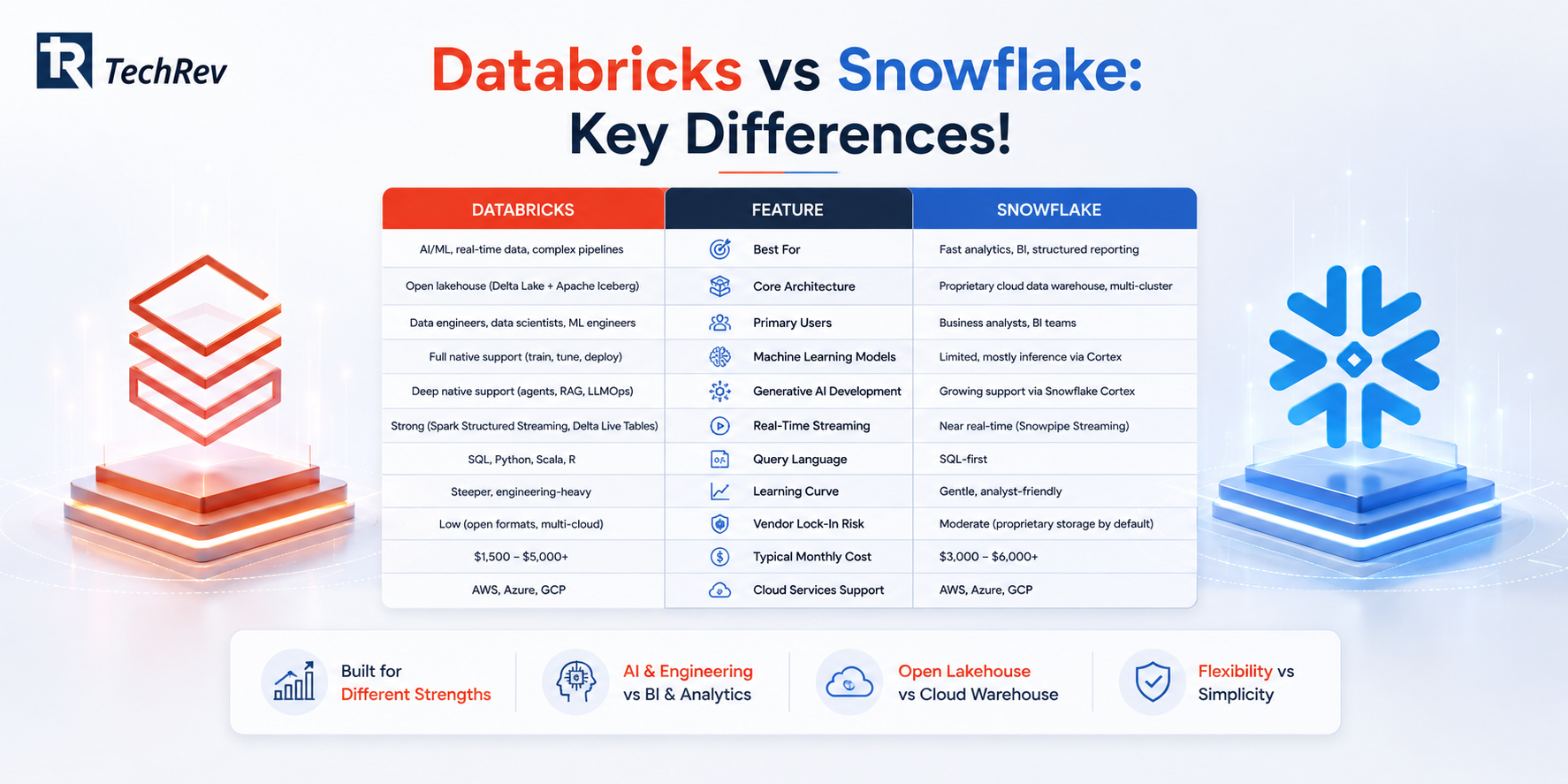
The following are some key differences of Databricks vs Snowflake:
| Feature | Databricks | Snowflake |
| Best For | AI/ML, real-time data, complex pipelines | Fast analytics, BI, structured reporting |
| Core Architecture | Open lakehouse (Delta Lake + Apache Iceberg) | Proprietary cloud data warehouse, multi-cluster |
| Primary Users | Data engineers, data scientists, ML engineers | Business analysts, BI teams |
| Machine Learning Models | Full native support (train, tune, deploy) | Limited, mostly inference via Cortex |
| Generative AI Development | Deep native support (agents, RAG, LLMOps) | Growing support via Snowflake Cortex |
| Real-Time Streaming | Strong (Spark Structured Streaming, Delta Live Tables) | Near real-time (Snowpipe Streaming) |
| Query Language | SQL, Python, Scala, R | SQL-first |
| Learning Curve | Steeper, engineering-heavy | Gentle, analyst-friendly |
| Vendor Lock-In Risk | Low (open formats, multi-cloud) | Moderate (proprietary storage by default) |
| Typical Monthly Cost | $1,500 to $5,000+ | $3,000 to $6,000+ |
| Cloud Services Support | AWS, Azure, GCP | AWS, Azure, GCP |
What is Databricks?
Databricks is a unified data and AI platform built by the original creators of Apache Spark. It was designed from day one for data engineers and data scientists who need to work with raw, messy, unstructured data and turn it into trained machine learning models.
Databricks runs on what it calls a lakehouse architecture, which merges the flexibility of a data lake with the reliability of a traditional warehouse.
Databricks raised $1.8 billion in additional debt in early 2026 to fund product growth ahead of its expected IPO, a signal that enterprise demand for AI-ready infrastructure keeps climbing
The platform also shipped Instructed Retriever, a retrieval system that delivers up to 70% better performance than traditional retrieval-augmented generation on complex, instruction-based queries, according to Databricks’ own engineering blog. That single feature shows exactly where Databricks is placing its bets: generative AI development and AI agents development, not just dashboards.
What Is Snowflake?
Snowflake is a fully managed cloud data warehouse built around a patented multi-cluster, shared-data architecture that separates storage from compute. Analysts and business teams get near-instant access to structured data without touching a single server, cluster, or index. Snowflake’s core value proposition has always been simplicity: you write SQL, Snowflake handles the rest.
Snowflake reports that more than 12,000 companies now run their data, apps, and AI workloads on its platform. In 2026, Snowflake also announced plans to acquire Observe to bring AI-powered observability into its stack, and it partnered with TVS Next to help manufacturers accelerate AI-driven digital transformation. Snowflake’s message is clear: it wants to be more than a cloud data warehouse, but analytics and reporting remain where it dominates.
Is Snowflake a database or a data warehouse?
Snowflake is a cloud data warehouse, not a traditional database. It stores structured and semi-structured data and separates storage from compute so multiple teams can query the same data simultaneously without performance loss.
1. Databricks vs Snowflake: Architecture Differences
The architecture is where every other difference in the Databricks vs Snowflake debate actually starts.
Databricks stores your data in open formats, primarily Delta Lake and Apache Iceberg, sitting directly on your cloud provider’s object storage (Amazon S3, Azure Data Lake, or Google Cloud Storage). Because the format is open, any engine that speaks Iceberg, including Spark, Trino, Flink, and even Snowflake itself, can read that data in place without copying it. This open foundation is a major reason engineering teams choose Databricks when they want to avoid getting locked into a single vendor’s cloud computing data warehouse ecosystem.
Snowflake, by contrast, uses a proprietary micro-partitioned columnar storage layer paired with independent virtual compute warehouses. This separation of storage and compute is elegant for SQL workloads. A runaway query in one warehouse never slows down another team’s dashboard. Snowflake has added support for Apache Iceberg tables too, but the majority of production Snowflake workloads still run on its native, closed format, which means your data stays inside Snowflake’s engine unless you actively plan an exit path.
If vendor lock-in worries you more than setup complexity, this single architectural choice should weigh heavily in your Databricks vs Snowflake decision.
2. Snowflake vs Databricks: Processing Engine and Performance
Databricks runs on Apache Spark, tuned further by its own Photon execution engine. Photon delivers up to 12x better price-to-performance compared to rival cloud data warehouses on certain workloads, and independent 2025 TPC-DI ETL benchmarking, run after Snowflake’s Gen2 launch, showed Databricks SQL Serverless completing extract-transform-load jobs roughly 2.8x faster at about 3.4x better price-to-performance than Snowflake Gen2. The gap widens further as concurrency and data volume increase.
Snowflake counters with a mature SQL optimizer, automatic result caching, and query pruning that make it genuinely fast for interactive business intelligence queries on pre-aggregated data. Snowflake’s Gen2 warehouses, launched in 2025, run roughly twice as fast as the prior generation with significantly better performance on data manipulation operations.
The honest takeaway: Snowflake tends to win on small, repeated BI queries. Databricks tends to win on heavy ETL, large-scale transformations, and anything feeding machine learning models. Neither platform wins performance outright; it depends entirely on your workload shape.
3. Databricks vs Snowflake: Machine Learning Models: Where Each Platform Stands?
This is where the snowflake vs databricks conversation gets the most one-sided.
Databricks was engineered around machine learning models from the start. It ships MLflow for the full model lifecycle, native support for TensorFlow, PyTorch, and scikit-learn, and collaborative notebooks where data scientists can train, test, and deploy machine learning models without leaving the platform.
Databricks earned a Leader position in the 2025 Gartner Magic Quadrant for Data Science and Machine Learning Platforms for the fifth consecutive year, ranking highest on both ability to execute and completeness of vision.
Snowflake supports machine learning models mainly through Snowflake Cortex, which allows teams to run inference and some model training directly inside SQL without moving data out. This is convenient for analysts who want to layer prediction on top of existing reports, but it does not replace a dedicated environment for training complex machine learning models from raw, unstructured data. If your roadmap includes training custom machine learning models on images, audio, sensor logs, or free text, Databricks remains the stronger foundation.
Which platform is better for a machine-learning-first product strategy? If your business is building AI-driven products and training large-scale machine learning models, Databricks is generally the stronger choice, since it lets data scientists work directly with raw data using frameworks like TensorFlow and PyTorch on one platform.
4. Snowflake vs Databricks: Generative AI Development and AI Agents Development
Generative AI development is no longer a side project for either vendor. It is the main event.
Databricks has invested heavily in generative AI development infrastructure: Unity Catalog for governed data access, Mosaic AI for training and serving custom models, and now Instructed Retriever, which improves retrieval accuracy for AI agents development by using metadata more intelligently than standard retrieval-augmented generation setups.
Because Databricks already unifies raw data, machine learning models, and compute in one environment, building and deploying AI agents development pipelines requires far less stitching together of separate tools.
Snowflake has responded with Snowflake Cortex AISQL, which lets teams run large language model functions directly inside SQL queries, and it is expanding its own AI agents development capabilities for governed, enterprise-grade agents.
This is a meaningful step forward, but it still assumes your data is already structured and inside Snowflake’s ecosystem, which is not always true for generative AI development projects that rely on unstructured or streaming inputs.
The global AI agents market is projected to reach somewhere between $52 billion and $183 billion by the early 2030s depending on the research firm, growing at a compound annual rate above 40%. Enterprises are not asking should we invest in AI agents development anymore. They are asking which platform gets us there fastest.
Do I need Databricks for generative AI development, or can I do it with Snowflake alone?
You can start generative AI development inside Snowflake using Cortex if your data is already structured, but for training custom models, handling unstructured data, or building complex AI agents development pipelines, Databricks offers deeper native support.
Cloud Computing Data Warehouse Costs: Full Pricing Breakdown
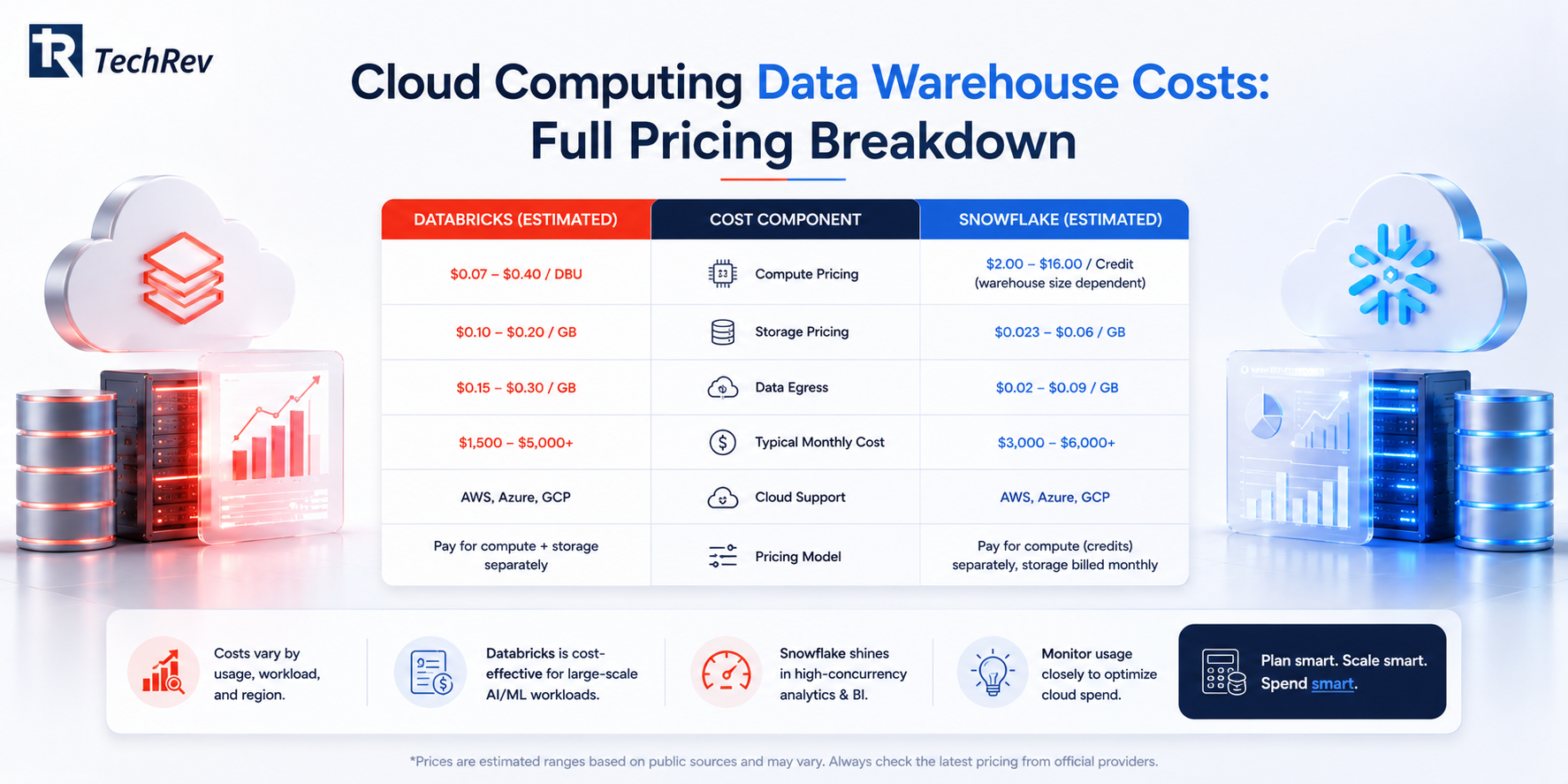
Cost is rarely simple in any cloud computing data warehouse comparison, and Databricks vs Snowflake is no exception. Here is the real breakdown, not just a headline number.
| Cost Component | Databricks | Snowflake |
| Compute Billing | Databricks Units (DBUs) billed per second, roughly $0.07 to $0.65+ per DBU depending on workload type | Credits billed per second, roughly $2 to $6 per credit depending on edition |
| Storage Billing | Cloud object storage (~$0.02 to $0.05/GB/month) plus Delta Lake overhead of 10 to 20% | Compressed storage at roughly $23 to $40 per TB/month |
| Infrastructure | Separate cloud VM and networking bills on top of DBUs | Bundled into Snowflake’s own pricing, no separate VM bill |
| Minimum Billing Window | Per-second billing, cluster-dependent | Per-second billing with a 60-second minimum at warehouse startup |
| Typical Monthly Range | $1,500 to $5,000+ for moderate ETL/ML workloads | $3,000 to $6,000+ for a medium warehouse with storage |
| Commitment Discounts | ~30 to 37% with committed usage | 30 to 70% with 1 to 3 year capacity commitments |
Medium-sized teams running regular data pipelines commonly land between $2,000 and $10,000 a month on either platform, while large enterprises can easily exceed $50,000 a month once machine learning models, streaming, and multiple business units enter the picture.
The pattern that shows up across nearly every 2025 to 2026 benchmark is this: Databricks tends to run large-scale ETL 20 to 40% more cheaply, while Snowflake delivers 15 to 30% faster response times on typical BI dashboards.
Neither number tells the whole story on its own, which is exactly why modeling your own workload before committing matters more than trusting either vendor’s marketing page.
5. Databricks vs Snowflake: Security and Compliance
Both platforms meet the compliance bar that regulated industries expect. Databricks and Snowflake both support HIPAA, SOC 2, and GDPR requirements, so both are viable for banking, insurance, and healthcare workloads.
Databricks gives engineers granular, role-based access control across workspaces, clusters, notebooks, and tables, plus Delta Lake audit logs and integrations with Azure Entra ID, Okta, and LDAP. It is powerful, but it demands hands-on configuration from your engineering team.
Snowflake leans toward automation: end-to-end encryption, multi-factor authentication, row-level security, and dynamic data masking that work out of the box with minimal setup. If your team lacks deep security engineering bandwidth, Snowflake’s automated approach reduces operational risk.

When Databricks Wins?
Databricks pulls ahead when your business needs:
- AI-first products that depend on training and retraining machine learning models continuously
- Streaming analytics for IoT, fintech, or ad-tech workloads that cannot wait for batch processing
- Unstructured or raw data pipelines covering logs, images, audio, or JSON that Snowflake struggles to process natively
- Generative AI development projects that require custom model training, not just inference on structured tables
- AI agents development at scale, where governed data access and model orchestration need to live in one place
- Feature engineering at scale for teams building complex machine learning models across massive datasets
When Snowflake Wins?
Snowflake pulls ahead when your business needs:
- Business intelligence teams who need fast, self-service dashboards without engineering support
- Finance, sales, and operations reporting that must be accurate, timely, and easy for non-technical staff to run
- High-concurrency SQL processing across hundreds of analysts running queries simultaneously
- Fast rollout with minimal infrastructure setup and near-zero cluster management
- Governed data sharing across departments or partner organizations without duplicating data
Can You Use Both Together?
Yes, and in 2026, most large enterprises do exactly that. Running both platforms is not a compromise; it is often the smartest cloud computing data warehouse strategy available.
A common pattern looks like this: Databricks processes raw, high-volume, or streaming data and trains machine learning models.
The refined output then flows into Snowflake, where business teams query governed, structured data through dashboards and reports without touching a cluster. Apache Iceberg support on both platforms now allows direct cross-platform queries without duplicating storage, which removes much of the friction that used to make dual-platform architectures expensive.
How TechRev Helps You Choose the Right Cloud Services Partner?
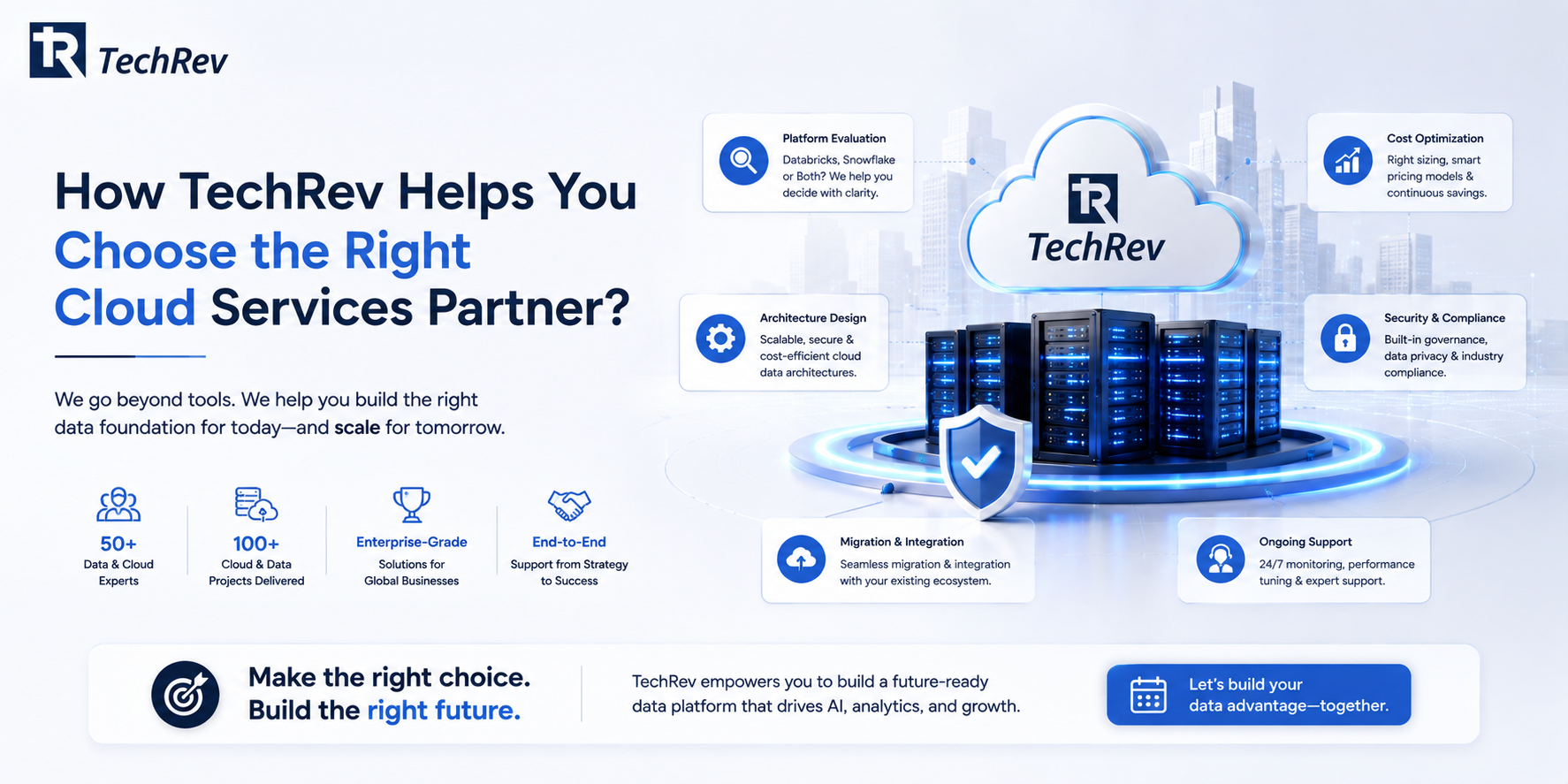
Choosing between Databricks vs Snowflake is only step one. The harder, more expensive part is implementation: connecting the right cloud services, training or fine-tuning machine learning models, and wiring up AI agents development without breaking your existing systems. This is exactly where TechRev comes in.
TechRev has been building AI-powered web, mobile, and cloud solutions for businesses across the United States since 2016. Our team works across generative AI development, AI agent development, machine learning integration, and cloud services, so you are not left alone to figure out how a data platform decision connects to the product your customers actually use.
Here is what that looks like in practice:
- Workload assessment first: We evaluate whether your priority is machine learning models, generative AI development, or business reporting before recommending a platform or architecture.
- Cloud services migration and setup: Our engineers handle the AWS, Azure, or GCP infrastructure work behind whichever cloud data warehouse strategy fits your business, so your internal team is not stuck configuring VMs and networking from scratch.
- AI agents development, done right: We build AI agents development pipelines that plug directly into your existing product, whether that means customer support automation, predictive analytics, or workflow agents that reduce manual work.
- Generative AI development that ships: From RAG-based assistants to custom fine-tuned models, we handle generative AI development end to end, not just a proof of concept that never reaches production.
- Ongoing support: Post-launch monitoring, performance tuning, and cost optimization so your cloud computing data warehouse spend does not spiral the way it does for teams without a governance plan.
If you are still weighing Databricks vs Snowflake, or you already know which platform you want and need a partner to build on top of it, talk to TechRev’s team about your project. You can also explore our AI development services and cloud services pages for a closer look at how we work.
FAQs
1. What is the main difference between Databricks vs Snowflake?
Databricks is an open lakehouse platform built for machine learning models, generative AI development, and large-scale data engineering. Snowflake is a fully managed cloud data warehouse built for fast, governed SQL analytics and business intelligence.
2. Is Snowflake better than Databricks for small businesses?
Snowflake often suits small businesses better because it requires minimal setup and no dedicated data engineering team. Databricks rewards technical depth, so smaller teams without engineers on staff may find Snowflake’s managed approach easier to adopt quickly.
3. How do Databricks and Snowflake handle data structure and ownership?
Databricks uses a schema-on-read approach, so data does not need a fixed structure before storage. Teams can evolve schemas as pipelines change. Snowflake uses schema-on-write, requiring data to match a defined structure before storage, which keeps datasets consistent for reporting and business intelligence work across teams.
4. What are the primary drivers of cost unpredictability in Databricks vs Snowflake?
Databricks charges through Databricks Units but also requires separate cloud VM, storage, and networking bills from your provider, so active cost monitoring matters. Snowflake bundles compute, storage, and services into one credit system, which is easier to track, though costs still rise quickly for heavy machine learning workloads.
5. Can Snowflake and Databricks be integrated into a single unified workflow?
Yes. Many companies use Databricks to clean raw data and train machine learning models, then move the refined output into Snowflake for fast analytics and executive reporting. Apache Iceberg support on both platforms makes this cross-platform setup easier than it was even two years ago.
6. Which platform is faster: Databricks or Snowflake?
It depends on the workload. Databricks tends to run large-scale ETL and machine learning training faster and more cheaply. Snowflake tends to deliver faster response times on smaller, repeated business intelligence queries thanks to automatic caching.
7. Does TechRev offer AI agents development for businesses using Databricks or Snowflake?
Yes. TechRev builds AI agents development pipelines that connect to whichever cloud data warehouse or cloud computing data warehouse setup your business already uses, including custom workflow agents, predictive models, and generative AI development integrations.
8. How much does it cost to hire TechRev for a generative AI development project?
Cost depends on scope, data complexity, and whether the project involves custom machine learning models or off-the-shelf APIs. TechRev provides a detailed quote after a workload assessment, similar to how enterprise generative AI development budgets are scoped industry-wide.
9. Can TechRev help migrate our data infrastructure between cloud services providers?
Yes. TechRev’s cloud services team handles migrations across AWS, Azure, and Google Cloud, including workloads moving between or alongside platforms like Databricks and Snowflake, with minimal downtime and a clear cost governance plan from day one.
10. Is Databricks or Snowflake better for real-time streaming data?
Databricks generally handles real-time streaming better through tools like Kafka and Delta Live Tables, built for continuous data as it arrives. Snowflake supports near-real-time ingestion through Snowpipe Streaming, but it remains primarily built for analytics and reporting rather than complex, event-driven machine learning pipelines.
Ready to turn your data platform decision into a working product?
Contact TechRev for a workload assessment covering cloud services, machine learning models, and generative AI development tailored to your business.