
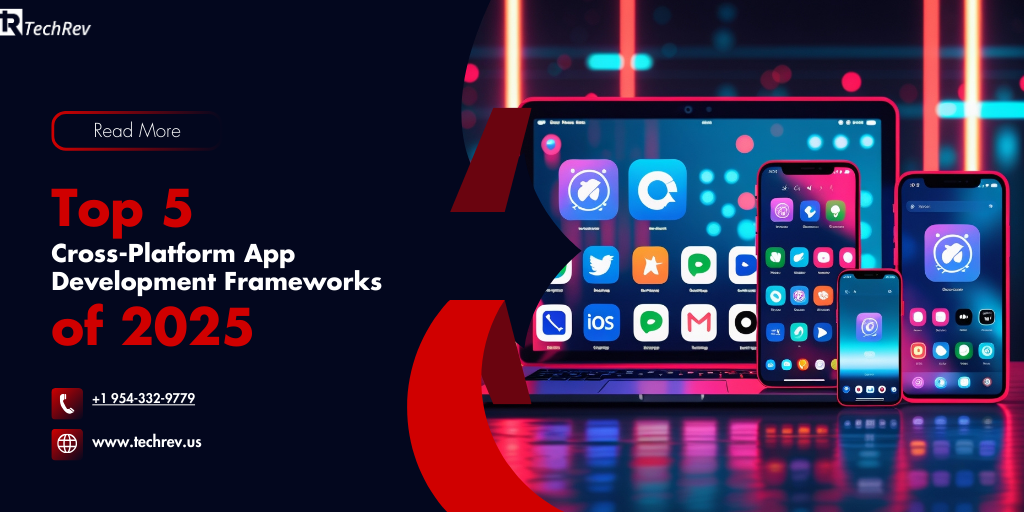

The mobile app development industry is an ever-evolving world, and businesses need to adapt to the changing landscape of technologies to remain competitive. Everyone knows that cross-platform app development frameworks empower developers to build apps for different platforms without requiring redundant coding, jumping and learning multiple tools, and managing the coding challenges at this time.
From startups and enterprises to custom mobile app development companies, the top cross-platform frameworks in 2025 are essential. They ensure affordable app development, shorten development time, and help to create powerful UI/UX.
If yes, you are right because this blog will lead you to the best cross-platform app development frameworks in 2025 that are transforming the market.
So, without any further ado, let’s get started!
What are Cross-Platform App Development Frameworks?
Cross-platform app development frameworks provide developers with tools to create mobile applications that run on several operating systems (OS) with a single codebase (e.g., Android, iOS). These frameworks use programming languages like JavaScript, Dart, and C# for easy application deployment.
Cross-Platform App Development Frameworks: Key Features!
- Code reusability – Write once and deploy on many.
- Decreased development time – Time-to-market is significantly reduced due to the absence of separate coding for iOS and Android.
- Economical – Reduces overall app development cost by avoiding repetitive work.
- Vast community support – Open-source app development frameworks get regular updates.
Moving ahead, let’s discuss,
Top Benefits of Cross-Platform App Development
Following are some benefits that you can consider: –

1. Cost-Effectiveness
With cross-platform development tools, businesses save money by eliminating the need for multiple development teams. You can manage both iOS and Android app development by the same team.
2. Fast App Development and Deployment
It speeds up the app development cycle, as developers need to write just a single codebase. This is especially useful for startups and enterprises needing to launch apps quickly.
3. Enhanced Code Reusability
Cross-platform frameworks allow code sharing, meaning mobile app development time is not wasted creating individual codes for each platform, and updates will be easier.
4. Personalization
Most frameworks include customizable components, which enable companies or businesses to modify applications based on their business requirements to enhance user experience and engagement.
As we have discussed a lot about features and benefits of cross-platform frameworks, it’s time to discuss the real deal of this blog, which is:
Building Cross-Platform Apps: Top Cross-Platform App Development Frameworks!
Following are some of the best frameworks that you can consider:

1. Flutter
With its quick rendering engine and dynamic UI capabilities, Flutter, backed by Google, continues to be one of the best options for cross-platform app development. But,
Why Choose Flutter?
- Utilizes the Dart programming language to support high-performance apps.
- Offers one codebase for iOS, Android, and web apps.
- They have a lot of community support and fixes.
2. React Native
React native, a Facebook product, is one of the fastest cross-platform app development tools in 2025.
Why choose React Native?:
- Web developers find it relatively easy to shift as it’s JavaScript-based.
- Native components => High performance.
- Broad support in libraries and third-party integrations.

3. Xamarin
Even now, in 2025, Microsoft’s Xamarin is one of the best cross-platform frameworks.
Cross-platform app developers can pursue a seamless development process for Android and iOS apps. This makes it a popular choice with enterprises and large-scale applications due to its close integration with .NET and C#.
- Xamarin compiles apps into native code, unlike many other hybrid frameworks, so you get native performance.
- Enterprise Support – Enterprise solutions require strong reliability and scalable capabilities, so many custom mobile app development companies prefer Xamarin.
- Access to Native APIs—Native APIs can be easily accessed, making it easier for developers to integrate advanced functionalities.
4. Unity for Mobile Application Development
However, Unity is one of the most popular mobile app development tools for AR/VR application development, which is why it’s a well-known gaming platform.
Reasons Unity is Used Like Crazy Outside of Gaming
- Cross-Platform 3D Development- This is Great for applications involving 3D rendering and animations.
- Businesses use Unity for AR/VR experiences.
- Performance Optimized – Unity maintains efficient functioning on mobile devices.
5. Ionic
Ionic is a complete framework for developing progressive web apps (PWAs) and hybrid mobile apps. It is commonly used by startups and enterprises seeking cost-efficient mobile app development services.
Why Ionic?
- Cross-Platform Support – iOS, Android, and desktop browsers.
- Large Developer Community – It has Great support and a lot of third-party plugins.
Choosing the Right Development Partner
When selecting the best mobile app development team, it is crucial to work with a custom mobile app development company that understands the latest frameworks and industry trends.
How to Choose the Right Top Mobile App Development Company?
- A Track Record of Success—A good portfolio does the talking for you. Consider the best person with a track record of launching mobile applications that connect to users.
- User-Centric UI/UX Design – A beautiful, intuitive user experience is paramount! Your partner should specialize in UI/UX design and deliver apps that are beautiful and easy to use.
Why TechRev Is Best in End-to-End Mobile App Development?
Think of a partner who will manage every stage of your app’s life cycle, from ideation to post-launch support.
TechRev offers end-to-end solutions, including application design, integration, and management, making the development process as easy and efficient as possible.
Turning Dreams into Reality — TechRev & what we can do for you
Your app idea is like no other, requiring a partner to get it. TechRev is a company that thrives on projecting complex ideas into clean, high-functioning mobile software applications. Through and through, the passionate architects are dedicated to making your vision a reality and delivering bespoke solutions that raise the standard.
The best mobile app development partner with broad industry experience comes with invaluable insights you need in your project.
TechRev has a vast portfolio across various sectors, including pharmaceuticals, healthcare, government, manufacturing, e-commerce, etc. This breadth of knowledge enables them to develop solutions that effectively tackle your sector’s unique challenges and requirements.
Want to know how to find the best mobile app development company? Read here.
Conclusion
Therefore, in 2025, the proper cross-platform app development framework is vital for developing high-performance and cost-effective applications. Flutter and React Native are top contenders, each with its pros and cons for various project types.
Businesses must consider performance, scalability, and support for third-party integrations when choosing a framework. A custom mobile app development company like TechRev can help you design an app that meets the best industry standards and keeps you ahead of the competition.
FAQs
1. Which is the best cross-platform app development framework in 2026?
Flutter is considered one of the best cross-platform app development frameworks in 2026 because of its high performance, fast rendering engine, and single codebase support for iOS, Android, web, and desktop applications.
2. Is Flutter better than React Native in 2026?
Flutter offers better UI consistency and rendering performance, while React Native is preferred by teams already experienced in JavaScript and React ecosystems. The right choice depends on project goals, budget, and developer expertise.
3. What are the advantages of cross-platform app development?
Cross-platform app development reduces development costs, shortens time-to-market, simplifies maintenance, and allows businesses to launch apps on multiple platforms using a single codebase.
4. Which framework is best for enterprise mobile app development?
Xamarin remains a strong choice for enterprise mobile app development because of its integration with Microsoft technologies, native API access, and scalability for large business applications.
5. Is React Native still relevant in 2026?
Yes. React Native continues to be one of the most popular frameworks in 2026 due to its JavaScript ecosystem, reusable components, live reload functionality, and strong community support.
6. Why do businesses prefer Flutter for app development?
Businesses prefer Flutter because it enables faster app development, attractive UI design, excellent performance, and deployment across multiple platforms from a single codebase.
7. What is the difference between native and cross-platform app development?
Native app development uses separate codebases for iOS and Android, while cross-platform development uses one shared codebase to build apps for multiple platforms simultaneously.
8. Which cross-platform framework is best for startups?
Flutter and React Native are commonly recommended for startups because they reduce development costs, accelerate MVP launches, and simplify app maintenance.
9. Can cross-platform apps deliver native-like performance?
Modern frameworks like Flutter and React Native can deliver near-native performance for most business applications, especially when optimized correctly.
10. Is Unity used only for game development?
No. Unity is widely used beyond gaming for AR/VR applications, interactive mobile experiences, simulations, and 3D visualization platforms.
Want to know how to build a winning mobile app? Read this blog.