
AI integration services exist because of a statistic most vendors will not put in their pitch decks: MIT researchers reported in 2025 that about 95% of enterprise generative AI pilots were failing to deliver measurable ROI, and the study’s core finding was not that the AI was weak. It was that the AI never got wired into real workflows and systems. The models worked; the integration did not happen.
That is the whole case for AI integration services in one paragraph. Businesses do not have an AI problem in 2026. They have a connection problem: intelligence on one side, the CRM, EHR, ERP, and custom apps that actually run the company on the other, and a gap in between where pilots go to die.
This guide covers everything the category includes: what AI integration services are, the market numbers behind the integration-first shift, the components and process, real costs, and how to choose an AI integration company that closes the gap instead of widening it.
What Are AI Integration Services?
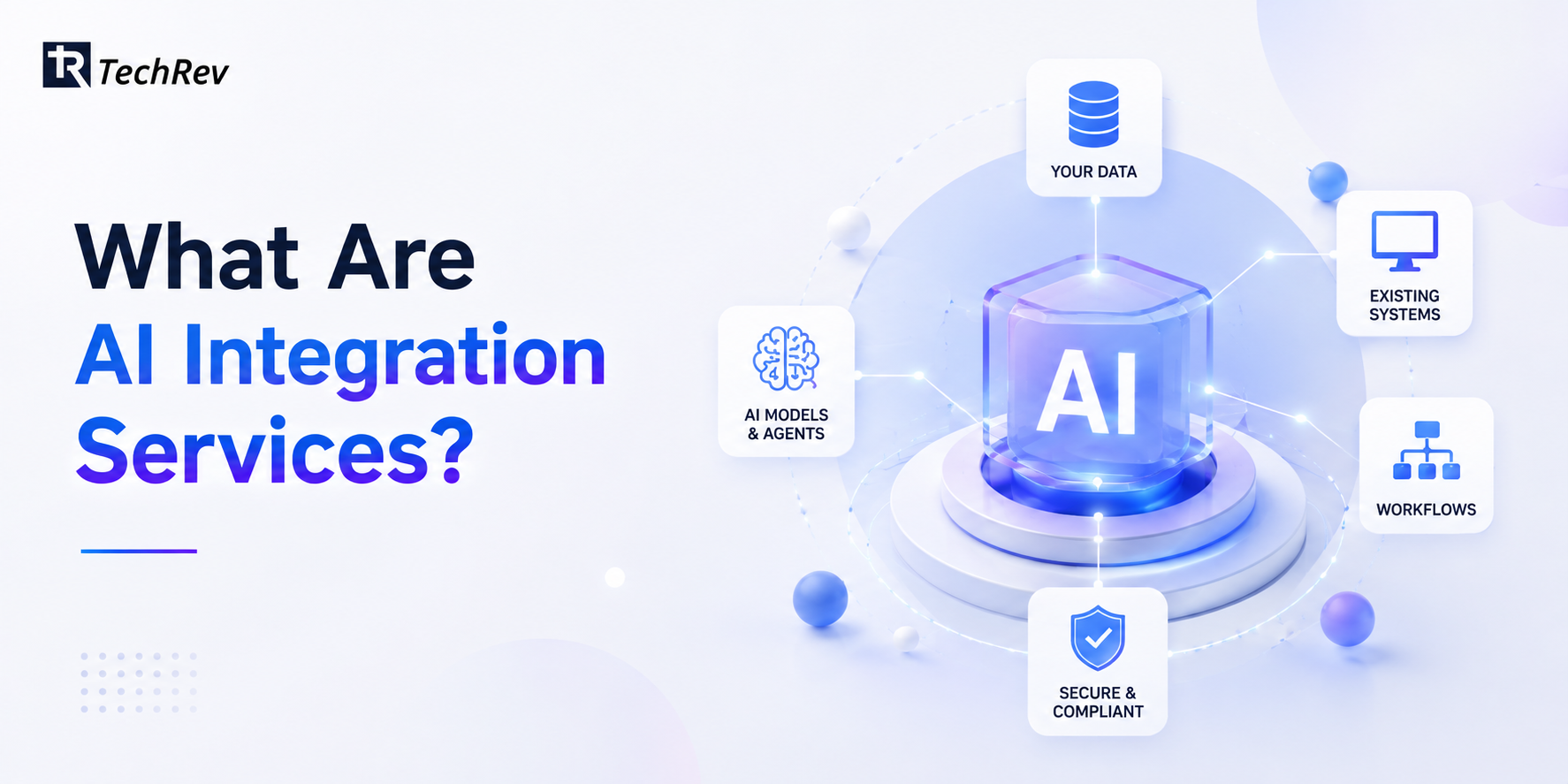
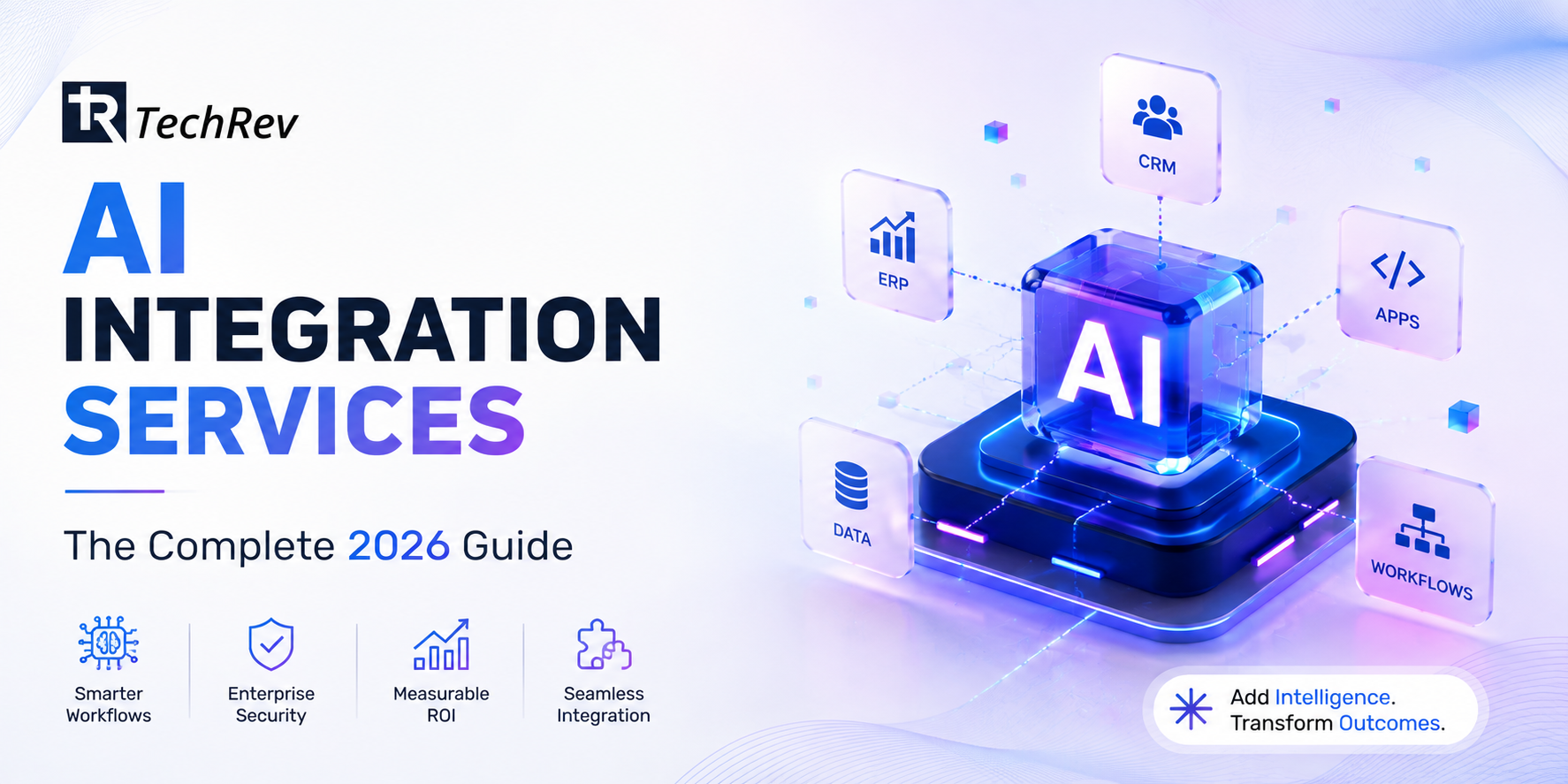
AI integration services connect AI capability, language models, agents, and automation, into the software a business already runs: embedding AI features in existing apps, grounding models in company data, wiring agents into CRMs and operational systems through APIs, and adding the governance that makes it safe. The defining principle is that your systems and workflows stay; intelligence is added to them.
The contrast that matters: AI replacement projects ask “what new system should we buy or build?” AI integration asks “what can the systems we trust do once they can think?” The second question is faster, cheaper, and, per the failure data below, far more likely to work.
Why AI Integration Beats AI Replacement: The Market Numbers
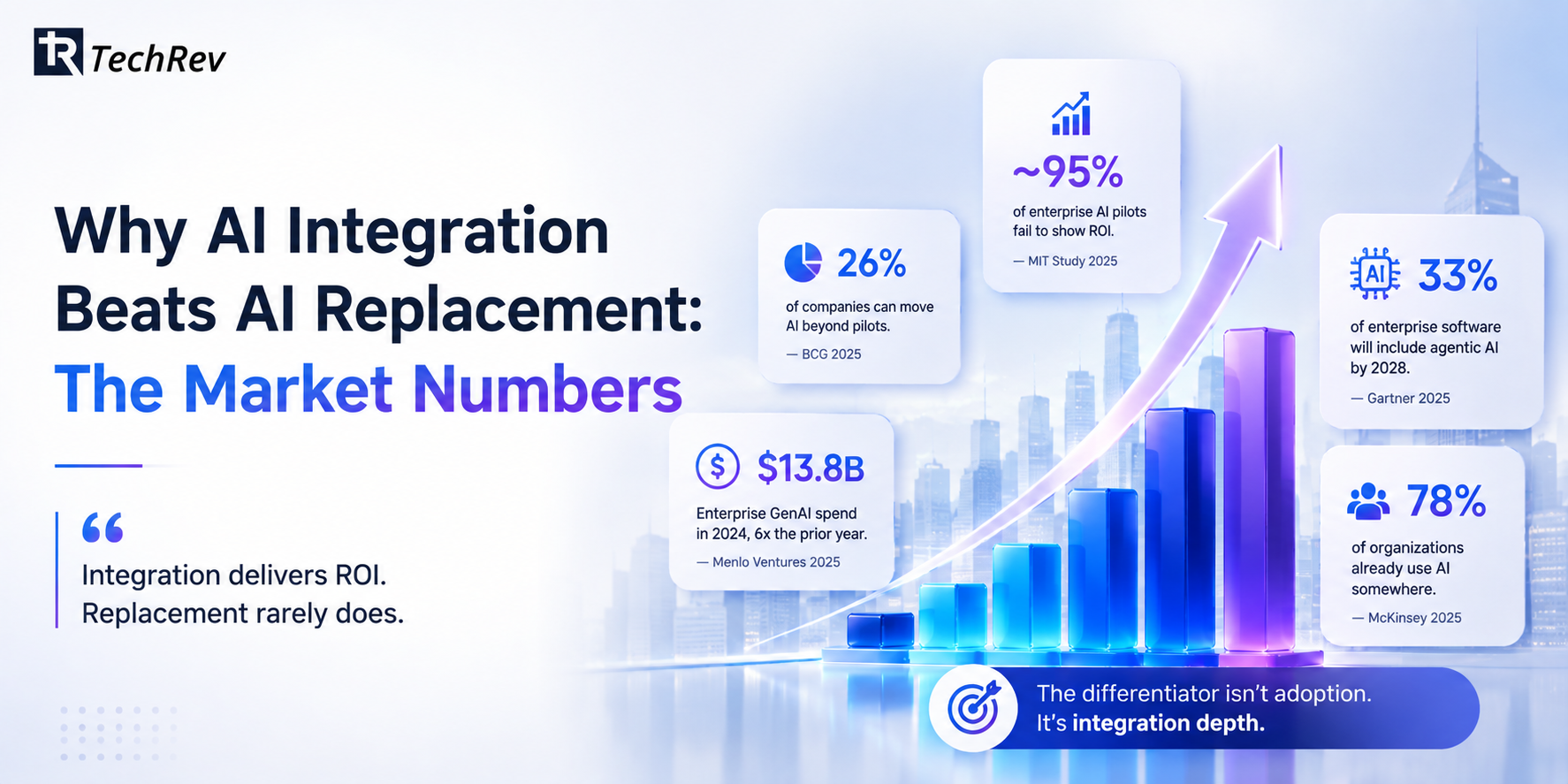
The 2025-2026 research record reads like a verdict:
- ~95% of enterprise AI pilots failed to show ROI (MIT’s widely reported 2025 study), with the failures concentrated in tools that were never embedded into workflows, while the successes bought or built narrowly integrated solutions.
- BCG’s research found only about 26% of companies have the capability to move AI beyond proofs of concept to real value, leaving roughly three quarters stuck at the pilot stage.
- Meanwhile the spending is real: enterprise generative AI spend hit roughly $13.8 billion in 2024, about 6x the prior year (Menlo Ventures), and Gartner projects 33% of enterprise software will include agentic AI by 2028.
- 78% of organizations already use AI somewhere (McKinsey), so the differentiator has moved from adoption to integration depth: whose AI can actually read the ticket, update the record, and close the loop.
Money in, value stuck, and the blocker named by the research is integration. That is why AI integration services became the fastest-growing engagement type in enterprise AI, and why “we have a pilot” impresses no one anymore.
What Do AI Integration Services Include?
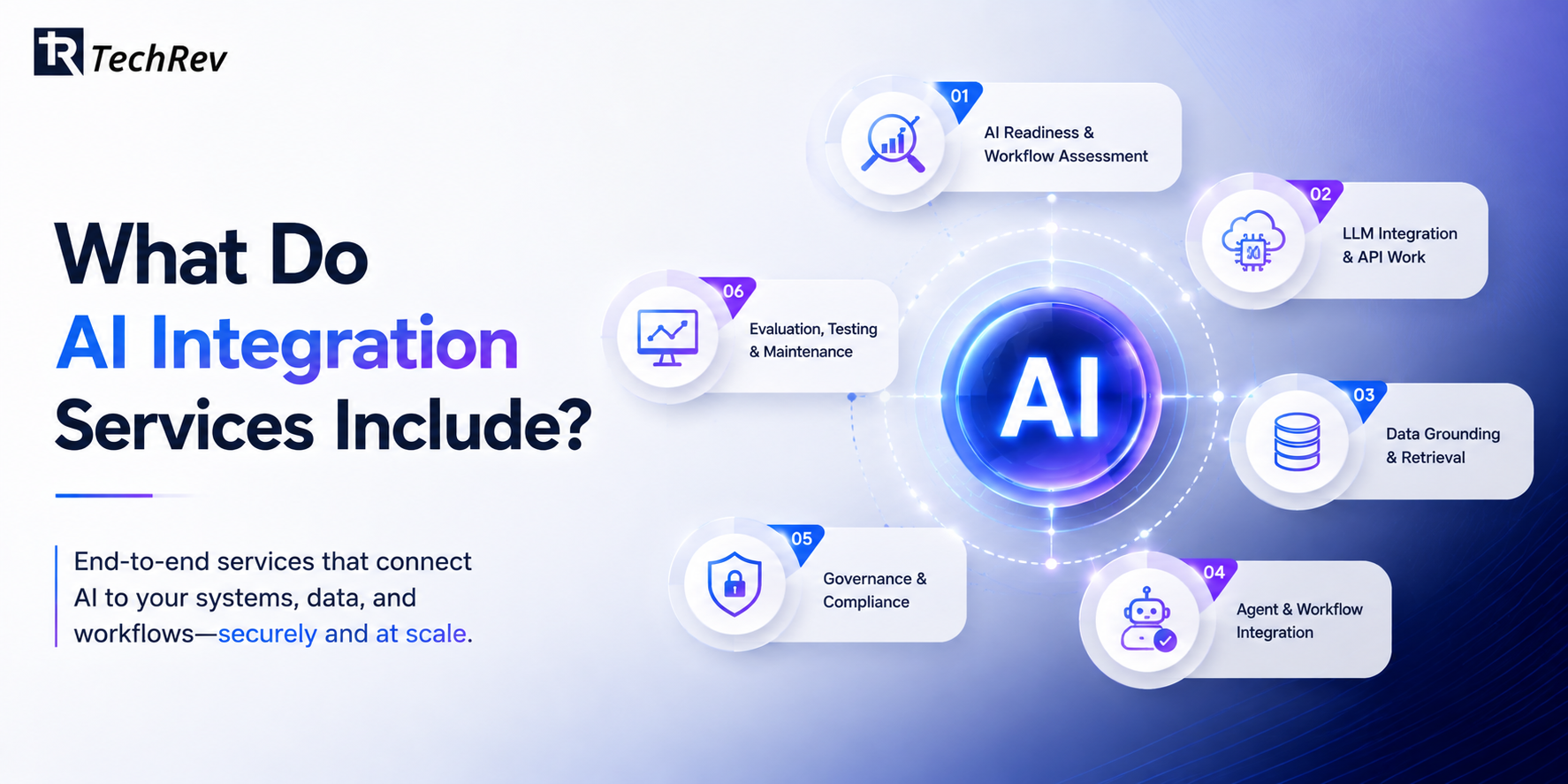
A complete engagement covers six components:
- AI readiness and workflow assessment. Which workflows have the volume, rules, and data access to pay back, and what the integration map looks like: the systems, APIs, and data sources involved.
- LLM integration and API work. Connecting language models to your applications through APIs, with model selection and routing engineered for your cost and latency targets, the craft behind sustainable LLM economics.
- Data grounding. Retrieval pipelines that let models answer from your documents, records, and knowledge rather than the open internet, the difference between an assistant that knows your business and one that improvises.
- Agent and workflow integration. AI that acts, not just answers: agents wired into CRM, EHR, ERP, and custom systems to execute multi-step work, the layer we detail across our enterprise AI agents coverage.
- Governance and compliance. Access controls, audit logging, human-in-the-loop checkpoints, and BAA-covered services where regulated data flows, mandatory in HIPAA and SOC 2 environments.
- Evaluation, testing, and maintenance. Structured testing before launch and monitoring after, because models evolve and integrations must keep proving themselves.
A seventh component appears in mature engagements: conversational surfaces, chat and voice interfaces on top of the integrated intelligence, the territory of our live guide to AI chatbot integration services.
How AI Integration Works: The 5-Step Process
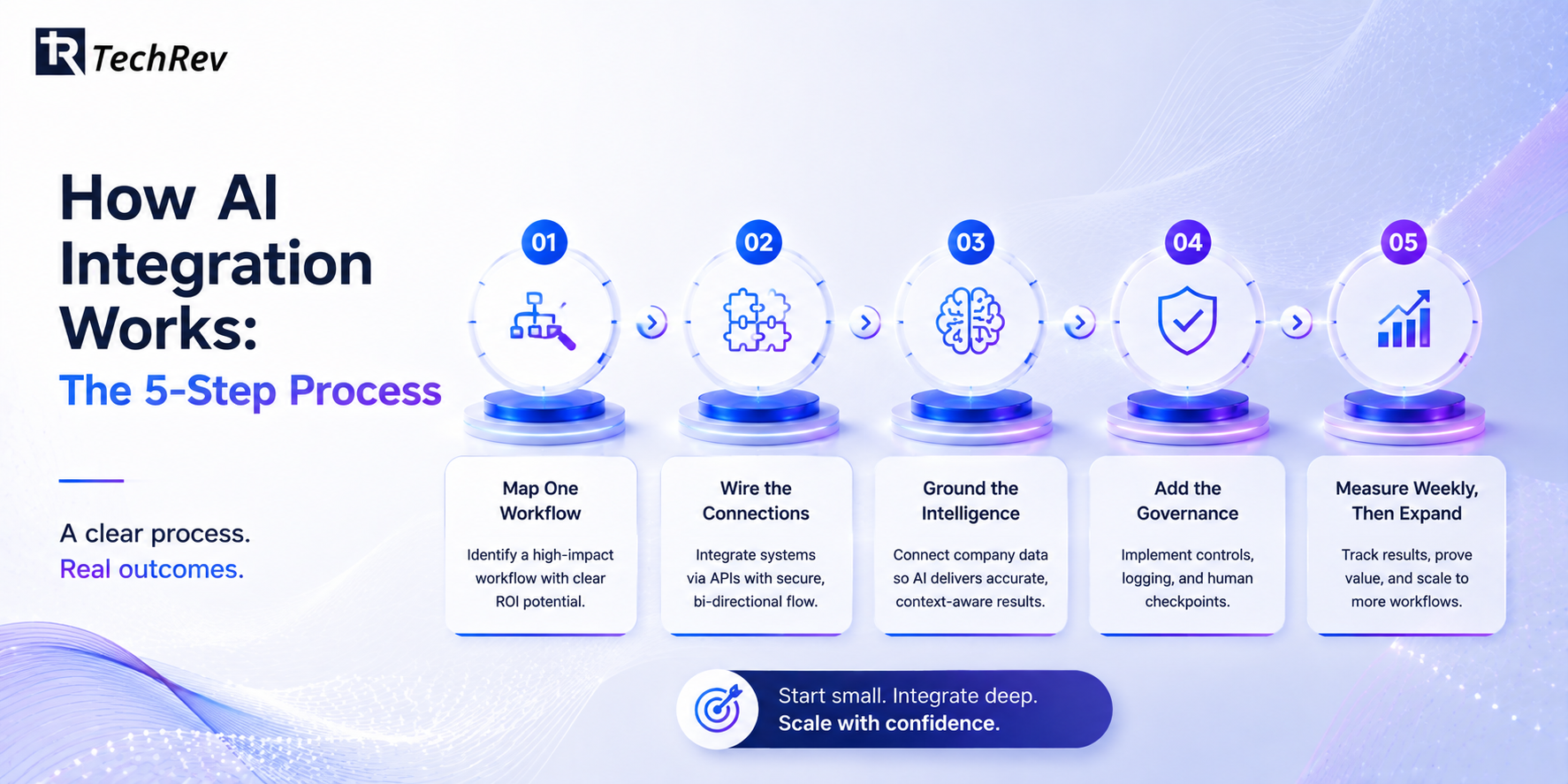
- Map one workflow. Not the AI strategy; one workflow with volume, rules, and a number that will prove success. This scoping filter is the same discipline that separates surviving AI projects from Gartner’s canceled 40%.
- Wire the connections. APIs into the systems of record, read and write, with permissions scoped tight. Integration depth here is where the MIT-documented failures are prevented.
- Ground the intelligence. Company data connected through retrieval, so outputs cite your reality.
- Add the governance. Logging, checkpoints, escalation paths, and compliance controls, designed in rather than bolted on.
- Measure weekly, then expand. The first integrated workflow generates the evidence, and the second one inherits the architecture, which is why it costs less. The MVP development rhythm, applied to intelligence.
How Long Does AI Integration Take?
Adding grounded AI features to an existing app typically takes 4 to 8 weeks. Agent-grade workflow integration with two or more systems commonly runs 8 to 16 weeks. Regulated environments phase by quarter, gated by metrics. Anything quoted in days is a demo; anything quoted in years is a replacement project wearing an integration costume.
How Much Do AI Integration Services Cost?
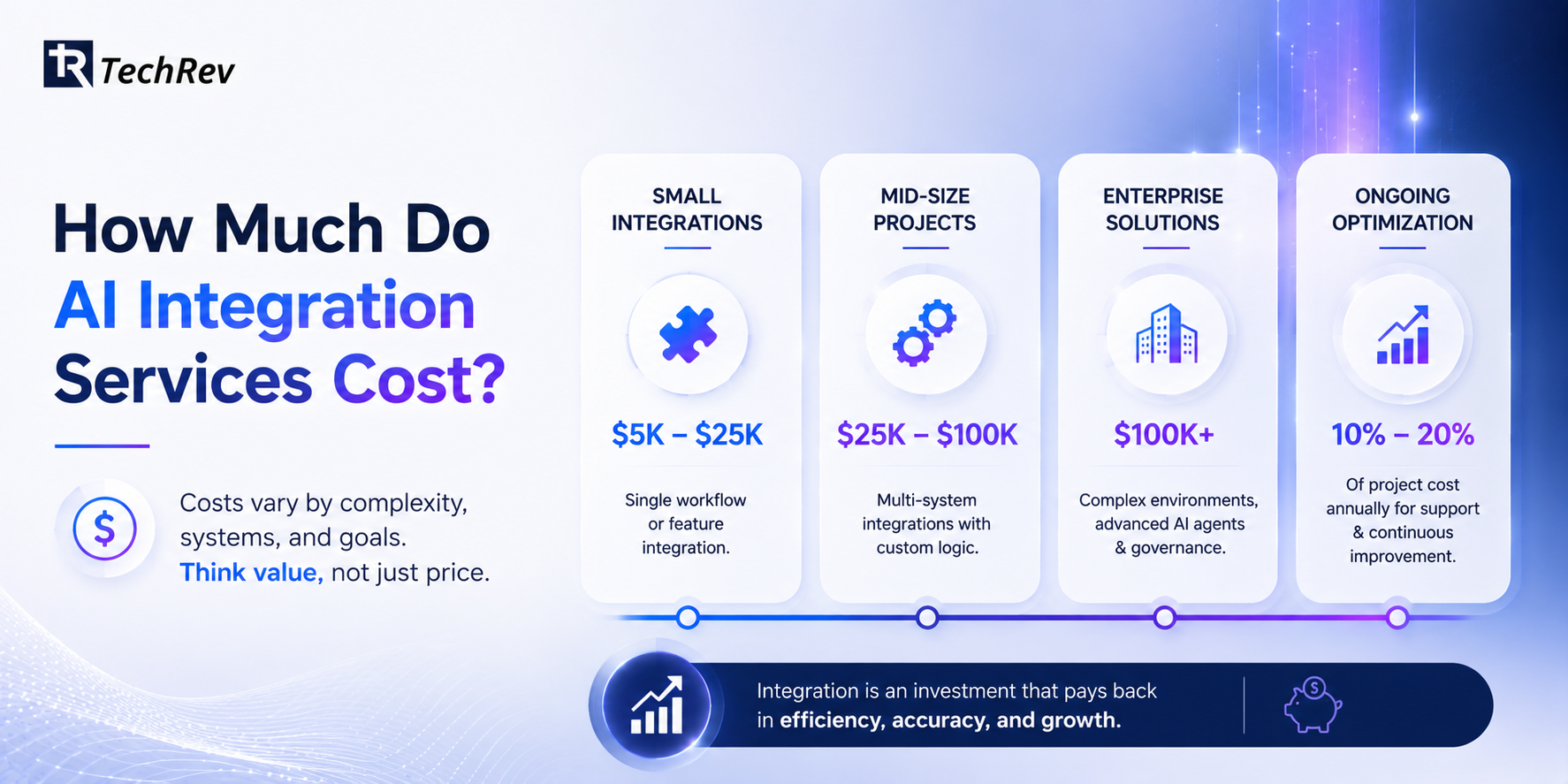
AI feature integration into an existing application typically starts in the low to mid five figures. Workflow and agent integration across multiple systems commonly runs mid five to low six figures, and regulated, multi-workflow programs reach six figures, phased. Ongoing costs, model usage, hosting, and maintenance, typically add 15 to 25% of build cost annually, with per-task economics engineered at design time.
Benchmark it against the alternatives the data prices for you: replacement builds cost multiples and take quarters longer, and unintegrated pilots, per MIT, mostly return zero. Integration-first is not the cheap option; it is the option with a denominator. For the fuller rent-vs-own and pricing mathematics, see our breakdowns of AI automation agency vs custom development and AI agent development cost.
How to Choose an AI Integration Company?
Five filters separate integrators from demo artists: insist on workflow-first scoping (they name the metric before the model), integration references (systems like yours, connected read-and-write, still running), grounding methodology (how your data reaches the model, and where it never goes), compliance fluency where you are regulated (HIPAA, SOC 2, BAAs discussed unprompted), and per-task cost projections at your volume, in writing.
An AI integration company that clears all five has shipped through the failure statistics; one that leads with model names has not.
How TechRev Delivers AI Integration Services?
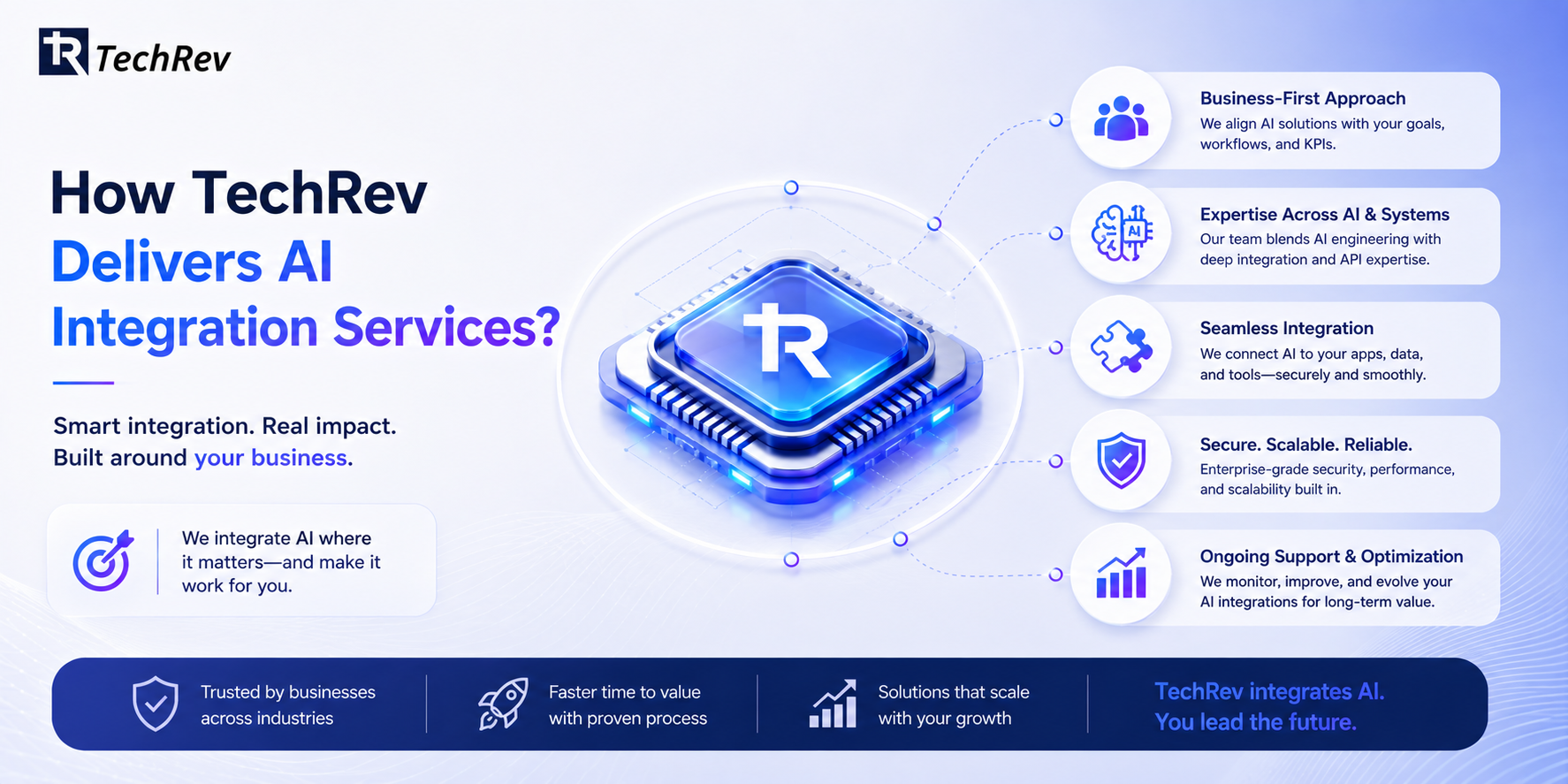
Integration-first is not a service line at TechRev; it is the founding thesis. TechRev is a US-based AI integration company that builds intelligence into the systems businesses already run, from generative AI development and agent integration to full custom software development where the gaps demand it, with deep experience in HIPAA and SOC 2 environments.
Q1: What makes TechRev’s AI integration services different?
We are built backwards from the failure data: every engagement starts with one workflow and a written metric, wires read-and-write API integration into your systems of record, grounds models exclusively in your governed data, and ships with the audit trails and human checkpoints regulated industries require.
Your team keeps its tools; the tools get smarter. Because the governance and integration architecture is built once, each subsequent workflow costs less than the last, which is how clients move from first pilot to portfolio without the budget spiral that cancels 40% of agentic projects.
The 95% failure statistic is, bluntly, our business case: we exist to be the other 5%.
Q2: Can TechRev integrate AI into legacy or custom-built systems?
Yes. We encapsulate legacy systems behind secure APIs and integrate AI on top, delivering automation value in weeks while deeper modernization proceeds when needed.
Q3: Does TechRev handle regulated AI integration?
Yes. TechRev integrates AI under HIPAA and SOC 2 discipline: BAA-covered services, encryption, role-based access, immutable logging, and human review checkpoints, designed from the architecture stage.
Q4: What measurable results has TechRev delivered with integrated AI?
For a hospital services vendor, TechRev’s AI-powered workflow and tracking system, integrated into how field teams already worked, cut installation errors by 90% and recovered lost billing evidence.
The Final Words on AI Integration Services
Billions spent, 95% of pilots stalling, and a research record that names the gap: not intelligence, integration. The companies winning with AI in 2026 did not buy better models than everyone else. They connected the models to the systems where their business actually happens, one measured workflow at a time.
If your AI is still answering instead of acting, talk to TechRev’s integration team. We will map the workflow, name the metric, and integrate intelligence into the software you already trust, built to land in the 5% that works.
FAQs About AI Integration Services
1. What is the difference between AI integration and AI development?
AI development builds new AI-powered products; AI integration adds intelligence to the products and systems you already run. Most 2026 value comes from integration first, with development reserved for genuinely new capability, and mature partners deliver both under one architecture.
2. How do you integrate AI into an existing app?
Through APIs: the app’s data and actions are exposed to a model or agent, the model is grounded in your content through retrieval, and governance (permissions, logging, review checkpoints) wraps the loop. Done well, users experience new capability inside familiar software.
3. What are examples of AI integration services?
Grounded chat and search inside a product, AI agents completing workflows across CRM or EHR systems, document intelligence added to operations software, voice AI on existing phone lines, and automation layers over legacy systems, each integrated rather than replacing.
4. Why do so many AI projects fail without integration?
Because ungrounded, unconnected AI cannot touch the systems where work happens, so it produces demos instead of outcomes. MIT’s research on failing pilots and BCG’s stuck-at-PoC findings both point to the same gap: workflow and system integration, not model quality.
5. Do AI integration services work for small businesses?
Yes, often best: small teams already run their business in a handful of cloud tools with APIs, so a single integrated workflow (intake, scheduling, follow-up) frequently pays back in weeks. The scoping rule is identical at every size: one workflow, one metric.
6. What is LLM integration?
LLM integration is connecting large language models to applications through APIs: selecting and routing models, grounding them in company data, engineering token economics, and adding controls. It is the technical core of most AI integration services engagements.