
AI app development cost is easier to pin down than the internet makes it look. A focused AI-powered app built on proven models typically runs mid five figures to low six figures; complex products with custom AI capability and deep integrations climb from there; and adding an AI feature to an existing app can cost a fraction of either.
The spread is wide because “AI app” spans everything from a chatbot layer to a diagnostic engine, so this blog breaks the number down the way AI agent development company actually estimate it: by app type, by AI feature, by cost driver, and by the decisions that move the total.
The spending context is real: Stanford’s AI Index put US private AI investment at roughly $109 billion in 2024, and Menlo Ventures tracked enterprise generative AI spend hitting about $13.8 billion, a 6x jump in one year. Budgets moved. What follows is how to spend yours accurately.
What Does AI App Development Cost in 2026?
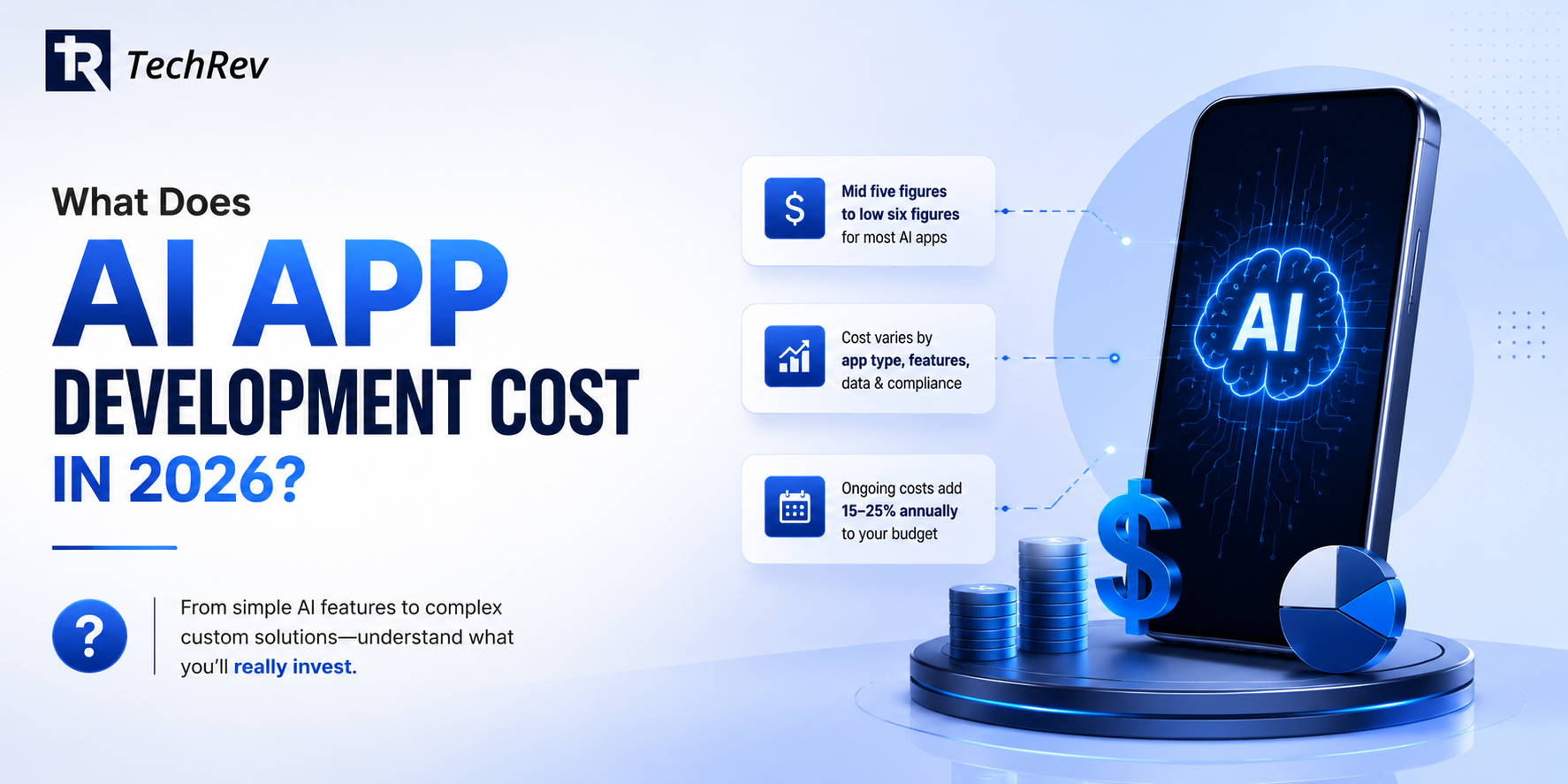
AI app development typically costs between the mid five figures and low six figures for a production-ready app using pre-trained models with one or two core AI features, while apps requiring custom-trained models, heavy data work, or regulated-industry compliance commonly run well into six figures. Adding AI features to an existing app usually starts in the low-to-mid five figures. Ongoing costs, model usage, hosting, and maintenance, typically add 15 to 25% of build cost annually.
Where your project lands depends on four things: app type, AI features, data readiness, and compliance. Each gets its own section below.
AI App Development Cost: The Market Numbers
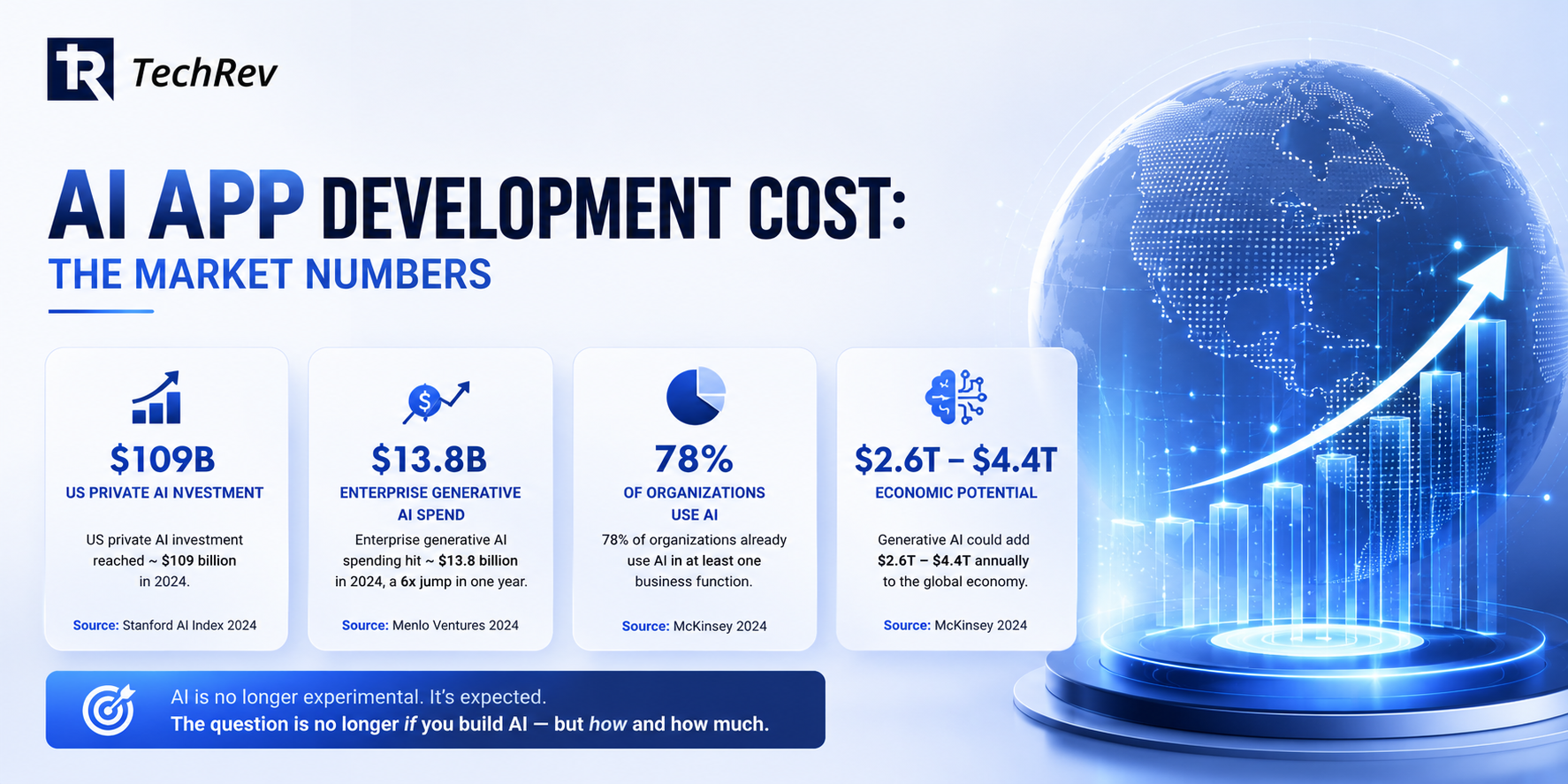
- US private AI investment reached ~$109 billion in 2024 per Stanford’s AI Index, more than ten times any other country, which is why AI development talent and tooling matured fastest in the US market.
- Enterprise generative AI spending hit ~$13.8 billion in 2024, roughly 6x the prior year (Menlo Ventures), pulling AI features from differentiator to expectation.
- 78% of organizations already use AI in at least one function per McKinsey, whose research also sizes generative AI’s economic potential at $2.6 to $4.4 trillion annually.
- The practical read: users now expect AI in apps the way they expect search, and the cost question has shifted from “should we” to “which features, at what price.”
Also Read – How to Develop an AI App Like StarryAI?
AI App Development Cost by App Type
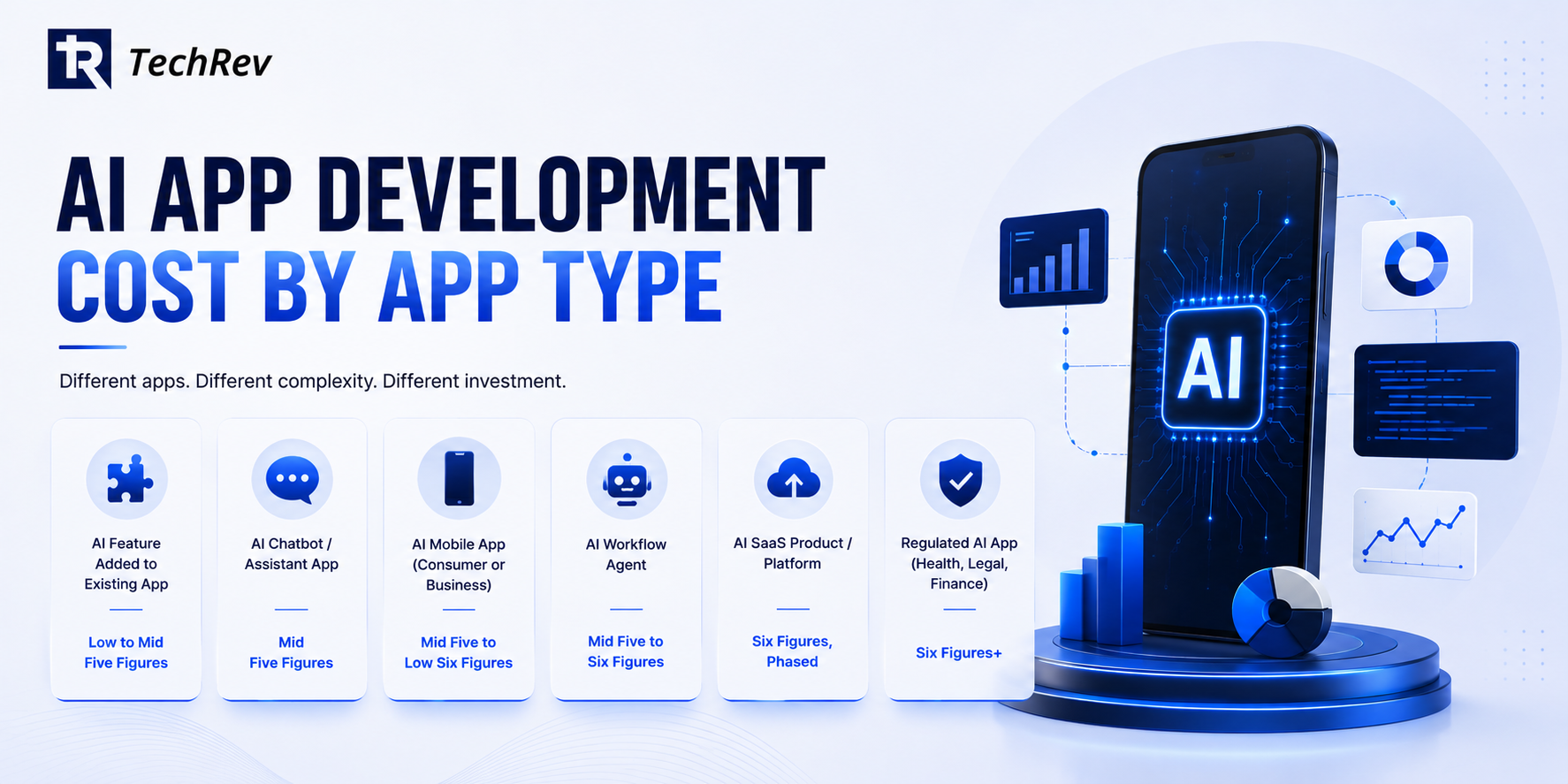
| App type | Typical cost range | What drives it? |
| AI feature added to existing app | Low to mid five figures | Integration with current code and data |
| AI chatbot / assistant app | Mid five figures | Conversation design, knowledge grounding; see our live chatbot app development cost breakdown |
| AI mobile app (consumer or business) | Mid five to low six figures | Full product build plus AI layer; parallels standard mobile app development cost with an AI premium |
| AI workflow agent | Mid five to six figures | Multi-system integration and governance; full pricing in our AI agent development cost blog |
| AI SaaS product / platform | Six figures, phased | Multi-tenant architecture, scale engineering, model economics |
| Regulated AI app (health, legal, finance) | Six figures | HIPAA/SOC 2 architecture, audit trails, human-in-the-loop controls |
AI App Development Cost by Feature
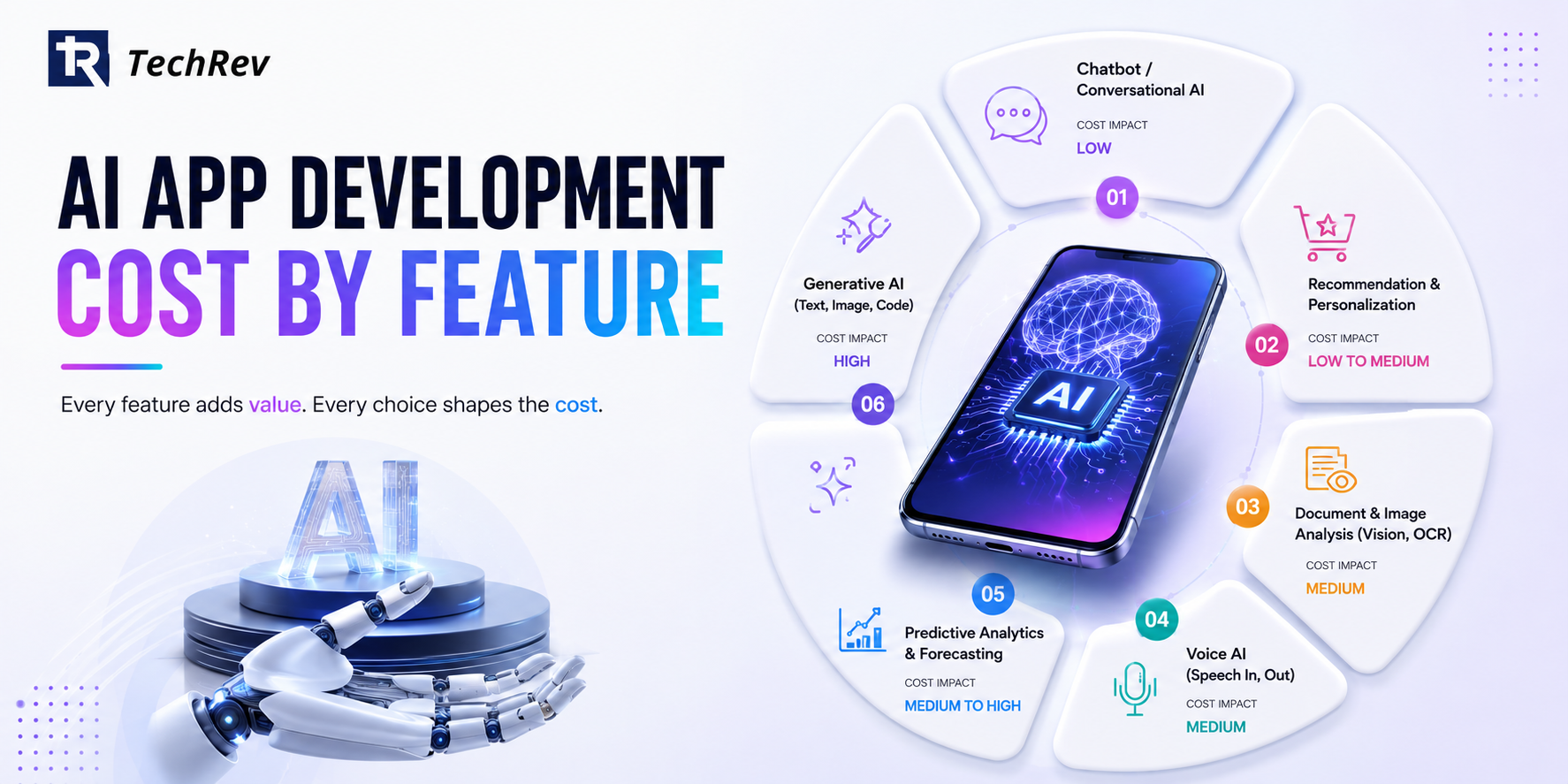
Feature choice moves budgets more than app category does:
- Chatbot / conversational AI: the most affordable entry point using modern language models with your data grounded in
- Recommendation and personalization: moderate cost, heavily dependent on how clean your behavioral data is
- Document and image analysis (vision, OCR, extraction): moderate cost with pre-trained models; custom accuracy targets raise it
- Voice AI (speech in, speech out): moderate cost, with real-time performance engineering as the premium
- Predictive analytics and forecasting: cost tracks data quality and validation rigor more than modeling
- Generative AI creation features (text, image, code): fast to prototype, with the real cost in guardrails, quality control, and token economics at scale
The pattern across all six: pre-trained models made the AI itself cheap. The budget now lives in integration, data, and control.
Also Read – How to Develop an AI App Like Wispr Flow?
What Drives the Cost of AI App Development? 6 Factors
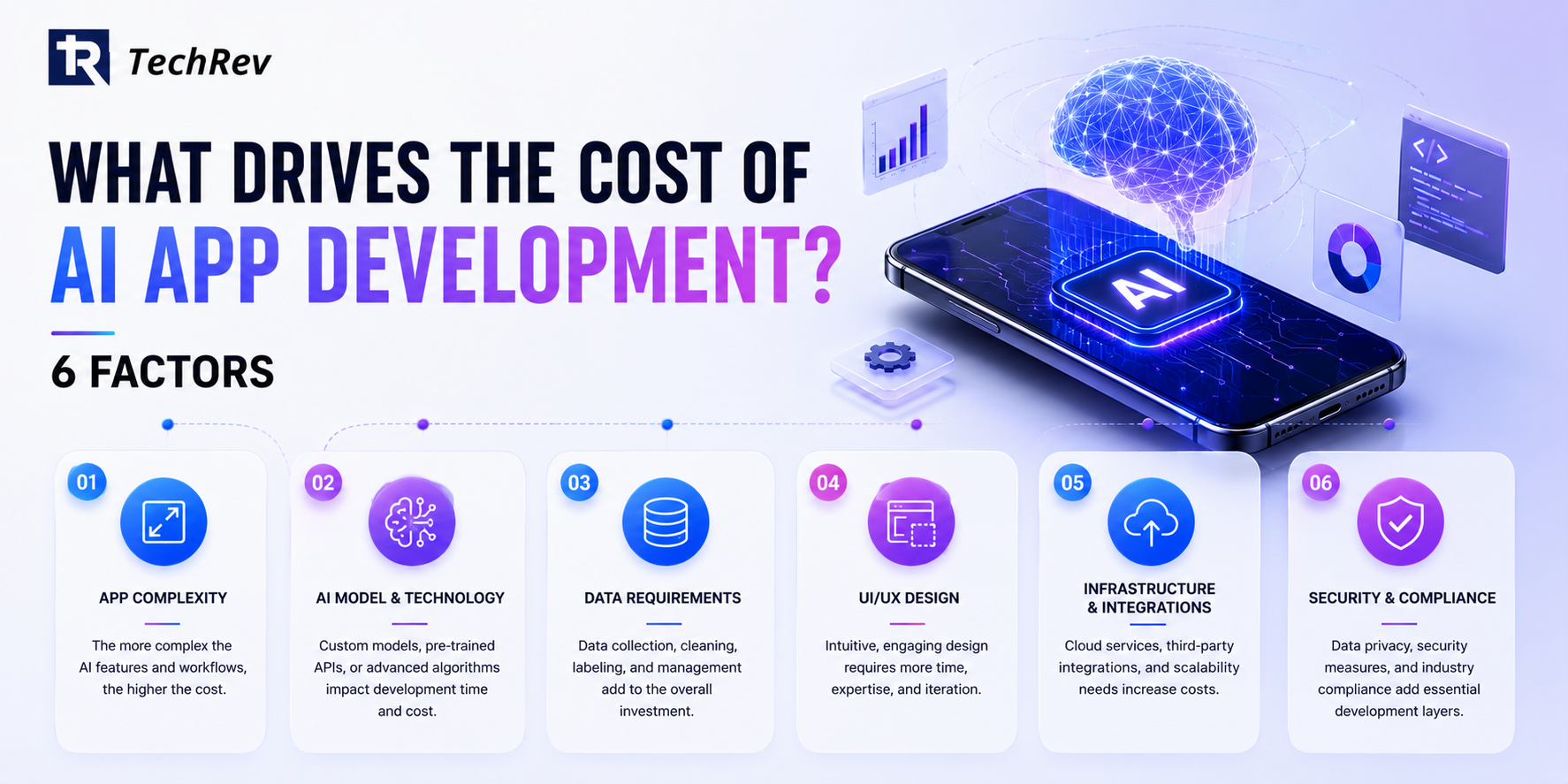
- Pre-trained vs custom models. The single biggest lever.
- Data readiness. Clean, accessible data keeps budgets intact; scattered or messy data adds a preparation phase most quotes omit.
- Integration depth. Each system the app connects to adds engineering, and integration typically consumes a third of serious builds.
- Compliance. HIPAA, SOC 2, and audit-grade logging add a commonly seen 15 to 30% premium, non-negotiable in regulated work.
- Scale and performance targets. An app for 100 internal users and one for 100,000 consumers are different engineering problems with different price tags.
- Team model. US-based senior teams cost more per hour and less per mistake, especially where domain and compliance knowledge compound; blended models balance the two.
Should You Use Pre-Trained Models or Build Custom AI?
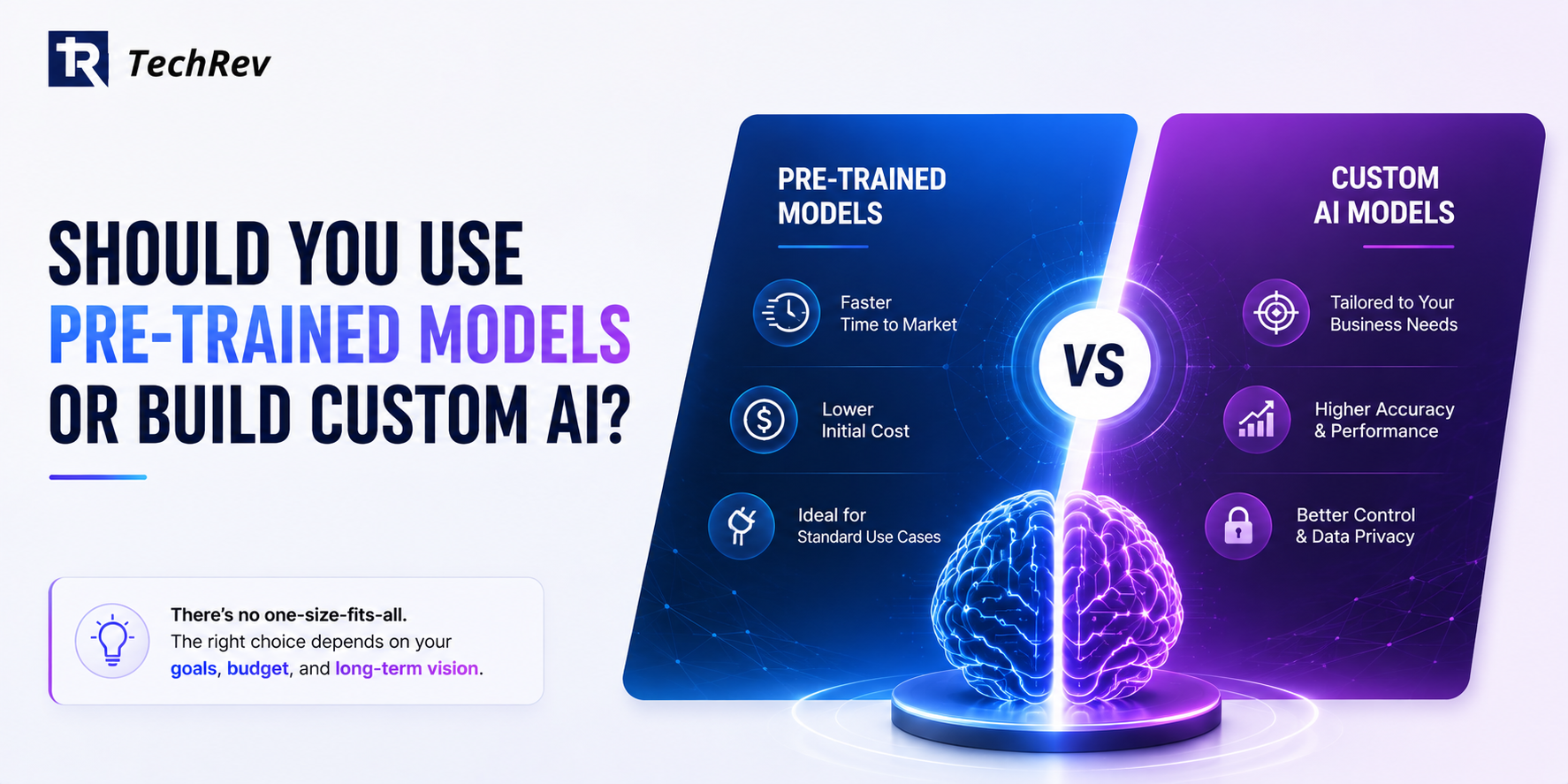
Use pre-trained models by default: modern foundation models handle language, vision, and reasoning tasks that once required custom builds, cutting both cost and time dramatically, and techniques like retrieval grounding adapt them to your data without training runs.
Build or fine-tune custom models only when the task is narrow and proprietary, accuracy requirements exceed what grounding achieves, or per-call economics at your volume justify owning the model.
Most 2026 AI apps that overspend do it here, paying for custom AI where a well-engineered pre-trained approach would have shipped faster and cheaper.
What Are the Ongoing Costs of an AI App?
Three lines: model usage (often hundreds of dollars monthly at moderate volume, scaling with usage rather than seats), hosting and monitoring, and maintenance as models and requirements evolve, together typically 15 to 25% of build cost annually. The number to demand upfront is projected cost per active user or per task at your target volume, engineered down with model routing and caching decisions made at design time, not after launch.
How to Reduce AI App Development Cost?
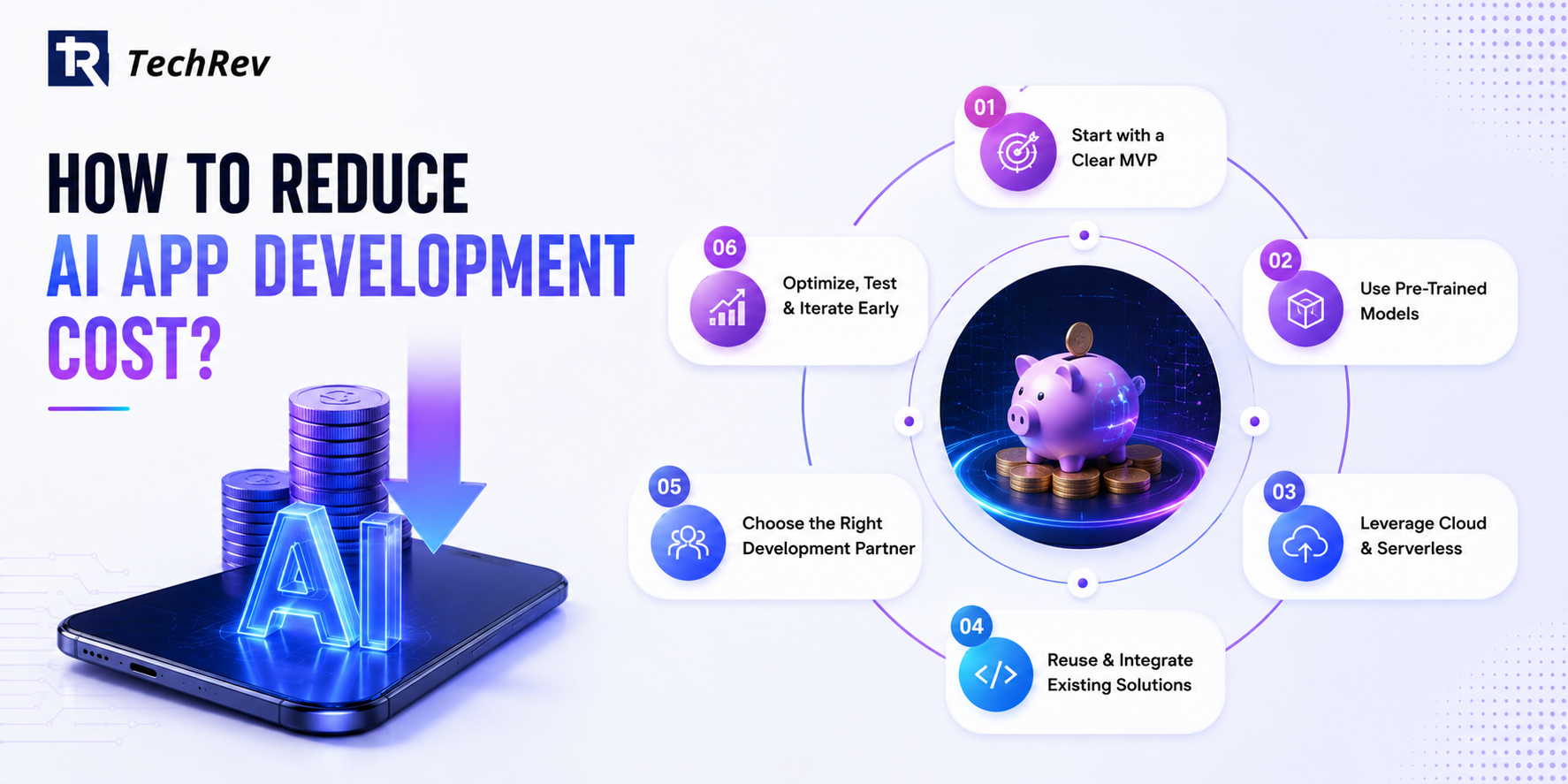
- Scope through MVP discipline. One core AI feature proving value beats five features guessing; the MVP development path routinely cuts first-phase budgets while raising success rates.
- Ground pre-trained models in your data instead of training custom ones, per the decision rule above.
- Integrate before you rebuild. Adding AI to systems you already run, the integration-first pattern, delivers the outcome without a replacement budget.
- Fix data before development. A short data-cleanup phase priced honestly beats discovering the mess mid-build.
- Design token economics early. Model routing, caching, and batching are design-time decisions that compound savings for the app’s whole life.
Industry note: these levers apply doubly in regulated builds, where our work in AI for healthcare apps and finance app development shows compliance architecture reused across features is what keeps second and third AI capabilities cheap.
How TechRev Prices AI App Development?
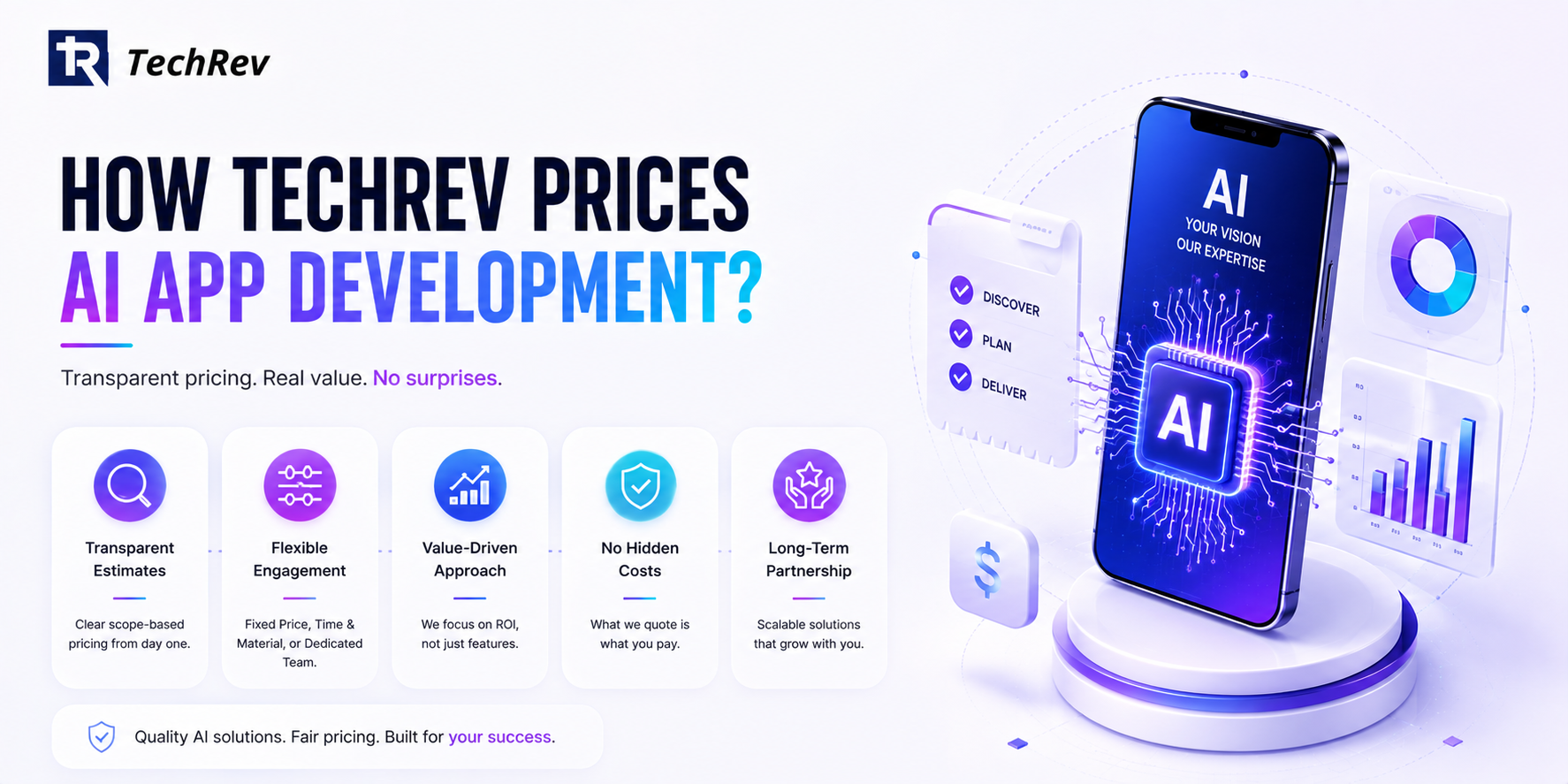
TechRev is a US-based AI app development company building AI-powered products and features through generative AI development and custom software development, priced in fixed, metric-gated phases.
Q1: How does TechRev keep AI app development cost predictable?
Three practices: fixed-scope phases with success metrics written in before we start; a pre-trained-first model strategy, so you only pay for custom AI where the task genuinely demands it; and per-user or per-task cost projections at your target volume, including model routing decisions, delivered before you sign.
Regulated builds carry the compliance premium transparently, and because our architecture (access controls, logging, integration layer) is built once and reused, each added AI feature costs less than the one before it. You see the full economics upfront, not in month three.
Q2: What does a first AI app project with TechRev typically cost?
Phase-one builds typically land between the mid five figures and low six figures depending on features, integrations, and compliance, with scope and metrics fixed in writing.
Q3: Can TechRev add AI features to our existing app?
Yes. Integration-first is our default: we build AI features into the app and systems you already run, which usually costs a fraction of a new build.
Q4: What measurable results has TechRev delivered with AI-powered builds?
For a hospital services vendor, TechRev’s AI-powered workflow system cut installation errors by 90% and recovered billing evidence manual processes kept losing.
Conclusion
A $109 billion investment wave, 6x enterprise budget growth, and pre-trained models that collapsed the old cost of intelligence: in 2026, AI app development cost is no longer about affording the AI. It is about scoping the app, readying the data, and engineering the economics, which is precisely where disciplined builders separate from expensive ones.
If you want your number instead of a range, talk to TechRev’s AI team. We will scope the feature set, set the model strategy, and hand you phase-one pricing with running costs projected at your volume, in writing, before you commit a dollar.
FAQs About AI App Development Cost
How much does it cost to build an AI app?
Typically mid five figures to low six figures for a production app using pre-trained models with one or two AI features; custom-model or regulated builds run higher, and adding AI to an existing app starts lower. Scope, data readiness, integrations, and compliance set the band.
Why is AI app development more expensive than regular app development?
The premium comes from data work, model integration and evaluation, guardrails, and ongoing model costs, typically a moderate uplift over comparable non-AI builds rather than a multiple, now that pre-trained models replaced most custom training.
How much does it cost to maintain an AI app?
Plan 15 to 25% of build cost annually across model usage, hosting, monitoring, and updates. Usage-based model pricing means costs scale with activity, so demand per-user or per-task projections at your volume before building.
Can I build an AI app cheaply with an AI app builder?
No-code AI app builders prototype ideas fast and cheaply, and that is their honest role. Production apps with real users, integrations, security, and unit economics outgrow them quickly, which is when scoped custom development becomes the cheaper path per outcome.
How long does AI app development take?
AI features into existing apps: 4 to 8 weeks. Focused AI apps on pre-trained models: 8 to 16 weeks. Custom-model or regulated builds: phased across quarters, each phase gated by metrics.
What should an AI app development quote include?
Written feature scope, model strategy (pre-trained vs custom, with reasoning), data preparation plan, named integrations, compliance controls where relevant, success metrics, projected running costs at your volume, and the maintenance model. Missing items are not savings; they are surprises scheduled for later.